

EN 12959:2000
(Main)Footwear - Test methods for shanks - Longitudinal stiffness
- Abstract
This European Standard specifies a method for assessing the stiffness in the longitudinal direction of steel shanks used for the reinforcement of the waist region of women's shoes and of some men's and children's shoes.
- Status
- Published
- Publication Date
- 15-Feb-2000
- Technical Committee
- CEN/TC 309 - Footwear
- Current Stage
- 9093 - Decision to confirm - Review Enquiry
- Start Date
- 27-Oct-2011
- Completion Date
- 27-Oct-2011


Overview
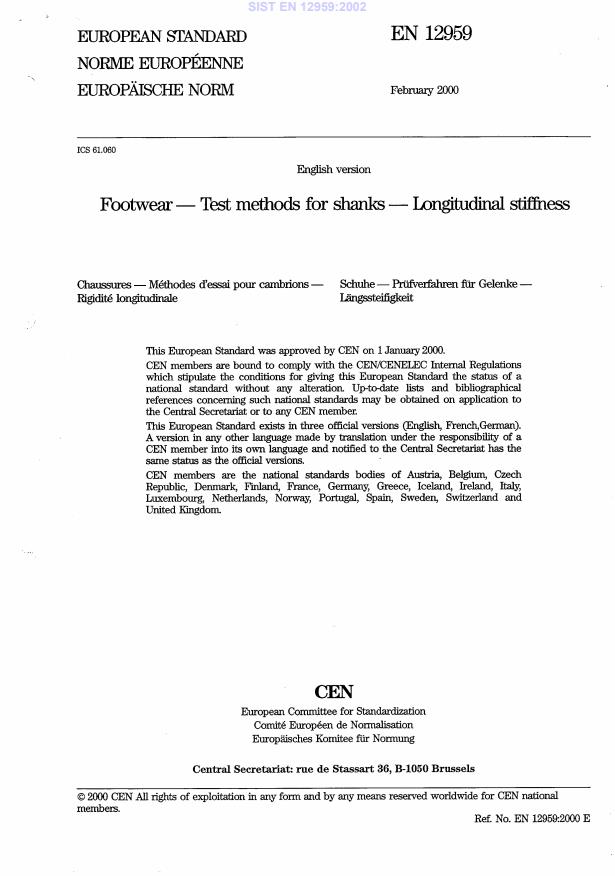
EN 12959:2000 - Footwear - Test methods for shanks - Longitudinal stiffness - is a CEN European Standard that specifies a method for assessing the longitudinal stiffness of steel shanks used to reinforce the waist region of footwear. The standard applies mainly to shanks intended for women's shoes and to some men's and children's shoes. It provides a repeatable way to evaluate how resistant a shank is to bending along the shoe’s length, producing objective data for design, quality control and compliance.
Key topics and requirements
The standard focuses on practical measurement and reporting of longitudinal stiffness. Main technical topics typically covered include:
- Scope and applicability - types of shanks (steel) and shoe categories covered (women’s, some men’s and children’s shoes).
- Specimen preparation and conditioning - requirements for sampling, environmental conditioning and any necessary trimming or mounting of the shank before testing.
- Test setup - description of how the shank is supported and where loads or displacements are applied to measure longitudinal bending resistance.
- Measurement and calculation - how to measure deflection or force and convert those measurements into a quantified stiffness value.
- Reporting - required test data, test conditions and presentation of results so values are reproducible and comparable between laboratories.
- Quality and repeatability considerations - recommendations to ensure consistent results across batches and test labs.
(Note: EN 12959:2000 specifies the test method; specific numeric test parameters and pass/fail criteria are provided within the full standard document.)
Applications
EN 12959:2000 is used wherever objective evaluation of shank stiffness is required:
- Footwear manufacturers - for material selection, design validation and batch quality control.
- Component suppliers - to verify shank properties offered to footwear brands.
- Test laboratories and certification bodies - to provide standardized, reproducible test data for compliance and product comparison.
- Product development and R&D teams - to compare alternative shank designs or materials and optimize comfort, fit and support.
- Regulatory and procurement - for specifying minimum stiffness requirements in tenders or safety-related footwear specifications.
Related standards
EN 12959:2000 complements other footwear test standards that address flexibility, abrasion, slip resistance, dimensional sizing and durability. Manufacturers and labs commonly use a suite of CEN footwear test methods to document overall product performance and compliance.
Keywords: EN 12959:2000, footwear test methods, shanks, longitudinal stiffness, steel shanks, waist region reinforcement, CEN standard, footwear quality control, test laboratory.
Relations
- Effective Date
- 28-Jan-2026
- Effective Date
- 13-Mar-2013
Frequently Asked Questions
EN 12959:2000 is a standard published by the European Committee for Standardization (CEN). Its full title is "Footwear - Test methods for shanks - Longitudinal stiffness". This standard covers: This European Standard specifies a method for assessing the stiffness in the longitudinal direction of steel shanks used for the reinforcement of the waist region of women's shoes and of some men's and children's shoes.
This European Standard specifies a method for assessing the stiffness in the longitudinal direction of steel shanks used for the reinforcement of the waist region of women's shoes and of some men's and children's shoes.
EN 12959:2000 is classified under the following ICS (International Classification for Standards) categories: 61.060 - Footwear. The ICS classification helps identify the subject area and facilitates finding related standards.
EN 12959:2000 has the following relationships with other standards: It is inter standard links to EN 12222:1997, prEN ISO 18896. Understanding these relationships helps ensure you are using the most current and applicable version of the standard.
EN 12959:2000 is available in PDF format for immediate download after purchase. The document can be added to your cart and obtained through the secure checkout process. Digital delivery ensures instant access to the complete standard document.
Standards Content (Sample)
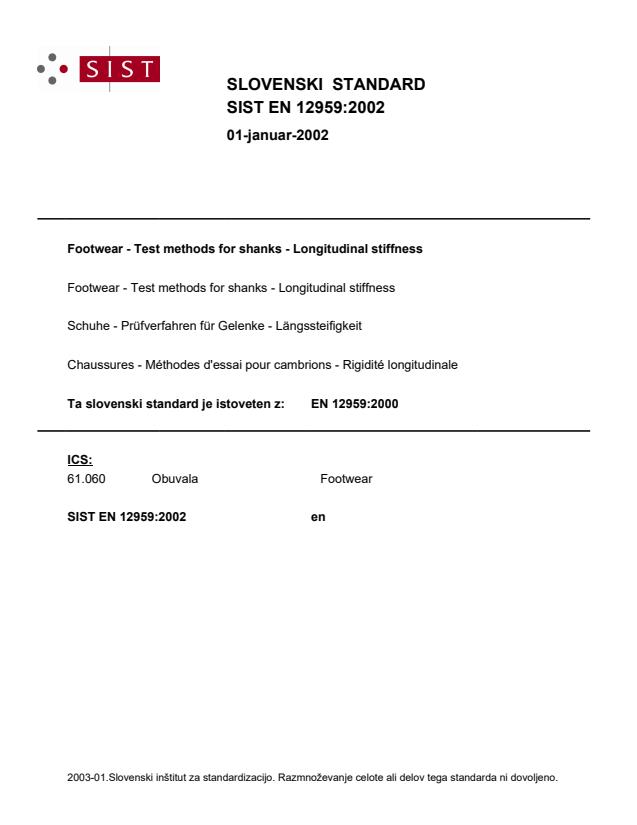
2003-01.Slovenski inštitut za standardizacijo. Razmnoževanje celote ali delov tega standarda ni dovoljeno.Footwear - Test methods for shanks - Longitudinal stiffnessSchuhe - Prüfverfahren für Gelenke - LängssteifigkeitChaussures - Méthodes d'essai pour cambrions - Rigidité longitudinaleFootwear - T
...