

ASTM F1252-21
(Test Method)Standard Test Method for Measuring Optical Reflectivity of Transparent Materials
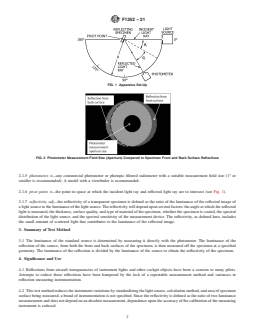
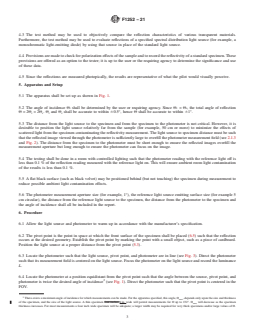
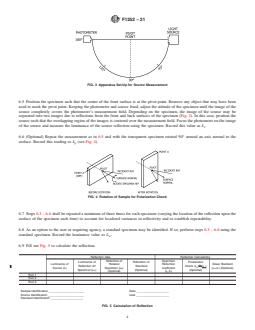
General Information
- Abstract
SIGNIFICANCE AND USE
4.1 Reflections from aircraft transparencies of instrument lights and other cockpit objects have been a concern to many pilots. Attempts to reduce these reflections have been hampered by the lack of a repeatable measurement method and variances in reflection measuring instrumentation.
4.2 This test method reduces the instrument variations by standardizing the light source, calculation method, and area of specimen surface being measured; a brand of instrumentation is not specified. Since the reflectivity is defined as the ratio of two luminance measurements and does not depend on an absolute measurement, dependence upon the accuracy of the calibration of the measuring instrument is reduced.
4.3 The test method may be used to objectively compare the reflection characteristics of various transparent materials. Furthermore, the test method may be used to evaluate reflections of a specified spectral distribution light source (for example, a monochromatic light-emitting diode) by using that source in place of the standard light source.
4.4 Provisions are made to check for polarization effects of the sample and to record the reflectivity of a standard specimen. These provisions are offered as an option to the tester; it is up to the user or the requiring agency to determine the significance and use of these data.
4.5 Since the reflections are measured photopically, the results are representative of what the pilot would visually perceive.
SCOPE
1.1 This test method covers a procedure for measuring the reflectivity of transparent materials, hereafter known as specimens. The results are repeatable without specifying a particular brand name of instrumentation.
1.2 This test method applies to substantially flat parts. Errors in measurement can occur if the parts being measured are not substantially flat.
1.3 Units—The values stated in SI units are to be regarded as standard. No other units of measurement are included in this standard.
1.4 This standard does not purport to address all of the safety concerns, if any, associated with its use. It is the responsibility of the user of this standard to establish appropriate safety, health, and environmental practices and determine the applicability of regulatory limitations prior to use.
1.5 This international standard was developed in accordance with internationally recognized principles on standardization established in the Decision on Principles for the Development of International Standards, Guides and Recommendations issued by the World Trade Organization Technical Barriers to Trade (TBT) Committee.
- Status
- Published
- Publication Date
- 30-Apr-2021
- Technical Committee
- F07 - Aerospace and Aircraft
- Drafting Committee
- F07.08 - Transparent Enclosures and Materials
Buy Documents
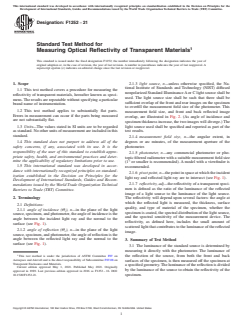
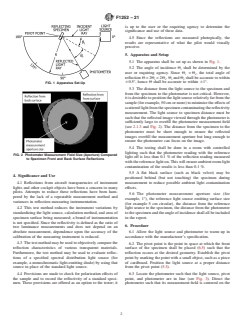
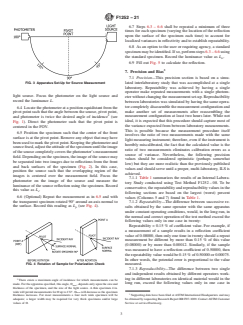

ASTM F1252-21 - Standard Test Method for Measuring Optical Reflectivity of Transparent Materials
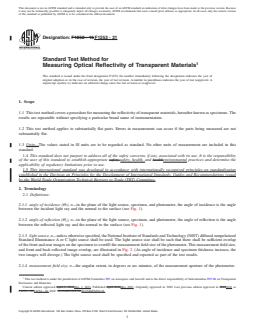
REDLINE ASTM F1252-21 - Standard Test Method for Measuring Optical Reflectivity of Transparent Materials
Overview
ASTM F1252-21, titled Standard Test Method for Measuring Optical Reflectivity of Transparent Materials, establishes a formal, repeatable methodology for determining the optical reflectivity of substantially flat transparent materials. Developed by ASTM Committee F07 on Aerospace and Aircraft, this standard addresses key industry concerns over cockpit glare and reflected instrument lighting, providing objective performance data critical to aerospace, transportation, and material manufacturing sectors.
By standardizing the testing apparatus, light source, and measurement calculations without specifying particular brands or models of instruments, ASTM F1252-21 ensures reliable, repeatable reflectivity measurements that can be confidently compared across different laboratories and product samples.
Key Topics
- Measurement of Reflectivity: Defines reflectivity as the ratio between the luminance of light reflected by the specimen and the luminance of the incident light source, incorporating both direct and scattered light contributions.
- Standardized Test Apparatus: Prescribes apparatus setup, including the positioning of a specified standard light source and photometer to ensure accurate and comparable measurements.
- Photopic Measurement: Uses photometric (eye-response) measurements to closely match human visual perception of reflections, which is especially important for safety and usability evaluations in cockpit and vehicle enclosures.
- Applicability: Limits the method to substantially flat transparent specimens to avoid measurement errors induced by curved surfaces.
- Instrument Independence: The method uses relative luminance ratios, reducing dependence on the measuring instrument’s absolute calibration accuracy.
- Optional Data Collection: Provides options for polarization checks and the use of standard specimens for additional quality assurance.
- Precision and Repeatability: Offers guidance on repeatability and reproducibility, establishing clear expectations for inter- and intra-laboratory consistency.
Applications
This ASTM reflectivity test method serves multiple industries, with notable applications including:
- Aerospace: Evaluation and comparison of aircraft cockpit windows, canopies, and other transparencies to minimize pilot distraction from unwanted reflections and enhance flight safety.
- Automotive and Rail: Assessing windshields and transparent panels in vehicles and trains for glare control and driver comfort.
- Optical Materials Manufacturing: Benchmarking performance of transparent materials (glass, acrylic, polycarbonate, coated plastics) for use in screens, protective covers, and enclosures.
- Lighting and Displays: Ensuring transparent components in lighting systems and electronic displays do not contribute to distracting or hazardous reflections.
- Quality Control and R&D: Objectively comparing new materials, surface treatments, or anti-reflective coatings for improved optical performance.
Related Standards
Several international and ASTM standards may be referenced or used alongside ASTM F1252-21:
- ASTM E308 - Standard Practice for Computing the Colors of Objects by Using the CIE System
- ASTM D1003 - Standard Test Method for Haze and Luminous Transmittance of Transparent Plastics
- ISO 9050 - Glass in Building - Determination of Light Transmittance, Solar Direct Transmittance, and Total Solar Energy Transmittance
- ASTM F1915 - Standard Test Method for Measuring the Optical Distortion in Transparent Parts Using Grid Line Reflection
- General photometry standards for calibration and verification of measuring equipment
By adhering to ASTM F1252-21, organizations can ensure rigorous, reliable, and comparable optical reflectivity data, supporting improved product quality, safety, and regulatory compliance for transparent materials.
Buy Documents
ASTM F1252-21 - Standard Test Method for Measuring Optical Reflectivity of Transparent Materials
REDLINE ASTM F1252-21 - Standard Test Method for Measuring Optical Reflectivity of Transparent Materials
Get Certified
Connect with accredited certification bodies for this standard

BSMI (Bureau of Standards, Metrology and Inspection)
Taiwan's standards and inspection authority.
Sponsored listings
Frequently Asked Questions
ASTM F1252-21 is a standard published by ASTM International. Its full title is "Standard Test Method for Measuring Optical Reflectivity of Transparent Materials". This standard covers: SIGNIFICANCE AND USE 4.1 Reflections from aircraft transparencies of instrument lights and other cockpit objects have been a concern to many pilots. Attempts to reduce these reflections have been hampered by the lack of a repeatable measurement method and variances in reflection measuring instrumentation. 4.2 This test method reduces the instrument variations by standardizing the light source, calculation method, and area of specimen surface being measured; a brand of instrumentation is not specified. Since the reflectivity is defined as the ratio of two luminance measurements and does not depend on an absolute measurement, dependence upon the accuracy of the calibration of the measuring instrument is reduced. 4.3 The test method may be used to objectively compare the reflection characteristics of various transparent materials. Furthermore, the test method may be used to evaluate reflections of a specified spectral distribution light source (for example, a monochromatic light-emitting diode) by using that source in place of the standard light source. 4.4 Provisions are made to check for polarization effects of the sample and to record the reflectivity of a standard specimen. These provisions are offered as an option to the tester; it is up to the user or the requiring agency to determine the significance and use of these data. 4.5 Since the reflections are measured photopically, the results are representative of what the pilot would visually perceive. SCOPE 1.1 This test method covers a procedure for measuring the reflectivity of transparent materials, hereafter known as specimens. The results are repeatable without specifying a particular brand name of instrumentation. 1.2 This test method applies to substantially flat parts. Errors in measurement can occur if the parts being measured are not substantially flat. 1.3 Units—The values stated in SI units are to be regarded as standard. No other units of measurement are included in this standard. 1.4 This standard does not purport to address all of the safety concerns, if any, associated with its use. It is the responsibility of the user of this standard to establish appropriate safety, health, and environmental practices and determine the applicability of regulatory limitations prior to use. 1.5 This international standard was developed in accordance with internationally recognized principles on standardization established in the Decision on Principles for the Development of International Standards, Guides and Recommendations issued by the World Trade Organization Technical Barriers to Trade (TBT) Committee.
SIGNIFICANCE AND USE 4.1 Reflections from aircraft transparencies of instrument lights and other cockpit objects have been a concern to many pilots. Attempts to reduce these reflections have been hampered by the lack of a repeatable measurement method and variances in reflection measuring instrumentation. 4.2 This test method reduces the instrument variations by standardizing the light source, calculation method, and area of specimen surface being measured; a brand of instrumentation is not specified. Since the reflectivity is defined as the ratio of two luminance measurements and does not depend on an absolute measurement, dependence upon the accuracy of the calibration of the measuring instrument is reduced. 4.3 The test method may be used to objectively compare the reflection characteristics of various transparent materials. Furthermore, the test method may be used to evaluate reflections of a specified spectral distribution light source (for example, a monochromatic light-emitting diode) by using that source in place of the standard light source. 4.4 Provisions are made to check for polarization effects of the sample and to record the reflectivity of a standard specimen. These provisions are offered as an option to the tester; it is up to the user or the requiring agency to determine the significance and use of these data. 4.5 Since the reflections are measured photopically, the results are representative of what the pilot would visually perceive. SCOPE 1.1 This test method covers a procedure for measuring the reflectivity of transparent materials, hereafter known as specimens. The results are repeatable without specifying a particular brand name of instrumentation. 1.2 This test method applies to substantially flat parts. Errors in measurement can occur if the parts being measured are not substantially flat. 1.3 Units—The values stated in SI units are to be regarded as standard. No other units of measurement are included in this standard. 1.4 This standard does not purport to address all of the safety concerns, if any, associated with its use. It is the responsibility of the user of this standard to establish appropriate safety, health, and environmental practices and determine the applicability of regulatory limitations prior to use. 1.5 This international standard was developed in accordance with internationally recognized principles on standardization established in the Decision on Principles for the Development of International Standards, Guides and Recommendations issued by the World Trade Organization Technical Barriers to Trade (TBT) Committee.
ASTM F1252-21 is classified under the following ICS (International Classification for Standards) categories: 17.180.20 - Colours and measurement of light. The ICS classification helps identify the subject area and facilitates finding related standards.
ASTM F1252-21 is available in PDF format for immediate download after purchase. The document can be added to your cart and obtained through the secure checkout process. Digital delivery ensures instant access to the complete standard document.
Standards Content (Sample)
This international standard was developed in accordance with internationally recognized principles on standardization established in the Decision on Principles for the
Development of International Standards, Guides and Recommendations issued by the World Trade Organization Technical Barriers to Trade (TBT) Committee.
Designation:F1252 −21
Standard Test Method for
Measuring Optical Reflectivity of Transparent Materials
This standard is issued under the fixed designation F1252; the number immediately following the designation indicates the year of
original adoption or, in the case of revision, the year of last revision. A number in parentheses indicates the year of last reapproval. A
superscript epsilon (´) indicates an editorial change since the last revision or reapproval.
1. Scope 2.1.3 light source, n—unless otherwise specified, the Na-
tional Institute of Standards and Technology (NIST) diffused
1.1 This test method covers a procedure for measuring the
nonpolarized Standard IlluminanceAor C light source shall be
reflectivity of transparent materials, hereafter known as speci-
used. The light source size shall be such that there shall be
mens.The results are repeatable without specifying a particular
sufficient overlap of the front and rear images on the specimen
brand name of instrumentation.
to overfill the measurement field size of the photometer. This
1.2 This test method applies to substantially flat parts.
measurement field size, and front and back reflected image
Errors in measurement can occur if the parts being measured
overlap, are illustrated in Fig. 2. (As angle of incidence and
are not substantially flat.
specimen thickness increase, the two images will diverge.)The
light source used shall be specified and reported as part of the
1.3 Units—The values stated in SI units are to be regarded
as standard. No other units of measurement are included in this test results.
standard.
2.1.4 measurement field size, n—the angular extent, in
1.4 This standard does not purport to address all of the degrees or arc minutes, of the measurement aperture of the
photometer.
safety concerns, if any, associated with its use. It is the
responsibility of the user of this standard to establish appro-
2.1.5 photometer, n—any commercial photometer or pho-
priate safety, health, and environmental practices and deter-
topic filtered radiometer with a suitable measurement field size
mine the applicability of regulatory limitations prior to use.
(1° or smaller is recommended). A model with a viewfinder is
1.5 This international standard was developed in accor-
recommended.
dance with internationally recognized principles on standard-
2.1.6 pivot point, n—the point in space at which the incident
ization established in the Decision on Principles for the
light ray and reflected light ray are to intersect (see Fig. 1).
Development of International Standards, Guides and Recom-
2.1.7 reflectivity, adj—the reflectivity of a transparent speci-
mendations issued by the World Trade Organization Technical
men is defined as the ratio of the luminance of the reflected
Barriers to Trade (TBT) Committee.
image of a light source to the luminance of the light source.
2. Terminology The reflectivity will depend upon several factors: the angle at
which the reflected light is measured, the thickness, surface
2.1 Definitions:
quality, and type of material of the specimen, whether the
2.1.1 angle of incidence (Θ ), n—in the plane of the light
i
specimen is coated, the spectral distribution of the light source,
source, specimen, and photometer, the angle of incidence is the
and the spectral sensitivity of the measurement device. The
angle between the incident light ray and the normal to the
reflectivity, as defined here, includes the small amount of
surface (see Fig. 1).
scattered light that contributes to the luminance of the reflected
2.1.2 angle of reflection (Θ ), n—in the plane of the light
r
image.
source, specimen, and photometer, the angle of reflection is the
angle between the reflected light ray and the normal to the
3. Summary of Test Method
surface (see Fig. 1).
3.1 The luminance of the standard source is determined by
measuring it directly with the photometer. The luminance of
the reflection of the source, from both the front and back
This test method is under the jurisdiction of ASTM Committee F07 on
Aerospace and Aircraft and is the direct responsibility of Subcommittee F07.08 on
surfaces of the specimen, is then measured off the specimen at
Transparent Enclosures and Materials.
aspecifiedgeometry.Theluminanceofthereflectionisdivided
Current edition approved May 1, 2021. Published May 2021. Originally
by the luminance of the source to obtain the reflectivity of the
approved in 1989. Last previous edition approved in 2016 as F1252 – 16. DOI:
10.1520/F1252-21. specimen.
Copyright © ASTM International, 100 Barr Harbor Drive, PO Box C700, West Conshohocken, PA 19428-2959. United States
F1252−21
is up to the user or the requiring agency to determine the
significance and use of these data.
4.5 Since the reflections are measured photopically, the
results are representative of what the pilot would visually
perceive.
5. Apparatus and Setup
5.1 The apparatus shall be set up as shown in Fig. 1.
5.2 The angle of incidence Θ shall be determined by the
i
user or requiring agency. Since Θ =Θ , the total angle of
i r
reflectionΘ=2Θ =2Θ .Θ andΘ shall be accurate to within
i r i r
60.5°, henceΘ shall be accurate to within 61°.
FIG. 1 Apparatus Set-Up
5.3 The distance from the light source to the specimen and
from the specimen to the photometer is not critical. However,
it is desirable to position the light source relatively far from the
sample (for example, 50 cm or more) to minimize the effects of
scatteredlightfromthespecimencontaminatingthereflectivity
measurement. The light source to specimen distance must be
such that the reflected image viewed through the photometer is
sufficiently large to overfill the photometer measurement field
(see 2.1.3 and Fig. 2). The distance from the specimen to the
photometer must be short enough to ensure the reflected
images overfill the measurement aperture but long enough to
ensure the photometer can focus on the image.
5.4 The testing shall be done in a room with controlled
lighting such that the photometer reading with the reference
FIG. 2 Photometer Measurement Field Size (Aperture) Compared
light off is less than 0.1 % of the reflection reading measured
to Specimen Front and Back Surface Reflections
withthereferencelighton.Thiswillensureambientroomlight
contamination of the results is less than 0.1 %.
5.5 A flat black surface (such as black velvet) may be
4. Significance and Use
positioned behind (but not touching) the specimen during
4.1 Reflections from aircraft transparencies of instrument measurement to reduce possible ambient light contamination
lights and other cockpit objects have been a concern to many effects.
pilots. Attempts to reduce these reflections have been ham-
5.6 The photometer measurement aperture size (for
pered by the lack of a repeatable measurement method and
example, 1°), the reference light source emitting surface size
variances in reflection measuring instrumentation.
(for example 5 cm circular), the distance from the reference
4.2 This test method reduces the instrument variations by light source to the specimen, the distance from the photometer
standardizing the light source, calculation method, and area of to the specimen and the angle of incidence shall all be included
specimen surface being measured; a brand of instrumentation in the report.
is not specified. Since the reflectivity is defined as the ratio of
6. Procedure
two luminance measurements and does not depend on an
absolute measurement, dependence upon the accuracy of the
6.1 Allow the light source and photometer to warm up in
calibration of the measuring instrument is reduced. accordance with the manufacturer’s specification.
4.3 The test method may be used to objectively compare the 6.2 The pivot point is the point in space at which the front
reflection characteristics of various transparent materials. surface of the specimen shall be placed (6.5) such that the
Furthermore, the test method may be used to evaluate reflec- reflection occurs at the desired geometry. Establish the pivot
tions of a specified spectral distribution light source (for point by marking the point with a small object, such as
...
This document is not an ASTM standard and is intended only to provide the user of an ASTM standard an indication of what changes have been made to the previous version. Because
it may not be technically possible to adequately depict all changes accurately, ASTM recommends that users consult prior editions as appropriate. In all cases only the current version
of the standard as published by ASTM is to be considered the official document.
Designation: F1252 − 16 F1252 − 21
Standard Test Method for
Measuring Optical Reflectivity of Transparent Materials
This standard is issued under the fixed designation F1252; the number immediately following the designation indicates the year of
original adoption or, in the case of revision, the year of last revision. A number in parentheses indicates the year of last reapproval. A
superscript epsilon (´) indicates an editorial change since the last revision or reapproval.
1. Scope
1.1 This test method covers a procedure for measuring the reflectivity of transparent materials, hereafter known as specimens. The
results are repeatable without specifying a particular brand name of instrumentation.
1.2 This test method applies to substantially flat parts. Errors in measurement can occur if the parts being measured are not
substantially flat.
1.3 Units—The values stated in SI units are to be regarded as standard. No other units of measurement are included in this
standard.
1.4 This standard does not purport to address all of the safety concerns, if any, associated with its use. It is the responsibility
of the user of this standard to establish appropriate safety safety, health, and healthenvironmental practices and determine the
applicability of regulatory limitations prior to use.
1.5 This international standard was developed in accordance with internationally recognized principles on standardization
established in the Decision on Principles for the Development of International Standards, Guides and Recommendations issued
by the World Trade Organization Technical Barriers to Trade (TBT) Committee.
2. Terminology
2.1 Definitions:
2.1.1 angle of incidence (Θ ), n—in the plane of the light source, specimen, and photometer, the angle of incidence is the angle
i
between the incident light ray and the normal to the surface (see Fig. 1).
2.1.2 angle of reflection (Θ ), n—in the plane of the light source, specimen, and photometer, the angle of reflection is the angle
r
between the reflected light ray and the normal to the surface (see Fig. 1).
2.1.3 light source, n—unless otherwise specified, the National Institute of Standards and Technology (NIST) diffused nonpolarized
Standard Illuminance A or C light source shall be used. The light source size shall be such that there shall be sufficient overlap
of the front and rear images on the specimen to overfill the measurement field size of the photometer. This measurement field size,
and front and back reflected image overlap, are illustrated in Fig. 2. (As angle of incidence and specimen thickness increase, the
two images will diverge.) The light source used shall be specified and reported as part of the test results.
2.1.4 measurement field size, n—the angular extent, in degrees or arc minutes, of the measurement aperture of the photometer.
This test method is under the jurisdiction of ASTM Committee F07 on Aerospace and Aircraft and is the direct responsibility of Subcommittee F07.08 on Transparent
Enclosures and Materials.
Current edition approved April 1, 2016May 1, 2021. Published April 2016May 2021. Originally approved in 1989. Last previous edition approved in 20102016 as
F1252 – 10.F1252 – 16. DOI: 10.1520/F1252-16.10.1520/F1252-21.
Copyright © ASTM International, 100 Barr Harbor Drive, PO Box C700, West Conshohocken, PA 19428-2959. United States
F1252 − 21
FIG. 1 Apparatus Set-Up
FIG. 2 Photometer Measurement Field Size (Aperture) Compared to Specimen Front and Back Surface Reflections
2.1.5 photometer, n—any commercial photometer or photopic filtered radiometer with a suitable measurement field size (1° or
smaller is recommended). A model with a viewfinder is recommended.
2.1.6 pivot point, n—the point in space at which the incident light ray and reflected light ray are to intersect (see Fig. 1).
2.1.7 reflectivity, adj—the reflectivity of a transparent specimen is defined as the ratio of the luminance of the reflected image of
a light source to the luminance of the light source. The reflectivity will depend upon several factors: the angle at which the reflected
light is measured, the thickness, surface quality, and type of material of the specimen, whether the specimen is coated, the spectral
distribution of the light source, and the spectral sensitivity of the measurement device. The reflectivity, as defined here, includes
the small amount of scattered light that contributes to the luminance of the reflected image.
3. Summary of Test Method
3.1 The luminance of the standard source is determined by measuring it directly with the photometer. The luminance of the
reflection of the source, from both the front and back surfaces of the specimen, is then measured off the specimen at a specified
geometry. The luminance of the reflection is divided by the luminance of the source to obtain the reflectivity of the specimen.
4. Significance and Use
4.1 Reflections from aircraft transparencies of instrument lights and other cockpit objects have been a concern to many pilots.
Attempts to reduce these reflections have been hampered by the lack of a repeatable measurement method and variances in
reflection measuring instrumentation.
4.2 This test method reduces the instrument variations by standardizing the light source, calculation method, and area of specimen
surface being measured; a brand of instrumentation is not specified. Since the reflectivity is defined as the ratio of two luminance
measurements and does not depend on an absolute measurement, dependence upon the accuracy of the calibration of the measuring
instrument is reduced.
F1252 − 21
4.3 The test method may be used to objectively compare the reflection characteristics of various transparent materials.
Furthermore, the test method may be used to evaluate reflections of a specified spectral distribution light source (for example, a
monochromatic light-emitting diode) by using that source in place of the standard light source.
4.4 Provisions are made to check for polarization effects of the sample and to record the reflectivity of a standard specimen. These
provisions are offered as an option to the tester; it is up to the user or the requiring agency to determine the significance and use
of these data.
4.5 Since the reflections are measured photopically, the results are representative of what the pilot would visually perceive.
5. Apparatus and Setup
5.1 The apparatus shall be set up as shown in Fig. 1.
5.2 The angle of incidence Θ shall be determined by the user or requiring agency. Since Θ = Θ , the total angle of reflection
i i r
Θ = 2Θ = 2Θ . Θ and Θ shall be accurate to within 60.5°, hence Θ shall be accurate to within 61°.
i r i r
5.3 The distance from the light source to the specimen and from the specimen to the photometer is not critical. However, it is
desirable to position the light source relatively far from the sample (for example, 50 cm or more) to minimize the effects of
scattered light from the specimen contaminating the reflectivity measurement. The light source to specimen distance must be such
that the reflected image viewed through the photometer is sufficiently large to overfill the photometer measurement field (see 2.1.3
and Fig. 2). The distance from the specimen to the photometer must be short enough to ensure the reflected images overfill the
measurement aperture but long enough to ensure the photometer can focus on the image.
5.4 The testing shall be done in a room with controlled lighting such that the photometer reading with the reference light off is
less than 0.1 % of the reflection reading measured with the reference light on. This will ensure ambient room light contamination
of the results is less than 0.1 %.
5.5 A flat black surface (such as black velvet) may be positioned behind (but not touching) the specimen during measurement to
reduce possible ambient light contamination effects.
5.6 The photometer measurement aperture size (for example, 1°), the reference light source emitting surface size (for example 5
cm circular), the distance from the reference light source to the specimen, the distance from the photometer to the specimen and
the
...