

ASTM E2592-16
(Practice)Standard Practice for Evaluating Response Robot Capabilities: Logistics: Packaging for Urban Search and Rescue Task Force Equipment Caches
General Information
- Abstract
SIGNIFICANCE AND USE
5.1 Introduction of robots to the responder's cache for use in urban search and rescue missions may have an impact on the logistical planning for the response teams. Additional volume and weight shall be stored and transported to the response site. Additional preparation time shall be allotted to ready the robot for deployment. The tools that are taken to the field may need to be augmented to service the robots. Once the robot is ready for deployment, it shall be transported from the base of operations to the mission zone. Responders may have to carry the robot and its controller or may have to provide some other transportation mechanism if it is too heavy.
5.2 This practice is designed to appraise the impact in terms of logistical considerations for a response organization.
SCOPE
1.1 This practice covers the requirement that urban search and rescue robots and all necessary associated components or equipment (for example, operator control station, power sources, spare parts, sensors, manipulators, tools, and so forth) shall complement the response organization’s cache packaging and transportation systems.
1.2 Shipment by ground, air, or marine should be considered.
1.3 Volume, weight, shipping classification, and deployability of the robots and associated components are considered in this practice.
1.3.1 The deployability is considered through the determination of:
1.3.1.1 The length of time required to prepare the robot system for deployment, and
1.3.1.2 The types of tools required for servicing the robot system in the field.
1.3.2 Associated components or equipment include not only all the onboard sensors, tethers, and operator control station, but also any spare parts and specialized tools needed for assembly, disassembly, and field servicing.
1.3.3 Associated components also include power equipment necessary for the operation of the system, such as batteries, chargers, and power converters. Gasoline, diesel, or other types of liquid fuel are not included.
1.4 The packaged items shall support the operational availability of the robot during a deployment of up to ten days. There shall be no resupply within the first 72 h of deployment.
1.5 No such standards currently exist except for those relevant to shipping (for example, CFR Title 49 and International Air Transport Association (IATA) documents).
1.6 The values stated in SI units are to be regarded as the standard. The values given in parentheses are for information only.
1.7 This standard does not purport to address all of the safety concerns, if any, associated with its use. It is the responsibility of the user of this standard to establish appropriate safety and health practices and determine the applicability of regulatory limitations prior to use.
- Status
- Published
- Publication Date
- 31-Dec-2015
- Technical Committee
- E54 - Homeland Security Applications
- Drafting Committee
- E54.09 - Response Robots
Buy Documents
ASTM E2592-16 - Standard Practice for Evaluating Response Robot Capabilities: Logistics: Packaging for Urban Search and Rescue Task Force Equipment Caches
REDLINE ASTM E2592-16 - Standard Practice for Evaluating Response Robot Capabilities: Logistics: Packaging for Urban Search and Rescue Task Force Equipment Caches
Overview
ASTM E2592-16 is a crucial standard practice developed by ASTM International for evaluating the logistics of packaging and transporting response robots and their essential components for urban search and rescue (USAR) task forces. This document addresses the challenges that arise when integrating robotics systems into the emergency responder’s equipment cache, focusing on factors such as cache packaging, weight, volume, setup time, and field servicing tools. By establishing consistent criteria, ASTM E2592-16 helps ensure that robotic systems support rapid, efficient deployment during emergency operations where every minute and kilogram counts.
Key Topics
- Cache Packaging and Transportation Compatibility: This standard mandates that all robots and associated equipment-including operator control stations, batteries, chargers, sensors, spare parts, and specialized tools-are assessed for their compatibility with established USAR cache packaging and transportation systems.
- Volume and Weight Evaluation: It provides guidance on determining the space (volume) and weight requirements for each package or case so that logistics managers can effectively allocate storage and transport resources.
- Shipping Considerations: Shipments by ground, air, or marine transport are addressed, including applicable size and weight constraints and palletization requirements (e.g., ISO 6780 for pallet dimensions).
- Deployability and Field Readiness: The standard outlines procedures to assess setup time-the time needed to unpack, assemble, and prepare the robot for operational deployment. This metric is vital for realistic mission planning.
- Tools for Maintenance and Deployment: It specifies the types of tools (basic or specialized) required in the field for assembly, disassembly, and servicing, ensuring responders are fully prepared.
- Sustainment in Operations: The standard assumes that robotic systems and all necessary components must support up to 10 days of deployment, with no resupply expected in the first 72 hours. This supports robust mission continuity.
Applications
ASTM E2592-16 is directly applicable to various stakeholders in the urban search and rescue and disaster response sectors:
- Response Organizations: Emergency task forces use this standard to integrate and manage robots within existing logistics frameworks, ensuring the efficient and safe deployment of robotic systems.
- Robotics Manufacturers: Robotic system designers utilize these criteria to optimize the form factor, weight, and maintainability of response robots for compliance with responder needs and logistical constraints.
- Procurement and Logistics Managers: This standard empowers purchasing agents and logistics coordinators to make informed decisions about acquiring and managing robotic systems, accounting for packaging, transferability, and deployability.
- Training and Operations Planning: Trainers and field operators use the measures outlined in ASTM E2592-16 to simulate deployment scenarios, refine packing procedures, and enhance operator proficiency and readiness.
Related Standards
- CFR Title 49 - Transportation: Regulatory guidance for transportation of hazardous and non-hazardous materials, including requirements for ground, air, and marine shipment.
- ISO 6780:2003 - Flat Pallets for Intercontinental Materials Handling: Specifies standard pallet dimensions for global logistics compatibility.
- IATA (International Air Transport Association) Documents: For air shipment classifications and restrictions.
Other ASTM standards from Committee E54 on Homeland Security Applications address broader aspects of response robots, including safety, maneuverability, sensing, communications, and durability.
Keywords: cache packaging, response robots, USAR logistics, deployment readiness, packaging weight, urban search and rescue, robot integration, setup time, field maintenance tools, pallet dimensions, emergency response equipment.
Relations
- Effective Date
- 01-Jan-2016
- Referred By
ASTM E2566-17a - Standard Test Method for Evaluating Response Robot Sensing: Visual Acuity - Effective Date
- 01-Jan-2016
- Effective Date
- 01-Jan-2016
- Effective Date
- 01-Jan-2016
- Effective Date
- 01-Jan-2016
- Effective Date
- 01-Jan-2016
- Effective Date
- 01-Jan-2016
- Effective Date
- 01-Jan-2016
- Effective Date
- 01-Jan-2016
- Effective Date
- 01-Jan-2016
- Effective Date
- 01-Jan-2016
- Effective Date
- 01-Jan-2016
- Effective Date
- 01-Jan-2016
- Effective Date
- 01-Jan-2016
- Effective Date
- 01-Jan-2016
Buy Documents
ASTM E2592-16 - Standard Practice for Evaluating Response Robot Capabilities: Logistics: Packaging for Urban Search and Rescue Task Force Equipment Caches
REDLINE ASTM E2592-16 - Standard Practice for Evaluating Response Robot Capabilities: Logistics: Packaging for Urban Search and Rescue Task Force Equipment Caches
Get Certified
Connect with accredited certification bodies for this standard

CIS Institut d.o.o.
Personal Protective Equipment (PPE) certification body. Notified Body NB-2890 for EU Regulation 2016/425 PPE.

Kiwa BDA Testing
Building and construction product certification.
Kmetijski inštitut Slovenije
Agricultural Institute of Slovenia. Soil testing, plant health, agricultural product analysis.
Sponsored listings
Frequently Asked Questions
ASTM E2592-16 is a standard published by ASTM International. Its full title is "Standard Practice for Evaluating Response Robot Capabilities: Logistics: Packaging for Urban Search and Rescue Task Force Equipment Caches". This standard covers: SIGNIFICANCE AND USE 5.1 Introduction of robots to the responder's cache for use in urban search and rescue missions may have an impact on the logistical planning for the response teams. Additional volume and weight shall be stored and transported to the response site. Additional preparation time shall be allotted to ready the robot for deployment. The tools that are taken to the field may need to be augmented to service the robots. Once the robot is ready for deployment, it shall be transported from the base of operations to the mission zone. Responders may have to carry the robot and its controller or may have to provide some other transportation mechanism if it is too heavy. 5.2 This practice is designed to appraise the impact in terms of logistical considerations for a response organization. SCOPE 1.1 This practice covers the requirement that urban search and rescue robots and all necessary associated components or equipment (for example, operator control station, power sources, spare parts, sensors, manipulators, tools, and so forth) shall complement the response organization’s cache packaging and transportation systems. 1.2 Shipment by ground, air, or marine should be considered. 1.3 Volume, weight, shipping classification, and deployability of the robots and associated components are considered in this practice. 1.3.1 The deployability is considered through the determination of: 1.3.1.1 The length of time required to prepare the robot system for deployment, and 1.3.1.2 The types of tools required for servicing the robot system in the field. 1.3.2 Associated components or equipment include not only all the onboard sensors, tethers, and operator control station, but also any spare parts and specialized tools needed for assembly, disassembly, and field servicing. 1.3.3 Associated components also include power equipment necessary for the operation of the system, such as batteries, chargers, and power converters. Gasoline, diesel, or other types of liquid fuel are not included. 1.4 The packaged items shall support the operational availability of the robot during a deployment of up to ten days. There shall be no resupply within the first 72 h of deployment. 1.5 No such standards currently exist except for those relevant to shipping (for example, CFR Title 49 and International Air Transport Association (IATA) documents). 1.6 The values stated in SI units are to be regarded as the standard. The values given in parentheses are for information only. 1.7 This standard does not purport to address all of the safety concerns, if any, associated with its use. It is the responsibility of the user of this standard to establish appropriate safety and health practices and determine the applicability of regulatory limitations prior to use.
SIGNIFICANCE AND USE 5.1 Introduction of robots to the responder's cache for use in urban search and rescue missions may have an impact on the logistical planning for the response teams. Additional volume and weight shall be stored and transported to the response site. Additional preparation time shall be allotted to ready the robot for deployment. The tools that are taken to the field may need to be augmented to service the robots. Once the robot is ready for deployment, it shall be transported from the base of operations to the mission zone. Responders may have to carry the robot and its controller or may have to provide some other transportation mechanism if it is too heavy. 5.2 This practice is designed to appraise the impact in terms of logistical considerations for a response organization. SCOPE 1.1 This practice covers the requirement that urban search and rescue robots and all necessary associated components or equipment (for example, operator control station, power sources, spare parts, sensors, manipulators, tools, and so forth) shall complement the response organization’s cache packaging and transportation systems. 1.2 Shipment by ground, air, or marine should be considered. 1.3 Volume, weight, shipping classification, and deployability of the robots and associated components are considered in this practice. 1.3.1 The deployability is considered through the determination of: 1.3.1.1 The length of time required to prepare the robot system for deployment, and 1.3.1.2 The types of tools required for servicing the robot system in the field. 1.3.2 Associated components or equipment include not only all the onboard sensors, tethers, and operator control station, but also any spare parts and specialized tools needed for assembly, disassembly, and field servicing. 1.3.3 Associated components also include power equipment necessary for the operation of the system, such as batteries, chargers, and power converters. Gasoline, diesel, or other types of liquid fuel are not included. 1.4 The packaged items shall support the operational availability of the robot during a deployment of up to ten days. There shall be no resupply within the first 72 h of deployment. 1.5 No such standards currently exist except for those relevant to shipping (for example, CFR Title 49 and International Air Transport Association (IATA) documents). 1.6 The values stated in SI units are to be regarded as the standard. The values given in parentheses are for information only. 1.7 This standard does not purport to address all of the safety concerns, if any, associated with its use. It is the responsibility of the user of this standard to establish appropriate safety and health practices and determine the applicability of regulatory limitations prior to use.
ASTM E2592-16 is classified under the following ICS (International Classification for Standards) categories: 13.200 - Accident and disaster control. The ICS classification helps identify the subject area and facilitates finding related standards.
ASTM E2592-16 has the following relationships with other standards: It is inter standard links to ASTM E2592-07, ASTM E2566-17a, ASTM E2853/E2853M-22, ASTM E2804-11(2020), ASTM E3311/E3311M-22, ASTM E3132/E3132M-17, ASTM E2829-11(2020), ASTM E2991/E2991M-17, ASTM E2855-12(2021), ASTM E2802/E2802M-21e1, ASTM E2992/E2992M-17, ASTM E3380/E3380M-23, ASTM E2803-11(2020), ASTM E2854/E2854M-21, ASTM E2830-11(2020). Understanding these relationships helps ensure you are using the most current and applicable version of the standard.
ASTM E2592-16 is available in PDF format for immediate download after purchase. The document can be added to your cart and obtained through the secure checkout process. Digital delivery ensures instant access to the complete standard document.
Standards Content (Sample)
This international standard was developed in accordance with internationally recognized principles on standardization established in the Decision on Principles for the
Development of International Standards, Guides and Recommendations issued by the World Trade Organization Technical Barriers to Trade (TBT) Committee.
Designation: E2592 − 16
Standard Practice for
Evaluating Response Robot Capabilities: Logistics:
Packaging for Urban Search and Rescue Task Force
Equipment Caches
This standard is issued under the fixed designation E2592; the number immediately following the designation indicates the year of
original adoption or, in the case of revision, the year of last revision. A number in parentheses indicates the year of last reapproval. A
superscript epsilon (´) indicates an editorial change since the last revision or reapproval.
INTRODUCTION
Anyone interested in developing or deploying response robots for hazardous environments needs
waystoquantitativelymeasurewhetheraparticularrobotiscapableofperformingandreliableenough
to perform specific missions. These missions decompose into sets of elemental robot tasks that can be
represented individually as standard test methods and repeatedly tested to gain confidence and
proficiency. They provide a tangible language to communicate mission requirements and demonstrate
robot capabilities.
The ASTM International Standards Committee on Homeland Security Applications, Operational
Equipment Subcommittee, Robots Task Group (E54.08.01) specifies standard test methods, practices,
and guides for evaluating response robots. These standard test methods measure individual robot
capabilities to facilitate comparisons among different robot models or different configurations of a
particularrobotmodel.Theoverallsetofstandardsaddressestheroboticlogistics,terminology,safety,
maneuvering, terrains, obstacles, dexterity, sensing, communications, energy/power, durability,
proficiency, and autonomy.
These standards support robot researchers, manufacturers, and user organizations in different ways
by enabling testing of chosen combinations that address envisioned mission tasks. Researchers use
them to understand mission requirements, refine innovative approaches, and demonstrate break-
through capabilities. Manufacturers use them to evaluate design decisions, integrate payloads and
emerging technologies, and harden systems. Responder organizations use them to guide purchasing,
align with deployment objectives, and focus training with measures of operator proficiency.
1. Scope 1.3 Volume, weight, shipping classification, and deployabil-
ity of the robots and associated components are considered in
1.1 This practice covers the requirement that urban search
this practice.
and rescue robots and all necessary associated components or
1.3.1 The deployability is considered through the determi-
equipment (for example, operator control station, power
nation of:
sources, spare parts, sensors, manipulators, tools, and so forth)
1.3.1.1 The length of time required to prepare the robot
shall complement the response organization’s cache packaging
system for deployment, and
and transportation systems.
1.3.1.2 The types of tools required for servicing the robot
1.2 Shipment by ground, air, or marine should be consid-
system in the field.
ered.
1.3.2 Associated components or equipment include not only
all the onboard sensors, tethers, and operator control station,
but also any spare parts and specialized tools needed for
assembly, disassembly, and field servicing.
This practice is under the jurisdiction of ASTM Committee E54 on Homeland
Security Applications and is the direct responsibility of Subcommittee E54.09 on
1.3.3 Associated components also include power equipment
Response Robots.
necessary for the operation of the system, such as batteries,
Current edition approved Jan. 1, 2016. Published January 2016. Originally
chargers,andpowerconverters.Gasoline,diesel,orothertypes
approved in 2007. Last previous edition approved in 2007 as E2592 – 07. DOI:
10.1520/E2592-16. of liquid fuel are not included.
Copyright © ASTM International, 100 Barr Harbor Drive, PO Box C700, West Conshohocken, PA 19428-2959. United States
E2592 − 16
1.4 The packaged items shall support the operational avail- organization an estimate of how long to allocate to the
ability of the robot during a deployment of up to ten days. preparation of the robot for deployment.
There shall be no resupply within the first 72 h of deployment.
4.3 The tools that are required for servicing the robot in the
1.5 No such standards currently exist except for those
field are identified. This will help the logistics manager
relevant to shipping (for example, CFR Title 49 and Interna-
determine whether additional, special tools will need to be
tional Air Transport Association (IATA) documents).
packed along with the robot. It is preferable to avoid using
specialized tools that are not typically available in toolboxes
1.6 The values stated in SI units are to be regarded as the
that are part of the existing cache. If a specialized tool is
standard. The values given in parentheses are for information
missing, there may be no recourse in resolving the problem
only.
with the robot in the field, and the robot may be rendered
1.7 This standard does not purport to address all of the
inoperable.
safety concerns, if any, associated with its use. It is the
responsibility of the user of this standard to establish appro- 4.4 The weights of the robot and OCU are measured. The
priate safety and health practices and determine the applica- responders already have to carry an array of tools and
bility of regulatory limitations prior to use.
equipment from the base of operation to the operational work
site. Part of their new logistical planning when robots are
2. Referenced Documents
deployed will be the additional burden of carrying the robot
2 andanyassociatedequipment,suchastheOCU.Itisimportant
2.1 Federal Standard:
that the weight of the robot and the OCU be factored into the
CFR Title 49 Transportation
response planning process on site.
2.2 ISO Standard:
ISO 6780:2003 Flat pallets for intercontinental materials
5. Significance and Use
handling—Principal dimensions and tolerances
5.1 Introductionofrobotstotheresponder’scacheforusein
3. Terminology
urban search and rescue missions may have an impact on the
logistical planning for the response teams. Additional volume
3.1 Definitions of Terms Specific to This Standard:
and weight shall be stored and transported to the response site.
3.1.1 cache, n—approved complement of tools, equipment,
Additional preparation time shall be allotted to ready the robot
and supplies stored in a designated location available for use
for deployment. The tools that are taken to the field may need
during responses to emergencies.
to be augmented to service the robots. Once the robot is ready
3.1.2 operator control unit (OCU), n—computer(s),
for deployment, it shall be transported from the base of
accessories, and data link equipment that an operator uses to
operations to the mission zone. Responders may have to carry
control, communicate with, receive data and information from,
the robot and its controller or may have to provide some other
and plan missions for one or more robots.
transportation mechanism if it is too heavy.
3.1.2.1 Discussion—Also referred to as operator control
interface (OCI), operator control station, or human interaction
5.2 This practice is designed to appraise the impact in terms
control unit.
of logistical considerations for a response organization.
3.1.3 robot system, n—robot platform and all necessary
6. Data Collection Form
associated components required for field operation and main-
tenance of the robot, which includes, but is not limited to, the
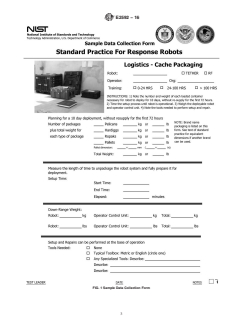
6.1 A sample data collection form is shown in Fig. 1. This
operator control station, power sources, spare parts, sensors,
form is referenced throughout Sections7–11.
manipulators, and maintenance tools.
Logistics
4. Summary of Practice
7. Volume of Cache Packaging
4.1 The number and types of cases required for packing the
robot and all associated components are identified, along with
7.1 The robot system shall be compatible with the respond-
the weight of each. This information will prepare the logistics
er’s cache packaging and transportation system.
manager of a response team to allocate space in the warehouse
7.2 Three standard packing cases are used by the Federal
as well as in the transportation vehicle to convey the robot to
Emergency Management Agency (FEMA) Urban Search and
and from the response site. Weight is taken into consideration
Rescue (USAR) task forces. Self-contained robot systems may
intermsoftransportingtheequipmenttoandfromtheresponse
also be loaded onto a pallet.
site.
4.2 The length of time required to unpack and ready the
7.3 Apparatus—Packing cases or pallets.
robot for operation is measured. This provides the responder
7.3.1 Packing Cases—These packing cases are requ
...
This document is not an ASTM standard and is intended only to provide the user of an ASTM standard an indication of what changes have been made to the previous version. Because
it may not be technically possible to adequately depict all changes accurately, ASTM recommends that users consult prior editions as appropriate. In all cases only the current version
of the standard as published by ASTM is to be considered the official document.
Designation: E2592 − 07 E2592 − 16
Standard Practice for
Evaluating Cache Packaged Weight and Volume of Robots
Response Robot Capabilities: Logistics: Packaging for
Urban Search and Rescue Task Force Equipment Caches
This standard is issued under the fixed designation E2592; the number immediately following the designation indicates the year of
original adoption or, in the case of revision, the year of last revision. A number in parentheses indicates the year of last reapproval. A
superscript epsilon (´) indicates an editorial change since the last revision or reapproval.
INTRODUCTION
Anyone interested in developing or deploying response robots for hazardous environments needs
ways to quantitatively measure whether a particular robot is capable of performing and reliable enough
to perform specific missions. These missions decompose into sets of elemental robot tasks that can be
represented individually as standard test methods and repeatedly tested to gain confidence and
proficiency. They provide a tangible language to communicate mission requirements and demonstrate
robot capabilities.
The ASTM International Standards Committee on Homeland Security Applications, Operational
Equipment Subcommittee, Robots Task Group (E54.08.01) specifies standard test methods, practices,
and guides for evaluating response robots. These standard test methods measure individual robot
capabilities to facilitate comparisons among different robot models or different configurations of a
particular robot model. The overall set of standards addresses the robotic logistics, terminology, safety,
maneuvering, terrains, obstacles, dexterity, sensing, communications, energy/power, durability,
proficiency, and autonomy.
These standards support robot researchers, manufacturers, and user organizations in different ways
by enabling testing of chosen combinations that address envisioned mission tasks. Researchers use
them to understand mission requirements, refine innovative approaches, and demonstrate break-
through capabilities. Manufacturers use them to evaluate design decisions, integrate payloads and
emerging technologies, and harden systems. Responder organizations use them to guide purchasing,
align with deployment objectives, and focus training with measures of operator proficiency.
1. Scope
1.1 This practice covers the requirement that urban search and rescue robots and all necessary associated components or
equipment (for example, operator control station, power sources, spare parts, sensors, manipulators, tools, and so forth) shall
complement the response organization’s cache packaging and transportation systems.
1.2 Shipment by ground, air, or marine should be considered.
1.3 Volume, weight, shipping classification, and deployability of the robots and associated components are considered in this
practice.
1.3.1 The deployability is considered through the determination of:
1.3.1.1 The length of time required to prepare the robot system for deployment, and
1.3.1.2 The types of tools required for servicing the robot system in the field.
1.3.2 Associated components or equipment include not only all the onboard sensors, tethers, and operator control station, but
also any spare parts and specialized tools needed for assembly, disassembly, and field servicing.
1.3.3 Associated components also include power equipment necessary for the operation of the system, such as batteries,
chargers, and power converters. Gasoline, diesel, or other types of liquid fuel are not included.
This practice is under the jurisdiction of ASTM Committee E54 on Homeland Security Applications and is the direct responsibility of Subcommittee E54.08 on
Operational Equipment.
Current edition approved Oct. 1, 2007Jan. 1, 2016. Published November 2007January 2016. Originally approved in 2007. Last previous edition approved in 2007 as
E2592 – 07. DOI: 10.1520/E2592-07.10.1520/E2592-16.
Copyright © ASTM International, 100 Barr Harbor Drive, PO Box C700, West Conshohocken, PA 19428-2959. United States
E2592 − 16
1.4 The packaged items shall support the operational availability of the robot during a deployment of up to ten days. There shall
be no resupply within the first 72 h of deployment.
1.5 No such standards currently exist except for those relevant to shipping (for example, CFR Title 49 and International Air
Transport Association (IATA) documents).
1.6 The values stated in SI units are to be regarded as the standard. The values given in parentheses are for information only.
1.7 This standard does not purport to address all of the safety concerns, if any, associated with its use. It is the responsibility
of the user of this standard to establish appropriate safety and health practices and determine the applicability of regulatory
limitations prior to use.
2. Referenced Documents
2.1 Federal Standard:
CFR Title 49 Transportation
2.2 ISO Standard:
ISO 6780:2003 Flat pallets for intercontinental materials handling—Principal dimensions and tolerances
3. Terminology
3.1 Definitions of Terms Specific to This Standard:
3.1.1 cache, n—approved complement of tools, equipment, and supplies stored in a designated location available for use during
responses to emergencies.
3.1.2 operator control unit (OCU), n—computer(s), accessories, and data link equipment that an operator uses to control,
communicate with, receive data and information from, and plan missions for one or more robots.
Available from the U.S. Government Printing Office, Superintendent of Documents, Stop SSOP, Washington, DC 20402-0001.
Available from American National Standards Institute (ANSI), 25 W. 43rd St., 4th Floor, New York, NY 10036, http://www.ansi.org.
3.1.2.1 Discussion—
Also referred to as operator control interface (OCI), operator control station, or human interaction control unit.
3.1.3 robot system, n—robot platform and all necessary associated components required for field operation and maintenance of
the robot, which includes, but is not limited to, the operator control station, power sources, spare parts, sensors, manipulators, and
maintenance tools.
4. Summary of Practice
4.1 The number and types of cases required for packing the robot and all associated components are identified, along with the
weight of each. This information will prepare the logistics manager of a response team to allocate space in the warehouse as well
as in the transportation vehicle to convey the robot to and from the response site. Weight is taken into consideration in terms of
transporting the equipment to and from the response site.
4.2 The length of time required to unpack and ready the robot for operation is measured. This provides the responder
organization an estimate of how long to allocate to the preparation of the robot for deployment.
4.3 The tools that are required for servicing the robot in the field are identified. This will help the logistics manager determine
whether additional, special tools will need to be packed along with the robot. It is preferable to avoid using specialized tools that
are not typically available in toolboxes that are part of the existing cache. If a specialized tool is missing, there may be no recourse
in resolving the problem with the robot in the field, and the robot may be rendered inoperable.
4.4 The weights of the robot and OCU are measured. The responders already have to carry an array of tools and equipment from
the base of operation to the operational work site. Part of their new logistical planning when robots are deployed will be the
additional burden of carrying the robot and any associated equipment, such as the OCU. It is important that the weight of the robot
and the OCU be factored into the response planning process on site.
5. Significance and Use
5.1 Introduction of robots to the responder’s cache for use in urban search and rescue missions may have an impact on the
logistical planning for the response teams. Additional volume and weight shall be stored and transported to the response site.
Additional preparation time shall be allotted to ready the robot for deployment. The tools that are taken to the field may need to
be augmented to service the robots. Once the robot is ready for deployment, it shall be transported from the base of operations to
the mission zone. Responders may have to carry the robot and its controller or may have to provide some other transportation
mechanism if it is too heavy.
E2592 − 16
5.2 This practice is designed to appraise the impact in terms of logistical considerations for a response organization.
6. Data Collection Form
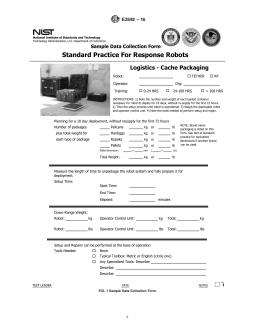
6.1 A sample data collection form is shown in Fig. 1. This form is referenced throughout Sections 7 – 11.
Logistics
7. Volume of C
...