


ASTM E2803-11(2020)
(Test Method)Standard Test Method for Evaluating Emergency Response Robot Capabilities: Mobility: Confined Area Obstacles: Inclined Planes
Standard Test Method for Evaluating Emergency Response Robot Capabilities: Mobility: Confined Area Obstacles: Inclined Planes
SIGNIFICANCE AND USE
5.1 A main purpose of using robots in emergency response operations is to enhance the safety and effectiveness of emergency responders operating in hazardous or inaccessible environments. The testing results of the candidate robot shall describe, in a statistically significant way, how reliably the robot is able to negotiate various types of obstacles, including the specified one, and thus provide emergency responders sufficiently high levels of confidence to determine the applicability of the robot.
5.2 This test method addresses robot performance requirements expressed by emergency responders and representatives from other interested organizations. The performance data captured within this test method are indicative of the testing robot’s capabilities. Having available a roster of successfully tested robots with associated performance data to guide procurement and deployment decisions for emergency responders is consistent with the guideline of “Governments at all levels have a responsibility to develop detailed, robust, all-hazards response plans,” as stated in National Response Framework.
5.3 The test apparatuses are scalable to constrain robot maneuverability during task performance for a range of robot sizes in confined areas associated with emergency response operations. (See 6.1 for specified incline sizes.)
5.4 The standard apparatus is specified to be easily fabricated to facilitate self-evaluation by robot developers and provide practice tasks for emergency responders that exercise robot actuators, sensors, and operator interfaces. The standard apparatus can also be used to support operator training and establish operator proficiency.
5.5 Although the test method was developed first for emergency response robots, it may be applicable to other operational domains.
SCOPE
1.1 Purpose:
1.1.1 The purpose of this test method is to quantitatively evaluate a teleoperated ground robot’s (see Terminology E2521) capability of traversing inclined planes in confined areas.
1.1.2 Robots shall possess a certain set of mobility capabilities, including negotiating obstacles, to suit critical operations such as emergency responses. An inclined slope is a type of obstacle that exists in emergency response and other environments. These environments often pose constraints to robotic mobility to various degrees. This test method specifies apparatuses, procedures, and metrics to standardize this obstacle for testing.
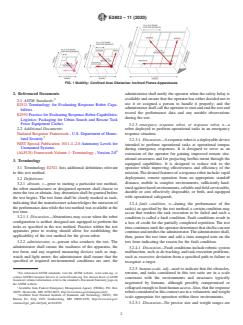
1.1.3 The test apparatuses are scalable to provide a range of dimensions to constrain the robotic mobility during task performance. Fig. 1 shows three apparatus sizes to test robots intended for different emergency response scenarios.
FIG. 1 Mobility: Confined Area Obstacles: Inclined Planes Apparatuses
1.1.4 Emergency response ground robots shall be able to handle many types of obstacles and terrain complexities. The required mobility capabilities include traversing gaps, hurdles, stairs, slopes, various types of floor surfaces or terrains, and confined passageways. Yet additional mobility requirements include sustained speeds and towing capabilities. Standard test methods are required to evaluate whether candidate robots meet these requirements.
1.1.5 ASTM Task Group E54.08.01 specifies a mobility test suite, which consists of a set of test methods for evaluating these mobility capability requirements. This inclined-plane-traversing test method is a part of the mobility test suite. The apparatuses associated with the test methods challenge specific robot capabilities in repeatable ways to facilitate comparison of different robot models as well as particular configurations of similar robot models.
1.1.6 The test suite quantifies elemental mobility capabilities necessary for ground robot intended for emergency response applications. As such, users of this standard can use either the entire suite or a subset based on their particular performance requirements...
General Information
- Status
- Published
- Publication Date
- 31-Dec-2019
- Technical Committee
- E54 - Homeland Security Applications
- Drafting Committee
- E54.09 - Response Robots
Relations
- Effective Date
- 01-Jan-2020
- Effective Date
- 01-Jan-2016
- Effective Date
- 01-Oct-2007
- Effective Date
- 01-Aug-2007
- Effective Date
- 01-Feb-2007
- Effective Date
- 01-Jan-2020
- Effective Date
- 01-Jan-2020
Overview
ASTM E2803-11(2020) is the internationally recognized standard titled Standard Test Method for Evaluating Emergency Response Robot Capabilities: Mobility: Confined Area Obstacles: Inclined Planes. Developed by ASTM, this test method provides a quantitative approach to evaluating the performance of teleoperated ground robots as they traverse inclined planes in confined spaces-a critical challenge in emergency response scenarios. The standard ensures consistent, statistically significant assessment of robot mobility, directly supporting the safety, effectiveness, and procurement decisions of emergency responders working in hazardous or inaccessible environments.
Key Topics
Robot Mobility in Confined Areas
The standard focuses on the ability of ground robots to navigate inclined surfaces within restricted spaces, which is a common obstacle in disaster and emergency response environments.Statistically Significant Evaluation
By requiring repeatable testing and defined metrics, ASTM E2803-11 ensures results that accurately reflect a robot’s reliability and performance under realistic operating conditions.Scalable and Standardized Test Apparatus
The test method specifies easily fabricated, scalable test apparatuses. This approach accommodates a range of robot sizes and promotes self-evaluation for developers, as well as operator training and proficiency assessment.Applicability Beyond Emergency Response
Although developed for emergency scenarios, the test method can be adapted for evaluating robots in other operational domains with similar mobility constraints.Objective Performance Data for Procurement
The standard supports the creation of performance data rosters, aiding procurement and deployment decisions aligned with guidelines such as the U.S. National Response Framework.
Applications
Emergency Response Robotics
Essential for evaluating robots deployed in search and rescue, hazardous material handling, and disaster recovery, especially where negotiating slopes and uneven terrain is vital.Operator Training and Proficiency
The standard apparatus can be used for consistent training exercises, allowing emergency responders to practice remote operation and develop proficiency.Robot Development and Self-Evaluation
Robot developers can use this standard to self-test their designs, ensuring their robots meet performance benchmarks required by emergency services and other end users.Comparative Assessments
Enables side-by-side comparison of robot models and configurations in a consistent, controlled manner, supporting informed decision-making.Expanding Operational Domains
The methodology may be extended to defense, industrial inspection, nuclear decommissioning, and any setting where robots need to navigate confined, inclined environments.
Related Standards
- ASTM E2521: Terminology for Evaluating Response Robot Capabilities
- ASTM E2592: Practice for Evaluating Response Robot Capabilities: Logistics: Packaging for Urban Search and Rescue Task Force Equipment Caches
- National Response Framework: Department of Homeland Security guidelines for robust, all-hazard emergency response planning.
- NIST SP 1011–I–2.0: Autonomy Levels for Unmanned Systems (ALFUS) Framework Volume 1: Terminology
Practical Value
ASTM E2803-11(2020) enhances the confidence of emergency response organizations by ensuring that robot mobility capabilities, particularly for traversing inclined planes in confined spaces, are measured reliably and repeatedly. This supports safer, more effective mission planning and improves the allocation and deployment of robotic assets in critical operations. Its standardized, scalable test method also drives industry-wide consistency, facilitating best practices for both robot manufacturers and first responders.
Keywords: emergency response robots, mobility testing, confined area obstacles, inclined planes, robot performance evaluation, standardized test, ASTM robot standards, operator training, emergency responder safety.
Get Certified
Connect with accredited certification bodies for this standard

National Aerospace and Defense Contractors Accreditation Program (NADCAP)
Global cooperative program for special process quality in aerospace.

NSF International
Global independent organization facilitating standards development and certification.
CARES (UK Certification Authority for Reinforcing Steels)
UK certification for reinforcing steels and construction.
Sponsored listings
Frequently Asked Questions
ASTM E2803-11(2020) is a standard published by ASTM International. Its full title is "Standard Test Method for Evaluating Emergency Response Robot Capabilities: Mobility: Confined Area Obstacles: Inclined Planes". This standard covers: SIGNIFICANCE AND USE 5.1 A main purpose of using robots in emergency response operations is to enhance the safety and effectiveness of emergency responders operating in hazardous or inaccessible environments. The testing results of the candidate robot shall describe, in a statistically significant way, how reliably the robot is able to negotiate various types of obstacles, including the specified one, and thus provide emergency responders sufficiently high levels of confidence to determine the applicability of the robot. 5.2 This test method addresses robot performance requirements expressed by emergency responders and representatives from other interested organizations. The performance data captured within this test method are indicative of the testing robot’s capabilities. Having available a roster of successfully tested robots with associated performance data to guide procurement and deployment decisions for emergency responders is consistent with the guideline of “Governments at all levels have a responsibility to develop detailed, robust, all-hazards response plans,” as stated in National Response Framework. 5.3 The test apparatuses are scalable to constrain robot maneuverability during task performance for a range of robot sizes in confined areas associated with emergency response operations. (See 6.1 for specified incline sizes.) 5.4 The standard apparatus is specified to be easily fabricated to facilitate self-evaluation by robot developers and provide practice tasks for emergency responders that exercise robot actuators, sensors, and operator interfaces. The standard apparatus can also be used to support operator training and establish operator proficiency. 5.5 Although the test method was developed first for emergency response robots, it may be applicable to other operational domains. SCOPE 1.1 Purpose: 1.1.1 The purpose of this test method is to quantitatively evaluate a teleoperated ground robot’s (see Terminology E2521) capability of traversing inclined planes in confined areas. 1.1.2 Robots shall possess a certain set of mobility capabilities, including negotiating obstacles, to suit critical operations such as emergency responses. An inclined slope is a type of obstacle that exists in emergency response and other environments. These environments often pose constraints to robotic mobility to various degrees. This test method specifies apparatuses, procedures, and metrics to standardize this obstacle for testing. 1.1.3 The test apparatuses are scalable to provide a range of dimensions to constrain the robotic mobility during task performance. Fig. 1 shows three apparatus sizes to test robots intended for different emergency response scenarios. FIG. 1 Mobility: Confined Area Obstacles: Inclined Planes Apparatuses 1.1.4 Emergency response ground robots shall be able to handle many types of obstacles and terrain complexities. The required mobility capabilities include traversing gaps, hurdles, stairs, slopes, various types of floor surfaces or terrains, and confined passageways. Yet additional mobility requirements include sustained speeds and towing capabilities. Standard test methods are required to evaluate whether candidate robots meet these requirements. 1.1.5 ASTM Task Group E54.08.01 specifies a mobility test suite, which consists of a set of test methods for evaluating these mobility capability requirements. This inclined-plane-traversing test method is a part of the mobility test suite. The apparatuses associated with the test methods challenge specific robot capabilities in repeatable ways to facilitate comparison of different robot models as well as particular configurations of similar robot models. 1.1.6 The test suite quantifies elemental mobility capabilities necessary for ground robot intended for emergency response applications. As such, users of this standard can use either the entire suite or a subset based on their particular performance requirements...
SIGNIFICANCE AND USE 5.1 A main purpose of using robots in emergency response operations is to enhance the safety and effectiveness of emergency responders operating in hazardous or inaccessible environments. The testing results of the candidate robot shall describe, in a statistically significant way, how reliably the robot is able to negotiate various types of obstacles, including the specified one, and thus provide emergency responders sufficiently high levels of confidence to determine the applicability of the robot. 5.2 This test method addresses robot performance requirements expressed by emergency responders and representatives from other interested organizations. The performance data captured within this test method are indicative of the testing robot’s capabilities. Having available a roster of successfully tested robots with associated performance data to guide procurement and deployment decisions for emergency responders is consistent with the guideline of “Governments at all levels have a responsibility to develop detailed, robust, all-hazards response plans,” as stated in National Response Framework. 5.3 The test apparatuses are scalable to constrain robot maneuverability during task performance for a range of robot sizes in confined areas associated with emergency response operations. (See 6.1 for specified incline sizes.) 5.4 The standard apparatus is specified to be easily fabricated to facilitate self-evaluation by robot developers and provide practice tasks for emergency responders that exercise robot actuators, sensors, and operator interfaces. The standard apparatus can also be used to support operator training and establish operator proficiency. 5.5 Although the test method was developed first for emergency response robots, it may be applicable to other operational domains. SCOPE 1.1 Purpose: 1.1.1 The purpose of this test method is to quantitatively evaluate a teleoperated ground robot’s (see Terminology E2521) capability of traversing inclined planes in confined areas. 1.1.2 Robots shall possess a certain set of mobility capabilities, including negotiating obstacles, to suit critical operations such as emergency responses. An inclined slope is a type of obstacle that exists in emergency response and other environments. These environments often pose constraints to robotic mobility to various degrees. This test method specifies apparatuses, procedures, and metrics to standardize this obstacle for testing. 1.1.3 The test apparatuses are scalable to provide a range of dimensions to constrain the robotic mobility during task performance. Fig. 1 shows three apparatus sizes to test robots intended for different emergency response scenarios. FIG. 1 Mobility: Confined Area Obstacles: Inclined Planes Apparatuses 1.1.4 Emergency response ground robots shall be able to handle many types of obstacles and terrain complexities. The required mobility capabilities include traversing gaps, hurdles, stairs, slopes, various types of floor surfaces or terrains, and confined passageways. Yet additional mobility requirements include sustained speeds and towing capabilities. Standard test methods are required to evaluate whether candidate robots meet these requirements. 1.1.5 ASTM Task Group E54.08.01 specifies a mobility test suite, which consists of a set of test methods for evaluating these mobility capability requirements. This inclined-plane-traversing test method is a part of the mobility test suite. The apparatuses associated with the test methods challenge specific robot capabilities in repeatable ways to facilitate comparison of different robot models as well as particular configurations of similar robot models. 1.1.6 The test suite quantifies elemental mobility capabilities necessary for ground robot intended for emergency response applications. As such, users of this standard can use either the entire suite or a subset based on their particular performance requirements...
ASTM E2803-11(2020) is classified under the following ICS (International Classification for Standards) categories: 13.200 - Accident and disaster control; 25.040.30 - Industrial robots. Manipulators. The ICS classification helps identify the subject area and facilitates finding related standards.
ASTM E2803-11(2020) has the following relationships with other standards: It is inter standard links to ASTM E2803-11, ASTM E2592-16, ASTM E2592-07, ASTM E2521-07a, ASTM E2521-07, ASTM E2992/E2992M-17, ASTM E2991/E2991M-17. Understanding these relationships helps ensure you are using the most current and applicable version of the standard.
ASTM E2803-11(2020) is available in PDF format for immediate download after purchase. The document can be added to your cart and obtained through the secure checkout process. Digital delivery ensures instant access to the complete standard document.
Standards Content (Sample)
This international standard was developed in accordance with internationally recognized principles on standardization established in the Decision on Principles for the
Development of International Standards, Guides and Recommendations issued by the World Trade Organization Technical Barriers to Trade (TBT) Committee.
Designation:E2803 −11 (Reapproved 2020)
Standard Test Method for
Evaluating Emergency Response Robot Capabilities:
Mobility: Confined Area Obstacles: Inclined Planes
This standard is issued under the fixed designation E2803; the number immediately following the designation indicates the year of
original adoption or, in the case of revision, the year of last revision. A number in parentheses indicates the year of last reapproval. A
superscript epsilon (´) indicates an editorial change since the last revision or reapproval.
1. Scope 1.1.6 The test suite quantifies elemental mobility capabili-
ties necessary for ground robot intended for emergency re-
1.1 Purpose:
sponse applications. As such, users of this standard can use
1.1.1 The purpose of this test method is to quantitatively
either the entire suite or a subset based on their particular
evaluate a teleoperated ground robot’s (see Terminology
performance requirements. Users are also allowed to weight
E2521) capability of traversing inclined planes in confined
particular test methods or particular metrics within a test
areas.
methoddifferentlybasedontheirspecificperformancerequire-
1.1.2 Robots shall possess a certain set of mobility
ments. The testing results should collectively represent an
capabilities, including negotiating obstacles, to suit critical
emergency response ground robot’s overall mobility perfor-
operations such as emergency responses.An inclined slope is a
mance. These performance data can be used to guide procure-
type of obstacle that exists in emergency response and other
ment specifications and acceptance testing for robots intended
environments. These environments often pose constraints to
for emergency response applications.
robotic mobility to various degrees. This test method specifies
apparatuses, procedures, and metrics to standardize this ob-
NOTE 1—Additional test methods within the suite are anticipated to be
stacle for testing.
developed to address additional or advanced robotic mobility capability
requirements, including newly identified requirements and for even new
1.1.3 The test apparatuses are scalable to provide a range of
application domains.
dimensions to constrain the robotic mobility during task
performance. Fig. 1 shows three apparatus sizes to test robots 1.2 Performing Location—This test method shall be per-
intended for different emergency response scenarios.
formed in a testing laboratory or the field where the specified
1.1.4 Emergency response ground robots shall be able to apparatus and environmental conditions are implemented.
handle many types of obstacles and terrain complexities. The
1.3 The values stated in SI units are to be regarded as the
required mobility capabilities include traversing gaps, hurdles,
standard. The values given in parentheses are not precise
stairs, slopes, various types of floor surfaces or terrains, and
mathematical conversions to inch-pound units. They are close
confined passageways. Yet additional mobility requirements
approximate equivalents for the purpose of specifying material
include sustained speeds and towing capabilities. Standard test
dimensions or quantities that are readily available to avoid
methods are required to evaluate whether candidate robots
excessive fabrication costs of test apparatuses while maintain-
meet these requirements.
ing repeatability and reproducibility of the test method results.
1.1.5 ASTMTask Group E54.08.01 specifies a mobility test
These values given in parentheses are provided for information
suite, which consists of a set of test methods for evaluating
only and are not considered standard.
these mobility capability requirements. This inclined-plane-
1.4 This standard does not purport to address all of the
traversing test method is a part of the mobility test suite. The
safety concerns, if any, associated with its use. It is the
apparatuses associated with the test methods challenge specific
responsibility of the user of this standard to establish appro-
robotcapabilitiesinrepeatablewaystofacilitatecomparisonof
priate safety, health, and environmental practices and deter-
different robot models as well as particular configurations of
mine the applicability of regulatory limitations prior to use.
similar robot models.
1.5 This international standard was developed in accor-
dance with internationally recognized principles on standard-
This test method is under the jurisdiction of ASTM Committee E54 on
Homeland Security Applications and is the direct responsibility of Subcommittee
ization established in the Decision on Principles for the
E54.09 on Response Robots.
Development of International Standards, Guides and Recom-
Current edition approved Jan. 1, 2020. Published January 2020. Originally
mendations issued by the World Trade Organization Technical
approved in 2011. Last previous edition approved in 2011 as E2803 – 11. DOI:
10.1520/E2803-11R20. Barriers to Trade (TBT) Committee.
Copyright © ASTM International, 100 Barr Harbor Drive, PO Box C700, West Conshohocken, PA 19428-2959. United States
E2803−11 (2020)
FIG. 1Mobility: Confined Area Obstacles: Inclined Planes Apparatuses
2. Referenced Documents administrator shall notify the operator when the safety belay is
2 available and ensure that the operator has either decided not to
2.1 ASTM Standards:
use it or assigned a person to handle it properly; and the
E2521 Terminology for Evaluating Response Robot Capa-
administratorshallcalltheoperatortostartandendthetestand
bilities
record the performance data and any notable observations
E2592 Practice for Evaluating Response Robot Capabilities:
during the test.
Logistics: Packaging for Urban Search and Rescue Task
Force Equipment Caches
3.2.3 emergency response robot, or response robot, n—a
2.2 Additional Documents: robot deployed to perform operational tasks in an emergency
National Response Framework , U.S. Department of Home-
response situation.
land Security
3.2.3.1 Discussion—Aresponserobotisadeployabledevice
NIST Special Publication 1011–I–2.0 Autonomy Levels for
intended to perform operational tasks at operational tempos
Unmanned Systems
during emergency responses. It is designed to serve as an
(ALFUS) Framework Volume 1: Terminology , Version 2.0
extension of the operator for gaining improved remote situ-
ational awareness and for projecting her/his intent through the
3. Terminology
equipped capabilities. It is designed to reduce risk to the
3.1 Terminology E2521 lists additional definitions relevant
operator while improving effectiveness and efficiency of the
to this test method.
mission.Thedesiredfeaturesofaresponserobotinclude:rapid
deployment, remote operation from an appropriate standoff
3.2 Definitions:
distance, mobile in complex environments, sufficiently hard-
3.2.1 abstain, v—prior to starting a particular test method,
enedagainstharshenvironments,reliableandfieldserviceable,
the robot manufacturer or designated operator shall choose to
durable or cost effectively disposable, or both, and equipped
enter the test or abstain.Any abstention shall be granted before
with operational safeguards.
the test begins. The test form shall be clearly marked as such,
indicating that the manufacturer acknowledges the omission of
3.2.4 fault condition, n—during the performance of the
theperformancedatawhilethetestmethodwasavailableatthe
task(s) as specified by the test method, a certain condition may
test time.
occur that renders the task execution to be failed and such a
3.2.1.1 Discussion—Abstentions may occur when the robot
condition is called a fault condition. Fault conditions result in
configuration is neither designed nor equipped to perform the
a loss of credit for the partially completed repetition. The test
tasks as specified in the test method. Practice within the test
timecontinuesuntiltheoperatordeterminesthatshe/hecannot
apparatus prior to testing should allow for establishing the
continueandnotifiestheadministrator.Theadministratorshall,
applicability of the test method for the given robot.
then, pause the test time and add a time-stamped note on the
test form indicating the reason for the fault condition.
3.2.2 administrator, n—person who conducts the test. The
administrator shall ensure the readiness of the apparatus, the
3.2.4.1 Discussion—Faultconditionsincluderoboticsystem
test form, and any required measuring devices such as stop-
malfunction, such as de-tracking, and task execution problems,
watch and light meter; the administrator shall ensure that the
such as excessive deviation from a specified path or failure to
specified or required environmental conditions are met; the
recognize a target.
3.2.5 human-scale, adj—used to indicate that the obstacles,
For referenced ASTM standards, visit the ASTM website, www.astm.org, or
terrains, and tasks considered in this test suite are in a scale
contact ASTM Customer Service at service@astm.org. For Annual Book of ASTM
consistent with the environments and structures typically
Standards volume information, refer to the standard’s Document Summary page on
negotiated by humans, although possibly compromised or
the ASTM website.
Available from Federal Emergency Management Agency (FEMA), P.O. Box collapsedenoughtolimithumanaccess.Also,thattheresponse
10055, Hyattsville, MD 20782-8055, http://www.fema.gov/emergency/nrf/.
robotsconsideredinthiscontextareinavolumetricandweight
Available from National Institute of Standards and Technology (NIST), 100
scale appropriate for operation within these environments.
Bureau Dr., Stop 1070, Gaithersburg, MD 20899-1070, http://www.nist.gov/
customcf/get_pdf.cfm?pub_id=824705. 3.2.5.1 Discussion—No precise size and weight ranges are
E2803−11 (2020)
specifiedforthisterm.Thetestapparatusspecifiestheconfined from the specified START point to the END point and back.
areas in which to perform the tasks. Such constraints limit the The robot shall not deviate from the path line for wider than
overall sizes of robots to those considered applicable to one half of the robot’s width at all times during a traverse. The
emergency response operations. testing sponsor has the authority to select a starting incline
(degrees)forthetestevent.Astheevaluationproceeds,thetask
3.2.6 operator, n—person who controls the robot to perform
shall be performed on the increased inclines, as specified in
thetasksasspecifiedinthetestmethod;she/heshallensurethe
Section 6, until the highest testing incline is accomplished for
readiness of all the applicable subsystems of the robot; she/he
the specified number of repetitions.
through a designated second shall be responsible for the use of
a safety belay; and she/he shall also determine whether to
4.2 The robot’s capability of traversing a plane of a particu-
abstain the test.
lar testing incline is defined as the robot’s ability to complete
3.2.6.1 Discussion—An operator is typically an emergency
all the three traversing tasks repeatedly. The robot’s capability
responder in emergency response situations.
oftraversingthistypeofinclinedplaneisdefinedasthehighest
3.2.7 operator station, n—apparatusforhostingtheoperator degree inclined plane that the robot is capable of traversing
and her/his operator control unit (OCU, see ALFUS Frame-
repeatedly. Further, the test sponsor can specify the statistical
work Volume I: Terminology) to teleoperate (see Terminology reliability and confidence levels of such a capability and, thus,
E2521) the robot. The operator station shall be positioned in
dictate the number of successful task performance repetitions
suchamannersoastoinsulatetheoperatorfromthesightsand that are required.
sounds generated at the test apparatuses.
4.3 Teleoperation shall be used from the operator station
3.2.8 repetition, n—robot’s completion of the task as speci-
specified by the administrator to test the robots using an OCU
fied in the test method and readiness for repeating the same
provided by the operator. The operator station shall be posi-
task when required.
tioned and implemented in such a manner so as to insulate the
3.2.8.1 Discussion—In a traversing task, the entire mobility
operator from the sights and sounds generated at the test
mechanism shall be behind the START point before the
apparatus.
traverse and shall pass the END point to complete a repetition.
4.4 The operator is allowed to practice before the test.
Atest method can also specify returning to the STARTpoint to
She/he is also allowed to abstain from the test before it is
complete the task. Multiple repetitions, performed in the same
started. Once the test begins, there shall be no verbal commu-
test condition, may be used to establish the test performance to
nication between the operator and the administrator regarding
a certain degree of statistical significance as specified by the
the performance of a test repetition other than instructions on
testing sponsor.
when to start and notifications of faults and any safety related
3.2.9 test eventor event, n—a set of testing activities that are
conditions. The operator shall have the full responsibility to
planned and organized by the test sponsor and to be held at the
determine whether and when the robot has completed a
one or multiple designated test site(s).
repetitionandnotifytheadministratoraccordingly.However,it
3.2.10 test form, n—form corresponding to a test method
istheadministrator’sauthoritytojudgethecompletenessofthe
that contains fields for recording the testing results and the
repetition.
associated information.
NOTE 2—Practice within the test apparatus could help establish the
3.2.11 test sponsor, n—an organization or individual that
applicability of the robot for the given test method. It allows the operator
commissions a particular test event and receives the corre-
to gain familiarity with the standard apparatus and environmental condi-
sponding test results.
tions.Italsoenablesthetestadministratortoestablishtheinitialapparatus
setting for the test.
3.2.12 test suite, n—designed collection of test methods that
are used, collectively, to evaluate the performance of a robot’s
4.5 The test sponsor has the authority to select the size for
particular subsystem or functionality, including mobility,
the specified confined area apparatus.The test sponsor also has
manipulation, sensors, energy/power, communications,
the authority to select the test methods that constitute the test
human-robot interaction (HRI), logistics, safety, and aerial or
event, to select one or more test site(s) at which the test
aquatic maneuvering.
methods are implemented, to determine the corresponding
statistical reliability and confidence levels of the results for
3.2.13 testing task, or task, n—a set of activities well
eachofthetestmethods,andtoestablishtheparticipationrules
defined in a test method for testing robots and the operators to
including the testing schedules and the test environmental
performs in order for the robots’performance to be evaluated.
conditions.
A test method may specify multiple tasks. A task corresponds
to the associated metric or metrics.
5. Significance and Use
4. Summary of Test Method
5.1 A main purpose of using robots in emergency response
4.1 This test method consists of three types of traversing operations is to enhance the safety and effectiveness of
tasks for the specified inclined plane apparatus setting: vertical emergency responders operating in hazardous or inaccessible
traverse forward and back, diagonal traverse forward and back, environments. The testing results of the candidate robot shall
and horizontal traverse forward and back. The completion of describe, in a statistically significant way, how reliably the
one of the tasks is defined as when the entire robot traverses robot is able to negotiate various types of obstacles, including
E2803−11 (2020)
the specified one, and thus provide emergency responders participating robots to execute the testing tasks. A safety rope
sufficiently high levels of confidence to determine the applica- belay shall be provided, although it is the operator’s option and
bility of the robot.
responsibility to attach, route, and handle it such that the robot
can be secured when needed.
5.2 This test method addresses robot performance require-
ments expressed by emergency responders and representatives
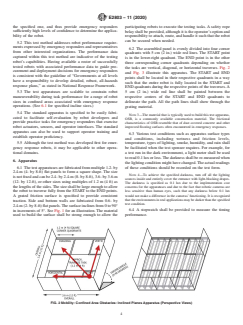
6.2 The assembled panel is evenly divided into four corner
from other interested organizations. The performance data
quadrants with 5 cm (2 in.) wide red lines. The START point
captured within this test method are indicative of the testing
is in the lower-right quadrant. The END point is in the other
robot’s capabilities. Having available a roster of successfully
three corresponding corner quadrants depending on whether
tested robots with associated performance data to guide pro-
the tasks are vertical, diagonal, or horizontal traverses. Fig. 2
curement and deployment decisions for emergency responders
and Fig. 3 illustrate this apparatus. The START and END
is consistent with the guideline of “Governments at all levels
points shall be located in their respective quadrants in a way
have a responsibility to develop detailed, robust, all-hazards
such that the entire robot is fully located in the START and
response plans,” as stated in National Response Framework.
END quadrants during the respective points of the traverses.A
5.3 The test apparatuses are scalable to constrain robot
5 cm (2 in.) wide red line shall be painted between the
maneuverability during task performance for a range of robot
respective centers of the START and END quadrants to
sizes in confined areas associated with emergency response
delineate the path. All the path lines shall show through the
operations. (See 6.1 for specified incline sizes.)
grating material.
5.4 The standard apparatus is specified to be easily fabri-
NOTE 3—The material that is typically used to build this test apparatus,
cated to facilitate self-evaluation by robot developers and
OSB, is a commonly available construction material. The frictional
provide practice tasks for emergency responders that exercise
characteristics of OSB resemble that of dust covered concrete and other
improved flooring surfaces often encountered in emergency responses.
robot actuators, sensors, and operator interfaces. The standard
apparatus can also be used to support operator training and
6.3 Various test conditions such as apparatus surface types
establish operator proficiency.
and conditions, including wetness and friction levels,
5.5 Although the test method was developed first for emer-
temperature, types of lighting, smoke, humidity, and rain shall
gency response robots, it may be applicable to other opera- be facilitated when the test sponsor requires. For example, for
tional domains.
a test run in the dark environment, a light meter shall be used
toread0.1luxorless.Thedarknessshallbere-measuredwhen
6. Apparatus
the lighting condition might have changed.The actual readings
6.1 Thetestapparatusesarefabricatedfrommultiple1.2-by of these conditions should be recorded on the test form.
2.4-m (4- by 8-ft) flat panels to form a square shape. The size
NOTE 4—To achieve the specified darkness, turn off all the lighting
is not fixed and can be 2.4- by 2.4-m (8- by 8-ft), 3.6- by 3.6-m
sources inside and entirely cover the entrance with light-blocking drapes.
(12- by 12-ft), or other sizes using multiples of 1.2 m (4 ft) as
The darkness is specified as 0.1 lux due to the implementation cost
the lengths of the sides
...
Questions, Comments and Discussion
Ask us and Technical Secretary will try to provide an answer. You can facilitate discussion about the standard in here.
Loading comments...