

ASTM F1932/F1932M-98(2018)
(Test Method)Standard Test Method for Measuring Sleeping Bag Loft
General Information
- Abstract
SIGNIFICANCE AND USE
3.1 In this context, this test method can be used for specifications, design, and quality control. Loft, in and of itself, is not to be used to predict the thermal properties of a sleeping bag.
SCOPE
1.1 This test method covers the determination of the loft of a sleeping bag under a standardized load.
1.2 The test method uses a physical height measurement applicable in the laboratory.
1.3 The values stated in either SI units or inch-pound units are to be regarded separately as standard. Within the text, the inch-pound units are shown in brackets. The values stated in each system are not exact equivalents; therefore, each system shall be used independently of the other. Combining values from the two systems may result in nonconformance with the test method.
1.4 This standard does not purport to address all of the safety concerns, if any, associated with its use. It is the responsibility of the user of this standard to establish appropriate safety, health, and environmental practices and determine the applicability of regulatory limitations prior to use.
1.5 This international standard was developed in accordance with internationally recognized principles on standardization established in the Decision on Principles for the Development of International Standards, Guides and Recommendations issued by the World Trade Organization Technical Barriers to Trade (TBT) Committee.
- Status
- Published
- Publication Date
- 30-Sep-2018
- Technical Committee
- F08 - Sports Equipment, Playing Surfaces, and Facilities
- Drafting Committee
- F08.22 - Camping Softgoods


Overview
ASTM F1932/F1932M-98(2018) sets forth a standardized test method for measuring the loft (thickness) of sleeping bags. Developed by ASTM International, this standard specifies procedures for determining sleeping bag loft under controlled laboratory conditions using a standardized load. Sleeping bag loft is a critical physical property for manufacturers, designers, and quality assurance personnel, providing a uniform measurement parameter across different products and materials.
Although loft is commonly referenced in product specifications and marketing, this standard emphasizes that loft alone should not be used to predict the thermal performance of sleeping bags. It is a physical measurement that assists in design, product development, quality comparisons, and the setting of performance specifications.
Key Topics
- Definition of Loft: Loft refers to the total thickness of a closed sleeping bag as measured while it lies flat under a standardized load.
- Test Apparatus: The method uses a gantry or similar structure, a disk of specified dimensions and weight, and a measurement rule with precise graduations.
- Conditioning Samples: Sleeping bags must be de-compressed, shaken, and allowed to rest in an uncompressed state for at least 24 hours before testing.
- Measurement Procedure:
- Conduct the test in a controlled environment (relative humidity ≤70%, temperature 10°C-25°C [55°F-80°F]).
- Place the disk at the midpoint along the length of the sleeping bag.
- Measure the thickness by reading the height difference with and without the sleeping bag under the disk.
- Reporting: Test results must include details such as the test method, sleeping bag description, and the loft measurement to the nearest 1 cm (0.5 in.).
- Units of Measurement: Both SI and inch-pound units are permitted, but they must not be combined in calculations or reporting.
Applications
Implementing ASTM F1932/F1932M-98(2018) offers several practical benefits within the sleeping bag industry and beyond:
- Quality Control: Manufacturers can use this method for batch consistency and to ensure products meet published specifications.
- Design and Development: Designers can benchmark and compare various prototypes and materials for loft properties.
- Product Comparison: Retailers and procurement specialists can confirm supplier claims for loft, supporting transparent communication with end users.
- Regulatory and Standards Compliance: Laboratories and organizations focused on equipment certification can apply this method for strict, standardized assessment.
This standard is relevant to all types of sleeping bags-whether filled with down, synthetics, or other combinations-and for a variety of use cases, including camping, outdoor recreation, and emergency preparedness.
Related Standards
For organizations and professionals interested in comprehensive testing and assessment, ASTM F1932/F1932M-98(2018) may be used in conjunction with other standards related to sleeping bags and outdoor equipment, such as:
- EN 13537: Requirements for thermal performance of sleeping bags
- ISO 23537: Sleeping bags - Requirements for testing and labeling
- ASTM F1720: Standard Test Method for Measuring Compactness of Sleeping Bags
By using ASTM F1932/F1932M-98(2018) alongside these or other relevant standards, stakeholders can ensure both the dimensional integrity and real-world performance of sleeping bags, supporting consumer confidence and product reliability.
Keywords: ASTM F1932, sleeping bag loft, sleeping bag testing, sleeping bag thickness, outdoor equipment standards, quality control, laboratory measurement.
Relations
- Effective Date
- 01-Oct-2018
Frequently Asked Questions
ASTM F1932/F1932M-98(2018) is a standard published by ASTM International. Its full title is "Standard Test Method for Measuring Sleeping Bag Loft". This standard covers: SIGNIFICANCE AND USE 3.1 In this context, this test method can be used for specifications, design, and quality control. Loft, in and of itself, is not to be used to predict the thermal properties of a sleeping bag. SCOPE 1.1 This test method covers the determination of the loft of a sleeping bag under a standardized load. 1.2 The test method uses a physical height measurement applicable in the laboratory. 1.3 The values stated in either SI units or inch-pound units are to be regarded separately as standard. Within the text, the inch-pound units are shown in brackets. The values stated in each system are not exact equivalents; therefore, each system shall be used independently of the other. Combining values from the two systems may result in nonconformance with the test method. 1.4 This standard does not purport to address all of the safety concerns, if any, associated with its use. It is the responsibility of the user of this standard to establish appropriate safety, health, and environmental practices and determine the applicability of regulatory limitations prior to use. 1.5 This international standard was developed in accordance with internationally recognized principles on standardization established in the Decision on Principles for the Development of International Standards, Guides and Recommendations issued by the World Trade Organization Technical Barriers to Trade (TBT) Committee.
SIGNIFICANCE AND USE 3.1 In this context, this test method can be used for specifications, design, and quality control. Loft, in and of itself, is not to be used to predict the thermal properties of a sleeping bag. SCOPE 1.1 This test method covers the determination of the loft of a sleeping bag under a standardized load. 1.2 The test method uses a physical height measurement applicable in the laboratory. 1.3 The values stated in either SI units or inch-pound units are to be regarded separately as standard. Within the text, the inch-pound units are shown in brackets. The values stated in each system are not exact equivalents; therefore, each system shall be used independently of the other. Combining values from the two systems may result in nonconformance with the test method. 1.4 This standard does not purport to address all of the safety concerns, if any, associated with its use. It is the responsibility of the user of this standard to establish appropriate safety, health, and environmental practices and determine the applicability of regulatory limitations prior to use. 1.5 This international standard was developed in accordance with internationally recognized principles on standardization established in the Decision on Principles for the Development of International Standards, Guides and Recommendations issued by the World Trade Organization Technical Barriers to Trade (TBT) Committee.
ASTM F1932/F1932M-98(2018) is classified under the following ICS (International Classification for Standards) categories: 97.200.30 - Camping equipment and camp-sites. The ICS classification helps identify the subject area and facilitates finding related standards.
ASTM F1932/F1932M-98(2018) has the following relationships with other standards: It is inter standard links to ASTM F1932/F1932M-98(2011)e1. Understanding these relationships helps ensure you are using the most current and applicable version of the standard.
ASTM F1932/F1932M-98(2018) is available in PDF format for immediate download after purchase. The document can be added to your cart and obtained through the secure checkout process. Digital delivery ensures instant access to the complete standard document.
Standards Content (Sample)
This international standard was developed in accordance with internationally recognized principles on standardization established in the Decision on Principles for the
Development of International Standards, Guides and Recommendations issued by the World Trade Organization Technical Barriers to Trade (TBT) Committee.
Designation: F1932/F1932M − 98 (Reapproved 2018) An American National Standard
Standard Test Method for
Measuring Sleeping Bag Loft
This standard is issued under the fixed designation F1932/F1932M; the number immediately following the designation indicates the year
of original adoption or, in the case of revision, the year of last revision. A number in parentheses indicates the year of last reapproval.
A superscript epsilon (´) indicates an editorial change since the last revision or reapproval.
INTRODUCTION
The loft (that is, thickness) of a sleeping bag refers to the total thickness of a closed sleeping bag.
It is a physical dimension/measurement used for specifications, design, and quality control. Loft, in
and of itself, is not to be used to predict the thermal properties of a sleeping bag.
1. Scope thereof, that is designed for people to use for thermal protec-
tion when sleeping (for example, outdoors, tent, cabin).
1.1 This test method covers the determination of the loft of
a sleeping bag under a standardized load.
3. Significance and Use
1.2 The test method uses a physical height measurement
3.1 In this context, this test method can be used for
applicable in the laboratory.
specifications, design, and quality control. Loft, in and of itself,
1.3 The values stated in either SI units or inch-pound units
is not to be used to predict the thermal properties of a sleeping
are to be regarded separately as standard. Within the text, the
bag.
inch-pound units are shown in brackets. The values stated in
each system are not exact equivalents; therefore, each system 4. Apparatus
shall be used independently of the other. Combining values
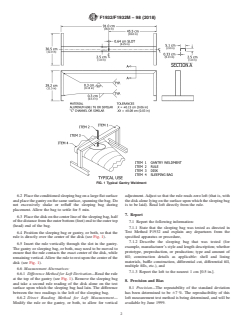
4.1 Gantry, a rigid structure of sufficient height and width to
from the two systems may result in nonconformance with the
span all sleeping bags to be measured is required. A purpose-
test method.
built device of the sort shown in Fig. 1 may be used, or a
1.4 This standard does not purport to address all of the
structure as simple as an office desk or workbench can suffice.
safety concerns, if any, associated with its use. It is the
4.2 Rule, having 1-mm [ ⁄16-in.] graduations, and long
responsibility of the user of this standard to establish appro-
enough to measure the zero height position.
priate safety, health, and environmental practices and deter-
4.3 Disk, having diameter of 30 cm [12 in.]. The weight of
mine the applicability of regulatory limitations prior to use.
the disk plus the rule must equal 50 g [1.8 oz] for a pressure of
1.5 This international standard was developed in accor-
6.9 Pa [0.001 psi]. Commercially available foam core dry-
dance with internationally recognized principles on standard-
mount board is suitable. A range of 61 % in diameter and
ization established in the Decision on Principles for the
65 % in weight is tolerable. Mark the center of the disk for
Development of International Standards, Guides and Recom-
positioning the rule during the test procedure.
mendations issued by the World Trade Organization Technical
Barriers to Trade (TBT) Committee.
5. Conditioning
2. Terminology
5.1 Remove the sleeping bag from the stuff sack, zip the bag
closed, and shake it for approximately 1 min, (for example, a
2.1 Definitions:
person shall hold the bag and shake it, turning it periodically
2.1.1 loft, n—the total thickness of a closed sleeping bag as
during the shaking). Lay it flat in an uncompressed state for at
measured while the bag is lying flat on a surface.
least 24 h prior to testing. A bag that has not been compressed
2.1.2 sleeping bag, n—a structure made of down, synthetic
in the 24 h prior to testing shall be considered to be conditioned
fiberfill, shell fabrics, or other materials, or a combination
(for example, bags drawn directly from production, bags
shipped uncompressed, replicate tests).
This test method is under the jurisdiction of ASTM Committee F08 on Sports
6. Procedure
Equipment, Playing Surfaces, and Facilities and is the direct responsibility of
Subcommittee F08.22 on Camping Softgoods.
6.1 Perform conditioning and testing at ambient tempera-
Current edition approved Oct. 1, 2018. Published November 2018. Originally
tur
...