

ASTM F1955-22
(Test Method)Standard Test Method for Flammability of Sleeping Bags
General Information
- Abstract
SIGNIFICANCE AND USE
5.1 This test method is suitable to assess the fabric burn rate of sleeping bag fabrics.
5.2 This test method is applicable to all sleeping bags.
5.3 This test method is technically equivalent to CPAI-75, which is used for the acceptance of commercial shipments of sleeping bags.
5.4 Most materials used to make sleeping bags are organic materials and are combustible (see 3.2.2). Sleeping bag materials can be combustible due to the inherent chemical composition of the material or due to the finishing processes used, or both.
5.5 When exposed to fire, combustible sleeping bag materials are potentially dangerous to the user because of their ease of ignition and because it is possible that they will exhibit a high burning rate.
5.5.1 If the sleeping bag material is noncombustible, it shall be deemed to meet the performance requirements of this test method. One way of demonstrating noncombustibility is by meeting the requirements of Test Method E136.
5.6 Changes in finishes or in fabric surface treatments can exert a large effect on the fabric flammability. Therefore, sleeping bags shall be tested both before and after cleaning or aging in accordance with one of the procedures in 7.3, in accordance with the manufacturer's instructions.
5.7 In this procedure, the specimens are subjected to one or more specific sets of laboratory test conditions. If different test conditions are substituted or the end-use conditions are changed, it is not always possible by or from this test method to predict changes in the fire-test-response characteristics measured. Therefore, the results are valid only for the fire test exposure conditions described in this procedure.
5.8 It must be understood, moreover, that no guarantee can be given and none is implied that sleeping bags complying with the performance requirements of this test method will not be hazardous under certain conditions.
5.9 It is feasible that the fabric will pass the test requirements as received ...
SCOPE
1.1 This fire-test response test method contains a method to assess the flammability, expressed as a burn rate, of sleeping bags which use various materials and constructions in their manufacture.
1.2 Sleeping bags that comply with the requirements in this test method shall be permitted to be labeled as complying with the appropriate requirements, to facilitate the identification of products conforming to this test method.
1.3 This test method is technically equivalent to the flammability standard CPAI-75, issued by the Industrial Fabrics Association International (see 2.2), and which has been in use as a flammability requirement for the sleeping bag industry in the U.S.
Note 1: CPAI-75 expresses burn rate in units of inches/minute while this test method expresses burn rate in units of centimetres/minute.
1.4 The values stated in SI units are to be regarded as the standard. The values given in parentheses are for information only.
1.5 This standard is used to measure and describe the response of materials, products, or assemblies to heat and flame under controlled conditions, but does not by itself incorporate all factors required for fire hazard or fire risk assessment of the materials, products, or assemblies under actual fire conditions.
1.6 This standard does not purport to address all of the safety concerns, if any, associated with its use. It is the responsibility of the user of this standard to establish appropriate safety, health, and environmental practices and determine the applicability of regulatory limitations prior to use.
1.7 Fire testing is inherently hazardous. Adequate safeguards for personnel and property shall be employed in conducting these tests.
1.8 This international standard was developed in accordance with internationally recognized principles on standardization established in the Decision on Principles for the Development of International Standards, Guides and Recommendat...
- Status
- Published
- Publication Date
- 30-Apr-2022
- Technical Committee
- F08 - Sports Equipment, Playing Surfaces, and Facilities
- Drafting Committee
- F08.22 - Camping Softgoods
Overview
ASTM F1955-22: Standard Test Method for Flammability of Sleeping Bags provides a recognized laboratory procedure to assess the burn rate and flammability of sleeping bag fabrics. Issued and maintained by ASTM International, this standard is essential for manufacturers, suppliers, and regulatory bodies concerned with the fire safety of camping softgoods.
The method applies a controlled flame to sleeping bag specimens to evaluate how quickly and easily the material burns. The outcome informs product labeling, risk assessments, and compliance with safety regulations. ASTM F1955-22 is technically equivalent to the widely used CPAI-75 standard, ensuring international alignment on flammability testing for sleeping bags.
Key Topics
- Methods for Assessing Burn Rate: The standard specifies procedures for sampling, specimen preparation (including pre- and post-cleaning or aging), and conducting burn rate tests under controlled laboratory conditions.
- Applicability: It applies to all types of sleeping bags regardless of fabric type, construction, or finish.
- Combustibility Evaluation: Describes how to determine whether a material is combustible and references ASTM E136 for certifying noncombustibility.
- Effect of Cleaning and Aging: Test procedures require evaluation both before and after cleaning or aging to capture the effects of laundering or use.
- Result Reporting and Labeling: Products meeting the burn rate criteria may be labeled accordingly, improving product transparency and traceability in the marketplace.
- Safety Considerations: The document stresses the need for proper safety precautions during laboratory fire testing, noting that compliance with the standard does not guarantee fire-proof performance in all real-world conditions.
Applications
ASTM F1955-22 is a critical standard for:
- Manufacturers: Ensuring that sleeping bags meet fire safety requirements by controlling material selection and product design to limit rapid burn rates.
- Retailers and Importers: Verifying product compliance before sale or distribution, particularly in markets where adherence to recognized flammability standards is mandatory.
- Regulators: Using standardized testing protocols to inform policy, set regulatory requirements, and enforce product safety in consumer goods.
- Consumers: Empowering buyers to identify sleeping bags compliant with established fire safety standards, thus supporting informed purchase decisions.
This test method also facilitates harmonization with previous standards (such as CPAI-75), streamlining international acceptance and regulatory approval for sleeping bag products.
Related Standards
- CPAI-75: The original "Rate of Burn Standard for Sleeping Bags," widely recognized in the sleeping bag industry and technically equivalent to ASTM F1955-22.
- ASTM E136: Test Method for Assessing Combustibility of Materials, referenced for evaluating whether sleeping bag materials are noncombustible.
- ASTM D123: Terminology Relating to Textiles, providing definitions for textile-specific terms used in the standard.
- ASTM D1776: Standard Practice for Conditioning and Testing Textiles, referenced for specimen preparation.
- ASTM D5025: Specification for Laboratory Burners, used to ensure consistent test apparatus.
- AATCC Test Method 124: Appearance of Fabrics After Repeated Home Laundering, referenced for cleaning procedures prior to testing.
Keywords: sleeping bag flammability, ASTM F1955-22, burn rate test, fire safety, camping equipment standards, CPAI-75 equivalent, laboratory fire testing, consumer product safety.
Relations
- Effective Date
- 01-Mar-2024
- Effective Date
- 01-Feb-2024
- Effective Date
- 01-Jan-2024
- Effective Date
- 01-Mar-2020
- Effective Date
- 01-Feb-2020
- Effective Date
- 01-Feb-2019
- Effective Date
- 15-Dec-2018
- Effective Date
- 01-Mar-2018
- Effective Date
- 01-Mar-2017
- Effective Date
- 01-Nov-2016
- Effective Date
- 01-Jan-2016
- Effective Date
- 15-Sep-2015
- Effective Date
- 01-Sep-2015
- Effective Date
- 01-Aug-2015
- Effective Date
- 01-Aug-2015
Frequently Asked Questions
ASTM F1955-22 is a standard published by ASTM International. Its full title is "Standard Test Method for Flammability of Sleeping Bags". This standard covers: SIGNIFICANCE AND USE 5.1 This test method is suitable to assess the fabric burn rate of sleeping bag fabrics. 5.2 This test method is applicable to all sleeping bags. 5.3 This test method is technically equivalent to CPAI-75, which is used for the acceptance of commercial shipments of sleeping bags. 5.4 Most materials used to make sleeping bags are organic materials and are combustible (see 3.2.2). Sleeping bag materials can be combustible due to the inherent chemical composition of the material or due to the finishing processes used, or both. 5.5 When exposed to fire, combustible sleeping bag materials are potentially dangerous to the user because of their ease of ignition and because it is possible that they will exhibit a high burning rate. 5.5.1 If the sleeping bag material is noncombustible, it shall be deemed to meet the performance requirements of this test method. One way of demonstrating noncombustibility is by meeting the requirements of Test Method E136. 5.6 Changes in finishes or in fabric surface treatments can exert a large effect on the fabric flammability. Therefore, sleeping bags shall be tested both before and after cleaning or aging in accordance with one of the procedures in 7.3, in accordance with the manufacturer's instructions. 5.7 In this procedure, the specimens are subjected to one or more specific sets of laboratory test conditions. If different test conditions are substituted or the end-use conditions are changed, it is not always possible by or from this test method to predict changes in the fire-test-response characteristics measured. Therefore, the results are valid only for the fire test exposure conditions described in this procedure. 5.8 It must be understood, moreover, that no guarantee can be given and none is implied that sleeping bags complying with the performance requirements of this test method will not be hazardous under certain conditions. 5.9 It is feasible that the fabric will pass the test requirements as received ... SCOPE 1.1 This fire-test response test method contains a method to assess the flammability, expressed as a burn rate, of sleeping bags which use various materials and constructions in their manufacture. 1.2 Sleeping bags that comply with the requirements in this test method shall be permitted to be labeled as complying with the appropriate requirements, to facilitate the identification of products conforming to this test method. 1.3 This test method is technically equivalent to the flammability standard CPAI-75, issued by the Industrial Fabrics Association International (see 2.2), and which has been in use as a flammability requirement for the sleeping bag industry in the U.S. Note 1: CPAI-75 expresses burn rate in units of inches/minute while this test method expresses burn rate in units of centimetres/minute. 1.4 The values stated in SI units are to be regarded as the standard. The values given in parentheses are for information only. 1.5 This standard is used to measure and describe the response of materials, products, or assemblies to heat and flame under controlled conditions, but does not by itself incorporate all factors required for fire hazard or fire risk assessment of the materials, products, or assemblies under actual fire conditions. 1.6 This standard does not purport to address all of the safety concerns, if any, associated with its use. It is the responsibility of the user of this standard to establish appropriate safety, health, and environmental practices and determine the applicability of regulatory limitations prior to use. 1.7 Fire testing is inherently hazardous. Adequate safeguards for personnel and property shall be employed in conducting these tests. 1.8 This international standard was developed in accordance with internationally recognized principles on standardization established in the Decision on Principles for the Development of International Standards, Guides and Recommendat...
SIGNIFICANCE AND USE 5.1 This test method is suitable to assess the fabric burn rate of sleeping bag fabrics. 5.2 This test method is applicable to all sleeping bags. 5.3 This test method is technically equivalent to CPAI-75, which is used for the acceptance of commercial shipments of sleeping bags. 5.4 Most materials used to make sleeping bags are organic materials and are combustible (see 3.2.2). Sleeping bag materials can be combustible due to the inherent chemical composition of the material or due to the finishing processes used, or both. 5.5 When exposed to fire, combustible sleeping bag materials are potentially dangerous to the user because of their ease of ignition and because it is possible that they will exhibit a high burning rate. 5.5.1 If the sleeping bag material is noncombustible, it shall be deemed to meet the performance requirements of this test method. One way of demonstrating noncombustibility is by meeting the requirements of Test Method E136. 5.6 Changes in finishes or in fabric surface treatments can exert a large effect on the fabric flammability. Therefore, sleeping bags shall be tested both before and after cleaning or aging in accordance with one of the procedures in 7.3, in accordance with the manufacturer's instructions. 5.7 In this procedure, the specimens are subjected to one or more specific sets of laboratory test conditions. If different test conditions are substituted or the end-use conditions are changed, it is not always possible by or from this test method to predict changes in the fire-test-response characteristics measured. Therefore, the results are valid only for the fire test exposure conditions described in this procedure. 5.8 It must be understood, moreover, that no guarantee can be given and none is implied that sleeping bags complying with the performance requirements of this test method will not be hazardous under certain conditions. 5.9 It is feasible that the fabric will pass the test requirements as received ... SCOPE 1.1 This fire-test response test method contains a method to assess the flammability, expressed as a burn rate, of sleeping bags which use various materials and constructions in their manufacture. 1.2 Sleeping bags that comply with the requirements in this test method shall be permitted to be labeled as complying with the appropriate requirements, to facilitate the identification of products conforming to this test method. 1.3 This test method is technically equivalent to the flammability standard CPAI-75, issued by the Industrial Fabrics Association International (see 2.2), and which has been in use as a flammability requirement for the sleeping bag industry in the U.S. Note 1: CPAI-75 expresses burn rate in units of inches/minute while this test method expresses burn rate in units of centimetres/minute. 1.4 The values stated in SI units are to be regarded as the standard. The values given in parentheses are for information only. 1.5 This standard is used to measure and describe the response of materials, products, or assemblies to heat and flame under controlled conditions, but does not by itself incorporate all factors required for fire hazard or fire risk assessment of the materials, products, or assemblies under actual fire conditions. 1.6 This standard does not purport to address all of the safety concerns, if any, associated with its use. It is the responsibility of the user of this standard to establish appropriate safety, health, and environmental practices and determine the applicability of regulatory limitations prior to use. 1.7 Fire testing is inherently hazardous. Adequate safeguards for personnel and property shall be employed in conducting these tests. 1.8 This international standard was developed in accordance with internationally recognized principles on standardization established in the Decision on Principles for the Development of International Standards, Guides and Recommendat...
ASTM F1955-22 is classified under the following ICS (International Classification for Standards) categories: 97.200.30 - Camping equipment and camp-sites. The ICS classification helps identify the subject area and facilitates finding related standards.
ASTM F1955-22 has the following relationships with other standards: It is inter standard links to ASTM E136-24a, ASTM E136-24, ASTM E176-24, ASTM D5025-20a, ASTM D5025-20, ASTM E136-19, ASTM E176-18a, ASTM E176-18, ASTM D123-17, ASTM E136-16a, ASTM E136-16, ASTM D123-15b, ASTM D123-15a, ASTM E176-15a, ASTM E176-15ae1. Understanding these relationships helps ensure you are using the most current and applicable version of the standard.
ASTM F1955-22 is available in PDF format for immediate download after purchase. The document can be added to your cart and obtained through the secure checkout process. Digital delivery ensures instant access to the complete standard document.
Standards Content (Sample)
This international standard was developed in accordance with internationally recognized principles on standardization established in the Decision on Principles for the
Development of International Standards, Guides and Recommendations issued by the World Trade Organization Technical Barriers to Trade (TBT) Committee.
Designation: F1955 − 22 An American National Standard
Standard Test Method for
Flammability of Sleeping Bags
This standard is issued under the fixed designation F1955; the number immediately following the designation indicates the year of
original adoption or, in the case of revision, the year of last revision. A number in parentheses indicates the year of last reapproval. A
superscript epsilon (´) indicates an editorial change since the last revision or reapproval.
1. Scope Development of International Standards, Guides and Recom-
mendations issued by the World Trade Organization Technical
1.1 This fire-test response test method contains a method to
Barriers to Trade (TBT) Committee.
assess the flammability, expressed as a burn rate, of sleeping
bags which use various materials and constructions in their
2. Referenced Documents
manufacture.
2.1 ASTM Standards:
1.2 Sleeping bags that comply with the requirements in this
D123 Terminology Relating to Textiles
test method shall be permitted to be labeled as complying with
D1776 Practice for Conditioning and Testing Textiles
the appropriate requirements, to facilitate the identification of
D5025 Specification for Laboratory Burner Used for Small-
products conforming to this test method.
Scale Burning Tests on Plastic Materials
1.3 This test method is technically equivalent to the flam-
E136 TestMethodforAssessingCombustibilityofMaterials
mability standard CPAI-75, issued by the Industrial Fabrics
Using a Vertical Tube Furnace at 750°C
Association International (see 2.2), and which has been in use
E176 Terminology of Fire Standards
as a flammability requirement for the sleeping bag industry in
2.2 Industrial Fabrics Association International Standard:
the U.S.
Specification CPAI-75 ARate of Burn Standard for Sleeping
NOTE 1—CPAI-75 expresses burn rate in units of inches/minute while
Bags
this test method expresses burn rate in units of centimetres/minute.
2.3 AATCC Standard:
1.4 The values stated in SI units are to be regarded as the
Test Method 124 - 2006 Appearance of Fabrics after Re-
standard. The values given in parentheses are for information
peated Home Laundering - Laboratory Procedure 1 (LP
only.
1)-2018 Home Laundering: Machine Washing
1.5 This standard is used to measure and describe the
response of materials, products, or assemblies to heat and
3. Terminology
flame under controlled conditions, but does not by itself
incorporate all factors required for fire hazard or fire risk 3.1 Definitions—For definitions of terms used in this test
assessment of the materials, products, or assemblies under method associated with fire issues, refer to Terminology E176.
actual fire conditions. Fordefinitionsoftermsusedinthistestmethodassociatedwith
1.6 This standard does not purport to address all of the textile issues, refer to Terminology D123.
safety concerns, if any, associated with its use. It is the
3.2 Definitions of Terms Specific to This Standard:
responsibility of the user of this standard to establish appro-
3.2.1 burn rate, n—the distance traveled by a flame on a
priate safety, health, and environmental practices and deter-
burning material or product during a specified time under
mine the applicability of regulatory limitations prior to use.
specified conditions.
1.7 Fire testing is inherently hazardous. Adequate safe-
3.2.2 combustible, adj—capable of undergoing combustion.
guards for personnel and property shall be employed in
3.2.2.1 Discussion—The term combustible is often delim-
conducting these tests.
ited to specific fire-exposure conditions.
1.8 This international standard was developed in accor-
dance with internationally recognized principles on standard-
ization established in the Decision on Principles for the
For referenced ASTM standards, visit the ASTM website, www.astm.org, or
contact ASTM Customer Service at service@astm.org. For Annual Book of ASTM
Standards volume information, refer to the standard’s Document Summary page on
This test method is under the jurisdiction of ASTM Committee F08 on Sports the ASTM website.
Equipment, Playing Surfaces, and Facilities and is the direct responsibility of Support for Specification CPA1–75 is to be discontinued by the Industrial
Subcommittee F08.22 on Camping Softgoods. Fabrics Association International and replaced with Test Method F1955.
Current edition approved May 1, 2022. Published May 2022. Originally Available from American Association of Textile Chemists and Colorists
approved in 1999. Last previous edition approved in 2020 as F1955 – 20. DOI: (AATCC), P.O. Box 12215, Research Triangle Park, NC 27709-2215, http://
10.1520/F1955-22. www.aatcc.org.
Copyright © ASTM International, 100 Barr Harbor Drive, PO Box C700, West Conshohocken, PA 19428-2959. United States
F1955 − 22
3.2.3 sleeping bag, n—a structure made of down, synthetic 5.9 It is feasible that the fabric will pass the test require-
fiberfill, shell fabrics, and/or other materials, that is designed ments as received but fail the requirements after cleaning. In
for thermal protection while sleeping (for example, outdoors, that case, the report shall indicate that the fabric is not suitable
tent, cabin). for cleaning or aging (as appropriate).
4. Summary of Test Method 6. Sampling
4.1 Ten specimens are cut from individual sleeping bags or 6.1 Lot Size—A lot shall be considered the size of the
from a physically accurate facsimile. contract between the buyer and the supplier unless otherwise
agreed upon between the supplier and the buyer.
4.2 Fiveofthesespecimensshallbetestedasreceived(after
conditioning). 6.2 All specimens shall be selected randomly from the lot.
4.3 The other five specimens shall be cleaned in accordance 6.3 Sample Unit—A sample unit shall consist of ten speci-
with 7.3 and then conditioned.These specimens shall also then mens.
be tested, after conditioning.
7. Test Specimens
4.4 Each of the specimens to be tested is placed in the test
7.1 Test Specimens—A total of ten test specimens shall be
apparatus. A standardized flame is applied to the folded edge
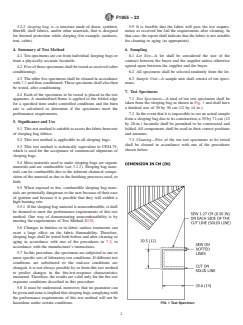
taken from the sleeping bag as shown in Fig. 1 and shall have
for a specified time under controlled conditions and the burn
a finished size of 30 by 36 cm (12 by 14 in.).
rate is calculated to determine if the specimens meet the
performance requirements.
7.2 In the event that it is impossible to cut an actual sample
from a sleeping bag due to its construction, a 30 by 71-cm (12
5. Significance and Use
by 28-in.) facsimile shall be permitted to be constructed and
5.1 This test method is suitable to assess the fabric burn rate folded. All components shall be used in their correct positions
of sleeping bag fabrics. and amounts.
5.2 This test method is applicable to all sleeping bags. 7.3 Cleaning—Five of the ten test specimens to be tested
shall be cleaned in accordance with one of the procedures
5.3 This test method is technically equivalent to CPAI-75,
shown below:
which is used for the acceptance of commercial shipments of
sleeping bags.
5.4 Most materials used to make sleeping bags are organic
materials and are combustible (see 3.2.2). Sleeping bag mate-
rials can be combustible due to the inherent chemical compo-
sition of the material or due to the finishing processes used, or
both.
5.5 When exposed to fire, combustible sleeping bag mate-
rials are potentially dangerous to the user because of their ease
of ignition and because it is possible that they will exhibit a
high burning rate.
5.5.1 If the sleeping bag material is noncombustible, it shall
be deemed to meet the performance requirements of this test
method. One way of demonstrating noncombustibility is by
meeting the requirements of Test Method E136.
5.6 Changes in finishes or in fabric surface treatments can
exert a large effect on the fabric flammability. Therefore,
sleeping bags shall be tested both before and after cleaning or
aging in accordance with one of the procedures in 7.3,in
accordance with the manufacturer’s instructions.
5.7 In this procedure, the specimens are subjected to one or
more specific sets of laboratory test conditions. If different test
conditions are substituted or the end-use conditions are
changed, it is not always possible by or from this test method
to predict changes in the fire-test-response characteristics
measured. Therefore, the results are valid only for the fire test
exposure conditions described in this procedure.
5.8 It must be understood, moreover, that no guarantee can
begivenandnoneisimpliedthatsleepingbagscomplyingwith
the performance requirements of this test method will not be
hazardous under certain conditions. FIG. 1 Test Specimen
F1955 − 22
7.3.1 If a laundering procedure is provided by the 8.3 All testing shall be performed in a draft-free environ-
manufacturer, the fabric test specimens shall be laundered, in ment.
accordance with the procedures recommended by the
9. Apparatus
manufacturer, by undergoing three wash-and-dry cycles.
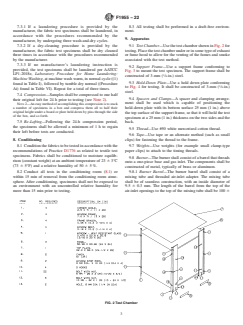
7.3.2 If a dry-cleaning procedure is provided by the 9.1 Test Chamber—UsethetestchambershowninFig.2for
manufacturer, the fabric test specimens shall be dry cleaned testing.Placethetestchamberunderorinsometypeofexhaust
three times in accordance with the procedures recommended or fume hood to allow for the venting of the fumes and smoke
by the manufacturer. associated with the test method.
7.3.3 If no manufacturer’s laundering instruction is
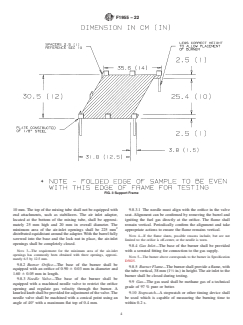
9.2 Support Frame—Use a support frame conforming to
provided, the test specimens shall be laundered per AATCC
Fig. 3 to mount the test specimen. The support frame shall be
LP1-2018e, Laboratory Procedure for Home Laundering:
constructed of 3-mm ( ⁄8-in.) steel.
Machine Washing,atmachinewashwarm,innormalcycle((1)
9.3 Hold-Down Plate—Use a hold down plate conforming
found in Table I), followed by tumb
...
This document is not an ASTM standard and is intended only to provide the user of an ASTM standard an indication of what changes have been made to the previous version. Because
it may not be technically possible to adequately depict all changes accurately, ASTM recommends that users consult prior editions as appropriate. In all cases only the current version
of the standard as published by ASTM is to be considered the official document.
Designation: F1955 − 20 F1955 − 22 An American National Standard
Standard Test Method for
Flammability of Sleeping Bags
This standard is issued under the fixed designation F1955; the number immediately following the designation indicates the year of
original adoption or, in the case of revision, the year of last revision. A number in parentheses indicates the year of last reapproval. A
superscript epsilon (´) indicates an editorial change since the last revision or reapproval.
1. Scope
1.1 This fire-test response test method contains a method to assess the flammability, expressed as a burn rate, of sleeping bags
which use various materials and constructions in their manufacture.
1.2 Sleeping bags that comply with the requirements in this test method shall be permitted to be labeled as complying with the
appropriate requirements, to facilitate the identification of products conforming to this test method.
1.3 This test method is technically equivalent to the flammability standard CPAI-75, issued by the Industrial Fabrics Association
International (see 2.2), and which has been in use as a flammability requirement for the sleeping bag industry in the U.S.
NOTE 1—CPAI-75 expresses burn rate in units of inches/minute while this test method expresses burn rate in units of centimetres/minute.
1.4 The values stated in SI units are to be regarded as the standard. The values given in parentheses are for information only.
1.5 This standard is used to measure and describe the response of materials, products, or assemblies to heat and flame under
controlled conditions, but does not by itself incorporate all factors required for fire hazard or fire risk assessment of the materials,
products, or assemblies under actual fire conditions.
1.6 This standard does not purport to address all of the safety concerns, if any, associated with its use. It is the responsibility
of the user of this standard to establish appropriate safety, health, and environmental practices and determine the applicability of
regulatory limitations prior to use.
1.7 Fire testing is inherently hazardous. Adequate safeguards for personnel and property shall be employed in conducting these
tests.
1.8 This international standard was developed in accordance with internationally recognized principles on standardization
established in the Decision on Principles for the Development of International Standards, Guides and Recommendations issued
by the World Trade Organization Technical Barriers to Trade (TBT) Committee.
2. Referenced Documents
2.1 ASTM Standards:
D123 Terminology Relating to Textiles
D1776 Practice for Conditioning and Testing Textiles
D5025 Specification for Laboratory Burner Used for Small-Scale Burning Tests on Plastic Materials
E136 Test Method for Assessing Combustibility of Materials Using a Vertical Tube Furnace at 750°C
This test method is under the jurisdiction of ASTM Committee F08 on Sports Equipment, Playing Surfaces, and Facilities and is the direct responsibility of Subcommittee
F08.22 on Camping Softgoods.
Current edition approved Oct. 1, 2020May 1, 2022. Published October 2020May 2022. Originally approved in 1999. Last previous edition approved in 20152020 as
F1955 – 15.F1955 – 20. DOI: 10.1520/F1955-20.10.1520/F1955-22.
For referenced ASTM standards, visit the ASTM website, www.astm.org, or contact ASTM Customer Service at service@astm.org. For Annual Book of ASTM Standards
volume information, refer to the standard’s Document Summary page on the ASTM website.
Copyright © ASTM International, 100 Barr Harbor Drive, PO Box C700, West Conshohocken, PA 19428-2959. United States
F1955 − 22
E176 Terminology of Fire Standards
2.2 Industrial Fabrics Association International Standard:
Specification CPAI-75 A Rate of Burn Standard for Sleeping Bags
2.3 AATCC Standard:
Test Method 124 - 2006 Appearance of Fabrics after Repeated Home Laundering - Laboratory Procedure 1 (LP 1)-2018 Home
Laundering: Machine Washing
3. Terminology
3.1 Definitions—For definitions of terms used in this test method associated with fire issues, refer to Terminology E176. For
definitions of terms used in this test method associated with textile issues, refer to Terminology D123.
3.2 Definitions of Terms Specific to This Standard:
3.2.1 burn rate, n—the distance traveled by a flame on a burning material or product during a specified time under specified
conditions.
3.2.2 combustible, adj—capable of undergoing combustion.
3.2.2.1 Discussion—
The term combustible is often delimited to specific fire-exposure conditions.
3.2.3 sleeping bag, n—a structure made of down, synthetic fiberfill, shell fabrics, and/or other materials, that is designed for
thermal protection while sleeping (for example, outdoors, tent, cabin).
4. Summary of Test Method
4.1 Ten specimens are cut from individual sleeping bags or from a physically accurate facsimile.
4.2 Five of these specimens shall be tested as received (after conditioning).
4.3 The other five specimens shall be cleaned in accordance with 7.3 and then conditioned. These specimens shall also then be
tested, after conditioning.
4.4 Each of the specimens to be tested is placed in the test apparatus. A standardized flame is applied to the folded edge for a
specified time under controlled conditions and the burn rate is calculated to determine if the specimens meet the performance
requirements.
5. Significance and Use
5.1 This test method is suitable to assess the fabric burn rate of sleeping bag fabrics.
5.2 This test method is applicable to all sleeping bags.
5.3 This test method is technically equivalent to CPAI-75, which is used for the acceptance of commercial shipments of sleeping
bags.
5.4 When combustible fabrics are used for sleeping bags they are potentially dangerous to the user because of their ease of ignition
(since all combustible materials will ignite) and because it is possible that they will exhibit a high burn rate.
5.4 Most fabricsmaterials used to make sleeping bags are organic materials and are combustible (see 3.2.2). Fabrics Sleeping bag
materials can be combustible due to the inherent chemical composition of the fabric material or due to the finishing processes used,
or both.
Support for Specification CPA1–75 is to be discontinued by the Industrial Fabrics Association International and replaced with Test Method F1955.
Available from American Association of Textile Chemists and Colorists (AATCC), P.O. Box 12215, Research Triangle Park, NC 27709-2215, http://www.aatcc.org.
F1955 − 22
5.5.1 Optionally, if there is a query as to whether a specific fabric used for a sleeping bag is combustible, it shall be tested in
accordance with Test Method E136. If the fabric complies with the requirements of Test Method E136 it shall be considered
noncombustible and shall be deemed to meet the performance requirements of this test method.
5.5 When exposed to fire, combustible sleeping bag materials are potentially dangerous to the user because of their ease of ignition
and because it is possible that they will exhibit a high burning rate.
5.5.1 If the sleeping bag material is noncombustible, it shall be deemed to meet the performance requirements of this test method.
One way of demonstrating noncombustibility is by meeting the requirements of Test Method E136.
5.6 Changes in finishes or in fabric surface treatments can exert a large effect on the fabric flammability. Therefore, sleeping bags
shall be tested both before and after cleaning or aging in accordance with one of the procedures in 7.3, in accordance with the
manufacturer’s instructions.
5.7 In this procedure, the specimens are subjected to one or more specific sets of laboratory test conditions. If different test
conditions are substituted or the end-use conditions are changed, it is not always possible by or from this test method to predict
changes in the fire-test-response characteristics measured. Therefore, the results are valid only for the fire test exposure conditions
described in this procedure.
5.8 It must be understood, moreover, that no guarantee can be given and none is implied that sleeping bags complying with the
performance requirements of this test method will not be hazardous under certain conditions.
5.9 It is feasible that the fabric will pass the test requirements as received but fail the requirements after cleaning. In that case,
the report shall indicate that the fabric is not suitable for cleaning or aging (as appropriate).
6. Sampling
6.1 Lot Size—A lot shall be considered the size of the contract between the buyer and the supplier unless otherwise agreed upon
between the supplier and the buyer.
6.2 All specimens shall be selected randomly from the lot.
6.3 Sample Unit—A sample unit shall consist of ten specimens.
7. Test Specimens
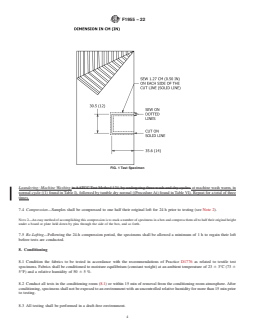
7.1 Test Specimens—A total of ten test specimens shall be taken from the sleeping bag as shown in Fig. 1 and shall have a finished
size of 30 by 36 cm (12 by 14 in.).
7.2 In the event that it is impossible to cut an actual sample from a sleeping bag due to its construction, a 30 by 71-cm (12 by
28-in.) facsimile shall be permitted to be constructed and folded. All components shall be used in their correct positions and
amounts.
7.3 Cleaning—Five of the ten test specimens to be tested shall be cleaned in accordance with one of the procedures shown below:
7.3.1 If a laundering procedure is provided by the manufacturer, the fabric test specimens shall be laundered, in accordance with
the procedures recommended by the manufacturer, by undergoing three wash-and-dry cycles.
7.3.2 If a dry-cleaning procedure is provided by the manufacturer, the fabric test specimens shall be dry cleaned three times in
accordance with the procedures recommended by the manufacturer.
7.3.3 If no laundering or dry-cleaning procedure is provided by the manufacturer, the fabric manufacturer’s laundering instruction
is provided, the test specimens shall be laundered as specified per AATCC LP1-2018e, Laboratory Procedure for Home
F1955 − 22
FIG. 1 Test Specimen
Laundering: Machine Washing,in AATCC Test Method 124, by undergoing three wash-and-dry cycles. at machine wash warm, in
normal cycle ((1) found in Table I), followed by tumble dry normal ((Procedure Ai) found in Table VI). Repeat for a
...