

ASTM A1014/A1014M-16(2021)
(Specification)Standard Specification for Precipitation-Hardening Bolting (UNS N07718) for High Temperature Service
General Information
- Abstract
ABSTRACT
This specification covers a precipitation hardening bolting material (UNS N07718) for high temperature service. The alloy shall be multiple melted using consumable electrode practice in the remelt cycle or shall be induction melted under vacuum. Requirements for solution treatment, precipitation heat treatment, straightening, and thread forming by rolling are detailed. Remelt ingots shall conform to the chemical composition requirements (as to chemical and product analyses) prescribed for the following elements: carbon, manganese, silicon, phosphorus, sulfur, chromium, cobalt, molybdenum, columbium, titanium, aluminum, boron, iron, copper, and nickel. Tensile, hardness, and stress rupture tests shall be performed and test specimen shall meet the requirements specified for tensile strength, yield strength, elongation, Brinell hardness, and stress rupture. The method of determining the minimum full size breaking strength for headed fastener is given. Metallography shall be taken for microstructure and macrostructure properties including grain size and flow lines.
SCOPE
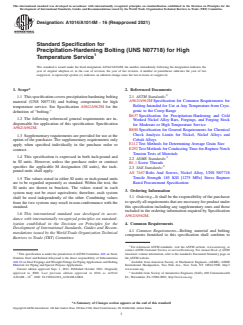
1.1 This specification covers precipitation hardening bolting material (UNS N07718) and bolting components for high temperature service. See Specification A962/A962M for the definition of “bolting.”
1.2 The following referenced general requirements are indispensable for application of this specification: Specification A962/A962M.
1.3 Supplementary requirements are provided for use at the option of the purchaser. The supplementary requirements only apply when specified individually in the purchase order or contract.
1.4 This specification is expressed in both inch-pound and in SI units. However, unless the purchase order or contract specifies the applicable M designation (SI units), the inch-pound units shall apply.
1.5 The values stated in either SI units or inch-pound units are to be regarded separately as standard. Within the text, the SI units are shown in brackets. The values stated in each system may not be exact equivalents; therefore, each system shall be used independently of the other. Combining values from the two systems may result in non-conformance with the standard.
1.6 This international standard was developed in accordance with internationally recognized principles on standardization established in the Decision on Principles for the Development of International Standards, Guides and Recommendations issued by the World Trade Organization Technical Barriers to Trade (TBT) Committee.
- Status
- Published
- Publication Date
- 31-Aug-2021
- Technical Committee
- A01 - Steel, Stainless Steel and Related Alloys

Overview
ASTM A1014/A1014M-16(2021) is a widely recognized standard specification developed by ASTM International. This standard defines the requirements for precipitation-hardening bolting material (UNS N07718) and bolting components intended for high temperature service. These nickel alloy bolting materials are crucial for performance in demanding environments, such as energy production, aerospace, and industrial processing, where resistance to heat and mechanical stress is essential.
ASTM A1014/A1014M outlines mandatory metallic, mechanical, and processing requirements, as well as test methods and quality control guidelines for manufacturers and purchasers. The specification ensures that bolting materials meet rigorous standards for strength, durability, and reliability in high temperature applications.
Key Topics
- Bolting Material and Alloy: Covers precipitation-hardened nickel alloy (UNS N07718), known for its excellent high temperature strength and corrosion resistance.
- Melt and Heat Treatment: Specifies multiple-melting using consumable electrode practice or vacuum induction melting, ensuring uniform material properties.
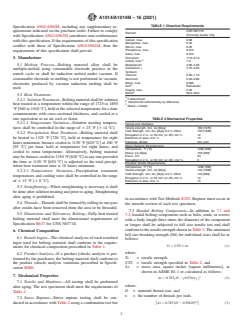
- Mechanical Properties: Sets requirements for tensile strength, yield strength, elongation, Brinell hardness, and stress rupture characteristics.
- Chemical Composition: Details precise limits for elements such as carbon, chromium, nickel, molybdenum, titanium, and more, ensuring consistency and performance.
- Manufacturing Processes: Outlines solution treatment, precipitation heat treatment, straightening, and thread forming by rolling.
- Metallography and Quality: Defines microstructural requirements, such as grain size and the absence of defects like freckles or Laves phases.
- Marking and Certification: Specifies marking requirements for traceability and the necessary certification of heat treatment cycles.
Applications
ASTM A1014/A1014M compliant bolting materials are engineered for environments where high temperature performance and mechanical integrity are critical. Key applications include:
- Power Generation: Turbines, boilers, and heat exchangers requiring high temperature resistant fastening solutions.
- Aerospace: Engines and exhaust systems relying on Inconel 718 (UNS N07718) bolting for optimal performance and safety.
- Petrochemical Processing: High temperature pressure vessels and reactors where both corrosion resistance and mechanical strength are paramount.
- Industrial Equipment: High stress, high heat machinery found in manufacturing plants, refineries, and chemical production.
The specification’s requirements ensure that bolting components maintain their strength, ductility, and performance under sustained stress and elevated temperatures, contributing to equipment reliability, safety, and longevity.
Related Standards
For comprehensive procurement and application of precipitation-hardening bolting material, the following related standards are referenced within ASTM A1014/A1014M:
- ASTM A962/A962M: Common requirements for bolting intended for use at any temperature, including definitions and ordering guidelines.
- ASTM B637: Specification for precipitation-hardening and cold-worked nickel alloy bars, forgings, and forging stock.
- ASTM B880: Requirements for chemical analysis of nickel and nickel alloys.
- ASTM E112 & E292: Test methods for determining average grain size and time-for-rupture notch tension testing.
- ASME B1.1: Unified Inch Screw Threads standard.
- SAE AS 7467: Specification for bolts and screws, nickel alloy UNS N07718.
Compliance with these referenced standards ensures proper integration, testing, and interchangeability within critical infrastructure and equipment.
Keywords: high temperature bolting, precipitation hardening, UNS N07718, Inconel 718, nickel alloy, ASTM A1014, mechanical testing, industrial fastening, power generation bolting, aerospace fasteners.
Relations
- Effective Date
- 01-Dec-2023
- Effective Date
- 01-Sep-2018
- Effective Date
- 01-May-2017
- Effective Date
- 01-Dec-2016
- Effective Date
- 01-Oct-2016
- Effective Date
- 01-May-2016
- Effective Date
- 01-Mar-2016
- Effective Date
- 01-Dec-2015
- Effective Date
- 01-Oct-2014
- Effective Date
- 01-May-2014
- Effective Date
- 01-Oct-2013
- Effective Date
- 01-May-2013
- Effective Date
- 01-Apr-2013
- Effective Date
- 15-Nov-2012
- Effective Date
- 15-May-2012
Get Certified
Connect with accredited certification bodies for this standard

Element Materials Technology
Materials testing and product certification.

Inštitut za kovinske materiale in tehnologije
Institute of Metals and Technology. Materials testing, metallurgical analysis, NDT.
Sponsored listings
Frequently Asked Questions
ASTM A1014/A1014M-16(2021) is a technical specification published by ASTM International. Its full title is "Standard Specification for Precipitation-Hardening Bolting (UNS N07718) for High Temperature Service". This standard covers: ABSTRACT This specification covers a precipitation hardening bolting material (UNS N07718) for high temperature service. The alloy shall be multiple melted using consumable electrode practice in the remelt cycle or shall be induction melted under vacuum. Requirements for solution treatment, precipitation heat treatment, straightening, and thread forming by rolling are detailed. Remelt ingots shall conform to the chemical composition requirements (as to chemical and product analyses) prescribed for the following elements: carbon, manganese, silicon, phosphorus, sulfur, chromium, cobalt, molybdenum, columbium, titanium, aluminum, boron, iron, copper, and nickel. Tensile, hardness, and stress rupture tests shall be performed and test specimen shall meet the requirements specified for tensile strength, yield strength, elongation, Brinell hardness, and stress rupture. The method of determining the minimum full size breaking strength for headed fastener is given. Metallography shall be taken for microstructure and macrostructure properties including grain size and flow lines. SCOPE 1.1 This specification covers precipitation hardening bolting material (UNS N07718) and bolting components for high temperature service. See Specification A962/A962M for the definition of “bolting.” 1.2 The following referenced general requirements are indispensable for application of this specification: Specification A962/A962M. 1.3 Supplementary requirements are provided for use at the option of the purchaser. The supplementary requirements only apply when specified individually in the purchase order or contract. 1.4 This specification is expressed in both inch-pound and in SI units. However, unless the purchase order or contract specifies the applicable M designation (SI units), the inch-pound units shall apply. 1.5 The values stated in either SI units or inch-pound units are to be regarded separately as standard. Within the text, the SI units are shown in brackets. The values stated in each system may not be exact equivalents; therefore, each system shall be used independently of the other. Combining values from the two systems may result in non-conformance with the standard. 1.6 This international standard was developed in accordance with internationally recognized principles on standardization established in the Decision on Principles for the Development of International Standards, Guides and Recommendations issued by the World Trade Organization Technical Barriers to Trade (TBT) Committee.
ABSTRACT This specification covers a precipitation hardening bolting material (UNS N07718) for high temperature service. The alloy shall be multiple melted using consumable electrode practice in the remelt cycle or shall be induction melted under vacuum. Requirements for solution treatment, precipitation heat treatment, straightening, and thread forming by rolling are detailed. Remelt ingots shall conform to the chemical composition requirements (as to chemical and product analyses) prescribed for the following elements: carbon, manganese, silicon, phosphorus, sulfur, chromium, cobalt, molybdenum, columbium, titanium, aluminum, boron, iron, copper, and nickel. Tensile, hardness, and stress rupture tests shall be performed and test specimen shall meet the requirements specified for tensile strength, yield strength, elongation, Brinell hardness, and stress rupture. The method of determining the minimum full size breaking strength for headed fastener is given. Metallography shall be taken for microstructure and macrostructure properties including grain size and flow lines. SCOPE 1.1 This specification covers precipitation hardening bolting material (UNS N07718) and bolting components for high temperature service. See Specification A962/A962M for the definition of “bolting.” 1.2 The following referenced general requirements are indispensable for application of this specification: Specification A962/A962M. 1.3 Supplementary requirements are provided for use at the option of the purchaser. The supplementary requirements only apply when specified individually in the purchase order or contract. 1.4 This specification is expressed in both inch-pound and in SI units. However, unless the purchase order or contract specifies the applicable M designation (SI units), the inch-pound units shall apply. 1.5 The values stated in either SI units or inch-pound units are to be regarded separately as standard. Within the text, the SI units are shown in brackets. The values stated in each system may not be exact equivalents; therefore, each system shall be used independently of the other. Combining values from the two systems may result in non-conformance with the standard. 1.6 This international standard was developed in accordance with internationally recognized principles on standardization established in the Decision on Principles for the Development of International Standards, Guides and Recommendations issued by the World Trade Organization Technical Barriers to Trade (TBT) Committee.
ASTM A1014/A1014M-16(2021) is classified under the following ICS (International Classification for Standards) categories: 77.140.30 - Steels for pressure purposes. The ICS classification helps identify the subject area and facilitates finding related standards.
ASTM A1014/A1014M-16(2021) has the following relationships with other standards: It is inter standard links to ASTM B637-23, ASTM A962/A962M-18, ASTM A962/A962M-17, ASTM A962/A962M-16b, ASTM B637-16, ASTM A962/A962M-16a, ASTM A962/A962M-16, ASTM A962/A962M-15, ASTM A962/A962M-14a, ASTM A962/A962M-14, ASTM A962/A962M-13b, ASTM A962/A962M-13a, ASTM A962/A962M-13, ASTM E112-12, ASTM A962/A962M-12. Understanding these relationships helps ensure you are using the most current and applicable version of the standard.
ASTM A1014/A1014M-16(2021) is available in PDF format for immediate download after purchase. The document can be added to your cart and obtained through the secure checkout process. Digital delivery ensures instant access to the complete standard document.
Standards Content (Sample)
This international standard was developed in accordance with internationally recognized principles on standardization established in the Decision on Principles for the
Development of International Standards, Guides and Recommendations issued by the World Trade Organization Technical Barriers to Trade (TBT) Committee.
Designation:A1014/A1014M −16 (Reapproved 2021)
Standard Specification for
Precipitation-Hardening Bolting (UNS N07718) for High
Temperature Service
This standard is issued under the fixed designation A1014/A1014M; the number immediately following the designation indicates the
year of original adoption or, in the case of revision, the year of last revision. A number in parentheses indicates the year of last
reapproval. A superscript epsilon (´) indicates an editorial change since the last revision or reapproval.
1. Scope* 2. Referenced Documents
2.1 ASTM Standards:
1.1 Thisspecificationcoversprecipitationhardeningbolting
A962/A962M Specification for Common Requirements for
material (UNS N07718) and bolting components for high
Bolting Intended for Use at Any Temperature from Cryo-
temperature service. See Specification A962/A962M for the
genic to the Creep Range
definition of “bolting.”
B637 Specification for Precipitation-Hardening and Cold
1.2 The following referenced general requirements are in-
Worked Nickel Alloy Bars, Forgings, and Forging Stock
dispensable for application of this specification: Specification
for Moderate or High Temperature Service
A962/A962M.
B880 Specification for General Requirements for Chemical
Check Analysis Limits for Nickel, Nickel Alloys and
1.3 Supplementary requirements are provided for use at the
Cobalt Alloys
option of the purchaser. The supplementary requirements only
E112 Test Methods for Determining Average Grain Size
apply when specified individually in the purchase order or
E292 Test Methods for Conducting Time-for-Rupture Notch
contract.
Tension Tests of Materials
1.4 This specification is expressed in both inch-pound and
2.2 ASME Standards:
in SI units. However, unless the purchase order or contract
B1.1 Screw Threads
specifies the applicable M designation (SI units), the inch-
2.3 SAE Standards:
pound units shall apply.
AS 7467 Bolts And Screws, Nickel Alloy, UNS N07718
Tensile Strength 185 KSI [1275 MPa] Stress Rupture
1.5 The values stated in either SI units or inch-pound units
Rated Procurement Specification
are to be regarded separately as standard. Within the text, the
SI units are shown in brackets. The values stated in each
3. Ordering Information
system may not be exact equivalents; therefore, each system
3.1 Ordering—It shall be the responsibility of the purchaser
shall be used independently of the other. Combining values
to specify all requirements that are necessary for product under
from the two systems may result in non-conformance with the
this specification including any supplementary ones and those
standard.
included in the ordering information required by Specification
1.6 This international standard was developed in accor-
A962/A962M.
dance with internationally recognized principles on standard-
ization established in the Decision on Principles for the
4. Common Requirements
Development of International Standards, Guides and Recom-
4.1 Common Requirements—Bolting material and bolting
mendations issued by the World Trade Organization Technical
components furnished to this specification shall conform to
Barriers to Trade (TBT) Committee.
For referenced ASTM standards, visit the ASTM website, www.astm.org, or
contact ASTM Customer Service at service@astm.org. For Annual Book of ASTM
This specification is under the jurisdiction of ASTM Committee A01 on Steel, Standards volume information, refer to the standard’s Document Summary page on
Stainless Steel and Related Alloysand is the direct responsibility of Subcommittee the ASTM website.
A01.22 on Steel Forgings and Wrought Fittings for PipingApplications and Bolting Available from American Society of Mechanical Engineers (ASME), ASME
Materials for Piping and Special Purpose Applications. International Headquarters, Two Park Ave., New York, NY 10016-5990, http://
Current edition approved Sept. 1, 2021. Published October 2021. Originally www.asme.org.
approved in 2000. Last previous edition approved in 2016 as A1014/ Available from Society of Automotive Engineers (SAE), 400 Commonwealth
ε1
A1014M – 16 . DOI: 10.1520/A1014_A1014M-16R21. Dr., Warrendale, PA 15096-0001, http://www.sae.org.
*A Summary of Changes section appears at the end of this standard
Copyright © ASTM International, 100 Barr Harbor Drive, PO Box C700, West Conshohocken, PA 19428-2959. United States
A1014/A1014M−16 (2021)
TABLE 1 Chemical Requirements
Specification A962/A962M, including any supplementary re-
quirements indicated on the purchase order. Failure to comply UNS N07718
Element
(Formerly Grade 718)
with Specification A962/A962M constitutes non-conformance
Carbon, max. 0.08
with this specification. If the requirements of this specification
Manganese, max. 0.35
conflict with those of Specification A962/A962M, then the
Silicon, max. 0.35
requirements of this specification shall prevail. Phosphorus, max. 0.015
Sulfur, max. 0.015
Chromium 17.0–21.0
5. Manufacture
A
Cobalt, max. 1.0
5.1 Melting Process—Bolting material alloy shall be
Molybdenum 2.80–3.30
Columbium + 4.75–5.50
multiple-melted using consumable electrode practice in the
Tantalum . . .
remelt cycle or shall be induction melted under vacuum. If
Titanium 0.65–1.15
consumable electrode re-melting is not performed in vacuum, Aluminum 0.20–0.80
Boron, max. 0.006
electrodes produced by vacuum induction melting shall be
B
Iron Remainder
used.
Copper, max. 0.30
C
Nickel 50.0–55.0
5.2 Heat Treatment:
A
If determined.
5.2.1 SolutionTreatment—Bolting material shall be solution
B
Determined arithmetically by difference.
heat treated at a temperature within the range of 1725 to 1850 C
Nickel + Cobalt.
°F [940 to 1010 °C], held at the selected temperature for a time
commensurate with cross-sectional thickness, and cooled at a
rate equivalent to an air cool or faster.
TABLE 2 Mechanical Properties
5.2.1.1 Temperature Variation—Solution treating tempera-
Tensile and Hardness
Tensile strength, min, ksi [Mpa] 185 [1275]
tures shall be controlled in the range of 6 25 °F [6 14 °C].
Yield Strength, min, ksi, [Mpa] 0.2 % offset 150 [1035]
5.2.2 Precipitation Heat Treatment—Bolting material shall
Elongation in 2 in., or 50 mm (or 4D) min % 12
be heated to 1325 °F [720 °C], held at temperature for eight
Reduction of area, min, % 15
Hardness, Brinell 331–444
hours minimum, furnace cooled to 1150 °F [620 °C] at 100 °F
Stress Rupture Requirements
[55 °C] per hour, held at temperature for eight hours, and
Temperature, °F [°C] 1200 [650]
cooled to room temperature. Alternatively, bolting material
Stress, ksi [Mpa] 100 [690]
Hours, min 23
maybefurnacecooledto1150°F[620°C]atanyrateprovided
Elongation in 2 in., or 50 mm (or 4D), min % 5
the time at 1150 °F [620 °C] is adjusted so the total precipi-
Elevated Tensile Requirements
tation heat treatment time is 18 hours minimum.
Temperature, °F [°C] 1200 [650]
Tensile strength, min, ksi [Mpa] 145 [1000]
5.2.2.1 Temperature Variation—Precipitation treatment
Yield Strength, min, ksi, [Mpa] 0.2 % offset 125 [860]
temperatures and cooling rates shall be controlled in the range
Elongation in 2 in., or 50 mm (or 4D) min % 12
of 6 15 °F [6 8 °C].
Reduction
...