

ASTM B200-22
(Specification)Standard Specification for Electrodeposited Coatings of Lead and Lead-Tin Alloys on Steel and Ferrous Alloys
General Information
- Abstract
ABSTRACT
This specification establishes the requirements for electrodeposited lead and lead-tin alloy coatings on steel and ferrous alloys. Sheets, strips, or wires in the unfabricated form are not covered here. Coatings shall be sampled, tested, and conform accordingly to specified requirements as to thickness, adhesion, corrosion resistance, hydrogen embrittlement, composition, workmanship, finish, and appearance.
SIGNIFICANCE AND USE
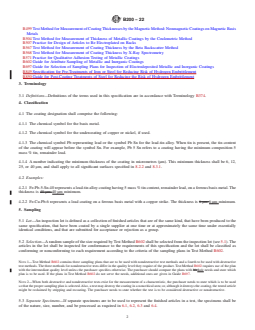
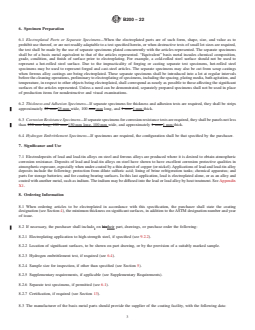
7.1 Electrodeposits of lead and lead-tin alloys on steel and ferrous alloys are produced where it is desired to obtain atmospheric corrosion resistance. Deposits of lead and lead-tin alloys on steel have shown to have excellent corrosion protective qualities in atmospheric exposure, especially when under-coated by a thin deposit of copper (or nickel). Applications of lead and lead-tin alloy deposits include the following: protection from dilute sulfuric acid; lining of brine refrigeration tanks; chemical apparatus; and parts for storage batteries; and for coating bearing surfaces. In this last application, lead is electroplated alone, or as an alloy and coated with another metal, such as indium. The indium may be diffused into the lead or lead alloy by heat treatment. See Appendix X1.
SCOPE
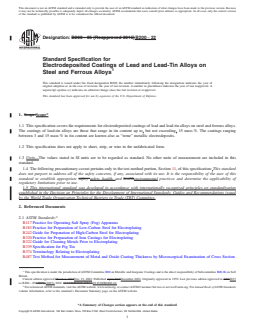
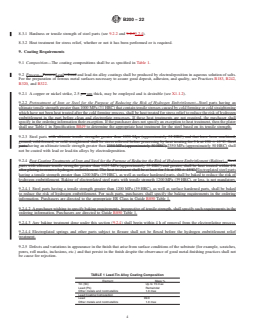
1.1 This specification covers the requirements for electrodeposited coatings of lead and lead-tin alloys on steel and ferrous alloys. The coatings of lead-tin alloys are those that range in tin content up to, but not exceeding, 15 mass %. The coatings ranging between 3 and 15 mass % in tin content are known also as “terne” metallic electrodeposits.
1.2 This specification does not apply to sheet, strip, or wire in the unfabricated form.
1.3 Units—The values stated in SI units are to be regarded as standard. No other units of measurement are included in this standard.
1.4 The following precautionary caveat pertains only to the test method portion, Section 11, of this specification: This standard does not purport to address all of the safety concerns, if any, associated with its use. It is the responsibility of the user of this standard to establish appropriate safety, health, and environmental practices and determine the applicability of regulatory limitations prior to use.
1.5 This international standard was developed in accordance with internationally recognized principles on standardization established in the Decision on Principles for the Development of International Standards, Guides and Recommendations issued by the World Trade Organization Technical Barriers to Trade (TBT) Committee.
- Status
- Published
- Publication Date
- 14-Nov-2022
- Technical Committee
- B08 - Metallic and Inorganic Coatings
- Drafting Committee
- B08.06 - Soft Metals
Buy Documents
ASTM B200-22 - Standard Specification for Electrodeposited Coatings of Lead and Lead-Tin Alloys on Steel and Ferrous Alloys
REDLINE ASTM B200-22 - Standard Specification for Electrodeposited Coatings of Lead and Lead-Tin Alloys on Steel and Ferrous Alloys
Overview
ASTM B200-22 is the internationally recognized standard specification for electrodeposited coatings of lead and lead-tin alloys on steel and ferrous alloys. Developed by ASTM International, this standard outlines the requirements for the composition, thickness, adhesion, corrosion resistance, hydrogen embrittlement, workmanship, finish, and appearance of these specialized coatings. ASTM B200-22 is widely referenced for quality control in electroplating processes where enhanced atmospheric corrosion resistance is critical. It is particularly relevant for fabricated parts and does not apply to unfabricated sheet, strip, or wire forms.
Key Topics
Coating Types and Composition
- Covers pure lead coatings and lead-tin alloys with up to 15% tin content.
- Includes terne coatings (3-15% tin) for specific applications.
- Emphasizes use of high-purity materials to ensure coating consistency.
Coating Requirements
- Minimum coating thickness levels: 6, 12, 25, or 40 μm.
- Strict criteria for uniformity, lack of defects, and appearance.
- Optional copper or nickel undercoating to enhance corrosion resistance.
Performance Testing
- Adhesion and thickness verified using standardized ASTM test methods.
- Corrosion resistance evaluated through salt spray tests, with required performance levels based on coating thickness.
- Procedures for managing and reducing the risk of hydrogen embrittlement in high-strength steels.
Inspection and Sampling
- Provides guidance for lot-based sampling and inspection protocols.
- Quality is ensured through both destructive and nondestructive testing, as specified in the order or contract.
- Allows for use of separate test specimens plated concurrently with production parts when direct testing is impractical.
Workmanship
- Finished surfaces must be free from blisters, pits, nodules, cracks, and other defects.
- Superficial staining from post-plating treatments such as baking is permitted and not grounds for rejection.
- Purchasing requirements include clear designation of coating type, thickness, and any supplementary tests.
Applications
ASTM B200-22 is widely utilized in several industries for its practical value in providing corrosion protection and functional surfaces, including:
- Chemical Processing Equipment: Components exposed to dilute sulfuric acid and other corrosive chemicals frequently require lead or lead-tin plating for extended durability.
- Brine Refrigeration Tanks: Coatings prevent aggressive brine solutions from attacking the underlying metal structure.
- Electrical and Storage Battery Parts: Lead’s electrical properties and corrosion resistance make it ideal for battery grids and connectors.
- Bearing and Mechanical Surfaces: Lead-tin alloys, such as 93% Pb–7% Sn, are used for their low-friction, wear-resistant qualities. Indium layers may be diffused for specialized performance.
- General Metal Fabrication: Any fabricated steel or ferrous alloy component requiring atmospheric corrosion resistance and enhanced longevity can benefit from these coatings.
Related Standards
Numerous ASTM standards are referenced within ASTM B200-22 to guide surface preparation, coating application, and laboratory testing:
- ASTM B117: Salt Spray Testing for corrosion resistance.
- ASTM B183, B242, B320, B322: Procedures for preparing steel and ferrous surfaces for electroplating.
- ASTM B374: Electroplating terminology.
- ASTM B487, B499, B504, B567, B568: Standard methods to measure metallic coating thickness.
- ASTM B571: Test procedure for coating adhesion.
- ASTM B602, B697: Sampling plans for inspecting metallic coatings.
- ASTM B849, B850: Guidelines for pre- and post-coating treatments to reduce hydrogen embrittlement.
By specifying ASTM B200-22, manufacturers and purchasers ensure reliable, documented performance and compliance for electrodeposited lead and lead-tin coatings on steel and ferrous alloy components. This standard supports safety, longevity, and quality across critical applications in multiple industries.
Relations
- Effective Date
- 01-Nov-2023
- Effective Date
- 01-Nov-2023
- Effective Date
- 01-Nov-2019
- Effective Date
- 01-Apr-2019
- Effective Date
- 01-Apr-2019
- Effective Date
- 01-Aug-2018
- Effective Date
- 01-Nov-2014
- Effective Date
- 01-Nov-2014
- Effective Date
- 01-Dec-2013
- Effective Date
- 01-Dec-2013
- Effective Date
- 01-May-2013
- Effective Date
- 01-May-2012
- Effective Date
- 01-Oct-2011
- Effective Date
- 01-Oct-2011
- Effective Date
- 01-Apr-2011
Buy Documents
ASTM B200-22 - Standard Specification for Electrodeposited Coatings of Lead and Lead-Tin Alloys on Steel and Ferrous Alloys
REDLINE ASTM B200-22 - Standard Specification for Electrodeposited Coatings of Lead and Lead-Tin Alloys on Steel and Ferrous Alloys
Get Certified
Connect with accredited certification bodies for this standard

DVS-ZERT GmbH
German welding certification society.
CARES (UK Certification Authority for Reinforcing Steels)
UK certification for reinforcing steels and construction.
EWF/IIW (European/International Welding Federation)
International welding personnel certification.
Sponsored listings
Frequently Asked Questions
ASTM B200-22 is a technical specification published by ASTM International. Its full title is "Standard Specification for Electrodeposited Coatings of Lead and Lead-Tin Alloys on Steel and Ferrous Alloys". This standard covers: ABSTRACT This specification establishes the requirements for electrodeposited lead and lead-tin alloy coatings on steel and ferrous alloys. Sheets, strips, or wires in the unfabricated form are not covered here. Coatings shall be sampled, tested, and conform accordingly to specified requirements as to thickness, adhesion, corrosion resistance, hydrogen embrittlement, composition, workmanship, finish, and appearance. SIGNIFICANCE AND USE 7.1 Electrodeposits of lead and lead-tin alloys on steel and ferrous alloys are produced where it is desired to obtain atmospheric corrosion resistance. Deposits of lead and lead-tin alloys on steel have shown to have excellent corrosion protective qualities in atmospheric exposure, especially when under-coated by a thin deposit of copper (or nickel). Applications of lead and lead-tin alloy deposits include the following: protection from dilute sulfuric acid; lining of brine refrigeration tanks; chemical apparatus; and parts for storage batteries; and for coating bearing surfaces. In this last application, lead is electroplated alone, or as an alloy and coated with another metal, such as indium. The indium may be diffused into the lead or lead alloy by heat treatment. See Appendix X1. SCOPE 1.1 This specification covers the requirements for electrodeposited coatings of lead and lead-tin alloys on steel and ferrous alloys. The coatings of lead-tin alloys are those that range in tin content up to, but not exceeding, 15 mass %. The coatings ranging between 3 and 15 mass % in tin content are known also as “terne” metallic electrodeposits. 1.2 This specification does not apply to sheet, strip, or wire in the unfabricated form. 1.3 Units—The values stated in SI units are to be regarded as standard. No other units of measurement are included in this standard. 1.4 The following precautionary caveat pertains only to the test method portion, Section 11, of this specification: This standard does not purport to address all of the safety concerns, if any, associated with its use. It is the responsibility of the user of this standard to establish appropriate safety, health, and environmental practices and determine the applicability of regulatory limitations prior to use. 1.5 This international standard was developed in accordance with internationally recognized principles on standardization established in the Decision on Principles for the Development of International Standards, Guides and Recommendations issued by the World Trade Organization Technical Barriers to Trade (TBT) Committee.
ABSTRACT This specification establishes the requirements for electrodeposited lead and lead-tin alloy coatings on steel and ferrous alloys. Sheets, strips, or wires in the unfabricated form are not covered here. Coatings shall be sampled, tested, and conform accordingly to specified requirements as to thickness, adhesion, corrosion resistance, hydrogen embrittlement, composition, workmanship, finish, and appearance. SIGNIFICANCE AND USE 7.1 Electrodeposits of lead and lead-tin alloys on steel and ferrous alloys are produced where it is desired to obtain atmospheric corrosion resistance. Deposits of lead and lead-tin alloys on steel have shown to have excellent corrosion protective qualities in atmospheric exposure, especially when under-coated by a thin deposit of copper (or nickel). Applications of lead and lead-tin alloy deposits include the following: protection from dilute sulfuric acid; lining of brine refrigeration tanks; chemical apparatus; and parts for storage batteries; and for coating bearing surfaces. In this last application, lead is electroplated alone, or as an alloy and coated with another metal, such as indium. The indium may be diffused into the lead or lead alloy by heat treatment. See Appendix X1. SCOPE 1.1 This specification covers the requirements for electrodeposited coatings of lead and lead-tin alloys on steel and ferrous alloys. The coatings of lead-tin alloys are those that range in tin content up to, but not exceeding, 15 mass %. The coatings ranging between 3 and 15 mass % in tin content are known also as “terne” metallic electrodeposits. 1.2 This specification does not apply to sheet, strip, or wire in the unfabricated form. 1.3 Units—The values stated in SI units are to be regarded as standard. No other units of measurement are included in this standard. 1.4 The following precautionary caveat pertains only to the test method portion, Section 11, of this specification: This standard does not purport to address all of the safety concerns, if any, associated with its use. It is the responsibility of the user of this standard to establish appropriate safety, health, and environmental practices and determine the applicability of regulatory limitations prior to use. 1.5 This international standard was developed in accordance with internationally recognized principles on standardization established in the Decision on Principles for the Development of International Standards, Guides and Recommendations issued by the World Trade Organization Technical Barriers to Trade (TBT) Committee.
ASTM B200-22 is classified under the following ICS (International Classification for Standards) categories: 25.220.40 - Metallic coatings. The ICS classification helps identify the subject area and facilitates finding related standards.
ASTM B200-22 has the following relationships with other standards: It is inter standard links to ASTM B571-23, ASTM B849-02(2023), ASTM B339-19, ASTM B849-02(2019), ASTM B320-60(2019), ASTM B571-18, ASTM B183-79(2014), ASTM B242-99(2014), ASTM B571-97(2013), ASTM B320-60(2013), ASTM B849-02(2013), ASTM B339-12, ASTM B117-11, ASTM B504-90(2011), ASTM B374-06(2011). Understanding these relationships helps ensure you are using the most current and applicable version of the standard.
ASTM B200-22 is available in PDF format for immediate download after purchase. The document can be added to your cart and obtained through the secure checkout process. Digital delivery ensures instant access to the complete standard document.
Standards Content (Sample)
This international standard was developed in accordance with internationally recognized principles on standardization established in the Decision on Principles for the
Development of International Standards, Guides and Recommendations issued by the World Trade Organization Technical Barriers to Trade (TBT) Committee.
Designation: B200 −22
Standard Specification for
Electrodeposited Coatings of Lead and Lead-Tin Alloys on
Steel and Ferrous Alloys
This standard is issued under the fixed designation B200; the number immediately following the designation indicates the year of
original adoption or, in the case of revision, the year of last revision.Anumber in parentheses indicates the year of last reapproval.A
superscript epsilon (´) indicates an editorial change since the last revision or reapproval.
This standard has been approved for use by agencies of the U.S. Department of Defense.
1. Scope* B242Guide for Preparation of High-Carbon Steel for Elec-
troplating
1.1 Thisspecificationcoverstherequirementsforelectrode-
B320Practice for Preparation of Iron Castings for Electro-
positedcoatingsofleadandlead-tinalloysonsteelandferrous
plating
alloys.Thecoatingsoflead-tinalloysarethosethatrangeintin
B322Guide for Cleaning Metals Prior to Electroplating
content up to, but not exceeding, 15 mass%. The coatings
B339Specification for Pig Tin
rangingbetween3and15mass%intincontentareknownalso
B374Terminology Relating to Electroplating
as “terne” metallic electrodeposits.
B487Test Method for Measurement of Metal and Oxide
1.2 This specification does not apply to sheet, strip, or wire
Coating Thickness by Microscopical Examination of
in the unfabricated form.
Cross Section
1.3 Units—The values stated in SI units are to be regarded B499Test Method for Measurement of CoatingThicknesses
by the Magnetic Method: Nonmagnetic Coatings on
asstandard.Nootherunitsofmeasurementareincludedinthis
standard. Magnetic Basis Metals
B504Test Method for Measurement of Thickness of Metal-
1.4 The following precautionary caveat pertains only to the
lic Coatings by the Coulometric Method
test method portion, Section 11, of this specification: This
B507Practice for Design ofArticles to Be Electroplated on
standard does not purport to address all of the safety concerns,
Racks
if any, associated with its use. It is the responsibility of the user
B567Test Method for Measurement of Coating Thickness
of this standard to establish appropriate safety, health, and
by the Beta Backscatter Method
environmental practices and determine the applicability of
B568Test Method for Measurement of Coating Thickness
regulatory limitations prior to use.
by X-Ray Spectrometry
1.5 This international standard was developed in accor-
B571Practice for Qualitative Adhesion Testing of Metallic
dance with internationally recognized principles on standard-
Coatings
ization established in the Decision on Principles for the
B602Guide for Attribute Sampling of Metallic and Inor-
Development of International Standards, Guides and Recom-
ganic Coatings
mendations issued by the World Trade Organization Technical
B697Guide for Selection of Sampling Plans for Inspection
Barriers to Trade (TBT) Committee.
of Electrodeposited Metallic and Inorganic Coatings
2. Referenced Documents
B849Specification for Pre-Treatments of Iron or Steel for
2 Reducing Risk of Hydrogen Embrittlement
2.1 ASTM Standards:
B850GuideforPost-CoatingTreatmentsofSteelforReduc-
B117Practice for Operating Salt Spray (Fog) Apparatus
ing the Risk of Hydrogen Embrittlement
B183Practice for Preparation of Low-Carbon Steel for
Electroplating
3. Terminology
3.1 Definitions—Definitions of the terms used in this speci-
This specification is under the jurisdiction of ASTM Committee B08 on
Metallic and Inorganic Coatings and is the direct responsibility of Subcommittee fication are in accordance with Terminology B374.
B08.06 on Soft Metals.
Current edition approved Nov. 15, 2022. Published December 2022. Originally
4. Classification
approvedin1970.Lastpreviouseditionapprovedin2015asB200–85(2015).DOI:
10.1520/B0200-22.
4.1 The coating designation shall comprise the following:
For referenced ASTM standards, visit the ASTM website, www.astm.org, or
4.1.1 The chemical symbol for the basis metal.
contact ASTM Customer Service at service@astm.org. For Annual Book of ASTM
4.1.2 The chemical symbol for the undercoating of copper
Standards volume information, refer to the standard’s Document Summary page on
the ASTM website. or nickel, if used.
*A Summary of Changes section appears at the end of this standard
Copyright © ASTM International, 100 Barr Harbor Drive, PO Box C700, West Conshohocken, PA 19428-2959. United States
B200 − 22
4.1.3 The chemical symbol Pb representing lead or the incudes chemical composition, grade, condition, and finish of
symbolPbSnforthelead-tinalloy.Whentinispresent,thetin surface prior to electroplating. For example, a cold-rolled steel
content of the coating will appear before the symbol Sn. For surface should not be used to represent a hot-rolled steel
example, Pb 5 Sn refers to a coating having the minimum surface.Duetotheimpracticalityofforgingorcastingseparate
composition 5 mass% tin, remainder lead. test specimens, hot-rolled steel specimens may be used to
4.1.4 A number indicating the minimum thickness of the representforgedandcast-steelarticles.Theseparatespecimens
coatinginmicrometres(µm).Thisminimumthicknessshallbe mayalsobecutfromscrapcastingswhenferrousalloycastings
6, 12, 25, or 40 µm, and shall apply to all significant surfaces are being electroplated. These separate specimens shall be
specified in 8.2.2 and 8.3.1. introduced into a lot at regular intervals before the cleaning
operations, preliminary to electroplating of specimens, includ-
4.2 Examples:
ingthespacing,platingmedia,bathagitation,andtemperature,
4.2.1 Fe-Pb-5-Sn-40 represents a lead-tin alloy coating
inrespecttootherobjectsbeingelectroplated,shallcorrespond
having5mass%tincontent,remainderlead,onaferrousbasis
as nearly as possible to those affecting the significant surfaces
metal. The thickness is 40µm minimum.
ofthearticlesrepresented.Unlessaneedcanbedemonstrated,
4.2.2 Fe-Cu-Pb-6 represents a lead coating on a ferrous
separately prepared specimens shall not be used in place of
basis metal with a copper strike. The thickness is 6µm
production items for nondestructive and visual examinations.
minimum.
6.2 Thickness and Adhesion Specimens—If separate speci-
5. Sampling
mens for thickness and adhesion tests are required, they shall
5.1 Lot—An inspection lot is defined as a collection of
bestripsapproximately25mmwide,100 mmlong,and1mm
finished articles that are of the same kind, that have been
thick.
produced to the same specification, that have been coated by a
6.3 Corrosion Resistance Specimens—Ifseparatespecimens
single supplier at one time or at approximately the same time
for corrosion resistance tests are required, they shall be panels
under essentially identical conditions, and that are submitted
not less than 150mm long, 100mm wide, and approximately
for acceptance or rejection as a group.
1mm thick.
5.2 Selection—ArandomsampleofthesizerequiredbyTest
6.4 Hydrogen Embrittlement Specimens—If specimens are
Method B602 shall be selected from the inspection lot (see
required, the configuration shall be that specified by the
5.1). The articles in the lot shall be inspected for conformance
purchaser.
to the requirements of this specification and the lot shall be
classifiedasconformingornonconformingtoeachrequirement
7. Significance and Use
according to the criteria of the sampling plans in Test Method
B602.
7.1 Electrodeposits of lead and lead-tin alloys on steel and
ferrous alloys are produced where it is desired to obtain
NOTE1—TestMethodB602containsthreesamplingplansthataretobe
atmosphericcorrosionresistance.Depositsofleadandlead-tin
used with nondestructive test methods and a fourth to be used with
destructivetestmethods.Thethreemethodsfornondestructivetestsdiffer alloys on steel have shown to have excellent corrosion protec-
inthequalityleveltheyrequireoftheproduct.TestMethodB602requires
tive qualities in atmospheric exposure, especially when under-
use of the plan with the intermediate quality level unless the purchaser
coated by a thin deposit of copper (or nickel).Applications of
specifies otherwise. The purchaser should compare the plans with their
lead and lead-tin alloy deposits include the following: protec-
needsandstatewhichplanistobeused.IftheplansinTestMethodB602
tion from dilute sulfuric acid; lining of brine refrigeration
do not serve the needs, additional ones are given in Guide B697.
NOTE 2—When both destructive and nondestructive tests exist for the
tanks; chemical apparatus; and parts for storage batteries; and
measurement of a characteristic, the purchaser needs to state which is to
for coating bearing surfaces. In this last application, lead is
be used so that the proper sampling plan is selected. Also, a test may
electroplated alone, or as an alloy and coated with another
destroy the coating in a noncritical area; or, although it destroys the
metal, such as indium. The indium may be diffused into the
coating, the tested article might be reclaimed by stripping and recoating.
lead or lead alloy by heat treatment. See Appendix X1.
The purchaser needs to state whether the test is to be considered
destructive or nondestructive.
8. Ordering Information
5.3 Separate Specimens—If separate specimens are to be
used to represent the finished articles in a test, the specimens
8.1 Whenorderingarticlestobeelectroplatedinaccordance
shall be of the nature, size, number, and be processed as
with this specification, the purchaser shall state the coating
required in 6.1, 6.2, 6.3 and 6.4.
designation (see Section 4), the minimum thickness on signifi-
cantsurfaces,inadditiontotheASTMdesignationnumberand
6. Specimen Preparation
year of issue.
6.1 Electroplated Parts or Separate Specimens—When the
8.2 If necessary, the purchaser shall include, on their part,
electroplated parts are of such form, shape, size, and value as
drawings, or purchase order the following:
to prohibit use thereof, or are not readily adaptable to a test
8.2.1 Electroplating application to high-strength steel, if
specifiedherein,orwhendestructivetestsofsmalllotsizesare
specified (see 9.2.2).
required, the test shall be made by the use of separate
8.2.2 Location of significant surfaces, to be shown on part
specimens plated concurrently with the articles represented.
drawing, or by the provision of a suitably marked sample.
The separate specimens shall be of a basis metal equivalent to
that of the articles represented. “Equivalent” basis metal 8.2.3 Hydrogen embrittlement test, if required (see 6.4).
B200 − 22
8.2.4 Samplesizeforinspection,ifotherthanspecified(see be baked to reduce the risk of hydrogen embrittlement. For
Section 5). such parts, purchasers shall specify the baking requirements in
8.2.5 Supplementary requirements, if applicable (see the ordering information. Purchasers are directed to the appro-
Supplementary Requirements). priate ER Class in Guide B850 Table 1.
8.2.6 Separate test specimens, if permitted (see 6.1). 9.2.4.2 Apurchaserwishingtospecifybakingrequirements,
8.2.7 Certification, if required (see Section 13). irrespectiveoftensilestrength,shallspecifysuchrequirements
in the ordering information. Purchasers are directed to Guide
8.3 The manufacturer of the basis metal parts should pro-
B850 Table 1.
vide the supplier of the coating facility, with the following
9.2.4.3 Anybakingtreatmentdoneunderthissection(9.2.4)
data:
shall begin within 4h of removal from the electroplating
8.3.1 Hardness or tensile strength of steel parts (see 9.2.2
process.
and 9.2.4).
9.2.4.4 Electroplated springs and other parts subject to
8.3.2 Heat treatment for stress relief, whether or not it has
flexure shall not be flexed before the hydrogen embrittlement
been performed or is required.
relief treatment.
9.2.5 Defects and variations in appearance in the finish that
9. Coating Requirements
arise from surface conditions of the substrate (for example,
9.1 Composition—The coating compositions shall be as
scratches, pores, roll marks, inclusions, etc.) and that persist in
specified in Table 1.
the finish despite the observance of good metal-finishing
9.2 Process—Lead and lead-tin alloy coatings shall be
practices shall not be cause for rejection.
producedbyelectrodepositioninaqueoussolutionofsalts.For
NOTE 3—Applied finishes generally perform better in service when the
the preparation of ferrous metal surfaces necessary to assure
substrate over which they are applied is smooth and free of torn metal,
good deposit, adhesion, and quality, see Practices B183, B242,
inclusions, pores, and other defects. It is recommended that the specifi-
B320, and B322.
cations covering the unfinished products provide limits for these defects.
Ametalfinishercanoftenremovedefectsthroughspecialtreatmentssuch
9.2.1 A copper or nickel strike, 2.5 µm thick, may be
as grinding, polishing, abrasive blasting, chemical etching, and electrop-
employed and is desirable (see X1.1.2).
olishing. However, these are not normal in the treatment steps preceding
9.2.2 Pretreatment of Iron or Steel for the Purpose of
the application of the finish. When they are desired, they shall be the
Reducing the Risk of Hydrogen Embrittlement—Steel parts
subject of agreement between the buyer and the seller.
having an ultimate tensile strength greater than 1000MPa
9.3 Thickness—The minimum thickness on significant sur-
(31HRC) that contain tensile stresses caused by cold forming
faces shall be 6, 12, 25, or 40µm, as designated by the
orcoldstraighteningwhichhavenotbeenheattreatedafterthe
purchaser (see 8.1).
cold forming process, shall be heat treated for stress relief to
9.4 Significant Surfaces—Significantsurfacesaredefinedas
reduce the risk of hydrogen embrittlement in the part before
thosenormallyvisible(directlyorbyreflection)orareessential
clean and electroplate processes. If these heat treatments are
to the serviceability or function of the article; or can be the
not required, the purchaser shall specify in the ordering
sourceofcorrosionproductsortarnishfilmsthatinterferewith
information their exception. If the purchaser does not specify
the function or desirable appearance of the article. When
anexceptiontoheattreatment,thentheplatershalluseTable1
necessary, the significant surfaces shall be indicated on the
in Specification B849 to determine the appropriate heat treat-
drawings of the parts, or by the provision of suitably marked
ment for the steel based on its tensile strength.
samples.
9.2.3 Steel parts having an ultimate tensile strength greater
than 2350MPa (approx
...
This document is not an ASTM standard and is intended only to provide the user of an ASTM standard an indication of what changes have been made to the previous version. Because
it may not be technically possible to adequately depict all changes accurately, ASTM recommends that users consult prior editions as appropriate. In all cases only the current version
of the standard as published by ASTM is to be considered the official document.
Designation: B200 − 85 (Reapproved 2015) B200 − 22
Standard Specification for
Electrodeposited Coatings of Lead and Lead-Tin Alloys on
Steel and Ferrous Alloys
This standard is issued under the fixed designation B200; the number immediately following the designation indicates the year of
original adoption or, in the case of revision, the year of last revision. A number in parentheses indicates the year of last reapproval. A
superscript epsilon (´) indicates an editorial change since the last revision or reapproval.
This standard has been approved for use by agencies of the U.S. Department of Defense.
1. Scope Scope*
1.1 This specification covers the requirements for electrodeposited coatings of lead and lead-tin alloys on steel and ferrous alloys.
The coatings of lead-tin alloys are those that range in tin content up to, but not exceeding, 15 mass %. The coatings ranging
between 3 and 15 mass % in tin content are known also as “terne” metallic electrodeposits.
1.2 This specification does not apply to sheet, strip, or wire in the unfabricated form.
1.3 Units—The values stated in SI units are to be regarded as standard. No other units of measurement are included in this
standard.
1.4 The following precautionary caveat pertains only to the test method portion, Section 11, of this specification: This standard
does not purport to address all of the safety concerns, if any, associated with its use. It is the responsibility of the user of this
standard to establish appropriate safety safety, health, and healthenvironmental practices and determine the applicability of
regulatory limitations prior to use.
1.5 This international standard was developed in accordance with internationally recognized principles on standardization
established in the Decision on Principles for the Development of International Standards, Guides and Recommendations issued
by the World Trade Organization Technical Barriers to Trade (TBT) Committee.
2. Referenced Documents
2.1 ASTM Standards:
B117 Practice for Operating Salt Spray (Fog) Apparatus
B183 Practice for Preparation of Low-Carbon Steel for Electroplating
B242 Guide for Preparation of High-Carbon Steel for Electroplating
B320 Practice for Preparation of Iron Castings for Electroplating
B322 Guide for Cleaning Metals Prior to Electroplating
B339 Specification for Pig Tin
B374 Terminology Relating to Electroplating
B487 Test Method for Measurement of Metal and Oxide Coating Thickness by Microscopical Examination of Cross Section
This specification is under the jurisdiction of ASTM Committee B08 on Metallic and Inorganic Coatings and is the direct responsibility of Subcommittee B08.06 on Soft
Metals.
Current edition approved March 1, 2015Nov. 15, 2022. Published April 2015December 2022. Originally approved in 1970. Last previous edition approved in 20092015
as B200 – 85 (2009).(2015). DOI: 10.1520/B0200-85R15.10.1520/B0200-22.
For referenced ASTM standards, visit the ASTM website, www.astm.org, or contact ASTM Customer Service at service@astm.org. For Annual Book of ASTM Standards
volume information, refer to the standard’s Document Summary page on the ASTM website.
*A Summary of Changes section appears at the end of this standard
Copyright © ASTM International, 100 Barr Harbor Drive, PO Box C700, West Conshohocken, PA 19428-2959. United States
B200 − 22
B499 Test Method for Measurement of Coating Thicknesses by the Magnetic Method: Nonmagnetic Coatings on Magnetic Basis
Metals
B504 Test Method for Measurement of Thickness of Metallic Coatings by the Coulometric Method
B507 Practice for Design of Articles to Be Electroplated on Racks
B567 Test Method for Measurement of Coating Thickness by the Beta Backscatter Method
B568 Test Method for Measurement of Coating Thickness by X-Ray Spectrometry
B571 Practice for Qualitative Adhesion Testing of Metallic Coatings
B602 Guide for Attribute Sampling of Metallic and Inorganic Coatings
B697 Guide for Selection of Sampling Plans for Inspection of Electrodeposited Metallic and Inorganic Coatings
B849 Specification for Pre-Treatments of Iron or Steel for Reducing Risk of Hydrogen Embrittlement
B850 Guide for Post-Coating Treatments of Steel for Reducing the Risk of Hydrogen Embrittlement
3. Terminology
3.1 Definitions—Definitions of the terms used in this specification are in accordance with Terminology B374.
4. Classification
4.1 The coating designation shall comprise the following:
4.1.1 The chemical symbol for the basis metal.
4.1.2 The chemical symbol for the undercoating of copper or nickel, if used.
4.1.3 The chemical symbol Pb representing lead or the symbol Pb Sn for the lead-tin alloy. When tin is present, the tin content
of the coating will appear before the symbol Sn. For example, Pb 5 Sn refers to a coating having the minimum composition 5
mass % tin, remainder lead.
4.1.4 A number indicating the minimum thickness of the coating in micrometres (μm). This minimum thickness shall be 6, 12,
25, or 40 μm, and shall apply to all significant surfaces specified in 8.2.2 and 8.3.1.
4.2 Examples:
4.2.1 Fe-Pb-5-Sn-40 represents a lead-tin alloy coating having 5 mass % tin content, remainder lead, on a ferrous basis metal. The
thickness is 40 μm 40 μm minimum.
4.2.2 Fe-Cu-Pb-6 represents a lead coating on a ferrous basis metal with a copper strike. The thickness is 6 μm 6 μm minimum.
5. Sampling
5.1 Lot—An inspection lot is defined as a collection of finished articles that are of the same kind, that have been produced to the
same specification, that have been coated by a single supplier at one time or at approximately the same time under essentially
identical conditions, and that are submitted for acceptance or rejection as a group.
5.2 Selection—A random sample of the size required by Test Method B602 shall be selected from the inspection lot (see 5.1). The
articles in the lot shall be inspected for conformance to the requirements of this specification and the lot shall be classified as
conforming or nonconforming to each requirement according to the criteria of the sampling plans in Test Method B602.
NOTE 1—Test Method B602 contains three sampling plans that are to be used with nondestructive test methods and a fourth to be used with destructive
test methods. The three methods for nondestructive tests differ in the quality level they require of the product. Test Method B602 requires use of the plan
with the intermediate quality level unless the purchaser specifies otherwise. The purchaser should compare the plans with histheir needs and state which
plan is to be used. If the plans in Test Method B602 do not serve the needs, additional ones are given in Guide B697.
NOTE 2—When both destructive and nondestructive tests exist for the measurement of a characteristic, the purchaser needs to state which is to be used
so that the proper sampling plan is selected. Also, a test may destroy the coating in a noncritical area; or, although it destroys the coating, the tested article
might be reclaimed by stripping and recoating. The purchaser needs to state whether the test is to be considered destructive or nondestructive.
5.3 Separate Specimens—If separate specimens are to be used to represent the finished articles in a test, the specimens shall be
of the nature, size, number, and be processed as required in 6.1, 6.2, 6.3 and 6.4.
B200 − 22
6. Specimen Preparation
6.1 Electroplated Parts or Separate Specimens—When the electroplated parts are of such form, shape, size, and value as to
prohibit use thereof, or are not readily adaptable to a test specified herein, or when destructive tests of small lot sizes are required,
the test shall be made by the use of separate specimens plated concurrently with the articles represented. The separate specimens
shall be of a basis metal equivalent to that of the articles represented. “Equivalent” basis metal incudes chemical composition,
grade, condition, and finish of surface prior to electroplating. For example, a cold-rolled steel surface should not be used to
represent a hot-rolled steel surface. Due to the impracticality of forging or casting separate test specimens, hot-rolled steel
specimens may be used to represent forged and cast-steel articles. The separate specimens may also be cut from scrap castings
when ferrous alloy castings are being electroplated. These separate specimens shall be introduced into a lot at regular intervals
before the cleaning operations, preliminary to electroplating of specimens, including the spacing, plating media, bath agitation, and
temperature, in respect to other objects being electroplated, shall correspond as nearly as possible to those affecting the significant
surfaces of the articles represented. Unless a need can be demonstrated, separately prepared specimens shall not be used in place
of production items for nondestructive and visual examinations.
6.2 Thickness and Adhesion Specimens—If separate specimens for thickness and adhesion tests are required, they shall be strips
approximately 25 mm 25 mm wide, 100 mm mm long, and 1 mm 1 mm thick.
6.3 Corrosion Resistance Specimens—If separate specimens for corrosion resistance tests are required, they shall be panels not less
than 150 mm long, 100 mm 150 mm long, 100 mm wide, and approximately 1 mm 1 mm thick.
6.4 Hydrogen Embrittlement Specimens—If specimens are required, the configuration shall be that specified by the purchaser.
7. Significance and Use
7.1 Electrodeposits of lead and lead-tin alloys on steel and ferrous alloys are produced where it is desired to obtain atmospheric
corrosion resistance. Deposits of lead and lead-tin alloys on steel have shown to have excellent corrosion protective qualities in
atmospheric exposure, especially when under-coated by a thin deposit of copper (or nickel). Applications of lead and lead-tin alloy
deposits include the following: protection from dilute sulfuric acid; lining of brine refrigeration tanks; chemical apparatus; and
parts for storage batteries; and for coating bearing surfaces. In this last application, lead is electroplated alone, or as an alloy and
coated with another metal, such as indium. The indium may be diffused into the lead or lead alloy by heat treatment. See Appendix
X1.
8. Ordering Information
8.1 When ordering articles to be electroplated in accordance with this specification, the purchaser shall state the coating
designation (see Section 4), the minimum thickness on significant surfaces, in addition to the ASTM designation number and year
of issue.
8.2 If necessary, the purchaser shall include, on histheir part, drawings, or purchase order the following:
8.2.1 Electroplating application to high-strength steel, if specified (see 9.2.2).
8.2.2 Location of significant surfaces, to be shown on part drawing, or by the provision of a suitably marked sample.
8.2.3 Hydrogen embrittlement test, if required (see 6.4).
8.2.4 Sample size for inspection, if other than specified (see Section 5).
8.2.5 Supplementary requirements, if applicable (see Supplementary Requirements).
8.2.6 Separate test specimens, if permitted (see 6.1).
8.2.7 Certification, if required (see Section 13).
8.3 The manufacturer of the basis metal parts should provide the supplier of the coating facility, with the following data:
B200 − 22
8.3.1 Hardness or tensile strength of steel parts (see 9.2.2 and 9.2.39.2.4).
8.3.2 Heat treatment for stress relief, whether or not it has been performed or is required.
9. Coating Requirements
9.1 Composition—The coating compositions shall be as specified in Table 1.
9.2 Process—ProcessLead—Lead and lead-tin alloy coatings shall be produced by electrodeposition in aqueous solution of salts.
For the preparation of ferrous metal surfaces necessary to assure good deposit, adhesion, and quality, see Practices B183, B242,
B320, and B322.
9.2.1 A copper or nickel strike, 2.5 μm μm thick, may be employed and is desirable (see X1.1.2).
9.2.2 Pretreatment of Iron or Steel for the Purpose of Reducing the Risk of Hydrogen Embrittlement—Steel parts having an
ultimate tensile strength greater than 1000 MPa (31 HRC) that contain tensile stresses caused by cold forming or cold straightening
which have not been heat treated after the cold forming process, shall be heat treated for stress relief to reduce the risk of hydrogen
embrittlement in the part before clean and electroplate processes. If these heat treatments are not required, the purchaser shall
specify in the ordering information their exception. If the purchaser does not specify an exception to heat treatment, then the plater
shall use Table 1 in Specification B849 to determine the appropriate heat treatment for the steel based on its tensile strength.
9.2.3 Steel parts with ultimate tensile strengths greater than 1050 Mpa (approximately 32 HRC) and that have been machined,
ground, cold-formed, or cold-straightened shall be stress relieved before processing by heat treating for 5 h at 190 6 15°C. Steel
parts having an ultimate tensile strength greater than 2350 MPa (approximately 50 HRC) 2350 MPa (approximately 50 HRC) shall
not be coated with lead or lead-tin alloys by electrodeposition.
9.2.4 Post Coating Treatments of Iron and Steel for the Purpose of Reducing the Risk of Hydrogen Embrittlement (Baking)—Steel
parts with ultimate tensile strengths greater than 1125 MPa (approximately 35 HRC) and greater, shall be heat treated within 4 h
after plating to remove hydrogen embrittlement. The heat treatment shall be at least for 3 h at 190 6 15°C.Electroplated steel parts
having a tensile strength greater than 1200 MPa (39 HRC), as well as surface hardened parts, shall be baked to reduce the risk of
hydrogen embrittlement. Baking of electroplated steel parts with tensile strength 1200 MPa (39 HRC), or less, is not mandatory.
9.2.4.1 Steel parts having a tensile strength greater than 1200 MPa (39 HRC), as well as surface hardened parts, shall be baked
to reduce the risk of hydrogen embrittlement. For such parts, purchasers shall specify the baking requirements in the ordering
information. Purchasers are directed to the appropriate ER Class in Guide B850 Table 1.
9.2.4.2 A purchaser wishing to specify baking requirements, irrespective of tensile strength, shall specify such requirements in the
ordering information. Purchasers are directed to Guide B850 Table 1.
9.2.4.3 Any baking treatment done under this section (9.2.4) shall begin within 4 h of removal from the electroplating process.
9.2.4.4 Electroplated springs and other parts subject to flexure shall not be flexed before the hydrogen embrittlement relief
treatment.
9.2.5 Defects and variations in appearance in the finish that arise from surface conditions of the substrate (for example, scratches,
pores, roll marks, inclusions, etc.) and that persist in the finish despite the observance of good metal-finishing practices shall not
be cause for rejection.
TABLE 1 Lead-Tin Alloy Coating Composition
Element Mass %
Tin (Sn) Up to 15 max
Lead (Pb) Remainder
Other metals and nonmetallics 1.0 max
Lead Coating Composition
Lead 99.0
Other metals and nonmetallics 1.0 max
B200 − 22
NOTE 3—Applied finishes ge
...