

ASTM D7365-09a(2022)
(Practice)Standard Practice for Sampling, Preservation and Mitigating Interferences in Water Samples for Analysis of Cyanide
General Information
- Abstract
SIGNIFICANCE AND USE
5.1 Cyanide is routinely analyzed in water samples, often to demonstrate regulatory compliance; however, improper sample collection or pretreatment can result in significant positive or negative bias potentially resulting in unnecessary permit violations or undetected cyanide releases into the environment.
SCOPE
1.1 This practice is applicable for the collection and preservation of water samples for the analysis of cyanide. This practice addresses the mitigation of known interferences prior to the analysis of cyanide. Responsibilities of field sampling personnel and the laboratory are indicated.
1.2 The sampling, preservation and mitigation of interference procedures described in this practice are recommended for the analysis of total cyanide, available cyanide, weak acid dissociable cyanide, and free cyanide by Test Methods D2036, D4282, D4374, D6888, D6994, D7237, D7284, and D7511. The information supplied in this practice can also be applied to other analytical methods for cyanide, for example, EPA Method 335.4.
1.3 The values stated in SI units are to be regarded as standard. No other units of measurement are included in this standard.
1.4 This standard does not purport to address all of the safety concerns, if any, associated with its use. It is the responsibility of the user of this standard to establish appropriate safety, health, and environmental practices and determine the applicability of regulatory limitations prior to use.
1.5 This international standard was developed in accordance with internationally recognized principles on standardization established in the Decision on Principles for the Development of International Standards, Guides and Recommendations issued by the World Trade Organization Technical Barriers to Trade (TBT) Committee.
- Status
- Published
- Publication Date
- 30-Apr-2022
- Technical Committee
- D19 - Water
- Drafting Committee
- D19.06 - Methods for Analysis for Organic Substances in Water
Overview
ASTM D7365-09a(2022): Standard Practice for Sampling, Preservation and Mitigating Interferences in Water Samples for Analysis of Cyanide provides comprehensive guidelines for collecting and preserving water samples intended for cyanide analysis. Developed by ASTM International, this standard is essential for ensuring reliable cyanide measurements in regulatory, environmental, and industrial contexts. Adhering to best practices for sampling, preservation, and interference mitigation is vital to minimize biases and obtain accurate analytical results.
Cyanide determination in water is a routine requirement, particularly for regulatory compliance and environmental monitoring. Inaccurate sampling or inadequate pretreatment may lead to false positives or negatives, causing unnecessary permit violations or undetected releases in the environment. ASTM D7365 outlines methods to avoid these issues by specifying procedures and responsibilities for both field and laboratory personnel.
Key Topics
Sample Collection: The standard recommends collecting water samples in containers that are free from contamination and made of chemically resistant glass or high-density polyethylene (HDPE). Amber bottles are suggested to minimize ultraviolet exposure, especially if samples are tested for cyanide.
Sample Preservation: Samples are typically preserved by adjusting the pH above 10 with sodium hydroxide and storing them at low temperatures (between freezing point and 6 °C). This prevents the degradation or loss of cyanide before analysis.
Interference Mitigation: The practice addresses common interferences in cyanide analysis, such as sulfides, aldehydes, oxidants, carbonates, nitrites, and particulate matter. Techniques include chemical treatment, filtration, and sample dilution, with specific guidance on handling each interference type.
Analytical Methods: The procedures are compatible with various cyanide analysis methods, including those for total cyanide, available cyanide, weak acid dissociable cyanide, and free cyanide. Referenced analytical methods include ASTM and EPA test methods.
Quality Assurance: Chain-of-custody protocols, proper documentation of sample handling, and laboratory quality control measures are emphasized to ensure the integrity and traceability of analytical results.
Safety Considerations: Due to the toxic nature of cyanide and some reagents, the standard highlights the need for appropriate safety, health, and environmental practices during sample collection and analysis.
Applications
- Regulatory Compliance: Widely used for demonstrating compliance with environmental permits and water quality regulations in industries such as mining, metal plating, and chemical manufacturing.
- Environmental Monitoring: Critical for routine monitoring of natural waters, wastewater, and drinking water to detect and respond to cyanide contamination.
- Laboratory Analysis: Provides standardized procedures for laboratories conducting cyanide analysis to maintain data consistency across different projects and jurisdictions.
- Field Sampling Programs: Assists field technicians and environmental professionals in collecting representative and interference-free samples, reducing the likelihood of data inaccuracies.
- Research and Assessment: Useful for academic and industrial research projects focused on water quality, cyanide remediation, or the study of environmental pollution.
Related Standards
- ASTM D2036 – Test Methods for Cyanides in Water
- ASTM D7284 – Test Method for Total Cyanide in Water by Micro Distillation
- ASTM D6888 – Test Method for Available Cyanides with Ligand Displacement
- ASTM D4374 – Test Methods for Cyanides in Water (Automated Methods)
- EPA Method 335.4 – Determination of Total Cyanide by Semi-Automated Colorimetry
- ASTM D4840 – Guide for Sample Chain-of-Custody Procedures
- ASTM D1193 – Specification for Reagent Water
By following ASTM D7365-09a(2022), professionals ensure the validity of cyanide testing in water samples, minimize errors caused by improper handling, and support credible reporting for environmental stewardship and compliance. This standard enhances the reliability and comparability of cyanide data in diverse water quality monitoring applications.
Relations
- Effective Date
- 01-Apr-2024
- Effective Date
- 15-Nov-2023
- Effective Date
- 15-Nov-2023
- Effective Date
- 01-Aug-2020
- Effective Date
- 01-May-2020
- Effective Date
- 01-Nov-2019
- Effective Date
- 15-Aug-2018
- Effective Date
- 15-Jul-2017
- Effective Date
- 01-Jul-2017
- Effective Date
- 01-Apr-2016
- Effective Date
- 01-Oct-2015
- Effective Date
- 01-Feb-2015
- Effective Date
- 01-Feb-2015
- Effective Date
- 01-Jan-2014
- Effective Date
- 01-Jan-2014
Get Certified
Connect with accredited certification bodies for this standard

CIS Institut d.o.o.
Personal Protective Equipment (PPE) certification body. Notified Body NB-2890 for EU Regulation 2016/425 PPE.

Kiwa BDA Testing
Building and construction product certification.
Kmetijski inštitut Slovenije
Agricultural Institute of Slovenia. Soil testing, plant health, agricultural product analysis.
Sponsored listings
Frequently Asked Questions
ASTM D7365-09a(2022) is a standard published by ASTM International. Its full title is "Standard Practice for Sampling, Preservation and Mitigating Interferences in Water Samples for Analysis of Cyanide". This standard covers: SIGNIFICANCE AND USE 5.1 Cyanide is routinely analyzed in water samples, often to demonstrate regulatory compliance; however, improper sample collection or pretreatment can result in significant positive or negative bias potentially resulting in unnecessary permit violations or undetected cyanide releases into the environment. SCOPE 1.1 This practice is applicable for the collection and preservation of water samples for the analysis of cyanide. This practice addresses the mitigation of known interferences prior to the analysis of cyanide. Responsibilities of field sampling personnel and the laboratory are indicated. 1.2 The sampling, preservation and mitigation of interference procedures described in this practice are recommended for the analysis of total cyanide, available cyanide, weak acid dissociable cyanide, and free cyanide by Test Methods D2036, D4282, D4374, D6888, D6994, D7237, D7284, and D7511. The information supplied in this practice can also be applied to other analytical methods for cyanide, for example, EPA Method 335.4. 1.3 The values stated in SI units are to be regarded as standard. No other units of measurement are included in this standard. 1.4 This standard does not purport to address all of the safety concerns, if any, associated with its use. It is the responsibility of the user of this standard to establish appropriate safety, health, and environmental practices and determine the applicability of regulatory limitations prior to use. 1.5 This international standard was developed in accordance with internationally recognized principles on standardization established in the Decision on Principles for the Development of International Standards, Guides and Recommendations issued by the World Trade Organization Technical Barriers to Trade (TBT) Committee.
SIGNIFICANCE AND USE 5.1 Cyanide is routinely analyzed in water samples, often to demonstrate regulatory compliance; however, improper sample collection or pretreatment can result in significant positive or negative bias potentially resulting in unnecessary permit violations or undetected cyanide releases into the environment. SCOPE 1.1 This practice is applicable for the collection and preservation of water samples for the analysis of cyanide. This practice addresses the mitigation of known interferences prior to the analysis of cyanide. Responsibilities of field sampling personnel and the laboratory are indicated. 1.2 The sampling, preservation and mitigation of interference procedures described in this practice are recommended for the analysis of total cyanide, available cyanide, weak acid dissociable cyanide, and free cyanide by Test Methods D2036, D4282, D4374, D6888, D6994, D7237, D7284, and D7511. The information supplied in this practice can also be applied to other analytical methods for cyanide, for example, EPA Method 335.4. 1.3 The values stated in SI units are to be regarded as standard. No other units of measurement are included in this standard. 1.4 This standard does not purport to address all of the safety concerns, if any, associated with its use. It is the responsibility of the user of this standard to establish appropriate safety, health, and environmental practices and determine the applicability of regulatory limitations prior to use. 1.5 This international standard was developed in accordance with internationally recognized principles on standardization established in the Decision on Principles for the Development of International Standards, Guides and Recommendations issued by the World Trade Organization Technical Barriers to Trade (TBT) Committee.
ASTM D7365-09a(2022) is classified under the following ICS (International Classification for Standards) categories: 13.060.50 - Examination of water for chemical substances. The ICS classification helps identify the subject area and facilitates finding related standards.
ASTM D7365-09a(2022) has the following relationships with other standards: It is inter standard links to ASTM D3694-96(2024), ASTM D6696-16(2023), ASTM D6888-16(2023), ASTM D7284-20, ASTM D1129-13(2020)e2, ASTM D4411-03(2019), ASTM D4840-99(2018)e1, ASTM D7284-13(2017), ASTM D7511-12(2017)e1, ASTM D6696-16, ASTM D6994-15, ASTM D4282-02(2015), ASTM D7237-15, ASTM D6696-14, ASTM D4411-03(2014)e1. Understanding these relationships helps ensure you are using the most current and applicable version of the standard.
ASTM D7365-09a(2022) is available in PDF format for immediate download after purchase. The document can be added to your cart and obtained through the secure checkout process. Digital delivery ensures instant access to the complete standard document.
Standards Content (Sample)
This international standard was developed in accordance with internationally recognized principles on standardization established in the Decision on Principles for the
Development of International Standards, Guides and Recommendations issued by the World Trade Organization Technical Barriers to Trade (TBT) Committee.
Designation: D7365 − 09a (Reapproved 2022)
Standard Practice for
Sampling, Preservation and Mitigating Interferences in
Water Samples for Analysis of Cyanide
This standard is issued under the fixed designation D7365; the number immediately following the designation indicates the year of
original adoption or, in the case of revision, the year of last revision. A number in parentheses indicates the year of last reapproval. A
superscript epsilon (´) indicates an editorial change since the last revision or reapproval.
1. Scope 2. Referenced Documents
2.1 ASTM Standards:
1.1 This practice is applicable for the collection and pres-
D1129 Terminology Relating to Water
ervation of water samples for the analysis of cyanide. This
D1193 Specification for Reagent Water
practice addresses the mitigation of known interferences prior
D2036 Test Methods for Cyanides in Water
to the analysis of cyanide. Responsibilities of field sampling
D3370 Practices for Sampling Water from Flowing Process
personnel and the laboratory are indicated.
Streams
1.2 The sampling, preservation and mitigation of interfer- D3694 Practices for Preparation of Sample Containers and
ence procedures described in this practice are recommended for Preservation of Organic Constituents
D3856 Guide for Management Systems in Laboratories
for the analysis of total cyanide, available cyanide, weak acid
Engaged in Analysis of Water
dissociable cyanide, and free cyanide by Test Methods D2036,
D4282 Test Method for Determination of Free Cyanide in
D4282, D4374, D6888, D6994, D7237, D7284, and D7511.
Water and Wastewater by Microdiffusion
The information supplied in this practice can also be applied to
D4374 Test Methods for Cyanides in Water—Automated
other analytical methods for cyanide, for example, EPA
Methods for Total Cyanide, Weak Acid Dissociable
Method 335.4.
Cyanide, and Thiocyanate (Withdrawn 2012)
1.3 The values stated in SI units are to be regarded as
D4411 Guide for Sampling Fluvial Sediment in Motion
standard. No other units of measurement are included in this
D4840 Guide for Sample Chain-of-Custody Procedures
standard.
D4841 Practice for Estimation of Holding Time for Water
Samples Containing Organic and Inorganic Constituents
1.4 This standard does not purport to address all of the
D5847 Practice for Writing Quality Control Specifications
safety concerns, if any, associated with its use. It is the
for Standard Test Methods for Water Analysis
responsibility of the user of this standard to establish appro-
D6888 Test Method for Available Cyanides with Ligand
priate safety, health, and environmental practices and deter-
Displacement and Flow InjectionAnalysis (FIA) Utilizing
mine the applicability of regulatory limitations prior to use.
Gas Diffusion Separation and Amperometric Detection
1.5 This international standard was developed in accor-
D6994 Test Method for Determination of Metal Cyanide
dance with internationally recognized principles on standard-
Complexes in Wastewater, Surface Water, Groundwater
ization established in the Decision on Principles for the
and Drinking Water Using Anion Exchange Chromatog-
Development of International Standards, Guides and Recom-
raphy with UV Detection
mendations issued by the World Trade Organization Technical
D6696 Guide for Understanding Cyanide Species
Barriers to Trade (TBT) Committee.
D7237 Test Method for Free Cyanide and Aquatic Free
Cyanide with Flow InjectionAnalysis (FIA) Utilizing Gas
Diffusion Separation and Amperometric Detection
D7284 Test Method for Total Cyanide in Water by Micro
Distillation followed by Flow InjectionAnalysis with Gas
1 2
This practice is under the jurisdiction of ASTM Committee D19 on Water and For referenced ASTM standards, visit the ASTM website, www.astm.org, or
is the direct responsibility of Subcommittee D19.06 on Methods for Analysis for contact ASTM Customer Service at service@astm.org. For Annual Book of ASTM
Organic Substances in Water. Standards volume information, refer to the standard’s Document Summary page on
Current edition approved May 1, 2022. Published May 2022. Originally the ASTM website.
approved in 2007. Last previous edition approved in 2015 as D7365 – 09a (2015). The last approved version of this historical standard is referenced on
DOI: 10.1520/D7365-09AR22. www.astm.org.
Copyright © ASTM International, 100 Barr Harbor Drive, PO Box C700, West Conshohocken, PA 19428-2959. United States
D7365 − 09a (2022)
Diffusion Separation and Amperometric Detection 6.2 Purity of Water—Unless otherwise indicated, references
D7511 Test Method for Total Cyanide by Segmented Flow to water shall be understood to mean reagent water that meets
InjectionAnalysis, In-Line Ultraviolet Digestion andAm- the purity specifications of Type I or Type II water, presented
perometric Detection in Specification D1193.
2.2 U.S. EPA Methods:
6.3 Acetate Buffer—Dissolve 410 g of sodium acetate trihy-
EPA Method OIA-1677 Available Cyanide by Flow Injec-
drate(NaC H O ·3H O)in500mLofwater.Addglacialacetic
2 3 2 2
tion with Ligand Exchange
acid to yield a solution pH of 4.5, approximately 500 mL.
EPA Method 335.2 Cyanide, Total (Titrimetric; Spectropho-
6.4 Lead Acetate Test Strips—Turns black in presence of
tometric)
sulfides. Moisten the paper with acetate buffer prior to use.
EPA Method 335.4 Determination of Total Cyanide by
Lead acetate test strips have been shown to be sensitive to
Semi-Automated Colorimetry
2-
about 50 mg/L S .
2.3 USGS Methods:
6.5 Potassium Iodide (KI) Starch Test Paper—Turns blue in
USGS I-3300-85
presence of free chlorine. Commercial alternative test strips
USGS I-4302-85
may be used if they are shown to be at least as sensitive as the
KI starch test strips.
3. Terminology
6.6 pH Indicator Test Strips—pH indicator test strips ca-
3.1 Definitions:
pable of changing color at 0.5 pH units in the range of pH 2 to
3.1.1 For definitions of terms used in this standard, refer to
12. More than one test strip may be necessary to cover this
Terminology D1129 and Guide D6696.
range.
3.1.2 refrigeration, n—storing the sample between its freez-
ing point and 6 °C. 6.7 Sodium Hydroxide Solution (1 M)—In a 1 L volumetric
flask, dissolve 40 g NaOH in reagent water and dilute to
3.1.3 holding time, n—the time lapsed from sample collec-
volume.
tion to sample analysis.
6.8 Sodium Hydroxide Solution (50 % wt/vol)—In a beaker,
4. Summary of Practice
dissolve 50 g NaOH in reagent water not to exceed 100 mL
total volume, then transfer to a 100 mL volumetric flask and
4.1 Samples are collected in appropriate containers and
dilute to volume. (Warning—This is an exothermic reaction
mitigated for known interferences either in the field during
and the solution will become very hot while being prepared. It
sample collection or in the laboratory prior to analysis.
is recommended to place the solution in a water bath to cool.)
5. Significance and Use
6.9 Hydrated Lime—Ca(OH) powder.
5.1 Cyanide is routinely analyzed in water samples, often to
6.10 Ethylenediamine Solution (EDA), 3.5%—Dilute
demonstrateregulatorycompliance;however,impropersample
3.5 mL(or 3.15 g) of anhydrous NH CH NH to 100 mLwith
2 2 2
collection or pretreatment can result in significant positive or
water.
negative bias potentially resulting in unnecessary permit vio-
6.11 Reducing Agents—Ascorbic acid, sodium arsenite
lations or undetected cyanide releases into the environment.
(NaAsO ).
6. Reagents and Materials
6.12 Filter Paper or Syringe equipped with Leur-Lock
Filters—5 µm and 0.45 µm pore size. If unspecified, use
6.1 Purity of Reagents—Reagent grade chemicals shall be
0.45 µm pore size.
used in this practice. Unless otherwise indicated, it is intended
that all reagents shall conform to the specifications of the
6.13 Dilute Acetic Acid—Add 1 part glacial acetic acid to 9
Committee on Analytical Reagents of the American Chemical
parts water.
Society, where such specifications are available. Other grades
6.14 Lead Carbonate (PbCO ) or Lead Acetate
may be used, provided it is first ascertained that the reagent is
(Pb(C H O ) ·3H O, Lead acetate can be put in solution with
2 3 2 2 2
of sufficiently high purity to permit its use without lessening
water at a suggested concentration of 50 g/L.
the accuracy of the determination.
6.15 Sulfamic acid (0.4N), H NSO H—Dissolve 40 g
2 3
H NSO H in 1 L of water.
2 3
AvailablefromUnitedStatesEnvironmentalProtectionAgency(EPA),William
6.16 Sample Bottles—See 8.2 for further information about
Jefferson Clinton Bldg., 1200 Pennsylvania Ave., NW, Washington, DC 20460,
sample bottles.
http://www.epa.gov.
Available from United States Geological Survey (USGS), USGS National
Center, John W. Powell Bldg, 12201 Sunrise Valley Dr., Reston, VA 20192,
7. Hazards
http://www.usgs.gov.
7.1 Warning—Because of the toxicity of cyanide, great
ACS Reagent Chemicals, Specifications and Procedures for Reagents and
Standard-Grade Reference Materials, American Chemical Society, Washington,
care must be exercised in its handling.Acidification of cyanide
DC. For suggestions on the testing of reagents not listed by theAmerican Chemical
solutions produces toxic hydrocyanic acid (HCN). Adequate
Society, see Analar Standards for Laboratory Chemicals, BDH Ltd., Poole, Dorset,
ventilation is necessary when handling cyanide solutions and a
U.K., and the United States Pharmacopeia and National Formulary, U.S. Pharma-
copeial Convention, Inc. (USPC), Rockville, MD. fume hood should be utilized whenever possible.
D7365 − 09a (2022)
7.2 Warning—Many of the reagents used in these test produce simple cyanide. In most total cyanide methods, this is
methods are highly toxic. These reagents and their solutions accomplished by distillation from acid solution. Although
must be disposed of properly. distillation is assumed to eliminate or at least minimize most
interferences, the high temperature and strong acid solutions
8. Procedure
can potentially introduce significant positive or negative bias.
Interferences for total cyanide by distillation are listed in
8.1 Laboratory personnel and field samplers should follow
Tables 2 and 3. Interferences are also dependent on the
thepracticesdescribedinGuideD3856.Whensamplingclosed
determinative step, which are shown in Table 4.
conduits such as process streams refer to Practices D3370.
When sampling fluvial sediment in motion or open channel 8.3.4 There may be interferences that are not mitigated by
flow refer to Guide D4411. It is recommended to consult with this procedure. Any technique for removal or suppression of
the analytical laboratory prior to collecting samples to ensure interference may be employed, provided the laboratory dem-
the proper sample volume, containers, etc., as these parameters onstrates that it more accurately measures cyanide through
mayvarydependingontheanalyticalmethodsusedtomeasure quality control measures described in the analytical test
the cyanide. method. Any removal or suppression technique not described
in this practice or the analytical test method should be
8.2 Sample Containers:
documented along with supporting data. A challenge solution
8.2.1 Sample containers shall be made of materials that will
with potential interferences for cyanide analysis is described in
not contaminate the sample, cleaned thoroughly to remove all
X1.1.1, which can be used as a sample matrix to examine
extraneous surface contamination prior to use. Chemically
analytical method performance.
resistant glass containers as well as rigid plastic containers
8.3.5 Treat the sample immediately upon sample collection
made of high density polyethylene (HDPE) are suitable.
using any or all of the following techniques as necessary,
Samples should be collected and stored in amber bottles to
followed by adjustment of the sample to pH > 10 and
minimize exposure to ultraviolet radiation in the sample
refrigeration. If applicable, laboratory mitigation techniques
containers. If samples will only be tested for total cyanide,
are also specified. Preserve the sample immediately (within 15
amber containers are not mandatory.
minutes of collection or treatment using procedures described
8.2.2 Virgin commercially-cleaned containers certified to be
in this practice) by adding 1 mLof 1M NaOH (6.7) per litre of
free of contamination are recommended; otherwise, wash
sample, and then verify that the pH is greater than pH 10 with
containers with soap or biodegradable detergent if required,
indicator test strips (6.6). If necessary, continue to add sodium
then dry by draining. For further information on sample
hydroxide(6.7or6.8)dropwiseuntilthepHisgreaterthanpH
containers, see Practices D3694.
10 being careful not to add excess. Do not add NaOH if the
8.3 Sample Collection, Preservation, and Mitigation of
cyanide concentration would change as a result of the addition.
Interferences:
8.3.5.1 Adding NaOH to samples containing formaldehyde
8.3.1 Collect a sample volume that is sufficient to the
(see Note 2 in 8.3.8) can possibly increase the cyanide
analytical method into a sample bottle described above. If the
concentration during storage. Conversely, adding NaOH to
required sample volume is not specified, usually 1 L is
samples containing sulfite (see Note 3 in 8.4.2.2) can rapidly
sufficient for most analytical test methods, however, flow
decrease the cyanide concentration. If the addition or lack of
injection and automated methods usually consume consider-
addition of NaOH would affect the holding time, hold the
ably less sample volume than manual methods.
sampleforatimenolongerthanthetimenecessarytomaintain
8.3.2 Unless otherwise specified, samples must be analyzed
sample integrity (8.3.2).
within 14 days. Certain sample matrices may require a shorter
8.3.6 Sulfide—During sample collection, test for the pres-
holding time or immediate analysis to avoid cyanide degrada-
ence of sulfide by placing a drop of sample on a lead acetate
tion due to interferences. Hold the sample no longer than the
test strip that has been previously moistened with acetate
time necessary to preclude a change in cyanide concentration.
buffer. If the test strip turns black, sulfide is present (above
A holding time study described in Practice D4841 is required
2-
approximately 50 mg/L S ) and treatment is necessary as
if there is evidence that a change in cyanide occurs from
described below.
interferences which would cause the holding time to be shorter
than specified in this section, or within the time the sample 8.3.6.1 If the sample contains sulfide as indicated with a
would be held if shorter than the time specified in this section. lead acetate test strip or is known to contain sulfides that will
Potential interferences and their corresponding analytical interfere with the test method, dilute the sample with reagent
methods are shown in Table 1. water until the lead acetate test strip no longer indicates the
2-
presence of sulfide (<50 mg/L S ) or until the interference is
NOTE 1—It is recommended to investigate holding times for samples
no longer significant to the analytical test method. For
that meet any of the following conditions—disinfected by chloramination
example, add 50 mL of freshly collected sample into a bottle
or ultraviolet irradiation, ammonia present and chlorinated, sulfur dioxide
or sulfite used to dechlorinate, or if aldehydes are known or suspected to
containing 200 mL of reagent water, then test for sulfide again
be present.
with the lead acetate test strip. If the test for sulfide is still
8.3.3 Intheabsenceofinterference,simplecyanidessuchas positive, further dilution is required; however, be careful not to
HCN, KCN, and NaCN are determined readily by each of the over dilute the sample as the detection limit will be elevated by
determinative steps, however, to determine “total” cyanide, this factor. In the aforementioned example, the dilution factor
metal cyanide bonds must be broken and cyanide separated to would be equal to 5 (total volume/sample volume). It is
D7365 − 09a (2022)
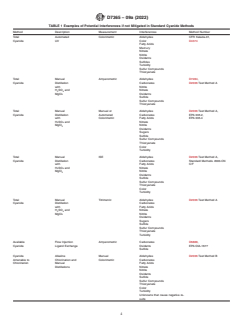
TABLE 1 Examples of Potential Interferences if not Mitigated in Standard Cyanide Methods
Method Description Measurement Interferences Method Number
Total Automated Colorimetric Aldehydes CFR Kelada-01,
Cyanide UV Color D4374
Fatty Acids
Mercury
Nitrate
Nitrite
Oxidants
Sulfides
Turbidity
Sulfur Compounds
Thiocyanate
Total Manual Amperometric Aldehydes D7284,
Cyanide Distillation Carbonates D2036 Test Method A
with Nitrite
H SO and Nitrate
2 4
MgCl Oxidants
Sulfide
Sulfur Compounds
Thiocyanate
Total Manual Manual or Aldehydes D2036 Test Method A,
Cyanide Distillation Automated Carbonates EPA 335.2,
with Colorimetric Fatty Acids EPA 335.4
H SO and Nitrate
2 4
MgCl Nitrite
Oxidants
Sugars
Sulfide
Sulfur Compounds
Thiocyanate
Color
Turbidity
Total Manual ISE Aldehydes D2036 Test Method A,
Cyanide Distillation Carbonates Standard Methods 4500-CN
with Fatty Acids C/F
H SO and Nitrate
2 4
MgCl Nitrite
Oxidants
Sulfide
Sulfur Compounds
Thiocyanate
Color
Turbidity
Total Manual Titrimetric Aldehydes D2036 Test Method A
Cyanide Distillation Carbonates
with Fatty Acids
H SO and Nitrate
2 4
MgCl Nitrite
Oxidants
Sugars
Sulfide
Sulfur Compounds
Thiocyanate
Turbidity
Available Flow Injection Amperometric Carbonates D6888,
Cyanide Ligand Exchange Oxidants EPA OIA-1677
Sulfide
Cyanide Alkaline Manual Aldehydes D2036 Test Method B
Amenable to Chlorination and Colorimetric Carbonates
Chlorination Manual Fatty Acids
Distillations Nitrate
Nitrite
Oxidants
Sulfide
Sulfur Compounds
Thiocyanate
Color
Turbidity
Unknowns that cause negative re-
sults
D7365 − 09a (2022)
TABLE 1 Continued
Method Description Measurement Interferences Method Number
Weak Acid Buffered Manual Aldehydes D2036 Test Method C
Dissociable Distillation Colorimetric Carbonates
Cyanide Fatty Acids
Nitrate
Nitrite
Oxidants
Sugars
Sulfide
Sulfur Compounds
Thiocyanate
Turbidity
Weak Acid Automated Automated Aldehydes D4374
Dissociable Method Colorimetric Color
Cyanide Fatty Acids
Mercury
Nitrate
Nitrite
Oxidants
Sulfides
Turbidity
Weak Acid Buffered ISE Aldehydes D2036 Test Method C
Dissociable Distillation Carbonates
Cyanide Fatty Acids
Nitrate
Nitrite
Oxidants
Sugars
Sulfide
Sulfur Compounds
Thiocyanate
Turbidity
Weak Acid Buffered Titrimetric Aldehydes D2036 Test Method C
Dissociable Distillation Carbonates
Cyanide Fatty Acids
Nitrate
Nitrite
Oxidants
Sugars
Sulfide
Sulfur Compounds
Thiocyanate
Turbidity
Weak Acid Buffered Manual Aldehydes D2036 Test Method B
Dissociable Distillation Colorimetric Carbonates
Cyanide Fatty Acids
Nitrite
Nitrate
Oxidants
Sugars
Sulfide
Sulfur Compounds
Thiocyanate
Volatile Compounds
Metal Ion UV Carbonate D6994
Cyanide Chromatography Dissolved Solids
Complexes Metal Anions
Metal Cations
Oxidants
Photodecomposition
Free Cyanide Flow Injection Amperometric Carbonate D7237
Oxidants
Sulfide
Free Cyanide Microdiffusion Colorimetric Aldehydes D4282
Oxidants
Sulfide
Sulfur Compounds
D7365 − 09a (2022)
TABLE 2 Potential Interferences with Selected Total Cyanide Methods Listed in 40 CFR Part 136
Methodology Reference Sample Processing Determinative Step Listed Interferences
Manual Distillation with EPA Method 335.4 The cyanide as hydrocyanic acid The cyanide ion in the absorbing (1) Oxidizing agents can destroy
Magnesium Chloride and (HCN) is released from cyanide solution is converted to CNCl by cyanides during storage.
Sulfuric Acid and Semi- complexes by means of a reflux- reaction with chloramine-T that (2) Sulfide can complex with cya-
Automated Colorimetry distillation operation and absorbed subsequently reacts with pyridine nide in sample or distillate.
in a scrubber containing sodium and barbituric acid resulting in a (3) Fatty acids cause interference
hydroxide solution. red colored complex. during distillation.
The cyanide is determined with (4) Carbonate causes interfer-
automated colorimetry. ence during distillation.
(5) Aldehydes cause interference
during distillation.
(6) Glucose/Sugars cause inter-
ference during distillation.
(7) Sulfur-containing compound
causes interference during distil-
lation by forming free sulfide that
is captured in distillate.
(8) Nitrate-Nitrite can cause high
bias if sulfamic acid is not added
during distillation
Manual Distillation with D2036 Test Method A Total Cyanides is based on the de- Either the titration, colorimetric or Common interferences in the
Magnesium Chloride and composition of nearly all cyanides selective ion electrode procedure analysis for cyanide include oxi-
Sulfuric Acid in the presence of strong acid, can be used to quantify the cya- dizing agents, sulfides,
magnesium chloride catalyst, and nide concentration. aldehydes, glucose and other
heat during a 1-h reflux distillation. sugars, high concentration of
carbonate, fatty acids,
thiocyanate, and other sulfur con-
taining compounds.
Manual Distillation with USGS I-3300-85 The decomposition of complex This method is based on the Oxidizing agents may interfere.
Magnesium Chloride and cyanides is accomplished by an chlorination of cyanide and the A concentration of 10 mg/L sul-
Sulfuric Acid acid reflux and distillation prior to subsequent reaction of the prod- fide increases the apparent cya-
the colorimetric procedure. uct with a mixed solution of nide concentration by approx
The distillation also removes cer- pyridine-pyrazolone to form a 0.02 mg
...