

ASTM C99/C99M-18
(Test Method)Standard Test Method for Modulus of Rupture of Dimension Stone
General Information
- Abstract
SIGNIFICANCE AND USE
4.1 This test method is useful in indicating the differences in modulus of rupture between the various dimension stones. This test method also provides one element in comparing stones of the same type.
SCOPE
1.1 This test method covers the determination of the modulus of rupture of all types of dimension stone except slate.
1.2 The values stated in either SI units or inch-pound units are to be regarded separately as standard. The values stated in each system may not be exact equivalents; therefore, each system shall be used independently of the other. Combining values from the two systems may result in non-conformance with the standard.
1.3 This standard does not purport to address all of the safety concerns, if any, associated with its use. It is the responsibility of the user of this standard to establish appropriate safety, health, and environmental practices and determine the applicability of regulatory limitations prior to use.
1.4 This international standard was developed in accordance with internationally recognized principles on standardization established in the Decision on Principles for the Development of International Standards, Guides and Recommendations issued by the World Trade Organization Technical Barriers to Trade (TBT) Committee.
- Status
- Published
- Publication Date
- 30-Sep-2018
- Technical Committee
- C18 - Dimension Stone
- Drafting Committee
- C18.01 - Test Methods


Overview
ASTM C99/C99M-18 - Standard Test Method for Modulus of Rupture of Dimension Stone is an internationally recognized standard developed by ASTM International. This standard defines the procedures for determining the modulus of rupture-a key measure of flexural strength-for all varieties of dimension stone, except slate. The modulus of rupture testing is essential for evaluating the mechanical performance and structural suitability of stone used in architectural and construction applications.
Key Topics
Scope and Applicability
- Applies to all types of dimension stone except slate.
- Permits measurements in either SI units or inch-pound units, but not both simultaneously.
- Emphasizes compliance with safety, health, and environmental regulations.
Test Method Significance
- Provides a scientific basis for comparing the flexural strength (modulus of rupture) among different dimension stones.
- Useful for comparing stones of the same type under similar testing conditions, including wet and dry states, and across different orientations relative to natural “rift” planes.
Sampling and Test Procedure
- Samples should represent the average characteristics of the stone type or grade.
- Test specimens are typically prepared with attention to rift direction, ensuring accurate measurement of strength both perpendicular and parallel to this direction.
- Procedures include clear instructions on specimen size, marking, conditioning, and load application.
Results and Reporting
- Requires documentation of average modulus of rupture values for all conditions tested.
- Reports must include specimen dimensions, orientation, stone type, source quarry, preparation methods, individual and average test results, deviations from standard procedures, and statistical information like standard deviation.
Applications
The ASTM C99/C99M-18 test method is widely utilized in several practical contexts:
- Stone Selection for Construction: Ensures appropriate dimension stone types are selected for load-bearing and decorative applications based on their proven flexural strength.
- Quality Control: Enables manufacturers and suppliers of stone products to verify and demonstrate conformity to project specifications and industry benchmarks.
- Design Guidance: Structural engineers and architects use modulus of rupture data to inform safe, efficient designs for facades, flooring, cladding, monuments, and structural supports.
- Performance Comparison: Facilitates direct comparison of different stone sources, grades, or finishes, as well as assessment of performance under various environmental conditions (e.g., dry vs. wet).
Related Standards
Several other ASTM standards are frequently referenced alongside ASTM C99/C99M-18 to ensure comprehensive evaluation and consistent terminology for dimension stone:
- ASTM C119 – Terminology Relating to Dimension Stone
- ASTM C1799 – Guide to Dimension Stone Test Specimen Sampling and Preparation
These related standards provide definitions, background information, and detailed guidance on specimen sampling and handling, supporting effective use of the ASTM C99/C99M procedure.
Keywords: ASTM C99/C99M-18, modulus of rupture, dimension stone, flexural strength, test method, stone testing, construction materials, architectural stone, stone quality, ASTM standards
Relations
- Effective Date
- 01-Oct-2018
- Effective Date
- 01-May-2019
- Effective Date
- 01-May-2016
- Effective Date
- 01-Dec-2014
- Effective Date
- 01-Dec-2014
- Effective Date
- 15-Jun-2011
- Effective Date
- 01-Feb-2008
- Effective Date
- 01-Feb-2008
- Effective Date
- 01-Feb-2008
- Effective Date
- 01-Feb-2008
- Effective Date
- 01-Aug-2007
- Effective Date
- 01-Jun-2007
- Effective Date
- 01-Apr-2006
- Effective Date
- 01-Nov-2005
- Effective Date
- 15-May-2005
Get Certified
Connect with accredited certification bodies for this standard

DIBt (Deutsches Institut für Bautechnik)
German Institute for Building Technology.
DIN CERTCO
DIN Group product certification.

Aboma Certification B.V.
Specialized in construction, metal, and transport sectors.
Sponsored listings
Frequently Asked Questions
ASTM C99/C99M-18 is a standard published by ASTM International. Its full title is "Standard Test Method for Modulus of Rupture of Dimension Stone". This standard covers: SIGNIFICANCE AND USE 4.1 This test method is useful in indicating the differences in modulus of rupture between the various dimension stones. This test method also provides one element in comparing stones of the same type. SCOPE 1.1 This test method covers the determination of the modulus of rupture of all types of dimension stone except slate. 1.2 The values stated in either SI units or inch-pound units are to be regarded separately as standard. The values stated in each system may not be exact equivalents; therefore, each system shall be used independently of the other. Combining values from the two systems may result in non-conformance with the standard. 1.3 This standard does not purport to address all of the safety concerns, if any, associated with its use. It is the responsibility of the user of this standard to establish appropriate safety, health, and environmental practices and determine the applicability of regulatory limitations prior to use. 1.4 This international standard was developed in accordance with internationally recognized principles on standardization established in the Decision on Principles for the Development of International Standards, Guides and Recommendations issued by the World Trade Organization Technical Barriers to Trade (TBT) Committee.
SIGNIFICANCE AND USE 4.1 This test method is useful in indicating the differences in modulus of rupture between the various dimension stones. This test method also provides one element in comparing stones of the same type. SCOPE 1.1 This test method covers the determination of the modulus of rupture of all types of dimension stone except slate. 1.2 The values stated in either SI units or inch-pound units are to be regarded separately as standard. The values stated in each system may not be exact equivalents; therefore, each system shall be used independently of the other. Combining values from the two systems may result in non-conformance with the standard. 1.3 This standard does not purport to address all of the safety concerns, if any, associated with its use. It is the responsibility of the user of this standard to establish appropriate safety, health, and environmental practices and determine the applicability of regulatory limitations prior to use. 1.4 This international standard was developed in accordance with internationally recognized principles on standardization established in the Decision on Principles for the Development of International Standards, Guides and Recommendations issued by the World Trade Organization Technical Barriers to Trade (TBT) Committee.
ASTM C99/C99M-18 is classified under the following ICS (International Classification for Standards) categories: 91.100.15 - Mineral materials and products. The ICS classification helps identify the subject area and facilitates finding related standards.
ASTM C99/C99M-18 has the following relationships with other standards: It is inter standard links to ASTM C99/C99M-15, ASTM C119-19, ASTM C119-16, ASTM C119-14, ASTM C119-14e1, ASTM C119-11, ASTM C119-08e3, ASTM C119-08e2, ASTM C119-08e1, ASTM C119-08, ASTM C119-07a, ASTM C119-07, ASTM C119-06, ASTM C119-05a, ASTM C119-05. Understanding these relationships helps ensure you are using the most current and applicable version of the standard.
ASTM C99/C99M-18 is available in PDF format for immediate download after purchase. The document can be added to your cart and obtained through the secure checkout process. Digital delivery ensures instant access to the complete standard document.
Standards Content (Sample)
This international standard was developed in accordance with internationally recognized principles on standardization established in the Decision on Principles for the
Development of International Standards, Guides and Recommendations issued by the World Trade Organization Technical Barriers to Trade (TBT) Committee.
Designation: C99/C99M − 18
Standard Test Method for
Modulus of Rupture of Dimension Stone
This standard is issued under the fixed designation C99/C99M; the number immediately following the designation indicates the year of
original adoption or, in the case of revision, the year of last revision. A number in parentheses indicates the year of last reapproval. A
superscript epsilon (´) indicates an editorial change since the last revision or reapproval.
1. Scope 4. Significance and Use
4.1 Thistestmethodisusefulinindicatingthedifferencesin
1.1 This test method covers the determination of the modu-
modulus of rupture between the various dimension stones.This
lus of rupture of all types of dimension stone except slate.
test method also provides one element in comparing stones of
1.2 The values stated in either SI units or inch-pound units
the same type.
are to be regarded separately as standard. The values stated in
each system may not be exact equivalents; therefore, each
5. Apparatus
system shall be used independently of the other. Combining
5.1 Testing Machine—The accuracy of the testing machine
values from the two systems may result in non-conformance
shall be within 1 % for the range from 10 to 1000 lbf [50 to
with the standard.
5000 N].
1.3 This standard does not purport to address all of the
5.2 Load Application and Support Blocks—The supports for
safety concerns, if any, associated with its use. It is the
the specimen shall be of the rocker type (Fig. 1) with edges at
responsibility of the user of this standard to establish appro- least as long as the width of the specimen.The load application
priate safety, health, and environmental practices and deter- block may be of either the rocker or rigid type. The portions of
the load application and support blocks contacting the stone
mine the applicability of regulatory limitations prior to use.
shall be rounded, with a nominal radius of ⁄2 in. [13 mm].
1.4 This international standard was developed in accor-
dance with internationally recognized principles on standard-
6. Sampling
ization established in the Decision on Principles for the
Development of International Standards, Guides and Recom- 6.1 Select the sample to represent a true average of the type
or grade of stone under consideration and of the quality
mendations issued by the World Trade Organization Technical
supplied to the market under the type designation to be tested.
Barriers to Trade (TBT) Committee.
The sample may be selected by the purchaser or his authorized
representativefromthequarriedstoneortakenfromthenatural
2. Referenced Documents
ledge and shall be of adequate size to permit the preparation of
2.1 ASTM Standards:
the desired number of test specimens. When perceptible
C119 Terminology Relating to Dimension Stone
variations occur, the purchaser may select as many samples as
C1799 Guide to Dimension Stone Test Specimen Sampling
are necessary for determining the variations in modulus of
and Preparation
rupture.
NOTE 1—Refer to Guide C1799 for additional information on selecting,
preparing, and conditioning test specimens.
3. Terminology
3.1 Definitions—All definitions are in accordance with Ter-
7. Test Specimens
minology C119.
7.1 The specimens shall be 4 by 8 by 2 ⁄4 in. [100 by 200 by
60 mm] in size and fabricated to tolerances of 6 ⁄16 in. [62
mm]. They shall be sawed from the sample and finished by
This test method is under the jurisdiction of ASTM Committee C18 on
grinding to smooth surfaces. The 4 by 8-in. [100 by 200-mm]
Dimension Stone and is the direct responsibility of Subcommittee C18.01 on Test
faces shall be as nearly plane and parallel as practicable. For
Methods.
loading perpendicular to the rift (Note 2) five specimens shall
Current edition approved Oct. 1, 2018. Published October 2018. Originally
be prepared with the 4 by 8-in. [100 by 200-mm] faces parallel
approved in 1931. Last previous edition approved in 2015 as C99–15. DOI:
10.1520/C0099_C0099M-18.
to the rift planes (see Fig. 1), and for loading parallel to the rift,
For referenced ASTM standards, visit the ASTM website, www.astm.org, or
five specimens shall be prepared with the 4 by 2 ⁄4-in. [100 by
contact ASTM Customer Service at service@astm.org. For Annual Book of ASTM
60-mm] faces parallel to the rift (Note 3). When tests are
Standards volume information, refer to the standard’s Document Summary page on
the ASTM website. desired on the stone in both the wet and dry condition, ten
Copyright © ASTM International, 100 Barr Harbor Drive, PO Box C700, West Conshohocken, PA 19428-2959. United States
C99/C99M − 18
SI Unit Equivalents
2 ⁄4 in. [60 mm]
3 ⁄2 in. [90 mm]
4 in. [100 mm]
8 in. [200 mm]
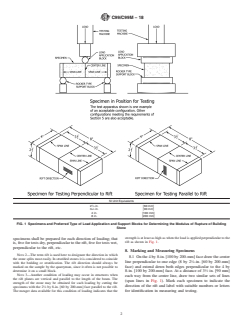
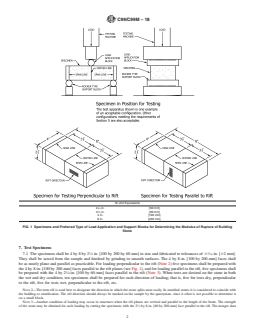
FIG. 1 Specimens and Preferred Type of Load Application and Support Blocks for Determining the Modulus of Rupture of Building
Stone
strength is at least as high as when the load is applied perpendicular to the
specimens shall be prepared for each direction of loading; that
rift as shown in Fig. 1.
is, five for tests dry, perpendicular to the rift, five for tests wet,
perpendicular to the rift, etc.
8. Marking and Measuring Specimens
NOTE 2—The term rift is used here to designate the direction in which
8.1 On the 4 by 8-in. [100 by 200-mm] face draw the center
the stone splits most easily. In stratified stones it is considered to coincide
line perpendicular to one edge (8 by 2 ⁄4-in. [60 by 200-mm]
with the bedding or stratification. The rift direction should always be
face) and extend down both edges perpendicular to the 4 by
marked on the sample by the quarryman, since it often is not possible to
determine it on a small block.
8-in. [100 by 200-mm] face. At a distance of 3 ⁄2 in. [90 mm]
NOTE 3—Another condition of loading may occur in structures when
each way from the center line, draw two similar sets of lines
the rift planes are vertical and parallel to the length of th
...
This document is not an ASTM standard and is intended only to provide the user of an ASTM standard an indication of what changes have been made to the previous version. Because
it may not be technically possible to adequately depict all changes accurately, ASTM recommends that users consult prior editions as appropriate. In all cases only the current version
of the standard as published by ASTM is to be considered the official document.
Designation: C99/C99M − 15 C99/C99M − 18
Standard Test Method for
Modulus of Rupture of Dimension Stone
This standard is issued under the fixed designation C99/C99M; the number immediately following the designation indicates the year of
original adoption or, in the case of revision, the year of last revision. A number in parentheses indicates the year of last reapproval. A
superscript epsilon (´) indicates an editorial change since the last revision or reapproval.
1. Scope
1.1 This test method covers the determination of the modulus of rupture of all types of dimension stone except slate.
1.2 The values stated in either SI units or inch-pound units are to be regarded separately as standard. The values stated in each
system may not be exact equivalents; therefore, each system shall be used independently of the other. Combining values from the
two systems may result in non-conformance with the standard.
1.3 This standard does not purport to address all of the safety concerns, if any, associated with its use. It is the responsibility
of the user of this standard to establish appropriate safety safety, health, and healthenvironmental practices and determine the
applicability of regulatory limitations prior to use.
1.4 This international standard was developed in accordance with internationally recognized principles on standardization
established in the Decision on Principles for the Development of International Standards, Guides and Recommendations issued
by the World Trade Organization Technical Barriers to Trade (TBT) Committee.
2. Referenced Documents
2.1 ASTM Standards:
C119 Terminology Relating to Dimension Stone
C1799 Guide to Dimension Stone Test Specimen Sampling and Preparation
3. Terminology
3.1 Definitions—All definitions are in accordance with Terminology C119.
4. Significance and Use
4.1 This test method is useful in indicating the differences in modulus of rupture between the various dimension stones. This
test method also provides one element in comparing stones of the same type.
5. Apparatus
5.1 Testing Machine—The accuracy of the testing machine shall be within 1 % for the range from 10 to 1000 lbf [50 to 5000
N].
5.2 Load Application and Support Blocks—The supports for the specimen shall be of the rocker type (Fig. 1) with edges at least
as long as the width of the specimen. The load application block may be of either the rocker or rigid type. The portions of the load
application and support blocks contacting the stone shall be rounded, with a nominal radius of ⁄2 in. [13 mm].
6. Sampling
6.1 Select the sample to represent a true average of the type or grade of stone under consideration and of the quality supplied
to the market under the type designation to be tested. The sample may be selected by the purchaser or his authorized representative
from the quarried stone or taken from the natural ledge and shall be of adequate size to permit the preparation of the desired number
of test specimens. When perceptible variations occur, the purchaser may select as many samples as are necessary for determining
the variations in modulus of rupture.
NOTE 1—Refer to Guide C1799 for additional information on selecting, preparing, and conditioning test specimens.
This test method is under the jurisdiction of ASTM Committee C18 on Dimension Stone and is the direct responsibility of Subcommittee C18.01 on Test Methods.
Current edition approved May 1, 2015Oct. 1, 2018. Published July 2015October 2018. Originally approved in 1931. Last previous edition approved in 20092015 as
C99–09.–15. DOI: 10.1520/C0099_C0099M-15.10.1520/C0099_C0099M-18.
For referenced ASTM standards, visit the ASTM website, www.astm.org, or contact ASTM Customer Service at service@astm.org. For Annual Book of ASTM Standards
volume information, refer to the standard’s Document Summary page on the ASTM website.
Copyright © ASTM International, 100 Barr Harbor Drive, PO Box C700, West Conshohocken, PA 19428-2959. United States
C99/C99M − 18
SI Unit Equivalents
2 ⁄4 in. [60 mm]
3 ⁄2 in. [90 mm]
4 in. [100 mm]
8 in. [200 mm]
FIG. 1 Specimens and Preferred Type of Load Application and Support Blocks for Determining the Modulus of Rupture of Building
Stone
7. Test Specimens
1 1
7.1 The specimens shall be 4 by 8 by 2 ⁄4 in. [100 by 200 by 60 mm] in size and fabricated to tolerances of 6 ⁄16 in. [62 mm].
They shall be sawed from the sample and finished by grinding to smooth surfaces. The 4 by 8-in. [100 by 200-mm] faces shall
be as nearly plane and parallel as practicable. For loading perpendicular to the rift (Note 2) five specimens shall be prepared with
the 4 by 8-in. [100 by 200-mm] faces parallel to the rift planes (see Fig. 1), and for loading parallel to the rift, five specimens shall
be prepared with the 4 by 2 ⁄4-in. [100 by 60-mm] faces parallel to the rift (Note 3). When tests are desired on the stone in both
the wet and dry condition, ten specimens shall be prepared for each direction of loading; that is, five for tests dry, perpendicular
to the rift, five for tests wet, perpendicular to the rift, etc.
NOTE 2—The term rift is used here to designate the direction in which the stone splits most easily. In stratified stones it is considered to coincide with
the bedding or stratification. The rift direction should always be marked on the sample by the quarryman, since it often is not possible to determine it
on a small block.
NOTE 3—Another condition of loading may occur in structures when the rift planes are vertical and parallel to the length of the beam. The strength
of the stone may be obtained for such loading by cutting the specimens with the 2 ⁄4 by 8-in. [60 by 200-mm] face parallel to the rift. The meager data
C99/C99M − 18
available for this condition of loading indicates that the strength is at least as high as when the load is applied perpendicular to the rift as shown in Fig.
1.
8. Marking and Measuring Specimens
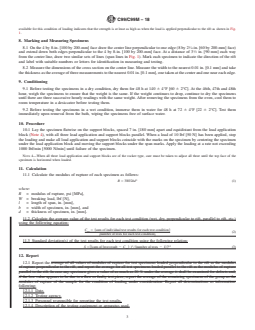
8.1 On the 4 by 8-in. [100 by 200-mm] face draw the center line perpendicular to one edge (8 by 2 ⁄4-in. [60 by 200-mm] face)
and extend down both edges perpendicular to the 4 by 8-in. [100 by 200-mm] face. At a distance of 3 ⁄2 in. [90 mm] each way
from the center line, draw two similar sets of lines (span lines in Fig. 1). Mark each specimen to indicate the direction of the rift
and label with sui
...