

ASTM E1830-15(2019)
(Test Method)Standard Test Methods for Determining Mechanical Integrity of Photovoltaic Modules
General Information
- Abstract
SIGNIFICANCE AND USE
4.1 The useful life of photovoltaic modules may depend on their ability to withstand periodic exposure to high wind forces, cyclic loads induced by specific site conditions or shipment methods, high loads caused by accumulated snow and ice on the module surface, and twisting deflections caused by mounting to non-planar surfaces or structures. The effects on the module may be physical or electrical, or both. Most importantly, the effects may compromise the safety of the module, particularly in high voltage applications, or where the public may be exposed to broken glass or other debris.
4.2 These test methods describe procedures for mounting the test specimen, conducting the prescribed mechanical tests, and reporting the effects of the testing.
4.2.1 The mounting and fastening method shall comply with the manufacturer's recommendations as closely as possible. If slots or multiple mounting holes are provided on the module frame for optional mounting point capability, the worst-case mounting positions shall be selected in order to subject the module to the maximum stresses.
4.2.2 If an unframed module is being tested, the module shall be mounted in strict accordance with the manufacturer's instructions using the recommended attachment clips, brackets, fasteners or other hardware, and tightened to the specified torque.
4.2.3 The test specimen is mounted on a test base in a planar manner (unless specified otherwise), simulating a field mounting arrangement in order to ensure that modules are tested in a configuration that is representative of their use in the field.
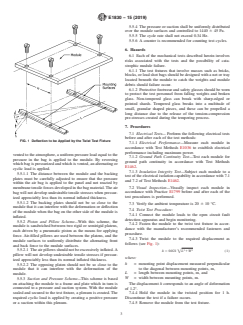
4.2.4 During the twist test, the module is mounted in a manner simulating a non-planar field mounting where one of the fastening points is displaced to create an intentional twist of 1.2°.
4.3 Data obtained during testing may be used to evaluate and compare the effects of the simulated environments on the test specimens. These test methods require analysis of both visible effects and electri...
SCOPE
1.1 These test methods cover procedures for determining the ability of photovoltaic modules to withstand the mechanical loads, stresses and deflections used to simulate, on an accelerated basis, high wind conditions, heavy snow and ice accumulation, and non-planar installation effects.
1.1.1 A static load test to 2400 Pa is used to simulate wind loads on both module surfaces.
1.1.2 A static load test to 5400 Pa is used to simulate heavy snow and ice accumulation on the module front surface.
1.1.3 A twist test is used to simulate the non-planar mounting of a photovoltaic module by subjecting it to a twist angle of 1.2°.
1.1.4 A cyclic load test of 10 000 cycles duration and peak loading to 1440 Pa is used to simulate dynamic wind or other flexural loading. Such loading might occur during shipment or after installation at a particular location.
1.2 These test methods define photovoltaic test specimens and mounting methods, and specify parameters that must be recorded and reported.
1.3 Any individual mechanical test may be performed singly, or may be combined into a test sequence with other mechanical or nonmechanical tests, or both. Certain preconditioning test methods such as annealing or light soaking may also be necessary or desirable as a part of such a sequence. However, the determination of such test sequencing and preconditioning is beyond the scope of these test methods.
1.4 These test methods do not establish pass or fail levels. The determination of acceptable or unacceptable results is beyond the scope of these test methods.
1.5 These test methods do not apply to concentrator modules.
1.6 The values stated in SI units are to be regarded as standard. No other units of measurement are included in this standard.
1.7 The following precautionary caveat pertains only to the hazards portion, Section 6, and the warning statements, 7.5.3.2 and 7.6.3.2, of these test methods.This standard doe...
- Status
- Published
- Publication Date
- 31-Mar-2019
- Technical Committee
- E44 - Solar, Geothermal and Other Alternative Energy Sources
- Drafting Committee
- E44.09 - Photovoltaic Electric Power Conversion
Overview
ASTM E1830-15(2019): Standard Test Methods for Determining Mechanical Integrity of Photovoltaic Modules defines standardized procedures to evaluate the ability of photovoltaic (PV) modules to withstand various mechanical stresses encountered in real-world conditions. The standard is designed to simulate accelerated exposure to environmental and handling factors such as high wind forces, heavy snow and ice accumulation, non-planar mounting, and dynamic loading during transport or installation. By following these methods, PV manufacturers, test laboratories, and system integrators can assess the structural durability and safety of solar panels over their expected operational life.
Ensuring the mechanical integrity of photovoltaic modules is essential for safeguarding performance, reliability, and public safety, particularly in installations subjected to demanding environmental conditions or where exposure to broken glass or other debris poses risks.
Key Topics
Mechanical Load Testing:
- Static wind load simulation (up to 2400 Pa) for both module surfaces.
- Static snow and ice accumulation simulation (up to 5400 Pa) on the front module surface.
- Twist testing to simulate effects of non-planar mounting, inducing a twist angle of 1.2°.
- Cyclic load testing (10,000 cycles at peak loading of 1440 Pa) to emulate dynamic wind or vibration stresses.
Mounting and Installation Simulation:
- Modules are mounted as per manufacturer instructions, simulating real installation scenarios for both framed and unframed modules.
- Worst-case mounting positions are selected to maximize stress.
Data Collection and Reporting:
- Both visible physical changes and electrical performance impacts are analyzed.
- Test results are recorded with full details on test configuration, loads, cycles, and any test deviations.
Safety Considerations:
- Procedures account for potential hazards, requiring protective measures for test personnel against risks like broken glass and falling objects.
No Pass/Fail Criteria:
- The standard does not prescribe minimum acceptable limits, leaving determination of suitable mechanical integrity to the user or applicable specification.
Applications
Photovoltaic Module Manufacturers:
- Evaluate new designs for mechanical robustness under simulated field conditions.
- Identify vulnerabilities to wind, snow, ice, and installation stresses prior to mass production.
- Document test protocols and results to support product quality and warranty claims.
Testing Laboratories:
- Perform reliable, repeatable mechanical integrity assessments that are internationally recognized.
- Compare competing PV technologies and materials for durability in extreme conditions.
Solar System Integrators and Installers:
- Select PV modules with demonstrated capability to withstand site-specific mechanical loads.
- Mitigate risks associated with module failure in public or high-voltage environments.
Insurance and Certification Bodies:
- Reference standardized test results for insurability and regulatory compliance.
Research and Development:
- Use data to correlate real-world failures with specific loading scenarios, informing improved materials and design.
Related Standards
- ASTM E772: Terminology of Solar Energy Conversion.
- ASTM E1036: Test Methods for Electrical Performance of Nonconcentrator Terrestrial Photovoltaic Modules and Arrays Using Reference Cells.
- ASTM E1462: Test Methods for Insulation Integrity and Ground Path Continuity of Photovoltaic Modules.
- ASTM E1799: Practice for Visual Inspections of Photovoltaic Modules.
These referenced standards provide additional detail on terminology, electrical performance testing, insulation integrity, and visual inspection protocols, supporting a comprehensive evaluation of photovoltaic module quality.
Keywords: mechanical integrity, photovoltaic modules, solar panel durability, static load, wind load, snow load, ice accumulation, twist test, cyclic loading, ASTM E1830, solar energy, PV module testing, safety.
Relations
- Effective Date
- 01-Apr-2019
- Effective Date
- 01-Feb-2018
- Effective Date
- 01-Feb-2015
- Effective Date
- 01-Sep-2013
- Effective Date
- 01-Dec-2012
- Effective Date
- 01-Dec-2012
- Effective Date
- 01-Mar-2012
- Effective Date
- 01-Sep-2011
- Effective Date
- 01-Nov-2008
- Effective Date
- 01-Apr-2008
- Effective Date
- 01-Nov-2007
- Effective Date
- 01-Mar-2006
- Effective Date
- 01-Apr-2005
- Effective Date
- 10-Oct-2002
- Effective Date
- 10-Oct-2002
Get Certified
Connect with accredited certification bodies for this standard

DNV
DNV is an independent assurance and risk management provider.

Lloyd's Register
Lloyd's Register is a global professional services organisation specialising in engineering and technology.
DNV Energy Systems
Energy and renewable energy certification.
Sponsored listings
Frequently Asked Questions
ASTM E1830-15(2019) is a standard published by ASTM International. Its full title is "Standard Test Methods for Determining Mechanical Integrity of Photovoltaic Modules". This standard covers: SIGNIFICANCE AND USE 4.1 The useful life of photovoltaic modules may depend on their ability to withstand periodic exposure to high wind forces, cyclic loads induced by specific site conditions or shipment methods, high loads caused by accumulated snow and ice on the module surface, and twisting deflections caused by mounting to non-planar surfaces or structures. The effects on the module may be physical or electrical, or both. Most importantly, the effects may compromise the safety of the module, particularly in high voltage applications, or where the public may be exposed to broken glass or other debris. 4.2 These test methods describe procedures for mounting the test specimen, conducting the prescribed mechanical tests, and reporting the effects of the testing. 4.2.1 The mounting and fastening method shall comply with the manufacturer's recommendations as closely as possible. If slots or multiple mounting holes are provided on the module frame for optional mounting point capability, the worst-case mounting positions shall be selected in order to subject the module to the maximum stresses. 4.2.2 If an unframed module is being tested, the module shall be mounted in strict accordance with the manufacturer's instructions using the recommended attachment clips, brackets, fasteners or other hardware, and tightened to the specified torque. 4.2.3 The test specimen is mounted on a test base in a planar manner (unless specified otherwise), simulating a field mounting arrangement in order to ensure that modules are tested in a configuration that is representative of their use in the field. 4.2.4 During the twist test, the module is mounted in a manner simulating a non-planar field mounting where one of the fastening points is displaced to create an intentional twist of 1.2°. 4.3 Data obtained during testing may be used to evaluate and compare the effects of the simulated environments on the test specimens. These test methods require analysis of both visible effects and electri... SCOPE 1.1 These test methods cover procedures for determining the ability of photovoltaic modules to withstand the mechanical loads, stresses and deflections used to simulate, on an accelerated basis, high wind conditions, heavy snow and ice accumulation, and non-planar installation effects. 1.1.1 A static load test to 2400 Pa is used to simulate wind loads on both module surfaces. 1.1.2 A static load test to 5400 Pa is used to simulate heavy snow and ice accumulation on the module front surface. 1.1.3 A twist test is used to simulate the non-planar mounting of a photovoltaic module by subjecting it to a twist angle of 1.2°. 1.1.4 A cyclic load test of 10 000 cycles duration and peak loading to 1440 Pa is used to simulate dynamic wind or other flexural loading. Such loading might occur during shipment or after installation at a particular location. 1.2 These test methods define photovoltaic test specimens and mounting methods, and specify parameters that must be recorded and reported. 1.3 Any individual mechanical test may be performed singly, or may be combined into a test sequence with other mechanical or nonmechanical tests, or both. Certain preconditioning test methods such as annealing or light soaking may also be necessary or desirable as a part of such a sequence. However, the determination of such test sequencing and preconditioning is beyond the scope of these test methods. 1.4 These test methods do not establish pass or fail levels. The determination of acceptable or unacceptable results is beyond the scope of these test methods. 1.5 These test methods do not apply to concentrator modules. 1.6 The values stated in SI units are to be regarded as standard. No other units of measurement are included in this standard. 1.7 The following precautionary caveat pertains only to the hazards portion, Section 6, and the warning statements, 7.5.3.2 and 7.6.3.2, of these test methods.This standard doe...
SIGNIFICANCE AND USE 4.1 The useful life of photovoltaic modules may depend on their ability to withstand periodic exposure to high wind forces, cyclic loads induced by specific site conditions or shipment methods, high loads caused by accumulated snow and ice on the module surface, and twisting deflections caused by mounting to non-planar surfaces or structures. The effects on the module may be physical or electrical, or both. Most importantly, the effects may compromise the safety of the module, particularly in high voltage applications, or where the public may be exposed to broken glass or other debris. 4.2 These test methods describe procedures for mounting the test specimen, conducting the prescribed mechanical tests, and reporting the effects of the testing. 4.2.1 The mounting and fastening method shall comply with the manufacturer's recommendations as closely as possible. If slots or multiple mounting holes are provided on the module frame for optional mounting point capability, the worst-case mounting positions shall be selected in order to subject the module to the maximum stresses. 4.2.2 If an unframed module is being tested, the module shall be mounted in strict accordance with the manufacturer's instructions using the recommended attachment clips, brackets, fasteners or other hardware, and tightened to the specified torque. 4.2.3 The test specimen is mounted on a test base in a planar manner (unless specified otherwise), simulating a field mounting arrangement in order to ensure that modules are tested in a configuration that is representative of their use in the field. 4.2.4 During the twist test, the module is mounted in a manner simulating a non-planar field mounting where one of the fastening points is displaced to create an intentional twist of 1.2°. 4.3 Data obtained during testing may be used to evaluate and compare the effects of the simulated environments on the test specimens. These test methods require analysis of both visible effects and electri... SCOPE 1.1 These test methods cover procedures for determining the ability of photovoltaic modules to withstand the mechanical loads, stresses and deflections used to simulate, on an accelerated basis, high wind conditions, heavy snow and ice accumulation, and non-planar installation effects. 1.1.1 A static load test to 2400 Pa is used to simulate wind loads on both module surfaces. 1.1.2 A static load test to 5400 Pa is used to simulate heavy snow and ice accumulation on the module front surface. 1.1.3 A twist test is used to simulate the non-planar mounting of a photovoltaic module by subjecting it to a twist angle of 1.2°. 1.1.4 A cyclic load test of 10 000 cycles duration and peak loading to 1440 Pa is used to simulate dynamic wind or other flexural loading. Such loading might occur during shipment or after installation at a particular location. 1.2 These test methods define photovoltaic test specimens and mounting methods, and specify parameters that must be recorded and reported. 1.3 Any individual mechanical test may be performed singly, or may be combined into a test sequence with other mechanical or nonmechanical tests, or both. Certain preconditioning test methods such as annealing or light soaking may also be necessary or desirable as a part of such a sequence. However, the determination of such test sequencing and preconditioning is beyond the scope of these test methods. 1.4 These test methods do not establish pass or fail levels. The determination of acceptable or unacceptable results is beyond the scope of these test methods. 1.5 These test methods do not apply to concentrator modules. 1.6 The values stated in SI units are to be regarded as standard. No other units of measurement are included in this standard. 1.7 The following precautionary caveat pertains only to the hazards portion, Section 6, and the warning statements, 7.5.3.2 and 7.6.3.2, of these test methods.This standard doe...
ASTM E1830-15(2019) is classified under the following ICS (International Classification for Standards) categories: 27.160 - Solar energy engineering. The ICS classification helps identify the subject area and facilitates finding related standards.
ASTM E1830-15(2019) has the following relationships with other standards: It is inter standard links to ASTM E1036-15(2019), ASTM E1462-12(2018), ASTM E1036-15, ASTM E772-13, ASTM E1799-12, ASTM E1036-12, ASTM E1462-12, ASTM E772-11, ASTM E1036-08, ASTM E1799-08, ASTM E1036-02(2007), ASTM E1462-00(2006), ASTM E772-05, ASTM E1799-02, ASTM E1036-02. Understanding these relationships helps ensure you are using the most current and applicable version of the standard.
ASTM E1830-15(2019) is available in PDF format for immediate download after purchase. The document can be added to your cart and obtained through the secure checkout process. Digital delivery ensures instant access to the complete standard document.
Standards Content (Sample)
This international standard was developed in accordance with internationally recognized principles on standardization established in the Decision on Principles for the
Development of International Standards, Guides and Recommendations issued by the World Trade Organization Technical Barriers to Trade (TBT) Committee.
Designation: E1830 − 15 (Reapproved 2019)
Standard Test Methods for
Determining Mechanical Integrity of Photovoltaic Modules
This standard is issued under the fixed designation E1830; the number immediately following the designation indicates the year of
original adoption or, in the case of revision, the year of last revision. A number in parentheses indicates the year of last reapproval. A
superscript epsilon (´) indicates an editorial change since the last revision or reapproval.
1. Scope 1.7 The following precautionary caveat pertains only to the
hazards portion, Section 6, and the warning statements, 7.5.3.2
1.1 These test methods cover procedures for determining
and 7.6.3.2, of these test methods.This standard does not
theabilityofphotovoltaicmodulestowithstandthemechanical
purport to address all of the safety concerns, if any, associated
loads, stresses and deflections used to simulate, on an acceler-
with its use. It is the responsibility of the user of this standard
ated basis, high wind conditions, heavy snow and ice
to establish appropriate safety, health, and environmental
accumulation, and non-planar installation effects.
practices and determine the applicability of regulatory limita-
1.1.1 A static load test to 2400 Pa is used to simulate wind
tions prior to use.
loads on both module surfaces.
1.8 This international standard was developed in accor-
1.1.2 Astatic load test to 5400 Pa is used to simulate heavy
dance with internationally recognized principles on standard-
snow and ice accumulation on the module front surface.
ization established in the Decision on Principles for the
1.1.3 A twist test is used to simulate the non-planar mount-
Development of International Standards, Guides and Recom-
ing of a photovoltaic module by subjecting it to a twist angle
mendations issued by the World Trade Organization Technical
of 1.2°.
Barriers to Trade (TBT) Committee.
1.1.4 A cyclic load test of 10 000 cycles duration and peak
loading to 1440 Pa is used to simulate dynamic wind or other
2. Referenced Documents
flexural loading. Such loading might occur during shipment or
2.1 ASTM Standards:
after installation at a particular location.
E772 Terminology of Solar Energy Conversion
1.2 These test methods define photovoltaic test specimens
E1036 Test Methods for Electrical Performance of Noncon-
and mounting methods, and specify parameters that must be
centrator Terrestrial Photovoltaic Modules and Arrays
recorded and reported.
Using Reference Cells
1.3 Any individual mechanical test may be performed E1462 Test Methods for Insulation Integrity and Ground
singly, or may be combined into a test sequence with other
Path Continuity of Photovoltaic Modules
mechanical or nonmechanical tests, or both. Certain precondi-
E1799 Practice for Visual Inspections of Photovoltaic Mod-
tioning test methods such as annealing or light soaking may
ules
also be necessary or desirable as a part of such a sequence.
3. Terminology
However, the determination of such test sequencing and
preconditioning is beyond the scope of these test methods.
3.1 Definitions—Definitions of terms used in these test
methods may be found in Terminology E772.
1.4 These test methods do not establish pass or fail levels.
The determination of acceptable or unacceptable results is
4. Significance and Use
beyond the scope of these test methods.
4.1 The useful life of photovoltaic modules may depend on
1.5 These test methods do not apply to concentrator mod-
theirabilitytowithstandperiodicexposuretohighwindforces,
ules.
cyclic loads induced by specific site conditions or shipment
1.6 The values stated in SI units are to be regarded as
methods, high loads caused by accumulated snow and ice on
standard. No other units of measurement are included in this
the module surface, and twisting deflections caused by mount-
standard.
ing to non-planar surfaces or structures. The effects on the
module may be physical or electrical, or both. Most
importantly, the effects may compromise the safety of the
These test methods are under the jurisdiction of ASTM Committee E44 on
Solar, Geothermal and Other Alternative Energy Sources and are the direct
responsibility of Subcommittee E44.09 on Photovoltaic Electric Power Conversion. For referenced ASTM standards, visit the ASTM website, www.astm.org, or
Current edition approved April 1, 2019. Published April 2019. Originally contact ASTM Customer Service at service@astm.org. For Annual Book of ASTM
approved in 1996. Last previous edition approved in 2015 as E1830 - 15. DOI: Standardsvolume information, refer to the standard’s Document Summary page on
10.1520/E1830-15R19. the ASTM website.
Copyright © ASTM International, 100 Barr Harbor Drive, PO Box C700, West Conshohocken, PA 19428-2959. United States
E1830 − 15 (2019)
module, particularly in high voltage applications, or where the 5.3.1 Test Base—A rigid test base shall be provided that
public may be exposed to broken glass or other debris. enables the module to be mounted front-side up or front-side
downinaccordancewiththerequirementsof4.2.1–4.2.3.The
4.2 These test methods describe procedures for mounting
test base shall enable the module to deflect freely during load
the test specimen, conducting the prescribed mechanical tests,
application to preclude any inadvertent interference or limiting
and reporting the effects of the testing.
of the normal deflections.
4.2.1 Themountingandfasteningmethodshallcomplywith
5.3.2 Load Measurement Equipment—Means shall be pro-
the manufacturer’s recommendations as closely as possible. If
vided for measuring the applied load to within the prescribed
slots or multiple mounting holes are provided on the module
tolerances.
frame for optional mounting point capability, the worst-case
5.3.3 Loads—Suitable masses or means of applying pres-
mounting positions shall be selected in order to subject the
sure shall be provided that enable the load to be applied in a
module to the maximum stresses.
gradual, uniform manner. Some examples of loads that can be
4.2.2 If an unframed module is being tested, the module
used are:
shall be mounted in strict accordance with the manufacturer’s
5.3.3.1 Stacks of paper or small canvas or plastic bags filled
instructionsusingtherecommendedattachmentclips,brackets,
with several kilograms of sand, loose stones, or lead shot in a
fasteners or other hardware, and tightened to the specified
sufficient quantity to meet the total load requirement,
torque.
5.3.3.2 A water bag that can be progressively filled to
4.2.3 Thetestspecimenismountedonatestbaseinaplanar
increase the load,
manner (unless specified otherwise), simulating a field mount-
5.3.3.3 Apneumatic bag that can be inflated to a controlled
ing arrangement in order to ensure that modules are tested in a
pressure and that is located between the module and a fixed
configuration that is representative of their use in the field.
surface (see 5.5, Cyclic Load Test Apparatus),
4.2.4 During the twist test, the module is mounted in a
5.3.3.4 Loose sand can be used provided that a perimeter
manner simulating a non-planar field mounting where one of
retaining skirt of cardboard or thin plywood, for example, is
thefasteningpointsisdisplacedtocreateanintentionaltwistof
employed around the module perimeter to retain the sand and
1.2°.
maintain load uniformity to the module edges, or
4.3 Data obtained during testing may be used to evaluate
5.3.3.5 Bricks or cement blocks may be used, but a pad
and compare the effects of the simulated environments on the
should first be placed on the module to prevent scratch or
test specimens. These test methods require analysis of both
particle damage. With such rigid load elements, care should be
visible effects and electrical performance effects.
exercised to minimize load concentration points.
4.3.1 Effects on modules may vary from no changes to
5.3.3.6 If the applied load is comprised of discrete load
significant changes. Some physical changes in the module may
elements such as bags, bricks, or blocks, the individual units
be visible even though there are no apparent electrical perfor-
shall weigh within 5 % of one another to ensure the application
mance changes. Conversely, electrical performance changes
of a uniform load on the module.
may occur with no visible change in the module.
5.3.3.7 The applied load may be measured by pre-weighing
4.3.2 All conditions of measurement, effects of the test
the load elements, or the load may be measured in situ during
exposure, and any deviations from these test methods must be
the test by the use of load scales incorporated into the test
described in the report so that an assessment of their signifi-
apparatus.Ifapneumaticbagisused,theloadcanbemeasured
cance can be made.
withapressuregagebecausetheloadisprovidedbypneumatic
pressure.
4.4 If these test methods are being performed as part of a
combined sequence with other mechanical or nonmechanical
5.4 Twist Test Apparatus:
tests, the results of the final electrical test (7.2) and visual
5.4.1 A rigid test fixture shall be provided that allows the
inspection (7.3) from one test may be used as the initial
module to be installed in a flat, planar configuration, and that
electrical test and visual inspection for the next test; duplica-
permits the displacement of one of the attachment points such
tion of these tests is unnecessary unless so specified.
that a twist is induced in the module (see Fig. 1). The test
fixture must meet the requirements of 4.2.1 – 4.2.4.
4.5 Some module designs may not use any external metallic
5.4.2 Acceptable test fixtures capable of meeting this re-
components and thus lack a ground point designation by the
quirement include a simple table and shim arrangement, or a
module manufacturer. In these cases, the ground path continu-
more complicated rack structure with a special screw adjust-
ity test is not applicable.
ment for imposing the twist-inducing displacement.
5. Apparatus
5.5 Cyclic Load TestApparatus—Severalschemesareavail-
able for conducting the cyclic load test. Whichever scheme is
5.1 In addition to the apparatus required for Test Methods
selected must adhere to the requirements of 4.2.1 – 4.2.3.
E1036 and E1462, the following apparatus is required.
Schemes that have been found acceptable are:
5.2 Open Circuit Fault Detection—Instrumentation for
5.5.1 Air Bag Scheme—With this scheme, pressure is ap-
monitoring the module under test for open circuit conditions
pliedbyinflatableairbags.Themoduleissandwichedbetween
during the mechanical integrity tests. An acceptable apparatus
two inflatable air bags which in turn are sandwiched between
is described in Annex A1.
rigid or semirigid backing plates. By pressurizing the bag on
5.3 Static Load Test Apparatus: one side of the module while the bag on the opposite side is
E1830 − 15 (2019)
5.5.4 The pressure or suction shall be uniformly distributed
over the module surfaces and controlled to 1440 6 45 Pa.
5.5.5 The cycle rate shall not
...