

ASTM D2860/D2860M-18
(Test Method)Standard Test Method for Adhesion of Pressure-Sensitive Tape to Fiberboard at 90° Angle and Constant Stress
General Information
- Abstract
SIGNIFICANCE AND USE
5.1 This test method is designed to show the adhesion of a pressure-sensitive tape to fiberboard when the tape is under a constant stress. Test data from this test method for some types of packaging tape relates to tape performance on fiberboard box closure.
5.2 Procedure A should be used when comparing tapes to an established requirement. The requirement may be established using either the standard linerboard or another linerboard representing a specific fiberboard.
5.3 Procedure B should be used to rank tapes as to their ability to adhere to fiberboard.
SCOPE
1.1 This test method covers the determination of the property of adhesion of pressure-sensitive tape to a fiber-board surface. The user of this test method has the option of choosing the paper surface for the test. The test surface may be the standard linerboard, another linerboard (or paper) of individual interest, or a specific fiberboard.
1.2 The values stated in either SI or inch-pound units are to be regarded separately as standard. The values stated in each system are not exact equivalents; therefore, each system must be used independently, without combining values in any way.
1.3 This standard does not purport to address all of the safety concerns, if any, associated with its use. It is the responsibility of the user of this standard to establish appropriate safety, health, and environmental practices and determine the applicability of regulatory limitations prior to use.
1.4 This international standard was developed in accordance with internationally recognized principles on standardization established in the Decision on Principles for the Development of International Standards, Guides and Recommendations issued by the World Trade Organization Technical Barriers to Trade (TBT) Committee.
- Status
- Published
- Publication Date
- 28-Feb-2018
- Technical Committee
- D10 - Packaging
- Drafting Committee
- D10.14 - Tape and Labels
Buy Documents
ASTM D2860/D2860M-18 - Standard Test Method for Adhesion of Pressure-Sensitive Tape to Fiberboard at 90° Angle and Constant Stress
REDLINE ASTM D2860/D2860M-18 - Standard Test Method for Adhesion of Pressure-Sensitive Tape to Fiberboard at 90° Angle and Constant Stress
Overview
ASTM D2860/D2860M-18 is the internationally recognized standard test method for measuring the adhesion of pressure-sensitive tape to fiberboard at a 90° angle and under constant stress. Developed by ASTM Committee D10 on Packaging, this standard provides a reliable approach for evaluating how well pressure-sensitive tapes-commonly used for packaging box closures-adhere to various fiberboard surfaces. The standard is widely adopted by packaging professionals, tape manufacturers, quality control teams, and laboratories to ensure the integrity of taped closures, especially in shipping and storage environments.
Key Topics
- Purpose of the Test: Measures the adhesion strength of pressure-sensitive tape on fiberboard when subjected to constant stress, simulating real-world packaging conditions.
- Test Procedures:
- Procedure A: Used for comparing tapes to established requirements using standard or specific linerboard.
- Procedure B: Ranks tapes by their ability to adhere to fiberboard, supporting comparative analysis.
- Selection of Test Surface: The user may choose a standard linerboard, custom paper substrate, or a specific fiberboard relevant to the application.
- Units of Measurement: Both SI and inch-pound units are supported, but they must not be combined.
- Reporting and Analysis: Emphasizes the need for complete identification of materials, conditions, and statistical analysis for reliable results.
- Precision and Bias: Outlines the statistical precision of the test results to ensure consistent inter- and intra-laboratory outcomes.
Applications
ASTM D2860/D2860M-18 is essential within the packaging industry and in quality assurance settings where the performance of pressure-sensitive tapes must be validated. Key applications include:
- Packaging Tape Evaluation: Assures that tapes used for box closures provide sufficient adhesion, reducing the risk of package failure during transport.
- Material Selection and Quality Control: Helps manufacturers select appropriate tapes and maintain consistency in production by benchmarking adhesion capabilities.
- Comparative Product Testing: Supports R&D by ranking different tape formulations for adhesion to specific fiberboards.
- Regulatory and Contract Compliance: Provides standardized data for meeting procurement specifications or regulatory packaging requirements.
The standard enables users to tailor tests to their specific linerboard or fiberboard of interest, making it flexible for diverse packaging contexts. By simulating stress and peel at a 90° angle, it closely models the forces encountered in actual package handling, ensuring practical, actionable results.
Related Standards
For a comprehensive approach to tape and packaging performance testing, ASTM D2860/D2860M-18 references and complements several other important standards:
- ASTM D996 – Terminology of Packaging and Distribution Environments
- ASTM D3715/D3715M – Practice for Quality Assurance of Pressure-Sensitive Tapes
- ASTM D4332 – Practice for Conditioning Containers, Packages, or Packaging Components for Testing
Organizations implementing ASTM D2860/D2860M-18 will benefit from integrating these related standards into their quality management and product development processes, ensuring robust and reliable tape-fiberboard adhesion performance.
Keywords: ASTM D2860/D2860M-18, pressure-sensitive tape adhesion, fiberboard, packaging tape performance, 90 degree angle, constant stress, packaging standards, tape testing, linerboard, quality control, ASTM packaging standards
Relations
- Effective Date
- 01-Mar-2018
- Refers
ASTM D3715/D3715M-98(2019) - Standard Practice for Quality Assurance of Pressure-Sensitive Tapes - Effective Date
- 01-Aug-2019
- Effective Date
- 15-Mar-2013
- Refers
ASTM D3715/D3715M-98(2011) - Standard Practice for Quality Assurance of Pressure-Sensitive Tapes - Effective Date
- 01-Apr-2011
- Effective Date
- 01-Dec-2010
- Effective Date
- 01-Nov-2006
- Effective Date
- 01-Apr-2004
- Effective Date
- 10-Apr-2002
- Effective Date
- 10-Apr-2002
- Effective Date
- 10-Apr-2001
- Effective Date
- 10-Apr-2001
- Effective Date
- 10-Apr-2001
- Effective Date
- 10-Apr-2001
- Effective Date
- 10-Apr-2001
- Effective Date
- 10-Apr-1998
Buy Documents
ASTM D2860/D2860M-18 - Standard Test Method for Adhesion of Pressure-Sensitive Tape to Fiberboard at 90° Angle and Constant Stress
REDLINE ASTM D2860/D2860M-18 - Standard Test Method for Adhesion of Pressure-Sensitive Tape to Fiberboard at 90° Angle and Constant Stress
Get Certified
Connect with accredited certification bodies for this standard

BRCGS (Brand Reputation Compliance Global Standards)
Global food safety and quality standards owner.
Sponsored listings
Frequently Asked Questions
ASTM D2860/D2860M-18 is a standard published by ASTM International. Its full title is "Standard Test Method for Adhesion of Pressure-Sensitive Tape to Fiberboard at 90° Angle and Constant Stress". This standard covers: SIGNIFICANCE AND USE 5.1 This test method is designed to show the adhesion of a pressure-sensitive tape to fiberboard when the tape is under a constant stress. Test data from this test method for some types of packaging tape relates to tape performance on fiberboard box closure. 5.2 Procedure A should be used when comparing tapes to an established requirement. The requirement may be established using either the standard linerboard or another linerboard representing a specific fiberboard. 5.3 Procedure B should be used to rank tapes as to their ability to adhere to fiberboard. SCOPE 1.1 This test method covers the determination of the property of adhesion of pressure-sensitive tape to a fiber-board surface. The user of this test method has the option of choosing the paper surface for the test. The test surface may be the standard linerboard, another linerboard (or paper) of individual interest, or a specific fiberboard. 1.2 The values stated in either SI or inch-pound units are to be regarded separately as standard. The values stated in each system are not exact equivalents; therefore, each system must be used independently, without combining values in any way. 1.3 This standard does not purport to address all of the safety concerns, if any, associated with its use. It is the responsibility of the user of this standard to establish appropriate safety, health, and environmental practices and determine the applicability of regulatory limitations prior to use. 1.4 This international standard was developed in accordance with internationally recognized principles on standardization established in the Decision on Principles for the Development of International Standards, Guides and Recommendations issued by the World Trade Organization Technical Barriers to Trade (TBT) Committee.
SIGNIFICANCE AND USE 5.1 This test method is designed to show the adhesion of a pressure-sensitive tape to fiberboard when the tape is under a constant stress. Test data from this test method for some types of packaging tape relates to tape performance on fiberboard box closure. 5.2 Procedure A should be used when comparing tapes to an established requirement. The requirement may be established using either the standard linerboard or another linerboard representing a specific fiberboard. 5.3 Procedure B should be used to rank tapes as to their ability to adhere to fiberboard. SCOPE 1.1 This test method covers the determination of the property of adhesion of pressure-sensitive tape to a fiber-board surface. The user of this test method has the option of choosing the paper surface for the test. The test surface may be the standard linerboard, another linerboard (or paper) of individual interest, or a specific fiberboard. 1.2 The values stated in either SI or inch-pound units are to be regarded separately as standard. The values stated in each system are not exact equivalents; therefore, each system must be used independently, without combining values in any way. 1.3 This standard does not purport to address all of the safety concerns, if any, associated with its use. It is the responsibility of the user of this standard to establish appropriate safety, health, and environmental practices and determine the applicability of regulatory limitations prior to use. 1.4 This international standard was developed in accordance with internationally recognized principles on standardization established in the Decision on Principles for the Development of International Standards, Guides and Recommendations issued by the World Trade Organization Technical Barriers to Trade (TBT) Committee.
ASTM D2860/D2860M-18 is classified under the following ICS (International Classification for Standards) categories: 55.040 - Packaging materials and accessories. The ICS classification helps identify the subject area and facilitates finding related standards.
ASTM D2860/D2860M-18 has the following relationships with other standards: It is inter standard links to ASTM D2860/D2860M-17, ASTM D3715/D3715M-98(2019), ASTM D4332-13, ASTM D3715/D3715M-98(2011), ASTM D996-10a, ASTM D4332-01(2006), ASTM D996-04, ASTM D996-99, ASTM D996-02, ASTM D4332-01e2, ASTM D4332-99, ASTM D4332-01e1, ASTM D4332-00, ASTM D4332-01, ASTM D3715/D3715M-98. Understanding these relationships helps ensure you are using the most current and applicable version of the standard.
ASTM D2860/D2860M-18 is available in PDF format for immediate download after purchase. The document can be added to your cart and obtained through the secure checkout process. Digital delivery ensures instant access to the complete standard document.
Standards Content (Sample)
This international standard was developed in accordance with internationally recognized principles on standardization established in the Decision on Principles for the
Development of International Standards, Guides and Recommendations issued by the World Trade Organization Technical Barriers to Trade (TBT) Committee.
Designation: D2860/D2860M − 18
Standard Test Method for
Adhesion of Pressure-Sensitive Tape to Fiberboard at 90°
Angle and Constant Stress
This standard is issued under the fixed designation D2860/D2860M; the number immediately following the designation indicates the
year of original adoption or, in the case of revision, the year of last revision. A number in parentheses indicates the year of last
reapproval. A superscript epsilon (´) indicates an editorial change since the last revision or reapproval.
This standard has been approved for use by agencies of the U.S. Department of Defense.
1. Scope Method that Produces Normally Distributed Data (With-
drawn 2008)
1.1 This test method covers the determination of the prop-
D2906 Practice for Statements on Precision and Bias for
erty of adhesion of pressure-sensitive tape to a fiber-board
Textiles (Withdrawn 2008)
surface.The user of this test method has the option of choosing
D3715/D3715M Practice for QualityAssurance of Pressure-
the paper surface for the test. The test surface may be the
Sensitive Tapes
standard linerboard, another linerboard (or paper) of individual
D4332 Practice for Conditioning Containers, Packages, or
interest, or a specific fiberboard.
Packaging Components for Testing
1.2 The values stated in either SI or inch-pound units are to
be regarded separately as standard. The values stated in each
3. Terminology
system are not exact equivalents; therefore, each system must
3.1 Definitions—Terminology found in Terminology D996
be used independently, without combining values in any way.
shall apply.
1.3 This standard does not purport to address all of the
safety concerns, if any, associated with its use. It is the
4. Summary of Test Method
responsibility of the user of this standard to establish appro-
4.1 ProcedureA—Thepressure-sensitivetapeismountedon
priate safety, health, and environmental practices and deter-
a rigid panel. The adhesive side is exposed. A strip of
mine the applicability of regulatory limitations prior to use.
linerboard, which represents the fiberboard, is placed against
1.4 This international standard was developed in accor-
the tape adhesive with controlled pressure. The area of contact
dance with internationally recognized principles on standard-
is specified. The panel is mounted in a horizontal position. A
ization established in the Decision on Principles for the
specified mass is fastened to one end of the linerboard. The
Development of International Standards, Guides and Recom-
mass acts to peel the linerboard away from the adhesive at an
mendations issued by the World Trade Organization Technical
angle of 90°. The time required to peel the linerboard from the
Barriers to Trade (TBT) Committee.
tape is measured.
2. Referenced Documents
4.2 Procedure B—In this procedure, the fiberboard or the
linerboard representing it is adhered to a rigid panel and the
2.1 ASTM Standards:
tape peeled from it. In all other respects, the procedure is the
D996 Terminology of Packaging and Distribution Environ-
same as Procedure A.
ments
D2904 Practice for Interlaboratory Testing of a Textile Test
5. Significance and Use
5.1 This test method is designed to show the adhesion of a
This test method is under the jurisdiction of ASTM Committee D10 on
pressure-sensitive tape to fiberboard when the tape is under a
Packaging and is the direct responsibility of Subcommittee D10.14 on Tape and
constant stress. Test data from this test method for some types
Labels.
of packaging tape relates to tape performance on fiberboard
Current edition approved March 1, 2018. Published April 2018. Originally
approved in 1970. Last previous edition approved in 2017 as D2860/D2860M – 17. box closure.
DOI: 10.1520/D2860_D2860M-18.
For referenced ASTM standards, visit the ASTM website, www.astm.org, or
contact ASTM Customer Service at service@astm.org. For Annual Book of ASTM
Standards volume information, refer to the standard’s Document Summary page on The last approved version of this historical standard is referenced on
the ASTM website. www.astm.org.
Copyright © ASTM International, 100 Barr Harbor Drive, PO Box C700, West Conshohocken, PA 19428-2959. United States
D2860/D2860M − 18
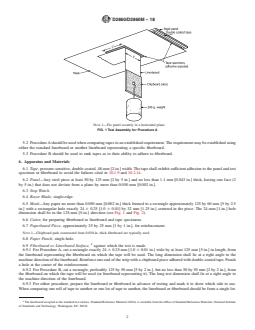
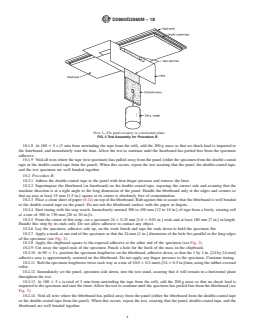
NOTE 1—Fix panel securely in a horizontal plane.
FIG. 1 Test Assembly for Procedure A
5.2 ProcedureAshould be used when comparing tapes to an 6.9 Fiberboard or Linerboard Surface, against which the
established requirement. The requirement may be established test is made.
using either the standard linerboard or another linerboard 6.9.1 For Procedure A, cut a rectangle exactly 24 6 0.25
representing a specific fiberboard. mm [1.0 6 0.01 in.] wide by at least 125 mm [5 in.] in length,
from the linerboard representing the fiberboard on which the
5.3 Procedure B should be used to rank tapes as to their
tape will be used. The long dimension shall lie at a right angle
ability to adhere to fiberboard.
to the machine direction of the linerboard. Reinforce one end
of the strip with a chipboard piece adhered with double-coated
6. Apparatus and Materials
tape. Punch a hole at the center of the reinforcement.
6.1 Tape, pressure-sensitive, double-coated, 48-mm [2-in.]
6.9.2 For Procedure B, cut a rectangle, preferably 125 by 50
width. The tape shall exhibit sufficient adhesion to the panel
mm[5by2in.],butnolessthan50by50mm[2by2in.],from
and test specimen or fiberboard to avoid the failures cited in
the fiberboard on which the tape will be used (or linerboard
10.1.9 and 10.2.14.
representing it). The long test dimension shall lie at a right
6.2 Panel—Any steel piece at least 50 by 125 mm [2 by 5 angle to the machine direction of the linerboard.
in.] and no less than 1.1 mm [0.043 in.] thick, having one face 6.9.3 For either procedure, prepare the linerboard or fiber-
(2 by 5 in.) that does not deviate from a plane by more than board in advance of testing and mark it to show which side to
0.050 mm [0.002 in.]. use. When comparing one roll of tape to another or one lot of
tape to another, the linerboard or fiberboard should be from a
6.3 Stop Watch.
single lot.
6.4 Razor Blade, single-edge.
6.10 Steel Roller, 82.5 6 2.5 mm [3.25 6 0.1 in.] in
6.5 Mask—Any paper no more than 0.050 mm [0.002 in.]
diameter and 45 6 1.5 mm [1.75 6 0.05 in.] in width, covered
thick formed to a rectangle approximately 125 by 60 mm [5 by
with rubber approximately 6 mm [0.25 in.] in thickness having
2.5 in.] with a rectangular hole exactly 24 6 0.25 [1.0 6 0.01]
a Shore A durometer hardness of 80 6 5. The surface shall be
by 32 mm [1.25 in.] centered in the piece. The 24-mm [1-in.]
a true cylinder void of any convex or concave deviations. The
hole dimension shall be in the 125-mm [5-in.] direction (see
mass of the roller shall be 2040 6 45 g [4.5 6 0.1 lb]. The
Fig. 1 and Fig. 2).
massofthehandleshallnotaddtothemassoftherollerduring
6.6 Cutter, for preparing fiberboard or linerboard and tape use.
specimens.
NOTE 2—A simple check to determine if the rubber surface is
cylindrical is to wrap the roller in a very thin paper (onionskin) and drag
6.7 Paperboard Piece, approximately 25 by 25 mm [1 by 1
in.], for reinforcement.
NOTE 1—Chipboard pads constructed from 0.030-in. thick fiberboard
The linerboard accepted as the standard test surface, Standard Reference
are typically used.
Material 1810A, is available form the Office of Standard Reference Materials,
6.8 Paper Punch, single-hole. National Institute of Standards and Technology, Washington, DC 20234.
D2860/D2860M − 18
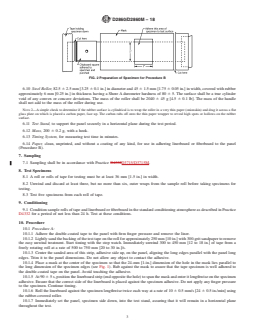
FIG. 2 Preparation of Specimen for Procedure B
it across a flat glass plate on which is placed a carbon paper, face up. The
10.1.4 Place a mask at the center of the specimen so that the
carbonrubsoffontothethinpaperwrappertorevealhighspotsorhollows
24-mm[1-in.]dimensionoftheholeinthemaskliesparallelto
on the rubber surface.
the long dimension of the specimen edges (see Fig. 1). Rub
6.11 Test Stand, to support the panel securely in a horizontal
against the mask to assure that the tape specimen is well
plane during the test period.
adhered to the double-coated tape on the panel.Avoid touching
the adhesive.
6.12 Mass, 200 6 0.2 g, with a hook.
10.1.5 At 90 6 5 s, position the linerboard strip (end
6.13 Timing System, for measuring test time in minutes.
opposite the hole) to span the mask and enter it lengthwise on
6.14 Paper, clean, unprinted, and without a coating of any
the specimen adhesive. Ensure that the correct side of the
kind, for use in adhering linerboard or fiberboard to the panel
linerboard is placed against the specimen adhesive. Do not
(Procedure B).
apply any finger pressure to the specimen. Continue timing.
10.1.6 Roll the linerboard against the specimen lengthwise
7. Sampling
twice each way at a rate of 10 6 0.5 mm/s [24 6 0.5 in./min]
7.1 Sampling shall be in accordance with Practice D3715/
using the rubber-covered roller.
D3715M.
10.1.7 Immediately set the panel, specimen side down, into
the test stand, assuring that it will remain in a horizontal plane
8. Test Specimens
throughout the test.
8.1 Aroll or rolls of tape for testing must be at least 36 mm
10.1.8 At 180 6 5 s (3 min from unwinding the tape from
[1.5 in.] in width.
the roll), add the 200-g mass so that no shock load is imparted
to the linerboard, and immediately start the time.Allow the test
8.2 Unwind and discard at least three, but no more than six,
to continue until the linerboard has peeled free from the
outer wraps from the sample roll before taking specimens for
specimen adhesive.
testing.
10.1.9 Void all tests where the tape (test specimen) has
8.3 Test five specimens from each roll of tape.
pulled away from the panel (either the specimen from the
double-coated tape or the double-coated tape from the panel).
9. Conditioning
When this occurs, repeat the test assuring that the panel, the
9.1 Condition sample rolls of tape and linerboard or fiber-
double-coated tape, and the test specimen are well bonded
board in the standard conditioning atmosphere as described in
together.
Practice D4332 for a period of not less than 24 h. Test at these
10.2 Procedure B:
conditions.
10.2.1 Adhere the double-coated tape to the panel with firm
10. Procedure finger pressure and remove the liner.
...
This document is not an ASTM standard and is intended only to provide the user of an ASTM standard an indication of what changes have been made to the previous version. Because
it may not be technically possible to adequately depict all changes accurately, ASTM recommends that users consult prior editions as appropriate. In all cases only the current version
of the standard as published by ASTM is to be considered the official document.
Designation: D2860/D2860M − 17 D2860/D2860M − 18
Standard Test Method for
Adhesion of Pressure-Sensitive Tape to Fiberboard at 90°
Angle and Constant Stress
This standard is issued under the fixed designation D2860/D2860M; the number immediately following the designation indicates the
year of original adoption or, in the case of revision, the year of last revision. A number in parentheses indicates the year of last
reapproval. A superscript epsilon (´) indicates an editorial change since the last revision or reapproval.
This standard has been approved for use by agencies of the U.S. Department of Defense.
1. Scope
1.1 This test method covers the determination of the property of adhesion of pressure-sensitive tape to a fiber-board surface. The
user of this test method has the option of choosing the paper surface for the test. The test surface may be the standard linerboard,
another linerboard (or paper) of individual interest, or a specific fiberboard.
1.2 The values stated in either SI or inch-pound units are to be regarded separately as standard. The values stated in each system
are not exact equivalents; therefore, each system must be used independently, without combining values in any way.
1.3 This standard does not purport to address all of the safety concerns, if any, associated with its use. It is the responsibility
of the user of this standard to establish appropriate safety safety, health, and healthenvironmental practices and determine the
applicability of regulatory limitations prior to use.
1.4 This international standard was developed in accordance with internationally recognized principles on standardization
established in the Decision on Principles for the Development of International Standards, Guides and Recommendations issued
by the World Trade Organization Technical Barriers to Trade (TBT) Committee.
2. Referenced Documents
2.1 ASTM Standards:
D996 Terminology of Packaging and Distribution Environments
D2904 Practice for Interlaboratory Testing of a Textile Test Method that Produces Normally Distributed Data (Withdrawn 2008)
D2906 Practice for Statements on Precision and Bias for Textiles (Withdrawn 2008)
D3715/D3715M Practice for Quality Assurance of Pressure-Sensitive Tapes
D4332 Practice for Conditioning Containers, Packages, or Packaging Components for Testing
3. Terminology
3.1 Definitions—Terminology found in Terminology D996 shall apply.
4. Summary of Test Method
4.1 Procedure A—The pressure-sensitive tape is mounted on a rigid panel. The adhesive side is exposed. A strip of linerboard,
which represents the fiberboard, is placed against the tape adhesive with controlled pressure. The area of contact is specified. The
panel is mounted in a horizontal position. A specified mass is fastened to one end of the linerboard. The mass acts to peel the
linerboard away from the adhesive at an angle of 90°. The time required to peel the linerboard from the tape is measured.
4.2 Procedure B—In this procedure, the fiberboard or the linerboard representing it is adhered to a rigid panel and the tape
peeled from it. In all other respects, the procedure is the same as Procedure A.
5. Significance and Use
5.1 This test method is designed to show the adhesion of a pressure-sensitive tape to fiberboard when the tape is under a constant
stress. Test data from this test method for some types of packaging tape relates to tape performance on fiberboard box closure.
This test method is under the jurisdiction of ASTM Committee D10 on Packaging and is the direct responsibility of Subcommittee D10.14 on Tape and Labels.
Current edition approved May 1, 2017March 1, 2018. Published July 2017April 2018. Originally approved in 1970. Last previous edition approved in 20102017 as
D2860/D2860M – 04 (2010).D2860/D2860M – 17. DOI: 10.1520/D2860_D2860M-17.10.1520/D2860_D2860M-18.
For referenced ASTM standards, visit the ASTM website, www.astm.org, or contact ASTM Customer Service at service@astm.org. For Annual Book of ASTM Standards
volume information, refer to the standard’s Document Summary page on the ASTM website.
The last approved version of this historical standard is referenced on www.astm.org.
Copyright © ASTM International, 100 Barr Harbor Drive, PO Box C700, West Conshohocken, PA 19428-2959. United States
D2860/D2860M − 18
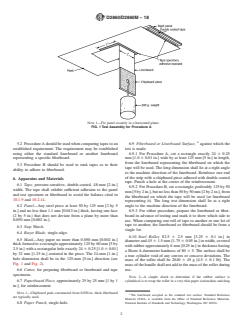
NOTE 1—Fix panel securely in a horizontal plane.
FIG. 1 Test Assembly for Procedure A
5.2 Procedure A should be used when comparing tapes to an established requirement. The requirement may be established using
either the standard linerboard or another linerboard representing a specific fiberboard.
5.3 Procedure B should be used to rank tapes as to their ability to adhere to fiberboard.
6. Apparatus and Materials
6.1 Tape, pressure-sensitive, double-coated, 48-mm [2-in.] width. The tape shall exhibit sufficient adhesion to the panel and test
specimen or fiberboard to avoid the failures cited in 10.1.9 and 10.2.14.
6.2 Panel—Any steel piece at least 50 by 125 mm [2 by 5 in.] and no less than 1.1 mm [0.043 in.] thick, having one face (2
by 5 in.) that does not deviate from a plane by more than 0.050 mm [0.002 in.].
6.3 Stop Watch.
6.4 Razor Blade, single-edge.
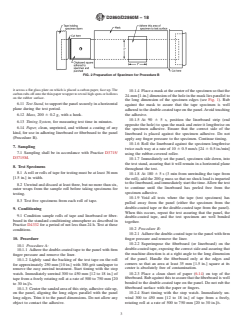
6.5 Mask—Any paper no more than 0.050 mm [0.002 in.] thick formed to a rectangle approximately 125 by 60 mm [5 by 2.5
in.] with a rectangular hole exactly 24 6 0.25 [1.0 6 0.01] by 32 mm [1.25 in.] centered in the piece. The 24-mm [1-in.] hole
dimension shall be in the 125-mm [5-in.] direction (see Fig. 1 and Fig. 2).
6.6 Cutter, for preparing fiberboard or linerboard and tape specimens.
6.7 Paperboard Piece, approximately 25 by 25 mm [1 by 1 in.], for reinforcement.
NOTE 1—Chipboard pads constructed from 0.030-in. thick fiberboard are typically used.
6.8 Paper Punch, single-hole.
6.9 Fiberboard or Linerboard Surface, against which the test is made.
6.9.1 For Procedure A, cut a rectangle exactly 24 6 0.25 mm [1.0 6 0.01 in.] wide by at least 125 mm [5 in.] in length, from
the linerboard representing the fiberboard on which the tape will be used. The long dimension shall lie at a right angle to the
machine direction of the linerboard. Reinforce one end of the strip with a chipboard piece adhered with double-coated tape. Punch
a hole at the center of the reinforcement.
6.9.2 For Procedure B, cut a rectangle, preferably 125 by 50 mm [5 by 2 in.], but no less than 50 by 50 mm [2 by 2 in.], from
the fiberboard on which the tape will be used (or linerboard representing it). The long test dimension shall lie at a right angle to
the machine direction of the linerboard.
6.9.3 For either procedure, prepare the linerboard or fiberboard in advance of testing and mark it to show which side to use.
When comparing one roll of tape to another or one lot of tape to another, the linerboard or fiberboard should be from a single lot.
The linerboard accepted as the standard test surface, Standard Reference Material 1810A, is available form the Office of Standard Reference Materials, National Institute
of Standards and Technology, Washington, DC 20234.
D2860/D2860M − 18
FIG. 2 Preparation of Specimen for Procedure B
6.10 Steel Roller, 82.5 6 2.5 mm [3.25 6 0.1 in.] in diameter and 45 6 1.5 mm [1.75 6 0.05 in.] in width, covered with rubber
approximately 6 mm [0.25 in.] in thickness having a Shore A durometer hardness of 80 6 5. The surface shall be a true cylinder
void of any convex or concave deviations. The mass of the roller shall be 2040 6 45 g [4.5 6 0.1 lb]. The mass of the handle
shall not add to the mass of the roller during use.
NOTE 2—A simple check to determine if the rubber surface is cylindrical is to wrap the roller in a very thin paper (onionskin) and drag it across a flat
glass plate on which is placed a carbon paper, face up. The carbon rubs off onto the thin paper wrapper to reveal high spots or hollows on the rubber
surface.
6.11 Test Stand, to support the panel securely in a horizontal plane during the test period.
6.12 Mass, 200 6 0.2 g, with a hook.
6.13 Timing System, for measuring test time in minutes.
6.14 Paper, clean, unprinted, and without a coating of any kind, for use in adhering linerboard or fiberboard to the panel
(Procedure B).
7. Sampling
7.1 Sampling shall be in accordance with Practice D4332D3715/D3715M.
8. Test Specimens
8.1 A roll or rolls of tape for testing must be at least 36 mm [1.5 in.] in width.
8.2 Unwind and discard at least three, but no more than six, outer wraps from the sample roll before taking specimens for
testing.
8.3 Test five specimens from each roll of tape.
9. Conditioning
9.1 Condition sample rolls of tape and linerboard or fiberboard in the standard conditioning atmosphere as described in Practice
D4332 for a period of not less than 24 h. Test at these conditions.
10. Procedure
10.1 Procedure A:
10.1.1 Adhere the double-coated tape to the panel with firm finger pressure and remove the liner.
10.1.2 Lightly sand the backing of the test tape on the roll for approximately 250 mm [10 in.] with 300-grit sandpaper to remove
the easy unwind treatment. Start timing with the stop watch. Immediately unwind 300 to 450 mm [12 to 18 in.] of tape from a
freely rotating roll at a rate of 500 to 750 mm [20 to 30 in.]/s.
10.1.3 Center the sanded area of this strip, adhesive side up, on the panel, aligning the long edges parallel with the panel long
edges. Trim it to the panel dimensions. Do not allow any object to contact the adhesive.
10.1.4 Place a mask at the center of the specimen so that the 24-mm [1-in.] dimension of the hole in the mask lies parallel to
the long dimension of the specimen edges (see Fig. 1). Rub against the mask to assure that the tape specimen is well adhered to
the double-coated tape on the panel. Avoid touching the adhesive.
10.1.5 At 90 6 5 s, position the linerboard strip (end opposite the hole) to span the mask and enter it lengthwise on the specimen
adhesive. Ensure that the correct side of the linerboard is placed against the specimen adhesive. Do not apply any finger pressure
to the specimen. Continue timing.
10.1.6 Roll the linerboard against the specimen lengthwise twice each way at a rate of 10 6 0.5 mm/s [24 6 0.5 in./min] using
the rubber-covered roller.
10.1.7 Immediately set the panel, specimen side down, into the test stand, assuring that it will rem
...