

ASTM D4724/D4724M-21
(Test Method)Standard Test Method for Entanglements in Filament Yarns by Needle Insertion
General Information
- Abstract
SIGNIFICANCE AND USE
5.1 Option 1 of this test method is for the determination of the degree of filament yarn entanglement, as measured instrumentally. It is used for acceptance testing of commercial shipments; however, caution is advised because information on between-laboratory precision is lacking. Comparative tests, as directed in 5.1.1, may be advisable.
5.1.1 If there are differences of practical significance between the reported test results for two or more laboratories, comparative tests should be performed by those laboratories to determine if there is a statistical bias between them, using competent statistical assistance. As a minimum, samples used for each comparative test should be as homogeneous as possible, drawn from the same lot of material as the samples that results in disparate results during initial testing, and randomly assigned in equal numbers to each laboratory. Other fabrics with established test values may be used for this purpose. The test results from the laboratories involved should be compared statistically. If a bias is found, either its cause must be found and corrected or future test results must be adjusted in consideration of the known bias.
5.2 Option 2 for this test method is intended for use when the supply of yarn is limited.
5.3 The instrumental option of this test method, Option 1, is based on the total randomization of the entanglements in the yarn; therefore, the distance measured between the point of insertion of a pin in the middle of the yarn and the point at which an entanglement is encountered, by movement of the yarn or the pin until it is stopped at a preset level of force, is representative of the distance between two entanglements at some location in the yarn.
5.4 Entanglements are used frequently instead of twist to ensure the integrity of filament yarns. Such entanglements generally give somewhat less protection during weaving or knitting than twist, but with proper care, will perform quite satisfactorily.
SCOPE
1.1 This test method covers two options for the measurement of entanglements in filament yarns using needle insertion options for instrument (Option 1) (Option 2) techniques.
1.2 The values stated in either SI units or inch-pound units are to be regarded separately as standard. The values stated in each system are not necessarily exact equivalents; therefore, to ensure conformance with the standard, each system shall be used independently of the other, and values from the two systems shall not be combined.
1.3 This standard does not purport to address all of the safety concerns, if any, associated with its use. It is the responsibility of the user of this standard to establish appropriate safety, health, and environmental practices and determine the applicability of regulatory limitations prior to use.
1.4 This international standard was developed in accordance with internationally recognized principles on standardization established in the Decision on Principles for the Development of International Standards, Guides and Recommendations issued by the World Trade Organization Technical Barriers to Trade (TBT) Committee.
- Status
- Published
- Publication Date
- 31-Dec-2020
- Technical Committee
- D13 - Textiles
- Drafting Committee
- D13.58 - Yarns and Fibers
Buy Documents
ASTM D4724/D4724M-21 - Standard Test Method for Entanglements in Filament Yarns by Needle Insertion
REDLINE ASTM D4724/D4724M-21 - Standard Test Method for Entanglements in Filament Yarns by Needle Insertion
Overview
ASTM D4724/D4724M-21, titled Standard Test Method for Entanglements in Filament Yarns by Needle Insertion, is a recognized international standard developed by ASTM International. This standard details two robust options for assessing the degree of entanglement in filament yarns using needle insertion techniques-one utilizing an instrumental (automated) approach and the other a manual method. The test provides vital data for the textile industry by measuring filament yarn entanglements, supporting both quality control and acceptance testing of commercial yarn shipments.
Key Topics
Dual Test Options:
- Option 1: Instrumental Testing
Employs automated needle insertion equipment to quantify yarn entanglements, ideal for routine quality and acceptance testing. - Option 2: Manual Testing
Uses a stationary needle and manual processes, often suited for cases where limited yarn supply precludes instrumental testing.
- Option 1: Instrumental Testing
Measurement Units:
Values may be reported in SI units or inch-pound units, but measurements must not be combined across systems.Testing Process:
- For instrumental methods, a needle is inserted automatically into yarn under controlled speed and tension, and entanglements are detected at a preset force.
- For manual techniques, entanglements are identified by observing resistance while moving a needle and hook through the yarn.
Sampling and Conditioning:
The method requires careful sampling from production lots and conditioning of test packages to standard environmental conditions.Precision and Statistical Guidance:
The test is designed for inter-laboratory and intra-laboratory consistency, with provisions for comparative testing if discrepancies arise.Significance of Entanglements:
Entanglements serve as alternatives to twist in maintaining yarn integrity, essential for weaving and knitting applications.
Applications
ASTM D4724/D4724M-21 is widely applicable in the textile and yarn manufacturing industries, particularly for:
Acceptance Testing:
Ensuring consistent entanglement levels in commercial yarn shipments, contributing to predictable performance in downstream processes.Quality Control:
Monitoring and maintaining the integrity of filament yarns during production to reduce defects and enhance final product performance.Product Development and Research:
Evaluating and controlling the process variables that influence yarn entanglement, especially when optimizing filament yarns for specific applications.Troubleshooting:
Identifying irregularities in yarn entanglement that could lead to processing issues such as filament breaks or uneven fabric appearance.Limited Material Scenarios:
Manual option supports testing when yarn quantities are insufficient for automated equipment, offering flexibility in small lab environments.
Related Standards
Several ASTM standards are referenced or are compatible for use in conjunction with ASTM D4724/D4724M-21, such as:
- ASTM D123: Terminology Relating to Textiles
- ASTM D1776: Practice for Conditioning and Testing Textiles
- ASTM D2258: Practice for Sampling Yarn for Testing
- ASTM D4849: Terminology Related to Yarns and Fibers
These related documents ensure standardized terminology, procedures, and sampling methodologies throughout the textile testing process, supporting the consistent implementation of entanglement assessments.
Keywords: ASTM D4724/D4724M, filament yarn entanglement, textile test method, needle insertion, yarn quality control, acceptance testing, manual yarn testing, instrumental testing, ASTM textile standards.
Relations
- Effective Date
- 01-Jul-2018
- Effective Date
- 01-Mar-2017
- Effective Date
- 15-Sep-2015
- Effective Date
- 01-Sep-2015
- Effective Date
- 01-Apr-2015
- Effective Date
- 01-Oct-2013
- Effective Date
- 01-Oct-2013
- Effective Date
- 01-Oct-2013
- Effective Date
- 01-Oct-2013
- Effective Date
- 15-Jun-2013
- Effective Date
- 15-Jun-2013
- Effective Date
- 15-May-2013
- Effective Date
- 01-Mar-2012
- Effective Date
- 01-Feb-2012
- Effective Date
- 01-Feb-2012
Buy Documents
ASTM D4724/D4724M-21 - Standard Test Method for Entanglements in Filament Yarns by Needle Insertion
REDLINE ASTM D4724/D4724M-21 - Standard Test Method for Entanglements in Filament Yarns by Needle Insertion
Get Certified
Connect with accredited certification bodies for this standard

Control Union Certifications
Global certification for agriculture and sustainability.

Hohenstein Institut
Textile testing and certification.

Bureau Veritas Bangladesh
Bureau Veritas certification services in Bangladesh.
Sponsored listings
Frequently Asked Questions
ASTM D4724/D4724M-21 is a standard published by ASTM International. Its full title is "Standard Test Method for Entanglements in Filament Yarns by Needle Insertion". This standard covers: SIGNIFICANCE AND USE 5.1 Option 1 of this test method is for the determination of the degree of filament yarn entanglement, as measured instrumentally. It is used for acceptance testing of commercial shipments; however, caution is advised because information on between-laboratory precision is lacking. Comparative tests, as directed in 5.1.1, may be advisable. 5.1.1 If there are differences of practical significance between the reported test results for two or more laboratories, comparative tests should be performed by those laboratories to determine if there is a statistical bias between them, using competent statistical assistance. As a minimum, samples used for each comparative test should be as homogeneous as possible, drawn from the same lot of material as the samples that results in disparate results during initial testing, and randomly assigned in equal numbers to each laboratory. Other fabrics with established test values may be used for this purpose. The test results from the laboratories involved should be compared statistically. If a bias is found, either its cause must be found and corrected or future test results must be adjusted in consideration of the known bias. 5.2 Option 2 for this test method is intended for use when the supply of yarn is limited. 5.3 The instrumental option of this test method, Option 1, is based on the total randomization of the entanglements in the yarn; therefore, the distance measured between the point of insertion of a pin in the middle of the yarn and the point at which an entanglement is encountered, by movement of the yarn or the pin until it is stopped at a preset level of force, is representative of the distance between two entanglements at some location in the yarn. 5.4 Entanglements are used frequently instead of twist to ensure the integrity of filament yarns. Such entanglements generally give somewhat less protection during weaving or knitting than twist, but with proper care, will perform quite satisfactorily. SCOPE 1.1 This test method covers two options for the measurement of entanglements in filament yarns using needle insertion options for instrument (Option 1) (Option 2) techniques. 1.2 The values stated in either SI units or inch-pound units are to be regarded separately as standard. The values stated in each system are not necessarily exact equivalents; therefore, to ensure conformance with the standard, each system shall be used independently of the other, and values from the two systems shall not be combined. 1.3 This standard does not purport to address all of the safety concerns, if any, associated with its use. It is the responsibility of the user of this standard to establish appropriate safety, health, and environmental practices and determine the applicability of regulatory limitations prior to use. 1.4 This international standard was developed in accordance with internationally recognized principles on standardization established in the Decision on Principles for the Development of International Standards, Guides and Recommendations issued by the World Trade Organization Technical Barriers to Trade (TBT) Committee.
SIGNIFICANCE AND USE 5.1 Option 1 of this test method is for the determination of the degree of filament yarn entanglement, as measured instrumentally. It is used for acceptance testing of commercial shipments; however, caution is advised because information on between-laboratory precision is lacking. Comparative tests, as directed in 5.1.1, may be advisable. 5.1.1 If there are differences of practical significance between the reported test results for two or more laboratories, comparative tests should be performed by those laboratories to determine if there is a statistical bias between them, using competent statistical assistance. As a minimum, samples used for each comparative test should be as homogeneous as possible, drawn from the same lot of material as the samples that results in disparate results during initial testing, and randomly assigned in equal numbers to each laboratory. Other fabrics with established test values may be used for this purpose. The test results from the laboratories involved should be compared statistically. If a bias is found, either its cause must be found and corrected or future test results must be adjusted in consideration of the known bias. 5.2 Option 2 for this test method is intended for use when the supply of yarn is limited. 5.3 The instrumental option of this test method, Option 1, is based on the total randomization of the entanglements in the yarn; therefore, the distance measured between the point of insertion of a pin in the middle of the yarn and the point at which an entanglement is encountered, by movement of the yarn or the pin until it is stopped at a preset level of force, is representative of the distance between two entanglements at some location in the yarn. 5.4 Entanglements are used frequently instead of twist to ensure the integrity of filament yarns. Such entanglements generally give somewhat less protection during weaving or knitting than twist, but with proper care, will perform quite satisfactorily. SCOPE 1.1 This test method covers two options for the measurement of entanglements in filament yarns using needle insertion options for instrument (Option 1) (Option 2) techniques. 1.2 The values stated in either SI units or inch-pound units are to be regarded separately as standard. The values stated in each system are not necessarily exact equivalents; therefore, to ensure conformance with the standard, each system shall be used independently of the other, and values from the two systems shall not be combined. 1.3 This standard does not purport to address all of the safety concerns, if any, associated with its use. It is the responsibility of the user of this standard to establish appropriate safety, health, and environmental practices and determine the applicability of regulatory limitations prior to use. 1.4 This international standard was developed in accordance with internationally recognized principles on standardization established in the Decision on Principles for the Development of International Standards, Guides and Recommendations issued by the World Trade Organization Technical Barriers to Trade (TBT) Committee.
ASTM D4724/D4724M-21 is classified under the following ICS (International Classification for Standards) categories: 59.080.20 - Yarns. The ICS classification helps identify the subject area and facilitates finding related standards.
ASTM D4724/D4724M-21 has the following relationships with other standards: It is inter standard links to ASTM D4849-13(2018), ASTM D123-17, ASTM D123-15b, ASTM D123-15a, ASTM D123-15, ASTM D4849-13, ASTM D4849-13e3, ASTM D4849-13e2, ASTM D4849-13e1, ASTM D123-13ae1, ASTM D123-13a, ASTM D123-13, ASTM D2258-99(2012), ASTM D123-12, ASTM D123-12e1. Understanding these relationships helps ensure you are using the most current and applicable version of the standard.
ASTM D4724/D4724M-21 is available in PDF format for immediate download after purchase. The document can be added to your cart and obtained through the secure checkout process. Digital delivery ensures instant access to the complete standard document.
Standards Content (Sample)
This international standard was developed in accordance with internationally recognized principles on standardization established in the Decision on Principles for the
Development of International Standards, Guides and Recommendations issued by the World Trade Organization Technical Barriers to Trade (TBT) Committee.
Designation: D4724/D4724M − 21
Standard Test Method for
Entanglements in Filament Yarns by Needle Insertion
This standard is issued under the fixed designation D4724/D4724M; the number immediately following the designation indicates the
year of original adoption or, in the case of revision, the year of last revision. A number in parentheses indicates the year of last
reapproval. A superscript epsilon (´) indicates an editorial change since the last revision or reapproval.
1. Scope 3.1.1.1 The following terms are relevant to this standard:
entanglement, filament yarn.
1.1 This test method covers two options for the measure-
3.2 For definitions of other textile terms used in this test
ment of entanglements in filament yarns using needle insertion
method, refer to Terminology D123.
options for instrument (Option 1) (Option 2) techniques.
1.2 The values stated in either SI units or inch-pound units
4. Summary of Test Method
are to be regarded separately as standard. The values stated in
4.1 A summary of each option is in the section for that
each system are not necessarily exact equivalents; therefore, to
option.
ensure conformance with the standard, each system shall be
used independently of the other, and values from the two
5. Significance and Use
systems shall not be combined.
1.3 This standard does not purport to address all of the 5.1 Option 1 of this test method is for the determination of
safety concerns, if any, associated with its use. It is the
the degree of filament yarn entanglement, as measured instru-
responsibility of the user of this standard to establish appro- mentally. It is used for acceptance testing of commercial
priate safety, health, and environmental practices and deter-
shipments; however, caution is advised because information on
mine the applicability of regulatory limitations prior to use. between-laboratory precision is lacking. Comparative tests, as
1.4 This international standard was developed in accor- directed in 5.1.1, may be advisable.
dance with internationally recognized principles on standard-
5.1.1 If there are differences of practical significance be-
ization established in the Decision on Principles for the
tween the reported test results for two or more laboratories,
Development of International Standards, Guides and Recom-
comparative tests should be performed by those laboratories to
mendations issued by the World Trade Organization Technical
determine if there is a statistical bias between them, using
Barriers to Trade (TBT) Committee.
competent statistical assistance. As a minimum, samples used
for each comparative test should be as homogeneous as
2. Referenced Documents
possible, drawn from the same lot of material as the samples
that results in disparate results during initial testing, and
2.1 ASTM Standards:
randomly assigned in equal numbers to each laboratory. Other
D123 Terminology Relating to Textiles
fabrics with established test values may be used for this
D1776 Practice for Conditioning and Testing Textiles
purpose. The test results from the laboratories involved should
D2258 Practice for Sampling Yarn for Testing
be compared statistically. If a bias is found, either its cause
D4849 Terminology Related to Yarns and Fibers
must be found and corrected or future test results must be
adjusted in consideration of the known bias.
3. Terminology
5.2 Option 2 for this test method is intended for use when
3.1 Definitions:
the supply of yarn is limited.
3.1.1 For definitions of terms relating to yarns and fibers,
refer to Terminology D4849.
5.3 The instrumental option of this test method, Option 1, is
based on the total randomization of the entanglements in the
yarn; therefore, the distance measured between the point of
1 insertion of a pin in the middle of the yarn and the point at
This test method is under the jurisdiction ofASTM Committee D13 on Textiles
and is the direct responsibility of Subcommittee D13.58 on Yarns and Fibers.
which an entanglement is encountered, by movement of the
Current edition approved Jan. 1, 2021. Published January 2021. Originally
yarn or the pin until it is stopped at a preset level of force, is
approved in 1999. Last previous edition approved in 2020 as D4724–20. DOI:
representative of the distance between two entanglements at
10.1520/D4724_D4724M-21.
some location in the yarn.
For referenced ASTM standards, visit the ASTM website, www.astm.org, or
contact ASTM Customer Service at service@astm.org. For Annual Book of ASTM
5.4 Entanglements are used frequently instead of twist to
Standards volume information, refer to the standard’s Document Summary page on
the ASTM website. ensure the integrity of filament yarns. Such entanglements
Copyright © ASTM International, 100 Barr Harbor Drive, PO Box C700, West Conshohocken, PA 19428-2959. United States
D4724/D4724M − 21
generally give somewhat less protection during weaving or 8.2.2 Standard Laboratory Weights, ranging from 1 to 100
knitting than twist, but with proper care, will perform quite g.
satisfactorily.
8.2.3 Stopwatch, with ⁄5-s divisions.
8.2.4 Speed Indicator, tachometer, 0 to 1000 r/min range.
6. Sampling and Test Specimens
8.2.5 Magnetic Whorl Tensioning Device, optional.
6.1 Primary Sampling Unit—Consider shipping containers
8.3 Procedure
or production lots of yarn to be the primary sampling unit.
8.3.1 Test the yarn in the standard atmosphere for testing
NOTE 1—A realistic specification or other agreement between the
textiles, as directed in Practice D1776.
purchaser and the supplier requires taking into account the variability
8.3.2 Calibrate the entanglement tester and tensiometer as
between lots, shipping containers, packages within a shipping container,
prescribed by the instrument manufacturer.
and successive lengths from a package to provide a plan that, at the
specified level for the property of interest, has a meaningful producer’s
8.3.3 Mount the test package on a suitable holder.
risk, consumer’s risk, acceptable quality level, and limiting quality level.
8.3.4 Yarn Pretension—Calculate the pretension by using
6.2 Laboratory Sample Unit—For each primary sampling
one of the equations below:
unit, take laboratory sampling units as directed in Practice
YP @g# 5 0.75 * =D for denier (1)
D2258.Donotrewindortransfermaterialfrompackagestaken
from shipping containers to other packages.
YP @cN# 5 0.7 * =T for dtex (2)
6.3 Test Specimen—For acceptance testing, use laboratory
YP @cN# 5 2.21 * =T for tex (3)
sample units as a source of specimens. Make (20–100) obser-
vations on each laboratory sampling unit.
8.3.5 Trip Level Tension—Calculate the trip level by using
one of the equations below:
7. Conditioning
8.3.5.1 For linear density >= 40 dtex, 4 tex or 36 den:
7.1 Preparation of Test Package—Before preconditioning
0.35
TLT g 5 3.50 * D for denier (4)
@ #
or conditioning the test package, remove at least 100 m or 110
0.35
TLT@cN# 5 3.31 * T for dtex (5)
yds of yarn from the test package to avoid testing nonrepre-
0.35
sentative yarn. TLT@cN# 5 7.41 * T for tex (6)
7.2 Preconditioning—Normally, preconditioning is not nec-
8.3.5.2 For linear density < 40 dtex, 4 tex or 36 den:
essary unless the test packages are received with higher than
TLT g 5 0.36 * D 2 0.68 for denier (7)
@ #
the normal moisture level. If preconditioning is necessary, treat
TLT cN 5 0.318 * T 2 0.68 for dtex (8)
@ #
the packages as directed in Practice D1776.
TLT@cN# 5 3.18 * T 2 0.68 for tex (9)
7.3 Conditioning—Condition the test packages as directed
in Practice D1776.
where:
YP = yarn pretension, cN[gf]
OPTION 1—INSTRUMENTAL MEASUREMENT OF
TLT = trip level tension, cN[gf],
THE DEGREE OF ENTANGLEMENT OF FILAMENT
T = linear density, tex or dtex, and
YARN
D = linear density, denier.
8. Summary of Option
8.3.6 Set the RAPID instrument as follows:
8.3.6.1 Continuous Yarn Speed During Measurement—
8.1 A yarn is passed at constant speed and constant preten-
0.5–20 m/min.
sion through the thread path of the instrument.After a required
yarn length has run through, the yarn is pierced by a needle, 8.3.6.2 Observations/Package—20–100.
and advanced automatically until a preset needle tension is
8.3.6.3 No-show Length—Refer to the manufacturer’s
attained. Then, the needle is withdrawn, and the yarn length
manual.
from insertion to this critical point is measured automatically.
8.3.6.4 Presentthelooseendoftheyarntotheinletgun(see
This cycle of yarn advance, piercing by the needle, and length
Fig. 1 and Fig. 2). The instrument will string up, automatically
measurement is repeated for a predetermined number of times.
strip some yarn, start the measurement cycle, and discard the
The individually measured pulled yarn lengths and the total of
tested yarn to waste.
these yarn lengths are automatically recorded.
If there is no entanglement in the “No-Show” length, the
8.2 Apparatus
instrument will do the following:
8.2.1 Automatic Needle Pull Entanglement Testers, Lenzing
(1) If the “Pin Miss Ignored Limit” has not been exceeded,
Instruments rapid automatic pin insertion detector (RAPID)
rotate the pinwheel, reinsert the needle in the yarn, and
with rotating pin, rapid automatic pin insertion detector
continue testing. The test is aborted and a “No-Show” re-
(RAPID-V) with vertical pin and Rothschild automatic yarn
corded.
entanglement testers NPT.
(2) If the “Pin Miss Ignored Limit” has been exceeded,
entera“Freeze”stateandrequestconfirmationofpininsertion.
The operator will restart the test if the pin did not pierce the
Apparatus is commercially available. yarn(increasingthe“PinMissCount”by1,ortheoperatorwill
D4724/D4724M − 21
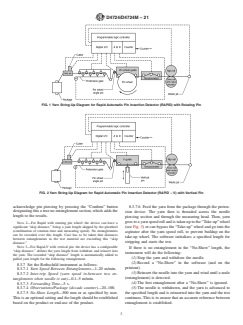
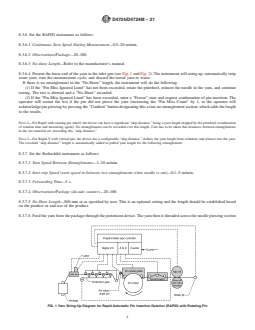
FIG. 1 Yarn String-Up Diagram for Rapid Automatic Pin Insertion Detector (RAPID) with Rotating Pin
FIG. 2 Yarn String-Up Diagram for Rapid Automatic Pin Insertion Detector (RAPID – V) with Vertical Pin
acknowledge pin piercing by pressing the “Confirm” button 8.3.7.6 Feed the yarn from the package through the preten-
designating this a true no entanglement section, which adds the sion device. The yarn then is threaded across the needle
length to the results.
piercing section and through the measuring head. Then, yarn
goestoayarnspeedrollandistakenuptothe“Take-up”wheel
NOTE 2—For Rapid with rotating pin wheel: the device can have a
(see Fig. 3) or can bypass the “Take-up” wheel and go into the
significant “skip distance,” being a yarn length skipped by the pinwheel
(combination of rotation time and measur
...
This document is not an ASTM standard and is intended only to provide the user of an ASTM standard an indication of what changes have been made to the previous version. Because
it may not be technically possible to adequately depict all changes accurately, ASTM recommends that users consult prior editions as appropriate. In all cases only the current version
of the standard as published by ASTM is to be considered the official document.
Designation: D4724/D4724M − 20 D4724/D4724M − 21
Standard Test Method for
Entanglements in Filament Yarns by Needle Insertion
This standard is issued under the fixed designation D4724/D4724M; the number immediately following the designation indicates the
year of original adoption or, in the case of revision, the year of last revision. A number in parentheses indicates the year of last
reapproval. A superscript epsilon (´) indicates an editorial change since the last revision or reapproval.
1. Scope
1.1 This test method covers two options for the measurement of entanglements in filament yarns using needle insertion options
for instrument (Option 1) (Option 2) techniques.
1.2 The values stated in either SI units or inch-pound units are to be regarded separately as standard. The values stated in each
system are not necessarily exact equivalents; therefore, to ensure conformance with the standard, each system shall be used
independently of the other, and values from the two systems shall not be combined.
1.3 This standard does not purport to address all of the safety concerns, if any, associated with its use. It is the responsibility
of the user of this standard to establish appropriate safety, health, and environmental practices and determine the applicability of
regulatory limitations prior to use.
1.4 This international standard was developed in accordance with internationally recognized principles on standardization
established in the Decision on Principles for the Development of International Standards, Guides and Recommendations issued
by the World Trade Organization Technical Barriers to Trade (TBT) Committee.
2. Referenced Documents
2.1 ASTM Standards:
D123 Terminology Relating to Textiles
D1776 Practice for Conditioning and Testing Textiles
D2258 Practice for Sampling Yarn for Testing
D4849 Terminology Related to Yarns and Fibers
3. Terminology
3.1 Definitions:
3.1.1 For definitions of terms relating to yarns and fibers, refer to Terminology D4849.
3.1.1.1 The following terms are relevant to this standard: entanglement, filament yarn.
3.2 For definitions of other textile terms used in this test method, refer to Terminology D123.
4. Summary of Test Method
4.1 A summary of each option is in the section for that option.
This test method is under the jurisdiction of ASTM Committee D13 on Textiles and is the direct responsibility of Subcommittee D13.58 on Yarns and Fibers.
Current edition approved April 1, 2020Jan. 1, 2021. Published June 2020January 2021. Originally approved in 1999. Last previous edition approved in 20112020 as
D4724–11.–20. DOI: 10.1520/D4724_D4724M-20.10.1520/D4724_D4724M-21.
For referenced ASTM standards, visit the ASTM website, www.astm.org, or contact ASTM Customer Service at service@astm.org. For Annual Book of ASTM Standards
volume information, refer to the standard’s Document Summary page on the ASTM website.
Copyright © ASTM International, 100 Barr Harbor Drive, PO Box C700, West Conshohocken, PA 19428-2959. United States
D4724/D4724M − 21
5. Significance and Use
5.1 Option 1 of this test method is for the determination of the degree of filament yarn entanglement, as measured instrumentally.
It is used for acceptance testing of commercial shipments; however, caution is advised because information on between-laboratory
precision is lacking. Comparative tests, as directed in 5.1.1, may be advisable.
5.1.1 If there are differences of practical significance between the reported test results for two or more laboratories, comparative
tests should be performed by those laboratories to determine if there is a statistical bias between them, using competent statistical
assistance. As a minimum, samples used for each comparative test should be as homogeneous as possible, drawn from the same
lot of material as the samples that results in disparate results during initial testing, and randomly assigned in equal numbers to each
laboratory. Other fabrics with established test values may be used for this purpose. The test results from the laboratories involved
should be compared statistically. If a bias is found, either its cause must be found and corrected or future test results must be
adjusted in consideration of the known bias.
5.2 Option 2 for this test method is intended for use when the supply of yarn is limited.
5.3 The instrumental option of this test method, Option 1, is based on the total randomization of the entanglements in the yarn;
therefore, the distance measured between the point of insertion of a pin in the middle of the yarn and the point at which an
entanglement is encountered, by movement of the yarn or the pin until it is stopped at a preset level of force, is representative of
the distance between two entanglements at some location in the yarn.
5.4 Entanglements are used frequently instead of twist to ensure the integrity of filament yarns. Such entanglements generally give
somewhat less protection during weaving or knitting than twist, but with proper care, will perform quite satisfactorily.
6. Sampling and Test Specimens
6.1 Primary Sampling Unit—Consider shipping containers or production lots of yarn to be the primary sampling unit.
NOTE 1—A realistic specification or other agreement between the purchaser and the supplier requires taking into account the variability between lots,
shipping containers, packages within a shipping container, and successive lengths from a package to provide a plan that, at the specified level for the
property of interest, has a meaningful producer’s risk, consumer’s risk, acceptable quality level, and limiting quality level.
6.2 Laboratory Sample Unit—For each primary sampling unit, take laboratory sampling units as directed in Practice D2258. Do
not rewind or transfer material from packages taken from shipping containers to other packages.
6.3 Test Specimen—For acceptance testing, use laboratory sample units as a source of specimens. Make (20–100) observations on
each laboratory sampling unit.
7. Conditioning
7.1 Preparation of Test Package—Before preconditioning or conditioning the test package, remove at least 100 m or 110 yds of
yarn from the test package to avoid testing nonrepresentative yarn.
7.2 Preconditioning—Normally, preconditioning is not necessary unless the test packages are received with higher than the normal
moisture level. If preconditioning is necessary, treat the packages as directed in Practice D1776.
7.3 Conditioning—Condition the test packages as directed in Practice D1776.
OPTION 1—INSTRUMENTAL MEASUREMENT OF THE DEGREE OF ENTANGLEMENT OF FILAMENT YARN
8. Summary of Option
8.1 A yarn is passed at constant speed and constant pretension through the thread path of the instrument. After a required yarn
length has run through, the yarn is pierced by a needle, and advanced automatically until a preset needle tension is attained. Then,
the needle is withdrawn, and the yarn length from insertion to this critical point is measured automatically. This cycle of yarn
D4724/D4724M − 21
advance, piercing by the needle, and length measurement is repeated for a predetermined number of times. The individually
measured pulled yarn lengths and the total of these yarn lengths are automatically recorded.
8.2 Apparatus
8.2.1 Automatic Needle Pull Entanglement Testers, Lenzing Instruments rapid automatic pin insertion detector (RAPID) with
rotating pin, rapid automatic pin insertion detector (RAPID-V) with vertical pin and Rothschild automatic yarn entanglement
testers NPT.
8.2.2 Standard Laboratory Weights, ranging from 1 to 100 g.
8.2.3 Stopwatch, with ⁄5-s divisions.
8.2.4 Speed Indicator, tachometer, 0 to 1000 rpmr/min range.
8.2.5 Magnetic Whorl Tensioning Device, optional.
8.3 Procedure
8.3.1 Test the yarn in the standard atmosphere for testing textiles, as directed in Practice D1776.
8.3.2 Calibrate the entanglement tester and tensiometer as prescribed by the instrument manufacturer.
8.3.3 Mount the test package on a suitable holder.
8.3.4 Yarn Pretension—Calculate the pretension by using one of the equations below:
YP @g# 5 0.75 * =D for denier (1)
YP @cN# 5 0.7 * =T for dtex (2)
YP @cN# 5 2.21 * =T for tex (3)
8.3.5 Trip Level Tension—Calculate the trip level by using one of the equations below:
8.3.5.1 For linear density >= 40 dtex, 4 tex or 36 den:
0.35
TLT@g# 5 3.50 * D for denier (4)
0.35
TLT@cN# 5 3.31 * T for dtex (5)
0.35
TLT cN 5 7.41 * T for tex (6)
@ #
8.3.5.2 For linear density < 40 dtex, 4 tex or 36 den:
TLT g 5 0.36 * D 2 0.68 for denier (7)
@ #
TLT@cN# 5 0.318 * T 2 0.68 for dtex (8)
TLT@cN# 5 0.0318 * T 2 0.68 for tex (9)
TLT cN 5 3.18 * T 2 0.68 for tex (9)
@ #
where:
YP = yarn pretension, cN[gf]
TLT = trip level tension, cN [gf],
TLT = trip level tension, cN[gf],
T = linear density, tex or dtex, and
D = linear density, denier.
Apparatus is commercially available.
D4724/D4724M − 21
8.3.6 Set the RAPID instrument as follows:
8.3.6.1 Continuous Yarn Speed During Measurement—0.5–20 m/min.
8.3.6.2 Observations/Package—20–100.
8.3.6.3 No-show Length—Refer to the manufacturer’s manual.
8.3.6.4 Present the loose end of the yarn to the inlet gun (see Fig. 1 and Fig. 2). The instrument will string up, automatically strip
some yarn, start the measurement cycle, and discard the tested yarn to waste.
If there is no entanglement in the “No-Show” length, the instrument will do the following:
(1) If the “Pin Miss Ignored Limit” has not been exceeded, rotate the pinwheel, reinsert the needle in the yarn, and continue
testing. The test is aborted and a “No-Show” recorded.
(2) If the “Pin Miss Ignored Limit” has been exceeded, enter a “Freeze” state and request confirmation of pin insertion. The
operator will restart the test if the pin did not pierce the yarn (increasing the “Pin Miss Count” by 1, or the operator will
acknowledge pin piercing by pressing the “Confirm” button designating this a true no entanglement section, which adds the length
to the results.
NOTE 2—For Rapid with rotating pin wheel: the device can have a significant “skip distance,” being a yarn length skipped by the pinwheel (combination
of rotation time and measuring speed). No entanglements can be recorded over this length. Care has to be taken that distances between entanglements
in the test material are exceeding this “skip distance.”
NOTE 3—For Rapid-V with vertical pin: the device has a configurable “skip distance,” defines the yarn length from withdraw and reinsert into the yarn.
The recorded “skip distance” length is automatically added to pulled yarn length for the following entanglement.
8.3.7 Set the Rothschild instrument as follows:
8.3.7.1 Yarn Speed Between Entanglements—1–20 m/min.
8.3.7.2 Inter-trip Speed (yarn speed in-between two entanglements when needle is out)—0.1–5 m/min.
8.3.7.3 Forwarding Time—5 s.
8.3.7.4 Observations/Package (decade counter)—20–100.
8.3.7.5 No-Show Length—500 mm or as specified by user. This is an optional setting and the length should be established based
on the product or end-use of the product.
8.3.7.6 Feed the yarn from the package through the pretension device. The yarn then is threaded across the needle piercing section
FIG. 1 Yarn String-Up Diagram for Rapid Automatic Pin I
...