

ASTM D4031-07(2018)
(Test Method)Standard Test Method for Bulk Properties of Textured Yarns
General Information
- Abstract
SIGNIFICANCE AND USE
5.1 The values obtained by this test method should not be used to predict similar properties in fabricated structures except in narrow well-defined comparisons, such as 16.7 tex (150-denier) polyester from the same feed yarn merge and textured on the same machine type. Attempts to relate yarn performance to fabric performance might result in poor correlations unless other factors affecting bulk such as yarn shrinkage and fabric finishing are eliminated.
5.2 Elapsed time between processing and testing has a marked effect on the results of this test especially during the first 72 h. Therefore, specimens should only be compared if tested after the same elapsed time. This effect is caused by stress decay which is known to be minimal beyond the seventh day and after which time the sample remains relatively stable. Comparisons are preferably made after the seventh day.
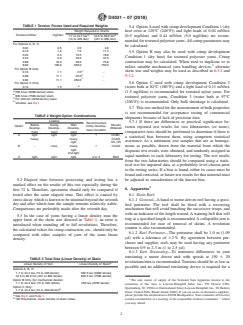
5.3 In the case of yarns having a linear density near the upper limit of the skein size directed in Table 3, an error is introduced when rounding off to full revolutions. Therefore, the calculated values for crimp contraction, etc., should only be compared with other samples of yarn of the same linear density. (A) See Eq 2, and Note 1.(B) 100 Revolutions, linear density of skein varies.
5.4 Option A used with crimp development Condition 1 (dry heat oven at 120°C (248°F)) and light loads of 0.04 mN/tex (0.5 mgf/den) and 0.44 mN/tex (5.0 mgf/den) are recommended for textured polyester yarns. All crimp parameters may be calculated.
5.5 Option B may also be used with crimp development Condition 1 (dry heat) for textured polyester yarns. Crimp contraction may be calculated. When used to duplicate or to utilize suitable mechanical yarn handling devices,3 alternate skein size and weights may be used as described in 6.5.2 and 9.3.2.
5.6 Option C used with crimp development Condition 2 (water bath at 82°C (180°F)) and a light load of 0.13 mN/tex (1.5 mgf/den) is recommended for textured nylon yarns. ...
SCOPE
1.1 This test method covers the measurement of the change in length of a tensioned skein of textured yarn due to change in crimp characteristics brought about by exposure to wet or dry heat. The change in length, depending on procedure, is a measure of skein shrinkage, crimp contraction, bulk shrinkage, or crimp recovery.
1.2 This test method applies to crimped, continuous multifilament yarns ranging from 1.7 to 88.9 tex (15 to 800 denier).
1.3 Three conditions are provided for crimp development mediums, and loading routines are provided to be used on the yarn skeins to allow determination of yarn bulk by several different procedures.
1.4 The values stated in either SI units or inch-pound units are to be regarded as standard. Within the text, the inch-pound units are shown in parentheses. The values stated in each system are not exact equivalent; therefore, each system shall be used independently of the other. Combining values from the two systems may result in nonconformance with the specification.
1.5 This standard does not purport to address all of the safety concerns, if any, associated with its use. It is the responsibility of the user of this standard to establish appropriate safety, health, and environmental practices and determine the applicability of regulatory limitations prior to use.
1.6 This international standard was developed in accordance with internationally recognized principles on standardization established in the Decision on Principles for the Development of International Standards, Guides and Recommendations issued by the World Trade Organization Technical Barriers to Trade (TBT) Committee.
- Status
- Published
- Publication Date
- 30-Jun-2018
- Technical Committee
- D13 - Textiles
- Drafting Committee
- D13.58 - Yarns and Fibers
Overview
ASTM D4031-07(2018), titled Standard Test Method for Bulk Properties of Textured Yarns, is an internationally recognized test method developed by ASTM International. This standard outlines procedures for evaluating the bulk properties-such as shrinkage, crimp contraction, bulk shrinkage, and crimp recovery-of crimped, continuous multifilament textured yarns. Key applications of this standard include quality control, product development, and inter-laboratory comparisons in the textile industry, particularly for synthetic fibers like polyester and nylon spanning from 1.7 to 88.9 tex (15 to 800 denier).
Key Topics
- Bulk Property Measurement: Measures the change in length of a tensioned skein of textured yarn after exposure to specific crimp development conditions (wet/dry heat), reflecting properties such as skein shrinkage and crimp contraction.
- Applicable Yarn Types: Focuses on textured, continuous multifilament yarns (e.g., textured polyester and nylon) within specified linear densities.
- Test Conditions: Provides three defined crimp development mediums (dry heat, water bath at 82°C, or water bath at 97°C) and associated loading routines to assess different bulk characteristics.
- Significance of Test Results: Notes limitations in predicting finished fabric properties from yarn measurements, highlighting the importance of specimen consistency for accurate comparisons and the vital impact of elapsed time between processing and testing.
- Statistical Guidance: Addresses interlaboratory testing, outlines steps to determine whether observed differences are statistically significant, and provides recommendations for data reporting and bias minimization.
Applications
The practical value of ASTM D4031 lies in its ability to:
- Quality Assurance: Provide standardized, reliable data on the bulk properties of textured yarns for manufacturers and suppliers, facilitating quality control across production batches and suppliers.
- Product Development: Aid researchers and engineers in comparing yarn treatments, evaluating process improvements, and optimizing texture processes for specific yarn types.
- Performance Benchmarking: Enable direct comparison of yarns produced from the same feedstock and textured on similar machinery-critical in research, process verification, and troubleshooting.
- Inter-Laboratory Validation: Offer a common reference for inter-laboratory tests, ensuring consistency across different textile facilities and supporting international trade by adhering to globally recognized procedures.
- Specification Compliance: Support compliance with contract and procurement specifications, particularly in regions or organizations requiring adherence to ASTM standards for synthetic yarns.
- Reporting Consistency: Provide clear guidelines for reporting key parameters (e.g., crimp contraction, skein shrinkage, bulk shrinkage, crimp recovery), standard deviations, and test conditions, ensuring transparency and repeatability.
Related Standards
ASTM D4031 is part of a broader network of textile testing standards, many of which may be referenced during yarn characterization:
- ASTM D1059 - Test Method for Yarn Number Based on Short-Length Specimens
- ASTM D1776 - Practice for Conditioning and Testing Textiles
- ASTM D1907 - Test Method for Linear Density of Yarn (Skein Method)
- ASTM D2258 - Practice for Sampling Yarn for Testing
- ASTM D4849 - Terminology Related to Yarns and Fibers
- ASTM D123 - Terminology Relating to Textiles
These related standards provide complementary guidance on sampling, terminology, and measurement techniques, supporting robust and comparable test results in accordance with international best practices.
Keywords: bulk properties of textured yarns, ASTM D4031, crimp contraction, skein shrinkage, crimp recovery, bulk shrinkage, yarn test method, textured polyester yarn, textured nylon yarn, textile quality control, ASTM textile standards, yarn testing procedure, international standard for yarns
Relations
- Effective Date
- 01-Jul-2018
- Effective Date
- 01-Mar-2017
- Effective Date
- 15-Sep-2015
- Effective Date
- 01-Sep-2015
- Effective Date
- 01-Apr-2015
- Effective Date
- 01-Oct-2013
- Effective Date
- 01-Oct-2013
- Effective Date
- 01-Oct-2013
- Effective Date
- 01-Oct-2013
- Effective Date
- 15-Jun-2013
- Effective Date
- 15-Jun-2013
- Effective Date
- 15-May-2013
- Effective Date
- 01-Mar-2012
- Effective Date
- 01-Feb-2012
- Effective Date
- 01-Feb-2012
Get Certified
Connect with accredited certification bodies for this standard

Control Union Certifications
Global certification for agriculture and sustainability.

Hohenstein Institut
Textile testing and certification.

Bureau Veritas Bangladesh
Bureau Veritas certification services in Bangladesh.
Sponsored listings
Frequently Asked Questions
ASTM D4031-07(2018) is a standard published by ASTM International. Its full title is "Standard Test Method for Bulk Properties of Textured Yarns". This standard covers: SIGNIFICANCE AND USE 5.1 The values obtained by this test method should not be used to predict similar properties in fabricated structures except in narrow well-defined comparisons, such as 16.7 tex (150-denier) polyester from the same feed yarn merge and textured on the same machine type. Attempts to relate yarn performance to fabric performance might result in poor correlations unless other factors affecting bulk such as yarn shrinkage and fabric finishing are eliminated. 5.2 Elapsed time between processing and testing has a marked effect on the results of this test especially during the first 72 h. Therefore, specimens should only be compared if tested after the same elapsed time. This effect is caused by stress decay which is known to be minimal beyond the seventh day and after which time the sample remains relatively stable. Comparisons are preferably made after the seventh day. 5.3 In the case of yarns having a linear density near the upper limit of the skein size directed in Table 3, an error is introduced when rounding off to full revolutions. Therefore, the calculated values for crimp contraction, etc., should only be compared with other samples of yarn of the same linear density. (A) See Eq 2, and Note 1.(B) 100 Revolutions, linear density of skein varies. 5.4 Option A used with crimp development Condition 1 (dry heat oven at 120°C (248°F)) and light loads of 0.04 mN/tex (0.5 mgf/den) and 0.44 mN/tex (5.0 mgf/den) are recommended for textured polyester yarns. All crimp parameters may be calculated. 5.5 Option B may also be used with crimp development Condition 1 (dry heat) for textured polyester yarns. Crimp contraction may be calculated. When used to duplicate or to utilize suitable mechanical yarn handling devices,3 alternate skein size and weights may be used as described in 6.5.2 and 9.3.2. 5.6 Option C used with crimp development Condition 2 (water bath at 82°C (180°F)) and a light load of 0.13 mN/tex (1.5 mgf/den) is recommended for textured nylon yarns. ... SCOPE 1.1 This test method covers the measurement of the change in length of a tensioned skein of textured yarn due to change in crimp characteristics brought about by exposure to wet or dry heat. The change in length, depending on procedure, is a measure of skein shrinkage, crimp contraction, bulk shrinkage, or crimp recovery. 1.2 This test method applies to crimped, continuous multifilament yarns ranging from 1.7 to 88.9 tex (15 to 800 denier). 1.3 Three conditions are provided for crimp development mediums, and loading routines are provided to be used on the yarn skeins to allow determination of yarn bulk by several different procedures. 1.4 The values stated in either SI units or inch-pound units are to be regarded as standard. Within the text, the inch-pound units are shown in parentheses. The values stated in each system are not exact equivalent; therefore, each system shall be used independently of the other. Combining values from the two systems may result in nonconformance with the specification. 1.5 This standard does not purport to address all of the safety concerns, if any, associated with its use. It is the responsibility of the user of this standard to establish appropriate safety, health, and environmental practices and determine the applicability of regulatory limitations prior to use. 1.6 This international standard was developed in accordance with internationally recognized principles on standardization established in the Decision on Principles for the Development of International Standards, Guides and Recommendations issued by the World Trade Organization Technical Barriers to Trade (TBT) Committee.
SIGNIFICANCE AND USE 5.1 The values obtained by this test method should not be used to predict similar properties in fabricated structures except in narrow well-defined comparisons, such as 16.7 tex (150-denier) polyester from the same feed yarn merge and textured on the same machine type. Attempts to relate yarn performance to fabric performance might result in poor correlations unless other factors affecting bulk such as yarn shrinkage and fabric finishing are eliminated. 5.2 Elapsed time between processing and testing has a marked effect on the results of this test especially during the first 72 h. Therefore, specimens should only be compared if tested after the same elapsed time. This effect is caused by stress decay which is known to be minimal beyond the seventh day and after which time the sample remains relatively stable. Comparisons are preferably made after the seventh day. 5.3 In the case of yarns having a linear density near the upper limit of the skein size directed in Table 3, an error is introduced when rounding off to full revolutions. Therefore, the calculated values for crimp contraction, etc., should only be compared with other samples of yarn of the same linear density. (A) See Eq 2, and Note 1.(B) 100 Revolutions, linear density of skein varies. 5.4 Option A used with crimp development Condition 1 (dry heat oven at 120°C (248°F)) and light loads of 0.04 mN/tex (0.5 mgf/den) and 0.44 mN/tex (5.0 mgf/den) are recommended for textured polyester yarns. All crimp parameters may be calculated. 5.5 Option B may also be used with crimp development Condition 1 (dry heat) for textured polyester yarns. Crimp contraction may be calculated. When used to duplicate or to utilize suitable mechanical yarn handling devices,3 alternate skein size and weights may be used as described in 6.5.2 and 9.3.2. 5.6 Option C used with crimp development Condition 2 (water bath at 82°C (180°F)) and a light load of 0.13 mN/tex (1.5 mgf/den) is recommended for textured nylon yarns. ... SCOPE 1.1 This test method covers the measurement of the change in length of a tensioned skein of textured yarn due to change in crimp characteristics brought about by exposure to wet or dry heat. The change in length, depending on procedure, is a measure of skein shrinkage, crimp contraction, bulk shrinkage, or crimp recovery. 1.2 This test method applies to crimped, continuous multifilament yarns ranging from 1.7 to 88.9 tex (15 to 800 denier). 1.3 Three conditions are provided for crimp development mediums, and loading routines are provided to be used on the yarn skeins to allow determination of yarn bulk by several different procedures. 1.4 The values stated in either SI units or inch-pound units are to be regarded as standard. Within the text, the inch-pound units are shown in parentheses. The values stated in each system are not exact equivalent; therefore, each system shall be used independently of the other. Combining values from the two systems may result in nonconformance with the specification. 1.5 This standard does not purport to address all of the safety concerns, if any, associated with its use. It is the responsibility of the user of this standard to establish appropriate safety, health, and environmental practices and determine the applicability of regulatory limitations prior to use. 1.6 This international standard was developed in accordance with internationally recognized principles on standardization established in the Decision on Principles for the Development of International Standards, Guides and Recommendations issued by the World Trade Organization Technical Barriers to Trade (TBT) Committee.
ASTM D4031-07(2018) is classified under the following ICS (International Classification for Standards) categories: 59.080.20 - Yarns. The ICS classification helps identify the subject area and facilitates finding related standards.
ASTM D4031-07(2018) has the following relationships with other standards: It is inter standard links to ASTM D4849-13(2018), ASTM D123-17, ASTM D123-15b, ASTM D123-15a, ASTM D123-15, ASTM D4849-13e3, ASTM D4849-13, ASTM D4849-13e1, ASTM D4849-13e2, ASTM D123-13ae1, ASTM D123-13a, ASTM D123-13, ASTM D2258-99(2012), ASTM D123-12e1, ASTM D123-12. Understanding these relationships helps ensure you are using the most current and applicable version of the standard.
ASTM D4031-07(2018) is available in PDF format for immediate download after purchase. The document can be added to your cart and obtained through the secure checkout process. Digital delivery ensures instant access to the complete standard document.
Standards Content (Sample)
This international standard was developed in accordance with internationally recognized principles on standardization established in the Decision on Principles for the
Development of International Standards, Guides and Recommendations issued by the World Trade Organization Technical Barriers to Trade (TBT) Committee.
Designation: D4031 − 07 (Reapproved 2018)
Standard Test Method for
Bulk Properties of Textured Yarns
This standard is issued under the fixed designation D4031; the number immediately following the designation indicates the year of
original adoption or, in the case of revision, the year of last revision. A number in parentheses indicates the year of last reapproval. A
superscript epsilon (´) indicates an editorial change since the last revision or reapproval.
1. Scope D1059 Test Method for Yarn Number Based on Short-
Length Specimens
1.1 This test method covers the measurement of the change
D1776 Practice for Conditioning and Testing Textiles
in length of a tensioned skein of textured yarn due to change in
D1907 Test Method for Linear Density of Yarn (Yarn Num-
crimp characteristics brought about by exposure to wet or dry
ber) by the Skein Method
heat. The change in length, depending on procedure, is a
D2258 Practice for Sampling Yarn for Testing
measure of skein shrinkage, crimp contraction, bulk shrinkage,
D4849 Terminology Related to Yarns and Fibers
or crimp recovery.
1.2 This test method applies to crimped, continuous multi-
3. Terminology
filament yarns ranging from 1.7 to 88.9 tex (15 to 800 denier).
3.1 For all terminology relating to D13.58, Yarns and
1.3 Three conditions are provided for crimp development
Fibers, refer to Terminology D4849.
mediums, and loading routines are provided to be used on the
3.1.1 The following terms are relevant to this standard: bulk
yarn skeins to allow determination of yarn bulk by several
shrinkage, crimp contraction, crimp development medium,
different procedures.
crimp recovery, skein shrinkage.
1.4 The values stated in either SI units or inch-pound units
3.2 For all other terms are related to textiles, refer to
are to be regarded as standard. Within the text, the inch-pound
Terminology D123.
units are shown in parentheses. The values stated in each
systemarenotexactequivalent;therefore,eachsystemshallbe
4. Summary of Test Method
used independently of the other. Combining values from the
4.1 A skein of yarn of a prescribed size (linear density) is
two systems may result in nonconformance with the specifi-
subjected to a crimp development medium using a specified
cation.
loading routine.As the crimp is developed or shrinkage occurs
1.5 This standard does not purport to address all of the
in the yarn, the skein changes in length. The lengths of the
safety concerns, if any, associated with its use. It is the
skein under specified tension forces are used to calculate the
responsibility of the user of this standard to establish appro-
value of bulk shrinkage, crimp contraction, skein shrinkage, or
priate safety, health, and environmental practices and deter-
crimp recovery.
mine the applicability of regulatory limitations prior to use.
4.2 The test method offers three options for loading routine
1.6 This international standard was developed in accor-
of the yarn skeins. Loading routines consist of using low-
dance with internationally recognized principles on standard-
tension forces (light loads of 0.04 to 0.98 mN/tex (0.5 to 11
ization established in the Decision on Principles for the
mgf/den)) that extend without removing crimp, and high-
Development of International Standards, Guides and Recom-
tension forces (heavy loads of 8.8 mN/tex (100 mgf/den)) that
mendations issued by the World Trade Organization Technical
remove crimp without elongating the yarn.Alist of weights to
Barriers to Trade (TBT) Committee.
be used is given in Table 1. Weight option combinations are
2. Referenced Documents
detailed in Table 2.
2.1 ASTM Standards:
5. Significance and Use
D123 Terminology Relating to Textiles
5.1 The values obtained by this test method should not be
This test method is under the jurisdiction ofASTM Committee D13 on Textiles
usedtopredictsimilarpropertiesinfabricatedstructuresexcept
and is the direct responsibility of Subcommittee D13.58 on Yarns and Fibers.
in narrow well-defined comparisons, such as 16.7 tex (150-
Current edition approved July 1, 2018. Published August 2018. Originally
denier) polyester from the same feed yarn merge and textured
approved in 1981. Last previous edition approved in 2007 as D4031 – 07(2012).
DOI: 10.1520/D4031-07R18.
onthesamemachinetype.Attemptstorelateyarnperformance
For referenced ASTM standards, visit the ASTM website, www.astm.org, or
to fabric performance might result in poor correlations unless
contact ASTM Customer Service at service@astm.org. For Annual Book of ASTM
other factors affecting bulk such as yarn shrinkage and fabric
Standards volume information, refer to the standard’s Document Summary page on
the ASTM website. finishing are eliminated.
Copyright © ASTM International, 100 Barr Harbor Drive, PO Box C700, West Conshohocken, PA 19428-2959. United States
D4031 − 07 (2018)
TABLE 1 Tension Forces Used and Required Weights
5.4 OptionAusedwithcrimpdevelopmentCondition1(dry
Weight Required in Grams heat oven at 120°C (248°F)) and light loads of 0.04 mN/tex
Tension-mN/tex mgf/den A B
1.7 to 44.4 tex 44.5 to 89.0 tex (0.5 mgf/den) and 0.44 mN/tex (5.0 mgf/den) are recom-
(15 to 400 den) (401 to 800 den)
mendedfortexturedpolyesteryarns.Allcrimpparametersmay
For Options A, B, C:
be calculated.
0.04 0.5 2.5 3.8
0.13 1.5 7.5 11.3
5.5 Option B may also be used with crimp development
0.22 2.5 12.5 18.8
Condition 1 (dry heat) for textured polyester yarns. Crimp
0.44 5.0 25.0 37.5
0.88 10.0 50.0 75.8 contraction may be calculated. When used to duplicate or to
8.83 100.0 500.0 750.0
utilize suitable mechanical yarn handling devices, alternate
For Option B Only:
C skein size and weights may be used as described in 6.5.2 and
0.10 1.1 2.5 .
C
0.98 11.1 25.0 . 9.3.2.
C
9.82 11.1 250.0 .
5.6 Option C used with crimp development Condition 2
For Option C Only:
D
0.13 1.5
(water bath at 82°C (180°F)) and a light load of 0.13 mN/tex
A
555.5-tex (5000-denier) skein. (1.5 mgf/den) is recommended for textured nylon yarns. For
B
833.3-tex (7500-denier) skein.
textured polyester yarns, Condition 3 (water bath at 97°C
C
For 250-tex (2250-denier) skein.
D (206°F)) is recommended. Only bulk shrinkage is calculated.
Variable, see Eq 1.
5.7 This test method for the measurement of bulk properties
is not recommended for acceptance testing of commercial
TABLE 2 Weight Option Combinations
shipments because of lack of precision data.
Loading
5.7.1 If there are differences or practical significance be-
Recommended
Before During After Results
Option Crimp Develop-
tween reported test results for two laboratories (or more),
Develop- Develop- Develop- Obtained
ment Condition
ment ment ment comparative tests should be performed to determine if there is
A light light light 1 CCBD,
a statistical bias between them, using competent statistical
heavy heavy CCAD
assistance. As a minimum, test samples that are as homoge-
light SS, CR
B . none heavy 1 CCAD
neous as possible, drawn from the material from which the
light
disparate test results were obtained, and randomly assigned in
2nd light
equal numbers to each laboratory for testing. The test results
C light light light 2 or 3 BKS
from the two laboratories should be compared using a statis-
tical test for unpaired data, at a probability level chosen prior
to the testing series. If a bias is found, either its cause must be
foundandcorrected,orfuturetestresultsforthatmaterialmust
be adjusted in consideration of the known bias.
5.2 Elapsed time between processing and testing has a
marked effect on the results of this test especially during the
6. Apparatus
first 72 h. Therefore, specimens should only be compared if
tested after the same elapsed time. This effect is caused by
6.1 Skein Reel:
stress decay which is known to be minimal beyond the seventh 6.1.1 General—Ahand or motor-driven reel having a speci-
day and after which time the sample remains relatively stable.
fied perimeter. The reel shall be fitted with a traversing
Comparisons are preferably made after the seventh day. mechanism that will avoid bunching the successive wraps, and
with an indicator of the length wound.Awarning bell that will
5.3 In the case of yarns having a linear density near the
ring at a specified length is recommended.Acollapsible arm is
upper limit of the skein size directed in Table 3, an error is
recommended for ease of removal of skeins. A revolution
introduced when rounding off to full revolutions. Therefore,
counter is also recommended.
thecalculatedvaluesforcrimpcontraction,etc.,shouldonlybe
6.1.2 Reel Perimeter—The perimeter shall be 1.0 m (1.09
compared with other samples of yarn of the same linear
yd) with a tolerance of 62 %. By agreement between pur-
density.
chaser and supplier, reels may be used having any perimeter
between 0.9 to 2.3 m (1 to 2.5 yd).
6.1.3 Yarn Tensioning—To minimize differences in yarn
tensioning a motor driven unit with speeds at 150 6 20
TABLE 3 Total Size (Linear Density) of Skein
revolutions/min is recommended.Tensions should be as low as
A
Linear Density of Yarn Linear Density of Skein
possible and no additional tensioning device is required for a
Options A, B, C:
1.7 to 44.4 tex (15 to 400 denier) 555.5 tex (5000 denier)
44.5 to 89.0 tex (401 to 800 denier) 833.5 tex (7500 denier)
Option B Only (for mechanical device):
The sole source of supply of the Textured Yarn Apparatus known to the
1.7 to 44.4 text (15 to 400 denier) 250 tex (2250 denier)
committee at this time is Lawson-Hemphill Sales, Inc., PO Drawer 6388,
Option C Only:
Spartanburg, SC 29304 or (International Sales) Lawson-Hemphill, Inc., 96 Hadwin
B
1.7 to 44.4 tex (15 to 400 denier)
Street, Central Falls, Rhode Island, 02863. If you are aware of alternative suppliers,
A
pleaseprovidethisinformationtoASTMHeadquarters.Yourcommentswillreceive
See Eq 2, and Note 1.
B
careful consideration at a meeting of the responsible technical committee, which
100 Revolutions, linear density of skein varies.
you may attend.
D4031 − 07 (2018)
motor driven reel. For a hand driven reel additional tensioning 7.3 Number of Specimens—Test three specimens from each
may be needed for yarn control. In no case should the tension package of yarn in the laboratory sampling unit.
exceed 13 mN/tex (0.15 gf/den).
8. Conditioning
6.2 Measuring Stand—A stand with a measuring scale, in
mm, and a hook to position the skein vertically in line with the
8.1 Condition each package in the standard atmosphere for
scale zero. testing textiles which is 70 6 2°F (21 6 1°C) and 65 62%
relative humidity as directed in Practice D1776 (7.3 and 7.5),
6.3 Heating Rack—A rack to support skeins during treat-
prior to winding skeins.
ment and while cooling or drying. The rack and measuring
stand may be combined in one piece.
9. Preparation of Test Specimens
6.4 Mechanical Yarn Handling Device.
9.1 Determine linear density of yarn by either of Test
6.5 Weights, which have a mass accurate to 60.1 g, for
Methods D1059 or Test Method D1907, unless known.
tensioning skeins:
9.2 Strip approximately 30 m (30 yd) of yarn from each
6.5.1 For Options A, B, and C, having mass dependent on
package and prepare skeins in the standard atmosphere for
yarn denier as shown below and listed in Table 1:
testing textiles as directed in 9.3.
6.5.1.1 1.7 to 44.4 tex (15 to 400 denier): 2.5, 7.5, 12.5,
25.0, 50.0 and 500.0 g.
9.3 Skein Sizes:
6.5.1.2 44.5 to 93.3 tex (401 to 840 denier): 3.8, 11.3, 18.8,
9.3.1 Options A, B, and C—Reel the skeins as directed in
37.5, 75.0, and 750 g.
Table 3 (see Eq 2). The number of turns required for a skein
6.5.2 For Option B only, where suitable mechanical device
size (linear density) of 555.5 tex (5000 denier) and yarn linear
is utilized or duplicated, a variation in skein size loading is
densitiesof1.7to44.4tex(15to400denier)aregiveninTable
used as shown in Table 1 and below.
4. For higher tex up to 89.0 tex (800 denier), the number of
6.5.2.1 1.7 to 44.4 tex (15 to 400 denier): 2.5, 27.5 and 250
wrapsperskeinisdeterminedusingEq2,raisinganyfractional
g.
wrap result to the next highest whole number.
6.5.3 For Option C, calculate the mass required, using Eq 1.
R 5 S/2D (2)
W 5 ~2 3 T!~L 3 R! (1)
where:
where:
R = number of reel revolutions required in the skein,
W = mass, g, S = size (linear density) of the skein, tex (denier),
T = tension, mN/tex (gf/den), D = yarn linear density, tex (denier), and
L = yarn linear density, tex (denier), and 2 = number of legs of skein.
R = 100, the number of reel revolutions.
NOTE 1—It is understood that the actual linear density of the reel skeins
6.6 Equipment for Developing Crimp by the Specified Con- is not equal to the size (linear density) selected for the calculation of reel
revolutions.The use of linear density to describe the total size of the skein
dition:
is common in the textured yarn industry.
6.6.1 Oven—For crimp development Condition 1, an oven
9.3.2 Option B—Where suitable mechanical device is uti-
with temperature controls to maintain a temperature of 120 6
lizedorduplicatedfordeniers1.7to44.4tex(15to400),a250
2°C (250 6 4°F) and large enough to hold skeins and attached
tex (2250 total skein denier) may be used. Calculate the
weights vertically without the weights touching the oven floor.
number of revolutions, using Eq 2.
6.6.2 Waterbath—For crimp development Conditions 2 and
9.3.3 Option C—In the case of a reel having a 1-m circum-
3, a water bath capable of maintaining a water temperature of
82 6 2°C (180 6 4°F) or of 97 6 2°C (206 6 4°F), and large ference where a skein of 100 m is used the number of
revolutions will be 100. Where reels of other circumferences
enough to hold skeins and attached weights vertically without
are used, a correction must be made for the number of
the weights touching the tank bottom (see Sections 5 and 6).
revo
...