

ASTM D8352-20
(Test Method)Standard Test Method for Determination of Relative Crystallinity of Zeolite Beta by X-Ray Diffraction
General Information
- Abstract
SIGNIFICANCE AND USE
4.1 Zeolite Beta is a siliceous zeolite that can be crystallized with SiO2/Al2O3 ratio greater than 20. Zeolite Beta, upon modification to the H-cation form in a post-crystallization step, has been used in catalytic NOx reduction, isomerization of waxes, alkylation of aromatics, hydrocarbon adsorption from exhaust gas emission, etc.
4.2 This X-ray procedure is designed to allow a reporting of the relative degree of crystallinity upon manufacture of zeolite Beta. The relative crystallinity of zeolite Beta number has proven useful in technology, research, and specifications.
4.3 The Integrated Peak Area Method (Procedure A) is preferred over the Peak Height Method (Procedure B) since it calculates XRD intensity as a sum from several peaks rather than utilizing just one peak. Drastic changes in intensity of individual peaks in the XRD pattern of zeolite Beta can result from changes in distribution of electron density within the unit cell of the zeolite Beta. The electron density distribution is dependent upon the following factors:
4.3.1 Extent of filling of pores with guest molecules and the nature of these guest molecules.
4.3.2 Type of cations and extent of their presence (these cations may also affect the absorption of X rays by the zeolite Beta sample).
4.3.3 In this XRD method, the guest molecule H2O completes the filling of the pores. Other guest molecule types may also be present, including one of numerous amines, diamines, and quaternary ammonium cations that can function as a template for crystallization of the zeolite Beta structure.
4.3.4 Because of the factors mentioned in 4.3.1 – 4.3.3 that could vary the intensities of the XRD peaks in zeolite Beta, this XRD method will provide the best determination of relative crystallinity when the reference zeolite Beta and sample zeolite Beta have a similar history of preparation and composition.
4.4 If crystalline phases other than zeolite Beta are present in the sample, their diffraction peaks...
SCOPE
1.1 This test method covers a procedure for determination of the relative crystallinity of zeolite Beta containing samples using selected peaks from the X-ray diffraction (XRD) pattern of the zeolite.
1.2 The test method provides a number that is the ratio of intensity of a portion of the XRD pattern of the sample zeolite Beta to intensity of the corresponding portion of the pattern of a reference zeolite Beta. The intensity ratio, expressed as a percentage, is then labeled percent XRD relative crystallinity of zeolite Beta. This type of comparison is commonly used in zeolite technology and is often referred to as percent crystallinity.
1.3 This standard does not purport to address all of the safety concerns, if any, associated with its use. It is the responsibility of the user of this standard to establish appropriate safety, health, and environmental practices and determine the applicability of regulatory limitations prior to use.
1.4 This international standard was developed in accordance with internationally recognized principles on standardization established in the Decision on Principles for the Development of International Standards, Guides and Recommendations issued by the World Trade Organization Technical Barriers to Trade (TBT) Committee.
- Status
- Published
- Publication Date
- 30-Sep-2020
- Technical Committee
- D32 - Catalysts
- Drafting Committee
- D32.05 - Zeolites
Overview
ASTM D8352-20 is the standard test method for the determination of the relative crystallinity of zeolite Beta using X-ray diffraction (XRD). Zeolite Beta is a siliceous zeolite with high SiO₂/Al₂O₃ ratios, valued for its applications in catalysis, hydrocarbon processing, and environmental technologies. This standard provides a quantitative method for assessing the relative crystallinity of zeolite Beta samples compared to a reference, an essential quality measure in both research and industrial processes.
The test method uses selected peaks from the XRD pattern to calculate the percent relative crystallinity, making it a reliable and repeatable approach frequently cited in zeolite technology documentation, specifications, and quality control procedures.
Key Topics
- Zeolite Beta Properties: Zeolite Beta is notable for its structural properties and effectiveness in catalytic reactions. Among its key features are a high degree of crystallinity and the ability to be modified to the H-cation form for enhanced catalytic activity.
- X-ray Diffraction (XRD): XRD is a powerful analytical technique for evaluating the structural integrity of crystalline materials, particularly zeolites. XRD patterns reveal crucial information about phase purity and degree of crystallinity.
- Procedures for Relative Crystallinity: ASTM D8352-20 describes two main analytical procedures:
- Integrated Peak Area Method (Procedure A): Preferred method, using the sum of intensities across several strong peaks (20–24° 2θ) for accurate, reproducible results.
- Peak Height Method (Procedure B): An alternative relying on the height of a single peak (22.5° 2θ), which can be useful if sample impurities interfere with multiple peak assessments.
- Influencing Factors: The distribution of electron density, presence of guest molecules (such as H₂O or organic templates), and cations in the zeolite’s pores can all affect XRD intensity and must be considered for reliable comparison.
- Sample and Reference Consistency: The accuracy of the test is maximized when both sample and reference have similar preparation histories and compositions.
Applications
- Catalysis: Zeolite Beta is commonly used as a catalyst in processes such as NOx reduction, alkylation of aromatics, and isomerization of waxes. The degree of crystallinity is directly related to catalytic efficiency and selectivity.
- Hydrocarbon Processing: In fuel and lubricant production, highly crystalline zeolite Beta is utilized for isomerization and adsorption, helping refine product quality and reduce unwanted emissions.
- Emission Control: Zeolite Beta’s adsorption properties make it suitable for capturing hydrocarbons from exhaust gases, an important application for environmental protection and regulatory compliance.
- Material Research and Development: The crystallinity assessment method outlined in ASTM D8352-20 supports quality control, research, and specification of zeolite Beta materials in laboratories and manufacturing facilities.
Related Standards
- ASTM E177 - Practice for Use of the Terms Precision and Bias in ASTM Test Methods.
- ASTM E691 - Practice for Conducting an Interlaboratory Study to Determine the Precision of a Test Method.
- Other Zeolite or XRD Standards - Review additional ASTM and ISO standards for broader methodologies on zeolite characterization and XRD techniques.
Practical Value
Implementing ASTM D8352-20 ensures that manufacturers, researchers, and quality control laboratories have a consistent, validated approach for quantifying the relative crystallinity of zeolite Beta. Regular use of this standard aids in maintaining product performance, optimizing catalytic processes, and supporting compliance with industry and regulatory requirements.
Keywords: ASTM D8352-20, zeolite Beta, relative crystallinity, X-ray diffraction, XRD, catalytic applications, hydrocarbon adsorption, material testing, integrated peak area, peak height method, precision testing, zeolite analysis, industrial standards.
Relations
- Effective Date
- 01-May-2014
- Effective Date
- 01-May-2013
- Effective Date
- 01-May-2013
- Effective Date
- 01-Nov-2011
- Effective Date
- 01-Oct-2010
- Effective Date
- 01-Oct-2008
- Effective Date
- 01-Oct-2008
- Refers
ASTM E177-06b - Standard Practice for Use of the Terms Precision and Bias in ASTM Test Methods - Effective Date
- 15-Nov-2006
- Refers
ASTM E177-06a - Standard Practice for Use of the Terms Precision and Bias in ASTM Test Methods - Effective Date
- 01-Nov-2006
- Effective Date
- 01-Nov-2005
- Refers
ASTM E177-04e1 - Standard Practice for Use of the Terms Precision and Bias in ASTM Test Methods - Effective Date
- 01-Nov-2004
- Effective Date
- 01-Nov-2004
- Effective Date
- 01-Nov-2004
- Refers
ASTM E177-90a(2002) - Standard Practice for Use of the Terms Precision and Bias in ASTM Test Methods - Effective Date
- 10-Jan-2002
- Effective Date
- 10-May-1999
Get Certified
Connect with accredited certification bodies for this standard

ECOCERT
Organic and sustainability certification.

Eurofins Food Testing Global
Global leader in food, environment, and pharmaceutical product testing.

Intertek Bangladesh
Intertek certification and testing services in Bangladesh.
Sponsored listings
Frequently Asked Questions
ASTM D8352-20 is a standard published by ASTM International. Its full title is "Standard Test Method for Determination of Relative Crystallinity of Zeolite Beta by X-Ray Diffraction". This standard covers: SIGNIFICANCE AND USE 4.1 Zeolite Beta is a siliceous zeolite that can be crystallized with SiO2/Al2O3 ratio greater than 20. Zeolite Beta, upon modification to the H-cation form in a post-crystallization step, has been used in catalytic NOx reduction, isomerization of waxes, alkylation of aromatics, hydrocarbon adsorption from exhaust gas emission, etc. 4.2 This X-ray procedure is designed to allow a reporting of the relative degree of crystallinity upon manufacture of zeolite Beta. The relative crystallinity of zeolite Beta number has proven useful in technology, research, and specifications. 4.3 The Integrated Peak Area Method (Procedure A) is preferred over the Peak Height Method (Procedure B) since it calculates XRD intensity as a sum from several peaks rather than utilizing just one peak. Drastic changes in intensity of individual peaks in the XRD pattern of zeolite Beta can result from changes in distribution of electron density within the unit cell of the zeolite Beta. The electron density distribution is dependent upon the following factors: 4.3.1 Extent of filling of pores with guest molecules and the nature of these guest molecules. 4.3.2 Type of cations and extent of their presence (these cations may also affect the absorption of X rays by the zeolite Beta sample). 4.3.3 In this XRD method, the guest molecule H2O completes the filling of the pores. Other guest molecule types may also be present, including one of numerous amines, diamines, and quaternary ammonium cations that can function as a template for crystallization of the zeolite Beta structure. 4.3.4 Because of the factors mentioned in 4.3.1 – 4.3.3 that could vary the intensities of the XRD peaks in zeolite Beta, this XRD method will provide the best determination of relative crystallinity when the reference zeolite Beta and sample zeolite Beta have a similar history of preparation and composition. 4.4 If crystalline phases other than zeolite Beta are present in the sample, their diffraction peaks... SCOPE 1.1 This test method covers a procedure for determination of the relative crystallinity of zeolite Beta containing samples using selected peaks from the X-ray diffraction (XRD) pattern of the zeolite. 1.2 The test method provides a number that is the ratio of intensity of a portion of the XRD pattern of the sample zeolite Beta to intensity of the corresponding portion of the pattern of a reference zeolite Beta. The intensity ratio, expressed as a percentage, is then labeled percent XRD relative crystallinity of zeolite Beta. This type of comparison is commonly used in zeolite technology and is often referred to as percent crystallinity. 1.3 This standard does not purport to address all of the safety concerns, if any, associated with its use. It is the responsibility of the user of this standard to establish appropriate safety, health, and environmental practices and determine the applicability of regulatory limitations prior to use. 1.4 This international standard was developed in accordance with internationally recognized principles on standardization established in the Decision on Principles for the Development of International Standards, Guides and Recommendations issued by the World Trade Organization Technical Barriers to Trade (TBT) Committee.
SIGNIFICANCE AND USE 4.1 Zeolite Beta is a siliceous zeolite that can be crystallized with SiO2/Al2O3 ratio greater than 20. Zeolite Beta, upon modification to the H-cation form in a post-crystallization step, has been used in catalytic NOx reduction, isomerization of waxes, alkylation of aromatics, hydrocarbon adsorption from exhaust gas emission, etc. 4.2 This X-ray procedure is designed to allow a reporting of the relative degree of crystallinity upon manufacture of zeolite Beta. The relative crystallinity of zeolite Beta number has proven useful in technology, research, and specifications. 4.3 The Integrated Peak Area Method (Procedure A) is preferred over the Peak Height Method (Procedure B) since it calculates XRD intensity as a sum from several peaks rather than utilizing just one peak. Drastic changes in intensity of individual peaks in the XRD pattern of zeolite Beta can result from changes in distribution of electron density within the unit cell of the zeolite Beta. The electron density distribution is dependent upon the following factors: 4.3.1 Extent of filling of pores with guest molecules and the nature of these guest molecules. 4.3.2 Type of cations and extent of their presence (these cations may also affect the absorption of X rays by the zeolite Beta sample). 4.3.3 In this XRD method, the guest molecule H2O completes the filling of the pores. Other guest molecule types may also be present, including one of numerous amines, diamines, and quaternary ammonium cations that can function as a template for crystallization of the zeolite Beta structure. 4.3.4 Because of the factors mentioned in 4.3.1 – 4.3.3 that could vary the intensities of the XRD peaks in zeolite Beta, this XRD method will provide the best determination of relative crystallinity when the reference zeolite Beta and sample zeolite Beta have a similar history of preparation and composition. 4.4 If crystalline phases other than zeolite Beta are present in the sample, their diffraction peaks... SCOPE 1.1 This test method covers a procedure for determination of the relative crystallinity of zeolite Beta containing samples using selected peaks from the X-ray diffraction (XRD) pattern of the zeolite. 1.2 The test method provides a number that is the ratio of intensity of a portion of the XRD pattern of the sample zeolite Beta to intensity of the corresponding portion of the pattern of a reference zeolite Beta. The intensity ratio, expressed as a percentage, is then labeled percent XRD relative crystallinity of zeolite Beta. This type of comparison is commonly used in zeolite technology and is often referred to as percent crystallinity. 1.3 This standard does not purport to address all of the safety concerns, if any, associated with its use. It is the responsibility of the user of this standard to establish appropriate safety, health, and environmental practices and determine the applicability of regulatory limitations prior to use. 1.4 This international standard was developed in accordance with internationally recognized principles on standardization established in the Decision on Principles for the Development of International Standards, Guides and Recommendations issued by the World Trade Organization Technical Barriers to Trade (TBT) Committee.
ASTM D8352-20 is classified under the following ICS (International Classification for Standards) categories: 71.040.30 - Chemical reagents. The ICS classification helps identify the subject area and facilitates finding related standards.
ASTM D8352-20 has the following relationships with other standards: It is inter standard links to ASTM E177-14, ASTM E691-13, ASTM E177-13, ASTM E691-11, ASTM E177-10, ASTM E691-08, ASTM E177-08, ASTM E177-06b, ASTM E177-06a, ASTM E691-05, ASTM E177-04e1, ASTM E177-04, ASTM E177-06, ASTM E177-90a(2002), ASTM E691-99. Understanding these relationships helps ensure you are using the most current and applicable version of the standard.
ASTM D8352-20 is available in PDF format for immediate download after purchase. The document can be added to your cart and obtained through the secure checkout process. Digital delivery ensures instant access to the complete standard document.
Standards Content (Sample)
This international standard was developed in accordance with internationally recognized principles on standardization established in the Decision on Principles for the
Development of International Standards, Guides and Recommendations issued by the World Trade Organization Technical Barriers to Trade (TBT) Committee.
Designation: D8352 − 20
Standard Test Method for
Determination of Relative Crystallinity of Zeolite Beta by
X-Ray Diffraction
This standard is issued under the fixed designation D8352; the number immediately following the designation indicates the year of
original adoption or, in the case of revision, the year of last revision. A number in parentheses indicates the year of last reapproval. A
superscript epsilon (´) indicates an editorial change since the last revision or reapproval.
1. Scope zeolite Beta and the reference zeolite Beta are obtained under
thesameconditions.Fromthesepatterns,thereisachoicefrom
1.1 This test method covers a procedure for determination
two procedures for calculation of relative crystallinity of
of the relative crystallinity of zeolite Beta containing samples
zeolite Beta.
using selected peaks from the X-ray diffraction (XRD) pattern
of the zeolite.
3.2 Procedure A (Integrated Peak Area Method)—A com-
parison is made of the sums of intensities (sample versus
1.2 The test method provides a number that is the ratio of
reference) of the strong peaks, having maxima between about
intensity of a portion of the XRD pattern of the sample zeolite
20.0 and 24.0° 2θ.
Beta to intensity of the corresponding portion of the pattern of
a reference zeolite Beta. The intensity ratio, expressed as a
3.3 Procedure B (Peak Height Method)—A comparison is
percentage, is then labeled percent XRD relative crystallinity
made of the absolute peak heights (sample versus reference) of
of zeolite Beta. This type of comparison is commonly used in
the 22.5° 2θ peak.
zeolite technology and is often referred to as percent crystal-
linity.
4. Significance and Use
1.3 This standard does not purport to address all of the
4.1 ZeoliteBetaisasiliceouszeolitethatcanbecrystallized
safety concerns, if any, associated with its use. It is the
with SiO /Al O ratio greater than 20. Zeolite Beta, upon
2 2 3
responsibility of the user of this standard to establish appro-
modification to the H-cation form in a post-crystallization step,
priate safety, health, and environmental practices and deter-
has been used in catalytic NOx reduction, isomerization of
mine the applicability of regulatory limitations prior to use.
waxes, alkylation of aromatics, hydrocarbon adsorption from
1.4 This international standard was developed in accor-
exhaust gas emission, etc.
dance with internationally recognized principles on standard-
4.2 This X-ray procedure is designed to allow a reporting of
ization established in the Decision on Principles for the
the relative degree of crystallinity upon manufacture of zeolite
Development of International Standards, Guides and Recom-
Beta. The relative crystallinity of zeolite Beta number has
mendations issued by the World Trade Organization Technical
proven useful in technology, research, and specifications.
Barriers to Trade (TBT) Committee.
4.3 The Integrated Peak Area Method (Procedure A) is
2. Referenced Documents
preferred over the Peak Height Method (Procedure B) since it
2.1 ASTM Standards:
calculates XRD intensity as a sum from several peaks rather
E177 Practice for Use of the Terms Precision and Bias in
than utilizing just one peak. Drastic changes in intensity of
ASTM Test Methods
individual peaks in the XRD pattern of zeolite Beta can result
E691 Practice for Conducting an Interlaboratory Study to
from changes in distribution of electron density within the unit
Determine the Precision of a Test Method
cell of the zeolite Beta. The electron density distribution is
dependent upon the following factors:
3. Summary of Test Method
4.3.1 Extent of filling of pores with guest molecules and the
3.1 This method applies to zeolite Beta samples with
nature of these guest molecules.
average crystallite size >150 nm. XRD patterns of the sample
4.3.2 Type of cations and extent of their presence (these
cations may also affect the absorption of X rays by the zeolite
This test method is under the jurisdiction of ASTM Committee D32 on
Beta sample).
Catalysts and is the direct responsibility of Subcommittee D32.05 on Zeolites.
4.3.3 In this XRD method, the guest molecule H O com-
Current edition approved Oct. 1, 2020. Published December 2020. DOI:
10.1520/D8352-20.
pletes the filling of the pores. Other guest molecule types may
For referenced ASTM standards, visit the ASTM website, www.astm.org, or
also be present, including one of numerous amines, diamines,
contact ASTM Customer Service at service@astm.org. For Annual Book of ASTM
and quaternary ammonium cations that can function as a
Standards volume information, refer to the standard’s Document Summary page on
the ASTM website. template for crystallization of the zeolite Beta structure.
Copyright © ASTM International, 100 Barr Harbor Drive, PO Box C700, West Conshohocken, PA 19428-2959. United States
D8352 − 20
4.3.4 Because of the factors mentioned in 4.3.1 – 4.3.3 that 7.2 Place about 1 to 3 g of finely divided zeolite Beta in the
couldvarytheintensitiesoftheXRDpeaksinzeoliteBeta,this drying oven at 110 °C for 1 h. Cool the sample in the hydrator
XRD method will provide the best determination of relative and hold there at room temperature and about 35 % relative
crystallinitywhenthereferencezeoliteBetaandsamplezeolite humidity for at least 16 h.
Beta have a similar history of preparation and composition.
NOTE 1—Grinding of coarse-textured samples should be done gently.
4.4 If crystalline phases other than zeolite Beta are present
Overgrinding can lead to breaking up of fine crystals and destruction of
in the sample, their diffraction peaks may overlap with some of the zeolite.
NOTE 2—Drying, followed by rehydration, results in filling the zeolite
the zeolite Beta peaks selected for the Integrated Peak Area
pores with water of hydration but without an excess of moisture residing
Method (Procedure A). If there is reason to suspect the
on the surface of the zeolite particles.
presence of such components, then the Peak Height Method
(Procedure B) should be chosen for analysis, provided that
7.3 Pack the sample into an XRD sample holder.
there is no interference with the 22.5° 2θ peak that is used for
7.4 Obtain an XRD pattern of the reference zeolite Beta and
the calculation.
also obtain a pattern of the sample zeolite Beta (in the same
day) by scanning over the angle range from 5 to 50° 2θ using
5. Apparatus
instrument parameters best suited to the X-ray diffractometer.
5.1 X-ray Diffractometer, equipped with computerized data
The collected data points above the full width half maximum
acquisition and reduction capability, or with a strip chart
(FWHM) of each peak is preferably 4 to 5 so that there are
recorder, and using copper K-alpha radiation (0.1541 nm).
enough data points to describe the peak shape. The scan range
5.2 Drying Oven, set at 110 °C.
includes the diffraction peaks that are to be used in the
calculation for relative crystallinity. The XRD pattern of the
5.3 Hydrator (Laboratory Desiccator), maintained at about
sample can also be used to check for crystalline phases (other
35 % relative humidity by a saturated solution of salt such as
than zeolite Beta) that might be present and might interfere
CaCl ·6H O
2 2
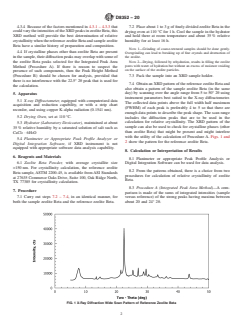
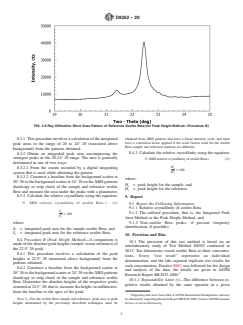
with the utility of the calculation of Procedure A. Figs. 1 and
5.4 Planimeter or Appropriate Peak Profile Analyzer or
2 show the pattern for the reference zeolite Beta.
Digital Integration Software, if XRD instrument is not
equipped with appropriate software data analysis capability.
8. Calculation or Interpretation of Results
6. Reagents and Materials
8.1 Planimeter or appropriate Peak Profile Analysis or
6.1 Zeolite Beta Powder, with average crystallite size Digital Integration Software can be used for data analysis.
>150 nm. For crystallinity calculation, the reference zeolite
8.2 From the patterns obtained, there is a choice from two
Beta sample,ASTM 2200-45, is available fromASI Standards
procedures for calculati
...