

ASTM D3500-20
(Test Method)Standard Test Methods for Wood Structural Panels in Tension
General Information
- Abstract
SIGNIFICANCE AND USE
3.1 These test methods determine the tensile properties of wood structural panels in response to stresses acting in the plane of the panel.
3.2 Test Method A—This test method is suited to material that is uniform with respect to tensile properties. It is normally applied to wood structural panels and plywood of clear, straight-grained veneers. It may also be used to evaluate the strength of scarf and finger joints and other manufacturing process variables that can be expected to influence the tensile properties of wood structural panels in a uniform manner across the width of the sheet.
3.3 Test Method B—This test method employs large test specimens and responds well to all manufacturing variables and growth characteristics that affect the tensile properties of wood structural panels.
3.4 It is recommended that where comparisons are to be made that the same test method and specimen size be used throughout. This is because the volume of material included in a test specimen can influence the tensile strength regardless of whether the material properties are uniform throughout the sheet or vary widely due to the presence of growth or manufacturing features.
SCOPE
1.1 These test methods cover the determination of the tensile properties of wood structural panels.
1.2 Wood structural panels in use include plywood, oriented strand board and composites of veneer, and other wood-based layers.
1.3 Test Method A, Tensile Test for Small Specimens:
1.3.1 This test method employs small specimens that should have a reduced cross section at the center of their length to avoid failure in the grip area. The transition from full width of specimen to reduced section at the center should be gradual to minimize stress concentration.
1.3.2 When the measurements of elastic properties are to be made, the length of the reduced cross section at the center should be of sufficient length to accommodate an extensometer.
1.4 Test Method B, Tensile Test for Large Specimens:
1.4.1 This test method employs large specimens and responds well to manufacturing variables, panel grade characteristics, and other variables influencing the tensile properties of structural panels.
1.4.2 The test specimens are large enough to contain the maximum sized grade characteristics found in panels. The test specimens have a constant cross section since the size and location of grade characteristics control the location of failures and the effect of stress concentration at the grips is overshadowed.
1.4.3 This test method is recommended for the following:
1.4.3.1 Comparative tests of wood structural panels,
1.4.3.2 Determining the influence of any specific strength reducing variables on the tensile properties of wood structural panels,
1.4.3.3 Determination of tensile properties of panels for use in developing structural recommendations.
1.5 The values stated in inch-pound units are to be regarded as standard. The values given in parentheses are mathematical conversions to SI units that are provided for information only and are not considered standard.
1.6 This standard does not purport to address all of the safety concerns, if any, associated with its use. It is the responsibility of the user of this standard to establish appropriate safety, health, and environmental practices and determine the applicability of regulatory limitations prior to use.
1.7 This international standard was developed in accordance with internationally recognized principles on standardization established in the Decision on Principles for the Development of International Standards, Guides and Recommendations issued by the World Trade Organization Technical Barriers to Trade (TBT) Committee.
- Status
- Published
- Publication Date
- 14-Jun-2020
- Technical Committee
- D07 - Wood
- Drafting Committee
- D07.03 - Panel Products
Overview
ASTM D3500-20: Standard Test Methods for Wood Structural Panels in Tension is an internationally recognized standard developed by ASTM International. This standard specifies the methodology for determining the tensile properties of wood structural panels-such as plywood, oriented strand board (OSB), and wood-based composite layers-under stresses acting in the plane of the panel. Tensile strength is a critical parameter for evaluating panel performance and suitability in structural applications, ensuring safety and reliability in construction and manufacturing processes.
Key Topics
Test Method A (Small Specimens):
- Designed for materials with uniform tensile properties, such as clear, straight-grained plywood and uniformly bonded panels.
- Useful for assessing variables like manufacturing joint integrity (scarf and finger joints) where uniformity is expected.
- Specimens have a reduced section at the center to avoid grip failure and minimize stress concentration.
- Measurements of elastic properties are possible when specimen geometry allows.
Test Method B (Large Specimens):
- Accommodates variability in manufacturing and natural wood characteristics.
- Utilizes large specimens sufficient to represent maximum grade features found in the full panel.
- Provides reliable assessments for comparative performance, influence of strength-reducing factors, and structural recommendations.
- Specimens have a constant cross section; grip effects are minimized by specimen size.
Conditioning and Variables:
- Moisture content and specific gravity are controlled and measured according to ASTM D4442 and ASTM D2395, respectively.
- Tests should be conducted under standard atmospheric conditions to ensure consistency.
- Comparisons must use identical test methods and specimen sizes due to the influence of specimen volume on strength measurements.
Reporting Requirements:
- Results include specimen details, test method identification, measured mechanical properties, and a description of any variables or features that could influence the results.
- Essential data: thickness, width, net length, specific gravity, moisture content, tensile stiffness, maximum load and strength, load-deflection curves, and failure description.
Applications
ASTM D3500-20 is widely used in the evaluation and qualification of wood structural panels for:
- Construction: Verifying the tensile strength of panels used in flooring, roofing, and wall sheathing to ensure they meet structural code requirements and safety standards.
- Product Development: Determining the effects of new adhesives, bonding methods, or manufacturing processes on panel integrity.
- Quality Control: Routine testing during production to ensure consistency and detect defects or changes in raw material properties.
- Research: Supporting studies into new wood-based composites and improving understanding of the factors influencing tensile performance in engineered wood products.
Related Standards
- ASTM D2395: Test Methods for Density and Specific Gravity (Relative Density) of Wood and Wood-Based Materials - referenced for specific gravity determination of test specimens.
- ASTM D4442: Test Methods for Direct Moisture Content Measurement of Wood and Wood-Based Materials - used to assess moisture content before tensile testing.
- Other ASTM Wood Panel Standards: Standards covering flexural, shear, and other properties of wood-based panels, complementing tensile testing for a comprehensive evaluation.
Keywords: ASTM D3500-20, wood structural panels, tensile properties, plywood, oriented strand board, wood composites, standard test methods, construction materials testing, structural integrity, panel performance.
Relations
- Effective Date
- 01-Mar-2020
- Effective Date
- 15-Nov-2016
- Effective Date
- 01-Jun-2015
- Effective Date
- 01-May-2014
- Effective Date
- 01-May-2014
- Effective Date
- 15-Nov-2007
- Refers
ASTM D2395-07ae1 - Standard Test Methods for Specific Gravity of Wood and Wood-Based Materials - Effective Date
- 01-Jul-2007
- Effective Date
- 01-Jul-2007
- Effective Date
- 01-Apr-2007
- Effective Date
- 01-Oct-2006
- Effective Date
- 10-Apr-2002
- Effective Date
- 10-Mar-1997
- Effective Date
- 15-Feb-1992
Get Certified
Connect with accredited certification bodies for this standard

Gozdarski inštitut Slovenije
Slovenian Forestry Institute. Forest management certification support, timber testing.
Sponsored listings
Frequently Asked Questions
ASTM D3500-20 is a standard published by ASTM International. Its full title is "Standard Test Methods for Wood Structural Panels in Tension". This standard covers: SIGNIFICANCE AND USE 3.1 These test methods determine the tensile properties of wood structural panels in response to stresses acting in the plane of the panel. 3.2 Test Method A—This test method is suited to material that is uniform with respect to tensile properties. It is normally applied to wood structural panels and plywood of clear, straight-grained veneers. It may also be used to evaluate the strength of scarf and finger joints and other manufacturing process variables that can be expected to influence the tensile properties of wood structural panels in a uniform manner across the width of the sheet. 3.3 Test Method B—This test method employs large test specimens and responds well to all manufacturing variables and growth characteristics that affect the tensile properties of wood structural panels. 3.4 It is recommended that where comparisons are to be made that the same test method and specimen size be used throughout. This is because the volume of material included in a test specimen can influence the tensile strength regardless of whether the material properties are uniform throughout the sheet or vary widely due to the presence of growth or manufacturing features. SCOPE 1.1 These test methods cover the determination of the tensile properties of wood structural panels. 1.2 Wood structural panels in use include plywood, oriented strand board and composites of veneer, and other wood-based layers. 1.3 Test Method A, Tensile Test for Small Specimens: 1.3.1 This test method employs small specimens that should have a reduced cross section at the center of their length to avoid failure in the grip area. The transition from full width of specimen to reduced section at the center should be gradual to minimize stress concentration. 1.3.2 When the measurements of elastic properties are to be made, the length of the reduced cross section at the center should be of sufficient length to accommodate an extensometer. 1.4 Test Method B, Tensile Test for Large Specimens: 1.4.1 This test method employs large specimens and responds well to manufacturing variables, panel grade characteristics, and other variables influencing the tensile properties of structural panels. 1.4.2 The test specimens are large enough to contain the maximum sized grade characteristics found in panels. The test specimens have a constant cross section since the size and location of grade characteristics control the location of failures and the effect of stress concentration at the grips is overshadowed. 1.4.3 This test method is recommended for the following: 1.4.3.1 Comparative tests of wood structural panels, 1.4.3.2 Determining the influence of any specific strength reducing variables on the tensile properties of wood structural panels, 1.4.3.3 Determination of tensile properties of panels for use in developing structural recommendations. 1.5 The values stated in inch-pound units are to be regarded as standard. The values given in parentheses are mathematical conversions to SI units that are provided for information only and are not considered standard. 1.6 This standard does not purport to address all of the safety concerns, if any, associated with its use. It is the responsibility of the user of this standard to establish appropriate safety, health, and environmental practices and determine the applicability of regulatory limitations prior to use. 1.7 This international standard was developed in accordance with internationally recognized principles on standardization established in the Decision on Principles for the Development of International Standards, Guides and Recommendations issued by the World Trade Organization Technical Barriers to Trade (TBT) Committee.
SIGNIFICANCE AND USE 3.1 These test methods determine the tensile properties of wood structural panels in response to stresses acting in the plane of the panel. 3.2 Test Method A—This test method is suited to material that is uniform with respect to tensile properties. It is normally applied to wood structural panels and plywood of clear, straight-grained veneers. It may also be used to evaluate the strength of scarf and finger joints and other manufacturing process variables that can be expected to influence the tensile properties of wood structural panels in a uniform manner across the width of the sheet. 3.3 Test Method B—This test method employs large test specimens and responds well to all manufacturing variables and growth characteristics that affect the tensile properties of wood structural panels. 3.4 It is recommended that where comparisons are to be made that the same test method and specimen size be used throughout. This is because the volume of material included in a test specimen can influence the tensile strength regardless of whether the material properties are uniform throughout the sheet or vary widely due to the presence of growth or manufacturing features. SCOPE 1.1 These test methods cover the determination of the tensile properties of wood structural panels. 1.2 Wood structural panels in use include plywood, oriented strand board and composites of veneer, and other wood-based layers. 1.3 Test Method A, Tensile Test for Small Specimens: 1.3.1 This test method employs small specimens that should have a reduced cross section at the center of their length to avoid failure in the grip area. The transition from full width of specimen to reduced section at the center should be gradual to minimize stress concentration. 1.3.2 When the measurements of elastic properties are to be made, the length of the reduced cross section at the center should be of sufficient length to accommodate an extensometer. 1.4 Test Method B, Tensile Test for Large Specimens: 1.4.1 This test method employs large specimens and responds well to manufacturing variables, panel grade characteristics, and other variables influencing the tensile properties of structural panels. 1.4.2 The test specimens are large enough to contain the maximum sized grade characteristics found in panels. The test specimens have a constant cross section since the size and location of grade characteristics control the location of failures and the effect of stress concentration at the grips is overshadowed. 1.4.3 This test method is recommended for the following: 1.4.3.1 Comparative tests of wood structural panels, 1.4.3.2 Determining the influence of any specific strength reducing variables on the tensile properties of wood structural panels, 1.4.3.3 Determination of tensile properties of panels for use in developing structural recommendations. 1.5 The values stated in inch-pound units are to be regarded as standard. The values given in parentheses are mathematical conversions to SI units that are provided for information only and are not considered standard. 1.6 This standard does not purport to address all of the safety concerns, if any, associated with its use. It is the responsibility of the user of this standard to establish appropriate safety, health, and environmental practices and determine the applicability of regulatory limitations prior to use. 1.7 This international standard was developed in accordance with internationally recognized principles on standardization established in the Decision on Principles for the Development of International Standards, Guides and Recommendations issued by the World Trade Organization Technical Barriers to Trade (TBT) Committee.
ASTM D3500-20 is classified under the following ICS (International Classification for Standards) categories: 79.060.10 - Plywood. The ICS classification helps identify the subject area and facilitates finding related standards.
ASTM D3500-20 has the following relationships with other standards: It is inter standard links to ASTM D4442-20, ASTM D4442-16, ASTM D4442-15, ASTM D2395-14e1, ASTM D2395-14, ASTM D4442-07, ASTM D2395-07ae1, ASTM D2395-07a, ASTM D2395-07, ASTM D2395-06, ASTM D2395-02, ASTM D4442-92(1997)e1, ASTM D4442-92(2003). Understanding these relationships helps ensure you are using the most current and applicable version of the standard.
ASTM D3500-20 is available in PDF format for immediate download after purchase. The document can be added to your cart and obtained through the secure checkout process. Digital delivery ensures instant access to the complete standard document.
Standards Content (Sample)
This international standard was developed in accordance with internationally recognized principles on standardization established in the Decision on Principles for the
Development of International Standards, Guides and Recommendations issued by the World Trade Organization Technical Barriers to Trade (TBT) Committee.
Designation: D3500 − 20
Standard Test Methods for
Wood Structural Panels in Tension
This standard is issued under the fixed designation D3500; the number immediately following the designation indicates the year of
original adoption or, in the case of revision, the year of last revision.Anumber in parentheses indicates the year of last reapproval.A
superscript epsilon (´) indicates an editorial change since the last revision or reapproval.
This standard has been approved for use by agencies of the U.S. Department of Defense.
1. Scope conversions to SI units that are provided for information only
and are not considered standard.
1.1 These test methods cover the determination of the
1.6 This standard does not purport to address all of the
tensile properties of wood structural panels.
safety concerns, if any, associated with its use. It is the
1.2 Woodstructuralpanelsinuseincludeplywood,oriented
responsibility of the user of this standard to establish appro-
strand board and composites of veneer, and other wood-based
priate safety, health, and environmental practices and deter-
layers.
mine the applicability of regulatory limitations prior to use.
1.3 Test Method A, Tensile Test for Small Specimens:
1.7 This international standard was developed in accor-
1.3.1 Thistestmethodemployssmallspecimensthatshould
dance with internationally recognized principles on standard-
have a reduced cross section at the center of their length to
ization established in the Decision on Principles for the
avoid failure in the grip area. The transition from full width of
Development of International Standards, Guides and Recom-
specimen to reduced section at the center should be gradual to
mendations issued by the World Trade Organization Technical
minimize stress concentration.
Barriers to Trade (TBT) Committee.
1.3.2 When the measurements of elastic properties are to be
made, the length of the reduced cross section at the center 2. Referenced Documents
shouldbeofsufficientlengthtoaccommodateanextensometer.
2.1 ASTM Standards:
1.4 Test Method B, Tensile Test for Large Specimens: D2395TestMethodsforDensityandSpecificGravity(Rela-
tive Density) of Wood and Wood-Based Materials
1.4.1 This test method employs large specimens and re-
sponds well to manufacturing variables, panel grade D4442Test Methods for Direct Moisture Content Measure-
ment of Wood and Wood-Based Materials
characteristics, and other variables influencing the tensile
properties of structural panels.
3. Significance and Use
1.4.2 The test specimens are large enough to contain the
maximum sized grade characteristics found in panels. The test
3.1 These test methods determine the tensile properties of
specimens have a constant cross section since the size and
wood structural panels in response to stresses acting in the
location of grade characteristics control the location of failures
plane of the panel.
and the effect of stress concentration at the grips is overshad-
3.2 Test Method A—This test method is suited to material
owed.
that is uniform with respect to tensile properties. It is normally
1.4.3 This test method is recommended for the following:
applied to wood structural panels and plywood of clear,
1.4.3.1 Comparative tests of wood structural panels,
straight-grained veneers. It may also be used to evaluate the
1.4.3.2 Determining the influence of any specific strength
strength of scarf and finger joints and other manufacturing
reducing variables on the tensile properties of wood structural
process variables that can be expected to influence the tensile
panels,
properties of wood structural panels in a uniform manner
1.4.3.3 Determination of tensile properties of panels for use
across the width of the sheet.
in developing structural recommendations.
3.3 Test Method B—This test method employs large test
1.5 The values stated in inch-pound units are to be regarded
specimens and responds well to all manufacturing variables
as standard. The values given in parentheses are mathematical
and growth characteristics that affect the tensile properties of
wood structural panels.
These test methods are under the jurisdiction of ASTM Committee D07 on
Wood and are the direct responsibility of Subcommittee D07.03 on Panel Products. For referenced ASTM standards, visit the ASTM website, www.astm.org, or
Current edition approved June 15, 2020. Published July 2020. Originally contact ASTM Customer Service at service@astm.org. For Annual Book of ASTM
approved in 1976. Last previous edition approved in 2014 as D3500–14. DOI: Standards volume information, refer to the standard’s Document Summary page on
10.1520/D3500-20. the ASTM website.
Copyright © ASTM International, 100 Barr Harbor Drive, PO Box C700, West Conshohocken, PA 19428-2959. United States
D3500 − 20
3.4 It is recommended that where comparisons are to be 5.2 Specific Gravity—Determine specific gravity in accor-
made that the same test method and specimen size be used dance with Test Methods D2395. The specimen may be the
throughout.This is because the volume of material included in same as that for moisture content determination but must have
3 3
a test specimen can influence the tensile strength regardless of volumeofatleast1in. (16cm )iffromsmallspecimens(Test
3 3
whether the material properties are uniform throughout the MethodA),andatleast3in. (49cm )iffromlargespecimens
sheet or vary widely due to the presence of growth or (Test Method B). Specimens containing veneer shall be free of
manufacturing features. visible knots or voids in any ply.
TEST METHOD A—TENSILE PROPERTIES
4. Control of Moisture Content
OF SMALL SPECIMENS
4.1 Wood structural panel specimens to be tested at specific
moisture contents or after reaching equilibrium moisture con-
6. Test Specimens
tent at specific temperature and relative humidity conditions
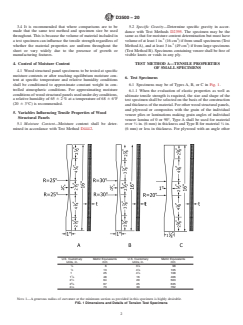
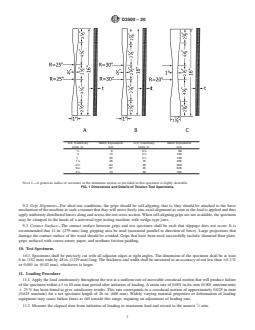
shall be conditioned to approximate constant weight in con- 6.1 Specimens may be of Types A, B, or C in Fig. 1.
trolled atmospheric conditions. For approximating moisture
6.1.1 When the evaluation of elastic properties as well as
conditionsofwoodstructuralpanelsusedunderdryconditions,
ultimate tensile strength is required, the size and shape of the
a relative humidity of 65 6 2% at a temperature of 68 6 6°F
test specimen shall be selected on the basis of the construction
(20 6 3°C) is recommended.
andthicknessofthematerial.Forotherwoodstructuralpanels,
and plywood or composites with the grain of the individual
5. Variables Influencing Tensile Properties of Wood
veneer plies or laminations making grain angles of individual
Structural Panels
veneer lamina of 0 or 90°, Type A shall be used for material
1 1
5.1 Moisture Content—Moisture content shall be deter- over ⁄4 in. (6 mm) in thickness and Type B for material ⁄4 in.
mined in accordance with Test Method D4442. (6 mm) or less in thickness. For plywood with an angle other
U.S. Customary Metric Equivalents U.S. Customary Metric Equivalents
Units, in. mm Units, in. mm
1 7
⁄4 63 ⁄8 98
1 1
⁄2 13 4 ⁄8 105
125 4 ⁄4 108
1 ⁄8 48 16 406
2 ⁄2 64 20 503
2 ⁄8 67 25 635
2 ⁄8 73 30 762
NOTE 1—A generous radius of curvature at the minimum section as provided in this specimen is highly desirable.
FIG. 1 Dimensions and Details of Tension Test Specimens
D3500 − 20
than0or90°betweenthelengthofthespecimensandthegrain
orientation,Type C shall be used regardless of the thickness of
thematerial.Thespecimensshallhaveathicknessequaltothat
of the material. The thickness and the width of each specimen
at the critical section shall be measured to an a
...
This document is not an ASTM standard and is intended only to provide the user of an ASTM standard an indication of what changes have been made to the previous version. Because
it may not be technically possible to adequately depict all changes accurately, ASTM recommends that users consult prior editions as appropriate. In all cases only the current version
of the standard as published by ASTM is to be considered the official document.
Designation: D3500 − 14 D3500 − 20
Standard Test Methods for
Wood Structural Panels in Tension
This standard is issued under the fixed designation D3500; the number immediately following the designation indicates the year of
original adoption or, in the case of revision, the year of last revision. A number in parentheses indicates the year of last reapproval. A
superscript epsilon (´) indicates an editorial change since the last revision or reapproval.
This standard has been approved for use by agencies of the U.S. Department of Defense.
1. Scope
1.1 These test methods cover the determination of the tensile properties of wood structural panels.
1.2 Structural Wood structural panels in use include plywood, oriented strand board and composites of veneer, and other
wood-based layerslayers.
1.3 Test Method A, Tensile Test for Small Specimens:
1.3.1 This test method employs small specimens that should have a reduced cross section at the center of their length to avoid
failure in the grip area. The transition from full width of specimen to reduced section at the center should be gradual to minimize
stress concentration.
1.3.2 When the measurements of elastic properties are to be made, the length of the reduced cross section at the center should
be of sufficient length to accommodate an extensometer.
1.4 Test Method B, Tensile Test for Large Specimens:
1.4.1 This test method employs large specimens and responds well to manufacturing variables, panel grade characteristics, and
other variables influencing the tensile properties of structural panels.
1.4.2 The test specimens are large enough to contain the maximum sized grade characteristics found in panels. The test
specimens have a constant cross section since the size and location of grade characteristics control the location of failures and the
effect of stress concentration at the grips is overshadowed.
1.4.3 This test method is recommended for the following:
1.4.3.1 Comparative tests of wood structural panels,
1.4.3.2 Determining the influence of any specific strength reducing variables on the tensile properties of wood structural panels,
1.4.3.3 Determination of tensile properties of panels for use in developing structural recommendations.
1.5 The values stated in inch-pound units are to be regarded as standard. The values given in parentheses are mathematical
conversions to SI units that are provided for information only and are not considered standard.
1.6 This standard does not purport to address all of the safety concerns, if any, associated with its use. It is the responsibility
of the user of this standard to establish appropriate safety safety, health, and healthenvironmental practices and determine the
applicability of regulatory limitations prior to use.
1.7 This international standard was developed in accordance with internationally recognized principles on standardization
established in the Decision on Principles for the Development of International Standards, Guides and Recommendations issued
by the World Trade Organization Technical Barriers to Trade (TBT) Committee.
2. Referenced Documents
2.1 ASTM Standards:
D2395 Test Methods for Density and Specific Gravity (Relative Density) of Wood and Wood-Based Materials
D4442 Test Methods for Direct Moisture Content Measurement of Wood and Wood-Based Materials
3. Significance and Use
3.1 These test methods determine the tensile properties of wood structural panels in response to stresses acting in the plane of
the panel.
These test methods are under the jurisdiction of ASTM Committee D07 on Wood and are the direct responsibility of Subcommittee D07.03 on Panel Products.
Current edition approved Oct. 1, 2014June 15, 2020. Published November 2014July 2020. Originally approved in 1976. Last previous edition approved in 20092014 as
D3500 – 90 (2009).D3500 – 14. DOI: 10.1520/D3500-14.10.1520/D3500-20.
For referenced ASTM standards, visit the ASTM website, www.astm.org, or contact ASTM Customer Service at service@astm.org. For Annual Book of ASTM Standards
volume information, refer to the standard’s Document Summary page on the ASTM website.
Copyright © ASTM International, 100 Barr Harbor Drive, PO Box C700, West Conshohocken, PA 19428-2959. United States
D3500 − 20
3.2 Test Method A—This test method is suited to material that is uniform with respect to tensile properties. It is normally applied
to wood structural panels and plywood of clear, straight-grained veneers. It may also be used to evaluate the strength of scarf and
finger joints and other manufacturing process variables that can be expected to influence the tensile properties of wood structural
panels in a uniform manner across the width of the sheet.
3.3 Test Method B—This test method employs large test specimens and responds well to all manufacturing variables and growth
characteristics that affect the tensile properties of wood structural panels.
3.4 It is recommended that where comparisons are to be made that the same test method and specimen size be used throughout.
This is because the volume of material included in a test specimen can influence the tensile strength regardless of whether the
material properties are uniform throughout the sheet or vary widely due to the presence of growth or manufacturing features.
4. Control of Moisture Content
4.1 Structural Wood structural panel specimens to be tested at specific moisture contents or after reaching equilibrium moisture
content at specific temperature and relative humidity conditions shall be conditioned to approximate constant weight in controlled
atmospheric conditions. For approximating moisture conditions of wood structural panels used under dry conditions, a relative
humidity of 65 6 2 % at a temperature of (6868 6 6°F)6°F (20 6 3°C) is recommended.
5. Variables Influencing Tensile Properties of Wood Structural Panels
5.1 Moisture Content—Moisture content shall be determined in accordance with Test Method D4442.
5.2 Specific Gravity—Determine specific gravity in accordance with Test Methods D2395. The specimen may be the same as
3 3
that for moisture content determination but must have volume of at least 1 in. (16 cm ) if from small specimens (Test Method
3 3
A), and at least 3 in. (49 cm ) if from large specimens (Test Method B). Specimens containing veneer shall be free of visible knots
or voids in any ply.
TEST METHOD A—TENSILE PROPERTIES
OF SMALL SPECIMENS
6. Test Specimens
6.1 Specimens may be of Types A, B, or C in Fig. 1.
6.1.1 When the evaluation of elastic properties as well as ultimate tensile strength is required, the size and shape of the test
specimen shall be selected on the basis of the construction and thickness of the material. For other wood structural panels, and
plywood or composites with the grain of the individual veneer plies or laminations making grain angles of individual veneer lamina
1 1
of 0 or 90°, Type A shall be used for material over ⁄4 in. (6 mm) in thickness and Type B for material ⁄4 in. (6 mm) or less in
thickness. For plywood with an angle other than 0 or 90° between the length of the specimens and the grain orientation, Type C
shall be used regardless of the thickness of the material. The specimens shall have a thickness equal to that of the material. The
thickness and the width of each specimen at the critical section shall be measured to an accuracy of not less than 60.3 % or 0.001
in. (0.02 mm) whichever is larger.
6.1.2 The test specimens shall be properly shaped, using a template in conjunction with a vertical-spindle wood-working shaper
or any other method that will give equally satisfactory results.
7. Loading Procedure
7.1 Hold the specimen in wedge-type self-tightening and self-aligning grips. Rate of crosshe
...