

ASTM D2959-95(2017)
(Test Method)Standard Test Method for Ethylene Oxide Content of Polyethoxylated Nonionic Surfactants
General Information
- Abstract
ABSTRACT
This test method covers the determination of ethylene oxide content in polyethoxylated nonionic surfactants. It can also be used for compounds containing propylene oxide or any compounds (glycols and glycol and polyglycol ethers and esters) which form unstable 1,2-diiodides on reaction with hydroiodic acid. The apparatus is comprised of the following: heat source which shall be an electric heater provided with a sliding rheostat or other means of heat control; flasks which shall be equipped with a standard ground-glass joint; condensers with standard joints; gas bubbler filled with dibutyl phthalate; buret; and pipet. The dual apparatus is designed to permit a sample and a blank to be run simultaneously. Reagent grade chemicals or reagents of sufficiently high purity including water, carbon dioxide or nitrogen, lubricant, dibutyl phthalate, glass beads, hydroiodic acid, hydrochloric acid, methanol, potassium dichromate, potassium iodide solution, sodium thiosulfate, and starch indicator solution shall be used in all tests. The ethylene oxide content shall be calculated from the amount of sodium thiosulfate solution required to titrate the sample and the blank, normality of sodium thiosulfate, and weight of the sample. Standard deviations for repeatability and reproducibility shall be estimated to determine the acceptability of the results.
SCOPE
1.1 This test method covers the determination of ethylene oxide in polyethoxylated nonionic surfactants. It can also be used for compounds containing propylene oxide or any compounds (glycols and glycol and polyglycol ethers and esters) which form unstable 1,2-diiodides on reaction with hydriodic acid.
Note 1: Compounds in which the oxyalkylene group is connected to a nitrogen cannot be entirely decomposed. This can be used to determine the percent of an ethoxylated surfactant in a mixture, if the ethylene oxide content of the ethoxylated surfactant is known.
Note 2: This method reports results as percent ethylene oxide. If this method is applied to unknown compounds or compositions, the analyst should be aware of the possible presence of material other than ethylene oxide.
Note 3: For use on built syndet compositions the organic active ingredient must be isolated in accordance with Test Method D2358.
1.2 The values stated in SI units are to be regarded as standard. No other units of measurement are included in this standard.
1.3 This standard does not purport to address all of the safety concerns, if any, associated with its use. It is the responsibility of the user of this standard to establish appropriate safety and health practices and determine the applicability of regulatory limitations prior to use. Material Safety Data Sheets are available for reagents and materials. Review them for hazards prior to usage.
- Status
- Published
- Publication Date
- 31-Dec-2016
- Technical Committee
- D12 - Soaps and Other Detergents


Overview
ASTM D2959-95(2017) is a standardized test method developed by ASTM International for determining the ethylene oxide content in polyethoxylated nonionic surfactants. This method is essential for quality control and characterization in the manufacture and application of surfactants, which are widely used in detergents, cleaning agents, and various industrial formulations. The standard can also be applied to compounds containing propylene oxide, glycols, and glycol or polyglycol ethers and esters that react with hydriodic acid to form unstable 1,2-diiodides.
Key Topics
- Scope of Measurement: The method covers polyethoxylated nonionic surfactants and similar oxyalkylene compounds. It specifically quantifies ethylene oxide as a percentage of the sample.
- Test Principle: Nonionic surfactants with ethylene oxide chains are cleaved with hydriodic acid, forming unstable 1,2-diiodoethane, which decomposes to produce ethylene and iodine. The iodine is then measured by titration with standard sodium thiosulfate solution.
- Apparatus and Reagents:
- Electric heater for controlled heating
- 100 mL ground-glass flasks and vertical condensers
- Dibutyl phthalate gas bubbler
- Buret and pipet for precise measurements
- High-purity reagents including hydriodic acid, potassium iodide, sodium thiosulfate, and starch indicator solution
- Calculation: The ethylene oxide content is calculated based on the volume of sodium thiosulfate used, its normality, and the weight of the sample.
Applications
ASTM D2959-95(2017) is widely utilized in the following practical areas:
- Surfactant Manufacturing: Ensures accurate ethylene oxide content for consistent product performance in cleaning and household products.
- Quality Assurance: Critical for batch certification and adherence to product specifications in the chemical, cosmetic, and pharmaceutical industries.
- Research and Development: Supports formulation and comparative analysis of new surfactant products or variants by providing reliable ethylene oxide content data.
- Analytical Laboratories: Employed as a reference method for validating in-house or alternative analytical techniques.
- Regulatory Compliance: Assists in meeting industry and safety regulations where the determination of ethylene oxide content is required.
Related Standards
For comprehensive application and compliance, the following related ASTM standards are referenced or may be applicable:
- ASTM D2358 – Test Method for Separation of Active Ingredient from Surfactant and Syndet Compositions. Required when working with built syndet compositions to isolate the organic active ingredient prior to analysis.
- ASTM D1193 – Specification for Reagent Water. Establishes the quality of water to be used in testing, ensuring reliability and repeatability.
- Other international or industry-specific standards may also be relevant for surfactant analysis and test method validation.
Keywords: ASTM D2959, ethylene oxide content, polyethoxylated nonionic surfactants, surfactant analysis, titration, quality control, chemical testing, industrial detergents, standard operating procedures
Relations
- Effective Date
- 01-Jan-2017
- Effective Date
- 01-Jul-2016
- Effective Date
- 01-Oct-2009
- Effective Date
- 01-Mar-2006
- Effective Date
- 10-Feb-1999
- Effective Date
- 10-Feb-1999
- Effective Date
- 01-Jan-1995
- Effective Date
- 26-May-1989
- Effective Date
- 01-Jan-2017
Get Certified
Connect with accredited certification bodies for this standard

ECOCERT
Organic and sustainability certification.

Eurofins Food Testing Global
Global leader in food, environment, and pharmaceutical product testing.

Intertek Bangladesh
Intertek certification and testing services in Bangladesh.
Sponsored listings
Frequently Asked Questions
ASTM D2959-95(2017) is a standard published by ASTM International. Its full title is "Standard Test Method for Ethylene Oxide Content of Polyethoxylated Nonionic Surfactants". This standard covers: ABSTRACT This test method covers the determination of ethylene oxide content in polyethoxylated nonionic surfactants. It can also be used for compounds containing propylene oxide or any compounds (glycols and glycol and polyglycol ethers and esters) which form unstable 1,2-diiodides on reaction with hydroiodic acid. The apparatus is comprised of the following: heat source which shall be an electric heater provided with a sliding rheostat or other means of heat control; flasks which shall be equipped with a standard ground-glass joint; condensers with standard joints; gas bubbler filled with dibutyl phthalate; buret; and pipet. The dual apparatus is designed to permit a sample and a blank to be run simultaneously. Reagent grade chemicals or reagents of sufficiently high purity including water, carbon dioxide or nitrogen, lubricant, dibutyl phthalate, glass beads, hydroiodic acid, hydrochloric acid, methanol, potassium dichromate, potassium iodide solution, sodium thiosulfate, and starch indicator solution shall be used in all tests. The ethylene oxide content shall be calculated from the amount of sodium thiosulfate solution required to titrate the sample and the blank, normality of sodium thiosulfate, and weight of the sample. Standard deviations for repeatability and reproducibility shall be estimated to determine the acceptability of the results. SCOPE 1.1 This test method covers the determination of ethylene oxide in polyethoxylated nonionic surfactants. It can also be used for compounds containing propylene oxide or any compounds (glycols and glycol and polyglycol ethers and esters) which form unstable 1,2-diiodides on reaction with hydriodic acid. Note 1: Compounds in which the oxyalkylene group is connected to a nitrogen cannot be entirely decomposed. This can be used to determine the percent of an ethoxylated surfactant in a mixture, if the ethylene oxide content of the ethoxylated surfactant is known. Note 2: This method reports results as percent ethylene oxide. If this method is applied to unknown compounds or compositions, the analyst should be aware of the possible presence of material other than ethylene oxide. Note 3: For use on built syndet compositions the organic active ingredient must be isolated in accordance with Test Method D2358. 1.2 The values stated in SI units are to be regarded as standard. No other units of measurement are included in this standard. 1.3 This standard does not purport to address all of the safety concerns, if any, associated with its use. It is the responsibility of the user of this standard to establish appropriate safety and health practices and determine the applicability of regulatory limitations prior to use. Material Safety Data Sheets are available for reagents and materials. Review them for hazards prior to usage.
ABSTRACT This test method covers the determination of ethylene oxide content in polyethoxylated nonionic surfactants. It can also be used for compounds containing propylene oxide or any compounds (glycols and glycol and polyglycol ethers and esters) which form unstable 1,2-diiodides on reaction with hydroiodic acid. The apparatus is comprised of the following: heat source which shall be an electric heater provided with a sliding rheostat or other means of heat control; flasks which shall be equipped with a standard ground-glass joint; condensers with standard joints; gas bubbler filled with dibutyl phthalate; buret; and pipet. The dual apparatus is designed to permit a sample and a blank to be run simultaneously. Reagent grade chemicals or reagents of sufficiently high purity including water, carbon dioxide or nitrogen, lubricant, dibutyl phthalate, glass beads, hydroiodic acid, hydrochloric acid, methanol, potassium dichromate, potassium iodide solution, sodium thiosulfate, and starch indicator solution shall be used in all tests. The ethylene oxide content shall be calculated from the amount of sodium thiosulfate solution required to titrate the sample and the blank, normality of sodium thiosulfate, and weight of the sample. Standard deviations for repeatability and reproducibility shall be estimated to determine the acceptability of the results. SCOPE 1.1 This test method covers the determination of ethylene oxide in polyethoxylated nonionic surfactants. It can also be used for compounds containing propylene oxide or any compounds (glycols and glycol and polyglycol ethers and esters) which form unstable 1,2-diiodides on reaction with hydriodic acid. Note 1: Compounds in which the oxyalkylene group is connected to a nitrogen cannot be entirely decomposed. This can be used to determine the percent of an ethoxylated surfactant in a mixture, if the ethylene oxide content of the ethoxylated surfactant is known. Note 2: This method reports results as percent ethylene oxide. If this method is applied to unknown compounds or compositions, the analyst should be aware of the possible presence of material other than ethylene oxide. Note 3: For use on built syndet compositions the organic active ingredient must be isolated in accordance with Test Method D2358. 1.2 The values stated in SI units are to be regarded as standard. No other units of measurement are included in this standard. 1.3 This standard does not purport to address all of the safety concerns, if any, associated with its use. It is the responsibility of the user of this standard to establish appropriate safety and health practices and determine the applicability of regulatory limitations prior to use. Material Safety Data Sheets are available for reagents and materials. Review them for hazards prior to usage.
ASTM D2959-95(2017) is classified under the following ICS (International Classification for Standards) categories: 71.100.40 - Surface active agents. The ICS classification helps identify the subject area and facilitates finding related standards.
ASTM D2959-95(2017) has the following relationships with other standards: It is inter standard links to ASTM D2959-95(2009), ASTM D2358-16, ASTM D2358-89(2009), ASTM D1193-06, ASTM D1193-99, ASTM D1193-99e1, ASTM D2358-89(1995)e1, ASTM D2358-89(2003), ASTM D4252-89(2017). Understanding these relationships helps ensure you are using the most current and applicable version of the standard.
ASTM D2959-95(2017) is available in PDF format for immediate download after purchase. The document can be added to your cart and obtained through the secure checkout process. Digital delivery ensures instant access to the complete standard document.
Standards Content (Sample)
This international standard was developed in accordance with internationally recognized principles on standardization established in the Decision on Principles for the
Development of International Standards, Guides and Recommendations issued by the World Trade Organization Technical Barriers to Trade (TBT) Committee.
Designation: D2959 − 95 (Reapproved 2017)
Standard Test Method for
Ethylene Oxide Content of Polyethoxylated Nonionic
Surfactants
This standard is issued under the fixed designation D2959; the number immediately following the designation indicates the year of
original adoption or, in the case of revision, the year of last revision. A number in parentheses indicates the year of last reapproval. A
superscript epsilon (´) indicates an editorial change since the last revision or reapproval.
1. Scope D2358 TestMethodforSeparationofActiveIngredientfrom
Surfactant and Syndet Compositions
1.1 This test method covers the determination of ethylene
oxide in polyethoxylated nonionic surfactants. It can also be
3. Summary of Test Method
used for compounds containing propylene oxide or any com-
3.1 By cleaving nonionic surfactants containing polyethyl-
pounds (glycols and glycol and polyglycol ethers and esters)
ene oxide chains with hydriodic acid, the unstable 1,2-
which form unstable 1,2-diiodides on reaction with hydriodic
diiodoethane is formed. This vicinal diiodide decomposes to
acid.
form ethylene and iodine.
NOTE 1—Compounds in which the oxyalkylene group is connected to a
nitrogencannotbeentirelydecomposed.Thiscanbeusedtodeterminethe
percent of an ethoxylated surfactant in a mixture, if the ethylene oxide
content of the ethoxylated surfactant is known.
NOTE 2—This method reports results as percent ethylene oxide. If this
method is applied to unknown compounds or compositions, the analyst
should be aware of the possible presence of material other than ethylene
oxide.
3.2 The percent ethylene oxide is determined by measuring
NOTE 3—For use on built syndet compositions the organic active
the amount of free iodine formed, since one mole of iodine is
ingredient must be isolated in accordance with Test Method D2358.
formed for each mole of ethylene oxide in the polyoxyalkylene
1.2 The values stated in SI units are to be regarded as
chain. The free iodine is titrated with a standard sodium
standard. No other units of measurement are included in this
thiosulfate solution.
standard.
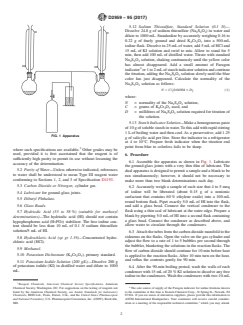
4. Apparatus (Fig. 1)
1.3 This standard does not purport to address all of the
safety concerns, if any, associated with its use. It is the
4.1 Heat Sources, two. The source of heat should be an
responsibility of the user of this standard to establish appro-
electric heater provided with a sliding rheostat or other means
priate safety and health practices and determine the applica-
of heat control.
bility of regulatory limitations prior to use. Material Safety
4.2 Flasks, two, 100-mL, round bottom. Each flask should
Data Sheets are available for reagents and materials. Review
be equipped with a standard ground-glass joint to accommo-
them for hazards prior to usage.
date a vertical condenser, and with a side arm through which
2. Referenced Documents carbon dioxide can be passed to blanket the reaction mixture.
4.3 Condensers, two, with standard joints to fit the flasks.
2.1 ASTM Standards:
D1193 Specification for Reagent Water
4.4 Gas Bubbler, filled with dibutyl phthalate.
4.5 Buret, 50-mL, with 0.1-mL graduations.
This method is under the jurisdiction of ASTM Committee D12 on Soaps and
Other Detergents and is the direct responsibility of Subcommittee D12.12 on
4.6 Pipet, 5-mL.
Analysis and Specifications of Soaps, Synthetics, Detergents and their Components.
Current edition approved Jan. 1, 2017. Published February 2017. Originally
5. Reagents
approved in 1971 as D2959 – 71 T. Last previous edition approved in 2009 as
D2959 – 95(2009). DOI: 10.1520/D2959-95R17.
5.1 Purity of Reagents—Reagent grade chemicals shall be
For referenced ASTM standards, visit the ASTM website, www.astm.org, or
used in all tests. Unless otherwise indicated, it is intended that
contact ASTM Customer Service at service@astm.org. For Annual Book of ASTM
all reagents shall conform to the specifications of the Commit-
Standards volume information, refer to the standard’s Document Summary page on
the ASTM website. tee onAnalytical Reagents of theAmerican Chemical Society,
Copyright © ASTM International, 100 Barr Harbor Drive, PO Box C700, West Conshohocken, PA 19428-2959. United States
D2959 − 95 (2017)
5.12 Sodium Thiosulfate, Standard Solution (0.1 N)—
Dissolve 24.8 g of sodium thiosulfate (Na S O ) in water and
2 2 3
dilute to 1000 mL. Standardize by accurately weighing 0.16 to
0.22 g of finely ground and dried K Cr O into a 500-mL
2 2 7
iodine flask. Dissolve in 25 mLof water, add 5 mLof HCl and
15 mL of KI solution and swirl to mix. Allow to stand for 5
min, then add 100 mL of distilled water. Titrate with standard
Na S O solution, shaking continuously until the yellow color
2 2 3
has almost disappeared. Add a small amount of Paragon
indicator or1to2mLofstarchindicatorsolutionandcontinue
the titration, adding the Na S O solution slowly until the blue
2 2 3
color has just disappeared. Calculate the normality of the
Na S O solution as follows:
2 2 3
N 5 C/ 0.04904 3 D (1)
~ !
where:
N = normality of the Na S O solution,
2 2 3
C = grams of K Cr O used, and
2 2 7
D = millilitres of Na S O solution required for titration of
2 2 3
the solution.
5.13 Starch Indicator Solution—Makeahomogeneouspaste
of10gofsolublestarchinwater.Tothisaddwithrapidstirring
1 Lof boiling water and then cool.As a preservative, add 1.25
FIG. 1 Apparatus
g of salicylic acid per litre. Store the indicator in a refrigerator
at 4 to 10°C. Prepare fresh indicator when the titration end
point from blue to colorless fails to be sharp.
where such specifications are available. Other grades may be
used, provided it is first ascertained that the reagent is of
6. Procedure
sufficiently high purity to permit its use without lessening the
6.1 Assemble the apparatus as shown in Fig. 1. Lubricate
accuracy of the determination.
the ground-glass joints with a very thin film of lubricant. The
5.2 Purity of Water—Unless otherwise indicated, references
dual apparatus is designed to permit a sample and a blank to be
to water shall be understood to mean Type III reagent water
run simultaneously; however, it should not be necessary to
conforming to Sections 1, 2, and 3 of Specification D119
...