

ASTM F1339-92(2016)
(Guide)Standard Guide for Organization and Operation of Emergency Medical Services Systems
General Information
- Abstract
SIGNIFICANCE AND USE
3.1 This guide suggests methods for organizing and operating state, regional, and local EMS systems, in accordance with Guide F1086. It will assist state, regional, or local organizations in assessing, planning, documenting, and implementing their specific operations. The guide is general in nature and able to be adapted for existing EMS Systems. For organizations that are establishing EMS System operations, the guide is specific enough to form the basis of the operational manual.
SCOPE
1.1 This standard established guidelines for the organization and operation of Emergency Medical Services Systems (EMSS) at the state, regional and local levels. This guide will identify methods of developing state standards, coordinating/managing regional EMS Systems, and delivering emergency medical services through the local EMS System.
1.1.1 At the state level this guide identifies scope, methods, procedures and participants in the following state structure responsibilities: (a) establishment of EMS legislation; (b) development of minimum standards; (c) enforcement of minimum standards; (d) designation of substate structure; (e) provision of technical assistance; (f) identification of funding and other resources for the development, maintenance, and enhancement of EMS systems; (g) development and implementation of training systems; (h) development and implementation of communication systems; (i) development and implementation of record-keeping and evaluation systems; (j) development and implementation of public information, public education, and public relations programs; (k) development and implementation of acute care center designation; (l) development and implementation of a disaster medical system; (m) overall coordination of EMS and related programs within the state and in concert with other states or federal authorities.
1.2 At the regional level, this guide identifies methods of planning, implementing, coordinating/managing, and evaluating the emergency medical services system which exists within a natural catchment area and provides guidance on the use of these methods.
1.3 At the local level, this guide identifies a basic structure for the organization and management of a local EMS system and outlines the responsibilities that a local EMS should assume in the planning, development, implementation and evaluation of its EMS system. (A) If there are no regional organizations, within the state, the State EMS will need to accomplish, either directly or through delegation, regional tasks.
- Status
- Published
- Publication Date
- 31-May-2016
- Technical Committee
- F30 - Emergency Medical Services
- Drafting Committee
- F30.03 - Organization/Management
Overview
ASTM F1339-92(2016), the "Standard Guide for Organization and Operation of Emergency Medical Services Systems," offers a comprehensive framework for the effective planning, organization, and management of Emergency Medical Services Systems (EMSS) at state, regional, and local levels. Published by ASTM International, this standard outlines recognized methods to develop, implement, and continuously improve EMS systems. It is adaptable to new and existing EMS organizations, serving both as a guide for operational assessment and a foundation for preparing or updating operational manuals.
Key Topics
This standard addresses essential elements for organizing and operating EMS systems:
- Legislative Framework: Establishment and enforcement of EMS legislation and minimum standards.
- System Structure: Defining roles and responsibilities at state, regional, and local levels.
- Standards Development: Methods for creating, reviewing, and enforcing EMS standards, protocols, and procedures.
- Technical Assistance & Funding: Identification of resources, funding, and support for EMSS development and maintenance.
- Training & Communication: Guidelines for developing training systems and implementing communication infrastructures.
- Evaluation & Record-Keeping: Methods for establishing data management and quality evaluation systems.
- Public Education: Initiatives for public information, education, and community relations.
Applications
The practical value of ASTM F1339 lies in its utility for:
- State Governance: Assisting state EMS agencies in legislating, setting standards, certifying services, and ensuring regulatory compliance.
- Regional Coordination: Providing regional authorities with methods for planning, coordinating, and evaluating EMS delivery in natural catchment areas.
- Local EMS Organizations: Outlining structures for local EMS management, including responsibilities for resource planning, personnel training, and daily operations.
- Continuous Improvement: Supporting EMS organizations in self-assessment, operational manual development, and system upgrades based on national best practices.
- Disaster Preparedness: Guidance for establishing medical disaster response systems and inter-jurisdictional cooperation.
- Stakeholder Engagement: Ensuring involvement from government bodies, healthcare providers, public safety organizations, and community representatives in EMS system planning and review.
Related Standards
ASTM F1339-92(2016) is linked with several other key standards and guidelines for emergency medical services:
- ASTM F1086: Guide for Structures and Responsibilities of Emergency Medical Services Systems Organizations
- ASTM F1149: Practice for Qualifications, Responsibilities, and Authority of Individuals and Institutions Providing Medical Direction of EMS
- ASTM F1220: Guide for Emergency Medical Services System Telecommunications
- ASTM F1268: Guide for Establishing and Operating a Public Information, Education, and Relations Program for EMS Systems
- ASTM F1285: Guide for Training the Emergency Medical Technician to Perform Patient Examination Techniques
- American Ambulance Association: Standards and Accreditation Documents
Summary
The ASTM F1339-92(2016) Standard Guide is an essential resource for policymakers, EMS administrators, public health planners, and emergency services coordinators aiming to build or enhance compliant, effective, and responsive emergency medical services. By integrating legislative, operational, and evaluation components, the standard facilitates cohesive EMS system development, improved patient outcomes, and robust inter-agency collaboration, aligned with internationally recognized quality and safety benchmarks.
Keywords: emergency medical services systems, EMS standards, EMS organization, ASTM F1339, EMS operations, EMS planning, EMS legislation, emergency medical response, EMS evaluation, EMS training.
Relations
- Effective Date
- 01-Jun-2016
- Effective Date
- 01-Jun-2016
- Effective Date
- 01-Feb-2008
- Effective Date
- 01-Feb-2008
- Effective Date
- 01-Feb-2008
- Refers
ASTM F1220-95(2006) - Standard Guide for Emergency Medical Services System (EMSS) Telecommunications - Effective Date
- 01-Mar-2006
- Effective Date
- 10-Sep-2003
- Effective Date
- 10-Sep-2003
- Refers
ASTM F1220-95(2001) - Standard Guide for Emergency Medical Services System (EMSS) Telecommunications - Effective Date
- 01-Jan-2001
- Refers
ASTM F1220-95 - Standard Guide for Emergency Medical Services System (EMSS) Telecommunications - Effective Date
- 01-Jan-2001
- Effective Date
- 10-Nov-1998
- Effective Date
- 10-Jun-1998
- Effective Date
- 15-Oct-1994
- Effective Date
- 15-Oct-1994
Get Certified
Connect with accredited certification bodies for this standard

BSI Group
BSI (British Standards Institution) is the business standards company that helps organizations make excellence a habit.

TÜV Rheinland
TÜV Rheinland is a leading international provider of technical services.

TÜV SÜD
TÜV SÜD is a trusted partner of choice for safety, security and sustainability solutions.
Sponsored listings
Frequently Asked Questions
ASTM F1339-92(2016) is a guide published by ASTM International. Its full title is "Standard Guide for Organization and Operation of Emergency Medical Services Systems". This standard covers: SIGNIFICANCE AND USE 3.1 This guide suggests methods for organizing and operating state, regional, and local EMS systems, in accordance with Guide F1086. It will assist state, regional, or local organizations in assessing, planning, documenting, and implementing their specific operations. The guide is general in nature and able to be adapted for existing EMS Systems. For organizations that are establishing EMS System operations, the guide is specific enough to form the basis of the operational manual. SCOPE 1.1 This standard established guidelines for the organization and operation of Emergency Medical Services Systems (EMSS) at the state, regional and local levels. This guide will identify methods of developing state standards, coordinating/managing regional EMS Systems, and delivering emergency medical services through the local EMS System. 1.1.1 At the state level this guide identifies scope, methods, procedures and participants in the following state structure responsibilities: (a) establishment of EMS legislation; (b) development of minimum standards; (c) enforcement of minimum standards; (d) designation of substate structure; (e) provision of technical assistance; (f) identification of funding and other resources for the development, maintenance, and enhancement of EMS systems; (g) development and implementation of training systems; (h) development and implementation of communication systems; (i) development and implementation of record-keeping and evaluation systems; (j) development and implementation of public information, public education, and public relations programs; (k) development and implementation of acute care center designation; (l) development and implementation of a disaster medical system; (m) overall coordination of EMS and related programs within the state and in concert with other states or federal authorities. 1.2 At the regional level, this guide identifies methods of planning, implementing, coordinating/managing, and evaluating the emergency medical services system which exists within a natural catchment area and provides guidance on the use of these methods. 1.3 At the local level, this guide identifies a basic structure for the organization and management of a local EMS system and outlines the responsibilities that a local EMS should assume in the planning, development, implementation and evaluation of its EMS system. (A) If there are no regional organizations, within the state, the State EMS will need to accomplish, either directly or through delegation, regional tasks.
SIGNIFICANCE AND USE 3.1 This guide suggests methods for organizing and operating state, regional, and local EMS systems, in accordance with Guide F1086. It will assist state, regional, or local organizations in assessing, planning, documenting, and implementing their specific operations. The guide is general in nature and able to be adapted for existing EMS Systems. For organizations that are establishing EMS System operations, the guide is specific enough to form the basis of the operational manual. SCOPE 1.1 This standard established guidelines for the organization and operation of Emergency Medical Services Systems (EMSS) at the state, regional and local levels. This guide will identify methods of developing state standards, coordinating/managing regional EMS Systems, and delivering emergency medical services through the local EMS System. 1.1.1 At the state level this guide identifies scope, methods, procedures and participants in the following state structure responsibilities: (a) establishment of EMS legislation; (b) development of minimum standards; (c) enforcement of minimum standards; (d) designation of substate structure; (e) provision of technical assistance; (f) identification of funding and other resources for the development, maintenance, and enhancement of EMS systems; (g) development and implementation of training systems; (h) development and implementation of communication systems; (i) development and implementation of record-keeping and evaluation systems; (j) development and implementation of public information, public education, and public relations programs; (k) development and implementation of acute care center designation; (l) development and implementation of a disaster medical system; (m) overall coordination of EMS and related programs within the state and in concert with other states or federal authorities. 1.2 At the regional level, this guide identifies methods of planning, implementing, coordinating/managing, and evaluating the emergency medical services system which exists within a natural catchment area and provides guidance on the use of these methods. 1.3 At the local level, this guide identifies a basic structure for the organization and management of a local EMS system and outlines the responsibilities that a local EMS should assume in the planning, development, implementation and evaluation of its EMS system. (A) If there are no regional organizations, within the state, the State EMS will need to accomplish, either directly or through delegation, regional tasks.
ASTM F1339-92(2016) is classified under the following ICS (International Classification for Standards) categories: 11.160 - First aid. The ICS classification helps identify the subject area and facilitates finding related standards.
ASTM F1339-92(2016) has the following relationships with other standards: It is inter standard links to ASTM F1339-92(2008), ASTM F1086-94(2016), ASTM F1285-90(2008), ASTM F1086-94(2008), ASTM F1149-93(2008), ASTM F1220-95(2006), ASTM F1149-93(2003), ASTM F1285-90(2003), ASTM F1220-95(2001), ASTM F1220-95, ASTM F1149-93(1998), ASTM F1285-90(1998), ASTM F1086-94(2002), ASTM F1086-94. Understanding these relationships helps ensure you are using the most current and applicable version of the standard.
ASTM F1339-92(2016) is available in PDF format for immediate download after purchase. The document can be added to your cart and obtained through the secure checkout process. Digital delivery ensures instant access to the complete standard document.
Standards Content (Sample)
This international standard was developed in accordance with internationally recognized principles on standardization established in the Decision on Principles for the
Development of International Standards, Guides and Recommendations issued by the World Trade Organization Technical Barriers to Trade (TBT) Committee.
Designation: F1339 − 92 (Reapproved 2016)
Standard Guide for
Organization and Operation of Emergency Medical Services
Systems
This standard is issued under the fixed designation F1339; the number immediately following the designation indicates the year of
original adoption or, in the case of revision, the year of last revision. A number in parentheses indicates the year of last reapproval. A
superscript epsilon (´) indicates an editorial change since the last revision or reapproval.
1. Scope 2. Referenced Documents
2.1 ASTM Standards:
1.1 Thisstandardestablishedguidelinesfortheorganization
F1086 Guide for Structures and Responsibilities of Emer-
and operation of Emergency Medical Services Systems
gency Medical Services Systems Organizations
(EMSS) at the state, regional and local levels. This guide will
F1149 Practice for Qualifications, Responsibilities, and Au-
identify methods of developing state standards, coordinating/
thority of Individuals and Institutions Providing Medical
managing regional EMS Systems, and delivering emergency
Direction of Emergency Medical Services
medical services through the local EMS System.
F1220 Guide for Emergency Medical Services System
1.1.1 At the state level this guide identifies scope, methods,
(EMSS) Telecommunications
procedures and participants in the following state structure
F1268 Guide for Establishing and Operating a Public
responsibilities: (a) establishment of EMS legislation; (b)
Information, Education, and Relations Program for Emer-
development of minimum standards; (c) enforcement of mini-
gency Medical Service Systems
mum standards; (d) designation of substate structure; (e)
F1285 Guide for Training the Emergency Medical Techni-
provision of technical assistance; (f) identification of funding
cian to Perform Patient Examination Techniques
and other resources for the development, maintenance, and
2.2 American Ambulance Association
enhancement of EMS systems; (g) development and imple-
Standards and Accreditation Document
mentation of training systems; (h) development and implemen-
tation of communication systems; (i) development and imple-
3. Significance and Use
mentation of record-keeping and evaluation systems; (j)
development and implementation of public information, public
3.1 This guide suggests methods for organizing and operat-
education, and public relations programs; (k) development and
ing state, regional, and local EMS systems, in accordance with
implementation of acute care center designation; (l) develop-
Guide F1086. It will assist state, regional, or local organiza-
ment and implementation of a disaster medical system; (m)
tions in assessing, planning, documenting, and implementing
overall coordination of EMS and related programs within the
their specific operations. The guide is general in nature and
state and in concert with other states or federal authorities.
able to be adapted for existing EMS Systems. For organiza-
tions that are establishing EMS System operations, the guide is
1.2 At the regional level, this guide identifies methods of
specific enough to form the basis of the operational manual.
planning, implementing, coordinating/managing, and evaluat-
ingtheemergencymedicalservicessystemwhichexistswithin
4. State Guide
a natural catchment area and provides guidance on the use of
4.1 Establishment of EMS Legislation:
these methods.
4.1.1 Methods and Procedures—Thelegislativeprocessvar-
1.3 At the local level, this guide identifies a basic structure
ies from state to state. The EMS lead agency should seek a
for the organization and management of a local EMS system
description of the process in its state from:
and outlines the responsibilities that a local EMS should
4.1.1.1 The legislature’s staff or clerk offices.
assume in the planning, development, implementation and
4.1.1.2 The legislative liaison, or other appropriate staff of
evaluation of its EMS system.
the governmental unit housing EMS (its “umbrella”).
4.1.1.3 The legal counsel assigned to EMS.
This guide is under the jurisdiction of ASTM Committee F30 on Emergency
Medical Services and is the direct responsibility of Subcommittee F30.03 on For referenced ASTM standards, visit the ASTM website, www.astm.org, or
Organization/Management. contact ASTM Customer Service at service@astm.org. For Annual Book of ASTM
Current edition approved June 1, 2016. Published June 2016. Originally Standards volume information, refer to the standard’s Document Summary page on
approved in 1992. Last previous edition approved in 2008 as F1339 – 92 (2008). the ASTM website.
DOI: 10.1520/F1339-92R16. Available from the American Ambulance Association.
Copyright © ASTM International, 100 Barr Harbor Drive, PO Box C700, West Conshohocken, PA 19428-2959. United States
F1339 − 92 (2016)
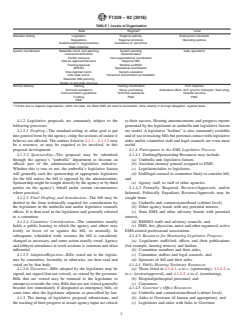
TABLE 1 Levels of Organization
A
State Regional Local
Standard Setting Legislation Regional policies Employment standards
Regulations Regional protocols Operating policies
Guidelines/policies/procedures Assistance re: personnel
State protocols
System Coordination Statewide coord. and planning System planning Daily operations
Licensure/certification Implementation
Facility licensure Inter-organizational coordination
Service approval/licensure Regional SMI
Training approval Medical audit/QA
MIS/QA Operational coordination
Inter-regional coord. System evaluation
Inter-state coord. Personnel authorization accreditation
Statewide SMI planning
Design of sub-state structure
Service Delivery Training Training coordination First response
Technical assistance Group purchasing Ambulance (BLS, ALS; ground, helicopter, fixed wing)
Communications guidelines Technical assistance Hospital services
Funding PI&E PI&E
PI&E
A
If there are no regional organizations, within the state, the State EMS will need to accomplish, either directly or through delegation, regional tasks.
4.1.2 Legislative proposals are commonly subject to the to their success. Hearing announcements and progress reports
following processes: generated by the legislature or umbrella unit legislative liaison
4.1.2.1 Drafting—The standard-setting or other goal is put are useful. A legislative “hotline” is also commonly available
into general form by the agency, citing the sections of statute it andofuseintrackingbillsbutpersonalcontactwithlegislative
believes are affected. The entities listed in 4.1.1 – 4.1.1.3 may aides and/or committee staff and legal counsels are even more
be a resource, or may be required to be involved, in this useful.
proposal development. 4.1.4 Participants in the EMS Legislative Process:
4.1.2.2 Sponsorship—The proposal may be submitted 4.1.4.1 Drafting/Sponsorship Resources may include:
through the agency’s “umbrella” department to become an (a) Umbrella unit legislative liaison,
official part of the administration’s legislative initiative. (b) Assistant attorney general assigned to EMS,
Whether this is true or not, the umbrella’s legislative liaison (c) Legislators/aides to legislators,
will generally seek the sponsorship of appropriate legislators (d) Staff/legal counsel to committee likely to consider bill,
for the bill unless the bill is opposed by the administration. and
Sponsorship might be sought directly by the agency or by third (e) Agency staff, or staff of other agencies.
parties on the agency’s behalf under certain circumstances 4.1.4.2 Formally Required Reviews/Approvals and/or
where practical. Informal, Politically Expedient, Reviews/Approvals may be
4.1.2.3 Final Drafting and Introduction—The bill may be sought from:
drafted in the form technically required for consideration by (a) Umbrella unit commissioner/head (cabinet level),
the legislature in the umbrella unit and/or legislative counsels (b) Other agency heads with any potential interest,
offices. It is then read in the legislature and generally referred (c) State EMS and other advisory boards with potential
to a committee. interest,
4.1.2.4 Committee Consideration—The committee usually (d) REMSO staffs and advisory councils, and
holds a public hearing at which the agency and others may (e) EMS, fire, physician, nurse and other organized, active
testify in favor of or against the bill, or neutrally. In EMS-related professional associations.
subsequent, scheduled work sessions the bill is considered, 4.1.4.3 Resources for Monitoring Legislative Progress:
changed as necessary, and some action usually voted. Agency (a) Legislature staff/clerk offices and their publications
and lobbyist attendance at work sessions is common and often (for example, hearing notices) and hotline,
influential. (b) Committee members and their aides,
4.1.2.5 Adoption/Rejection—Bills voted out to the legisla- (c) Committee staffers and legal counsels, and
ture by committee, favorably or otherwise, are then read and (d) Sponsors of bill and their aides.
voted on by that body. 4.1.4.4 Public Hearing Testimony Resources:
4.1.2.6 Governor—Bills adopted by the legislature may be (a) Those listed in 4.1.4.1, a to e, (sponsoring), 4.1.4.2, a
signed, not signed (but not vetoed), or vetoed by the governor. to e, (review/approval), and 4.1.4.3, a to d, (monitoring),
Bills that are vetoed may be returned to the legislature to (b) Hospital/prehospital personnel, and
attempt to override the veto. Bills that are not vetoed generally (c) Consumers.
become law immediately if designated as emergency bills, or 4.1.4.5 Governor’s Offıce Resources:
some time after the legislature adjourns as prescribed by law. (a) Umbrella unit commissioner/head (cabinet level),
4.1.3 The timing of legislative proposal submissions, and (b) Aides to Governor (if known and appropriate), and
the tracking of their progress to assure agency input are critical (c) Legislators and aides with links to Governor.
F1339 − 92 (2016)
4.2 Development of Minimum Standards: clarifying required licensure/certification processes for provid-
ers and in providing immediate direction to providers where
4.2.1 Methods and Procedures—A variety of standard-
such direction is not provided in law, rules, or elsewhere.
setting mechanisms exist, from that which is formal and
explicitly housed in the state’s laws to that which is the least 4.2.2.5 Protocols—Virtually unique to EMS in their re-
formal, for instance, the non-binding opinion of EMS staff gional or statewide application, treatment protocols may be
which is standard-setting to the extent of the dissemination and used to set clinical and operational standards and to define
“rightness” of the opinion and the perceived expertise of the scope of practice. Protocols are most effective when they are
staff. The most commonly employed method and procedures given power of law by virtue of specific reference in statute
are listed below. (for example, “Treatment shall be in accord with protocols
established by the medical director of the state (or regional)
4.2.1.1 Origins of Standards—State standards should be
EMS agency.”). Protocol-development may require a
derived from the ASTM process. When this process has not
consensus-buildingprocessamongthestate’smedicaladvisory
provided a standard in a needed area, standards set by the
committee, regional medical directors and others.
National Association of State EMS Directors and/or,
secondarily, by other EMS-related professional associations 4.2.2.6 Contracts and/or Letters of Agreement—Generally
should be used as a foundation. in return for funding or other resources, regional and local
structures and providers may agree to certain standards of
4.2.1.2 When utilizing standards documents generated by
performance. For example, state funding of training courses or
other than the ASTM process, these should be critically
ambulance equipment items may be afforded with agreement
reviewed by experts from a range of EMS-related clinical,
on standards for course content or equipment use. States
administrative, training, planning, regulatory and other disci-
generally have a standard process and forms for contracts and
plines. In these cases, this process should assure that all
grants. Consult the purchasing and/or contracts office or legal
interested parties have an opportunity to comment. Federal
counsel assigned to EMS.
standards, in law and otherwise, may exist in certain areas of
EMS which may affect a state’s future receipt of federal funds; 4.2.3 Participants in the Development of Minimum Stan-
dards:
these should be reviewed for consistency with planned stan-
dards.
4.2.3.1 By Legislation—See 4.1.
4.2.2 Specific Methods and Procedures:
4.2.3.2 By Rules/Regulations:
(a) Agency staff (drafting),
4.2.2.1 Legislation—Used for setting broad, legally-binding
standards. Sets the responsibilities of the state, regional, and (b) Legal counsel assigned to EMS (review),
(c) REMSO staffs/advisory councils/committees (review),
local EMS structures; defines areas of rule or regulation-
(d) State advisory council/committees (review),
making authority, and sets general minimum standards for the
(e) State EMS-related professional associations (review),
system as a whole. See 4.1.
(f) Impartial legal counsel (approval),
4.2.2.2 Rules/Regulations—Used to set more specific stan-
(g) Secretary of state (records/announces proposals, certi-
dards for system design and operation including, but not
fies adopted rules),
limited to, the interaction of state, regional, and local EMS
(h) Legislature (subject to review),
structures in provider operation (for example, licensure, train-
(i) Umbrella unit staff and head (review/approval unless
ing course approval); requirements for and terms of operation
EMS agency has own rule-making authority), and
(usually through licensure or certification) for EMS personnel,
(j) Providers/general public.
vehicles, equipment and services; organization of EMS train-
4.2.3.3 By Executive Order:
ingforcertificationorlicensure;organizationofcertificationor
(a) Agency staff (drafting),
licensure testing; scope of practice; causes and procedures for
disciplinary actions. This process is governed by the adminis- (b) Legal counsel assigned to EMS (review),
(c) Umbrella unit head/commissioner (cabinet level),
trative procedures act (“APA”) of the state and generally
requires the EMS rule-making authority to publish notices and (d) Governor; governor’s staff,
(e) State advisory council/committees,
hold hearings on proposed changes. Consult the state’s APA
and discuss with the legal counsel assigned to EMS. (f) Consider those listed in 4.2.3.2 for review.
4.2.3.4 By Policies/Procedures:
4.2.2.3 Executive Order—TheGovernormaybeempowered
(a) Agency staff (drafting and review),
to take actions which have a standard-setting impact. Consult
(b) REMSO staff (review), and
the legal counsel assigned to EMS or the Governor’s staff.
(c) Consider umbrella unit/advisory council review.
4.2.2.4 Policies/Procedures—Used by the state agency to
4.2.3.5 By Protocols:
govern the details of its operations and interactions with
(a) Agency staff,
providers. Examples could include the personnel licensure/
(b) REMSO staff,
certification application form, procedures for in-state grant
(c) State/regional medical directors and medical advisory
programs, or a policy for the administration of state licensure
boards, and
examinations.Thesearegenerallycreatedoutsideoflegislative
(d) Consider those listed in 4.2.2.2 for review.
or rule-making arenas. This makes them easier to create than
laws or rules but also much less binding upon the EMS system 4.2.3.6 By Contracts/Letters of Agreement:
and its providers. In fact, these are generally not considered to (a) Agency staff,
be legally binding. They are useful, though, in defining and (b) REMSO (contractor or reviewer),
F1339 − 92 (2016)
(c) Local system/provider (contractor), medical directors on the state and regional levels, REMSO
(d) Legal counsel assigned to EMS, staff, the legal counsel assigned to EMS, and others identified
(e) Consider umbrella unit/advisory council review, in 4.2.2 may be involved in enforcement on a formal or
(f) Impartial legal counsel for contract approval, informal basis.
(g) Budget office if funding involved (approval/
4.4 Designation of Substate Structure:
encumbrance), and
4.4.1 Methods and Procedures:
(h) Purchasing/contract review if funding involved.
4.4.1.1 Determine purpose of substate structure (refer to
4.3 Enforcement of Minimum Standards:
Guide F1086).
4.3.1 Methods and Procedures—Enforcement may be ac- 4.4.1.2 Determine maximum funding available to support
complishedinavarietyofformalandinformalways.Themore structure established.
formal methods are discussed below, however, it is worth 4.4.1.3 Given purpose and funding level, establish regional
considering informal means (for example, peer pressure, train-
boundaries (ideally according to natural catchment areas).
ing approaches, meetings with town and hospital officials and 4.4.1.4 Select REMSO for each Region, using RFPor other
others with whom the non-complying individual or organiza-
process, and establish a specific contract for services.
tion routinely interacts). If formal methods of enforcement are
4.4.2 Participants—This is a decision with significant sys-
used, due process should be ensured. The need to enforce may
tems operation and political impact. Agency staff, state and
be discovered when a specific complaint is made, from
local advisory councils, appropriate local governments, profes-
incidental information derived from the media and other
sional associations, provider services, hospitals and others
sources, from routine quality assurance processes, from
should be involved.
service/vehicle inspections, and from the EMS management
4.5 Provision of Technical Assistance:
information system when it is used to link training, licensure,
4.5.1 Methods and Procedures—States should have a
and run/patient reporting to monitor compliance with licensure
mechanism for identifying needs for technical assistance.
requirements.
4.5.1.1 Dissemination of current EMS information and de-
4.3.1.1 Of Enforcing Laws, Rules or Regulations, Executive
scription of technical assistance availability through statewide
Orders:
newsletter,computerbulletinboardservice,andspecialnotices
(a) General information/education for those affected,
to providers or through REMSOs.
(b) Specific verbal/written warnings of potential non-
4.5.1.2 Participation of agency staff in statewide, regional,
compliance and consequences,
and local conferences and other educational programs.
(c) Formal investigation by agency. Such investigations
4.5.1.3 Regular coordinating meetings with REMSO staffs,
may lead to licensure action, fines, and/or imprisonment. Such
and agency staff attendance at regional council meetings.
penalties, conditions for penalties and avenues of appeal
4.5.1.4 State agency assistance in drafting EMS legislation
should be specified in law and rules/regulations. Refer to the
and obtaining outside grant funding for local and regional
Council of State Governments’ certification curriculum for
projects.
those who conduct administrative law investigations,
4.5.1.5 State agency participation in ASTM and other na-
(d) Criminal investigations as appropriate.
tional EMS technical and educational programs in order to
4.3.1.2 Of Enforcing Policies/Procedures:
represent interests of state and import new knowledge.
(a) General information/education for those affected,
4.5.2 Participants— State agency and REMSO staffs and
(b) Refusal to issue licenses/certifications for non-
agents.
compliance (consult legal counsel assigned to EMS), and
(c) Investigate and pursue policy non-compliance under a 4.6 Identification of Funding and Other Resources for
general “unprofessional conduct” or similar provision for Development, Maintenance, and Enhancement of EMS Sys-
licensure action under state EMS law. tems:
4.3.1.3 Of Enforcing Protocols—Regional and/or state QA 4.6.1 See document of F30.03.05 (“Standard Guide for the
Development of EMS Funding”).
and EMS/MIS processes should exist to identify protocol
non-compliance. If protocols are enforceable under state EMS
4.7 Development and Implementation of Training Systems:
law see 4.3.1.1. Other methods of enforcement include:
4.7.1 Methods and Procedures—Development of standards
(a) Withholding of medical control orders or privileges to
(for example, specific objectives, curricula, instructor outlines)
practice at a regional or state level,
for training programs leading to certification/licensure. Deter-
(b) Withholding franchise to operate (dispatcher no longer
mine purpose of substate structure (refer to Guide F1086).
calls the service), and
4.8 Development and Implementation of Communication
(c) Withholding Medicaid, indigent fees, grants or other
Systems: (Refer to the work of, and standards developed by,
subsidies received by non-complying provider.
Subcommittee F30.04 on communications).
4.3.1.4 Of Enforcing Contracts/Letters of Agreement:
(a) Withholding of grants, or the other resources or
4.9 Development and Implementation of Record-Keeping
privileges identified in the particular document, and
and Evaluation Systems: (Refer to the work of, and standards
(b) Cancellation of contract.
developed by, Task Group F30.03.03 on Management Infor-
4.3.2 Participants—Those involved in enforcement are usu- mation Systems; 4.9.11 see the Centers for Disease Control’s
ally state EMS agency officials or their agents. Agency staff, Trauma Registry Patient Data Set).
F1339 − 92 (2016)
4.10 Development and Implementation of Public ensure close cooperation, to limit conflict, and to ensure that
Information, Public Education, and Public Relations Pro- the interests of the patients are primary in the system.
grams:(Refertotheworkof,andstandardsdevelopedby,Task
5.2 Planning Functions:
Group F30.03.06 on Public Information, Education, and Rela-
5.2.1 An EMS system plan should be developed for each
tions).
system. The plan should:
4.11 Development and Implementation of Acute Care Cen-
5.2.1.1 Determine the optimal system design for the EMS
ter Designation:(Refertoworkof,andstandardsdevelopedby
system, based on appropriate ASTM standards, when not in
Subcommittee F30.05 on Facilities;
conflict with state law, rules, or regulations, or with local
4.11.1 See the American Medical Association Commission
ordinances. The system design should be based on
on EMS’ Guidelines for the Categorization of Hospital Emer-
predetermined, desired goals (for example, response time,
gency Capabilities (most recent version).
clinical performance, fiscal performance, and the like) and
should include:
4.12 Development and Implementation of a Disaster Medi-
(a) The staffing level and level of training of hospital and
cal System: (Refer to the work of, and standards developed by
pre-hospital personnel,
Task Group F30.03.07 on Disaster Management Response).
(b) The number, location, and service level of pre-hospital
4.12.1 Resources for larger scale events involving out-of-
providers,
state responses include the National Disaster Medical System
(c) Communications pathways and methods necessary to
(NDMS) and the Federal Emergency Management Agency
address citizen access, dispatch, coordination, and medical
(FEMA).
control,
4.13 Overall Coordination of EMS and Related Programs
(d) The role of hospitals and speciality care centers,
Within the State and in Concert with Other States or Federal
including initial patient triage, and interfacility transfer, and
Authorities:
(e) Policies, procedures, personnel, and facilities, to pro-
4.13.1 This broad responsibility involves the establishment
vide medical control, as described in Practice F1149,
and on-going maintenance of efficient and effective communi-
(f) Apr
...