

ASTM C845/C845M-18
(Specification)Standard Specification for Expansive Hydraulic Cement
General Information
- Abstract
ABSTRACT
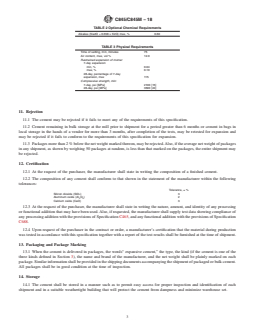
This specification covers hydraulic cements that expand during the early hardening period after setting. The cement covered by this specification is suitable for use in shrinkage-compensating concrete and shall be designated as Type E-1. Expansive cement shall conform to the requirements as to chemical composition prescribed. Expansive cement shall conform to the physical requirements prescribed. The cement shall be sampled and the properties shall be determined with the following test methods: sampling, chemical analysis, time of setting, air content, restrained expansion of mortar, compressive strength, and density.
SCOPE
1.1 This specification covers hydraulic cements that expand during the early hardening period after setting.
1.2 The values stated in either SI units or inch-pound units are to be regarded separately as standard. The values stated in each system may not be exact equivalents; therefore, each system shall be used independently of the other. Combining values from the two systems may result in non-conformance with the standard.
1.3 The text of this standard references notes and footnotes which provide explanatory material. These notes and footnotes (excluding those in tables and figures) shall not be considered as requirements of this standard.
1.4 This international standard was developed in accordance with internationally recognized principles on standardization established in the Decision on Principles for the Development of International Standards, Guides and Recommendations issued by the World Trade Organization Technical Barriers to Trade (TBT) Committee.
- Status
- Published
- Publication Date
- 30-Jun-2018
- Technical Committee
- C01 - Cement
- Drafting Committee
- C01.13 - Special Cements



Overview
ASTM C845/C845M-18: Standard Specification for Expansive Hydraulic Cement establishes the requirements for hydraulic cements that expand during the early hardening period after setting. This expansive cement is specifically designed for use in shrinkage-compensating concrete where dimensional stability and crack resistance are important. The standard, developed by ASTM International, outlines the chemical composition, physical properties, testing methods, packaging, and certification criteria that manufacturers and users must follow to ensure product quality and performance.
Key Topics
- Expansive Hydraulic Cement Type E-1: The specification covers Type E-1 expansive hydraulic cement, which is engineered to expand during early curing and counteract drying shrinkage in concrete.
- Chemical Composition: Strict limits are set for key components such as magnesium oxide, insoluble residue, loss on ignition, and optional alkalies content to ensure predictable expansion and durability.
- Physical Requirements: Criteria include minimum times of setting, air content, measured restrained expansion at 7 and 28 days, and specified minimum compressive strengths.
- Testing Methods: The standard references established ASTM procedures for sampling (C183), chemical analysis (C114), time of setting (C807), air content (C185), restrained expansion (C806), compressive strength (C109), and density (C188).
- Marking, Packaging, and Storage: Ensures all expansive cements are appropriately labeled, securely packaged, and stored under conditions that maintain quality.
Applications
Expansive hydraulic cement specified by ASTM C845/C845M-18 is vital for:
- Shrinkage-Compensating Concrete: Reduces or eliminates shrinkage cracks, enhancing the longevity and performance of slabs, pavements, and structural elements.
- Reinforced Concrete Structures: Used in construction where internal steel reinforcement needs to be compressed to offset tensile stresses from shrinkage, such as industrial floors, bridge decks, and water-retaining structures.
- Repair and Grouting: Ideal for grouting of machine bases, anchoring bolts, and repairing cracks in existing concrete, where expansive behavior provides improved adhesion and stability.
- Specialized Applications: Useful in large pore or joint-free concrete placements, tunnel linings, and where dimensional control is crucial during the setting process.
The standard offers significant practical value by providing guidance that helps ensure:
- Improved concrete durability and integrity
- Minimization of cracks and defects caused by shrinkage
- Consistency in performance and product quality for manufacturers and end-users
Related Standards
For comprehensive use of expansive hydraulic cement, ASTM C845/C845M-18 references the following key standards:
- ASTM C33/C33M - Specification for Concrete Aggregates
- ASTM C109/C109M - Test Method for Compressive Strength of Hydraulic Cement Mortars
- ASTM C114 - Test Methods for Chemical Analysis of Hydraulic Cement
- ASTM C183/C183M - Practice for Sampling and the Amount of Testing of Hydraulic Cement
- ASTM C185 - Test Method for Air Content of Hydraulic Cement Mortar
- ASTM C188 - Test Method for Density of Hydraulic Cement
- ASTM C465 - Specification for Processing Additions for Use in the Manufacture of Hydraulic Cements
- ASTM C688 - Specification for Functional Additions for Use in Hydraulic Cements
- ASTM C806 - Test Method for Restrained Expansion of Expansive Cement Mortar
- ASTM C807 - Test Method for Time of Setting of Hydraulic Cement Mortar
By following ASTM C845/C845M-18, engineers, architects, concrete producers, and contractors can confidently select and specify expansive hydraulic cement to meet demanding construction needs, ensuring both safety and structural longevity.
Relations
- Effective Date
- 15-Dec-2023
- Effective Date
- 15-Dec-2023
- Effective Date
- 01-Oct-2023
- Effective Date
- 01-Apr-2020
- Effective Date
- 01-Dec-2019
- Effective Date
- 01-Jul-2018
- Effective Date
- 01-Apr-2018
- Effective Date
- 15-Dec-2016
- Effective Date
- 01-Feb-2016
- Effective Date
- 01-Oct-2015
- Effective Date
- 01-Jul-2015
- Effective Date
- 01-Jul-2014
- Effective Date
- 01-Oct-2013
- Effective Date
- 01-Jan-2013
- Effective Date
- 15-Dec-2012
Get Certified
Connect with accredited certification bodies for this standard

DIBt (Deutsches Institut für Bautechnik)
German Institute for Building Technology.
DIN CERTCO
DIN Group product certification.

Aboma Certification B.V.
Specialized in construction, metal, and transport sectors.
Sponsored listings
Frequently Asked Questions
ASTM C845/C845M-18 is a technical specification published by ASTM International. Its full title is "Standard Specification for Expansive Hydraulic Cement". This standard covers: ABSTRACT This specification covers hydraulic cements that expand during the early hardening period after setting. The cement covered by this specification is suitable for use in shrinkage-compensating concrete and shall be designated as Type E-1. Expansive cement shall conform to the requirements as to chemical composition prescribed. Expansive cement shall conform to the physical requirements prescribed. The cement shall be sampled and the properties shall be determined with the following test methods: sampling, chemical analysis, time of setting, air content, restrained expansion of mortar, compressive strength, and density. SCOPE 1.1 This specification covers hydraulic cements that expand during the early hardening period after setting. 1.2 The values stated in either SI units or inch-pound units are to be regarded separately as standard. The values stated in each system may not be exact equivalents; therefore, each system shall be used independently of the other. Combining values from the two systems may result in non-conformance with the standard. 1.3 The text of this standard references notes and footnotes which provide explanatory material. These notes and footnotes (excluding those in tables and figures) shall not be considered as requirements of this standard. 1.4 This international standard was developed in accordance with internationally recognized principles on standardization established in the Decision on Principles for the Development of International Standards, Guides and Recommendations issued by the World Trade Organization Technical Barriers to Trade (TBT) Committee.
ABSTRACT This specification covers hydraulic cements that expand during the early hardening period after setting. The cement covered by this specification is suitable for use in shrinkage-compensating concrete and shall be designated as Type E-1. Expansive cement shall conform to the requirements as to chemical composition prescribed. Expansive cement shall conform to the physical requirements prescribed. The cement shall be sampled and the properties shall be determined with the following test methods: sampling, chemical analysis, time of setting, air content, restrained expansion of mortar, compressive strength, and density. SCOPE 1.1 This specification covers hydraulic cements that expand during the early hardening period after setting. 1.2 The values stated in either SI units or inch-pound units are to be regarded separately as standard. The values stated in each system may not be exact equivalents; therefore, each system shall be used independently of the other. Combining values from the two systems may result in non-conformance with the standard. 1.3 The text of this standard references notes and footnotes which provide explanatory material. These notes and footnotes (excluding those in tables and figures) shall not be considered as requirements of this standard. 1.4 This international standard was developed in accordance with internationally recognized principles on standardization established in the Decision on Principles for the Development of International Standards, Guides and Recommendations issued by the World Trade Organization Technical Barriers to Trade (TBT) Committee.
ASTM C845/C845M-18 is classified under the following ICS (International Classification for Standards) categories: 91.100.10 - Cement. Gypsum. Lime. Mortar. The ICS classification helps identify the subject area and facilitates finding related standards.
ASTM C845/C845M-18 has the following relationships with other standards: It is inter standard links to ASTM C806-23, ASTM C109/C109M-23, ASTM C114-23, ASTM C185-20, ASTM C185-19, ASTM C806-18, ASTM C465-18, ASTM C188-16, ASTM C33/C33M-16e1, ASTM C188-15, ASTM C185-15, ASTM C188-14, ASTM C114-13, ASTM C33/C33M-13, ASTM C109/C109M-12. Understanding these relationships helps ensure you are using the most current and applicable version of the standard.
ASTM C845/C845M-18 is available in PDF format for immediate download after purchase. The document can be added to your cart and obtained through the secure checkout process. Digital delivery ensures instant access to the complete standard document.
Standards Content (Sample)
This international standard was developed in accordance with internationally recognized principles on standardization established in the Decision on Principles for the
Development of International Standards, Guides and Recommendations issued by the World Trade Organization Technical Barriers to Trade (TBT) Committee.
Designation:C845/C845M −18
Standard Specification for
Expansive Hydraulic Cement
This standard is issued under the fixed designation C845/C845M; the number immediately following the designation indicates the year
of original adoption or, in the case of revision, the year of last revision. A number in parentheses indicates the year of last reapproval.
A superscript epsilon (´) indicates an editorial change since the last revision or reapproval.
1. Scope C465 Specification for Processing Additions for Use in the
Manufacture of Hydraulic Cements
1.1 This specification covers hydraulic cements that expand
C688 Specification for Functional Additions for Use in
during the early hardening period after setting.
Hydraulic Cements
1.2 The values stated in either SI units or inch-pound units
C806 Test Method for Restrained Expansion of Expansive
are to be regarded separately as standard. The values stated in
Cement Mortar
each system may not be exact equivalents; therefore, each
C807 Test Method for Time of Setting of Hydraulic Cement
system shall be used independently of the other. Combining
Mortar by Modified Vicat Needle
values from the two systems may result in non-conformance
with the standard.
3. Terminology
1.3 The text of this standard references notes and footnotes
3.1 Definitions:
which provide explanatory material. These notes and footnotes
(excluding those in tables and figures) shall not be considered 3.1.1 expansive cement (K)—an expansive cement contain-
as requirements of this standard. ing anhydrous calcium aluminosulfate (4CaO·3Al O ·SO ),
2 3 3
calcium sulfate, and uncombined calcium oxide.
1.4 This international standard was developed in accor-
dance with internationally recognized principles on standard-
3.1.2 expansive cement (M)—an expansive cement contain-
ization established in the Decision on Principles for the
ing calcium aluminate cement and calcium sulfate.
Development of International Standards, Guides and Recom-
3.1.3 expansive cement (S)—an expansive cement contain-
mendations issued by the World Trade Organization Technical
ing tricalcium aluminate (C A) and calcium sulfate.
Barriers to Trade (TBT) Committee.
3.1.4 expansive hydraulic cement—a cement composed es-
2. Referenced Documents
sentiallyofhydrauliccalciumsilicates,calciumaluminatesand
2.1 ASTM Standards:
calcium sulfates, which, upon being mixed with water, forms a
C33/C33M Specification for Concrete Aggregates
paste that increases significantly in volume during the early
C109/C109M Test Method for Compressive Strength of
hardening period occurring after setting. This volume increase
Hydraulic Cement Mortars (Using 2-in. or [50-mm] Cube
is due principally to the reaction of the calcium aluminates and
Specimens)
calcium sulfates.
C114 Test Methods for Chemical Analysis of Hydraulic
3.1.5 shrinkage-compensating concrete—concrete that is in-
Cement
ternally restrained with resilient reinforcing and made with
C183/C183M Practice for Sampling and the Amount of
expansivecementwhichinducesbothcompressivestressinthe
Testing of Hydraulic Cement
concrete and positive steel strain that approximately off-sets
C185 Test Method for Air Content of Hydraulic Cement
tensile stresses and negative strains induced by drying shrink-
Mortar
age.
C188 Test Method for Density of Hydraulic Cement
4. Classification
This specification is under the jurisdiction of ASTM Committee C01 on
Cement and is the direct responsibility of Subcommittee C01.13 on Special 4.1 The cement covered by this specification is suitable for
Cements.
use in shrinkage-compensating concrete and shall be desig-
Current edition approved July 1, 2018. Published July 2018. Originally approved
nated as Type E-1.
in 1976. Last previous edition approved in 2012 as C845 – 12. DOI: 10.1520/C0845
_C0845M-18.
2 NOTE1—ThreekindsofexpansivecementareidentifiedinSection3by
For referenced ASTM standards, visit the ASTM website, www.astm.org, or
the letters K, M, and S. The appropriate letter should be used as a suffix
contact ASTM Customer Service at service@astm.org. For Annual Book of ASTM
to the type designation when one of these kinds is desired. Expansive
Standards volume information, refer to the standard’s Document Summary page on
the ASTM website. cement may also be prepared in other ways.
Copyright © ASTM International, 100 Barr Harbor Drive, PO Box C700, West Conshohocken, PA 19428-2959. United States
C845/C845M−18
TABLE 2 Optional Chemical Requirements
5. Ordering Information
Alkalies (Na2O + 0.658 × K2O) max, % 0.60
5.1 When it is desired that an optional requirement apply or
that the cement be of a particular kind, a specific request to this
effect should be made by the purchaser.
TABLE 3 Physical Requirements
Time of setting, min, minutes 75
6. Chemical Composition
Air content, max, vol % 12.0
Restrained expansion of mortar:
6.1 Expansive cement shall conform to the requirements as
7-day expansion:
to chemical composition prescribed in Table 1.
min, % 0.04
max, % 0.10
6.2 The purchaser has the option of specifying that the
28-day, percentage of 7-day
alkalies (Na O + 0.658K O) shall not exceed 0.60 % (see
2 2
expansion, max 115
Compressive strength, min:
Table 2).
7-day, psi [MPa] 2100 [15]
NOTE 2—This limit should be specified when the cement is to be used 28-day, psi [MPa] 3500 [24]
in concrete with aggregates that may be reactive. Reference should be
made to Specification C33/C33M for suitable criteria of deleterious
reactivity.
10. Inspection
7. Physical Properties
10.1 Every facility shall be provided the purchaser for
7.1 Expansive cement shall conform to the physical require-
careful inspection and sampling of the finished cement. The
ments prescribed in Table 3.
finished cement may be inspected and sampled either at the
mill or at the site of the work, as may be specified by the
8. Additions
purchaser. The following periods from time of
...
This document is not an ASTM standard and is intended only to provide the user of an ASTM standard an indication of what changes have been made to the previous version. Because
it may not be technically possible to adequately depict all changes accurately, ASTM recommends that users consult prior editions as appropriate. In all cases only the current version
of the standard as published by ASTM is to be considered the official document.
Designation: C845/C845M − 12 C845/C845M − 18
Standard Specification for
Expansive Hydraulic Cement
This standard is issued under the fixed designation C845/C845M; the number immediately following the designation indicates the year
of original adoption or, in the case of revision, the year of last revision. A number in parentheses indicates the year of last reapproval.
A superscript epsilon (´) indicates an editorial change since the last revision or reapproval.
1. Scope
1.1 This specification covers hydraulic cements that expand during the early hardening period after setting.
1.2 The values stated in either SI units or inch-pound units are to be regarded separately as standard. The values stated in each
system may not be exact equivalents; therefore, each system shall be used independently of the other. Combining values from the
two systems may result in non-conformance with the standard.
1.3 The text of this standard references notes and footnotes which provide explanatory material. These notes and footnotes
(excluding those in tables and figures) shall not be considered as requirements of this standard.
1.4 This international standard was developed in accordance with internationally recognized principles on standardization
established in the Decision on Principles for the Development of International Standards, Guides and Recommendations issued
by the World Trade Organization Technical Barriers to Trade (TBT) Committee.
2. Referenced Documents
2.1 ASTM Standards:
C33C33/C33M Specification for Concrete Aggregates
C109/C109M Test Method for Compressive Strength of Hydraulic Cement Mortars (Using 2-in. or [50-mm] Cube Specimens)
C114 Test Methods for Chemical Analysis of Hydraulic Cement
C183C183/C183M Practice for Sampling and the Amount of Testing of Hydraulic Cement
C185 Test Method for Air Content of Hydraulic Cement Mortar
C188 Test Method for Density of Hydraulic Cement
C465 Specification for Processing Additions for Use in the Manufacture of Hydraulic Cements
C688 Specification for Functional Additions for Use in Hydraulic Cements
C806 Test Method for Restrained Expansion of Expansive Cement Mortar
C807 Test Method for Time of Setting of Hydraulic Cement Mortar by Modified Vicat Needle
3. Terminology
3.1 Definitions:
3.1.1 expansive cement (K)—an expansive cement containing anhydrous calcium aluminosulfate (4CaO·3Al O ·SO ), calcium
2 3 3
sulfate, and uncombined calcium oxide.
3.1.2 expansive cement (M)—an expansive cement containing calcium aluminate cement and calcium sulfate.
3.1.3 expansive cement (S)—an expansive cement containing tricalcium aluminate (C A) and calcium sulfate.
3.1.4 expansive hydraulic cement—a cement composed essentially of hydraulic calcium silicates, calcium aluminates and
calcium sulfates, which, upon being mixed with water, forms a paste that increases significantly in volume during the early
hardening period occurring after setting. This volume increase is due principally to the reaction of the calcium aluminates and
calcium sulfates.
3.1.5 shrinkage-compensating concrete—concrete that is internally restrained with resilient reinforcing and made with
expansive cement which induces both compressive stress in the concrete and positive steel strain that approximately off-sets tensile
stresses and negative strains induced by drying shrinkage.
This specification is under the jurisdiction of ASTM Committee C01 on Cement and is the direct responsibility of Subcommittee C01.13 on Special Cements.
Current edition approved Dec. 15, 2012July 1, 2018. Published February 2013July 2018. Originally approved in 1976. Last previous edition approved in 20042012 as
C845 – 04.C845 – 12. DOI: 10.1520/C0845_C0845M-12.10.1520/C0845_C0845M-18.
For referenced ASTM standards, visit the ASTM website, www.astm.org, or contact ASTM Customer Service at service@astm.org. For Annual Book of ASTM Standards
volume information, refer to the standard’s Document Summary page on the ASTM website.
Copyright © ASTM International, 100 Barr Harbor Drive, PO Box C700, West Conshohocken, PA 19428-2959. United States
C845/C845M − 18
4. Classification
4.1 The cement covered by this specification is suitable for use in shrinkage-compensating concrete and shall be designated as
Type E-1.
NOTE 1—Three kinds of expansive cement are identified in Section 3 by the letters K, M, and S. The appropriate letter should be used as a suffix to
the type designation when one of these kinds is desired. Expansive cement may also be prepared in other ways.
5. Ordering Information
5.1 When it is desired that an optional requirement apply or that the cement be of a particular kind, a specific request to this
effect should be made by the purchaser.
6. Chemical Composition
6.1 Expansive cement shall conform to the requirements as to chemical composition prescribed in Table 1.
6.2 The purchaser has the option of specifying that the alkalies (Na O + 0.658K O) shall not exceed 0.60 % (See(see Table 2).
2 2
NOTE 2—This limit should be specified when the cement is to be used in concrete with aggregates that may be reactive. Reference should be made
to Specification C33C33/C33M for suitable criteria of deleterious reactivity.
7. Physical Properties
7.1 Expansive cement shall conform to the physical requirements prescribed in Table 3.
8. Additions
8.1 The cement covered by this specification shall contain no additions except as follows:
8.1.1 Water, or a functional addition, or both, that has been shown to meet the requirements of Specification C688, may be added
in amounts such that the limits shown in Table 1 for loss on ignition shall not be exceeded.
8.1.2 At the option of the manufacturer, processing additions may be used in the manufacture of the cement, provided such
materials in the amounts used have been shown to be not harmful in accordance with Specification C465.
9. Test Methods
9.1 The cement shall be sampled and the properties enumerated
...