

ASTM D4323-21
(Test Method)Standard Test Method for Hydrogen Sulfide in the Atmosphere by Rate of Change of Reflectance
General Information
- Abstract
SIGNIFICANCE AND USE
5.1 Hydrogen sulfide is an odorous substance which is offensive even at low concentrations in the atmosphere and toxic at higher levels. It may be a product of biological processes in the absence of oxygen, as may occur in municipal landfills. It is emitted from geothermal sources, occurs in oil and gas, and may be emitted from industrial processes. Measurement is required for air pollution studies, for pollution control, environmental justice based monitoring, and for plume characterization. This test method is intended for hydrogen sulfide content up to 3000 ppbv. Measurement of hydrogen sulfide above this concentration in gaseous fuels, carbon dioxide or other gaseous matrices is described in Test Method D4084. Equipment described is suitable for fixed site or for mobile monitoring.
SCOPE
1.1 This test method covers the automatic continuous determination of hydrogen sulfide (H2S) in the atmosphere or in gaseous samples in the range from one part per billion by volume (1 ppb/v) to 3000 ppb/v. Information obtained may be used for air-pollution studies, fence-line monitoring, and other source emission monitoring.
1.2 The range may be extended by appropriate dilution techniques or by equipment modification.
1.3 The values stated in SI units are to be regarded as standard. The values given in parentheses are mathematical conversions to inch-pound units that are provided for information only and are not considered standard.
1.4 This standard does not purport to address all of the safety concerns, if any, associated with its use. It is the responsibility of the user of this standard to establish appropriate safety, health, and environmental practices and determine the applicability of regulatory limitations prior to use. (See Section 9 for specific safety precautionary statements.)
1.5 This international standard was developed in accordance with internationally recognized principles on standardization established in the Decision on Principles for the Development of International Standards, Guides and Recommendations issued by the World Trade Organization Technical Barriers to Trade (TBT) Committee.
- Status
- Published
- Publication Date
- 31-Oct-2021
- Technical Committee
- D22 - Air Quality
- Drafting Committee
- D22.03 - Ambient Atmospheres and Source Emissions
Buy Documents
ASTM D4323-21 - Standard Test Method for Hydrogen Sulfide in the Atmosphere by Rate of Change of Reflectance
REDLINE ASTM D4323-21 - Standard Test Method for Hydrogen Sulfide in the Atmosphere by Rate of Change of Reflectance
Overview
ASTM D4323-21 is the internationally recognized standard test method for the automatic, continuous measurement of hydrogen sulfide (H₂S) in the atmosphere using the rate of change of reflectance. Developed by ASTM International, this method is highly applicable for the detection of H₂S levels in ambient air and gaseous samples, especially between 1 part per billion by volume (ppb/v) and 3000 ppb/v. Hydrogen sulfide is an odorous and potentially toxic gas, commonly found near landfill sites, geothermal sources, oil and gas processing areas, and various industrial processes. Accurate monitoring is crucial not only for air pollution and emission control studies but also for environmental justice initiatives and regulatory compliance.
Key Topics
- Measurement Principle: This method uses a lead acetate-impregnated paper tape exposed to a gas sample. The presence of H₂S leads to a color change on the tape, which is detected by measuring the rate of change in reflectance using optical and electronic systems.
- Concentration Range: Suitable for hydrogen sulfide concentrations from 1 ppb/v up to 3000 ppb/v, with possibilities for extending range by dilution or equipment modification.
- Application Environments: Can be deployed at fixed monitoring sites or for mobile atmospheric sampling.
- Sample Preparation: Emphasizes the use of proper materials for sampling lines and containers-materials must not absorb H₂S and should avoid copper, brass, or petroleum-based lubricants.
- Calibration and Quality Control: The method includes detailed guidance on preparation of calibration standards, quality control checks, and procedures to ensure accurate and reliable measurements.
- Interference and Safety: Addresses possible interferences from other sulfur compounds (e.g., methyl mercaptan, arsine) and highlights key safety considerations for handling H₂S, acetic acid, and lead acetate.
Applications
ASTM D4323-21 is vital in a range of settings, supporting both regulatory compliance and environmental protection initiatives. Typical applications include:
- Air Pollution Studies: Continuous H₂S monitoring is essential for studies assessing urban, rural, or industrial air quality and for identifying emission hot spots.
- Emission Source Monitoring: Used for fence-line and source-specific measurements at petrochemical plants, refineries, geothermal operations, and landfills.
- Pollution Control and Remediation: Data collected enables swift identification of pollution events, aiding in rapid response and remediation planning.
- Environmental Justice Initiatives: Supports community-level monitoring to ensure fair treatment related to exposure risk.
- Plume Characterization: Valuable for tracing and characterizing plumes at industrial sites or in emergency response situations.
This method’s robustness and versatility make it a preferred choice for air quality laboratories, environmental consultants, regulatory agencies, and industrial operators seeking reliable and repeatable H₂S measurement techniques.
Related Standards
For effective implementation and comprehensive air quality monitoring, consider the following related ASTM standards:
- ASTM D4084 - Test Method for Analysis of Hydrogen Sulfide in Gaseous Fuels
- ASTM D2420 - Test Method for Hydrogen Sulfide in Liquefied Petroleum Gases (Lead Acetate Method)
- ASTM D1193 - Specification for Reagent Water
- ASTM D1356 - Terminology Relating to Sampling and Analysis of Atmospheres
- ASTM D3609 - Practice for Calibration Techniques Using Permeation Tubes
- ASTM D6299 - Practice for Applying Statistical Quality Assurance and Control Charting Techniques
- ASTM D6792 - Practice for Quality Management Systems in Petroleum Products and Related Testing Laboratories
ASTM D4323-21 is a critical standard for reliable hydrogen sulfide detection, supporting air quality management, regulatory compliance, and public health protection.
Relations
- Effective Date
- 01-Dec-2023
- Effective Date
- 01-Nov-2023
- Effective Date
- 01-Oct-2023
- Effective Date
- 01-Sep-2020
- Effective Date
- 15-Mar-2020
- Effective Date
- 15-Dec-2017
- Effective Date
- 15-Nov-2017
- Effective Date
- 01-Jan-2017
- Effective Date
- 15-Oct-2015
- Effective Date
- 01-Jul-2015
- Effective Date
- 01-Dec-2014
- Effective Date
- 01-May-2014
- Effective Date
- 15-Jan-2014
- Effective Date
- 01-Oct-2013
- Effective Date
- 15-Jun-2013
Buy Documents
ASTM D4323-21 - Standard Test Method for Hydrogen Sulfide in the Atmosphere by Rate of Change of Reflectance
REDLINE ASTM D4323-21 - Standard Test Method for Hydrogen Sulfide in the Atmosphere by Rate of Change of Reflectance
Get Certified
Connect with accredited certification bodies for this standard

CIS Institut d.o.o.
Personal Protective Equipment (PPE) certification body. Notified Body NB-2890 for EU Regulation 2016/425 PPE.

Kiwa BDA Testing
Building and construction product certification.
Kmetijski inštitut Slovenije
Agricultural Institute of Slovenia. Soil testing, plant health, agricultural product analysis.
Sponsored listings
Frequently Asked Questions
ASTM D4323-21 is a standard published by ASTM International. Its full title is "Standard Test Method for Hydrogen Sulfide in the Atmosphere by Rate of Change of Reflectance". This standard covers: SIGNIFICANCE AND USE 5.1 Hydrogen sulfide is an odorous substance which is offensive even at low concentrations in the atmosphere and toxic at higher levels. It may be a product of biological processes in the absence of oxygen, as may occur in municipal landfills. It is emitted from geothermal sources, occurs in oil and gas, and may be emitted from industrial processes. Measurement is required for air pollution studies, for pollution control, environmental justice based monitoring, and for plume characterization. This test method is intended for hydrogen sulfide content up to 3000 ppbv. Measurement of hydrogen sulfide above this concentration in gaseous fuels, carbon dioxide or other gaseous matrices is described in Test Method D4084. Equipment described is suitable for fixed site or for mobile monitoring. SCOPE 1.1 This test method covers the automatic continuous determination of hydrogen sulfide (H2S) in the atmosphere or in gaseous samples in the range from one part per billion by volume (1 ppb/v) to 3000 ppb/v. Information obtained may be used for air-pollution studies, fence-line monitoring, and other source emission monitoring. 1.2 The range may be extended by appropriate dilution techniques or by equipment modification. 1.3 The values stated in SI units are to be regarded as standard. The values given in parentheses are mathematical conversions to inch-pound units that are provided for information only and are not considered standard. 1.4 This standard does not purport to address all of the safety concerns, if any, associated with its use. It is the responsibility of the user of this standard to establish appropriate safety, health, and environmental practices and determine the applicability of regulatory limitations prior to use. (See Section 9 for specific safety precautionary statements.) 1.5 This international standard was developed in accordance with internationally recognized principles on standardization established in the Decision on Principles for the Development of International Standards, Guides and Recommendations issued by the World Trade Organization Technical Barriers to Trade (TBT) Committee.
SIGNIFICANCE AND USE 5.1 Hydrogen sulfide is an odorous substance which is offensive even at low concentrations in the atmosphere and toxic at higher levels. It may be a product of biological processes in the absence of oxygen, as may occur in municipal landfills. It is emitted from geothermal sources, occurs in oil and gas, and may be emitted from industrial processes. Measurement is required for air pollution studies, for pollution control, environmental justice based monitoring, and for plume characterization. This test method is intended for hydrogen sulfide content up to 3000 ppbv. Measurement of hydrogen sulfide above this concentration in gaseous fuels, carbon dioxide or other gaseous matrices is described in Test Method D4084. Equipment described is suitable for fixed site or for mobile monitoring. SCOPE 1.1 This test method covers the automatic continuous determination of hydrogen sulfide (H2S) in the atmosphere or in gaseous samples in the range from one part per billion by volume (1 ppb/v) to 3000 ppb/v. Information obtained may be used for air-pollution studies, fence-line monitoring, and other source emission monitoring. 1.2 The range may be extended by appropriate dilution techniques or by equipment modification. 1.3 The values stated in SI units are to be regarded as standard. The values given in parentheses are mathematical conversions to inch-pound units that are provided for information only and are not considered standard. 1.4 This standard does not purport to address all of the safety concerns, if any, associated with its use. It is the responsibility of the user of this standard to establish appropriate safety, health, and environmental practices and determine the applicability of regulatory limitations prior to use. (See Section 9 for specific safety precautionary statements.) 1.5 This international standard was developed in accordance with internationally recognized principles on standardization established in the Decision on Principles for the Development of International Standards, Guides and Recommendations issued by the World Trade Organization Technical Barriers to Trade (TBT) Committee.
ASTM D4323-21 is classified under the following ICS (International Classification for Standards) categories: 13.040.20 - Ambient atmospheres. The ICS classification helps identify the subject area and facilitates finding related standards.
ASTM D4323-21 has the following relationships with other standards: It is inter standard links to ASTM D6299-23a, ASTM D6792-23c, ASTM D6792-23b, ASTM D1356-20a, ASTM D1356-20, ASTM D6299-17b, ASTM D6299-17a, ASTM D6299-17, ASTM D1356-15a, ASTM D1356-15, ASTM D1356-14b, ASTM D1356-14a, ASTM D1356-14, ASTM D6299-13e1, ASTM D2420-13. Understanding these relationships helps ensure you are using the most current and applicable version of the standard.
ASTM D4323-21 is available in PDF format for immediate download after purchase. The document can be added to your cart and obtained through the secure checkout process. Digital delivery ensures instant access to the complete standard document.
Standards Content (Sample)
This international standard was developed in accordance with internationally recognized principles on standardization established in the Decision on Principles for the
Development of International Standards, Guides and Recommendations issued by the World Trade Organization Technical Barriers to Trade (TBT) Committee.
Designation:D4323 −21
Standard Test Method for
Hydrogen Sulfide in the Atmosphere by Rate of Change of
Reflectance
This standard is issued under the fixed designation D4323; the number immediately following the designation indicates the year of
original adoption or, in the case of revision, the year of last revision. A number in parentheses indicates the year of last reapproval. A
superscript epsilon (´) indicates an editorial change since the last revision or reapproval.
1. Scope D2420 Test Method for Hydrogen Sulfide in Liquefied
Petroleum (LP) Gases (Lead Acetate Method)
1.1 This test method covers the automatic continuous deter-
D2725 Test Method for Hydrogen Sulfide in Natural Gas
mination of hydrogen sulfide (H S) in the atmosphere or in
(Methylene Blue Method) (Withdrawn 1996)
gaseous samples in the range from one part per billion by
D3609 Practice for Calibration Techniques Using Perme-
volume (1 ppb/v) to 3000 ppb/v. Information obtained may be
ation Tubes
used for air-pollution studies, fence-line monitoring, and other
D4084 Test Method for Analysis of Hydrogen Sulfide in
source emission monitoring.
Gaseous Fuels (Lead Acetate Reaction Rate Method)
1.2 The range may be extended by appropriate dilution
D4323 TestMethodforHydrogenSulfideintheAtmosphere
techniques or by equipment modification.
by Rate of Change of Reflectance
1.3 The values stated in SI units are to be regarded as
D6299 Practice for Applying Statistical Quality Assurance
standard. The values given in parentheses are mathematical
and Control Charting Techniques to Evaluate Analytical
conversions to inch-pound units that are provided for informa-
Measurement System Performance
tion only and are not considered standard.
D6792 Practice for Quality Management Systems in Petro-
1.4 This standard does not purport to address all of the leum Products, Liquid Fuels, and Lubricants Testing
safety concerns, if any, associated with its use. It is the Laboratories
responsibility of the user of this standard to establish appro-
priate safety, health, and environmental practices and deter- 3. Terminology
mine the applicability of regulatory limitations prior to use.
3.1 Definitions—For definitions of terms used in this test
(See Section 9 for specific safety precautionary statements.)
method, refer to Terminology D1356.
1.5 This international standard was developed in accor-
dance with internationally recognized principles on standard-
4. Summary of Test Method
ization established in the Decision on Principles for the
Development of International Standards, Guides and Recom-
4.1 Hydrogen sulfide is determined by reaction of H S with
mendations issued by the World Trade Organization Technical
lead acetate-impregnated paper tape and by comparing a
Barriers to Trade (TBT) Committee.
reading of an unknown sample with that of a known standard
using differential colorimetric detection. Detection of the rate
2. Referenced Documents
of change of reflectance provides measurement in ppb/v ranges
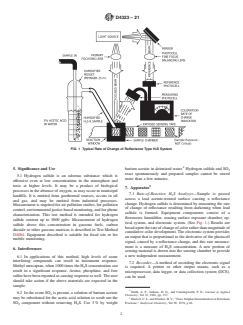
with an analysis time appropriate for the application. (See Fig.
2.1 ASTM Standards:
D1193 Specification for Reagent Water 1.) Sample gas is passed through a flowmeter and a humidifier;
D1356 Terminology Relating to Sampling and Analysis of thenacrossleadacetate-treatedpapertape.Aconstanthumidity
Atmospheres isrequiredforaconstantreactionrateofH Swithleadacetate.
H Sreactswithleadacetatetoformabrownstainonthepaper.
The resultant change in reflectance is detected by a photon
1 detection system. The rate of change of reflectance is propor-
This test method is under the jurisdiction of ASTM Committee D22 on Air
Quality and is the direct responsibility of Subcommittee D22.03 on Ambient
tional to H S concentration. The analyzer is composed of an
Atmospheres and Source Emissions.
optical system, a photon detection system, a signal differentia-
Current edition approved Nov. 1, 2021. Published May 2022. Originally
tion system of first order, and a signal output system.
approved in 1984. Last previous edition approved in 2015 as D4323 – 15. DOI:
10.1520/D4323-21.
For referenced ASTM standards, visit the ASTM website, www.astm.org, or
contact ASTM Customer Service at service@astm.org. For Annual Book of ASTM
Standards volume information, refer to the standard’s Document Summary page on The last approved version of this historical standard is referenced on
the ASTM website. www.astm.org.
Copyright © ASTM International, 100 Barr Harbor Drive, PO Box C700, West Conshohocken, PA 19428-2959. United States
D4323−21
FIG. 1 Typical Rate of Change of Reflectance Type H S System
5. Significance and Use barium acetate in deionized water. Hydrogen sulfide and SO
react spontaneously and prepared samples cannot be stored
5.1 Hydrogen sulfide is an odorous substance which is
more than a few minutes.
offensive even at low concentrations in the atmosphere and
toxic at higher levels. It may be a product of biological 5
7. Apparatus
processes in the absence of oxygen, as may occur in municipal
7.1 Rate-of-Reaction H S Analyzer—Sample is passed
landfills. It is emitted from geothermal sources, occurs in oil
across a lead acetate-treated surface causing a reflectance
and gas, and may be emitted from industrial processes.
change. Hydrogen sulfide is determined by measuring the rate
Measurement is required for air pollution studies, for pollution
of change of reflectance resulting from darkening when lead
control,environmentaljusticebasedmonitoring,andforplume
sulfide is formed. Equipment components consist of a
characterization. This test method is intended for hydrogen
flowmeter, humidifier, sensing surface exposure chamber, op-
sulfide content up to 3000 ppbv. Measurement of hydrogen
tical system, and electronic system. (See Fig. 1.) Results are
sulfide above this concentration in gaseous fuels, carbon
basedupontherateofchangeofcolorratherthanmagnitudeof
dioxide or other gaseous matrices is described in Test Method
cumulative color development. The electronic system provides
D4084. Equipment described is suitable for fixed site or for
an output that is proportional to the derivative of the photocell
mobile monitoring.
signal, caused by a reflectance change, and this rate measure-
ment is a measure of H S concentration. A new portion of
6. Interferences
sensing material is drawn into the sensing chamber to provide
a new independent measurement.
6.1 In applications of this method, high levels of some
interfering compounds can result in instrument response.
7.2 Recorder—A method of recording the electronic signal
Methylmercaptan,when1000timestheH Sconcentrationcan
2 is required. A printer or other output means, such as a
result in a significant response. Arsine, phosphine, and free
microprocessor, data logger, or data collection system (DCS),
sulfurhavebeenreportedascausingresponseaswell.Theuser
can be used.
should take action if the above materials are expected in the
sample.
Smith, A. F., Jenkins, D. G., and Cunningworth, P. E., Journal of Applied
6.2 In the event SO is present, a solution of barium acetate
Chemistry, Vol 11, 1961, pp. 317.
may be substituted for the acetic acid solution to scrub out the 5
Kimbell, C. L. and Drushel, H. V., “Trace Sulphur Determination in Petroleum
SO component without removing H S. Use 3 % by weight Fractions,” Analytical Chemistry, Vol 50, 1978, p 26.
2 2
D4323−21
7.3 Reference Gas Preparation: 8.4.1 Compressed Gas Standards—The protocol for com-
7.3.1 Mixing—Acalibrated 10-Lcylinder having a movable pressedgasstandardscontainedinAppendixX3canbeusedto
piston for use in making volumetric mixtures of gases in the ensureuniformityincompressedgasstandardmanufactureand
ppb/v range may be used. Construction materials must be inert provide for traceability to a NIST or other standard reference
to H S and not lead to a deterioration of samples.Acylinder of materials.
acrylic lubricated with silicone grease and using a silicone 8.4.1.1 Compressed gas standard regulators must be appro-
O-ring has been found to be suitable in many applications.
priate for the delivery of sulfur gases and attached fittings must
Concentration remains stable to within 1 % over a 1-h period. be passivated or inert to sulfur gases.
Alternatively, a reference mixture can be prepared by dilution
8.4.2 Permeation Devices—Hydrogen sulfide standards can
using a commercially available diluter with passivated compo-
be prepared using a permeation tube gravimetrically calibrated
nents and diluent gas. These devices are not needed when the
andcertifiedataconvenientoperatingtemperature.Atconstant
permeation tube method of dynamic mixing is used to prepare
temperature, calibration gases covering a wide range of con-
the reference sample since this method will generate a refer-
centration can be generated by varying and accurately measur-
ence mixture.
ing the flow rate of diluent gas passing over the tubes. These
7.3.2 Hypodermic Syringe—Gas-tight syringes of 10 and
calibration gases are used to calibrate the analyzer.
50-µL capacity. A side port is convenient for purging. Avoid
8.4.2.1 Permeation System Temperature Control—
LuertipsyringesmadeofplatedbrassasH Sreactswithbrass.
Permeation devices are maintained at the calibration tempera-
Other convenient small volume measurement devices such as a
ture within 0.1 °C.
microlitre valve may be used.
8.4.2.2 Permeation System Flow Control—The permeation
7.3.3 Pump—A sample pump capable of providing 500
flow system measures diluent gas flow over the permeation
mL/min flow at approximately 35 kPa (5 psi). The pump
tubes within 62%.
wetted parts must be inert to H S and not lead to sample
2 8.4.2.3 Permeation tubes are inspected and weighed to the
deterioration.
nearest 0.01 mg at least monthly using a balance calibrated
against NIST traceable “S” class weights or the equivalent.
8. Reagent and Materials
Analyte concentration is calculated by weight loss rate and
8.1 Purity of Reagents—Reagent grade chemicals shall be
dilution gas flow rate as in accordance with Practice D3609.
used in all tests. Unless otherwise noted, all reagents shall These devices are discarded when the liquid contents are
conform to the specifications of the Committee on Analytical
reduced to less than ten percent of the initial volume or when
Reagents of the American Chemical Society, where such the permeation surface is unusually discolored or otherwise
specifications are available.
compromised. Used permeation tubes should be disposed of in
accordance with local, state, or federal environmental
8.2 Acetic Acid Solution (50 mL/L)—Dilute 50 mL of
regulations, or combination thereof.
glacial acetic acid (CH COOH), reagent grade, to make 1 Lof
solution using Type III water prepared as described in Speci-
8.5 Dilution Gas—A chemically pure grade or purified gas
fication D1193.
similar to the gas to be sampled, H S-free. Mixture can be
prepared using the 10-L cylinder or commercially available
8.3 Sensing Tape—Prepare sensing tape as described inTest
diluter as described in 7.3.1.
Method D2420 or use commercial sensing tape that has been
prepared in a similar manner. Keep sensing tape in a sealed
8.6 Lead Acetate Sensing Paper—Prepare in accordance
container to prevent exposure to ambient H S.
with Test Method D2420, using appropriate size strips and
drying in an H S-free environment. Commercially available
8.4 Hydrogen Sulfide (99.5 %)—Commercially available 2
test paper has been found satisfactory. Used Lead Acetate
H S has been found to be insufficiently pure. Purity certifica-
Sensing Paper should be disposed of in accordance with local,
tion is recommended or use of H S generators using perme-
state, or federal environmental regulations, or combination
ation devices may be used. Alternatively, a certified H S
thereof.
mixture at concentrations as low as 1000 ppbv can be obtained
from a gas standard vendor in an air or nitrogen matrix. These
9. Hazards
mixturescanbeeitheraprimarystandard,whichisthendiluted
to the desired H S concentration using a 10-L cylinder with a
2 9.1 Hydrogen sulfide contained in lecture bottles, perme-
piston or commercially available dilution apparatus, or a
ation tubes or compressed gas cylinders may be flammable and
standard in a pressurized cylinder containing the desired H S
2 harmful or fatal if ingested or inhaled. Hydrogen sulfide is
concentration. Because of the potential for degradation, H S
toxic at levels above 10 000 ppb/v. Use only under an
mixturesobtainedfromagasstandardvendormustbeproperly
appropriate fume hood. Use protective glasses if liquid HSin
stored and used only within the stated certification period.
cylindersishandled.Senseofsmellmaybelostonexposureto
H S and is unreliable as a warning of danger. (See 6.1 and 6.2
on Interferences.)
ACS Reagent Chemicals, Specifications and Procedures for Reagents and
Standard-Grade Reference Materials, American Chemical Society, Washington,
9.2 Lecture bottles, permeation tubes and compressed gas
DC. For suggestions on the testing of reagents not listed by theAmerican Chemical
standards should only be handled in well ventilated locations
Society, see Analar Standards for Laboratory Chemicals, BDH Ltd., Poole, Dorset,
away from sparks and flames. Improper handling of com-
U.K., and the United States Pharmacopeia and National Formulary, U.S. Pharma-
copeial Convention, Inc. (USPC), Rockville, MD. pressed gas cylinders containing air, nitrogen, or hydrocarbons
D4323−21
can result in explosion. Rapid release of nitrogen or hydrocar- At constant temperature, calibration gases covering a wide
bon gasses can result in asphyxiation. range of concentration can be generated by varying and
accurately measuring the flow rate of diluent gas passing over
9.3 Compressed air supports combustion.
the tubes. These calibration gases are used to calibrate the
9.4 Concentrated acetic acid fumes are an irritant and can
analyzer. 8.4.2 presents parameters critical for generating
cause damage to skin and mucus membrane. Handle carefully
standards of known concentration with accuracy suitable for
to avoid injury.
use under this standard. See Practice D3609 for details on
9.5 Lead acetate is a cumulate poison; wash hands after performing calibrations using permeation devices.
11.2.3 Dilution of Primary H S Cylinder Gas Standard—As
handling and do not breathe dus
...
This document is not an ASTM standard and is intended only to provide the user of an ASTM standard an indication of what changes have been made to the previous version. Because
it may not be technically possible to adequately depict all changes accurately, ASTM recommends that users consult prior editions as appropriate. In all cases only the current version
of the standard as published by ASTM is to be considered the official document.
Designation: D4323 − 15 D4323 − 21
Standard Test Method for
Hydrogen Sulfide in the Atmosphere by Rate of Change of
Reflectance
This standard is issued under the fixed designation D4323; the number immediately following the designation indicates the year of
original adoption or, in the case of revision, the year of last revision. A number in parentheses indicates the year of last reapproval. A
superscript epsilon (´) indicates an editorial change since the last revision or reapproval.
1. Scope
1.1 This test method covers the automatic continuous determination of hydrogen sulfide (H S) in the atmosphere or in gaseous
samples in the range from one part per billion by volume (1 ppb/v) to 3000 ppb/v. Information obtained may be used for
air-pollution studies and to monitor for emission sources.studies, fence-line monitoring, and other source emission monitoring.
1.2 The range may be extended by appropriate dilution techniques or by equipment modification.
1.3 The values stated in SI units are to be regarded as standard. The values given in parentheses are mathematical conversions to
inch-pound units that are provided for information only and are not considered standard.
1.4 This standard does not purport to address all of the safety concerns, if any, associated with its use. It is the responsibility
of the user of this standard to establish appropriate safety safety, health, and healthenvironmental practices and determine the
applicability of regulatory limitations prior to use. (See Section 9 for specific safety precautionary statements.)
1.5 This international standard was developed in accordance with internationally recognized principles on standardization
established in the Decision on Principles for the Development of International Standards, Guides and Recommendations issued
by the World Trade Organization Technical Barriers to Trade (TBT) Committee.
2. Referenced Documents
2.1 ASTM Standards:
D1193 Specification for Reagent Water
D1356 Terminology Relating to Sampling and Analysis of Atmospheres
D2420 Test Method for Hydrogen Sulfide in Liquefied Petroleum (LP) Gases (Lead Acetate Method)
D2725 Test Method for Hydrogen Sulfide in Natural Gas (Methylene Blue Method) (Withdrawn 1996)
D3609 Practice for Calibration Techniques Using Permeation Tubes
D4084 Test Method for Analysis of Hydrogen Sulfide in Gaseous Fuels (Lead Acetate Reaction Rate Method)
D4323 Test Method for Hydrogen Sulfide in the Atmosphere by Rate of Change of Reflectance
D6299 Practice for Applying Statistical Quality Assurance and Control Charting Techniques to Evaluate Analytical Measure-
ment System Performance
D6792 Practice for Quality Management Systems in Petroleum Products, Liquid Fuels, and Lubricants Testing Laboratories
This test method is under the jurisdiction of ASTM Committee D22 on Air Quality and is the direct responsibility of Subcommittee D22.03 on Ambient Atmospheres
and Source Emissions.
Current edition approved April 1, 2015Nov. 1, 2021. Published April 2015May 2022. Originally approved in 1984. Last previous edition approved in 20092015 as
D4323 – 84 (2009).D4323 – 15. DOI: 10.1520/D4323-15.10.1520/D4323-21.
For referenced ASTM standards, visit the ASTM website, www.astm.org, or contact ASTM Customer Service at service@astm.org. For Annual Book of ASTM Standards
volume information, refer to the standard’s Document Summary page on the ASTM website.
The last approved version of this historical standard is referenced on www.astm.org.
Copyright © ASTM International, 100 Barr Harbor Drive, PO Box C700, West Conshohocken, PA 19428-2959. United States
D4323 − 21
3. Terminology
3.1 Definitions—For definitions of terms used in this test method, refer to Terminology D1356.
4. Summary of Test Method
4.1 Hydrogen sulfide is determined by use of the reaction of H S with lead acetate-impregnated paper tape and by comparing a
reading of an unknown sample with that of a known standard using a differential colorimetric detection. Detection of the rate of
change of reflectance provides measurement in ppb/v ranges with an analysis time appropriate for the application. (See Fig. 1.)
Sample gas is passed through a flowmeter and a humidifier; then across lead acetate-treated paper tape. A constant humidity is
required for a constant reaction rate of H S with lead acetate. H S reacts with lead acetate to form a brown stain on the paper. The
2 2
resultant change in reflectance is detected by a photon detection system. The rate of change of reflectance is proportional to H S
concentration. The analyzer is composed of an optical system, a photon detection system, a signal differentiation system of first
order, and a signal output system.
5. Significance and Use
5.1 Hydrogen sulfide is an odorous substance which is offensive even at low concentrations in the atmosphere and toxic at higher
levels. It may be a product of biological processes in the absence of oxygen, as may occur in municipal garbage landfills. It is
emitted from geothermal sources, occurs in oil and gas, and may be emitted from industrial processes. Measurement is required
for air pollution studies, for pollution control, environmental justice based monitoring, and for plume characterization. This test
method is intended for hydrogen sulfide content up to 3000 ppbv. Measurement of hydrogen sulfide above this concentration in
gaseous fuels, carbon dioxide or other gaseous matrices is described in Test Method D4084. Equipment described is suitable for
fixed site or for mobile monitoring.
6. Interferences
6.1 In applications of this method, high levels of some interfering compounds can result in instrument response. Methyl
mercaptan, when 1000 times the H S concentration can affect response equal to Hresult in a significant S response. Arsine,
2 2
FIG. 1 Typical Rate of Change of Reflectance Type H S System
D4323 − 21
phosphine, and free sulfur have been reported as causing response. The operatorresponse as well. The user should take required
precautions action if the above materials are expected to be present in the sample.
6.2 In the event SO may be is present, a solution of barium acetate may be substituted for the acetic acid solution to scrub out
the SO component without removing H S. Use 3 % by weight barium acetate in deionized water. Hydrogen sulfide and SO react
2 2 2
spontaneously and prepared samples cannot be stored more than a few minutesminutes.
7. Apparatus
7.1 Rate-of-Reaction H S Analyzer—Sample is passed across a lead acetate-treated surface causing a reflectance change.
Hydrogen sulfide is determined by measuring the rate of change of reflectance resulting from darkening when lead sulfide is
formed. Equipment consists components consist of a flowmeter, humidifier, sensing surface exposure chamber, optical system, and
electronic system. (See Fig. 1.) A complete analysis results from use of Results are based upon the rate of change of color rather
than magnitude of cumulative color development. The electronic system provides an output that is proportional to the derivative
of the photocell signal, caused by a reflectance change, and this rate measurement is a measure of H S concentration. A new
sectionportion of sensing material is drawn into the sensing chamber to provide a new independent measurement.
7.2 Recorder—A method of recording the electronic signal is required. A printer or other output means, such as a microprocessor,
data logger, or data collection system (DCS), can be used.
7.3 Reference Gas Preparation:
7.3.1 Mixing—A calibrated 10-L cylinder having a movable piston for use in making volumetric mixtures of gases in the ppb/v
range may be used. Materials of construction Construction materials must be inert to H S and not lead to a deterioration of prepared
samples. A cylinder of acrylic lubricated with silicone grease and using a silicone O-ring has been found to be suitable. suitable
in many applications. Concentration remains stable to within 1 % over a 1-h period. Alternatively, a reference mixture can be
prepared by dilution using a commercially available diluter with passivated components and diluent gas. These devices are not
needed when the permeation tube method of dynamic mixing is used to prepare the reference sample since this method will
generate a reference mixture.
7.3.2 Hypodermic Syringe—Gas-tight syringes of 10 and 50-μl50-μL capacity. A side port is convenient for purging. Avoid Luer
tip syringes made of plated brass as H S reacts with brass. Other convenient small volume measurement devices such as a
microlitre valve may be used.
7.3.3 Pump—A sample pump capable of providing 500 mL/min flow at approximately 35 kPa [5 psi].(5 psi). The pump wetted
parts must be inert to H S and not lead to a deterioration of the sample.sample deterioration.
8. Reagent and Materials
8.1 Purity of Reagents—Reagent grade chemicals shall be used in all tests. Unless otherwise noted, all reagents shall conform to
the specifications of the Committee on Analytical Reagents of the American Chemical Society, where such specifications are
available.
8.2 Acetic Acid Solution (50 mL/L)—Dilute 50 mL of glacial acetic acid (CH COOH), reagent grade, to make 1 L of solution using
Type III water prepared as described in Specification D1193.
8.3 Sensing Tape—Prepare sensing tape as described in Test Method D2420 or use commercial sensing tape that has been
prepared in a similar manner. Keep sensing tape in a sealed container to prevent exposure to ambient H S.
8.4 Hydrogen Sulfide (99.5 %)—Commercially available H S has been found to be insufficiently pure. Purity certification is
Smith, A. F., Jenkins, D. G., and Cunningworth, P. E., Journal of Applied Chemistry, Vol 11, 1961, pp. 317.
Kimbell, C. L. and Drushel, H. V., “Trace Sulphur Determination in Petroleum Fractions,” Analytical Chemistry, Vol 50, 1978, p 26.
Reagent Chemicals, American Chemical Society Specifications,ACS Reagent Chemicals, Specifications and Procedures for Reagents and Standard-Grade Reference
Materials, American Chemical Society, Washington, DC. For suggestions on the testing of reagents not listed by the American Chemical Society, see Analar Standards for
Laboratory Chemicals, BDH Ltd., Poole, Dorset, U.K., and the United States Pharmacopeia and National Formulary, U.S. PharmaceuticalPharmacopeial Convention, Inc.
(USPC), Rockville, MD.
D4323 − 21
recommended or use of H S generators using permeation devices may be used. Alternatively, a certified H S mixture at
2 2
concentrations as low as 1000 ppbv can be obtained from a gas standard vendor in an air or nitrogen matrix. These mixtures can
be either a primary standard, which is then diluted to the desired H S concentration using a 10-L cylinder with a piston, or piston
or commercially available dilution apparatus, or a standard in a pressurized cylinder containing the desired H S concentration.
Because of the potential for degradation, H S mixtures obtained from a gas standard vendor must be properly stored and used only
within the stated certification period.
8.4.1 Compressed Gas Standards—The protocol for compressed gas standards contained in Appendix X3 can be used to ensure
uniformity in compressed gas standard manufacture and provide for traceability to a NIST or other standard reference materials.
8.4.1.1 Compressed gas standard regulators must be appropriate for the delivery of sulfur gases and attached fittings must be
passivated or inert to sulfur gases.
8.4.2 Permeation Devices—Hydrogen Sulfidesulfide standards can be prepared using a permeation tube gravimetrically calibrated
and certified at a convenient operating temperature. At constant temperature, calibration gases covering a wide range of
concentration can be generated by varying and accurately measuring the flow rate of diluent gas passing over the tubes. These
calibration gases are used to calibrate the analyzer analyzer.
8.4.2.1 Permeation System Temperature Control—Permeation devices are maintained at the calibration temperature within
0.1°C.0.1 °C.
8.4.2.2 Permeation System Flow Control—The permeation flow system measures diluent gas flow over the permeation tubes
within 62 percent.62 %.
8.4.2.3 Permeation tubes are inspected and weighed to the nearest 0.01 mg on at least a monthly basis using a balance calibrated
against NIST traceable “S” class weights or the equivalent. Analyte concentration is calculated by weight loss rate and dilution
gas flow rate as in accordance with Practice D3609. These devices are discarded when the liquid contents are reduced to less than
ten percent of the initial volume or when the permeation surface is unusually discolored or otherwise compromised. Used
permeation tubes should be disposed of in accordance with local, state, or federal environmental regulations, or combination
thereof.
8.5 Dilution Gas—A chemically pure grade or purified gas similar to the gas to be sampled, H S-free. Mixture can be prepared
using the 10-L cylinder or commercially available diluter as described in 7.3.1.
8.6 Lead Acetate Sensing Paper—Prepare in accordance with Test Method D2420, using appropriate size strips and drying in an
H S-free environment. Commercially available test paper has been found satisfactory. Used Lead Acetate Sensing Paper should
be disposed of in accordance with local, state, or federal environmental regulations, or combination thereof.
9. Hazards
9.1 Hydrogen Sulfidesulfide contained in lecture bottles, permeation tubes or compressed gas cylinders may be flammable and
harmful or fatal if ingested or inhaled. Hydrogen sulfide is toxic at levels above 10 000 ppb/v. Use only under an appropriate fume
hood. Use protective glasses if liquid H S in cylinders is handled. Sense of smell may be lost on exposure to H S and is unreliable
2 2
as a warning of danger. (See 6.1 and 6.2 on Interferences.)
9.2 Lecture bottles, permeation tubes and compressed gas standards should only be handled in well ventilated locations away from
sparks and flames. Improper handling of compressed gas cylinders containing air, nitrogen, or hydrocarbons can result in
explosion. Rapid release of nitrogen or hydrocarbon gasses can result in asphyxiation.
9.3 Compressed air supports combustion.
9.4 Concentrated acetic acid fumes are an irritant and can cause damage to skin and mucus membrane. Handle carefully to avoid
injury.
9.5 Lead acetate is a cumulate poison; wash hands after handling and do not breathe any dust containing lead acetate.
D4323 − 21
10. Sampling
10.1 Sample lines and containers must not absorb sample H S. Suitable materials are fluorocarbon resins, aluminum, borosilicate
glass, silica lined metal tubing, and suitable inactive acrylic. Stainless steel (Type 316) may be used when required by regulations
but is not preferred.
10.2 Avoid materials containing copper, brass, or having petroleum lubricant coatings.
11. Calibration and Standardization
11.1 Reference Standard—Reference standards are prepared by volumetric measurement or reference standard dilution to the
desired concentration at the time the reference material is to be used. This minimizes deterioration of the sample. The permeation
tube method or compressed gas cylinders certified as to concentration by the manufacturer may be
...