

ASTM D8275-22
(Specification)Standard Specification for Gasoline-like Test Fuel for Compression-Ignition Engines
General Information
- Abstract
SCOPE
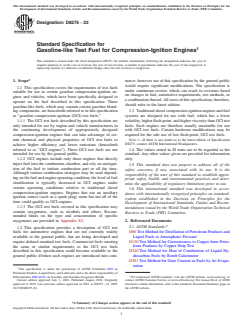
1.1 This specification covers the requirements of test fuels suitable for use in certain gasoline compression-ignition engines and vehicles, which have been specifically designed to operate on the fuel described in this specification. These gasoline-like fuels, which may contain certain gasoline blending components, are henceforth referred to in this specification as “gasoline compression-ignition (GCI) test fuels.”
1.1.1 The GCI test fuels described by this specification are only intended for use by engine and vehicle manufacturers in the continuing development of appropriately designed compression-ignition engines that can take advantage of certain chemical and physical properties of GCI test fuels to achieve higher efficiency and lower emissions (henceforth referred to as “GCI engines”). These GCI test fuels are not intended for use by the general public.
1.1.2 GCI engines include only those engines that directly inject fuel into the combustion chamber, and rely on autoignition of the fuel to initiate combustion part or all the time. Although various combustion strategies may be used depending on the fuel and engine operating condition, the level of fuel stratification is typically decreased in GCI engines under certain operating conditions relative to traditional diesel compression-ignition engines. Engines that use an auxiliary ignition source (such as a spark plug) some but not all of the time could qualify as GCI engines.
1.1.3 The GCI test fuels covered in this specification may contain oxygenates, such as alcohols and ethers. Recommended limits on the type and concentration of specific oxygenates are provided in Appendix X3.
1.2 This specification provides a description of GCI test fuels for automotive engines that are not currently widely available to the general public, but are being developed and require defined standard test fuels. Commercial fuels meeting the same or similar requirements as the GCI test fuels described in this specification could become available to the general public if/when such engines are introduced into commerce; however use of this specification by the general public would require significant modifications. The specification is under continuous review, which can result in revisions based on changes in fuel, automotive requirements, test methods, or a combination thereof. All users of this specification, therefore, should refer to the latest edition.
1.3 Traditional diesel compression-ignition engines and fuel systems are designed for use with fuel, which has a lower volatility, higher flash-point, and higher viscosity than GCI test fuels. Such engines are therefore usually unsuitable for use with GCI test fuels. Certain hardware modifications may be required for the safe use of low flash-point, GCI test fuels.
Note 1: If there is any doubt as to the latest edition of Specification D8275, contact ASTM International Headquarters.
1.4 The values stated in SI units are to be regarded as the standard. Any other values given are provided for information only.
1.5 This standard does not purport to address all of the safety concerns, if any, associated with its use. It is the responsibility of the user of this standard to establish appropriate safety, health, and environmental practices and determine the applicability of regulatory limitations prior to use.
1.6 This international standard was developed in accordance with internationally recognized principles on standardization established in the Decision on Principles for the Development of International Standards, Guides and Recommendations issued by the World Trade Organization Technical Barriers to Trade (TBT) Committee.
- Status
- Published
- Publication Date
- 30-Jun-2022
- Technical Committee
- D02 - Petroleum Products, Liquid Fuels, and Lubricants
- Drafting Committee
- D02.A0.01 - Gasoline and Gasoline-Oxygenate Blends
Buy Documents
ASTM D8275-22 - Standard Specification for Gasoline-like Test Fuel for Compression-Ignition Engines
REDLINE ASTM D8275-22 - Standard Specification for Gasoline-like Test Fuel for Compression-Ignition Engines
Overview
ASTM D8275-22: Standard Specification for Gasoline-like Test Fuel for Compression-Ignition Engines offers comprehensive guidelines on the requirements, use, and properties of gasoline compression-ignition (GCI) test fuels. Developed by ASTM International, this standard is specifically designed for engine and vehicle manufacturers who are developing advanced compression-ignition engines-also known as GCI engines-that are engineered for optimized efficiency and reduced emissions through the use of gasoline-like fuels.
This specification establishes the criteria for the composition and properties of GCI test fuels, which may incorporate oxygenates such as alcohols and ethers. Not intended for use by the general public, these test fuels play an essential role in research and development, allowing manufacturers to benchmark performance, emissions, and other operational characteristics of modern gasoline compression-ignition engines under controlled and repeatable conditions.
Key Topics
Scope and Purpose
ASTM D8275-22 details the essential attributes of GCI test fuels, specifies their chemical and physical properties, and outlines their intended applications within the automotive engine development sector. The fuel is designed explicitly for direct-injection engines utilizing autoignition to initiate combustion, either wholly or partially.Fuel Properties and Requirements
The standard addresses a variety of properties for GCI test fuels, including:- Maximum allowable levels for lead, sulfur, manganese, and other components
- Limits on vapor pressure, distillation temperatures, and residue content
- Controls on gum content, oxidation stability, and corrosiveness to engine materials
- Guidance on acceptable levels and types of oxygenates
These properties ensure that the fuel supports high-efficiency engine operation while minimizing the risk of corrosion, deposit formation, and emissions.
Sampling, Handling, and Testing
ASTM D8275-22 references established ASTM test methods for verifying compliance with property requirements. Proper sampling, container selection, and sample handling procedures are critical for obtaining accurate test data.Workmanship and Contaminants
The specification mandates that GCI test fuels must be clear, bright, and visually free of water, sediment, or suspended matter. It also cautions manufacturers and blenders against the inclusion of adulterants or contaminants, such as silicon compounds, which can damage vehicle components.Safety and Regulatory Compliance
The standard underscores the user’s responsibility to comply with safety, health, and environmental regulations relevant to the manufacture, handling, and usage of these fuels.
Applications
Advanced Engine Development
GCI test fuels are instrumental for automotive and engine manufacturers carrying out research and development on next-generation compression-ignition engines. These engines are expected to deliver superior efficiency and lower emissions compared to conventional spark-ignition and diesel engines.Laboratory and Field Testing
Use of standardized fuels ensures consistency and repeatability in performance and emissions testing, which is vital for benchmarking, validation, and regulatory certification processes.Prototype and Pre-commercial Engines
As GCI technology evolves, these fuels serve as a baseline for evaluating new designs and combustion strategies prior to the commercialization and broader adoption of GCI-powered vehicles.
Related Standards
ASTM D8275-22 is closely associated with a range of fundamental test methods and specifications that govern the analysis and characterization of petroleum products and liquid fuels, including:
- ASTM D86: Distillation of Petroleum Products
- ASTM D525: Oxidation Stability of Gasoline
- ASTM D130, D7667: Corrosiveness Tests for Metals in Fuels
- ASTM D4052: Density and API Gravity of Liquids
- ASTM D4176: Inspection for Free Water and Contaminants
- ASTM D4814: Specification for Automotive Spark-Ignition Engine Fuel
- ASTM D4815: Determination of Oxygenates in Gasoline
These referenced standards ensure that the properties and performance of GCI test fuels are assessed with reliable and internationally recognized methodologies, supporting the overarching goals of high efficiency, low emissions, and engine durability.
Keywords: ASTM D8275-22, GCI test fuel, gasoline compression-ignition, advanced engine development, fuel specification, emissions reduction, research fuel, automotive test methods, engine efficiency, fuel standards.
Relations
- Effective Date
- 01-Mar-2024
- Effective Date
- 01-Mar-2024
- Effective Date
- 01-Mar-2024
- Effective Date
- 01-Jan-2024
- Refers
ASTM D4175-23a - Standard Terminology Relating to Petroleum Products, Liquid Fuels, and Lubricants - Effective Date
- 15-Dec-2023
- Effective Date
- 01-Dec-2023
- Effective Date
- 01-Dec-2023
- Effective Date
- 01-Dec-2023
- Effective Date
- 01-Nov-2023
- Refers
ASTM D2699-23b - Standard Test Method for Research Octane Number of Spark-Ignition Engine Fuel - Effective Date
- 01-Nov-2023
- Refers
ASTM D2699-23a - Standard Test Method for Research Octane Number of Spark-Ignition Engine Fuel - Effective Date
- 01-Oct-2023
- Effective Date
- 01-Oct-2023
- Refers
ASTM D5842-23 - Standard Practice for Sampling and Handling of Fuels for Volatility Measurement - Effective Date
- 01-Oct-2023
- Refers
ASTM D4175-23e1 - Standard Terminology Relating to Petroleum Products, Liquid Fuels, and Lubricants - Effective Date
- 01-Jul-2023
- Effective Date
- 01-May-2020
Buy Documents
ASTM D8275-22 - Standard Specification for Gasoline-like Test Fuel for Compression-Ignition Engines
REDLINE ASTM D8275-22 - Standard Specification for Gasoline-like Test Fuel for Compression-Ignition Engines
Get Certified
Connect with accredited certification bodies for this standard

Element Materials Technology
Materials testing and product certification.

ABS Group Brazil
ABS Group certification services in Brazil.

ABS Quality Evaluations Inc.
American Bureau of Shipping quality certification.
Sponsored listings
Frequently Asked Questions
ASTM D8275-22 is a technical specification published by ASTM International. Its full title is "Standard Specification for Gasoline-like Test Fuel for Compression-Ignition Engines". This standard covers: SCOPE 1.1 This specification covers the requirements of test fuels suitable for use in certain gasoline compression-ignition engines and vehicles, which have been specifically designed to operate on the fuel described in this specification. These gasoline-like fuels, which may contain certain gasoline blending components, are henceforth referred to in this specification as “gasoline compression-ignition (GCI) test fuels.” 1.1.1 The GCI test fuels described by this specification are only intended for use by engine and vehicle manufacturers in the continuing development of appropriately designed compression-ignition engines that can take advantage of certain chemical and physical properties of GCI test fuels to achieve higher efficiency and lower emissions (henceforth referred to as “GCI engines”). These GCI test fuels are not intended for use by the general public. 1.1.2 GCI engines include only those engines that directly inject fuel into the combustion chamber, and rely on autoignition of the fuel to initiate combustion part or all the time. Although various combustion strategies may be used depending on the fuel and engine operating condition, the level of fuel stratification is typically decreased in GCI engines under certain operating conditions relative to traditional diesel compression-ignition engines. Engines that use an auxiliary ignition source (such as a spark plug) some but not all of the time could qualify as GCI engines. 1.1.3 The GCI test fuels covered in this specification may contain oxygenates, such as alcohols and ethers. Recommended limits on the type and concentration of specific oxygenates are provided in Appendix X3. 1.2 This specification provides a description of GCI test fuels for automotive engines that are not currently widely available to the general public, but are being developed and require defined standard test fuels. Commercial fuels meeting the same or similar requirements as the GCI test fuels described in this specification could become available to the general public if/when such engines are introduced into commerce; however use of this specification by the general public would require significant modifications. The specification is under continuous review, which can result in revisions based on changes in fuel, automotive requirements, test methods, or a combination thereof. All users of this specification, therefore, should refer to the latest edition. 1.3 Traditional diesel compression-ignition engines and fuel systems are designed for use with fuel, which has a lower volatility, higher flash-point, and higher viscosity than GCI test fuels. Such engines are therefore usually unsuitable for use with GCI test fuels. Certain hardware modifications may be required for the safe use of low flash-point, GCI test fuels. Note 1: If there is any doubt as to the latest edition of Specification D8275, contact ASTM International Headquarters. 1.4 The values stated in SI units are to be regarded as the standard. Any other values given are provided for information only. 1.5 This standard does not purport to address all of the safety concerns, if any, associated with its use. It is the responsibility of the user of this standard to establish appropriate safety, health, and environmental practices and determine the applicability of regulatory limitations prior to use. 1.6 This international standard was developed in accordance with internationally recognized principles on standardization established in the Decision on Principles for the Development of International Standards, Guides and Recommendations issued by the World Trade Organization Technical Barriers to Trade (TBT) Committee.
SCOPE 1.1 This specification covers the requirements of test fuels suitable for use in certain gasoline compression-ignition engines and vehicles, which have been specifically designed to operate on the fuel described in this specification. These gasoline-like fuels, which may contain certain gasoline blending components, are henceforth referred to in this specification as “gasoline compression-ignition (GCI) test fuels.” 1.1.1 The GCI test fuels described by this specification are only intended for use by engine and vehicle manufacturers in the continuing development of appropriately designed compression-ignition engines that can take advantage of certain chemical and physical properties of GCI test fuels to achieve higher efficiency and lower emissions (henceforth referred to as “GCI engines”). These GCI test fuels are not intended for use by the general public. 1.1.2 GCI engines include only those engines that directly inject fuel into the combustion chamber, and rely on autoignition of the fuel to initiate combustion part or all the time. Although various combustion strategies may be used depending on the fuel and engine operating condition, the level of fuel stratification is typically decreased in GCI engines under certain operating conditions relative to traditional diesel compression-ignition engines. Engines that use an auxiliary ignition source (such as a spark plug) some but not all of the time could qualify as GCI engines. 1.1.3 The GCI test fuels covered in this specification may contain oxygenates, such as alcohols and ethers. Recommended limits on the type and concentration of specific oxygenates are provided in Appendix X3. 1.2 This specification provides a description of GCI test fuels for automotive engines that are not currently widely available to the general public, but are being developed and require defined standard test fuels. Commercial fuels meeting the same or similar requirements as the GCI test fuels described in this specification could become available to the general public if/when such engines are introduced into commerce; however use of this specification by the general public would require significant modifications. The specification is under continuous review, which can result in revisions based on changes in fuel, automotive requirements, test methods, or a combination thereof. All users of this specification, therefore, should refer to the latest edition. 1.3 Traditional diesel compression-ignition engines and fuel systems are designed for use with fuel, which has a lower volatility, higher flash-point, and higher viscosity than GCI test fuels. Such engines are therefore usually unsuitable for use with GCI test fuels. Certain hardware modifications may be required for the safe use of low flash-point, GCI test fuels. Note 1: If there is any doubt as to the latest edition of Specification D8275, contact ASTM International Headquarters. 1.4 The values stated in SI units are to be regarded as the standard. Any other values given are provided for information only. 1.5 This standard does not purport to address all of the safety concerns, if any, associated with its use. It is the responsibility of the user of this standard to establish appropriate safety, health, and environmental practices and determine the applicability of regulatory limitations prior to use. 1.6 This international standard was developed in accordance with internationally recognized principles on standardization established in the Decision on Principles for the Development of International Standards, Guides and Recommendations issued by the World Trade Organization Technical Barriers to Trade (TBT) Committee.
ASTM D8275-22 is classified under the following ICS (International Classification for Standards) categories: 75.160.20 - Liquid fuels. The ICS classification helps identify the subject area and facilitates finding related standards.
ASTM D8275-22 has the following relationships with other standards: It is inter standard links to ASTM D2699-24, ASTM D2700-24, ASTM D3606-24, ASTM D4814-24, ASTM D4175-23a, ASTM D86-23a, ASTM D86-23ae1, ASTM D4814-23a, ASTM D2700-23b, ASTM D2699-23b, ASTM D2699-23a, ASTM D2700-23a, ASTM D5842-23, ASTM D4175-23e1, ASTM D5482-20. Understanding these relationships helps ensure you are using the most current and applicable version of the standard.
ASTM D8275-22 is available in PDF format for immediate download after purchase. The document can be added to your cart and obtained through the secure checkout process. Digital delivery ensures instant access to the complete standard document.
Standards Content (Sample)
This international standard was developed in accordance with internationally recognized principles on standardization established in the Decision on Principles for the
Development of International Standards, Guides and Recommendations issued by the World Trade Organization Technical Barriers to Trade (TBT) Committee.
Designation: D8275 −22
Standard Specification for
Gasoline-like Test Fuel for Compression-Ignition Engines
This standard is issued under the fixed designation D8275; the number immediately following the designation indicates the year of
original adoption or, in the case of revision, the year of last revision. A number in parentheses indicates the year of last reapproval. A
superscript epsilon (´) indicates an editorial change since the last revision or reapproval.
1. Scope* merce; however use of this specification by the general public
would require significant modifications. The specification is
1.1 This specification covers the requirements of test fuels
under continuous review, which can result in revisions based
suitable for use in certain gasoline compression-ignition en-
on changes in fuel, automotive requirements, test methods, or
gines and vehicles, which have been specifically designed to
a combination thereof.All users of this specification, therefore,
operate on the fuel described in this specification. These
should refer to the latest edition.
gasoline-like fuels, which may contain certain gasoline blend-
ing components, are henceforth referred to in this specification 1.3 Traditionaldieselcompression-ignitionenginesandfuel
as “gasoline compression-ignition (GCI) test fuels.” systems are designed for use with fuel, which has a lower
1.1.1 The GCI test fuels described by this specification are volatility,higherflash-point,andhigherviscositythanGCItest
only intended for use by engine and vehicle manufacturers in fuels. Such engines are therefore usually unsuitable for use
the continuing development of appropriately designed with GCI test fuels. Certain hardware modifications may be
compression-ignition engines that can take advantage of cer- required for the safe use of low flash-point, GCI test fuels.
NOTE 1—If there is any doubt as to the latest edition of Specification
tain chemical and physical properties of GCI test fuels to
D8275, contact ASTM International Headquarters.
achieve higher efficiency and lower emissions (henceforth
referred to as “GCI engines”). These GCI test fuels are not 1.4 The values stated in SI units are to be regarded as the
intended for use by the general public. standard. Any other values given are provided for information
1.1.2 GCI engines include only those engines that directly only.
inject fuel into the combustion chamber, and rely on autoigni-
1.5 This standard does not purport to address all of the
tion of the fuel to initiate combustion part or all the time.
safety concerns, if any, associated with its use. It is the
Although various combustion strategies may be used depend-
responsibility of the user of this standard to establish appro-
ing on the fuel and engine operating condition, the level of fuel
priate safety, health, and environmental practices and deter-
stratification is typically decreased in GCI engines under
mine the applicability of regulatory limitations prior to use.
certain operating conditions relative to traditional diesel
1.6 This international standard was developed in accor-
compression-ignition engines. Engines that use an auxiliary
dance with internationally recognized principles on standard-
ignition source (such as a spark plug) some but not all of the
ization established in the Decision on Principles for the
time could qualify as GCI engines.
Development of International Standards, Guides and Recom-
1.1.3 The GCI test fuels covered in this specification may
mendations issued by the World Trade Organization Technical
contain oxygenates, such as alcohols and ethers. Recom-
Barriers to Trade (TBT) Committee.
mended limits on the type and concentration of specific
2. Referenced Documents
oxygenates are provided in Appendix X3.
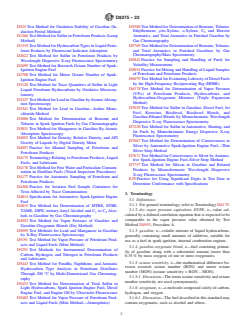
1.2 This specification provides a description of GCI test 2.1 ASTM Standards:
D86 Test Method for Distillation of Petroleum Products and
fuels for automotive engines that are not currently widely
available to the general public, but are being developed and Liquid Fuels at Atmospheric Pressure
D130 Test Method for Corrosiveness to Copper from Petro-
require defined standard test fuels. Commercial fuels meeting
the same or similar requirements as the GCI test fuels leum Products by Copper Strip Test
D240 Test Method for Heat of Combustion of Liquid Hy-
described in this specification could become available to the
general public if/when such engines are introduced into com- drocarbon Fuels by Bomb Calorimeter
D381 Test Method for Gum Content in Fuels by Jet Evapo-
ration
This specification is under the jurisdiction of ASTM Committee D02 on
Petroleum Products, Liquid Fuels, and Lubricants and is the direct responsibility of
Subcommittee D02.A0.01 on Gasoline and Gasoline-Oxygenate Blends. For referenced ASTM standards, visit the ASTM website, www.astm.org, or
Current edition approved July 1, 2022. Published August 2022. Originally contact ASTM Customer Service at service@astm.org. For Annual Book of ASTM
approved in 2019. Last previous edition approved in 2021 as D8275 – 21. DOI: Standards volume information, refer to the standard’s Document Summary page on
10.1520/D8275-22. the ASTM website.
*A Summary of Changes section appears at the end of this standard
Copyright © ASTM International, 100 Barr Harbor Drive, PO Box C700, West Conshohocken, PA 19428-2959. United States
D8275 − 22
D525 Test Method for Oxidation Stability of Gasoline (In- D5580 Test Method for Determination of Benzene, Toluene,
duction Period Method) Ethylbenzene, p/m-Xylene, o-Xylene, C and Heavier
Aromatics, and Total Aromatics in Finished Gasoline by
D1266 Test Method for Sulfur in Petroleum Products (Lamp
Method) Gas Chromatography
D5769 Test Method for Determination of Benzene, Toluene,
D1319 Test Method for Hydrocarbon Types in Liquid Petro-
and Total Aromatics in Finished Gasolines by Gas
leum Products by Fluorescent Indicator Adsorption
Chromatography/Mass Spectrometry
D2622 Test Method for Sulfur in Petroleum Products by
D5842 Practice for Sampling and Handling of Fuels for
Wavelength Dispersive X-ray Fluorescence Spectrometry
Volatility Measurement
D2699 Test Method for Research Octane Number of Spark-
D5854 Practice for Mixing and Handling of Liquid Samples
Ignition Engine Fuel
of Petroleum and Petroleum Products
D2700 Test Method for Motor Octane Number of Spark-
D6079 Test Method for Evaluating Lubricity of Diesel Fuels
Ignition Engine Fuel
by the High-Frequency Reciprocating Rig (HFRR)
D3120 Test Method for Trace Quantities of Sulfur in Light
D6378 Test Method for Determination of Vapor Pressure
Liquid Petroleum Hydrocarbons by Oxidative Microcou-
(VP ) of Petroleum Products, Hydrocarbons, and
X
lometry
Hydrocarbon-Oxygenate Mixtures (Triple Expansion
D3237 TestMethodforLeadinGasolinebyAtomicAbsorp-
Method)
tion Spectroscopy
D7039 Test Method for Sulfur in Gasoline, Diesel Fuel, Jet
D3341 Test Method for Lead in Gasoline—Iodine Mono-
Fuel, Kerosine, Biodiesel, Biodiesel Blends, and
chloride Method
Gasoline-Ethanol Blends by Monochromatic Wavelength
D3606 Test Method for Determination of Benzene and
Dispersive X-ray Fluorescence Spectrometry
Toluene in Spark Ignition Fuels by Gas Chromatography
D7220 Test Method for Sulfur in Automotive, Heating, and
D3831 Test Method for Manganese in Gasoline By Atomic
Jet Fuels by Monochromatic Energy Dispersive X-ray
Absorption Spectroscopy
Fluorescence Spectrometry
D4052 Test Method for Density, Relative Density, and API
D7667 Test Method for Determination of Corrosiveness to
Gravity of Liquids by Digital Density Meter
Silver by Automotive Spark-Ignition Engine Fuel—Thin
D4057 Practice for Manual Sampling of Petroleum and
Silver Strip Method
Petroleum Products
D7671 Test Method for Corrosiveness to Silver byAutomo-
D4175 Terminology Relating to Petroleum Products, Liquid
tive Spark–Ignition Engine Fuel–Silver Strip Method
Fuels, and Lubricants
D7757 Test Method for Silicon in Gasoline and Related
D4176 Test Method for FreeWater and Particulate Contami-
Products by Monochromatic Wavelength Dispersive
nation in Distillate Fuels (Visual Inspection Procedures)
X-ray Fluorescence Spectrometry
D4177 Practice for Automatic Sampling of Petroleum and
E29 Practice for Using Significant Digits in Test Data to
Petroleum Products
Determine Conformance with Specifications
D4306 Practice for Aviation Fuel Sample Containers for
Tests Affected by Trace Contamination
3. Terminology
D4814 Specification for Automotive Spark-Ignition Engine
3.1 Definitions:
Fuel
3.1.1 For general terminology, refer to Terminology D4175.
D4815 Test Method for Determination of MTBE, ETBE,
3.1.2 dry vapor pressure equivalent, DVPE, n—value cal-
TAME, DIPE, tertiary-Amyl Alcohol and C to C Alco-
1 4
culated by a defined correlation equation that is expected to be
hols in Gasoline by Gas Chromatography
comparable to the vapor pressure value obtained by Test
D4953 Test Method for Vapor Pressure of Gasoline and
Method D4953, Procedure A.
Gasoline-Oxygenate Blends (Dry Method)
D5059 Test Methods for Lead and Manganese in Gasoline
3.1.3 gasoline, n—volatile mixture of liquid hydrocarbons,
by X-Ray Fluorescence Spectroscopy
generally containing small amounts of additives, suitable for
D5191 Test Method for Vapor Pressure of Petroleum Prod- use as a fuel in spark-ignition, internal combustion engines.
ucts and Liquid Fuels (Mini Method)
3.1.4 gasoline-oxygenate blend, n—fuel consisting primar-
D5291 Test Methods for Instrumental Determination of
ily of gasoline along with a substantial amount (more than
Carbon, Hydrogen, and Nitrogen in Petroleum Products
0.35 % by mass oxygen) of one or more oxygenates.
and Lubricants
3.1.5 octane sensitivity, n—the mathematical difference be-
D5443 Test Method for Paraffin, Naphthene, and Aromatic
tween research octane number (RON) and motor octane
Hydrocarbon Type Analysis in Petroleum Distillates
number (MON) (octane sensitivity = RON – MON).
Through 200 °C by Multi-Dimensional Gas Chromatog-
3.1.5.1 Discussion—Thetermsoctanesensitivityandoctane
raphy
number sensitivity are used synonymously.
D5453 Test Method for Determination of Total Sulfur in
Light Hydrocarbons, Spark Ignition Engine Fuel, Diesel 3.1.6 oxygenate, n—a molecule composed solely of carbon,
Engine Fuel, and Engine Oil by Ultraviolet Fluorescence hydrogen, and oxygen.
D5482 Test Method for Vapor Pressure of Petroleum Prod- 3.1.6.1 Discussion—Thefueldescribedinthisstandardmay
ucts and Liquid Fuels (Mini Method—Atmospheric) contain oxygenates, such as alcohol and ethers.
D8275 − 22
3.2 Definitions of Terms Specific to This Standard: brightatthefueltemperatureatthepoint-of-custodytransferor
3.2.1 gasoline compression-ignition test fuel, n—a atalowertemperatureagreeduponbythepurchaserandseller.
homogeneous, volatile mixture of liquid hydrocarbons with or
5.1.1 Test Method D4176 can be helpful for evaluating the
without oxygenates, generally containing small amounts of
product.
additives, suitable for use as a fuel in certain gasoline
5.1.2 Avoiding Water Haze and Phase Separation—GCItest
compression-ignition engines and vehicles.
fuel should not contain a separate water or water-alcohol phase
3.2.2 gasoline compression-ignition engine, n—a type of
atthetimeitisintroducedintoavehicleorequipmentfueltank
internal combustion engine in which gasoline or gasoline-like
or under the conditions the fuel is used. Water that is dissolved
fuel is directly injected into the combustion chamber, and
in fuel at the point of use does not generally cause engine
which uses a compression-ignition process to initiate combus-
problems. However, if excess water is present in gasoline
tion under some operating conditions.
compression-ignition fuel, a separate phase, either “free water”
4. Performance Requirements or a water-alcohol mixture, can form. Either condition can lead
to engine damage, or the engine failing to start or operate
4.1 The fuel shall conform to the requirements of Table 1.
properly. A separated water-rich phase can be observed as a
The significance of each of the properties of this specification
haze, water droplets or a distinct lower layer. This lower
is shown in Appendix X2.
aqueous phase can be corrosive to many metals and the engine
4.1.1 The reader is advised to review other applicable
cannot operate on it. Similarly, the upper hydrocarbon phase
national, state, provincial, or local requirements.
may no longer meet volatility properties. See Appendix X8 in
4.1.2 The following applies to all specified limits in this
Specification D4814 for additional information on water haze
specification: For purposes of determining conformance with
and phase separation.
this specification, an observed value or a calculated value shall
be rounded “to the nearest unit” in the right-most significant
5.1.2.1 GCI test fuel should be resistant to phase separation
digit used in expressing the specification limit, in accordance
or undissolved matter at the lowest temperatures to which it is
withtheroundingmethodofPracticeE29.Alldigitsassociated
likely to be subjected, dependent on the time and place of its
with property limits in this specification are significant unless
intended use.
otherwise noted.
NOTE 2—Solubility is temperature dependent.As this fuel cools, water
4.2 Seasonal and regional volatility classes are not specified
or water-alcohol and some high molecular weight additives can become
as the limits in this specification are provided for research and
insoluble.
development purposes only, and are not meant for use by the
5.2 The GCI test fuel shall also be free of any adulterant or
general public.
contaminant that can render the fuel unacceptable for its
4.3 Additional recommended property limits for GCI test
commonly used applications.
fuel formulation are provided in Table X3.1. These property
5.2.1 Manufacturers and blenders of GCI test fuel shall
requirements are provided as guidance for continued research
avoid blending stocks (for example, purchased used toluene
and development purposes. Those properties which are subse-
solvents or improperly recycled ethanol) contaminated by
quentlyshowntoberequiredforGCIvehicleperformancewill
silicon-containing materials. Silicon contamination can lead to
be included in Table 1 in future versions of this specification.
fouled vehicle components requiring parts replacement and
5. Workmanship
repairs. Test Method D7757 is a procedure for determining
siliconcontentbutnospecificationlimitshavebeenestablished
5.1 The GCI test fuel shall be visually free of undissolved
water, sediment, and suspended matter; it shall be clear and for silicon.
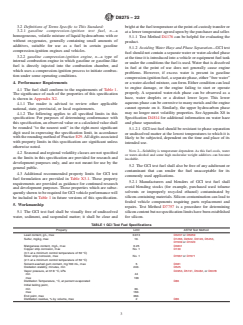
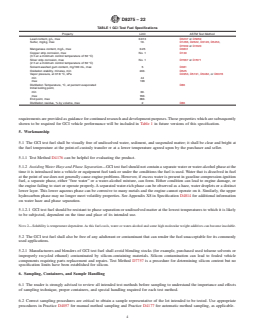
TABLE 1 GCI Test Fuel Specifications
Property Limit ASTM Test Method
Lead content, g/L, max 0.013 D3237 or D5059
Sulfur, mg/kg, max 10. D1266, D2622, D3120, D5453,
D7039 or D7220
Manganese content, mg/L, max 0.25 D3831
Copper strip corrosion, max No. 1 D130
(3 h at a minimum control temperature of 50 °C)
Silver strip corrosion, max No. 1 D7667 or D7671
(2 h at a minimum control temperature of 50 °C)
Solvent-washed gum content, mg/100 mL, max 5 D381
Oxidation stability, minutes, min 240. D525
Vapor pressure, at 37.8 °C, kPa D4953, D5191, D5482,or D6378
min 44
max 103
Distillation Temperature, °C, at percent evaporated D86
Initial boiling point,
min 30.
max 160.
End point, max 360.
Distillation residue, % by volume, max 2 D86
D8275 − 22
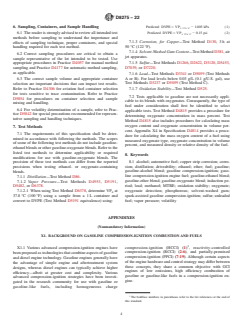
6. Sampling, Containers, and Sample Handling Predicted DVPE 5VP 2 1.005 kPa (1)
4 37.8 °C
6.1 Thereaderisstronglyadvisedtoreviewallintendedtest Predicted DVPE 5VP 2 0.15 psi (2)
4 37.8 °C
methods before sampling to understand the importance and
7.1.3 Corrosion, for Copper—Test Method D130,3hat
effects of sampling technique, proper containers, and special
50 °C (122 °F).
handling required for each test method.
7.1.4 Solvent-Washed Gum Content—TestMethodD381,air
6.2 Correct sampling procedures are critical to obtain a
jet apparatus.
sample representative of the lot intended to be tested. Use
7.1.5 Sulfur—Test Methods D1266, D2622, D3120, D5453,
appropriate procedures in Practice D4057 for manual method
D7039,or D7220.
sampling and Practice D4177 for automatic method sampling,
as applicable.
7.1.6 Lead—Test Methods D3341 or D5059 (Test Methods
A or B). For lead levels below 0.03 g/L (0.1 g/U.S. gal), use
6.3 The correct sample volume and appropriate container
Test Methods D3237 or D5059 (Test Method C).
selection are important decisions that can impact test results.
Refer to Practice D4306 for aviation fuel container selection 7.1.7 Oxidation Stability—Test Method D525.
for tests sensitive to trace contamination. Refer to Practice
7.2 Tests applicable to gasoline are not necessarily appli-
D5854 for procedures on container selection and sample
cable to its blends with oxygenates. Consequently, the type of
mixing and handling.
fuel under consideration shall first be identified to select
6.4 For volatility determination of a sample, refer to Prac-
applicable tests. Test Method D4815 provides a procedure for
tice D5842 for special precautions recommended for represen-
determining oxygenate concentration in mass percent. Test
tative sampling and handling techniques.
Method D4815 also includes procedures for calculating mass
oxygen content and oxygenate concentration in volume per-
7. Test Methods
cent. Appendix X4 in Specification D4814 provides a proce-
7.1 The requirements of this specification shall be deter-
dure for calculating the mass oxygen content of a fuel using
mined in accordance with following the methods. The scopes
measured oxygenate type, oxygenate concentration in volume
of some of the following test methods do not include gasoline-
percent, and measured density or relative density of the fuel.
ethanolblendsorothergasoline-oxygenateblends.Refertothe
listed test methods to determine applicability or required
8. Keywords
modifications for use with gasoline-oxygenate blends. The
8.1 alcohol; automotive fuel; copper strip corrosion; corro-
precision of these test methods can differ from the reported
sion; distillation; driveability; ethanol; ether; fuel; gasoline;
precisions when testing ethanol- or oxygenate-containing
gasoline-alcohol blend; gasoline compression-ignition; gaso-
blends.
line compression-ignition engine fuel; gasoline-ethanol blend;
7.1.1 Distillation—Test Method D86.
gasoline-ether blend; gasoline-oxygenate blend; induction pe-
7.1.2 Vapor Pressure—Test Methods D4953, D5191,
riod; lead; methanol; MTBE; oxidation stability; oxygenate;
D5482,or D6378.
7.1.2.1 When using Test Method D6378, determine VP at oxygenate detection; phosphorous; solvent-washed gum;
37.8 °C (100 °F) using a sample from a 1 L container and spark-assisted gasoline compression-ignition; sulfur; unleaded
convert to DVPE (Test Method D5191 equivalence) using: fuel; vapor pressure; volatility
APPENDIXES
(Nonmandatory Information)
X1. BACKGROUND ON GASOLINE COMPRESSION-IGNITION COMBUSTION AND FUELS
X1.1 Various advanced compression-ignition engines have compression-ignition (HCCI) (1) , reactivity-controlled
beenproposedastechnologiesthatcombineaspectsofgasoline compression-ignition (RCCI) (2-6), and partially-premixed
compression-ignition (PPCI) (7-19). Although certain aspects
and diesel engine technology. Gasoline engines generally have
oftheenginehardwareandcontrolstrategymaydifferbetween
the advantage of simple engine and aftertreatment system
these concepts, they share a common objective with GCI
designs, whereas diesel engines can typically achieve higher
engines of low emissions, high efficiency combustion of
efficiency—albeit at greater cost and complexity. Various
gasoline or gasoline-like fuels in a compression-ignition en-
advanced compression-ignition strategies have been investi-
gine.
gated in the research community for use with gasoline or
gasoline-like fuels, including homogeneous charge
The boldface numbers in parentheses refer to the list references at the end of
this standard.
D8275 − 22
X1.2 Increased efficiency of GCI engines relative to tradi- compression-ignition engines, the optimal fuel for these en-
tional spark-ignition (SI) engines is driven by several factors. gines is also different. Many previous works have explored the
Compression-ignition engines do not experience traditional
effect of fuel properties such as fuel reactivity, distillation, and
engine knock observed in SI engines, and globally lean
chemical composition on combustion behavior, engine
operation significantly reduces pumping losses while improv-
performance, and emissions under partially-premixed combus-
ing thermodynamic efficiency. At the same time, greater
tion conditions. Fuels tested in these studies include gasoline
mixing of fuel and air prior to combustion reduces soot
(2, 8, 9, 14-18, 20-35), diesel (9, 15, 16, 18, 20-22, 24-28,
production relative to conventional mixing-controlled (diesel)
30-32, 36-41), gasoline-diesel blends (25, 30-32, 37, 38, 41,
combustion and may also reduce pressure requirements for the
42), low-octane gasolines (8, 9, 14, 17, 21-23, 25, 27-29, 35,
fuel injection system. High rates of exhaust gas recirculation
39-46), model fuel blends (9, 14, 23, 25, 37, 39, 41), and other
(EGR) are typically used to limit peak temperatures and
blends of petroleum-based fuels with solvents, oxygenated
oxygen concentrations, thereby reducing engine-out emissions
compounds and additives (16, 22, 25, 26, 37, 39, 40, 44).A
of nitrogen oxides (NOx).While various combustion strategies
large number of studies have shown that fuel reactivity (as
may be employed, key featuresof GCI combustion include
measured by RON, MON, cetane number, or homogeneous
faster fuel-air mixing, an increased portion of premixed
ignition delay) plays an important role in GCI engine perfor-
combustion, improved air utilization, and in some cases, a
mance (7-9, 14-16, 18, 20-23, 25, 30, 32, 35, 36, 39, 44, 47),
greater degree of separation between the end of injection and
however the potential exists for other fuel effects pertaining to
start of combustion.These features are partially enabled by the
physical properties or chemical composition to also affect
use of gasoline-like fuels which have a higher vapor pressure,
combustion, performance, or emissions in GCI engines.
lowerboilingrange,andlongerignitiondelaythandieselfuels.
Accordingly, recommended property limits for achieving con-
X1.3 Because GCI engines utilize a combustion process sistent test results between various GCI engine research and
which is different from traditional mixing-controlled, diesel development laboratories have been provided in Appendix X3.
X2. SIGNIFICANCE OF ASTM SPECIFICATION FOR GASOLINE COMPRESSION-IGNITION TEST FUEL
X2.1 General the fuel tank, pumps, lines, and injectors, as well as the degree
of mixing that occurs in the combustion chamber before
X2.1.1 Distillation and vapor pressure define the general
combustion.
characteristics of GCI test fuel. Other characteristics relate to:
X2.2.2 Fuels in the gasoline boiling range are expected to
limiting the concentration of undesirable components so that
mix more readily with air than middle-distillate or diesel fuels
they will not adversely affect engine performance and ensuring
due to their lower viscosity and density, and higher vapor
the stability of fuel as well as its compatibility with materials
pressure (Table 1). This can reduce local richness during
used in engines and their fuel systems. No octane number or
combustion and thus reduce soot formation. At high operating
anti-knock requirements are specified as GCI engines do not
temperatures,fuelscanboilinfuelpumps,orlines.Iftoomuch
experience conventional spark-ignition engine knock.
va
...
This document is not an ASTM standard and is intended only to provide the user of an ASTM standard an indication of what changes have been made to the previous version. Because
it may not be technically possible to adequately depict all changes accurately, ASTM recommends that users consult prior editions as appropriate. In all cases only the current version
of the standard as published by ASTM is to be considered the official document.
Designation: D8275 − 21 D8275 − 22
Standard Specification for
Gasoline-like Test Fuel for Compression-Ignition Engines
This standard is issued under the fixed designation D8275; the number immediately following the designation indicates the year of
original adoption or, in the case of revision, the year of last revision. A number in parentheses indicates the year of last reapproval. A
superscript epsilon (´) indicates an editorial change since the last revision or reapproval.
1. Scope*
1.1 This specification covers the requirements of test fuels suitable for use in certain gasoline compression-ignition engines and
vehicles, which have been specifically designed to operate on the fuel described in this specification. These gasoline-like fuels,
which may contain certain gasoline blending components, are henceforth referred to in this specification as “gasoline
compression-ignition (GCI) test fuels.”
1.1.1 The GCI test fuels described by this specification are only intended for use by engine and vehicle manufacturers in the
continuing development of appropriately designed compression-ignition engines that can take advantage of certain chemical and
physical properties of GCI test fuels to achieve higher efficiency and lower emissions (henceforth referred to as “GCI engines”).
These GCI test fuels are not intended for use by the general public.
1.1.2 GCI engines include only those engines that directly inject fuel into the combustion chamber, and rely on autoignition of
the fuel to initiate combustion part or all the time. Although various combustion strategies may be used depending on the fuel and
engine operating condition, the level of fuel stratification is typically decreased in GCI engines under certain operating conditions
relative to traditional diesel compression-ignition engines. Engines that use an auxiliary ignition source (such as a spark plug) some
but not all of the time could qualify as GCI engines.
1.1.3 The GCI test fuels covered in this specification may contain oxygenates, such as alcohols and ethers. Recommended limits
on the type and concentration of specific oxygenates are provided in Appendix X3.
1.2 This specification provides a description of GCI test fuels for automotive engines that are not currently widely available to
the general public, but are being developed and require defined standard test fuels. Commercial fuels meeting the same or similar
requirements as the GCI test fuels described in this specification could become available to the general public if/when such engines
are introduced into commerce; however use of this specification by the general public would require significant modifications. The
specification is under continuous review, which can result in revisions based on changes in fuel, automotive requirements, test
methods, or a combination thereof. All users of this specification, therefore, should refer to the latest edition.
1.3 Traditional diesel compression-ignition engines and fuel systems are designed for use with fuel, which has a lower volatility,
higher flash-point, and higher viscosity than GCI test fuels. Such engines are therefore usually unsuitable for use with GCI test
fuels. Certain hardware modifications may be required for the safe use of low flash-point, GCI test fuels.
NOTE 1—If there is any doubt as to the latest edition of Specification D8275, contact ASTM International Headquarters.
1.4 The values stated in SI units are to be regarded as the standard. Any other values given are provided for information only.
This specification is under the jurisdiction of ASTM Committee D02 on Petroleum Products, Liquid Fuels, and Lubricants and is the direct responsibility of Subcommittee
D02.A0.01 on Gasoline and Gasoline-Oxygenate Blends.
Current edition approved Jan. 1, 2021July 1, 2022. Published January 2021August 2022. Originally approved in 2019. Last previous edition approved in 20192021 as
D8275 – 19a.D8275 – 21. DOI: 10.1520/D8275-21.10.1520/D8275-22.
*A Summary of Changes section appears at the end of this standard
Copyright © ASTM International, 100 Barr Harbor Drive, PO Box C700, West Conshohocken, PA 19428-2959. United States
D8275 − 22
1.5 This standard does not purport to address all of the safety concerns, if any, associated with its use. It is the responsibility
of the user of this standard to establish appropriate safety, health, and environmental practices and determine the applicability of
regulatory limitations prior to use.
1.6 This international standard was developed in accordance with internationally recognized principles on standardization
established in the Decision on Principles for the Development of International Standards, Guides and Recommendations issued
by the World Trade Organization Technical Barriers to Trade (TBT) Committee.
2. Referenced Documents
2.1 ASTM Standards:
D86 Test Method for Distillation of Petroleum Products and Liquid Fuels at Atmospheric Pressure
D130 Test Method for Corrosiveness to Copper from Petroleum Products by Copper Strip Test
D240 Test Method for Heat of Combustion of Liquid Hydrocarbon Fuels by Bomb Calorimeter
D381 Test Method for Gum Content in Fuels by Jet Evaporation
D525 Test Method for Oxidation Stability of Gasoline (Induction Period Method)
D1266 Test Method for Sulfur in Petroleum Products (Lamp Method)
D1319 Test Method for Hydrocarbon Types in Liquid Petroleum Products by Fluorescent Indicator Adsorption
D2622 Test Method for Sulfur in Petroleum Products by Wavelength Dispersive X-ray Fluorescence Spectrometry
D2699 Test Method for Research Octane Number of Spark-Ignition Engine Fuel
D2700 Test Method for Motor Octane Number of Spark-Ignition Engine Fuel
D3120 Test Method for Trace Quantities of Sulfur in Light Liquid Petroleum Hydrocarbons by Oxidative Microcoulometry
D3237 Test Method for Lead in Gasoline by Atomic Absorption Spectroscopy
D3341 Test Method for Lead in Gasoline—Iodine Monochloride Method
D3606 Test Method for Determination of Benzene and Toluene in Spark Ignition Fuels by Gas Chromatography
D3831 Test Method for Manganese in Gasoline By Atomic Absorption Spectroscopy
D4052 Test Method for Density, Relative Density, and API Gravity of Liquids by Digital Density Meter
D4057 Practice for Manual Sampling of Petroleum and Petroleum Products
D4175 Terminology Relating to Petroleum Products, Liquid Fuels, and Lubricants
D4176 Test Method for Free Water and Particulate Contamination in Distillate Fuels (Visual Inspection Procedures)
D4177 Practice for Automatic Sampling of Petroleum and Petroleum Products
D4306 Practice for Aviation Fuel Sample Containers for Tests Affected by Trace Contamination
D4814 Specification for Automotive Spark-Ignition Engine Fuel
D4815 Test Method for Determination of MTBE, ETBE, TAME, DIPE, tertiary-Amyl Alcohol and C to C Alcohols in
1 4
Gasoline by Gas Chromatography
D4953 Test Method for Vapor Pressure of Gasoline and Gasoline-Oxygenate Blends (Dry Method)
D5059 Test Methods for Lead and Manganese in Gasoline by X-Ray Fluorescence Spectroscopy
D5191 Test Method for Vapor Pressure of Petroleum Products and Liquid Fuels (Mini Method)
D5291 Test Methods for Instrumental Determination of Carbon, Hydrogen, and Nitrogen in Petroleum Products and Lubricants
D5443 Test Method for Paraffin, Naphthene, and Aromatic Hydrocarbon Type Analysis in Petroleum Distillates Through 200 °C
by Multi-Dimensional Gas Chromatography
D5453 Test Method for Determination of Total Sulfur in Light Hydrocarbons, Spark Ignition Engine Fuel, Diesel Engine Fuel,
and Engine Oil by Ultraviolet Fluorescence
D5482 Test Method for Vapor Pressure of Petroleum Products and Liquid Fuels (Mini Method—Atmospheric)
D5580 Test Method for Determination of Benzene, Toluene, Ethylbenzene, p/m-Xylene, o-Xylene, C and Heavier Aromatics,
and Total Aromatics in Finished Gasoline by Gas Chromatography
D5769 Test Method for Determination of Benzene, Toluene, and Total Aromatics in Finished Gasolines by Gas
Chromatography/Mass Spectrometry
D5842 Practice for Sampling and Handling of Fuels for Volatility Measurement
D5854 Practice for Mixing and Handling of Liquid Samples of Petroleum and Petroleum Products
D6079 Test Method for Evaluating Lubricity of Diesel Fuels by the High-Frequency Reciprocating Rig (HFRR)
D6378 Test Method for Determination of Vapor Pressure (VP ) of Petroleum Products, Hydrocarbons, and Hydrocarbon-
X
Oxygenate Mixtures (Triple Expansion Method)
D7039 Test Method for Sulfur in Gasoline, Diesel Fuel, Jet Fuel, Kerosine, Biodiesel, Biodiesel Blends, and Gasoline-Ethanol
Blends by Monochromatic Wavelength Dispersive X-ray Fluorescence Spectrometry
D7220 Test Method for Sulfur in Automotive, Heating, and Jet Fuels by Monochromatic Energy Dispersive X-ray Fluorescence
Spectrometry
For referenced ASTM standards, visit the ASTM website, www.astm.org, or contact ASTM Customer Service at service@astm.org. For Annual Book of ASTM Standards
volume information, refer to the standard’s Document Summary page on the ASTM website.
D8275 − 22
D7667 Test Method for Determination of Corrosiveness to Silver by Automotive Spark-Ignition Engine Fuel—Thin Silver Strip
Method
D7671 Test Method for Corrosiveness to Silver by Automotive Spark–Ignition Engine Fuel–Silver Strip Method
D7757 Test Method for Silicon in Gasoline and Related Products by Monochromatic Wavelength Dispersive X-ray Fluorescence
Spectrometry
E29 Practice for Using Significant Digits in Test Data to Determine Conformance with Specifications
3. Terminology
3.1 Definitions:
3.1.1 For general terminology, refer to Terminology D4175.
3.1.2 dry vapor pressure equivalent, DVPE, n—value calculated by a defined correlation equation that is expected to be
comparable to the vapor pressure value obtained by Test Method D4953, Procedure A.
3.1.3 gasoline, n—volatile mixture of liquid hydrocarbons, generally containing small amounts of additives, suitable for use as a
fuel in spark-ignition, internal combustion engines.
3.1.4 gasoline-oxygenate blend, n—fuel consisting primarily of gasoline along with a substantial amount (more than 0.35 % by
mass oxygen) of one or more oxygenates.
3.1.5 octane sensitivity, n—the mathematical difference between research octane number (RON) and motor octane number (MON)
(octane sensitivity = RON – MON).
3.1.5.1 Discussion—
The terms octane sensitivity and octane number sensitivity are used synonymously.
3.1.6 oxygenate, n—oxygen-containing, ashless, organic compound, such as an alcohol or ether, which can be used as a fuel or
fuel supplement.a molecule composed solely of carbon, hydrogen, and oxygen.
3.1.6.1 Discussion—
The fuel described in this standard may contain oxygenates, such as alcohol and ethers.
3.2 Definitions of Terms Specific to This Standard:
3.2.1 gasoline compression-ignition test fuel, n—a homogeneous, volatile mixture of liquid hydrocarbons with or without
oxygenates, generally containing small amounts of additives, suitable for use as a fuel in certain gasoline compression-ignition
engines and vehicles.
3.2.2 gasoline compression-ignition engine, n—a type of internal combustion engine in which gasoline or gasoline-like fuel is
directly injected into the combustion chamber, and which uses a compression-ignition process to initiate combustion under some
operating conditions.
4. Performance Requirements
4.1 The fuel shall conform to the requirements of Table 1. The significance of each of the properties of this specification is shown
in Appendix X2.
4.1.1 The reader is advised to review other applicable national, state, provincial, or local requirements.
4.1.2 The following applies to all specified limits in this specification: For purposes of determining conformance with this
specification, an observed value or a calculated value shall be rounded “to the nearest unit” in the right-most significant digit used
in expressing the specification limit, in accordance with the rounding method of Practice E29. All digits associated with property
limits in this specification are significant unless otherwise noted.
4.2 Seasonal and regional volatility classes are not specified as the limits in this specification are provided for research and
development purposes only, and are not meant for use by the general public.
4.3 Additional recommended property limits for GCI test fuel formulation are provided in Table X3.1. These property
D8275 − 22
TABLE 1 GCI Test Fuel Specifications
Property Limit ASTM Test Method
Lead content, g/L, max 0.013 D3237 or D5059
Sulfur, mg/kg, max 10. D1266, D2622, D3120, D5453,
D7039 or D7220
Manganese content, mg/L, max 0.25 D3831
Copper strip corrosion, max No. 1 D130
(3 h at a minimum control temperature of 50 °C)
Silver strip corrosion, max No. 1 D7667 or D7671
(2 h at a minimum control temperature of 50 °C)
Solvent-washed gum content, mg/100 mL, max 5 D381
Oxidation stability, minutes, min 240. D525
Vapor pressure, at 37.8 °C, kPa D4953, D5191, D5482, or D6378
min 44
max 103
Distillation Temperature, °C, at percent evaporated D86
Initial boiling point,
min 30.
max 160.
End point, max 360.
Distillation residue, % by volume, max 2 D86
requirements are provided as guidance for continued research and development purposes. Those properties which are subsequently
shown to be required for GCI vehicle performance will be included in Table 1 in future versions of this specification.
5. Workmanship
5.1 The GCI test fuel shall be visually free of undissolved water, sediment, and suspended matter; it shall be clear and bright at
the fuel temperature at the point-of-custody transfer or at a lower temperature agreed upon by the purchaser and seller.
5.1.1 Test Method D4176 can be helpful for evaluating the product.
5.1.2 Avoiding Water Haze and Phase Separation—GCI test fuel should not contain a separate water or water-alcohol phase at the
time it is introduced into a vehicle or equipment fuel tank or under the conditions the fuel is used. Water that is dissolved in fuel
at the point of use does not generally cause engine problems. However, if excess water is present in gasoline compression-ignition
fuel, a separate phase, either “free water” or a water-alcohol mixture, can form. Either condition can lead to engine damage, or
the engine failing to start or operate properly. A separated water-rich phase can be observed as a haze, water droplets or a distinct
lower layer. This lower aqueous phase can be corrosive to many metals and the engine cannot operate on it. Similarly, the upper
hydrocarbon phase may no longer meet volatility properties. See Appendix X8 in Specification D4814 for additional information
on water haze and phase separation.
5.1.2.1 GCI test fuel should be resistant to phase separation or undissolved matter at the lowest temperatures to which it is likely
to be subjected, dependent on the time and place of its intended use.
NOTE 2—Solubility is temperature dependent. As this fuel cools, water or water-alcohol and some high molecular weight additives can become insoluble.
5.2 The GCI test fuel shall also be free of any adulterant or contaminant that can render the fuel unacceptable for its commonly
used applications.
5.2.1 Manufacturers and blenders of GCI test fuel shall avoid blending stocks (for example, purchased used toluene solvents or
improperly recycled ethanol) contaminated by silicon-containing materials. Silicon contamination can lead to fouled vehicle
components requiring parts replacement and repairs. Test Method D7757 is a procedure for determining silicon content but no
specification limits have been established for silicon.
6. Sampling, Containers, and Sample Handling
6.1 The reader is strongly advised to review all intended test methods before sampling to understand the importance and effects
of sampling technique, proper containers, and special handling required for each test method.
6.2 Correct sampling procedures are critical to obtain a sample representative of the lot intended to be tested. Use appropriate
procedures in Practice D4057 for manual method sampling and Practice D4177 for automatic method sampling, as applicable.
D8275 − 22
6.3 The correct sample volume and appropriate container selection are important decisions that can impact test results. Refer to
Practice D4306 for aviation fuel container selection for tests sensitive to trace contamination. Refer to Practice D5854 for
procedures on container selection and sample mixing and handling.
6.4 For volatility determination of a sample, refer to Practice D5842 for special precautions recommended for representative
sampling and handling techniques.
7. Test Methods
7.1 The requirements of this specification shall be determined in accordance with following the methods. The scopes of some of
the following test methods do not include gasoline-ethanol blends or other gasoline-oxygenate blends. Refer to the listed test
methods to determine applicability or required modifications for use with gasoline-oxygenate blends. The precision of these test
methods can differ from the reported precisions when testing ethanol- or oxygenate-containing blends.
7.1.1 Distillation—Test Method D86.
7.1.2 Vapor Pressure—Test Methods D4953, D5191, D5482, or D6378.
7.1.2.1 When using Test Method D6378, determine VP at 37.8 °C (100 °F) using a sample from a 1 L container and convert to
DVPE (Test Method D5191 equivalence) using:
Predicted DVPE 5 VP 2 1.005 kPa (1)
4 37.8 °C
Predicted DVPE 5 VP 2 0.15 psi (2)
4 37.8 °C
7.1.3 Corrosion, for Copper—Test Method D130, 3 h at 50 °C (122 °F).
7.1.4 Solvent-Washed Gum Content—Test Method D381, air jet apparatus.
7.1.5 Sulfur—Test Methods D1266, D2622, D3120, D5453, D7039, or D7220.
7.1.6 Lead—Test Methods D3341 or D5059 (Test Methods A or B). For lead levels below 0.03 g/L (0.1 g/U.S. gal), use Test
Methods D3237 or D5059 (Test Method C).
7.1.7 Oxidation Stability—Test Method D525.
7.2 Tests applicable to gasoline are not necessarily applicable to its blends with oxygenates. Consequently, the type of fuel under
consideration shall first be identified to select applicable tests. Test Method D4815 provides a procedure for determining oxygenate
concentration in mass percent. Test Method D4815 also includes procedures for calculating mass oxygen content and oxygenate
concentration in volume percent. Appendix X4 in Specification D4814 provides a procedure for calculating the mass oxygen
content of a fuel using measured oxygenate type, oxygenate concentration in volume percent, and measured density or relative
density of the fuel.
8. Keywords
8.1 alcohol; automotive fuel; copper strip corrosion; corrosion; distillation; driveability; ethanol; ether; fuel; gasoline;
gasoline-alcohol blend; gasoline compression-ignition; gasoline compression-ignition engine fuel; gasoline-ethanol blend;
gasoline-ether blend; gasoline-oxygenate blend; induction period; lead; methanol; MTBE; oxidation stability; oxygenate;
oxygenate detection; phosphorous; solvent-washed gum; spark-assisted gasoline compression-ignition; sulfur; unleaded fuel; vapor
pressure; volatility
D8275 − 22
APPENDIXES
(Nonmandatory Information)
X1. BACKGROUND ON GASOLINE COMPRESSION-IGNITION COMBUSTION AND FUELS
X1.1 Various advanced compression-ignition engines have been proposed as technologies that combine aspects of gasoline and
diesel engine technology. Gasoline engines generally have the advantage of simple engine and aftertreatment system designs,
whereas diesel engines can typically achieve higher efficiency—albeit at greater cost and complexity. Various advanced
compression-ignition strategies have been investigated in the research community for use with gasoline or gasoline-like fuels,
including homogeneous charge compression-ignition (HCCI) (1) , reactivity-controlled compression-ignition (RCCI) (2-6), and
partially-premixed compression-ignition (PPCI) (7-19). Although certain aspects of the engine hardware and control strategy may
differ between these concepts, they share a common objective with GCI engines of low emissions, high efficiency combustion of
gasoline or gasoline-like fuels in a compression-ignition engine.
X1.2 Increased efficiency of GCI engines relative to traditional spark-ignition (SI) engines is driven by several factors.
Compression-ignition engines do not experience traditional engine knock observed in SI engines, and globally lean operation
significantly reduces pumping losses while improving thermodynamic efficiency. At the same time, greater mixing of fuel and air
prior to combustion reduces soot production relative to conventional mixing-controlled (diesel) combustion and may also reduce
pressure requirements for the fuel injection system. High rates of exhaust gas recirculation (EGR) are typically used to limit peak
temperatures and oxygen concentrations, thereby reducing engine-out emissions of nitrogen oxides (NOx). While various
combustion strategies may be employed, key featuresof GCI combustion include faster fuel-air mixing, an increased portion of
premixed combustion, improved air utilization, and in some cases, a greater degree of separation between the end of injection and
start of combustion. These features are partially enabled by the use of gasoline-like fuels which have a higher vapor pressure, lower
boiling range, and longer ignition delay than diesel fuels.
X1.3 Because GCI engines utilize a combustion process which is different from traditional mixing-controlled, diesel compression-
ignition engines, the optimal fuel for these engines is also different. Many previous works have explored the effect of fuel
properties such as fuel reactivity, distillation, and chemical composition on combustion behavior, engine performance, and
emissions under partially-premixed combustion conditions. Fuels tested in these studies include gasoline (2, 8, 9, 14-18, 20-35),
diesel (9, 15, 16, 18, 20-22, 24-28, 30-32, 36-41), gasoline-diesel blends (25, 30-32, 37, 38, 41, 42), low-octane gasolines (8, 9,
14, 17, 21-23, 25, 27-29, 35, 39-46), model fuel blends (9, 14, 23, 25, 37, 39, 41), and other blends of petroleum-based fuels with
solvents, oxygenated compounds and additives (16, 22, 25, 26, 37, 39, 40, 44). A large number of studies have shown that fuel
reactivity (as measured by RON, MON, cetane number, or homogeneous ignition delay) plays an important role in GCI engine
performance (7-9, 14-16, 18, 20-23, 25, 30, 32, 35, 36, 39, 44, 47), however the potential exists for other fuel effects pertaining
to physical properties or chemical composition to also affect combustion, performance, or emissions in GCI engines. Accordingly,
recommended property limits for achieving consistent test results between various GCI engine research and development
laboratories have been provided in Appendix X3.
X2. SIGNIFICANCE OF ASTM SPECIFICATION FOR GASOLINE COMPRESSION-IGNITION TEST FUEL
X2.1 General
X2.1.1 Distillation and vapor pressure define the general characteristics of GCI test fuel. Other characteristics relate to: limiting
the concentration of undesirable components so that they will not adversely affect engine performance and ensuring the stability
of fuel as well as its compatibility with materials used in engines and their fuel systems. No octane number or anti-knock
requirements are specified as GCI engines do not experience conventional spark-ignition engine knock.
The boldface numbers in parentheses refer to the list references at the end of this standard.
D8275 − 22
X2.1.2 Gasoline compression-ignition test fuel is a complex mixture composed of relatively volatile hydrocarbons that vary
widely in their physical and chemical properties and may contain oxygenates. Fuel is exposed to a wide variety of mechanical,
physical, and chemical environments. Thus, the properties of the fuel shall be balanced to give satisfactory engine performance
over an extremely wide range of operating conditions. The prevailing standards for fuel represent compromises among the
numerous quality and performance requirements. Some of the limits specified in this specification are established on the basis of
the broad
...