

ASTM D4698-21
(Practice)Standard Practice for Total Digestion of Sediment Samples for Chemical Analysis of Various Metals
General Information
- Abstract
SIGNIFICANCE AND USE
5.1 The chemical analysis of sediments, collected from such locations as streams, rivers, lakes, and oceans can provide information of environmental significance.
5.2 These practices can be used with either suspended sediment (material actively transported by water) or bed sediment (material temporarily at rest on the bed of a water body).
5.3 Standardized practices for digesting sediments, for subsequent chemical analysis, will facilitate inter- and intra-areal comparisons as well as comparison of data generated by different groups. The use of total digestions also eliminates the ambiguities and interpretational difficulties associated with partial digestions and the operational definitions that accompany them.
SCOPE
1.1 This practice covers two procedures for the total digestion of sediments for subsequent determination of metals by such techniques as flame atomic absorption spectrophotometry, graphite-furnace atomic absorption spectrophotometry, atomic emission spectroscopy, etc.
1.2 This practice is applicable in the subsequent determination of volatile, semivolatile, and nonvolatile metals of sediments.
1.3 Actual metal quantitation can be accomplished by following the various test methods outlined under other appropriate ASTM standards for the metal(s) of interest. Before selecting either of the digestion techniques outlined in this practice, the user should consult the appropriate quantitation standard(s) for any special analytical considerations, and Practice D3976 for any special preparatory considerations.
1.4 The values stated in inch-pound units are to be regarded as standard. The values given in parentheses are mathematical conversions to SI units that are provided for information only and are not considered standard.
1.5 This standard does not purport to address all of the safety concerns, if any, associated with its use. It is the responsibility of the user of this standard to establish appropriate safety, health, and environmental practices and determine the applicability of regulatory limitations prior to use. For a specific hazard statement, see 15.5.
1.6 This international standard was developed in accordance with internationally recognized principles on standardization established in the Decision on Principles for the Development of International Standards, Guides and Recommendations issued by the World Trade Organization Technical Barriers to Trade (TBT) Committee.
- Status
- Published
- Publication Date
- 31-Oct-2021
- Technical Committee
- D19 - Water
- Drafting Committee
- D19.07 - Sediments, Geomorphology, and Open-Channel Flow
Buy Documents
ASTM D4698-21 - Standard Practice for Total Digestion of Sediment Samples for Chemical Analysis of Various Metals
REDLINE ASTM D4698-21 - Standard Practice for Total Digestion of Sediment Samples for Chemical Analysis of Various Metals
Overview
ASTM D4698-21: Standard Practice for Total Digestion of Sediment Samples for Chemical Analysis of Various Metals establishes procedures for the complete digestion of sediment samples. Developed by ASTM International, this practice enables accurate chemical analysis of metals in sediments collected from streams, rivers, lakes, and oceans. By standardizing sediment digestion prior to analysis, this method supports consistent environmental data collection and reliable comparison of metals concentrations across research sites and laboratories.
Key Topics
- Total Digestion Methods: The standard describes two primary procedures for the total digestion of bed and suspended sediment:
- Fusion with lithium metaborate/tetraborate
- Wet digestion using hydrofluoric, perchloric, and nitric acids
- Metals Analyzed: Applicable to the determination of a wide range of metals, including volatile, semivolatile, and nonvolatile metals, such as aluminum, calcium, iron, magnesium, potassium, manganese, silicon, sodium, titanium, strontium, copper, zinc, cadmium, lead, cobalt, nickel, chromium, arsenic, antimony, and selenium.
- Analytical Techniques Supported:
- Flame Atomic Absorption Spectrophotometry
- Graphite Furnace Atomic Absorption Spectrophotometry
- Atomic Emission Spectroscopy
- Interferences and Suppression: Provides guidance on how to manage inter-element interferences using specific reagents and mixed salt standards, which support accurate quantitation.
- Sample Preparation: Includes steps for grinding, splitting, and preparing sediment samples, referencing additional ASTM practices for preparatory procedures.
Applications
The standardized digestion practices covered by ASTM D4698-21 add significant practical value to environmental monitoring and geochemical studies:
- Environmental Assessment: Offers a scientifically defensible approach for detecting and monitoring heavy metals and trace elements in aquatic environments, supporting pollution assessment and remediation strategies.
- Comparability of Results: Facilitates inter-laboratory and intra-site comparisons by eliminating variability associated with non-standardized or partial digestion methods. This is especially valuable for long-term monitoring projects and regulatory compliance testing.
- Adaptability: Can be used with different types of sediment samples, whether suspended in the water column or settled on the bed, broadening its application in diverse water and sediment systems.
- Regulatory and Research Use: Supports research, regulatory assessment, and quality control programs needing precise measurement of metal content in sediments.
- Data Integrity: Using total digestion helps avoid ambiguities and interpretational difficulties created by partial digestion methods, thus improving the reliability of environmental data.
Related Standards
For optimal implementation and broader scope of sediment and water analysis, the following ASTM standards are frequently referenced alongside ASTM D4698-21:
- ASTM D1129: Terminology Relating to Water - foundational definitions used in water and sediment studies.
- ASTM D3976: Practice for Preparation of Sediment Samples for Chemical Analysis - preparatory steps for accurate analysis.
- ASTM D1193: Specification for Reagent Water - ensures water purity used across analytical procedures.
Researchers and technicians are encouraged to consult relevant quantitation standards for metals of interest and adhere to safety, health, and regulatory guidelines when using concentrated acids and other hazardous reagents.
Keywords: ASTM D4698-21, total digestion, sediment analysis, metal quantitation, environmental assessment, chemical analysis, water quality standards, heavy metals in sediment, digestion procedures, ASTM sediment standards.
Relations
- Effective Date
- 01-May-2020
- Refers
ASTM D3976-92(2010) - Standard Practice for Preparation of Sediment Samples for Chemical Analysis - Effective Date
- 15-Jun-2010
- Effective Date
- 01-Mar-2010
- Effective Date
- 01-Sep-2006
- Effective Date
- 01-Sep-2006
- Effective Date
- 01-Mar-2006
- Effective Date
- 15-Feb-2006
- Refers
ASTM D3976-92(2005) - Standard Practice for Preparation of Sediment Samples for Chemical Analysis - Effective Date
- 01-Jul-2005
- Effective Date
- 01-Mar-2004
- Effective Date
- 01-Mar-2004
- Effective Date
- 10-Aug-2003
- Effective Date
- 10-Mar-2003
- Effective Date
- 10-Jul-2002
- Effective Date
- 10-Jul-2002
- Effective Date
- 10-Feb-2002
Buy Documents
ASTM D4698-21 - Standard Practice for Total Digestion of Sediment Samples for Chemical Analysis of Various Metals
REDLINE ASTM D4698-21 - Standard Practice for Total Digestion of Sediment Samples for Chemical Analysis of Various Metals
Get Certified
Connect with accredited certification bodies for this standard

CIS Institut d.o.o.
Personal Protective Equipment (PPE) certification body. Notified Body NB-2890 for EU Regulation 2016/425 PPE.

Kiwa BDA Testing
Building and construction product certification.
Kmetijski inštitut Slovenije
Agricultural Institute of Slovenia. Soil testing, plant health, agricultural product analysis.
Sponsored listings
Frequently Asked Questions
ASTM D4698-21 is a standard published by ASTM International. Its full title is "Standard Practice for Total Digestion of Sediment Samples for Chemical Analysis of Various Metals". This standard covers: SIGNIFICANCE AND USE 5.1 The chemical analysis of sediments, collected from such locations as streams, rivers, lakes, and oceans can provide information of environmental significance. 5.2 These practices can be used with either suspended sediment (material actively transported by water) or bed sediment (material temporarily at rest on the bed of a water body). 5.3 Standardized practices for digesting sediments, for subsequent chemical analysis, will facilitate inter- and intra-areal comparisons as well as comparison of data generated by different groups. The use of total digestions also eliminates the ambiguities and interpretational difficulties associated with partial digestions and the operational definitions that accompany them. SCOPE 1.1 This practice covers two procedures for the total digestion of sediments for subsequent determination of metals by such techniques as flame atomic absorption spectrophotometry, graphite-furnace atomic absorption spectrophotometry, atomic emission spectroscopy, etc. 1.2 This practice is applicable in the subsequent determination of volatile, semivolatile, and nonvolatile metals of sediments. 1.3 Actual metal quantitation can be accomplished by following the various test methods outlined under other appropriate ASTM standards for the metal(s) of interest. Before selecting either of the digestion techniques outlined in this practice, the user should consult the appropriate quantitation standard(s) for any special analytical considerations, and Practice D3976 for any special preparatory considerations. 1.4 The values stated in inch-pound units are to be regarded as standard. The values given in parentheses are mathematical conversions to SI units that are provided for information only and are not considered standard. 1.5 This standard does not purport to address all of the safety concerns, if any, associated with its use. It is the responsibility of the user of this standard to establish appropriate safety, health, and environmental practices and determine the applicability of regulatory limitations prior to use. For a specific hazard statement, see 15.5. 1.6 This international standard was developed in accordance with internationally recognized principles on standardization established in the Decision on Principles for the Development of International Standards, Guides and Recommendations issued by the World Trade Organization Technical Barriers to Trade (TBT) Committee.
SIGNIFICANCE AND USE 5.1 The chemical analysis of sediments, collected from such locations as streams, rivers, lakes, and oceans can provide information of environmental significance. 5.2 These practices can be used with either suspended sediment (material actively transported by water) or bed sediment (material temporarily at rest on the bed of a water body). 5.3 Standardized practices for digesting sediments, for subsequent chemical analysis, will facilitate inter- and intra-areal comparisons as well as comparison of data generated by different groups. The use of total digestions also eliminates the ambiguities and interpretational difficulties associated with partial digestions and the operational definitions that accompany them. SCOPE 1.1 This practice covers two procedures for the total digestion of sediments for subsequent determination of metals by such techniques as flame atomic absorption spectrophotometry, graphite-furnace atomic absorption spectrophotometry, atomic emission spectroscopy, etc. 1.2 This practice is applicable in the subsequent determination of volatile, semivolatile, and nonvolatile metals of sediments. 1.3 Actual metal quantitation can be accomplished by following the various test methods outlined under other appropriate ASTM standards for the metal(s) of interest. Before selecting either of the digestion techniques outlined in this practice, the user should consult the appropriate quantitation standard(s) for any special analytical considerations, and Practice D3976 for any special preparatory considerations. 1.4 The values stated in inch-pound units are to be regarded as standard. The values given in parentheses are mathematical conversions to SI units that are provided for information only and are not considered standard. 1.5 This standard does not purport to address all of the safety concerns, if any, associated with its use. It is the responsibility of the user of this standard to establish appropriate safety, health, and environmental practices and determine the applicability of regulatory limitations prior to use. For a specific hazard statement, see 15.5. 1.6 This international standard was developed in accordance with internationally recognized principles on standardization established in the Decision on Principles for the Development of International Standards, Guides and Recommendations issued by the World Trade Organization Technical Barriers to Trade (TBT) Committee.
ASTM D4698-21 is classified under the following ICS (International Classification for Standards) categories: 13.060.50 - Examination of water for chemical substances. The ICS classification helps identify the subject area and facilitates finding related standards.
ASTM D4698-21 has the following relationships with other standards: It is inter standard links to ASTM D1129-13(2020)e2, ASTM D3976-92(2010), ASTM D1129-10, ASTM D1129-06a, ASTM D1129-06ae1, ASTM D1193-06, ASTM D1129-06, ASTM D3976-92(2005), ASTM D1129-04, ASTM D1129-04e1, ASTM D1129-03a, ASTM D1129-03, ASTM D1129-02a, ASTM D1129-01, ASTM D1129-99a. Understanding these relationships helps ensure you are using the most current and applicable version of the standard.
ASTM D4698-21 is available in PDF format for immediate download after purchase. The document can be added to your cart and obtained through the secure checkout process. Digital delivery ensures instant access to the complete standard document.
Standards Content (Sample)
This international standard was developed in accordance with internationally recognized principles on standardization established in the Decision on Principles for the
Development of International Standards, Guides and Recommendations issued by the World Trade Organization Technical Barriers to Trade (TBT) Committee.
Designation: D4698 − 21
Standard Practice for
Total Digestion of Sediment Samples for Chemical Analysis
of Various Metals
This standard is issued under the fixed designation D4698; the number immediately following the designation indicates the year of
original adoption or, in the case of revision, the year of last revision. A number in parentheses indicates the year of last reapproval. A
superscript epsilon (´) indicates an editorial change since the last revision or reapproval.
1. Scope 2. Referenced Documents
2.1 ASTM Standards:
1.1 This practice covers two procedures for the total diges-
D1129 Terminology Relating to Water
tion of sediments for subsequent determination of metals by
D1192 Guide for Equipment for Sampling Water and Steam
suchtechniquesasflameatomicabsorptionspectrophotometry,
in Closed Conduits (Withdrawn 2003)
graphite-furnace atomic absorption spectrophotometry, atomic
D1193 Specification for Reagent Water
emission spectroscopy, etc.
D3976 Practice for Preparation of Sediment Samples for
1.2 This practice is applicable in the subsequent determina-
Chemical Analysis
tion of volatile, semivolatile, and nonvolatile metals of sedi-
3. Terminology
ments.
3.1 Definitions:
1.3 Actual metal quantitation can be accomplished by fol-
3.1.1 For definitions of terms used in this standard, refer to
lowing the various test methods outlined under other appropri-
Terminology D1129.
ate ASTM standards for the metal(s) of interest. Before
3.2 Definitions of Terms Specific to This Standard:
selecting either of the digestion techniques outlined in this
3.2.1 partial digestion, n—the dissolution of a sediment
practice, the user should consult the appropriate quantitation
matrix such that quantitation will produce a measurement of
standard(s) for any special analytical considerations, and Prac-
less than 95 % of the constituent present in the sample. In such
tice D3976 for any special preparatory considerations.
cases, recovery is operationally defined by the digestion
1.4 The values stated in inch-pound units are to be regarded
procedure.
as standard. The values given in parentheses are mathematical
3.2.2 total digestion, n—the dissolution of a sediment ma-
conversions to SI units that are provided for information only
trixsuchthatquantitationwillproduceameasurementwhichis
and are not considered standard.
more than 95 % of the constituent present in the sample.
1.5 This standard does not purport to address all of the
4. Summary of Practice
safety concerns, if any, associated with its use. It is the
responsibility of the user of this standard to establish appro-
4.1 Many procedures are available for the total digestion of
priate safety, health, and environmental practices and deter-
sediments prior to metal analysis, but almost all the methods
mine the applicability of regulatory limitations prior to use. fall into one of two main classes: fusion and subsequent
For a specific hazard statement, see 15.5. dissolution of the bead, and wet digestion which directly
dissolves the sample with mineral acids. Each of the classes
1.6 This international standard was developed in accor-
has advantages and disadvantages, as do the individual proce-
dance with internationally recognized principles on standard-
dures which fall under them. The two procedures outlined in
ization established in the Decision on Principles for the
this practice were selected because they are the least restricted,
Development of International Standards, Guides and Recom-
in terms of utility, for dealing with a wide variety of matrices.
mendations issued by the World Trade Organization Technical
Before choosing a particular method, the user should consult
Barriers to Trade (TBT) Committee.
the pertinent literature to determine the utility and applicability
1 2
This practice is under the jurisdiction of ASTM Committee D19 on Water and For referenced ASTM standards, visit the ASTM website, www.astm.org, or
is the direct responsibility of Subcommittee D19.07 on Sediments, Geomorphology, contact ASTM Customer Service at service@astm.org. For Annual Book of ASTM
and Open-Channel Flow. Standards volume information, refer to the standard’s Document Summary page on
Current edition approved Nov. 1, 2021. Published January 2022. Originally the ASTM website.
approved in 1987. Last previous edition approved in 2013 as D4698 – 92 (2013). The last approved version of this historical standard is referenced on
DOI: 10.1520/D4698-21. www.astm.org.
Copyright © ASTM International, 100 Barr Harbor Drive, PO Box C700, West Conshohocken, PA 19428-2959. United States
D4698 − 21
of either method, prior to final selection; or if a less rigorous 8.2 Magnetic Stirrer.
digestion could be employed (1-4). Even then, experience
8.3 Muffle Furnace, capable of reaching a temperature of at
with a particular sample type or digestion test method, or both,
least 1000°C.
may have to be the final arbiter in test method selection.
9. Reagents
4.2 Field collected samples should be treated according to
the procedures outlined in Practice D3976.
9.1 Purity of Reagents—Reagent grade chemicals shall be
usedinalldigestions.Unlessotherwiseindicated,itisintended
4.3 Dried samples are ground to finer than 100 mesh (150
thatallreagentsconformtothespecificationsoftheCommittee
µm) using an appropriate grinding device or system.
on Analytical Reagents of the American Chemical Society
4.4 Procedure A—Fusion with lithium metaborate/
where such specifications are available. Other grades may be
tetraborate.
used, provided it is first ascertained that the reagent is of
4.5 Procedure B—Wet digestion using a combination of
sufficiently high purity to permit its use without reducing the
hydrofluoric, perchloric, and nitric acids.
accuracy of the subsequent quantitation.
5. Significance and Use 9.2 Purity of Water—Unless otherwise indicated, references
to water shall be understood to mean reagent water as defined
5.1 Thechemicalanalysisofsediments,collectedfromsuch
by Type II of Specification D1193.
locations as streams, rivers, lakes, and oceans can provide
information of environmental significance. 9.3 Mixed Salt Standards—The mixed salt standards are
provided as a guide to the user for use with atomic absorption
5.2 These practices can be used with either suspended
analyses to reduce matrix and interelement interferences. They
sediment (material actively transported by water) or bed
have been found effective for the constit-uents listed in 6.1.
sediment (material temporarily at rest on the bed of a water
They may have to be modified to accommodate others.
body).
9.4 Cesium Chloride, Solution (4 g/L)—Dissolve4gof
5.3 Standardized practices for digesting sediments, for sub-
CsCl in water and dilute to 1 L.
sequent chemical analysis, will facilitate inter- and intra-areal
comparisons as well as comparison of data generated by 9.5 Diluent Solution—Dissolve6gofflux mixture in 500
different groups. The use of total digestions also eliminates the mLofwater.Add12.5mLconcentratednitricacid(spgr1.41),
ambiguities and interpretational difficulties associated with and dilute to 1 L with water.
partial digestions and the operational definitions that accom-
9.6 Flux Mixture—Thoroughly mix 1 part powdered anhy-
pany them.
drous lithium metaborate, LiBO , and 2 parts anhydrous
lithium tetraborate, Li B O . Store in a tightly closed bottle.
2 4 7
PROCEDURE A—FUSION
NOTE1—Itispossibletopurchasepre-mixedfusionfluxesfromseveral
6. Scope
suppliers, and provided they are of sufficient purity, have been found quite
satisfactory.
6.1 This procedure is effective for the total digestion of
suspended and bottom sediments for the subsequent determi-
9.7 Mixed Metals Solution, Stock—Dissolve by appropriate
nation of aluminum, calcium, iron, magnesium, potassium,
means, the following compounds, elements, or both:aluminum
manganese, silicon, sodium, and titanium.
metal (1.500 g), calcium carbonate (1.249 g), iron metal (1.000
g), magnesium metal (0.200 g), manganese metal (0.040 g),
6.2 This practice may be appropriate for the subsequent
KCl (0.668 g), ammonium hexafluorosilicate (18.987 g), NaCl
determination of other metals provided the concentrations are
(0.636 g), and ammonium titanyl oxalate (1.227 g), and dilute
high enough or if the instrumental sensitivity is sufficient.
to 1000 mL with diluent solution (9.5). This solution will
7. Interferences
contain the following concentrations: aluminum (1500 mg/L),
calcium (500 mg/L), iron (1000 mg/L), magnesium (200
7.1 Numerous inter-element interferences, both positive and
mg/L), manganese (40 mg/L), potassium (350 mg/L), silica
negative, exist for this procedure and have been amply docu-
(3000 mg/L), sodium (250 mg/L), and titanium (200 mg/L).
mented elsewhere (1, 2).
Store in a plastic or TFE-fluorocarbon bottle.
7.2 Interferencesareeliminatedorcompensatedfor,orboth,
9.8 Mixed Metals Solutions, Standards 1, 2, and 3—Take
through the use of cesium chloride (CsCl), orthoboric acid
respectively, a 10-, 6-, and 2-mL aliquot of the mixed metals
(H BO ), lithium metaborate (LiBO ), lithium tetraborate
3 3 2
stock solution (9.7), and dilute to 100 mL in volumetric
(Li B O ), and the use of mixed salt standards during quanti-
2 4 7
glassware with standard diluent solution (9.5). Concentrations
tation by flame atomic absorption spectrophotometry.
are given in Table 1.
8. Apparatus
8.1 Graphite Crucibles, drill point, with a 7.5-mL capacity
ACS Reagent Chemicals, Specifications and Procedures for Reagents and
and a 1-in. (25.4 mm) outside diameter, ⁄4-in. (19.05 mm)
Standard-Grade Reference Materials, American Chemical Society, Washington,
inside diameter, and total depth of 1 ⁄8 in. (34.925 mm).
DC. For suggestions on the testing of reagents not listed by theAmerican Chemical
Society, see Analar Standards for Laboratory Chemicals, BDH Ltd., Poole, Dorset,
The boldface numbers in parentheses refer to a list of references at the end of U.K., and the United States Pharmacopeia and National Formulary, U.S. Pharma-
this standard. copeial Convention, Inc. (USPC), Rockville, MD.
D4698 − 21
TABLE 1 Concentrations of Mixed Metals
bar. Add approximately 50-mL boiling water using a plastic
Solutions 1, 2, and 3
graduate, place the bottle on a magnetic stirrer, and mix. Add
Standard 1, Standard 2, Standard 3,
5mLofHNO (1 + 1) to each bottle and stir rapidly for about
mg/L mg/L mg/L
60 min. Cap the bottle lightly to prevent both contamination
Volume (mL) 10 6 2
and possible spattering.
Iron 100 60 20
Magnesium 20 12 4
10.11 Immediatelyafter60min,removethebottlesfromthe
Silicon 300 180 60
stirrers, and add about 100 mL of water to prevent the
Aluminum 150 90 30
Titanium 20 12 4
polymerization of silica.
Calcium 50 30 10
Sodium 25 15 5
NOTE4—Thesolutionsmaycontainsmallamountsofgraphitefromthe
Potassium 35 21 7
crucibles which can be ignored. However, if the solution is cloudy, this
Manganese 4 2 1
indicatesaveryhighconcentrationofsilicaintheoriginalsampleandthat
it has polymerized. Such a solution must be discarded, and a new fusion
performed using a smaller quantity of sample.
10.12 Pour each solution into a 200-mL volumetric flask,
9.9 Nitric Acid, concentrated (sp gr 1.41).
using a funnel, in order to retain the stirring bar. Rinse the
9.10 NitricAcid(1+1)—Add250mLofconcentratednitric
bottle and cap, and bring to the mark with water. Pour the
acid (sp gr 1.41) to 250 mL water. Store in a plastic bottle.
solution back into the plastic bottle for storage.
9.11 Orthoboric Acid Solution (50 g/L)—Dissolve 50 g of
10.13 Add 10 mL of CsCl solution and 20 mL of H BO
3 3
H BO in water and dilute to 1 L. Heat may be required to
3 3
solution to each bottle.
complete dissolution. Prepare fresh daily because orthoboric
NOTE 5—The CsCl acts as an ionization suppressant and the H BO
acid may precipitate within 12 to 18 h.
3 3
stabilizes the silica; these are used when quantitation is by flame atomic
absorption spectrophotometry.
10. Procedure
10.14 Prepare the mixed metals standard solutions (see 9.8)
10.1 Immediately before each use, clean all glassware by
and to each 100 mL, add 5 mLof CsCl solution, and 10 mLof
rinsing first with HNO (1 + 1), and then with water.
H BO solution (Note 5).
3 3
10.2 Dry the sediment sample by an appropriate procedure
10.15 See the appropriate ASTM test methods for subse-
such as freeze-drying, or oven drying at 105°C (see Practice
quent quantitation.
D3976).
10.3 If the sediment sample is greater than 100 g, split it to
PROCEDURE B—WET DIGESTION
less than 100 g by the use of a nonmetallic sample splitter
(riffle sampler) or by coning and quartering.
11. Scope
10.4 Grind the sample with an appropriate system until all
11.1 This procedure is effective for the total digestion of
material is finer than 100 mesh (150 µm).
suspended and bottom sediments for the subsequent determi-
nation of aluminum, calcium, iron, magnesium, manganese,
10.5 Transfer approximately 1.2 g of flux mixture to a
potassium, sodium, titanium, strontium, lithium, copper, zinc,
waxed or plastic-coated weighing paper (6 in. by 6 in. (152.4
cadmium, lead, cobalt, nickel, chromium, arsenic, antimony,
mm by 152.4 mm)). Weigh and transfer 0.2000 g
...
This document is not an ASTM standard and is intended only to provide the user of an ASTM standard an indication of what changes have been made to the previous version. Because
it may not be technically possible to adequately depict all changes accurately, ASTM recommends that users consult prior editions as appropriate. In all cases only the current version
of the standard as published by ASTM is to be considered the official document.
Designation: D4698 − 92 (Reapproved 2013) D4698 − 21
Standard Practice for
Total Digestion of Sediment Samples for Chemical Analysis
of Various Metals
This standard is issued under the fixed designation D4698; the number immediately following the designation indicates the year of
original adoption or, in the case of revision, the year of last revision. A number in parentheses indicates the year of last reapproval. A
superscript epsilon (´) indicates an editorial change since the last revision or reapproval.
1. Scope
1.1 This practice covers two procedures for the total digestion of sediments for subsequent determination of metals by such
techniques as flame atomic absorption spectrophotometry, graphite-furnace atomic absorption spectrophotometry, atomic emission
spectroscopy, etc.
1.2 This practice is applicable in the subsequent determination of volatile, semivolatile, and nonvolatile metals of sediments.
1.3 Actual metal quantitation can be accomplished by following the various test methods outlined under other appropriate ASTM
standards for the metal(s) of interest. Before selecting either of the digestion techniques outlined in this practice, the user should
consult the appropriate quantitation standard(s) for any special analytical considerations, and Practice D3976 for any special
preparatory considerations.
1.4 The values stated in inch-pound units are to be regarded as standard. The values given in parentheses are mathematical
conversions to SI units that are provided for information only and are not considered standard.
1.5 This standard does not purport to address all of the safety concerns, if any, associated with its use. It is the responsibility
of the user of this standard to establish appropriate safety safety, health, and healthenvironmental practices and determine the
applicability of regulatory limitations prior to use. For a specific hazard statement, see Note 715.5.
1.5 The values stated in inch-pound units are to be regarded as the standard. The values given in parentheses are for information
only.
1.6 This international standard was developed in accordance with internationally recognized principles on standardization
established in the Decision on Principles for the Development of International Standards, Guides and Recommendations issued
by the World Trade Organization Technical Barriers to Trade (TBT) Committee.
2. Referenced Documents
2.1 ASTM Standards:
D1129 Terminology Relating to Water
D1192 Guide for Equipment for Sampling Water and Steam in Closed Conduits (Withdrawn 2003)
This practice is under the jurisdiction of ASTM Committee D19 on Water and is the direct responsibility of Subcommittee D19.07 on Sediments, Geomorphology, and
Open-Channel Flow.
Current edition approved Jan. 1, 2013Nov. 1, 2021. Published January 2013January 2022. Originally approved in 1987. Last previous edition approved in 20072013 as
D4698 – 92 (2007).(2013). DOI: 10.1520/D4698-92R13.10.1520/D4698-21.
For referenced ASTM standards, visit the ASTM website, www.astm.org, or contact ASTM Customer Service at service@astm.org. For Annual Book of ASTM Standards
volume information, refer to the standard’sstandard’s Document Summary page on the ASTM website.
The last approved version of this historical standard is referenced on www.astm.org.
Copyright © ASTM International, 100 Barr Harbor Drive, PO Box C700, West Conshohocken, PA 19428-2959. United States
D4698 − 21
D1193 Specification for Reagent Water
D3976 Practice for Preparation of Sediment Samples for Chemical Analysis
3. Terminology
3.1 Definitions—Definitions: For definitions of terms used in this practice, refer to Terminology D1129.
3.1.1 For definitions of terms used in this standard, refer to Terminology D1129.
3.2 Definitions of Terms Specific to This Standard:
3.2.1 total digestion—partial digestion, n—the dissolution of a sediment matrix such that quantitation will produce a measurement
which is more of less than 95 % of the constituent present in the sample. In such cases, recovery is operationally defined by the
digestion procedure.
3.2.2 partial digestion—total digestion, n—the dissolution of a sediment matrix such that quantitation will produce a measurement
of less which is more than 95 % of the constituent present in the sample. In such cases, recovery is operationally defined by the
digestion procedure.
4. Summary of Practice
4.1 Many procedures are available for the total digestion of sediments prior to metal analysis, but almost all the methods fall into
one of two main classes: fusion and subsequent dissolution of the bead, and wet digestion which directly dissolves the sample with
mineral acids. Each of the classes has advantages and disadvantages, as do the individual procedures which fall under them. The
two procedures outlined in this practice were selected because they are the least restricted, in terms of utility, for dealing with a
wide variety of matrices. Before choosing a particular method, the user should consult the pertinent literature to determine the
, ,
utility and applicability of either method, prior to final selection; or if a less rigorous digestion could be employed.employed ( 1-4).
4,
Even then, experience with a particular sample type or digestion test method, or both, may have to be the final arbiter in test
method selection.
4.2 Field collected samples should be treated according to the procedures outlined in Practice D3976.
4.3 Dried samples are ground to finer than 100 mesh (150 μm) using an appropriate grinding device or system.
4.4 Procedure A—Fusion with lithium metaborate/tetraborate.
4.5 Procedure B—Wet digestion using a combination of hydrofluoric, perchloric, and nitric acids.
5. Significance and Use
5.1 The chemical analysis of sediments, collected from such locations as streams, rivers, lakes, and oceans can provide
information of environmental significance.
5.2 These practices can be used with either suspended sediment (material actively transported by water) or bed sediment (material
temporarily at rest on the bed of a water body).
5.3 Standardized practices for digesting sediments, for subsequent chemical analysis, will facilitate inter- and intra-areal
comparisons as well as comparison of data generated by different groups. The use of total digestions also eliminates the ambiguities
and interpretational difficulties associated with partial digestions and the operational definitions that accompany them.
Johnson, W., and Maxwell, J.,The boldface numbers in parentheses Rock and Mineral Analysis,refer to a list 2nd Edition, John Wiley & Sons, New York, 1981, p. 489.of
references at the end of this standard.
Pinta, M., Modern Methods for Trace Element Analysis, Ann Arbor Science Publishers, Ann Arbor, 1982, pp. 133–264.
Dolezal, J., Povondra, C., and Sulcek, Z., Decomposition Techniques in Inorganic Analysis, Elsevier Publishing Co., New York, 1968, pp. 11–157.
Shapiro, L., “Rapid Analysis of Silicate, Carbonate, and Phosphate Rocks,” Revised Edition, U.S. Geological Survey Bulletin, 1401, 1975, p. 76.
D4698 − 21
PROCEDURE A—FUSION
6. Scope
6.1 This procedure is effective for the total digestion of suspended and bottom sediments for the subsequent determination of
aluminum, calcium, iron, magnesium, potassium, manganese, silicon, sodium, and titanium.
6.2 This practice may be appropriate for the subsequent determination of other metals provided the concentrations are high enough
or if the instrumental sensitivity is sufficient.
7. Interferences
7.1 Numerous inter-element interferences, both positive and negative, exist for this procedure and have been amply documented
,
elsewhere.elsewhere (1, 2).
7.2 Interferences are eliminated or compensated for, or both, through the use of cesium chloride (CsCl), orthoboric acid (H BO ),
3 3
lithium metaborate (LiBO ), lithium tetraborate (Li B O ), and the use of mixed salt standards during quantitation by flame atomic
2 2 4 7
absorption spectrophotometry.
8. Apparatus
8.1 Graphite Crucibles, drill point, with a 7.5-mL capacity and a 1-in. (25.4 mm) outside diameter, ⁄4-in. (19.05 mm) inside
diameter, and total depth of 1 ⁄8 in. (34.925 mm).
8.2 Magnetic Stirrer.
8.3 Muffle Furnace, capable of reaching a temperature of at least 1000°C.
9. Reagents
9.1 Purity of Reagents—Reagent grade chemicals shall be used in all digestions. Unless otherwise indicated, it is intended that all
reagents conform to the specifications of the Committee on Analytical Reagents of the American Chemical Society where such
specifications are available. Other grades may be used, provided it is first ascertained that the reagent is of sufficiently high purity
to permit its use without lesseningreducing the accuracy of the subsequent quantitation.
9.2 Purity of Water—Unless otherwise indicated, references to water shall be understood to mean reagent water as defined by Type
II of Specification D1193.
9.3 Mixed Salt Standards—The mixed salt standards are provided as a guide to the user for use with atomic absorption analyses
to reduce matrix and interelement interferences. They have been found effective for the constit-uents listed in 6.1. They may have
to be modified to accommodate others.
9.4 Cesium Chloride, Solution (4 g/L)—Dissolve 4 g of CsCl in water and dilute to 1 L.
9.5 Diluent Solution—Dissolve 6 g of flux mixture in 500 mL of water. Add 12.5 mL concentrated nitric acid (sp gr 1.41), and
dilute to 1 L with water.
9.6 Flux Mixture—Thoroughly mix 1 part powdered anhydrous lithium metaborate, LiBO , and 2 parts anhydrous lithium
tetraborate, Li B O . Store in a tightly closed bottle.
2 4 7
Reagent Chemicals, American Chemical Society Specifications,ACS Reagent Chemicals, Specifications and Procedures for Reagents and Standard-Grade Reference
Materials, American Chemical Society, Washington, DC. For suggestions on the testing of reagents not listed by the American Chemical Society, see Analar Standards for
Laboratory Chemicals, BDH Ltd., Poole, Dorset, U.K., and the United States Pharmacopeia and National Formulary, U.S. Pharmacopeial Convention, Inc. (USPC),
Rockville, MD.
D4698 − 21
NOTE 1—It is possible to purchase pre-mixed fusion fluxes from several suppliers, and provided they are of sufficient purity, have been found quite
satisfactory.
9.7 Mixed Metals Solution, Stock—Dissolve by appropriate means, the following compounds, elements, or both: aluminum metal
(1.500 g), calcium carbonate (1.249 g), iron metal (1.000 g), magnesium metal (0.200 g), manganese metal (0.040 g), KCl (0.668
g), ammonium hexafluorosilicate (18.987 g), NaCl (0.636 g), and ammonium titanyl oxalate (1.227 g), and dilute to 1000 mL with
diluent solution (9.5). This solution will contain the following concentrations: aluminum (1500 mg/L), calcium (500 mg/L), iron
(1000 mg/L), magnesium (200 mg/L), manganese (40 mg/L), potassium (350 mg/L), silica (3000 mg/L), sodium (250 mg/L), and
titanium (200 mg/L). Store in a plastic or TFE-fluorocarbon bottle.
9.8 Mixed Metals Solutions, Standards 1, 2, and 3—Take respectively, a 10-, 6-, and 2-mL aliquot of the mixed metals stock
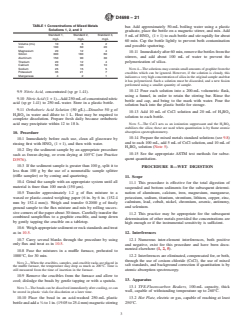
solution (9.7), and dilute to 100 mL in volumetric glassware with standard diluent solution (9.5). Concentrations are given in Table
1.
9.9 Nitric Acid, concentrated (sp gr 1.41).
9.10 Nitric Acid (1 + 1)—Add 250 mL of concentrated nitric acid (sp gr 1.41) to 250 mL water. Store in a plastic bottle.
9.11 Orthoboric Acid Solution (50 g/L)—Dissolve 50 g of H BO in water and dilute to 1 L. Heat may be required to complete
3 3
dissolution. Prepare fresh daily because orthoboric acid may precipitate within 12 to 18 h.
10. Procedure
10.1 Immediately before each use, clean all glassware by rinsing first with HNO (1 + 1), and then with water.
10.2 Dry the sediment sample by an appropriate procedure such as freeze-drying, or oven drying at 105°C (see Practice D3976).
10.3 If the sediment sample is greater than 100 g, split it to less than 100 g by the use of a nonmetallic sample splitter (riffle
sampler) or by coning and quartering.
10.4 Grind the sample with an appropriate system until all material is finer than 100 mesh (150 μm).
10.5 Transfer approximately 1.2 g of flux mixture to a waxed or plastic-coated weighing paper (6 in. by 6 in. (152.4 mm by 152.4
mm)). Weigh and transfer 0.2000 g of finely ground sample to the flux mixture and mix by rolling successive corners of the paper
about 30 times. Carefully transfer the combined sample/flux to a graphite crucible, and tamp down by gently tapping the crucible
on a tabletop.
10.6 Weigh appropriate sediment or rock standards and treat as in 10.5.
10.7 Carry several blanks through the procedure by using only flux and treat as in 10.5.
TABLE 1 Concentrations of Mixed Metals
Solutions 1, 2, and 3
Standard 1, Standard 2, Standard 3,
mg/L mg/L mg/L
Volume (mL) 10 6 2
Iron 100 60 20
Magnesium 20 12 4
Silicon 300 180 60
Aluminum 150 90 30
Titanium 20 12 4
Calcium 50 30 10
Sodium 25 15 5
Potassium 35 21 7
Manganese 4 2 1
D4698 − 21
10.8 Fuse the mixtures in a muffle furnace, preheated to 1000°C, for 30 min.
NOTE 2—When the crucibles, samples, and crucible racks are placed in the muffle furnace, the temperature may drop as much as 200°C. Time is still
measured from the time of insertion in the furnace.
10.9 Remove the crucibles from the furnace and allow to cool; dislodge the beads by gentle tapping or with a spatula.
NOTE 3—The beads can be dissolved immediately after cooling, or can be stored in plastic vials for dissolution at a later time.
10.10 Place the bead in an acid-washed 250-mL plastic bottle and add a ⁄4 to 1 in. (19.05 to 25.4 mm) magnetic stirring bar. Add
approximately 50-mL boiling water using a plastic graduate, place the bottle on a magnetic stirrer, and mix. Add 5 mL of HNO
(1 + 1) to each bottle and stir rapidly for about 60 min. Cap the bottle lightly to prevent both contamination and possible spattering.
10.11 Immediately after 60 min, remove the bottles from the stirrers, and add about 100 mL of water to prevent th
...