

ASTM D8460-22
(Test Method)Standard Test Method for Quantification of Volatile Organic Compounds Using Proton Transfer Reaction Mass Spectrometry
General Information
- Abstract
SIGNIFICANCE AND USE
5.1 Vapor intrusion testing has been performed traditionally using multiple canister samples or thermal desorption tube samples. These discontinuous measurements have been shown to be snapshots and provide averages of exposure. In many cases a higher temporal resolution is desirable to identify peaks of emissions due to specific occupancy or environmental changes. For these cases, a continuous real-time monitoring solution is desirable. These continuous monitoring setups can be either short-term or be part of a long-term monitoring plan as described in ASTM guide “Standard Guide for the development of LongTerm Monitoring Plans for Vapor Mitigation Systems” (E2600).
5.2 The PTR-MS provides real-time measurement of multiple VOCs at ultra-trace levels, that is, in the µL/L (ppm) to less than pL/L (ppt) range. Its strengths lie with the ability to measure VOCs in real-time and continuously (that is, ~1 Hz or faster, using time-of-flight analyzers), and with limited sample pre-treatment, compared to a gas chromatograph (GC) system, which is commonly the method of choice to measure VOCs using a variety of detectors. In case of PTR-MS with quadrupole analyzers, the terms would be nearreal-time and semi-continuous. The high temporal resolution of the PTR-MS measurement in the range of second(s) is often desired when studying the atmospheric chemistry or source emissions that result in unpredictable, sudden, and short-term fluctuations. For a detailed description on the design and theory and practical aspects of operation for the different types of PTR-MS, please refer to Yuan et al. (2017)(1).
5.3 For ambient air measurements, such as vapor intrusion (VI) related emission testing, the PTR-MS can be used in three different modes of operation: (1) in scanning mode to identify sources and VI entry points within buildings; (2) in variation identification mode, as a continuous monitoring instrument with seconds to minutes of temporal resolution covering a large number of V...
SCOPE
1.1 This test method describes a technique of quantifying the results from measuring various volatile organic compound contents using a chemical ionization mass spectrometer resulting in the production of positively charged target compound ions. Depending on the nature of production of so-called primary ions, the associated instruments having the capability to perform such analyses are either named Proton Transfer Reaction Mass Spectrometers (PTR-MS), Selected Ion Flow Tube Mass Spectrometers (SIFT-MS) or, in the most generic term, Mid-pressure chemical ionization mass spectrometers (MPCI-MS). Within this standard, the term PTR-MS is used to represent any of these instrumentations.
1.2 Either of the instrument types can be used with the two main mass analyzers on the market, that is, with either quadrupole (QMS) or time-of-flight (TOFMS) mass analyzer. This method relates only to the quantification portion of the analysis. Due to large differences in user interfaces and operating procedures for the instruments of the main instrument providers, the specifics on instrument operation are not described in this method.
1.3 Details on the theoretical aspects concerning ion production and chemical reactions are included in this standard as far as required to understand the quantification aspects and practical operation of the instrument in the field of vapor intrusion analyses. Specifics on the operation and/or calibration of the instrument need to be identified by using the user’s manual of the individual instrument vendor. A comprehensive discussion on the technique including individual mass-line interferences and in-depth comparison with alternate methods are given in multiple publications, such as Yuan et al. (2017) (1) and Dunne et al. (2018) (2)2.
1.4 Units—Values stated in SI units are to be regarded as standard. No other units of measurement are included in this standard. Reporting of test results in units othe...
- Status
- Published
- Publication Date
- 30-Apr-2022
- Technical Committee
- D18 - Soil and Rock
- Drafting Committee
- D18.21 - Groundwater and Vadose Zone Investigations
Overview
ASTM D8460-22 is the Standard Test Method for Quantification of Volatile Organic Compounds Using Proton Transfer Reaction Mass Spectrometry (PTR-MS), published by ASTM International. This document outlines a standardized method for quantifying volatile organic compounds (VOCs) in ambient air samples via chemical ionization mass spectrometry, primarily employing PTR-MS technology. The standard aims to provide reliable, real-time data to address the growing need for enhanced temporal and spatial resolution in vapor intrusion testing and broader ambient air monitoring.
By harnessing the unique capabilities of PTR-MS, organizations can conduct continuous VOC measurement with minimal sample preparation, offering faster response and higher sensitivity than traditional techniques.
Key Topics
- Real-Time VOC Quantification: Focuses on the use of PTR-MS and similar mass spectrometry instruments for direct, continuous measurement of VOCs in various environments.
- Instrument Scope: Covers PTR-MS, Selected Ion Flow Tube Mass Spectrometers (SIFT-MS), and Mid-pressure Chemical Ionization Mass Spectrometers (MPCI-MS), along with both quadrupole (QMS) and time-of-flight (TOFMS) analyzers.
- High Sensitivity and Temporal Resolution: Highlights the ability to detect VOCs at ultra-trace levels, delivering results at second-level intervals or faster, depending on the analyzer.
- Sampling and Calibration: Outlines compatible sampling techniques, calibration requirements, and performance criteria to ensure accurate VOC quantification.
- Applications in Vapor Intrusion Testing: Details the advantages of continuous monitoring setups for identifying emission peaks and assessing temporal variability, enabling improved exposure risk assessments.
- Data Analysis: Discusses quantification aspects, including ion transmission, calibration, and consideration of interferences, with instructions to consult the instrument manufacturer's guidelines for specific operation and calibration procedures.
Applications
The ASTM D8460-22 standard has broad practical utility across environmental, industrial, and research sectors, specifically in scenarios where the detection and quantification of volatile organic compounds are critical:
- Vapor Intrusion Assessments: Enables high-resolution, real-time detection of VOCs infiltrating indoor environments from subsurface sources, addressing shortcomings of snapshot-based sampling.
- Ambient Air Quality Monitoring: Supports regulatory compliance or research-driven studies by providing detailed temporal data on VOC fluctuations, source identification, and emission tracking.
- Site Characterization and Remediation: Valuable in environmental site assessments, especially for long-term monitoring plans of vapor mitigation systems during remediation or property transactions.
- Industrial Hygiene and Process Safety: Assists in monitoring occupational environments for hazardous VOCs, aiding risk management and emergency response.
- Research Applications: Ideal for studying atmospheric chemistry, short-term emission events, or metabolic reactions reflected in exhaled breath analysis.
- Real Estate and Property Transactions: Facilitates proactive screening for vapor encroachment, helping to identify potential liabilities early as described in related ASTM guides (e.g., E2600).
Related Standards
To enhance and contextualize the implementation of ASTM D8460-22, it is beneficial to consider these related documents and guidelines:
- ASTM E2600 - Guide for Vapor Encroachment Screening on Property Involved in Real Estate Transactions: Complements D8460-22 by addressing site-specific VOC risks in property transactions.
- ASTM D8408/D8408M - Guide for Development of Long-Term Monitoring Plans for Vapor Mitigation Systems: Supports the integration of continuous monitoring into site-wide management strategies.
- ASTM D653 - Terminology Relating to Soil, Rock, and Contained Fluids: Provides definitions for technical terms used in vapor intrusion and environmental site assessments.
- ASTM D1357 - Practice for Planning the Sampling of the Ambient Atmosphere: Offers guidance on ambient air sampling strategies for VOC analysis.
- ASTM D6026 - Practice for Using Significant Digits and Data Records in Geotechnical Data: Ensures standardization in reporting and significant figures of measured data.
Adopting ASTM D8460-22 ensures a consistent, robust approach to VOC quantification, facilitating regulatory compliance, enhancing risk assessments, and supporting environmental stewardship through accurate and timely data collection.
Relations
- Effective Date
- 01-Nov-2023
- Effective Date
- 01-Oct-2019
- Effective Date
- 01-Aug-2019
- Effective Date
- 01-Aug-2014
- Effective Date
- 01-May-2012
- Effective Date
- 01-Mar-2012
- Effective Date
- 01-Oct-2011
- Effective Date
- 01-Sep-2011
- Effective Date
- 01-Sep-2011
- Effective Date
- 01-Jun-2010
- Effective Date
- 01-Mar-2010
- Effective Date
- 01-Jan-2009
- Effective Date
- 01-Dec-2008
- Effective Date
- 01-Nov-2008
- Effective Date
- 01-Mar-2008
Get Certified
Connect with accredited certification bodies for this standard

CIS Institut d.o.o.
Personal Protective Equipment (PPE) certification body. Notified Body NB-2890 for EU Regulation 2016/425 PPE.

Kiwa BDA Testing
Building and construction product certification.
Kmetijski inštitut Slovenije
Agricultural Institute of Slovenia. Soil testing, plant health, agricultural product analysis.
Sponsored listings
Frequently Asked Questions
ASTM D8460-22 is a standard published by ASTM International. Its full title is "Standard Test Method for Quantification of Volatile Organic Compounds Using Proton Transfer Reaction Mass Spectrometry". This standard covers: SIGNIFICANCE AND USE 5.1 Vapor intrusion testing has been performed traditionally using multiple canister samples or thermal desorption tube samples. These discontinuous measurements have been shown to be snapshots and provide averages of exposure. In many cases a higher temporal resolution is desirable to identify peaks of emissions due to specific occupancy or environmental changes. For these cases, a continuous real-time monitoring solution is desirable. These continuous monitoring setups can be either short-term or be part of a long-term monitoring plan as described in ASTM guide “Standard Guide for the development of LongTerm Monitoring Plans for Vapor Mitigation Systems” (E2600). 5.2 The PTR-MS provides real-time measurement of multiple VOCs at ultra-trace levels, that is, in the µL/L (ppm) to less than pL/L (ppt) range. Its strengths lie with the ability to measure VOCs in real-time and continuously (that is, ~1 Hz or faster, using time-of-flight analyzers), and with limited sample pre-treatment, compared to a gas chromatograph (GC) system, which is commonly the method of choice to measure VOCs using a variety of detectors. In case of PTR-MS with quadrupole analyzers, the terms would be nearreal-time and semi-continuous. The high temporal resolution of the PTR-MS measurement in the range of second(s) is often desired when studying the atmospheric chemistry or source emissions that result in unpredictable, sudden, and short-term fluctuations. For a detailed description on the design and theory and practical aspects of operation for the different types of PTR-MS, please refer to Yuan et al. (2017)(1). 5.3 For ambient air measurements, such as vapor intrusion (VI) related emission testing, the PTR-MS can be used in three different modes of operation: (1) in scanning mode to identify sources and VI entry points within buildings; (2) in variation identification mode, as a continuous monitoring instrument with seconds to minutes of temporal resolution covering a large number of V... SCOPE 1.1 This test method describes a technique of quantifying the results from measuring various volatile organic compound contents using a chemical ionization mass spectrometer resulting in the production of positively charged target compound ions. Depending on the nature of production of so-called primary ions, the associated instruments having the capability to perform such analyses are either named Proton Transfer Reaction Mass Spectrometers (PTR-MS), Selected Ion Flow Tube Mass Spectrometers (SIFT-MS) or, in the most generic term, Mid-pressure chemical ionization mass spectrometers (MPCI-MS). Within this standard, the term PTR-MS is used to represent any of these instrumentations. 1.2 Either of the instrument types can be used with the two main mass analyzers on the market, that is, with either quadrupole (QMS) or time-of-flight (TOFMS) mass analyzer. This method relates only to the quantification portion of the analysis. Due to large differences in user interfaces and operating procedures for the instruments of the main instrument providers, the specifics on instrument operation are not described in this method. 1.3 Details on the theoretical aspects concerning ion production and chemical reactions are included in this standard as far as required to understand the quantification aspects and practical operation of the instrument in the field of vapor intrusion analyses. Specifics on the operation and/or calibration of the instrument need to be identified by using the user’s manual of the individual instrument vendor. A comprehensive discussion on the technique including individual mass-line interferences and in-depth comparison with alternate methods are given in multiple publications, such as Yuan et al. (2017) (1) and Dunne et al. (2018) (2)2. 1.4 Units—Values stated in SI units are to be regarded as standard. No other units of measurement are included in this standard. Reporting of test results in units othe...
SIGNIFICANCE AND USE 5.1 Vapor intrusion testing has been performed traditionally using multiple canister samples or thermal desorption tube samples. These discontinuous measurements have been shown to be snapshots and provide averages of exposure. In many cases a higher temporal resolution is desirable to identify peaks of emissions due to specific occupancy or environmental changes. For these cases, a continuous real-time monitoring solution is desirable. These continuous monitoring setups can be either short-term or be part of a long-term monitoring plan as described in ASTM guide “Standard Guide for the development of LongTerm Monitoring Plans for Vapor Mitigation Systems” (E2600). 5.2 The PTR-MS provides real-time measurement of multiple VOCs at ultra-trace levels, that is, in the µL/L (ppm) to less than pL/L (ppt) range. Its strengths lie with the ability to measure VOCs in real-time and continuously (that is, ~1 Hz or faster, using time-of-flight analyzers), and with limited sample pre-treatment, compared to a gas chromatograph (GC) system, which is commonly the method of choice to measure VOCs using a variety of detectors. In case of PTR-MS with quadrupole analyzers, the terms would be nearreal-time and semi-continuous. The high temporal resolution of the PTR-MS measurement in the range of second(s) is often desired when studying the atmospheric chemistry or source emissions that result in unpredictable, sudden, and short-term fluctuations. For a detailed description on the design and theory and practical aspects of operation for the different types of PTR-MS, please refer to Yuan et al. (2017)(1). 5.3 For ambient air measurements, such as vapor intrusion (VI) related emission testing, the PTR-MS can be used in three different modes of operation: (1) in scanning mode to identify sources and VI entry points within buildings; (2) in variation identification mode, as a continuous monitoring instrument with seconds to minutes of temporal resolution covering a large number of V... SCOPE 1.1 This test method describes a technique of quantifying the results from measuring various volatile organic compound contents using a chemical ionization mass spectrometer resulting in the production of positively charged target compound ions. Depending on the nature of production of so-called primary ions, the associated instruments having the capability to perform such analyses are either named Proton Transfer Reaction Mass Spectrometers (PTR-MS), Selected Ion Flow Tube Mass Spectrometers (SIFT-MS) or, in the most generic term, Mid-pressure chemical ionization mass spectrometers (MPCI-MS). Within this standard, the term PTR-MS is used to represent any of these instrumentations. 1.2 Either of the instrument types can be used with the two main mass analyzers on the market, that is, with either quadrupole (QMS) or time-of-flight (TOFMS) mass analyzer. This method relates only to the quantification portion of the analysis. Due to large differences in user interfaces and operating procedures for the instruments of the main instrument providers, the specifics on instrument operation are not described in this method. 1.3 Details on the theoretical aspects concerning ion production and chemical reactions are included in this standard as far as required to understand the quantification aspects and practical operation of the instrument in the field of vapor intrusion analyses. Specifics on the operation and/or calibration of the instrument need to be identified by using the user’s manual of the individual instrument vendor. A comprehensive discussion on the technique including individual mass-line interferences and in-depth comparison with alternate methods are given in multiple publications, such as Yuan et al. (2017) (1) and Dunne et al. (2018) (2)2. 1.4 Units—Values stated in SI units are to be regarded as standard. No other units of measurement are included in this standard. Reporting of test results in units othe...
ASTM D8460-22 is classified under the following ICS (International Classification for Standards) categories: 13.040.20 - Ambient atmospheres. The ICS classification helps identify the subject area and facilitates finding related standards.
ASTM D8460-22 has the following relationships with other standards: It is inter standard links to ASTM D3740-23, ASTM D3740-19, ASTM D1357-95(2019), ASTM D653-14, ASTM D3740-12a, ASTM D3740-12, ASTM D1357-95(2011), ASTM D653-11, ASTM D3740-11, ASTM E2600-10, ASTM D3740-10, ASTM D653-09, ASTM D653-08a, ASTM D653-08, ASTM D3740-08. Understanding these relationships helps ensure you are using the most current and applicable version of the standard.
ASTM D8460-22 is available in PDF format for immediate download after purchase. The document can be added to your cart and obtained through the secure checkout process. Digital delivery ensures instant access to the complete standard document.
Standards Content (Sample)
This international standard was developed in accordance with internationally recognized principles on standardization established in the Decision on Principles for the
Development of International Standards, Guides and Recommendations issued by the World Trade Organization Technical Barriers to Trade (TBT) Committee.
Designation:D8460 −22
Standard Test Method for
Quantification of Volatile Organic Compounds Using Proton
Transfer Reaction Mass Spectrometry
This standard is issued under the fixed designation D8460; the number immediately following the designation indicates the year of
original adoption or, in the case of revision, the year of last revision.Anumber in parentheses indicates the year of last reapproval.A
superscript epsilon (´) indicates an editorial change since the last revision or reapproval.
1. Scope standard. Reporting of test results in units other than SI shall
not be regarded as nonconformance with this standard.
1.1 This test method describes a technique of quantifying
the results from measuring various volatile organic compound 1.5 All observed and calculated values shall conform to the
contents using a chemical ionization mass spectrometer result- guidelines for significant digits and rounding established in
ing in the production of positively charged target compound Practice D6026.
ions. Depending on the nature of production of so-called 1.5.1 Theproceduresusedtospecifyhowdataarecollected/
primary ions, the associated instruments having the capability recorded or calculated in the standard are regarded as the
to perform such analyses are either named Proton Transfer industry standard. In addition, they are representative of the
Reaction Mass Spectrometers (PTR-MS), Selected Ion Flow significant digits that generally should be retained. The proce-
Tube Mass Spectrometers (SIFT-MS) or, in the most generic dures used do not consider material variation, purpose for
term, Mid-pressure chemical ionization mass spectrometers obtaining the data, special purpose studies, or any consider-
(MPCI-MS).Withinthisstandard,thetermPTR-MSisusedto ations for the user’s objectives; and it is common practice to
represent any of these instrumentations. increase or reduce significant digits of reported data to be
commensuratewiththeseconsiderations.Itisbeyondthescope
1.2 Either of the instrument types can be used with the two
of this standard to consider significant digits used in analysis
main mass analyzers on the market, that is, with either
methods for engineering data.
quadrupole (QMS) or time-of-flight (TOFMS) mass analyzer.
1.6 This standard may involve hazardous materials,
This method relates only to the quantification portion of the
operations, and equipment. This standard does not purport to
analysis. Due to large differences in user interfaces and
address all of the safety concerns, if any, associated with its
operating procedures for the instruments of the main instru-
use. It is the responsibility of the user of this standard to
ment providers, the specifics on instrument operation are not
establish appropriate safety, health, and environmental prac-
described in this method.
tices and determine the applicability of regulatory limitations
1.3 Details on the theoretical aspects concerning ion pro-
prior to use.
duction and chemical reactions are included in this standard as
1.7 This international standard was developed in accor-
far as required to understand the quantification aspects and
dance with internationally recognized principles on standard-
practical operation of the instrument in the field of vapor
ization established in the Decision on Principles for the
intrusionanalyses.Specificsontheoperationand/orcalibration
Development of International Standards, Guides and Recom-
of the instrument need to be identified by using the user’s
mendations issued by the World Trade Organization Technical
manual of the individual instrument vendor. A comprehensive
Barriers to Trade (TBT) Committee.
discussion on the technique including individual mass-line
interferences and in-depth comparison with alternate methods
2. Referenced Documents
are given in multiple publications, such as Yuan et al. (2017)
2.1 ASTM Standards:
(1) and Dunne et al. (2018) (2) .
D653Terminology Relating to Soil, Rock, and Contained
1.4 Units—Values stated in SI units are to be regarded as
Fluids
standard. No other units of measurement are included in this
D1357Practice for Planning the Sampling of the Ambient
Atmosphere
D3740Practice for Minimum Requirements for Agencies
ThistestmethodisunderthejurisdictionofASTMCommitteeD18onSoiland
Rock and is the direct responsibility of Subcommittee D18.21 on Groundwater and
Vadose Zone Investigations.
Current edition approved May 1, 2022. Published June 2022. DOI: 10.1520/ For referenced ASTM standards, visit the ASTM website, www.astm.org, or
D8460-22 contact ASTM Customer Service at service@astm.org. For Annual Book of ASTM
The boldface numbers in parentheses refer to a list of references at the end of Standards volume information, refer to the standard’s Document Summary page on
this standard. the ASTM website.
Copyright © ASTM International, 100 Barr Harbor Drive, PO Box C700, West Conshohocken, PA 19428-2959. United States
D8460−22
Engaged in Testing and/or Inspection of Soil and Rock as 3.3.5 FEP—fluorinated ethylene propylene
Used in Engineering Design and Construction
3.3.6 GC—gas chromatography
D5314Guide for Soil Gas Monitoring in the Vadose Zone
3.3.7 ICAL—initial multipoint calibration
(Withdrawn 2015)
3.3.8 IMR—ion molecule reactor
D5730Guide for Site Characterization for Environmental
Purposes With Emphasis on Soil, Rock, the Vadose Zone 3.3.9 LCS—laboratory control sample
and Groundwater (Withdrawn 2013)
3.3.10 MDL—method detection limit
D6026Practice for Using Significant Digits and Data Re-
3.3.11 MS—mass spectrometer
cords in Geotechnical Data
3.3.12 NIST—National Institutes of Standards and Technol-
D8408/D8408M Guide for Development of Long-Term
ogy
Monitoring Plans for Vapor Mitigation Systems
E2600Guide for Vapor Encroachment Screening on Prop-
3.3.13 PEEK—polyetheretherketone
erty Involved in Real Estate Transactions
3.3.14 PFA—polyfluoroalkoxy alkane
3.3.15 PTFE—polytetrafluoroethylene
3. Terminology
3.3.16 PTR-MS—proton transfer reaction - mass spectrom-
3.1 Definitions:
eter or spectrometry
3.1.1 For ease of reading, the term PTR-MS is used to
reflectanyvariationsofinstrumentationasdescribedin1.1and 3.3.17 QMS—quadrupole mass spectrometer
1.2.
3.3.18 SDS—safety data sheet
3.1.2 Fordefinitionsofcommontechnicaltermsusedinthis
3.3.19 SIFT-MS—selected ion flow tube - mass spectrom-
standard, refer to the guidelines in Practice D1357 and Termi-
eter or spectrometry
nology D653.
3.3.20 TOFMS—time-of-flight mass spectrometer
3.2 Definitions of Terms Specific to This Standard:
3.3.21 VI—vapor intrusion
3.2.1 gas analysis, n—involves multiple gas measurements
including calibration and zero gas background subtraction, 3.3.22 VOC—volatile organic compound
therefore involves multiple gas measurements.
3.4 Symbols Used in Equations:
3.2.2 gas measurement, n—an analysis performed with a
3.4.1 A—a target compound (analyte)
PTR-MS without calibration nor zero gas background subtrac- +
3.4.2 AH —a protonated target compound
tion.
3.4.3 R—reagent ion (primarily hydronium)
3.2.3 ion molecule reactor, n—theinstrumentpartwithinthe
N
3.4.4 C (A)= [A]—number concentration (molecules/mL)
V
PTR-MS where ionization reactions of the target molecules
of a neutral A in the ion molecule reactor
using primary ions happen
V
3.4.5 C (A)—mixing ratio or concentration of a constitu-
V
3.2.4 ZeroAir, n—a gas determined to be free of any
ent ion sample air (mL/L)
interfering substances at the reporting limit of the project.
+
3.4.6 I(AH )—signal intensity, that is, ion count rates
3.2.4.1 Discussion—For example, the PTR-MS can be used
(ions/s)
to perform the analysis or an equivalent methodology or the
certificate can be used in case of a certified cylinder.
3.4.7 E(AH+)—ion transmission efficiencies through the
mass spectrometer
3.3 Abbreviations:
3.3.1 CI-MS—chemical ionization - mass spectrometer or
3.4.8 k—ion–molecule reaction rate constant (molecules
–1 –1
spectrometry mL s )
3.3.2 DOD—United States Department of Defense
3.4.9 t—reaction time (s)
3.3.3 DOE—United States Department of Energy 3.4.10 τ—dwell time (s)
N
3.3.4 EPA—UnitedStatesEnvironmentalProtectionAgency
3.4.11 [air] —C (air) number concentration of air in the
R V
ion molecule reactor (molecules/mL)
4 3.4.12 C —calibration concentration (nL/L)
The last approved version of this historical standard is referenced on cal
www.astm.org.
3.4.13 p —pressure of the ion molecule reactor (mbar)
R
Background—Signal is caused by contaminations in the sampling system and
the ionizer.This is different from the base line signal, which is caused by electronic 3.4.14 T —temperature of the ion molecule reactor (K)
R
noise, stray ions, and/or peak tails of very abundant compounds.
3.4.15 U —voltage of the ion molecule reactor (V)
R
In practice this means that a gas mixture can have 20 components present at 10
2 –1 –1
nL/L (ppb) each. These components shall not produce interfering signals or
3.4.16 µ—ion mobility (m V s )
contribute significantly to the consumption of the reagent ion. Commercially sold
2 –1 –1
3.4.17 µ —reduced ion mobility (cm V s ) at standard
ZeroAir cylinders and generators usually guarantee the content to have <0.1 nL/L
hydrocarbons. The actual amount of hydrocarbons within a given air needs to be
conditions of p and T
0 0
identified separately. In case of the use of a ZeroAir generator, the feedline might
3.4.18 p —air pressure in standard conditions (mbar)
require additional scrubbers. Despite of these aspects, a ZeroAir generator is 0
preferred over bottled air for the system blank (see Chapter 12) since the ambient
3.4.19 T —temperature in standard conditions (K)
humidity can be an important factor for the calibration in some systems. Zero
Nitrogen is an option, with the same conditions as described above. 3.4.20 N —Avogadro constant
A
D8460−22
3.4.21 l—length of the ion molecule reactor (m) valve allow different sample flows from discreet, separate
locations to be programmatically measured at a single instru-
3.5 Quantities, their symbols and SI units, non-SI units
ment location.
acceptedwiththeSIandequivalentnon-SIunitsareoftenused
inthescientificliteratureofthisfield.Inthisstandardwetryto 4.2 Theinstrumentiscalibratedeitherfrommanualinputof
use SI units where possible and indicate scientific jargon units calibration standards and zero air or through the use of an
in parenthesis.An overview of the quantities and units used in automated calibration and zero system.Automatic systems are
this field is listed in Table 1. commercially available and can be linked to the PTR-MS
throughinerttubing.Suchsystemsusuallyproducezeroairfor
4. Summary of Test Method blanks and use a calibration mixture through dynamic dilution
ofthatcalibrationstandardintothezeroair.Whethermanualor
4.1 This method describes the practical aspects of quantifi-
automatic, the concept of calibration remains the same, and is
cation of a proton transfer reaction - mass spectrometer
described in detail later in this method.
(PTR-MS) in quantifying various volatile organic compounds
inambientairsamples.Ambientairsamplesaredrawnthrough 4.3 This method is used to quantify the concentration of
inert tubing and routed to the PTR-MS for analysis. Sampling VOCs in the gas phase using ambient air as the carrier gas. In
can be performed either through direct input of the sample gas the standard case this method will draw VOCs into the
into the instrument or by using a secondary pump system for PTR-MSusingairasthecarriergas,butgassesthatareinertto
sampling from more distant areas by using PTFE, PFA or the method can be substituted as the carrier gas (N or noble
equivalent sampling tubing; by using the latter approach, gasses).Calibrationsandblanksareeitherconductedautomati-
distances between sampling spot and instrument of several callyusinganappropriatecalibrationsystemormanuallyusing
hundred feet can be achieved. Limitations in terms of distance auxiliary standards.
aredescribedinSears,et.al.(2013) (3).Theinletcanbesetup
5. Significance and Use
to handle either continuous sampling or for discreet sample
intake of previously acquired air samples in, for example, 5.1 Vapor intrusion testing has been performed traditionally
canisters or bags. Instruments configured with a multiport using multiple canister samples or thermal desorption tube
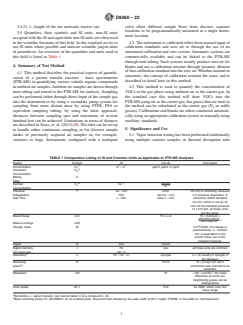
TABLE 1 Comparative Listing of SI and Common Units as Applicable to PTR-MS Analyses
Quality Symbol SI non-SI Comments
V 3 3
Concentration C m /m ppmV, ppbV, or pptV
V
N
Volumetric C
N
Concentration
Mixing C
Ratio
N –1 molecules
Number C mL
V
mL
Concentration
Pressure F mL ⁄ min sccm mL/min is confusing, because
Independent hPa bar mL ⁄ min it is pressure dependent. It
Gas Flow L⁄min mbar L ⁄ min should be called standard
mL/min, which is not an SI
unit. At the standard pressure
of 1.013 bar, all these units
are the same.
Mass/charge m/z Th = u ⁄e Th = thomson =
unified atomic mass unit
=
atomic charge unit
Mass-to-charge m/Q
Chargic mass M In PTR-MS, the charge is
predominantly +1, therefor
m/z is equivalent to the
atomic mass unit of the
charged molecule.
Signal S ions counts
Signal intensity, I Hz cps all three units are common
ion count rate ion ⁄ s
A
Sensitivity s Hz / (nL ⁄ L) cps/ppb s=I⁄C usually in cps/ppb in
the literature
Resolving R Th/Th R=(m⁄Q)⁄∆(m ⁄Q) is
B
power sometimes also referred to as
resolution
Resolution ∆M Th ∆M= ∆(m/Q) = the mass
difference at which two
neighboring peaks can be
distinguished
Scan speed M/t Th/s for QMS, which scan the
mass range
A
Sensitivity s = signal intensity I per concentration C of a compound = I/C.
B
Mass resolving powerR=M⁄∆M50%: for an isolated peak, observed mass divided by the peak width at 50 % height (FWHM, or full-width-at- half-maximum).
D8460−22
samples. These discontinuous measurements have been shown obscured from view by floor coverings, furniture or walls,
to be snapshots and provide averages of exposure. In many which in itself can be a large source of VOC. The current
casesahighertemporalresolutionisdesirabletoidentifypeaks methods of choice require the use of time-discreet monitoring
of emissions due to specific occupancy or environmental or time-averaged monitoring of a specific sampling spot.
changes. For these cases, a continuous real-time monitoring Real-time monitoring provides a method to assess the spatial
solution is desirable. These continuous monitoring setups can distributionofvaporconcentrations,whichmayhelptorapidly
be either short-term or be part of a long-term monitoring plan and efficiently identify the location of vapor entry points.
as described in ASTM guide “Standard Guide for the devel-
5.5 Real time assessment is valuable as a component of a
opment of LongTerm Monitoring Plans for Vapor Mitigation
program of assessment with two or more supporting lines of
Systems” (E2600).
evidence and can be used to:
5.2 The PTR-MS provides real-time measurement of mul-
5.5.1 Provide support for real-time decisions such as where
tiple VOCs at ultra-trace levels, that is, in the µL/L (ppm) to
and when to collect long-term samples for fixed laboratory
less than pL/L (ppt) range. Its strengths lie with the ability to
analysis using canisters or sorbent tubes;
measureVOCs in real-time and continuously (that is, ~1 Hz or
5.5.2 Verify data quality (for example, monitoring the effi-
faster, using time-of-flight analyzers), and with limited sample
cacy of soil gas probe purging prior to sampling, providing
pre-treatment, compared to a gas chromatograph (GC) system,
leak checks; and
which is commonly the method of choice to measure VOCs
5.5.3 Measure changes in VOC vapor concentrations in
using a variety of detectors. In case of PTR-MS with quadru-
response to changes in building pressure, temperature, solar
pole analyzers, the terms would be nearreal-time and semi-
irradiation, or other weather conditions and factors affecting
continuous. The high temporal resolution of the PTR-MS
vapor fate and transport, including secondary chemistry occur-
measurement in the range of second(s) is often desired when
ring within the building.
studying the atmospheric chemistry or source emissions that
5.5.4 Identify alternative pathways based on prior identified
result in unpredictable, sudden, and short-term fluctuations.
intrusion compounds or based on emissions within such
For a detailed description on the design and theory and
pathways, such as stormwater drains.
practical aspects of operation for the different types of PTR-
5.6 Screening of a property prior to a real estate transaction
MS, please refer to Yuan et al. (2017)(1).
based on site specific potential sources of concern. The option
5.3 For ambient air measurements, such as vapor intrusion
for voluntary investigative assessments of potential VI in the
(VI)relatedemissiontesting,thePTR-MScanbeusedinthree
real estate business is described in ASTM method E2600-15.
different modes of operation: (1) in scanning mode to identify
NOTE 1—The quality of the result produced by this standard is
sources and VI entry points within buildings; (2) in variation
dependent on the competence of the personnel performing it, and the
identification mode, as a continuous monitoring instrument
suitability of the equipment and facilities used. Agencies that meet the
withsecondstominutesoftemporalresolutioncoveringalarge
criteria of Practice D3740 are generally considered capable of competent
number of VOCs; (3) in source tracking mode, as a scanner of
and objective testing/sampling/inspection/etc. Users of this standard are
cautioned that compliance with Practice D3740 does not in itself assure
indoor and outdoor sources and as a rapid tracking device for
reliable results. Reliable results depend on many factors; Practice D3740
external emissions; this requires the instrument to be mounted
provides a means of evaluating some of those factors.
onamoveableplatform,suchasonan(autonomous)vehicleor
trolley. The same operation can be used to identify various
6. PTR-MS Instrument
other constituents in air, depending on the application—be it
fugitive emissions from toxic materials or illicit materials, or 6.1 This chapter only describes the steps necessary for
understanding the quantification of PTR-MS generated data.
metabolic reactions to infections expressed in different breath
emissions. For general description of the instrument, please refer to Yuan
et al. (2017) (1) and Dunne et al. (2018) (2).
5.4 Spatial and temporal variability are two common chal-
lengeswithambientairmeasurementsandsourceassessments. 6.2 Amass spectrometer is usually considered as consisting
Within a given building, the sources for vapors can be few or of a sampling system, an ionizer, a mass analyzer and data
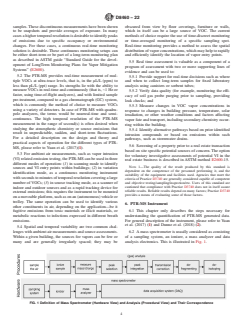
many and are generally irregularly spaced; they may be analysis electronics. This is illustrated in Fig. 1.
FIG. 1Definition of Mass Spectrometer (Hardware View) and Analysis (Procedural View) and Their Correspondence
D8460−22
1 1
6.3 A gas analysis consists of the following procedures: A1R →AR
ionizing the sample gas, mass analysis of the ions, quantifying
6.7.4 The chemical ionization reaction takes place within
the mass peaks, correcting for transmission differences of ions
the ion molecule reactor (IMR), that is, where the sample air
with different mass/charge, assigning fragment ions to their
stream interacts with the reagent ions produced by the reagent
parent ions and assigning isotopes to their compound. Those
ionsource(Fig.1).Theionmoleculereactor(IMR)ispressure,
processes are also illustrated in Fig. 1. The last three proce-
temperature and voltage adjusted to control reaction kinetics.
dures are not always required. For example, if a measurement
6.7.5 TheIMRgaspressuredeterminesthereactiondynam-
of isotope ratios is to be done, the de-isotoping procedure will
ics. We differentiate three different pressure regimes:
be omitted.
6.7.5.1 Lowpressurechemicalionization(LPCI): pR<0.01
6.4 Gas sampling is usually done with inert tubes, mostly
mbar: in this pressure regime, ion molecule reactions are rare.
made of PTFE, PFA, PEEK or equivalent. These tubes are
Therefore, secondary reactions are very unlikely. This is the
usually temperature controlled. When measuring semi-volatile
purest form of chemical ionization, but also not very sensitive.
organic compounds (SVOC) the temperature should be above
6.7.5.2 Medium pressure chemical ionization (MPCI): 0.01
100 in order to minimize condensation. It is preferable to
mbar< pR<10mbar:inthispressureregimecollisionenergies
keep the sampling lines short and move the mass spectrometer
are sufficiently high to allow disintegrate water clusters;
+
to the sample.
therefore, the medium pressure regime is used for H O
ionization. However, some secondary reactions do happen,
6.5 Chemical ionization (CI) is chosen in this method
especially with samples of high VOC loads.
because it is soft, selective and sensitive.
6.7.5.3 High pressure chemical ionization (HPCI): 10 mbar
6.5.1 Soft ionization means that only a small number of
< pR: In this pressure regime secondary ionization is very
fragments are produced from a target compound and a higher
likely and the highest sensitivities are achieved since the
likelihood of production of the charged complete molecule.
reaction collisions are very numerous. This is best suited for
This results in simpler spectra and therefore is key for direct
very clean air measurements.
mass spectrometry, for example, analysis without chromato-
graphic separation.
6.8 Massanalyzerscomeindifferentvarietieswithdifferent
6.5.2 Selective ionization means the main gases (N,O)of
2 2 properties:
the atmosphere are not ionized. This is important to reach low
6.8.1 Quadrupole mass analyzers (QMA) are the “tradi-
detection limits. Without selective ionization, the mass spec-
tional” analyzers in PTR-MS.Their resolving power is limited
trometer would be overwhelmed and saturated by the highly
to“unitmass,”whichmeansisobarscannotberesolved,which
abundant air compounds.
usually is important for CI-MS due to the lack of chromato-
6.5.3 Sensitive ionization means that the signal intensity I
graphic separation. PTR-MS with QMS are ideally deployed
per concentration C of a compound A is large. This allows for
when the monitoring duration is over multiple days or weeks
fast measurements and reduces signal-to-noise.
and a temporal resolution of multiple minutes is acceptable.
6.8.1.1 Quadrupole MS—Analyte ions are measured se-
6.6 Chemical ionization means that a compound A is ion-
quentially in a measurement cycle. In a multiple ion detection
ized via the chemical reaction with a reagent R. In most cases
z
cycle the measurement cycle consists of measuring the reagent
the reagent is an ion, which is indicated as R where z is the
+ + + +
ion (H O ), other diagnostic ions (O ,NO ,(H O) H ), and
charge state of the reagent. In some cases, the reagent can be a
3 2 2 2
up to 50 analyte ions. The instrument repeats this cycle
neutral, metastable molecule or element, which is indicated as
●
indefinitely storing the data to file.
R .
6.8.1.2 The dwell time (τ) is the length of time the mass
6.7 The reaction can be of many different types. Common
spectrometer spends measuring an ion and can be varied to
reaction types are proton transfer ionization, electron transfer
improve signal to noise; typically, dwell time is 1 second for
ionization, or adduct ionization.
analyte ions. A measurement cycle is the sum of the dwell
+
6.7.1 PTR-MS uses the reagent ion H O and therefore
times of all analytes being measured, which ultimately deter-
ionizes organic analytes (A) via the following proton transfer
mines the time resolution of measurements.
reaction:
6.8.2 Time-of-flight mass analyzers (TOF) have widely
1 1
A1H O →AH 1H O
3 2
replaced the QMA in chemical ionization mass spectrometry.
The key differences of TOF-MS instrumentation are the mass
6.7.1.1 Only compounds that have a proton affinity greater
resolution of 1 Th (nominal mass) meaning that no elemental
than that of water (693 kJ/mol) can be ionized when using the
compositionidentificationcanbeperformed;andthestaggered
hydronium mode of ionization.
(nonconcurrent) measurement of individual analyte ions. They
6.7.1.2 This reaction may also take place with water cluster
+
can reach high resolving power (R > 10,000) which allows
ions (H O) H O as reagent ions or adduct ions, which can be
2 n 3
separation of many isobars which is very useful to compensate
helpful in untargeted analytical approaches.
the lack of chromatographic separation. Their high mass
6.7.2 Electron transfer ionization (ETI) can also result in
positive ionization:
1 1
A1R →A 1R
Mass resolution:∆M50% = peak width at 50% height, which is approximately
6.7.3 Adduct chemical ionization is sometimes preferred to
thesmallestdifferencebetweentwopeaksM1andM2sothattheycanbeidentified
+
H O because it is even “softer”: as separate signals.
D8460−22
accuracy enables identification of compounds without frag- 6.9.3.2 De-isotopingmeansaccountingforthemassspectral
ment libraries. They measure all masses simultaneously and signalofthevariousisotopesofagivencompoundduringpeak
therefore are quite sensitive. In addition, they can be quite integration, and potentially assigning the integrated signal of
compact and robust. less-abundant isotope ions to the monoisotopic ion pertinent to
that compound.
6.8.2.1 TOF analyzers require a pulsed and cyclic ion
extraction into the field free region of the MS. All ions are
6.10 Based on reaction kinetics, the number concentration
measured in each extraction cycle which repeat at a rate of
(in molecules/mL) of neutral VOC [A], in the IMR can be
typically 10 to 50 kHz dependent upon instrument specifics.
determined by the following equation:
Datafrommultipleextractionsareaccumulatedintospectrafor
1 1
1 I~AH ! E~H O !
predefined time periods (typically 0.01 to 10 seconds) to
@A# 5 (1)
1 1
ktI H O E AH
~ ! ~ !
improve signal to noise in the spectra.
where k is the ion—molecule reaction rate constant
6.9 The PTR-MS with TOF analyzers are ideal when rapid
–1 +
(molecules/mL s ), t is the reaction time (s), I(AH ) and
changes (bolus events, fugitive emissions) in vapor concentra-
+
I(H O ) are the respective ion counts rates (ions/s), and
tions are anticipated which require high temporal resolution.
+ +
E(AH ) and E(H O ) are the ion transmission efficiencies
Other mass analyzers such as Fourier transform ion cyclotron
through the ion optics and the mass spectrometer. The mixing
resonance mass analyzers are used primarily in academic
ratio or concentration of the organicAin the sample air is then
research settings and are not used in field deployments. Data
determined by the following equation:
acquisition system (DAQ) usually includes electronics for
A A A
@ # @ # @ #
recording the signals from the mass analyzer and a computing
9 9
X A 5 5 10 nL⁄L 5 10 ppb
~ !
AIR AIR AIR
@ # @ # @ #
unit.
IMR IMR IMR
(2)
6.9.1 The recording electronics can be either a time-to-
digital converter (TDC) or an analog-to-digital converter
where [AIR] is the number concentration of air
IMR
(ADC). Whereas TDCs count the ions individually, ADCs
(molecules/mL)intheIMR;thisequationmayalsobeadjusted
measurethecurrentproducedbytheions.TDCsarefaster,less
to take water cluster ion reactions into account.
expensive but have a limited dynamic range. With ADCs
6.11 In practice the sensitivity of the PTR-MS to various
becoming faster and mimicking TDC properties, the ADCs
VOCsisdeterminedbyusingmulticomponentcompressedgas
gradually replace the TDCs. Modern ADCs have on-board
standardstoestablishthesensitivitys=I/S(signalintensityper
processing, which means some data analysis can be done
concentration); this sensitivity s is measured in (ions/s)/(nL/L)
on-board.
= cps/ppb.
6.9.2 The main processing steps done in the computing unit
6.12 In practice, due to differences in ion-molecule reaction
are listed in Fig. 1:
rate constant and transmission efficiency, and different degree
6.9.2.1 Peak selection can be done in two different ways:
of fragmentation, different species have different sensitivities.
• Peaks are selected from a pre-defined peak list. This is
For example, sensitivities are typically larger for polar oxy-
referred to as “targeted analysis.”
genated compounds.
• Peaks are selected using a peak finder algorithm in
addition to the pre-defined peak list or from scratch. This is
7. Special Skills
referred to as “non-targeted analysis.”
7.1 This method aims at post-analytical quantification
Manystandardsincludealistofcompoundstobemeasured,
aspects. Personnel must be competent in the operation of the
which amounts to a “targeted analysis.”
PTR-MS instrument, calibration and blank procedure.
Inmanycases,the“peakfinding”ofpeaksthatarenotinthe
7.2 The user must be educated in the steps to calculate the
peak list is done in post-processing and even manually. The
normalized sensitivity of VOCs using data collected from the
new peaks can then be added to the predefined list and the
PTR-MS and calibration and zero system. Ultimately, this
complete data analysis can be repeated. This blurs the line
requirestheknowledgetodetermineambientconcentrationsof
between targeted and non-targeted analysis.
VOCs from the calculated sensitivities. Personnel should also
6.9.2.2 Peak integration collects all signal of an ion species
be able to estimate the concentrations of tentatively identified
into a single intensity for that species. This process includes
compounds (TIC’s) using calculated sensitivities and proton
mass calibration, integration of a signal peak sometimes using
transfer reaction rate constant data.
peak fitting, and massspectral baseline correction. These pro-
cesses can be done either real-time during recording or in
8. Safety
postprocessing.
8.1 Components of the PTR-MS are at a high voltage and
6.9.3 Transmissioncorrectionmeansaccountingforthefact
protected from accidental human contact. However, care
that the total ion transmission depends on the mass/charge of
should be taken to avoid contact with energized parts and only
an ion. This step does not need to be done when a compound
qualified PTR-MS technicians should attempt repair or main-
is quantified using a calibration gas with a known concentra-
tenance within potentially energized areas of the instrument.
tion of the compound.
6.9.3.1 De-fragmenting means assigning the signal of mul- 8.2 The multi-component VOC blend is stored inside a
tiple fragment ions to their precursor ion. pressurizedaluminumbottlewithanattachedregulator.Before
D8460−22
movement of the bottle from the security straps, the regulator
should be removed and the bottle head should be covered with
thesuppliedcap.SafetyDataSheets(SDS)forchemicals,such
as analytes and solvents, should be consulted before use. The
user of this test method should also be aware of the hazards
associated with the operation of the multicomponent VOC
blend that contains many toxic compounds. Therefore, the
exhaustofthecalibrationandzerosystemandPTR-MSshould
be vented outside the analytical workspace to avoid contami-
nation of the air with the compounds of the multi component
VOC mixture. In case of primary ion sources other than
hydronium, such as O , standard safety procedures are to be
consulted for handling gas cylinders with such content.
8.3 Turbomolecularvacuumpumpscanfailcatastrophically
if suddenly exposed to high pressure while they are operating,
whichcouldpresentahazardtohumansorproperty.Turbomo-
lecular pumps should be turned off and allowed to come to a
complete stop before the instrument is vented.
9. Setup, Sample Collection, and Handling
9.1 Fig. 2 illustrates the schematic layout of a basic
PTR-MS system. Due to the connection with ZeroAir, a
dilution of the actual sample can be performed in case of large
amountsofVOCemissionsthatcanoverwhelmtheinstrument.
Anexamplecouldbetheinvestigationofalternativepathways.
For calibration the 2-way valve is switched to the calibration
gas, while for measurements the valve is switched to the
sample inlet side. The sample inlet side can be either a single
line of tubing or could be a multi-valve that switches between
multiple sampling lines. Due to the relatively low flow rate of
the PTR-MS, which is in the range of 100 sccm, it is usually
beneficial to use a secondary pump and subsample from that
main flow.
9.2 More sophisticated setups have been shown to be
adequate for specific problem settings, such as GC-PTR-MS.
FIG. 2Basic Configuration of a Calibration and Sampling System
9.3 The PTR-MS does not require any pre-conditioning of
for PTR-MS Analysis
the sample. While filters can be used to remove larger dust
particles, these can also interfere with the vapor content of a
9.5 To provide the optimal sample to the instrument guide-
sample.Avirtual-impactorsetupisrecommended,inwhichthe
linesareprovidedbyseveralASTMstandards,suchas,D5314
PTR-MS samples a small flow orthogonally from a much
and D5730. Minimal calibration requirements are shown in
largerflowsuppliedbyanexternalpump(seeFig.2).Depend-
Table 2.
ingontheambientairconditions,someadvantagescanalsobe
9.6 The sampling line is to be kept at a stable temperature
gainedthroughdifferentsamplingtechniquessuchastheuseof
into the instrument, ideally with increasing temperature from
coldtraps,nafiondryers,thermaldesorptionorsampledilution
the point of sampling to the IMR. This avoids the so-called
using either a mass flow controller or flow orifices, however,
coldspots,whichareareaswithinthesamplinglinecolderthan
this is not a requirement for general indoor sampling and
the ambient temperature and which potentially produce false
analyses.
results due to condensation on the walls. However, due to the
9.4 Thesamplinglinecanbeextendedtothelengthrequired
pressure difference between the ambient pressure and in the
by location. Standard tubing diameters in the U.S. are ⁄4 in.
IMR,thetemperaturewithinthechambercanbereducedupto
(6.4mm)or ⁄8in.(9.5mm)OD;PFAorFEParematerialswith
20°C in comparison to the inlet tube temperature while still
averygood(thatis,low)retentionandprice.Samplinglinesof
preventing condensation of sampling constituents. This is
up to 100 feet (30.5 m) can be set up.
beneficial to further reduce the amount of fragmentation for
labile compounds during ionization.
Such systems have a reduced ability for real-time monitoring but an additional
10. Operating Procedure
layer of separation which can be beneficial in tracking very low concentrations of
10.1 Startup and Operating Steps—The individual steps on
targetanalytes;asidebenefitisthatthissetupwouldfulfillthecriteriatoapplyU.S.
EPA method 18. For comparison of such methods see Warneke et al. (2015) (4). how to setup a PTR-MS run are highly dependent on the
D8460−22
individual instrument’s operating software. The general steps calibrantgaswithalargerflowofzeroair,suchthatthesignals
described below serve to assure quality control. For details on fortheionspertinenttothecompoundsinthecalibrantmixture
howtostarttheinstrumentandhowtosetuptheparametersfor dominate any neighboring interferences. As delineated in the
analysis, such as IMR temperature, pressure, and voltage, chapter on mass calibration, two points or more are to be used,
+ +
sample inlet temperature, characteristics of the detectors and in the low (21.0232 Th for H O isotope or NO at 29.9987
ion optics modules (if present) and of the output files are to be Th) and upper range (for QMS, alpha-pinene at 137 Th, for
identified using the manufacturer’s guidelines. TOFMS 203.9940 Th from the fragmentation of 1,3-di-
iodobenzeneifpresentoranequivalentstandardintherangeof
10.2 Leak Detection—Upon start-up it is necessary to tune
analysis); a simple validation is to briefly breathe into the inlet
the ion source and identify the presence of a leak in the
andcheckforthemassofprotonatedacetone,whichis59.0865
instrument. Leaks should not occur during normal use of the
Th.
instrument.Incasethevacuumchamberpressuredoesn’treach
the appropriate range within regular time frames of initial
11. Interferences
startup (typically 15-45 minutes for QMS, 1-3 hours for
TOFMS), a vacuum leak is the cause for such a delay. Should 11.1 The PTR-MS identifies compounds as the molecular
the system fail to pump to the required vacuum, the leak must
massofthechemicalspeciesplusthemassofoneprotonwhen
be found and corrected. usinghydroniumionsforionization.Thetechniqueistherefore
limited by isobaric interferences for PTR-QMS and isomeric
10.3 Tune Ion Source—The ion source is tuned to optimize
interferences for PTR-TOFMS with higher than mass unit
+ +
the H O count rate and keep the O count rate less than 2%
3 2
+ resolution. One approach to identify interferences is to use
of the H O count rate by using dry VOC-free air. To tune the
3 + +
different reagent ions, such as O or NO and use the
+ + +
ion source the following ions are measured: H O ,O ,NO ,
3 2
potentially different reaction mechanisms in the IMR as a
+ +
H O ,(H O) H .TheionsourceistunedbyadjustingtheH O
2 2 2 2
separator. Also, some species fragment upon ionization. An-
flow through the ion source, by adjusting the ion source
other way to separate isomers is to use GC, see 9.2).
current, and by adjusting the voltages of the secondary IMR
lenses.Atthispointthedetectorvoltagecanbeincreasedtoget 11.2 An important contributor to analyte fragmentation is
+ +
H O count rates into the desired range (actual rates of ions/s
the reaction with O ; this ion is produced along with the
3 2
+
depend on the individual instrument model and are usually hydronium ion (H O ), but the IMR is tuned to increase the
provided by the manufacturer). Equivalently, the ion ratios of
concentrations of the hydronium ion and reduce the concen-
+ + + + + + +
O to H O,(H O) H /H O , and NO /O are trations of the O ion.As the ion source ages, the abundance
2 3 2 2 3 2 2
+
performance indicators, but the actual numbers of these ratios of interference ions such as O slowly increases (see 10.3 on
+
are instrument-dependent and vary between manufacturers. tuning of the source). O ionizes the VOCs of interest mainly
through charge transfer reactions. The reaction is a form of
10.4 Tuning of Alternative Ion Sources—If an ion source
hard ionization and typically fragments the VOCs of interest
different to hydronium is chosen, the source ion needs to be
which can lead to either overestimation of some compound
optimized. Due to the large number of potential source ions,
concentrationsthroughtheinterferencebyfragmentionsorthe
only hydronium is specifically described within this guideline.
underestimationofsomeVOCconcentrationsduetothelossof
An individual optimization protocol shall be developed within
+
the primary ion. The O concentration should be monitored
the sampling plan. In addition, many of these ion sources
and recorded at a minimum daily and if found out of control
ionize the analyte by reactions other than proton-transfer.
based on the manufacturer’s specifications, the IMR retuned
+ +
These include the use of NO and O as reagent ion.
according to the manufacturer’s guidelines.
10.5 Mass Calibration (Internal Standard)—Before mea-
+
11.3 NO is also produced in the source, but to a lesser
surements are to be made, the mass-scale calibration must be
+
extent than O . This ion undergoes soft ionization reaction
verified. The mass calibration verifies that the ion peaks are
with several common analytes resulting in detectable interfer-
centered over the correct value of the ion mass.
ences. The ion can also fragment some VOC species resulting
10.6 Mass drift can occur for various reasons, the most
in further interferences.
important being temperature changes and vibrations during
11.4 Water dimers and larger clusters formed through the
transportation. A good practice is to perform a quick mass
hydration of the reagent ion can also positively interfere with
calibration verification check after every transport. Several
the quantification of polar species such as ketones, aldehydes
instrumentsprovideinternal“continuous”masscalibration.By
andorganicacids.Ifaspecieshasaprotonaffinitygreaterthan
injectionofaninertsubstancesuchas1,3-Di-iodobenzeneinto
the water dimer, then the organic compound will be ionized
the IMR a permanent signal is generated that the instrument
through proton transfer reaction from the water dimer. Polar
can target. With such an omnipresent signal, software algo-
species can also be ionized through ligand switching reactions
rithms can validate the accuracy of the peak center every
with the water dimers. Because the basic calculation of the
minute or less; these autocorrection features have limitations.
samplecompoundsisafunctionofthereagentiononlyandnot
10.7 In case the calibration is off by more than one mass in fromionizationfromanyothermeans,thequantificationofthe
the target region, the algorithms usually cannot identify the samplecompoundwillbepositivelybiasedduetothepresence
appropriate peak. In this case, a manual calibration with a of water dimers. The formation of water dimers is controlled
known standard gas mix is advised by mixing a small flow of through tuning the IMR voltage across the IMR. The drift
D8460−22
voltagecontrolsthevelocitytheionstraveldowntheIMR.The voltageistunedtominimizethewaterdimerinterferencewhile
water dimers break apart through random collisions with other maintaining the sensitivity to VOCs.
molecules in the flight path. Increasing the voltage results in a
lowerabundanceofwaterdimersthroughforcedfragmentation
12. Quality Control Measures
but may also decrease the abundance of ionized sample VOCs
12.1 Table 2 provides the recommended quality control
through loss of the proton by random collisions. The IMR
TABLE 2 Quality Control Protocol for Continuous Monitoring with PTR-MS
Activity Frequency Comments
Ion source tune Prior to ICAL and prior to each 24-hour period of See 10.3.
sample analysis
Initial Multipoint Calibration (ICAL) After movement of the instrument to the test site Minimum of 5 concentrations, one of them being at
At the beginning of a sampling campaign the CCV level and the lowest being at or below the
LOD. Acceptable if linear least square regression for
each analyte is$0.99.
If ICAL fails, rerun, if still fails, check dilution
apparatus, check if zero air source is functional,
verify there is no leak in the system (that is, no
diluting with ambient air).
Analytes should cover as many targets as possible,
however reaction kinetics approach does not require
all analytes being present in calibration (see
14.2.1.3).
Initial Calibration Verification (ICV) Once after each ICAL to verify source standard. All reported analytes of the laboratory control
sample (LCS) within ±30 % of certified value (either
certified gas cylinder or pre-made canister).
If ICV fails, rerun ICV, if still fails, repeat ICAL.
Continuing Calibration Verification (CCV) Daily before sample analysis, if continuous, after Concentration of the mid-point level of ICAL. All
every 24 hours of analyses, and at the end of the analytes within ±30 % of the true value.
batch run. If CCV fails, analyze two consecutive samples of at
least 5 seconds each. If both pass in comparison
with last CCV but fail with ICV, check for drastic
changes in humidity. Some analytes have strong ties
to humidity levels, such as formaldehyde.
If humidity had drastic changes, explain in Case
Narrative. In any case, since measurements are
continuous and cannot be repeated, apply Q-flag to
all results for the specific analytes for the duration of
failure. Data can be reported but must be explained
in the Case Narrative.
System (Method) Blank Once after the first CCV, and prior to starting field The method blank is zero air – either provided
analysis. through a certified canister/cylinder or through
In addition, after sampling gasses of high generator system.
concentration or high humidity. No analytes shall be detected higher than ⁄2 LOQ or
1 1
⁄10 of the amount measured in any sample or ⁄10
the regulatory limit, whatever is greater. Common
interferences must not be detected larger than LOQ.
If it fails, perform investigation on source and take
appropriate corrective actions. In some cases,
running the instrumen
...