

ASTM D7974-21
(Test Method)Standard Test Method for Determination of Farnesane, Saturated Hydrocarbons, and Hexahydrofarnesol Content of Synthesized Iso-Paraffins (SIP) Fuel for Blending with Jet Fuel by Gas Chromatography
General Information
- Abstract
SIGNIFICANCE AND USE
5.1 Synthesized iso-paraffins (SIP) fuel are being approved for blending with jet fuel provided that they meet a purity specification of more than 97 % farnesane, more than 98 % saturated hydrocarbons, and less than 1.5 % hexahydrofarnesol in accordance with Specification D7566. This test method provides a method of determining the percentage of farnesane (purity) in the synthesized iso-paraffins (SIP) fuel for blending with jet fuel.
SCOPE
1.1 This test method covers the determination of farnesane (2,6,10-trimethyldodecane), saturated hydrocarbons, and hexahydrofarnesol content in synthesized iso-paraffins (SIP) fuel for blending with jet fuel by gas chromatography.
1.2 Farnesane is determined from 96 % to 99.9 % by mass. Sum of saturated hydrocarbons including farnesane is determined from 97 % to 99.9 % by mass, and hexahydrofarnesol is determined from 0.02 % to 2.0 % by mass.
1.3 This test method does identify and quantify main impurities or group type of impurities but does not purport to identify all individual components that can be present in synthesized iso-paraffins (SIP) fuel for jet fuel blending.
1.4 This test method is inappropriate for impurities that boil at temperatures higher than 460 °C or for impurities that cause poor or no response in a flame ionization detector.
1.5 The values stated in SI units are to be regarded as standard. No other units of measurement are included in this standard.
1.6 This standard does not purport to address all of the safety concerns, if any, associated with its use. It is the responsibility of the user of this standard to establish appropriate safety, health, and environmental practices and determine the applicability of regulatory limitations prior to use.
1.7 This international standard was developed in accordance with internationally recognized principles on standardization established in the Decision on Principles for the Development of International Standards, Guides and Recommendations issued by the World Trade Organization Technical Barriers to Trade (TBT) Committee.
- Status
- Published
- Publication Date
- 31-Dec-2020
- Technical Committee
- D02 - Petroleum Products, Liquid Fuels, and Lubricants
- Drafting Committee
- D02.04.0L - Gas Chromatography Methods
Buy Documents
ASTM D7974-21 - Standard Test Method for Determination of Farnesane, Saturated Hydrocarbons, and Hexahydrofarnesol Content of Synthesized Iso-Paraffins (SIP) Fuel for Blending with Jet Fuel by Gas Chromatography
REDLINE ASTM D7974-21 - Standard Test Method for Determination of Farnesane, Saturated Hydrocarbons, and Hexahydrofarnesol Content of Synthesized Iso-Paraffins (SIP) Fuel for Blending with Jet Fuel by Gas Chromatography
Overview
ASTM D7974-21 is the Standard Test Method for the Determination of Farnesane, Saturated Hydrocarbons, and Hexahydrofarnesol Content of Synthesized Iso-Paraffins (SIP) Fuel for Blending with Jet Fuel by Gas Chromatography. Published by ASTM International, this standard provides a reliable procedure for analyzing the key components of SIP fuel, which are increasingly blended with conventional jet fuel. The method utilizes gas chromatography to accurately quantify the mass percentage of farnesane (an iso-paraffin), saturated hydrocarbons, and hexahydrofarnesol in SIP fuel, supporting compliance with purity and performance requirements for aviation fuel blending.
Key Topics
- Quantitative Analysis by Gas Chromatography: The standard specifies a method for determining farnesane (2,6,10-trimethyldodecane), saturated hydrocarbons, and hexahydrofarnesol within SIP fuel, using a gas chromatograph equipped with a flame ionization detector.
- Purity Assessment: Ensures SIP fuel meets jet fuel blending specifications, including:
- More than 97% farnesane by mass
- More than 98% saturated hydrocarbons by mass (including farnesane)
- Less than 1.5% hexahydrofarnesol by mass
- Mass Percentage Range: Farnesane content can be determined from 96% to 99.9%, saturated hydrocarbons from 97% to 99.9%, and hexahydrofarnesol from 0.02% to 2%.
- Main Impurity Detection: While the method identifies primary groups of impurities, it does not comprehensively catalog all potential minor or trace components in SIP fuel.
- Limitations: The method is not suitable for impurities boiling above 460°C or substances not responsive in flame ionization detection.
Applications
- Quality Control in SIP Fuel Production: Used by manufacturers to confirm that synthesized iso-paraffins meet required purity and composition specifications before being blended with jet fuel.
- Aviation Fuel Blending: Supports compliance with ASTM D7566, the specification for aviation turbine fuel containing synthesized hydrocarbons, by assuring regulated content of farnesane, saturated hydrocarbons, and hexahydrofarnesol.
- Regulatory and Safety Assurance: Provides analytical data necessary for regulatory submission and ensures the safety, performance, and environmental compliance of blended jet fuels.
- Analytical Laboratory Use: Standardizes procedures for laboratories performing gas chromatography on SIP fuels, ensuring reproducibility and comparability of results across the industry.
Related Standards
- ASTM D4057 – Practice for Manual Sampling of Petroleum and Petroleum Products: Guides sampling techniques necessary for obtaining representative SIP fuel samples.
- ASTM D4307 – Practice for Preparation of Liquid Blends for Use as Analytical Standards: Describes blending practices for accurate analytical calibration.
- ASTM D7566 – Specification for Aviation Turbine Fuel Containing Synthesized Hydrocarbons: Sets forth criteria for the blending of SIP fuels into commercial jet fuel.
- ASTM E355 – Practice for Gas Chromatography Terms and Relationships: Defines chromatographic terminology relevant to this test method.
- ASTM E594 – Practice for Testing Flame Ionization Detectors Used in Gas or Supercritical Fluid Chromatography: Outlines procedures for verifying detector performance.
Practical Value
Implementing ASTM D7974-21 ensures that SIP fuels are consistently produced and assessed to meet stringent jet fuel blending requirements, supporting both fuel quality and aviation safety. The use of this test method helps manufacturers, testing laboratories, and fuel suppliers maintain regulatory compliance and optimize the performance of aviation fuels through precise analytical measurement.
Keywords: ASTM D7974-21, SIP fuel, farnesane, saturated hydrocarbons, hexahydrofarnesol, gas chromatography, jet fuel blending, aviation fuel analysis, ASTM standards, fuel purity testing.
Relations
- Effective Date
- 15-Mar-2024
- Refers
ASTM D7566-24 - Standard Specification for Aviation Turbine Fuel Containing Synthesized Hydrocarbons - Effective Date
- 01-Mar-2024
- Effective Date
- 01-Oct-2023
- Effective Date
- 01-Jul-2023
- Refers
ASTM D7566-23 - Standard Specification for Aviation Turbine Fuel Containing Synthesized Hydrocarbons - Effective Date
- 01-Jun-2023
- Effective Date
- 15-Dec-2019
- Effective Date
- 01-Dec-2019
- Effective Date
- 01-Sep-2019
- Refers
ASTM D7566-19 - Standard Specification for Aviation Turbine Fuel Containing Synthesized Hydrocarbons - Effective Date
- 01-Mar-2019
- Effective Date
- 01-Dec-2018
- Refers
ASTM D7566-18 - Standard Specification for Aviation Turbine Fuel Containing Synthesized Hydrocarbons - Effective Date
- 01-Apr-2018
- Effective Date
- 01-Dec-2017
- Effective Date
- 01-Oct-2017
- Refers
ASTM D7566-17 - Standard Specification for Aviation Turbine Fuel Containing Synthesized Hydrocarbons - Effective Date
- 01-May-2017
- Effective Date
- 01-Jul-2016
Buy Documents
ASTM D7974-21 - Standard Test Method for Determination of Farnesane, Saturated Hydrocarbons, and Hexahydrofarnesol Content of Synthesized Iso-Paraffins (SIP) Fuel for Blending with Jet Fuel by Gas Chromatography
REDLINE ASTM D7974-21 - Standard Test Method for Determination of Farnesane, Saturated Hydrocarbons, and Hexahydrofarnesol Content of Synthesized Iso-Paraffins (SIP) Fuel for Blending with Jet Fuel by Gas Chromatography
Get Certified
Connect with accredited certification bodies for this standard

Element Materials Technology
Materials testing and product certification.

ABS Group Brazil
ABS Group certification services in Brazil.

ABS Quality Evaluations Inc.
American Bureau of Shipping quality certification.
Sponsored listings
Frequently Asked Questions
ASTM D7974-21 is a standard published by ASTM International. Its full title is "Standard Test Method for Determination of Farnesane, Saturated Hydrocarbons, and Hexahydrofarnesol Content of Synthesized Iso-Paraffins (SIP) Fuel for Blending with Jet Fuel by Gas Chromatography". This standard covers: SIGNIFICANCE AND USE 5.1 Synthesized iso-paraffins (SIP) fuel are being approved for blending with jet fuel provided that they meet a purity specification of more than 97 % farnesane, more than 98 % saturated hydrocarbons, and less than 1.5 % hexahydrofarnesol in accordance with Specification D7566. This test method provides a method of determining the percentage of farnesane (purity) in the synthesized iso-paraffins (SIP) fuel for blending with jet fuel. SCOPE 1.1 This test method covers the determination of farnesane (2,6,10-trimethyldodecane), saturated hydrocarbons, and hexahydrofarnesol content in synthesized iso-paraffins (SIP) fuel for blending with jet fuel by gas chromatography. 1.2 Farnesane is determined from 96 % to 99.9 % by mass. Sum of saturated hydrocarbons including farnesane is determined from 97 % to 99.9 % by mass, and hexahydrofarnesol is determined from 0.02 % to 2.0 % by mass. 1.3 This test method does identify and quantify main impurities or group type of impurities but does not purport to identify all individual components that can be present in synthesized iso-paraffins (SIP) fuel for jet fuel blending. 1.4 This test method is inappropriate for impurities that boil at temperatures higher than 460 °C or for impurities that cause poor or no response in a flame ionization detector. 1.5 The values stated in SI units are to be regarded as standard. No other units of measurement are included in this standard. 1.6 This standard does not purport to address all of the safety concerns, if any, associated with its use. It is the responsibility of the user of this standard to establish appropriate safety, health, and environmental practices and determine the applicability of regulatory limitations prior to use. 1.7 This international standard was developed in accordance with internationally recognized principles on standardization established in the Decision on Principles for the Development of International Standards, Guides and Recommendations issued by the World Trade Organization Technical Barriers to Trade (TBT) Committee.
SIGNIFICANCE AND USE 5.1 Synthesized iso-paraffins (SIP) fuel are being approved for blending with jet fuel provided that they meet a purity specification of more than 97 % farnesane, more than 98 % saturated hydrocarbons, and less than 1.5 % hexahydrofarnesol in accordance with Specification D7566. This test method provides a method of determining the percentage of farnesane (purity) in the synthesized iso-paraffins (SIP) fuel for blending with jet fuel. SCOPE 1.1 This test method covers the determination of farnesane (2,6,10-trimethyldodecane), saturated hydrocarbons, and hexahydrofarnesol content in synthesized iso-paraffins (SIP) fuel for blending with jet fuel by gas chromatography. 1.2 Farnesane is determined from 96 % to 99.9 % by mass. Sum of saturated hydrocarbons including farnesane is determined from 97 % to 99.9 % by mass, and hexahydrofarnesol is determined from 0.02 % to 2.0 % by mass. 1.3 This test method does identify and quantify main impurities or group type of impurities but does not purport to identify all individual components that can be present in synthesized iso-paraffins (SIP) fuel for jet fuel blending. 1.4 This test method is inappropriate for impurities that boil at temperatures higher than 460 °C or for impurities that cause poor or no response in a flame ionization detector. 1.5 The values stated in SI units are to be regarded as standard. No other units of measurement are included in this standard. 1.6 This standard does not purport to address all of the safety concerns, if any, associated with its use. It is the responsibility of the user of this standard to establish appropriate safety, health, and environmental practices and determine the applicability of regulatory limitations prior to use. 1.7 This international standard was developed in accordance with internationally recognized principles on standardization established in the Decision on Principles for the Development of International Standards, Guides and Recommendations issued by the World Trade Organization Technical Barriers to Trade (TBT) Committee.
ASTM D7974-21 is classified under the following ICS (International Classification for Standards) categories: 75.160.20 - Liquid fuels. The ICS classification helps identify the subject area and facilitates finding related standards.
ASTM D7974-21 has the following relationships with other standards: It is inter standard links to ASTM D7566-24a, ASTM D7566-24, ASTM D7566-23b, ASTM D7566-23a, ASTM D7566-23, ASTM D7566-19b, ASTM D7566-19a, ASTM E594-96(2019), ASTM D7566-19, ASTM D7566-18a, ASTM D7566-18, ASTM D7566-17b, ASTM D7566-17a, ASTM D7566-17, ASTM D7566-16b. Understanding these relationships helps ensure you are using the most current and applicable version of the standard.
ASTM D7974-21 is available in PDF format for immediate download after purchase. The document can be added to your cart and obtained through the secure checkout process. Digital delivery ensures instant access to the complete standard document.
Standards Content (Sample)
This international standard was developed in accordance with internationally recognized principles on standardization established in the Decision on Principles for the
Development of International Standards, Guides and Recommendations issued by the World Trade Organization Technical Barriers to Trade (TBT) Committee.
Designation: D7974 − 21
Standard Test Method for
Determination of Farnesane, Saturated Hydrocarbons, and
Hexahydrofarnesol Content of Synthesized Iso-Paraffins
(SIP) Fuel for Blending with Jet Fuel by Gas
Chromatography
This standard is issued under the fixed designation D7974; the number immediately following the designation indicates the year of
original adoption or, in the case of revision, the year of last revision. A number in parentheses indicates the year of last reapproval. A
superscript epsilon (´) indicates an editorial change since the last revision or reapproval.
1. Scope* 2. Referenced Documents
2.1 ASTM Standards:
1.1 This test method covers the determination of farnesane
D4057 Practice for Manual Sampling of Petroleum and
(2,6,10-trimethyldodecane), saturated hydrocarbons, and hexa-
Petroleum Products
hydrofarnesol content in synthesized iso-paraffins (SIP) fuel
D4307 Practice for Preparation of Liquid Blends for Use as
for blending with jet fuel by gas chromatography.
Analytical Standards
1.2 Farnesane is determined from 96 % to 99.9 % by mass.
D7566 Specification for Aviation Turbine Fuel Containing
Sum of saturated hydrocarbons including farnesane is deter-
Synthesized Hydrocarbons
mined from 97 % to 99.9 % by mass, and hexahydrofarnesol is
E355 Practice for Gas Chromatography Terms and Relation-
determined from 0.02 % to 2.0 % by mass.
ships
1.3 This test method does identify and quantify main E594 Practice for Testing Flame Ionization Detectors Used
in Gas or Supercritical Fluid Chromatography
impurities or group type of impurities but does not purport to
identify all individual components that can be present in
3. Terminology
synthesized iso-paraffins (SIP) fuel for jet fuel blending.
3.1 Definitions:
1.4 This test method is inappropriate for impurities that boil
3.1.1 This test method makes reference to many common
at temperatures higher than 460 °C or for impurities that cause
gas chromatographic procedures, terms, and relationships.
poor or no response in a flame ionization detector.
Detailed definitions can be found in Practices E355 and E594.
1.5 The values stated in SI units are to be regarded as
3.1.2 saturated hydrocarbons, n—paraffinic and naphthenic
standard. No other units of measurement are included in this
compounds.
standard.
4. Summary of Test Method
1.6 This standard does not purport to address all of the
safety concerns, if any, associated with its use. It is the
4.1 A representative aliquot of the synthesized iso-paraffins
responsibility of the user of this standard to establish appro-
(SIP) fuel sample is introduced into a gas chromatograph
priate safety, health, and environmental practices and deter-
equipped with a 5 % phenyl-methylpolysiloxane bonded phase
mine the applicability of regulatory limitations prior to use.
capillary column. Helium or hydrogen carrier gas transports
1.7 This international standard was developed in accor- the vaporized aliquot through the column where the compo-
dance with internationally recognized principles on standard- nents are separated by the chromatographic process. Compo-
ization established in the Decision on Principles for the nents are sensed by a flame ionization detector as they elute
Development of International Standards, Guides and Recom- from the column. The detector signal is processed by an
mendations issued by the World Trade Organization Technical electronic data acquisition system. The farnesane and its
Barriers to Trade (TBT) Committee. impurities are identified by comparing their relative retention
times to the ones reported in the method. Identification has
been previously performed analyzing reference samples by
This test method is under the jurisdiction of ASTM Committee D02 on
Petroleum Products, Liquid Fuels, and Lubricants and is the direct responsibility of
Subcommittee D02.04.0L on Gas Chromatography Methods. For referenced ASTM standards, visit the ASTM website, www.astm.org, or
Current edition approved Jan. 1, 2021. Published January 2021. Originally contact ASTM Customer Service at service@astm.org. For Annual Book of ASTM
approved in 2015. Last previous edition approved in 2015 as D7974 – 15. DOI: Standards volume information, refer to the standard’s Document Summary page on
10.1520/D7974-21. the ASTM website.
*A Summary of Changes section appears at the end of this standard
Copyright © ASTM International, 100 Barr Harbor Drive, PO Box C700, West Conshohocken, PA 19428-2959. United States
D7974 − 21
mass spectrometry under identical conditions. The concentra- 6.4.1 Normalized percent calculation based on peak area,
tions of all components are determined in mass percent area by 6.4.2 Identification of individual components based on re-
normalization of the peak areas. tention time,
6.4.3 Noise and spike rejection capability,
5. Significance and Use
6.4.4 Sampling rate of 5 Hz.
5.1 Synthesized iso-paraffins (SIP) fuel are being approved
7. Reagents and Materials
for blending with jet fuel provided that they meet a purity
specification of more than 97 % farnesane, more than 98 %
7.1 Carrier Gas, Helium or hydrogen, with a minimum
saturated hydrocarbons, and less than 1.5 % hexahydrofarnesol
purity of 99.9 % mol. Oxygen removal systems and gas
in accordance with Specification D7566. This test method
purifiers should be used. (Warning—Helium, compressed gas
provides a method of determining the percentage of farnesane
under high pressure.) (Warning—Hydrogen, extremely flam-
(purity) in the synthesized iso-paraffins (SIP) fuel for blending
mablegasunderhighpressure.)Theuseofhydrogensensorsin
with jet fuel.
the oven is strongly recommended that can shutoff the hydro-
gen source in case the hydrogen leaks.
6. Apparatus
7.2 Detector Gases, Hydrogen, air, nitrogen, and helium.
6.1 Gas Chromatograph, capable of operating at the condi-
The minimum purity of the gases used should be 99.9 % mol
tions listed in Table 1. A heated flash vaporizing injector
for the hydrogen, nitrogen, and helium. The air should be
designed to provide a linear sample split injection (for
hydrocarbon-free grade with a minimum purity of 99.0 % mol.
example, 100:1) is required for proper sample introduction.
Gas purifiers are recommended for the detector gases.
Carrier gas controls shall be of adequate precision to provide
(Warning—Hydrogen, extremely flammable gas under high
reproducible column flows and split ratios in order to maintain
pressure.) (Warning—Air and helium, compressed gases un-
analytical integrity. A hydrogen flame ionization detector with
der high pressure.)
associated gas controls and electronics, designed for optimum
7.3 Blank of Solvent, n-Hexane with a minimum purity of
response with open tubular columns, is required.
99.0 %.
6.2 Sample Introduction—Manual or automatic liquid sy-
7.4 Validation Mixture for Apparatus Performance Checks:
ringe sample injection to the splitting injector is employed.
7.4.1 Solvent, n-Octane with a minimum purity of 99.0 %.
Devices capable of 1.0 µL injections are suitable.
7.4.2 Standards, n-decane, n-dodecane, n-tetradecane,
6.3 Column—This test method utilizes a fused silica open
n-hexadecane with a minimum purity of 99.0 %.
tubularcolumnwithnon-polar5 %phenyl-methylpolysiloxane
bonded (cross-linked) phase internal coating.
8. Sampling
6.3.1 Open tubular column with a non-polar 5 % phenyl-
8.1 See Practice D4057 for general sampling. Transfer an
methylpolysiloxane bonded (cross-linked) phase internal coat-
aliquot of synthesized iso-paraffins (SIP) fuel sample into a
ing; a 30 m long by 0.25 mm internal diameter column with a
septum vial and seal. Obtain the test sample for analysis
0.25 µm film thickness has been found to be suitable.
directly from the sealed septum vial, for either manual or
6.4 Electronic Data Acquisition System—Any data acquisi-
automatic syringe injection.
tion and integration device used for quantification of these
analyses shall meet or exceed these minimum requirements:
9. Preparation of Apparatus
9.1 Install and condition column in accordance with manu-
TABLE 1 Typical Operating Conditions
facturer’s or supplier’s instructions. After conditioning, attach
Column Temperature Program
column outlet to flame ionization detector inlet and check for
Column length 30 m
Column inner diameter 0.25 mm leaks throughout the system. When leaks are found, tighten or
Film thickness 0.25 µm
replace fittings before proceeding.
Initial temperature 50 °C
9.1.1 When using hydrogen as carrier gas, column condi-
Initial hold time 0 min
Program rate 3 °C ⁄min tioning shall be performed after connecting the column to the
Final temperature 270 °C
detector.
Final hold time 20 min
Injector
9.2 Adjust the operating conditions of the gas chromato-
Temperature 300 °C
graph (Table 1) and allow the system to equilibrate.
Split ratio 100:1
Sample size 1.0 µL
9.3 Performance Checks—The apparatus shall be checked
Detector
in regular intervals to make sure that it is in perfect working
Type Flame ionization
Temperature 300 °C condition. Performance checks are realized by analyzing a
Fuel gas Hydrogen ('40 mL/min)
calibrationmixtureintheanalyticalconditionsdefinedinTable
Oxidizing gas Air ('400 mL/min)
1.
Make-up gases Helium ('45 mL/min) or
Nitrogen ('45 mL/min) 9.3.1 Linearity Verification—Verify linearity by analyzing a
Carrier Gas
series of diluted standards or equivalent spread across the
Type Helium or Hydrogen
farnesane content range of the method in order to have at the
Flow rate 1 mL/min (Constant)
minimums 15 degrees of freedom. Standard deviation of the
D7974 − 21
residuals shall be less than 0.5 % which corresponds to a 95 % 9.3.5 Minimum Detectable Level (MDL)—Minimum detect-
confidenceintervalof1 %.AnnexA1givesanexampleofhow able level is determined by injecting the validation mixture
linearity may be confirmed. preparation diluted in n-octane in order to obtain a concentra-
9.3.2 Calibration Mixture Preparation—Weigh the same tion of 10 mg/kg of each component. The signal/noise ratio of
amount of n-decane, n-dodecane, n-tetradecane, and each component shall be higher than 3. (S/N ratio = S (signal
n-hexadec
...
This document is not an ASTM standard and is intended only to provide the user of an ASTM standard an indication of what changes have been made to the previous version. Because
it may not be technically possible to adequately depict all changes accurately, ASTM recommends that users consult prior editions as appropriate. In all cases only the current version
of the standard as published by ASTM is to be considered the official document.
Designation: D7974 − 15 D7974 − 21
Standard Test Method for
Determination of Farnesane, Saturated Hydrocarbons, and
Hexahydrofarnesol Content of Synthesized Iso-Paraffins
(SIP) Fuel for Blending with Jet Fuel by Gas
Chromatography
This standard is issued under the fixed designation D7974; the number immediately following the designation indicates the year of
original adoption or, in the case of revision, the year of last revision. A number in parentheses indicates the year of last reapproval. A
superscript epsilon (´) indicates an editorial change since the last revision or reapproval.
1. Scope Scope*
1.1 This test method covers the determination of farnesane (2,6,10-trimethyldodecane), saturated hydrocarbons, and hexahydro-
farnesol content in synthesized iso-paraffins (SIP) fuel for blending with jet fuel by gas chromatography.
1.2 Farnesane is determined from 96 % to 99.9 % by mass. Sum of saturated hydrocarbons including farnesane is determined from
97 % to 99.9 % by mass, and hexahydrofarnesol is determined from 0.02 % to 2.0 % by mass.
1.3 This test method does identify and quantify main impurities or group type of impurities but does not purport to identify all
individual components that can be present in synthesized iso-paraffins (SIP) fuel for jet fuel blending.
1.4 This test method is inappropriate for impurities that boil at temperatures higher than 460 °C or for impurities that cause poor
or no response in a flame ionization detector.
1.5 The values stated in SI units are to be regarded as standard. No other units of measurement are included in this standard.
1.6 This standard does not purport to address all of the safety concerns, if any, associated with its use. It is the responsibility
of the user of this standard to establish appropriate safety safety, health, and healthenvironmental practices and determine the
applicability of regulatory limitations prior to use.
1.7 This international standard was developed in accordance with internationally recognized principles on standardization
established in the Decision on Principles for the Development of International Standards, Guides and Recommendations issued
by the World Trade Organization Technical Barriers to Trade (TBT) Committee.
2. Referenced Documents
2.1 ASTM Standards:
D4057 Practice for Manual Sampling of Petroleum and Petroleum Products
D4307 Practice for Preparation of Liquid Blends for Use as Analytical Standards
D7566 Specification for Aviation Turbine Fuel Containing Synthesized Hydrocarbons
This test method is under the jurisdiction of ASTM Committee D02 on Petroleum Products, Liquid Fuels, and Lubricants and is the direct responsibility of Subcommittee
D02.04.0L on Gas Chromatography Methods.
Current edition approved March 15, 2015Jan. 1, 2021. Published June 2015January 2021. Originally approved in 2015. Last previous edition approved in 2015 as
D7974 – 15. DOI: 10.1520/D7974-15.10.1520/D7974-21.
For referenced ASTM standards, visit the ASTM website, www.astm.org, or contact ASTM Customer Service at service@astm.org. For Annual Book of ASTM Standards
volume information, refer to the standard’s Document Summary page on the ASTM website.
*A Summary of Changes section appears at the end of this standard
Copyright © ASTM International, 100 Barr Harbor Drive, PO Box C700, West Conshohocken, PA 19428-2959. United States
D7974 − 21
E355 Practice for Gas Chromatography Terms and Relationships
E594 Practice for Testing Flame Ionization Detectors Used in Gas or Supercritical Fluid Chromatography
3. Terminology
3.1 Definitions:
3.1.1 This test method makes reference to many common gas chromatographic procedures, terms, and relationships. Detailed
definitions can be found in Practices E355 and E594.
3.1.2 saturated hydrocarbons, n—paraffinic and naphthenic compounds.
4. Summary of Test Method
4.1 A representative aliquot of the synthesized iso-paraffins (SIP) fuel sample is introduced into a gas chromatograph equipped
with a 5 % phenyl-methylpolysiloxane bonded phase capillary column. Helium or hydrogen carrier gas transports the vaporized
aliquot through the column where the components are separated by the chromatographic process. Components are sensed by a
flame ionization detector as they elute from the column. The detector signal is processed by an electronic data acquisition system.
The farnesane and its impurities are identified by comparing their relative retention times to the ones reported in the method.
Identification has been previously performed analyzing reference samples by mass spectrometry under identical conditions. The
concentrations of all components are determined in mass percent area by normalization of the peak areas.
5. Significance and Use
5.1 Synthesized iso-paraffins (SIP) fuel are being approved for blending with jet fuel provided that they meet a purity specification
of more than 97 % farnesane, more than 98 % saturated hydrocarbons, and less than 1.5 % hexahydrofarnesol in accordance with
Specification D7566. This test method provides a method of determining the percentage of farnesane (purity) in the synthesized
iso-paraffins (SIP) fuel for blending with jet fuel.
6. Apparatus
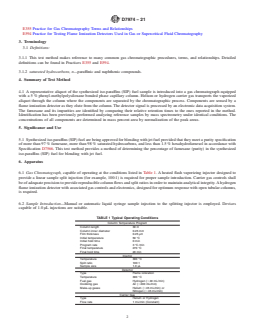
6.1 Gas Chromatograph, capable of operating at the conditions listed in Table 1. A heated flash vaporizing injector designed to
provide a linear sample split injection (for example, 100:1) is required for proper sample introduction. Carrier gas controls shall
be of adequate precision to provide reproducible column flows and split ratios in order to maintain analytical integrity. A hydrogen
flame ionization detector with associated gas controls and electronics, designed for optimum response with open tubular columns,
is required.
6.2 Sample Introduction—Manual or automatic liquid syringe sample injection to the splitting injector is employed. Devices
capable of 1.0 μL injections are suitable.
TABLE 1 Typical Operating Conditions
Column Temperature Program
Column length 30 m
Column inner diameter 0.25 mm
Film thickness 0.25 μm
Initial temperature 50 °C
Initial hold time 0 min
Program rate 3 °C ⁄min
Final temperature 270 °C
Final hold time 20 min
Injector
Temperature 300 °C
Split ratio 100:1
Sample size 1.0 μL
Detector
Type Flame ionization
Temperature 300 °C
Fuel gas Hydrogen ('40 mL/min)
Oxidizing gas Air ('400 mL/min)
Make-up gases Helium ('45 mL/min) or
Nitrogen ('45 mL/min)
Carrier Gas
Type Helium or Hydrogen
Flow rate 1 mL/min (Constant)
D7974 − 21
6.3 Column—This test method utilizes a fused silica open tubular column with non-polar 5 % phenyl-methylpolysiloxane bonded
(cross-linked) phase internal coating.
6.3.1 Open tubular column with a non-polar 5 % phenyl-methylpolysiloxane bonded (cross-linked) phase internal coating; a 30 m
long by 0.25 mm internal diameter column with a 0.25 μm film thickness has been found to be suitable.
6.4 Electronic Data Acquisition System—Any data acquisition and integration device used for quantification of these analyses shall
meet or exceed these minimum requirements:
6.4.1 Normalized percent calculation based on peak area,
6.4.2 Identification of individual components based on retention time,
6.4.3 Noise and spike rejection capability,
6.4.4 Sampling rate of 5 Hz.
7. Reagents and Materials
7.1 Carrier Gas, Helium or hydrogen, with a minimum purity of 99.9 % mol. Oxygen removal systems and gas purifiers should
be used. (Warning—Helium, compressed gas under high pressure.) (Warning—Hydrogen, extremely flammable gas under high
pressure.) The use of hydrogen sensors in the oven is strongly recommended that can shutoff the hydrogen source in case the
hydrogen leaks.
7.2 Detector Gases, Hydrogen, air, nitrogen, and helium. The minimum purity of the gases used should be 99.9 % mol for the
hydrogen, nitrogen, and helium. The air should be hydrocarbon-free grade with a minimum purity of 99.0 % mol. Gas purifiers
are recommended for the detector gases. (Warning—Hydrogen, extremely flammable gas under high pressure.) (Warning—Air
and helium, compressed gases under high pressure.)
7.3 Blank of Solvent, n-Hexane with a minimum purity of 99.0 %.
7.4 Validation Mixture for Apparatus Performance Checks:
7.4.1 Solvent, n-Octane with a minimum purity of 99.0 %.
7.4.2 Standards, n-decane, n-dodecane, n-tetradecane, n-hexadecane with a minimum purity of 99.0 %.
8. Sampling
8.1 See Practice D4057 for general sampling. Transfer an aliquot of synthesized iso-paraffins (SIP) fuel sample into a septum vial
and seal. Obtain the test sample for analysis directly from the sealed septum vial, for either manual or automatic syringe injection.
9. Preparation of Apparatus
9.1 Install and condition column in accordance with manufacturer’s or supplier’s instructions. After conditioning, attach column
outlet to flame ionization detector inlet and check for leaks throughout the system. When leaks are found, tighten or replace fittings
before proceeding.
9.1.1 When using hydrogen as carrier gas, column conditioning shall be performed after connecting the column to the detector.
9.2 Adjust the operating conditions of the gas chromatograph (Table 1) and allow the system to equilibrate.
9.3 Performance Checks—The apparatus shall be checked in regular intervals to make sure that it is in perfect working condition.
Performance checks are realized by analyzing a calibration mixture in the analytical conditions defined in Table 1.
D7974 − 21
9.3.1 Linearity Verification—Verify linearity by analyzing a series of diluted standards or equivalent spread across the farnesane
content range of the method in order to have at the minimums 15 degrees of freedom. Standard deviation of the residuals shall
be less than 0.5 % which corresponds to a 95 % confidence interval of 1 %. Annex A1 gives an example of how linearity may be
confirmed.
9.3.2 Calibration Mixture Preparation—Weigh the same amount of n-decane, n-dodecane, n-tetradecane, and n-hexadecane.
Dilute the mixture in n-octane in order to obtain a concentration of 2 % mass of each component. See Practice D4307.
9.3.3 Column Effıciency—Calculate the number of theoretical plates on n-tetradecane peak using Eq 1:
n 5 5.545~R t
...