

ASTM D3329-03(2023)
(Test Method)Standard Test Method for Purity of Methyl Isobutyl Ketone by Gas Chromatography
General Information
- Abstract
SIGNIFICANCE AND USE
4.1 This test method provides a measurement of commonly found impurities in commercially available methyl isobutyl ketone. The measurement of these impurities and the results thereof can individually or when totaled and subtracted from 100 (assay) be used for specification acceptance.
SCOPE
1.1 This test method covers the determination of the purity of methyl isobutyl ketone (MIBK) by gas chromatography and in addition provides a means for measuring certain impurities such as methyl isobutyl carbinol which are of interest. Impurities such as water and acidity are measured by other appropriate ASTM procedures and the results are used to normalize the chromatographic value.
1.2 The following applies to all specified limits in this standard; for purposes of determining conformance with this standard, an observed value or a calculated value shall be rounded off “to the nearest unit” in the last right-hand digit used in expressing the specification limit, in accordance with the round-off method of Practice E29.
1.3 The values stated in SI units are to be regarded as the standard. The values given in parentheses are for information only.
1.4 This standard does not purport to address all of the safety concerns, if any, associated with its use. It is the responsibility of the user of this standard to establish appropriate safety, health, and environmental practices and determine the applicability of regulatory limitations prior to use.
1.5 For specific hazard information and guidance, see the supplier’s Safety Data Sheet for the materials listed in this test method.
1.6 This international standard was developed in accordance with internationally recognized principles on standardization established in the Decision on Principles for the Development of International Standards, Guides and Recommendations issued by the World Trade Organization Technical Barriers to Trade (TBT) Committee.
- Status
- Published
- Publication Date
- 30-Jun-2023
- Technical Committee
- D01 - Paint and Related Coatings, Materials, and Applications
- Drafting Committee
- D01.35 - Solvents, Plasticizers, and Chemical Intermediates

Overview
ASTM D3329-03(2023), titled Standard Test Method for Purity of Methyl Isobutyl Ketone by Gas Chromatography, provides a robust procedure for determining the purity of methyl isobutyl ketone (MIBK) and detecting commonly found impurities using gas chromatography. Issued by ASTM International, this test method is widely recognized for its role in quality assurance and specification acceptance within the chemical and industrial sectors. It supports compliance with international principles for standardization and is accepted by agencies such as the U.S. Department of Defense.
Key Topics
- Purity Determination: The method specifies the procedure for quantifying methyl isobutyl ketone in commercial samples, allowing users to measure the presence and amount of impurities such as methyl isobutyl carbinol, acetone, and other volatiles.
- Gas Chromatography Principle: The test method involves introducing a sample into a gas chromatograph, where components are separated in a partition column and detected-commonly by a flame ionization or thermal conductivity detector.
- Correction and Calibration: Results are adjusted for water and acidity by referencing separate ASTM methods, ensuring accurate normalization of the final chromatographic value.
- Reporting & Precision: The standard includes guidance for rounding results, reporting to the nearest 0.01% for major constituents, and provides precision criteria for repeatability and reproducibility across laboratories.
- Safety & Compliance: Users are instructed to follow safety, health, and environmental protocols, and to reference suppliers' Safety Data Sheets for risk management and regulatory compliance.
Applications
The ASTM D3329-03(2023) standard is employed in several practical contexts, including:
- Quality Control for Solvent Production: Ensures the purity of commercially available MIBK meets required specifications for use in coatings, adhesives, and chemical intermediates.
- Specification Acceptance Testing: The assay can serve as a primary acceptance criterion for material shipments, with results used to approve or reject product lots.
- Pharmaceutical and Industrial Manufacturing: Guarantees solvent quality in formulations where impurity levels can impact product efficacy or process safety.
- Laboratory Analysis in Research and Development: Used for method validation, calibration of analytical equipment, and as a reference for related chromatographic techniques.
- Regulatory Compliance: Supports conformance with international trade requirements and environmental safety standards by providing standardized purity data for MIBK.
Related Standards
This test method works in conjunction with several other ASTM standards that support comprehensive analysis of solvent quality and safety:
- ASTM D1364 – Test Method for Water in Volatile Solvents (Karl Fischer Reagent Titration Method): Used to measure water content for normalization.
- ASTM D1613 – Test Method for Acidity in Volatile Solvents and Chemical Intermediates: Determines acidity levels for accurate purity assessment.
- ASTM E29 – Practice for Using Significant Digits in Test Data to Determine Conformance with Specifications: Provides guidance on data rounding and reporting.
- ASTM E260 – Practice for Packed Column Gas Chromatography: Reference for chromatographic practices.
- ASTM D2593 – Test Method for Butadiene Purity and Hydrocarbon Impurities by Gas Chromatography: Related method for similar compounds.
Summary
Adopting ASTM D3329-03(2023) ensures the integrity of methyl isobutyl ketone used in industrial and laboratory applications. By leveraging gas chromatography, this standard provides a reliable, internationally recognized approach to quantify purity and impurities in MIBK, facilitating quality assurance, regulatory compliance, and operational efficiency.
Keywords: ASTM D3329, MIBK purity, methyl isobutyl ketone, gas chromatography, solvent analysis, industrial standards, chemical impurity detection, ASTM solvent testing.
Relations
- Effective Date
- 01-Sep-2019
- Effective Date
- 01-Jun-2012
- Effective Date
- 01-Nov-2011
- Effective Date
- 01-Jul-2009
- Effective Date
- 01-Oct-2008
- Effective Date
- 01-Jun-2007
- Effective Date
- 15-Nov-2006
- Effective Date
- 15-Sep-2006
- Effective Date
- 01-May-2006
- Effective Date
- 01-Apr-2006
- Effective Date
- 01-Mar-2006
- Effective Date
- 01-Dec-2004
- Effective Date
- 01-Nov-2004
- Effective Date
- 01-Oct-2003
- Effective Date
- 10-Dec-2002
Get Certified
Connect with accredited certification bodies for this standard

ECOCERT
Organic and sustainability certification.

Eurofins Food Testing Global
Global leader in food, environment, and pharmaceutical product testing.

Intertek Bangladesh
Intertek certification and testing services in Bangladesh.
Sponsored listings
Frequently Asked Questions
ASTM D3329-03(2023) is a standard published by ASTM International. Its full title is "Standard Test Method for Purity of Methyl Isobutyl Ketone by Gas Chromatography". This standard covers: SIGNIFICANCE AND USE 4.1 This test method provides a measurement of commonly found impurities in commercially available methyl isobutyl ketone. The measurement of these impurities and the results thereof can individually or when totaled and subtracted from 100 (assay) be used for specification acceptance. SCOPE 1.1 This test method covers the determination of the purity of methyl isobutyl ketone (MIBK) by gas chromatography and in addition provides a means for measuring certain impurities such as methyl isobutyl carbinol which are of interest. Impurities such as water and acidity are measured by other appropriate ASTM procedures and the results are used to normalize the chromatographic value. 1.2 The following applies to all specified limits in this standard; for purposes of determining conformance with this standard, an observed value or a calculated value shall be rounded off “to the nearest unit” in the last right-hand digit used in expressing the specification limit, in accordance with the round-off method of Practice E29. 1.3 The values stated in SI units are to be regarded as the standard. The values given in parentheses are for information only. 1.4 This standard does not purport to address all of the safety concerns, if any, associated with its use. It is the responsibility of the user of this standard to establish appropriate safety, health, and environmental practices and determine the applicability of regulatory limitations prior to use. 1.5 For specific hazard information and guidance, see the supplier’s Safety Data Sheet for the materials listed in this test method. 1.6 This international standard was developed in accordance with internationally recognized principles on standardization established in the Decision on Principles for the Development of International Standards, Guides and Recommendations issued by the World Trade Organization Technical Barriers to Trade (TBT) Committee.
SIGNIFICANCE AND USE 4.1 This test method provides a measurement of commonly found impurities in commercially available methyl isobutyl ketone. The measurement of these impurities and the results thereof can individually or when totaled and subtracted from 100 (assay) be used for specification acceptance. SCOPE 1.1 This test method covers the determination of the purity of methyl isobutyl ketone (MIBK) by gas chromatography and in addition provides a means for measuring certain impurities such as methyl isobutyl carbinol which are of interest. Impurities such as water and acidity are measured by other appropriate ASTM procedures and the results are used to normalize the chromatographic value. 1.2 The following applies to all specified limits in this standard; for purposes of determining conformance with this standard, an observed value or a calculated value shall be rounded off “to the nearest unit” in the last right-hand digit used in expressing the specification limit, in accordance with the round-off method of Practice E29. 1.3 The values stated in SI units are to be regarded as the standard. The values given in parentheses are for information only. 1.4 This standard does not purport to address all of the safety concerns, if any, associated with its use. It is the responsibility of the user of this standard to establish appropriate safety, health, and environmental practices and determine the applicability of regulatory limitations prior to use. 1.5 For specific hazard information and guidance, see the supplier’s Safety Data Sheet for the materials listed in this test method. 1.6 This international standard was developed in accordance with internationally recognized principles on standardization established in the Decision on Principles for the Development of International Standards, Guides and Recommendations issued by the World Trade Organization Technical Barriers to Trade (TBT) Committee.
ASTM D3329-03(2023) is classified under the following ICS (International Classification for Standards) categories: 71.080.80 - Aldehydes and ketones. The ICS classification helps identify the subject area and facilitates finding related standards.
ASTM D3329-03(2023) has the following relationships with other standards: It is inter standard links to ASTM E260-96(2019), ASTM D1613-06(2012), ASTM E260-96(2011), ASTM D2593-93(2009), ASTM E29-08, ASTM D1364-02(2007), ASTM E29-06b, ASTM E29-06a, ASTM E29-06, ASTM D1613-06, ASTM E260-96(2006), ASTM E29-04, ASTM D2593-93(2004)e1, ASTM D1613-03, ASTM D1364-02. Understanding these relationships helps ensure you are using the most current and applicable version of the standard.
ASTM D3329-03(2023) is available in PDF format for immediate download after purchase. The document can be added to your cart and obtained through the secure checkout process. Digital delivery ensures instant access to the complete standard document.
Standards Content (Sample)
This international standard was developed in accordance with internationally recognized principles on standardization established in the Decision on Principles for the
Development of International Standards, Guides and Recommendations issued by the World Trade Organization Technical Barriers to Trade (TBT) Committee.
Designation: D3329 − 03 (Reapproved 2023)
Standard Test Method for
1,2
Purity of Methyl Isobutyl Ketone by Gas Chromatography
This standard is issued under the fixed designation D3329; the number immediately following the designation indicates the year of
original adoption or, in the case of revision, the year of last revision. A number in parentheses indicates the year of last reapproval. A
superscript epsilon (´) indicates an editorial change since the last revision or reapproval.
This standard has been approved for use by agencies of the U.S. Department of Defense.
1. Scope 2. Referenced Documents
1.1 This test method covers the determination of the purity 2.1 ASTM Standards:
of methyl isobutyl ketone (MIBK) by gas chromatography and D1364 Test Method for Water in Volatile Solvents (Karl
in addition provides a means for measuring certain impurities Fischer Reagent Titration Method)
such as methyl isobutyl carbinol which are of interest. Impu- D1613 Test Method for Acidity in Volatile Solvents and
rities such as water and acidity are measured by other appro- Chemical Intermediates Used in Paint, Varnish, Lacquer,
priate ASTM procedures and the results are used to normalize and Related Products
the chromatographic value. D2593 Test Method for Butadiene Purity and Hydrocarbon
Impurities by Gas Chromatography
1.2 The following applies to all specified limits in this
E29 Practice for Using Significant Digits in Test Data to
standard; for purposes of determining conformance with this
Determine Conformance with Specifications
standard, an observed value or a calculated value shall be
E180 Practice for Determining the Precision of ASTM
rounded off “to the nearest unit” in the last right-hand digit
Methods for Analysis and Testing of Industrial and Spe-
used in expressing the specification limit, in accordance with
cialty Chemicals (Withdrawn 2009)
the round-off method of Practice E29.
E260 Practice for Packed Column Gas Chromatography
1.3 The values stated in SI units are to be regarded as the
standard. The values given in parentheses are for information
3. Summary of Test Method
only.
3.1 A representative specimen is introduced onto a gas-
1.4 This standard does not purport to address all of the
liquid partition column. Methyl isobutyl ketone is separated
safety concerns, if any, associated with its use. It is the
from impurities such as acetone, 2-propanol, pentanone, mesi-
responsibility of the user of this standard to establish appro-
tyl oxide, methyl isobutyl carbinol, and several unidentified
priate safety, health, and environmental practices and deter-
compounds as the components are transported through the
mine the applicability of regulatory limitations prior to use.
column by an inert carrier gas. The separated components are
1.5 For specific hazard information and guidance, see the
measured in the effluent by a detector and recorded as a
supplier’s Safety Data Sheet for the materials listed in this test
chromatogram. The chromatogram is interpreted by applying
method.
component attenuation and detector response factors to the
1.6 This international standard was developed in accor-
peak areas, and the relative concentrations are determined by
dance with internationally recognized principles on standard-
relating the individual peak responses to the total peak re-
ization established in the Decision on Principles for the
sponse. Water and acidity are measured in accordance with Test
Development of International Standards, Guides and Recom-
Methods D1364 and D1613 and the results are used to
mendations issued by the World Trade Organization Technical
normalize the values obtained by gas chromatography.
Barriers to Trade (TBT) Committee.
4. Significance and Use
4.1 This test method provides a measurement of commonly
This test method is under the jurisdiction of ASTM Committee D01 on Paint
found impurities in commercially available methyl isobutyl
and Related Coatings, Materials, and Applications and is the direct responsibility of
ketone. The measurement of these impurities and the results
Subcommittee D01.35 on Solvents, Plasticizers, and Chemical Intermediates.
thereof can individually or when totaled and subtracted from
Current edition approved July 1, 2023. Published August 2023. Originally
100 (assay) be used for specification acceptance.
approved in 1974. Last previous edition approved in 2017 as D3329 – 03 (2017).
DOI: 10.1520/D3329-03R23.
For referenced ASTM standards, visit the ASTM website, www.astm.org, or
contact ASTM Customer Service at service@astm.org. For Annual Book of ASTM
Standards volume information, refer to the standard’s Document Summary page on The last approved version of this historical standard is referenced on
the ASTM website. www.astm.org.
Copyright © ASTM International, 100 Barr Harbor Drive, PO Box C700, West Conshohocken, PA 19428-2959. United States
D3329 − 03 (2023)
5. Apparatus carrier gas used should be 99.95 mol %. (Warning—If hydro-
gen is used, take special safety precautions to ensure that the
5.1 Chromatograph—Any gas liquid chromatographic in-
system is free from leaks and that the effluent is vented
strument having either a thermal conductivity or flame ioniza-
properly.)
tion detector provided the system has sufficient sensitivity and
stability to obtain for 0.01 % of impurity a recorder deflection
6.2 Column Materials:
of at least 2 mm at a signal-to-noise ratio of at least 5 to 1. The
6.2.1 Liquid Phase—The materials successfully used in
specimen size used in judging the sensitivity must be such that
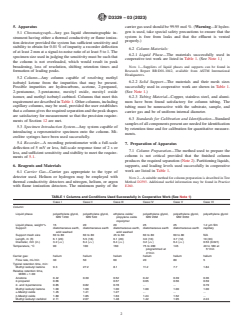
cooperative test work are listed in Table 1. (See Note 1.)
the column is not overloaded, which would result in peak
broadening, loss of resolution, shifting retention times and
NOTE 1—Suppliers of liquid phases and supports can be found in
Research Report RR:D01-1042, available from ASTM International
formation of leading peaks.
Headquarters.
5.2 Column—Any column capable of resolving methyl
6.2.2 Solid Support—The materials and their mesh sizes
isobutyl ketone from the impurities that may be present.
successfully used in cooperative work are shown in Table 1.
Possible impurities are hydrocarbons, acetone, 2-propanol,
2-pentanone, 3-pentanone, mesityl oxide, mesityl oxide (See Note 1.)
isomer, and methyl isobutyl carbinol. Columns that meet this
6.2.3 Tubing Material—Copper, stainless steel, and alumi-
requirement are described in Table 1. Other columns, including
num have been found satisfactory for column tubing. The
capillary columns, may be used, provided the user establishes
tubing must be nonreactive with the substrate, sample, and
that a column gives the required separation and the peak shapes
carrier gas and be of uniform internal diameter.
are satisfactory for measurement so that the precision require-
6.3 Standards for Calibration and Identification—Standard
ments of Section 12 are met.
samples of all components present are needed for identification
5.3 Specimen Introduction System—Any system capable of
by retention time and for calibration for quantitative measure-
introducing a representative specimen onto the column. Mi-
ments.
crolitre syringes have been used successfully.
5.4 Recorder—A recording potentiometer with a full-scale
7. Preparation of Apparatus
deflection of 5 mV or less, full-scale response time of 2 s or
7.1 Column Preparation—The method used to prepare the
less, and sufficient sensitivity and stability to meet the require-
column is not critical provided that the finished column
ments of 5.1.
produces the required separation (Note 2). Partitioning liquids,
6. Reagents and Materials supports, and loading levels used successfully in cooperative
work are listed in Table 1.
6.1 Carrier Gas—Carrier gas appropriate to the type of
detector used. Helium or hydrogen may be employed with
NOTE 2—A suitable method for column preparation is described in Test
thermal conductivity detectors and nitrogen, helium, or argon
Method D2593. Additional useful information may be found in Practice
with flame ionization detectors. The minimum purity of the E260.
TABLE 1 Columns and Conditions Used Successfully in Cooperative Work (See Note 1)
Case I Case II Case III Case IV Case V Case VI
Column:
Liquid phase polyethylene glycol, polyethylene glycol, ethylene oxide/ polyethylene glycol, polyethy
...