

ASTM D2257-20
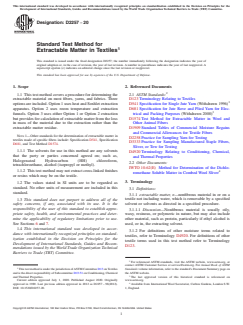
(Test Method)Standard Test Method for Extractable Matter in Textiles
General Information
- Abstract
SIGNIFICANCE AND USE
5.1 This test method may be used for acceptance testing of commercial shipments.
5.1.1 In case of a dispute arising from differences in reported test results using this test method for acceptance testing of commercial shipments, the purchaser and the supplier should conduct comparative tests to determine if there is a statistical bias between the laboratories. Competent statistical assistance is recommended for the investigation of bias. As a minimum, the two parties should take a group of test specimens which are as homogeneous as possible and which are from a lot of material of the type in question. The test specimens should then be randomly assigned in equal numbers to each laboratory for testing. The average results from the two laboratories should be compared using appropriate statistical analysis and a probability level chosen by the two parties before the testing begins. If a bias is found, either its cause must be found and corrected, or the purchaser and supplier must agree to interpret future test results with consideration to the known bias.
5.2 This test method is used for the determination of the amounts of naturally present oily or waxy impurities that have not been completely removed from textiles made from animal fibers, and for the determination of the amounts of oily or waxy finishing materials applied to raw materials or textiles during manufacture. See 3.1.1, extractable matter.
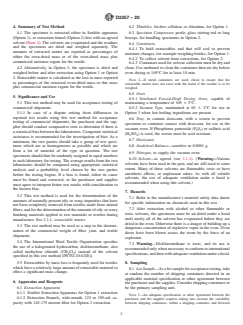
5.3 The test method may be used as a step in the determination of the commercial weight of fiber, yarn, and textile shipments.
5.4 The International Wool Textile Organization specifies the use of a halogenated hydrocarbon, dichloromethane, also called methylene chloride (CH2Cl2) instead of the solvent specified in this test method (IWTO-10-62(E)).
5.5 Extractables by mass loss is frequently used for textiles which have a relatively large amount of extractable material to effect a significant mass change.
SCOPE
1.1 This test method covers a procedure for determining the extractable material on most fibers, yarns, and fabrics. Three options are included. Option 1 uses heat and Soxhlet extraction apparatus. Option 2 uses room temperature and extraction funnels. Option 3 uses either Option 1 or Option 2 extraction but provides for calculation of extractable matter from the loss in mass of the material due to the extraction rather than the extractable matter residue.
Note 1: Other standards for the determination of extractable matter in textiles made of specific fibers include: Specification D541, Specification D681, and Test Method D1574.
1.1.1 The solvents for use in this method are any solvents that the party or parties concerned agreed on; such as, Halogenated Hydrocarbon (HH) chloroform, tetrachloroethane, alcohol (isopropyl or methyl).
1.1.2 This test method may not extract cross-linked finishes or resins which may be on the textile.
1.2 The values stated in SI units are to be regarded as standard. No other units of measurement are included in this standard.
1.3 This standard does not purport to address all of the safety concerns, if any, associated with its use. It is the responsibility of the user of this standard to establish appropriate safety, health, and environmental practices and determine the applicability of regulatory limitations prior to use. See Sections 6 and 7.
1.4 This international standard was developed in accordance with internationally recognized principles on standardization established in the Decision on Principles for the Development of International Standards, Guides and Recommendations issued by the World Trade Organization Technical Barriers to Trade (TBT) Committee.
- Status
- Published
- Publication Date
- 30-Jun-2020
- Technical Committee
- D13 - Textiles
- Drafting Committee
- D13.51 - Conditioning, Chemical and Thermal Properties
Overview
ASTM D2257-20: Standard Test Method for Extractable Matter in Textiles provides a comprehensive process for determining the amount of extractable matter-such as oils, waxes, and other non-fibrous substances-in textile fibers, yarns, and fabrics. Developed by ASTM, this standard is recognized for ensuring product consistency across the textile industry and is widely used in quality control, commercial shipment acceptance, and regulatory compliance.
The test method covers three extraction options and allows flexibility in solvent usage, making it applicable to a range of fiber types, including animal and synthetic fibers. The results inform both manufacturers and purchasers about potential residual impurities and added finishing agents that may affect textile properties or commercial value.
Key Topics
- Extractable Matter Defined: Non-fibrous materials-including natural or applied oils, waxes, and resins-removable by specific solvents as outlined in a standardized procedure.
- Test Method Options:
- Option 1: Soxhlet extraction with heat.
- Option 2: Extraction funnels at room temperature.
- Option 3: Determination by mass loss during extraction.
- Result Calculation: Extractable content is reported either as a percentage of oven-dried mass or as adjusted for the commercial moisture regain appropriate to the fiber type.
- Sampling and Reporting: Guidance is given for sampling across lots, lab techniques, and documentation to ensure statistical reliability and reproducibility.
- Solvent Selection: Parties can agree on suitable solvents, such as chloroform, tetrachloroethane, and various alcohols. Dichloromethane is referenced per international (IWTO) practices for wool textiles.
- Precision & Bias: The standard describes requirements to control and analyze variability, especially in cases of commercial dispute.
- Safety Considerations: Users must assess chemical and operational hazards associated with volatile and flammable solvents, complying with health, safety, and environmental regulations.
Applications
ASTM D2257-20 is widely implemented across many areas of the textile industry:
- Commercial Lot Acceptance: Assures suppliers and purchasers that shipped textile batches meet agreed extractable matter content requirements, reducing risk and supporting contract compliance.
- Quality Control: Detects residual impurities or excessive finishing agents that could affect textile quality, dyeability, or performance.
- Fiber Weight Determination: Used as a step in calculating the net commercial weight of fibers, yarns, or fabrics, helping determine accurate invoicing and processing yields.
- Comparative Laboratory Analysis: In the case of disputes, the method provides a basis for comparative testing and statistical analysis between different laboratories.
- Regulatory Compliance & Certification: Supports adherence to national and international textile standards, especially where product purity or processing consistency is mandated.
- Research & Development: Facilitates evaluation of new fiber treatments and finishing processes to ensure minimal unwanted residue remains on the final product.
Related Standards
Adherence to ASTM D2257-20 can be enhanced by referencing related standards, ensuring a holistic approach to textile testing and quality:
- ASTM D1574: Test Method for Extractable Matter in Wool and Other Animal Fibers
- Specification D541: Specification for Single Jute Yarn (Withdrawn)
- Specification D681: Specification for Jute Rove and Plied Yarn (Withdrawn)
- ASTM D2258: Practice for Sampling Yarn for Testing
- ASTM D3333: Practice for Sampling Manufactured Staple Fibers, Sliver, or Tow for Testing
- ASTM D1909: Standard Tables of Commercial Moisture Regains for Textile Fibers
- IWTO-10-62(E): International Wool Textile Organization method for dichloromethane soluble matter in wool
Keywords: extractable matter, textile test method, ASTMD2257, textile quality control, fabric purity, solvent extraction textile, Soxhlet extraction textiles, finishing agents, textile shipment acceptance, textile standards.
Relations
- Effective Date
- 01-Jul-2018
- Effective Date
- 01-Mar-2017
- Effective Date
- 15-Sep-2015
- Effective Date
- 01-Sep-2015
- Effective Date
- 01-Apr-2015
- Effective Date
- 15-Jun-2013
- Effective Date
- 15-Jun-2013
- Effective Date
- 15-May-2013
- Effective Date
- 01-Jul-2012
- Effective Date
- 01-Mar-2012
- Effective Date
- 01-Feb-2012
- Effective Date
- 01-Feb-2012
- Effective Date
- 15-Jan-2009
- Effective Date
- 15-Jan-2009
- Effective Date
- 15-Jan-2009
Get Certified
Connect with accredited certification bodies for this standard

Control Union Certifications
Global certification for agriculture and sustainability.

Hohenstein Institut
Textile testing and certification.

Bureau Veritas Bangladesh
Bureau Veritas certification services in Bangladesh.
Sponsored listings
Frequently Asked Questions
ASTM D2257-20 is a standard published by ASTM International. Its full title is "Standard Test Method for Extractable Matter in Textiles". This standard covers: SIGNIFICANCE AND USE 5.1 This test method may be used for acceptance testing of commercial shipments. 5.1.1 In case of a dispute arising from differences in reported test results using this test method for acceptance testing of commercial shipments, the purchaser and the supplier should conduct comparative tests to determine if there is a statistical bias between the laboratories. Competent statistical assistance is recommended for the investigation of bias. As a minimum, the two parties should take a group of test specimens which are as homogeneous as possible and which are from a lot of material of the type in question. The test specimens should then be randomly assigned in equal numbers to each laboratory for testing. The average results from the two laboratories should be compared using appropriate statistical analysis and a probability level chosen by the two parties before the testing begins. If a bias is found, either its cause must be found and corrected, or the purchaser and supplier must agree to interpret future test results with consideration to the known bias. 5.2 This test method is used for the determination of the amounts of naturally present oily or waxy impurities that have not been completely removed from textiles made from animal fibers, and for the determination of the amounts of oily or waxy finishing materials applied to raw materials or textiles during manufacture. See 3.1.1, extractable matter. 5.3 The test method may be used as a step in the determination of the commercial weight of fiber, yarn, and textile shipments. 5.4 The International Wool Textile Organization specifies the use of a halogenated hydrocarbon, dichloromethane, also called methylene chloride (CH2Cl2) instead of the solvent specified in this test method (IWTO-10-62(E)). 5.5 Extractables by mass loss is frequently used for textiles which have a relatively large amount of extractable material to effect a significant mass change. SCOPE 1.1 This test method covers a procedure for determining the extractable material on most fibers, yarns, and fabrics. Three options are included. Option 1 uses heat and Soxhlet extraction apparatus. Option 2 uses room temperature and extraction funnels. Option 3 uses either Option 1 or Option 2 extraction but provides for calculation of extractable matter from the loss in mass of the material due to the extraction rather than the extractable matter residue. Note 1: Other standards for the determination of extractable matter in textiles made of specific fibers include: Specification D541, Specification D681, and Test Method D1574. 1.1.1 The solvents for use in this method are any solvents that the party or parties concerned agreed on; such as, Halogenated Hydrocarbon (HH) chloroform, tetrachloroethane, alcohol (isopropyl or methyl). 1.1.2 This test method may not extract cross-linked finishes or resins which may be on the textile. 1.2 The values stated in SI units are to be regarded as standard. No other units of measurement are included in this standard. 1.3 This standard does not purport to address all of the safety concerns, if any, associated with its use. It is the responsibility of the user of this standard to establish appropriate safety, health, and environmental practices and determine the applicability of regulatory limitations prior to use. See Sections 6 and 7. 1.4 This international standard was developed in accordance with internationally recognized principles on standardization established in the Decision on Principles for the Development of International Standards, Guides and Recommendations issued by the World Trade Organization Technical Barriers to Trade (TBT) Committee.
SIGNIFICANCE AND USE 5.1 This test method may be used for acceptance testing of commercial shipments. 5.1.1 In case of a dispute arising from differences in reported test results using this test method for acceptance testing of commercial shipments, the purchaser and the supplier should conduct comparative tests to determine if there is a statistical bias between the laboratories. Competent statistical assistance is recommended for the investigation of bias. As a minimum, the two parties should take a group of test specimens which are as homogeneous as possible and which are from a lot of material of the type in question. The test specimens should then be randomly assigned in equal numbers to each laboratory for testing. The average results from the two laboratories should be compared using appropriate statistical analysis and a probability level chosen by the two parties before the testing begins. If a bias is found, either its cause must be found and corrected, or the purchaser and supplier must agree to interpret future test results with consideration to the known bias. 5.2 This test method is used for the determination of the amounts of naturally present oily or waxy impurities that have not been completely removed from textiles made from animal fibers, and for the determination of the amounts of oily or waxy finishing materials applied to raw materials or textiles during manufacture. See 3.1.1, extractable matter. 5.3 The test method may be used as a step in the determination of the commercial weight of fiber, yarn, and textile shipments. 5.4 The International Wool Textile Organization specifies the use of a halogenated hydrocarbon, dichloromethane, also called methylene chloride (CH2Cl2) instead of the solvent specified in this test method (IWTO-10-62(E)). 5.5 Extractables by mass loss is frequently used for textiles which have a relatively large amount of extractable material to effect a significant mass change. SCOPE 1.1 This test method covers a procedure for determining the extractable material on most fibers, yarns, and fabrics. Three options are included. Option 1 uses heat and Soxhlet extraction apparatus. Option 2 uses room temperature and extraction funnels. Option 3 uses either Option 1 or Option 2 extraction but provides for calculation of extractable matter from the loss in mass of the material due to the extraction rather than the extractable matter residue. Note 1: Other standards for the determination of extractable matter in textiles made of specific fibers include: Specification D541, Specification D681, and Test Method D1574. 1.1.1 The solvents for use in this method are any solvents that the party or parties concerned agreed on; such as, Halogenated Hydrocarbon (HH) chloroform, tetrachloroethane, alcohol (isopropyl or methyl). 1.1.2 This test method may not extract cross-linked finishes or resins which may be on the textile. 1.2 The values stated in SI units are to be regarded as standard. No other units of measurement are included in this standard. 1.3 This standard does not purport to address all of the safety concerns, if any, associated with its use. It is the responsibility of the user of this standard to establish appropriate safety, health, and environmental practices and determine the applicability of regulatory limitations prior to use. See Sections 6 and 7. 1.4 This international standard was developed in accordance with internationally recognized principles on standardization established in the Decision on Principles for the Development of International Standards, Guides and Recommendations issued by the World Trade Organization Technical Barriers to Trade (TBT) Committee.
ASTM D2257-20 is classified under the following ICS (International Classification for Standards) categories: 59.080.20 - Yarns. The ICS classification helps identify the subject area and facilitates finding related standards.
ASTM D2257-20 has the following relationships with other standards: It is inter standard links to ASTM D3333-07(2018), ASTM D123-17, ASTM D123-15b, ASTM D123-15a, ASTM D123-15, ASTM D123-13ae1, ASTM D123-13a, ASTM D123-13, ASTM D3333-07(2012), ASTM D2258-99(2012), ASTM D123-12e1, ASTM D123-12, ASTM D123-09, ASTM D123-09e2, ASTM D123-09e1. Understanding these relationships helps ensure you are using the most current and applicable version of the standard.
ASTM D2257-20 is available in PDF format for immediate download after purchase. The document can be added to your cart and obtained through the secure checkout process. Digital delivery ensures instant access to the complete standard document.
Standards Content (Sample)
This international standard was developed in accordance with internationally recognized principles on standardization established in the Decision on Principles for the
Development of International Standards, Guides and Recommendations issued by the World Trade Organization Technical Barriers to Trade (TBT) Committee.
Designation: D2257 − 20
Standard Test Method for
Extractable Matter in Textiles
This standard is issued under the fixed designation D2257; the number immediately following the designation indicates the year of
original adoption or, in the case of revision, the year of last revision. A number in parentheses indicates the year of last reapproval. A
superscript epsilon (´) indicates an editorial change since the last revision or reapproval.
This standard has been approved for use by agencies of the U.S. Department of Defense.
1. Scope 2. Referenced Documents
1.1 This test method covers a procedure for determining the 2.1 ASTM Standards:
extractable material on most fibers, yarns, and fabrics. Three D123 Terminology Relating to Textiles
options are included. Option 1 uses heat and Soxhlet extraction D541 Specification for Single Jute Yarn (Withdrawn 1996)
apparatus. Option 2 uses room temperature and extraction D681 Specification for Jute Rove and Plied Yarn for Elec-
funnels. Option 3 uses either Option 1 or Option 2 extraction trical and Packing Purposes (Withdrawn 2000)
but provides for calculation of extractable matter from the loss D1574 Test Method for Extractable Matter in Wool and
in mass of the material due to the extraction rather than the Other Animal Fibers
D1909 Standard Tables of Commercial Moisture Regains
extractable matter residue.
and Commercial Allowances for Textile Fibers
NOTE 1—Other standards for the determination of extractable matter in
D2258 Practice for Sampling Yarn for Testing
textiles made of specific fibers include: Specification D541, Specification
D3333 Practice for Sampling Manufactured Staple Fibers,
D681, and Test Method D1574.
Sliver, or Tow for Testing
1.1.1 The solvents for use in this method are any solvents
D4920 Terminology Relating to Conditioning, Chemical,
that the party or parties concerned agreed on; such as,
and Thermal Properties
Halogenated Hydrocarbon (HH) chloroform,
2.2 Other Documents:
tetrachloroethane, alcohol (isopropyl or methyl).
IWTO 10-62(E) Method for Determination of the Dichlo-
1.1.2 This test method may not extract cross-linked finishes 4
romethane Soluble Matter in Combed Wool Sliver
or resins which may be on the textile.
3. Terminology
1.2 The values stated in SI units are to be regarded as
standard. No other units of measurement are included in this
3.1 Definitions:
standard.
3.1.1 extractable matter, n—nonfibrous material in or on a
textile not including water, which is removable by a specified
1.3 This standard does not purport to address all of the
solvent or solvents as directed in a specified procedure.
safety concerns, if any, associated with its use. It is the
responsibility of the user of this standard to establish appro-
3.1.1.1 Discussion—Nonfibrous material is usually oily,
priate safety, health, and environmental practices and deter-
waxy, resinous, or polymeric in nature, but may also include
mine the applicability of regulatory limitations prior to use.
other material, such as protein, particularly if ethyl alcohol is
See Sections 6 and 7.
used, or in, the extracting solvent.
1.4 This international standard was developed in accor-
3.1.2 For definitions of other moisture terms related to
dance with internationally recognized principles on standard-
textiles, refer to Terminology D4920. For definitions of other
ization established in the Decision on Principles for the
textile terms used in this test method refer to Terminology
Development of International Standards, Guides and Recom-
D123.
mendations issued by the World Trade Organization Technical
Barriers to Trade (TBT) Committee.
For referenced ASTM standards, visit the ASTM website, www.astm.org, or
contact ASTM Customer Service at service@astm.org. For Annual Book of ASTM
This test method is under the jurisdiction ofASTM Committee D13 on Textiles Standards volume information, refer to the standard’s Document Summary page on
and is the direct responsibility of Subcommittee D13.51 on Conditioning, Chemical the ASTM website.
and Thermal Properties. The last approved version of this historical standard is referenced on
Current edition approved July 1, 2020. Published August 2020. Originally www.astm.org.
approved in 1989. Last previous edition approved in 2012 as D2257 – 98(2012). Available from International Wool Secretariat, Carlton Gardens, London S.W.
DOI: 10.1520/D2257-20. 1, England.
Copyright © ASTM International, 100 Barr Harbor Drive, PO Box C700, West Conshohocken, PA 19428-2959. United States
D2257 − 20
4. Summary of Test Method 6.2 Thimbles, fat-free cellulose or Alundum, for Option 1.
4.1 The specimen is extracted either in Soxhlet apparatus 6.3 Specimen Compressor, pestle, glass stirring rod or long
(Option 1), or extraction funnel (Option 2) first with an agreed forceps, for handling specimens in Option 2.
solvent (Note 2). The solvents are evaporated and the residues
6.4 Containers,
and the specimens are dried and weighed separately. The
6.4.1 To hold extractables and that will seal to prevent
amounts of extracted matter are reported as percentages of
moisture changes, for example weighing bottles, for Option 1.
either the oven-dried mass or of the oven-dried mass plus
6.4.2 To collect solvent from extractions, for Option 2.
commercial moisture regain for the textile.
6.4.3 Containers used for solvent collection must be dry and
4.2 Alternatively, in Option 3, the specimen is dried and clean. Use methanol to clean the containers then air-dry before
weighed before and after extraction using Option 1 or Option oven drying at 105°C for at least 10 min.
2. Extractable matter is calculated as the loss in mass reported
NOTE 2—If metal containers are used, check to ensure that the
as percentages of the extracted oven-dried mass or this mass
extractable matter does not react with the metal if the residue is to be
plus commercial moisture regain for the textile.
weighed.
6.5 Oven
5. Significance and Use
6.5.1 Ventilated Forced-Draft Drying Oven, capable of
maintaining a temperature of 105 6 3°C.
5.1 This test method may be used for acceptance testing of
commercial shipments. 6.5.2 Vacuum Type, maintained at 65 6 2°C for use in
Option 3 when low-boiling ingredients are present.
5.1.1 In case of a dispute arising from differences in
reported test results using this test method for acceptance
6.6 Tray, to contain desiccant, with a screen to prevent
testing of commercial shipments, the purchaser and the sup-
specimen or container contact with desiccant, for use in the
plier should conduct comparative tests to determine if there is
vacuum oven. If Phosphorus pentoxide (P 0 ) or sulfuric acid
2 5
a statistical bias between the laboratories. Competent statistical
(H SO ) is used, the screen must be acid resistant.
2 4
assistance is recommended for the investigation of bias. As a
6.7 Dessicator
minimum, the two parties should take a group of test speci-
mens which are as homogeneous as possible and which are 6.8 Analytical Balance—sensitive to 0.0001 g.
from a lot of material of the type in question. The test
6.9 Nitrogen, to supply the vacuum oven.
specimens should then be randomly assigned in equal numbers
6.10 Solvent—as agreed (see 1.1.1). (Warning—Various
to each laboratory for testing.The average results from the two
solvents have been used in the past, and are still used to some
laboratories should be compared using appropriate statistical
extent. Many of these solvents are flammable, toxic or have
analysis and a probability level chosen by the two parties
anesthetic effects, or unpleasant odors. As with all volatile
before the testing begins. If a bias is found, either its cause
solvents, the use of adequate ventilation under a hood is
must be found and corrected, or the purchaser and supplier
recommended when using this solvent.)
must agree to interpret future test results with consideration to
the known bias.
7. Hazards
5.2 This test method is used for the determination of the
7.1 Refer to the manufacturer’s material safety data sheets
amounts of naturally present oily or waxy impurities that have
for specific information on chemicals used in this test.
not been completely removed from textiles made from animal
7.2 After extraction with alcohol or other flammable or
fibers,andforthedeterminationoftheamountsofoilyorwaxy
toxic solvents, the specimens must be air-dried under a hood
finishing materials applied to raw materials or textiles during
until nearly all of the solvent has evaporated before they are
manufacture. See 3.1.1, extractable matter.
dried in the oven. Otherwise there is a danger of building up a
5.3 The test method may be used as a step in the determi-
dangerous concentration of explosive vapor in the oven. Oven
nation of the commercial weight of fiber, yarn, and textile
doors have been blown across the room by the force of an
shipments.
explosion.
5.4 The International Wool Textile Organization specifies
7.3 Warning—Dichloromethane is toxic, and its use is
the use of a halogenated hydrocarbon, dichloromethane, also
recommended only when necessary to conform to international
called methylene chloride (CH Cl ) instead of the solvent
2 2
specifications,andthenwithadequateventilationunderahood.
specified in this test method (IWTO-10-62(E)).
8. Sampling
5.5 Extractables by mass loss is frequently used for textiles
which have a relatively large amount of extractable material to
8.1 LotSample—Asalotsampleforacceptancetesting,take
effect a significant mass change.
at random the number of shipping containers directed in an
applicable material specification or other agreement between
6. Apparatus and Reagents
the purchaser and the supplier. Consider shipping containers to
be the primary sampling unit.
6.1 Extraction Apparatus
6.1.1 Soxhlet Extraction Apparatus for Option 1 extraction
NOTE 3—An adequate specification or other agreement between the
6.1.2 Extraction Funnels, wide-mouth, 125 or 150-mL ca-
purchaser and the supplier requires taking into account the variability
pacity with 145-175 micron filter for Option 2 extraction. between shipping containers, within a shipping container, and between
D2257 − 20
specimens taken from a single unit within a shipping container, so as to
contain low boiling ingredients and the extracted residue is
provide a sampling plan with a meaningful producer’s risk, consumer’s
dried in the oven before final weighing.
risk, acceptable quality level, and limiting quality level.
10.2 Option 1, Soxlet Extraction,
8.2 Laboratory Sample—As a laboratory sample for accep-
10.2.1 Extract fat-free cellulose or Alundum thimbles for
tance testing, proceed as follows:
each specimen in the solvents to be used, in the Soxhlet
8.2.1 Yarn on Packages—Take at random from each ship-
chamber.Asuitablyfoldedqualitativegradefilterpapermaybe
ping container in the lot sample the number of packages
usedinplaceofthethimble.Thimblesarenotneededforfabric
directed in an applicable material specification or other agree-
yarn or thread specimens.
ment between the purchaser and the supplier, such as an
10.2.2 Weigh 10 6 1 g of each specimen to the nearest
agreement to use Practice D2258. Preferably, the same number
0.010 g.
of packages should be taken from each shipping case in the lot
10.2.3 Place the specimens in the thimbles, if used, and
sample. If differing numbers of packages are to be taken from
transfer to the Soxhlet apparatus. Thimbles must be long
shipping cases in the lot sample, determine at random which
enough to cover the opening of the siphon tube.
shipping cases are to have each number of packages drawn.
10.2.4 Add sufficient solvent to overflow plus about 25 %
8.2.2 Yarn on Beams—Take a l
...
This document is not an ASTM standard and is intended only to provide the user of an ASTM standard an indication of what changes have been made to the previous version. Because
it may not be technically possible to adequately depict all changes accurately, ASTM recommends that users consult prior editions as appropriate. In all cases only the current version
of the standard as published by ASTM is to be considered the official document.
Designation: D2257 − 98 (Reapproved 2012) D2257 − 20
Standard Test Method for
Extractable Matter in Textiles
This standard is issued under the fixed designation D2257; the number immediately following the designation indicates the year of
original adoption or, in the case of revision, the year of last revision. A number in parentheses indicates the year of last reapproval. A
superscript epsilon (´) indicates an editorial change since the last revision or reapproval.
This standard has been approved for use by agencies of the U.S. Department of Defense.
1. Scope
1.1 This test method covers a procedure for determining the extractable material on most fibers, yarns, and fabrics. Three
options are included. Option 1 uses heat and Soxhlet extraction apparatus. Option 2 uses room temperature and extraction funnels.
Option 3 uses either Option 1 or Option 2 extraction but provides for calculation of extractable matter from the loss in mass of
the material due to the extraction rather than the extractable matter residue.
NOTE 1—Other standards for the determination of extractable matter in textiles made of specific fibers include: Specification D541, Specification D681,
and Test Method D1574.
1.1.1 The solvents for use in this method are any solvents that the party or parties concerned agreed on; such as, Halogenated
Hydrocarbon (HH) chloroform, tetrachloroethane, alcohol.alcohol (isopropyl or methyl).
1.1.2 This test method may not extract cross-linked finishes or resins which may be on the textile.
1.2 The values stated in SI units are to be regarded as standard. No other units of measurement are included in this standard.
1.3 This standard does not purport to address all of the safety concerns, if any, associated with its use. It is the responsibility
of the user of this standard to establish appropriate safety safety, health, and healthenvironmental practices and determine the
applicability of regulatory limitations prior to use. See Sections 6 and 7.
1.4 This international standard was developed in accordance with internationally recognized principles on standardization
established in the Decision on Principles for the Development of International Standards, Guides and Recommendations issued
by the World Trade Organization Technical Barriers to Trade (TBT) Committee.
2. Referenced Documents
2.1 ASTM Standards:
D123 Terminology Relating to Textiles
D541 Specification for Single Jute Yarn (Withdrawn 1996)
D681 Specification for Jute Rove and Plied Yarn for Electrical and Packing Purposes (Withdrawn 2000)
D1574 Test Method for Extractable Matter in Wool and Other Animal Fibers
D1909 Standard Tables of Commercial Moisture Regains and Commercial Allowances for Textile Fibers
D2258 Practice for Sampling Yarn for Testing
D3333 Practice for Sampling Manufactured Staple Fibers, Sliver, or Tow for Testing
D4920 Terminology Relating to Conditioning, Chemical, and Thermal Properties
2.2 Other Documents:
IWTO 10-62(E) Method for Determination of the Dichloromethane Soluble Matter in Combed Wool Sliver
3. Terminology
3.1 Definitions:
This test method is under the jurisdiction of ASTM Committee D13 on Textiles and is the direct responsibility of Subcommittee D13.51 on Conditioning and,
Conditioning, Chemical and Thermal Properties.
Current edition approved Feb. 1, 2012July 1, 2020. Published February 2012August 2020. Originally approved in 1989. Last previous edition approved in 19982012 as
D2257 – 98(2004).(2012). DOI: 10.1520/D2257-98R12.10.1520/D2257-20.
For referenced ASTM standards, visit the ASTM website, www.astm.org, or contact ASTM Customer Service at service@astm.org. For Annual Book of ASTM Standards
volume information, refer to the standard’s Document Summary page on the ASTM website.
The last approved version of this historical standard is referenced on www.astm.org.
Available from International Wool Secretariat, Carlton Gardens, London S.W. 1, England.
Copyright © ASTM International, 100 Barr Harbor Drive, PO Box C700, West Conshohocken, PA 19428-2959. United States
D2257 − 20
3.1.1 extractable matter, n—nonfibrous material in or on a textile not including water, which is removable by a specified solvent
or solvents as directed in a specified procedure.
3.1.1.1 Discussion—
Nonfibrous material is usually oily, waxy, resinous, or polymeric in nature, but may also include other material, such as protein,
particularly if ethyl alcohol is used, or in, the extracting solvent.
3.1.2 For definitions of other moisture terms related to textiles, refer to Terminology D4920. For definitions of other textile
terms used in this test method refer to Terminology D123.
4. Summary of Test Method
4.1 The specimen is extracted either in Soxhlet apparatus (Option 1), or extraction funnel (Option 2) first with an agreed solvent
(Note 2). The solvents are evaporated and the residues and the specimens are dried and weighed separately. The amounts of
extracted matter are reported as percentages of either the oven-dried mass or of the oven-dried mass plus commercial moisture
regain for the textile.
4.2 Alternatively, in Option 3, the specimen is dried and weighed before and after extraction using Option 1 or Option 2.
Extractable matter is calculated as the loss in mass reported as percentages of the extracted oven-dried mass or this mass plus
commercial moisture regain for the textile.
5. Significance and Use
5.1 This test method may be used for acceptance testing of commercial shipments.
5.1.1 In case of a dispute arising from differences in reported test results using this test method for acceptance testing of
commercial shipments, the purchaser and the supplier should conduct comparative tests to determine if there is a statistical bias
between the laboratories. Competent statistical assistance is recommended for the investigation of bias. As a minimum, the two
parties should take a group of test specimens which are as homogeneous as possible and which are from a lot of material of the
type in question. The test specimens should then be randomly assigned in equal numbers to each laboratory for testing. The average
results from the two laboratories should be compared using appropriate statistical analysis and a probability level chosen by the
two parties before the testing begins. If a bias is found, either its cause must be found and corrected, or the purchaser and supplier
must agree to interpret future test results with consideration to the known bias.
5.2 This test method is used for the determination of the amounts of naturally present oily or waxy impurities that have not been
completely removed from textiles made from animal fibers, and for the determination of the amounts of oily or waxy finishing
materials applied to raw materials or textiles during manufacture. See 3.1.1, extractable matter.
5.3 The test method may be used as a step in the determination of the commercial weight of fiber, yarn, and textile shipments.
5.4 The International Wool Textile Organization specifies the use of a halogenated hydrocarbon, dichloromethane, also called
methylene chloride (CH Cl ) instead of the solvent specified in this test method (IWTO-10-62(E)).
2 2
5.5 Extractables by mass loss is frequently used for textiles which have a relatively large amount of extractable material to effect
a significant mass change.
6. Apparatus and Reagents
6.1 Extraction Apparatus
6.1.1 Soxhlet Extraction Apparatus for Option 1 extraction
6.1.2 Extraction Funnels, wide-mouth, 125 or 150-mL capacity with 145-175 micron filter for Option 2 extraction.
6.2 Thimbles, fat-free cellulose or Alundum, for Option 1.
6.3 Specimen Compressor, pestle pestle, glass stirring rod or long forceps, for handling specimens in Option 2.
6.4 Containers,
6.4.1 To hold extractables and that will seal to prevent moisture changes, for example weighing bottles, for Option 1.
6.4.2 To collect solvent from extractions, for Option 2.
6.4.3 Containers used for solvent collection must be dry and clean. Use methanol to clean the containers then air-dry before
oven drying at 105°C for at least 10 min.
NOTE 2—If metal containers are used, check to ensure that the extracatableextractable matter does not react with the metal if the residue is to be
weighed.
6.5 Oven
6.5.1 Ventilated Forced-Draft Drying Oven, capable of maintaining a temperature of 105 6 3°C.
6.5.2 Vacuum Type, maintained at 65 6 2°C for use in Option 3 when low-boiling ingredients are present.
D2257 − 20
6.6 Tray, to contain desiccant, with a screen to prevent specimen or container contact with desiccant, for use in the vacuum oven.
If Phosphorus pentoxide (P 0 ) or sulfuric acid (H SO ) is used, the screen must be acid resistant.
2 5 2 4
6.7 Dessicator
6.8 Analytical Balance—sensitive to 0.0001 g.
6.9 Nitrogen, to supply the vacuum oven.
6.10 Solvent—as agreed (see 1.1.1). (Warning—Various solvents have been used in the past, and are still used to some extent.
Many of these solvents are flammable, toxic or have anesthetic effects, or unpleasant odors. As with all volatile solvents, the use
of adequate ventilation under a hood is recommended when using this solvent.)
7. Hazards
7.1 Refer to the manufacturer’s material safety data sheets for specific information on chemicals used in this test.
7.2 After extraction with alcohol or other flammable or toxic solvents, the specimens must be air-dried under a hood until nearly
all of the solvent has evaporated before they are dried in the oven. Otherwise there is a danger of building up a dangerous
concentration of explosive vapor in the oven. Oven doors have been blown across the room by the force of an explosion.
7.3 Warning—Dichloromethane is toxic, and its use is recommended only when necessary to conform to international
specifications, and then with adequate ventilation under a hood.
8. Sampling
8.1 Lot Sample—As a lot sample for acceptance testing, take at random the number of shipping containers directed in an
applicable material specification or other agreement between the purchaser and the supplier. Consider shipping containers to be
the primary sampling unit.
NOTE 3—An adequate specification or other agreement between the purchaser and the supplier requires taking into account the variability between
shipping containers, within a shipping container, and between specimens taken from a single unit within a shipping container, so as to provide a sampling
plan with a meaningful producer’s risk, consumer’s risk, acceptable quality level, and limiting quality level.
8.2 Laboratory Sample—As a laboratory sample for acceptance testing, proceed as follows:
8.2.1 Yarn on Packages—Take at random from each shipping container in the lot sample the number of packages directed in
an applicable material specification or other agreement between the purchaser and the supplier, such as an agreement to use
Practice D2258. Preferably, the same number of packages should be taken from each shipping case in the lot sample. If differing
numbers of packages are to be taken from shipping cases in the lot sample, determine at random which shipping cases are to have
each number of packages drawn.
8.2.2 Yarn on Beams—Take a laboratory sample from each of the beams in the lot sample as agreed between the purchaser and
the supplier.
8.2.3 Fabrics—Take a full width swatch 1 m long from the end of each roll of fabric in the lot sample, after first discarding a
minimum of 1 m of fabric from the very outside of the roll.
8.2.4 Staple Fiber—Systematically take five laboratory sample units from each bale in the lot sample as directed in Practice
D3333.
8.2.5 Tow, Sliver, or Top—Take from the lead end of a strand from each shipping container in the lot sample the first metre of
material that has a clean, uniform appearance. If the shippin
...