

ASTM D3426-19
(Test Method)Standard Test Method for Dielectric Breakdown Voltage and Dielectric Strength of Solid Electrical Insulating Materials Using Impulse Waves
General Information
- Abstract
SIGNIFICANCE AND USE
5.1 It is possible for insulating materials used in high-voltage equipment to be subjected to transient voltage stresses, resulting from such causes as nearby lightning strokes. This is particularly true of apparatus such as transformers and switchgear used in electrical-power transmission and distribution systems. The ability of insulating materials to withstand these transient voltages is important in establishing the reliability of apparatus insulated with these materials.
5.2 Transient voltages caused by lightning will be of either positive or negative polarity. In a symmetrical field between identical electrodes, the polarity has no effect on the breakdown strength. However, with dissimilar electrodes there can be a pronounced polarity effect. It is common practice when using dissimilar electrodes, to make negative that electrode at which the higher gradient will appear. When asymmetrical electrodes are used for testing materials with which the tester has no previous experience or knowledge, it is recommended that he make comparative tests with positive polarity and negative polarity applied to the higher gradient, or smaller electrode, to determine which polarity produces the lower breakdown voltage.
5.3 The standard wave shape is a 1.2 by 50-μs wave, reaching peak voltage in approximately 1.2 μs and decaying to 50 % of peak voltage in approximately 50 μs after the beginning of the wave. This wave is intended to simulate a lightning stroke that strikes a system without causing failure on the system.
5.4 For most materials, the impulse dielectric strength will be higher than either its power frequency alternating voltage or its direct voltage dielectric strengths. Because of the short time involved, dielectric heating and other thermal effects are largely eliminated during impulse testing. Thus, the impulse test gives values closer to the intrinsic breakdown strength than do longer time tests. From comparisons of the impulse dielectric strength with th...
SCOPE
1.1 This test method covers the determination of dielectric strength of solid electrical insulating materials under simulated-lightning impulse conditions.
1.2 Procedures are given for tests using standard 1.2 by 50 μs full-wave impulses.
1.3 This test method is intended for use in determining the impulse dielectric strength of insulating materials, either using simple electrodes or functional models. It is not intended for use in impulse testing of apparatus.
1.4 This test method is similar to IEC Publication 243-3. All procedures in this test method are included in IEC 243-3. Differences between this test method and IEC 243-3 are largely editorial.
1.5 This standard does not purport to address all of the safety concerns, if any, associated with its use. It is the responsibility of the user of this standard to establish appropriate safety, health, and environmental practices and determine the applicability of regulatory limitations prior to use. Specific precaution statements are given in Section 9.
1.6 This international standard was developed in accordance with internationally recognized principles on standardization established in the Decision on Principles for the Development of International Standards, Guides and Recommendations issued by the World Trade Organization Technical Barriers to Trade (TBT) Committee.
- Status
- Published
- Publication Date
- 28-Feb-2019
- Technical Committee
- D09 - Electrical and Electronic Insulating Materials
- Drafting Committee
- D09.12 - Electrical Tests
Buy Documents

ASTM D3426-19 - Standard Test Method for Dielectric Breakdown Voltage and Dielectric Strength of Solid Electrical Insulating Materials Using Impulse Waves
REDLINE ASTM D3426-19 - Standard Test Method for Dielectric Breakdown Voltage and Dielectric Strength of Solid Electrical Insulating Materials Using Impulse Waves
Overview
ASTM D3426-19 is the Standard Test Method for Dielectric Breakdown Voltage and Dielectric Strength of Solid Electrical Insulating Materials Using Impulse Waves. Published by ASTM International, this standard provides procedures to determine the dielectric strength of solid insulating materials under simulated lightning impulse conditions. The method is highly relevant for evaluating materials used in high-voltage equipment such as transformers and switchgear, where exposure to transient voltage stresses, including lightning strokes, can compromise system reliability.
By applying impulse voltage waves that replicate real-world transient events, ASTM D3426-19 provides a reliable measure of an insulating material’s ability to withstand short-duration, high-voltage surges. This standard aligns with international best practices and is similar to IEC 243-3, ensuring global applicability and acceptance.
Key Topics
- Simulated Lightning Impulse Waves: The method uses a standard 1.2 by 50 microsecond full impulse voltage wave, mimicking the conditions produced by lightning strokes.
- Dielectric Breakdown Voltage Testing: Sequential high-voltage impulse waves are applied to a test specimen until breakdown occurs, establishing the breakdown voltage and impulse dielectric strength.
- Polarity Considerations: The test method addresses the impact of voltage polarity, especially when dissimilar electrodes are involved, and offers guidance for comparative testing with different polarities.
- Specimen Preparation and Safety: Detailed recommendations on specimen conditioning, sample handling, and test apparatus safety are included to ensure reliable and safe results.
- Precision and Reporting: The standard requires comprehensive documentation of test conditions, voltage levels, specimen dimensions, ambient temperatures, and the dielectric strength values obtained.
Applications
ASTM D3426-19 is essential for manufacturers, researchers, and quality assurance professionals working with:
- High-Voltage Electrical Equipment: Ensures insulating materials used in transformers, circuit breakers, and switchgear can withstand transient voltages without failure.
- Material Qualification and Selection: Helps assess and compare the intrinsic impulse dielectric strength of various solid insulating materials, guiding material selection for electrical insulation systems.
- R&D and Quality Assurance: Supports the development and implementation of reliable insulation systems for use within power transmission and distribution networks.
- Comparative Testing: Offers a standardized approach for comparing new materials to existing benchmarks, especially where short-term high-voltage performance is critical.
- Regulatory and International Compliance: Facilitates conformity with international standards and industry requirements, supporting global trade and safety initiatives.
Related Standards
For best practices and comprehensive testing protocols, ASTM D3426-19 references and aligns with the following standards:
- ASTM D149 - Test Method for Dielectric Breakdown Voltage and Dielectric Strength of Solid Electrical Insulating Materials at Commercial Power Frequencies
- ASTM D374 - Test Methods for Thickness of Solid Electrical Insulation (Metric)
- ASTM D2413 - Practice for Preparation of Insulating Paper and Board Impregnated with a Liquid Dielectric
- ANSI C68.1 (IEEE 4) - Techniques for Dielectric Tests
- IEC 243-3 - Methods of Test for Electric Strength of Solid Insulating Materials – Part 3: Additional Requirements for Impulse Tests
Keywords: dielectric breakdown, dielectric strength, impulse voltage, insulating material, lightning impulse test, high-voltage insulation, ASTM D3426, dielectric testing standard, electrical insulation reliability.
Relations
- Effective Date
- 01-Mar-2019
- Effective Date
- 01-Jan-2020
- Effective Date
- 01-Oct-2009
- Effective Date
- 01-Mar-2004
- Effective Date
- 10-May-1999
- Effective Date
- 10-May-1999
- Effective Date
- 10-Mar-1999
- Effective Date
- 10-Mar-1999
- Effective Date
- 01-Jan-1997
- Effective Date
- 01-Mar-2019
- Effective Date
- 01-Mar-2019
- Referred By
ASTM D3394-16(2022) - Standard Test Methods for Sampling and Testing Electrical Insulating Board - Effective Date
- 01-Mar-2019
- Effective Date
- 01-Mar-2019
Buy Documents
ASTM D3426-19 - Standard Test Method for Dielectric Breakdown Voltage and Dielectric Strength of Solid Electrical Insulating Materials Using Impulse Waves
REDLINE ASTM D3426-19 - Standard Test Method for Dielectric Breakdown Voltage and Dielectric Strength of Solid Electrical Insulating Materials Using Impulse Waves
Get Certified
Connect with accredited certification bodies for this standard

IMQ S.p.A. (Certification)
Italian electrical product certification.

SLG Prüf- und Zertifizierungs GmbH
German testing and certification body.

UL Solutions
Global safety science company with testing, inspection and certification.
Sponsored listings
Frequently Asked Questions
ASTM D3426-19 is a standard published by ASTM International. Its full title is "Standard Test Method for Dielectric Breakdown Voltage and Dielectric Strength of Solid Electrical Insulating Materials Using Impulse Waves". This standard covers: SIGNIFICANCE AND USE 5.1 It is possible for insulating materials used in high-voltage equipment to be subjected to transient voltage stresses, resulting from such causes as nearby lightning strokes. This is particularly true of apparatus such as transformers and switchgear used in electrical-power transmission and distribution systems. The ability of insulating materials to withstand these transient voltages is important in establishing the reliability of apparatus insulated with these materials. 5.2 Transient voltages caused by lightning will be of either positive or negative polarity. In a symmetrical field between identical electrodes, the polarity has no effect on the breakdown strength. However, with dissimilar electrodes there can be a pronounced polarity effect. It is common practice when using dissimilar electrodes, to make negative that electrode at which the higher gradient will appear. When asymmetrical electrodes are used for testing materials with which the tester has no previous experience or knowledge, it is recommended that he make comparative tests with positive polarity and negative polarity applied to the higher gradient, or smaller electrode, to determine which polarity produces the lower breakdown voltage. 5.3 The standard wave shape is a 1.2 by 50-μs wave, reaching peak voltage in approximately 1.2 μs and decaying to 50 % of peak voltage in approximately 50 μs after the beginning of the wave. This wave is intended to simulate a lightning stroke that strikes a system without causing failure on the system. 5.4 For most materials, the impulse dielectric strength will be higher than either its power frequency alternating voltage or its direct voltage dielectric strengths. Because of the short time involved, dielectric heating and other thermal effects are largely eliminated during impulse testing. Thus, the impulse test gives values closer to the intrinsic breakdown strength than do longer time tests. From comparisons of the impulse dielectric strength with th... SCOPE 1.1 This test method covers the determination of dielectric strength of solid electrical insulating materials under simulated-lightning impulse conditions. 1.2 Procedures are given for tests using standard 1.2 by 50 μs full-wave impulses. 1.3 This test method is intended for use in determining the impulse dielectric strength of insulating materials, either using simple electrodes or functional models. It is not intended for use in impulse testing of apparatus. 1.4 This test method is similar to IEC Publication 243-3. All procedures in this test method are included in IEC 243-3. Differences between this test method and IEC 243-3 are largely editorial. 1.5 This standard does not purport to address all of the safety concerns, if any, associated with its use. It is the responsibility of the user of this standard to establish appropriate safety, health, and environmental practices and determine the applicability of regulatory limitations prior to use. Specific precaution statements are given in Section 9. 1.6 This international standard was developed in accordance with internationally recognized principles on standardization established in the Decision on Principles for the Development of International Standards, Guides and Recommendations issued by the World Trade Organization Technical Barriers to Trade (TBT) Committee.
SIGNIFICANCE AND USE 5.1 It is possible for insulating materials used in high-voltage equipment to be subjected to transient voltage stresses, resulting from such causes as nearby lightning strokes. This is particularly true of apparatus such as transformers and switchgear used in electrical-power transmission and distribution systems. The ability of insulating materials to withstand these transient voltages is important in establishing the reliability of apparatus insulated with these materials. 5.2 Transient voltages caused by lightning will be of either positive or negative polarity. In a symmetrical field between identical electrodes, the polarity has no effect on the breakdown strength. However, with dissimilar electrodes there can be a pronounced polarity effect. It is common practice when using dissimilar electrodes, to make negative that electrode at which the higher gradient will appear. When asymmetrical electrodes are used for testing materials with which the tester has no previous experience or knowledge, it is recommended that he make comparative tests with positive polarity and negative polarity applied to the higher gradient, or smaller electrode, to determine which polarity produces the lower breakdown voltage. 5.3 The standard wave shape is a 1.2 by 50-μs wave, reaching peak voltage in approximately 1.2 μs and decaying to 50 % of peak voltage in approximately 50 μs after the beginning of the wave. This wave is intended to simulate a lightning stroke that strikes a system without causing failure on the system. 5.4 For most materials, the impulse dielectric strength will be higher than either its power frequency alternating voltage or its direct voltage dielectric strengths. Because of the short time involved, dielectric heating and other thermal effects are largely eliminated during impulse testing. Thus, the impulse test gives values closer to the intrinsic breakdown strength than do longer time tests. From comparisons of the impulse dielectric strength with th... SCOPE 1.1 This test method covers the determination of dielectric strength of solid electrical insulating materials under simulated-lightning impulse conditions. 1.2 Procedures are given for tests using standard 1.2 by 50 μs full-wave impulses. 1.3 This test method is intended for use in determining the impulse dielectric strength of insulating materials, either using simple electrodes or functional models. It is not intended for use in impulse testing of apparatus. 1.4 This test method is similar to IEC Publication 243-3. All procedures in this test method are included in IEC 243-3. Differences between this test method and IEC 243-3 are largely editorial. 1.5 This standard does not purport to address all of the safety concerns, if any, associated with its use. It is the responsibility of the user of this standard to establish appropriate safety, health, and environmental practices and determine the applicability of regulatory limitations prior to use. Specific precaution statements are given in Section 9. 1.6 This international standard was developed in accordance with internationally recognized principles on standardization established in the Decision on Principles for the Development of International Standards, Guides and Recommendations issued by the World Trade Organization Technical Barriers to Trade (TBT) Committee.
ASTM D3426-19 is classified under the following ICS (International Classification for Standards) categories: 29.035.01 - Insulating materials in general. The ICS classification helps identify the subject area and facilitates finding related standards.
ASTM D3426-19 has the following relationships with other standards: It is inter standard links to ASTM D3426-97(2012), ASTM D149-20, ASTM D2413-99(2009), ASTM D149-97a(2004), ASTM D2413-99, ASTM D2413-99(2005), ASTM D374-99, ASTM D374-99(2004), ASTM D149-97a, ASTM D1711-22, ASTM D2413-16(2022), ASTM D3394-16(2022), ASTM D4566-20. Understanding these relationships helps ensure you are using the most current and applicable version of the standard.
ASTM D3426-19 is available in PDF format for immediate download after purchase. The document can be added to your cart and obtained through the secure checkout process. Digital delivery ensures instant access to the complete standard document.
Standards Content (Sample)
This international standard was developed in accordance with internationally recognized principles on standardization established in the Decision on Principles for the
Development of International Standards, Guides and Recommendations issued by the World Trade Organization Technical Barriers to Trade (TBT) Committee.
Designation: D3426 − 19
Standard Test Method for
Dielectric Breakdown Voltage and Dielectric Strength of
Solid Electrical Insulating Materials Using Impulse Waves
This standard is issued under the fixed designation D3426; the number immediately following the designation indicates the year of
original adoption or, in the case of revision, the year of last revision. A number in parentheses indicates the year of last reapproval. A
superscript epsilon (´) indicates an editorial change since the last revision or reapproval.
1. Scope at Commercial Power Frequencies
D374 Test Methods for Thickness of Solid Electrical Insu-
1.1 This test method covers the determination of dielectric
lation (Metric) D0374_D0374M
strength of solid electrical insulating materials under
D2413 Practice for Preparation of Insulating Paper and
simulated-lightning impulse conditions.
Board Impregnated with a Liquid Dielectric
1.2 Procedures are given for tests using standard 1.2 by
2.2 American National Standard:
50 µs full-wave impulses.
C68.1 Techniques for Dielectric Tests (IEEE Standard No.
1.3 This test method is intended for use in determining the
4)
impulse dielectric strength of insulating materials, either using
2.3 IEC Standard:
simple electrodes or functional models. It is not intended for
Pub 243-3 Methods of Test for Electric Strength of Solid
use in impulse testing of apparatus.
Insulating Materials—Part 3:Additional Requirements for
1.4 This test method is similar to IEC Publication 243-3.All
Impulse Tests
procedures in this test method are included in IEC 243-3.
DifferencesbetweenthistestmethodandIEC243-3arelargely
3. Terminology
editorial.
3.1 Definitions:
1.5 This standard does not purport to address all of the
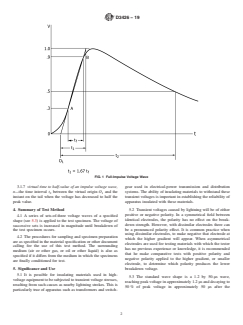
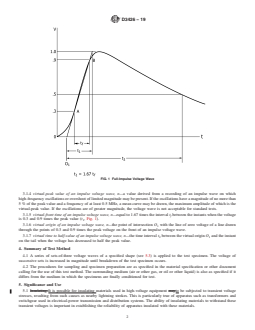
3.1.1 Reference Fig. 1 for the symbols mentioned.
safety concerns, if any, associated with its use. It is the
3.1.2 full-impulse-voltage wave, n—an aperiodic transient
responsibility of the user of this standard to establish appro-
voltage that rises rapidly to a maximum value, then falls less
priate safety, health, and environmental practices and deter-
rapidly to zero.
mine the applicability of regulatory limitations prior to use.
3.1.3 peak value of an impulse voltage wave, n—the maxi-
Specific precaution statements are given in Section 9.
mum value of voltage.
1.6 This international standard was developed in accor-
3.1.4 virtual-peak value of an impulse voltage wave, n—a
dance with internationally recognized principles on standard-
value derived from a recording of an impulse wave on which
ization established in the Decision on Principles for the
high-frequency oscillations or overshoot of limited magnitude
Development of International Standards, Guides and Recom-
maybepresent.Iftheoscillationshaveamagnitudeofnomore
mendations issued by the World Trade Organization Technical
than5 %ofthepeakvalueandafrequencyofatleast0.5MHz,
Barriers to Trade (TBT) Committee.
a mean curve may be drawn, the maximum amplitude of which
is the virtual-peak value. If the oscillations are of greater
2. Referenced Documents
magnitude, the voltage wave is not acceptable for standard
2.1 ASTM Standards:
tests.
D149 Test Method for Dielectric Breakdown Voltage and
3.1.5 virtual-front time of an impulse voltage wave,
DielectricStrengthofSolidElectricalInsulatingMaterials
n—equal to 1.67 times the interval t between the instants when
f
the voltage is 0.3 and 0.9 times the peak value (t , Fig. 1).
This test method is under the jurisdiction of ASTM Committee D09 on
3.1.6 virtual origin of an impulse voltage wave, n—thepoint
Electrical and Electronic Insulating Materials and is the direct responsibility of
of intersection O with the line of zero voltage of a line drawn
Subcommittee D09.12 on Electrical Tests.
through the points of 0.3 and 0.9 times the peak voltage on the
Current edition approved March 1, 2019. Published March 2019. Originally
front of an impulse voltage wave.
approved in 1975. Last previous edition approved in 2012 as D3426 – 97 (2012).
DOI: 10.1520/D3426-19.
For referenced ASTM standards, visit the ASTM website, www.astm.org, or
contact ASTM Customer Service at service@astm.org. For Annual Book of ASTM
Standards volume information, refer to the standard’s Document Summary page on Available from American National Standards Institute (ANSI), 25 W. 43rd St.,
the ASTM website. 4th Floor, New York, NY 10036.
Copyright © ASTM International, 100 Barr Harbor Drive, PO Box C700, West Conshohocken, PA 19428-2959. United States
D3426 − 19
FIG. 1 Full-Impulse Voltage Wave
3.1.7 virtual time to half-value of an impulse voltage wave, gear used in electrical-power transmission and distribution
n—the time interval t between the virtual origin O and the systems. The ability of insulating materials to withstand these
2 1
instant on the tail when the voltage has decreased to half the
transient voltages is important in establishing the reliability of
peak value.
apparatus insulated with these materials.
4. Summary of Test Method 5.2 Transient voltages caused by lightning will be of either
positive or negative polarity. In a symmetrical field between
4.1 A series of sets-of-three voltage waves of a specified
identical electrodes, the polarity has no effect on the break-
shape (see 5.3) is applied to the test specimen. The voltage of
down strength. However, with dissimilar electrodes there can
successive sets is increased in magnitude until breakdown of
be a pronounced polarity effect. It is common practice when
the test specimen occurs.
using dissimilar electrodes, to make negative that electrode at
4.2 The procedures for sampling and specimen preparation
which the higher gradient will appear. When asymmetrical
are as specified in the material specification or other document
electrodes are used for testing materials with which the tester
calling for the use of this test method. The surrounding
has no previous experience or knowledge, it is recommended
medium (air or other gas, or oil or other liquid) is also as
that he make comparative tests with positive polarity and
specified if it differs from the medium in which the specimens
negative polarity applied to the higher gradient, or smaller
are finally conditioned for test.
electrode, to determine which polarity produces the lower
5. Significance and Use
breakdown voltage.
5.1 It is possible for insulating materials used in high-
5.3 The standard wave shape is a 1.2 by 50-µs wave,
voltage equipment to be subjected to transient voltage stresses,
reaching peak voltage in approximately 1.2 µs and decaying to
resulting from such causes as nearby lightning strokes. This is
50 % of peak voltage in approximately 50 µs after the
particularly true of apparatus such as transformers and switch-
D3426 − 19
beginning of the wave. This wave is intended to simulate a 8.2 Prepare the specimens for test using procedures as
lightningstrokethatstrikesasystemwithoutcausingfailureon specified in the material specification. (In general, it is prefer-
the system. able for materials to be tested in the medium in which they are
to be used, after conditioning in a manner representative of the
5.4 For most materials, the impulse dielectric strength will
manufacturing methods to which they will be subjected.)
be higher than either its power frequency alternating voltage or
its direct voltage dielectric strengths. Because of the short time 8.3 When testing specimens in a surrounding medium other
involved, dielectric heating and other thermal effects are than air, do not remove them from that surrounding medium
largely eliminated during impulse testing. Thus, the impulse subsequent to final conditioning for test until after completion
testgivesvaluesclosertotheintrinsicbreakdownstrengththan of the test. As a specific example, when conditioning speci-
do longer time tests. From comparisons of the impulse dielec- mens for testing in oil by vacuum-impregnation with oil do not
tric strength with the values obtained from longer time tests, it remove the specimen from oil even momentarily prior to
testing.
is possible to draw inferences as to the modes of failures under
the various tests for a
...
This document is not an ASTM standard and is intended only to provide the user of an ASTM standard an indication of what changes have been made to the previous version. Because
it may not be technically possible to adequately depict all changes accurately, ASTM recommends that users consult prior editions as appropriate. In all cases only the current version
of the standard as published by ASTM is to be considered the official document.
Designation: D3426 − 97 (Reapproved 2012) D3426 − 19
Standard Test Method for
Dielectric Breakdown Voltage and Dielectric Strength of
Solid Electrical Insulating Materials Using Impulse Waves
This standard is issued under the fixed designation D3426; the number immediately following the designation indicates the year of
original adoption or, in the case of revision, the year of last revision. A number in parentheses indicates the year of last reapproval. A
superscript epsilon (´) indicates an editorial change since the last revision or reapproval.
1. Scope
1.1 This test method covers the determination of dielectric strength of solid electrical insulating materials under simulated-
lightning impulse conditions.
1.2 Procedures are given for tests using standard 1.2 by 50 μs 50 μs full-wave impulses.
1.3 This test method is intended for use in determining the impulse dielectric strength of insulating materials, either using simple
electrodes or functional models. It is not intended for use in impulse testing of apparatus.
1.4 This test method is similar to IEC Publication 243-3. All procedures in this test method are included in IEC 243-3.
Differences between this test method and IEC 243-3 are largely editorial.
1.5 This standard does not purport to address all of the safety concerns, if any, associated with its use. It is the responsibility
of the user of this standard to establish appropriate safety safety, health, and healthenvironmental practices and determine the
applicability of regulatory limitations prior to use. Specific precaution statements are given in Section 9.
1.6 This international standard was developed in accordance with internationally recognized principles on standardization
established in the Decision on Principles for the Development of International Standards, Guides and Recommendations issued
by the World Trade Organization Technical Barriers to Trade (TBT) Committee.
2. Referenced Documents
2.1 ASTM Standards:
D149 Test Method for Dielectric Breakdown Voltage and Dielectric Strength of Solid Electrical Insulating Materials at
Commercial Power Frequencies
D374 Test Methods for Thickness of Solid Electrical Insulation (Metric) D0374_D0374M
D2413 Practice for Preparation of Insulating Paper and Board Impregnated with a Liquid Dielectric
2.2 American National Standard:
C 68.1C68.1 Techniques for Dielectric Tests (IEEE Standard No. 4)
2.3 IEC Standard:
Pub 243-3 Methods of Test for Electric Strength of Solid Insulating Materials—Part 3: Additional Requirements for Impulse
Tests
3. Terminology
3.1 Definitions:
3.1.1 Reference should be made to Fig. 1 for the symbols mentioned.
3.1.2 full-impulse-voltage wave, n—an aperiodic transient voltage that rises rapidly to a maximum value, then falls less rapidly
to zero.
3.1.3 peak value of an impulse voltage wave, n—the maximum value of voltage.
This test method is under the jurisdiction of ASTM Committee D09 on Electrical and Electronic Insulating Materials and is the direct responsibility of Subcommittee
D09.12 on Electrical Tests.
Current edition approved Nov. 1, 2012March 1, 2019. Published November 2012March 2019. Originally approved in 1975. Last previous edition approved in 20042012
as D3426 – 97 (2012).(2004). DOI: 10.1520/D3426-97R12.10.1520/D3426-19.
For referenced ASTM standards, visit the ASTM website, www.astm.org, or contact ASTM Customer Service at service@astm.org. For Annual Book of ASTM Standards
volume information, refer to the standard’s Document Summary page on the ASTM website.
Available from American National Standards Institute (ANSI), 25 W. 43rd St., 4th Floor, New York, NY 10036.
Copyright © ASTM International, 100 Barr Harbor Drive, PO Box C700, West Conshohocken, PA 19428-2959. United States
D3426 − 19
FIG. 1 Full-Impulse Voltage Wave
3.1.4 virtual-peak value of an impulse voltage wave, n—a value derived from a recording of an impulse wave on which
high-frequency oscillations or overshoot of limited magnitude may be present. If the oscillations have a magnitude of no more than
5 % of the peak value and a frequency of at least 0.5 MHz, a mean curve may be drawn, the maximum amplitude of which is the
virtual-peak value. If the oscillations are of greater magnitude, the voltage wave is not acceptable for standard tests.
3.1.5 virtual-front time of an impulse voltage wave, n—equal to 1.67 times the interval t between the instants when the voltage
f
is 0.3 and 0.9 times the peak value (t , Fig. 1).
3.1.6 virtual origin of an impulse voltage wave, n—the point of intersection O with the line of zero voltage of a line drawn
through the points of 0.3 and 0.9 times the peak voltage on the front of an impulse voltage wave.
3.1.7 virtual time to half-value of an impulse voltage wave, n—the time interval t between the virtual origin O and the instant
2 1
on the tail when the voltage has decreased to half the peak value.
4. Summary of Test Method
4.1 A series of sets-of-three voltage waves of a specified shape (see 5.3) is applied to the test specimen. The voltage of
successive sets is increased in magnitude until breakdown of the test specimen occurs.
4.2 The procedures for sampling and specimen preparation are as specified in the material specification or other document
calling for the use of this test method. The surrounding medium (air or other gas, or oil or other liquid) is also as specified if it
differs from the medium in which the specimens are finally conditioned for test.
5. Significance and Use
5.1 Insulating It is possible for insulating materials used in high-voltage equipment mayto be subjected to transient voltage
stresses, resulting from such causes as nearby lightning strokes. This is particularly true of apparatus such as transformers and
switchgear used in electrical-power transmission and distribution systems. The ability of insulating materials to withstand these
transient voltages is important in establishing the reliability of apparatus insulated with these materials.
D3426 − 19
5.2 Transient voltages caused by lightning maywill be of either positive or negative polarity. In a symmetrical field between
identical electrodes, the polarity has no effect on the breakdown strength. However, with dissimilar electrodes there maycan be a
pronounced polarity effect. It is common practice when using dissimilar electrodes, to make negative that electrode at which the
higher gradient will appear. When asymmetrical electrodes are used for testing materials with which the tester has no previous
experience or knowledge, it is recommended that he make comparative tests with positive polarity and negative polarity applied
to the higher gradient, or smaller electrode, to determine which polarity produces the lower breakdown voltage.
5.3 The standard wave shape is a 1.2 by 50-μs wave, reaching peak voltage in approximately 1.2 μs and decaying to 50 % of
peak voltage in approximately 50 μs after the beginning of the wave. This wave is intended to simulate a lightning stroke that may
strike strikes a system without causing failure on the system.
5.4 For most materials, the impulse dielectric strength will be higher than either its power frequency alternating voltage or its
direct voltage dielectric strengths. Because of the short time involved, dielectric heating and other thermal effects are largely
eliminated during impulse testing. Thus, the impulse test gives values closer to the intrinsic breakdown strength than do longer time
tests. From comparisons of the impulse dielectric strength with the values obtained from longer time tests, inferences may be drawn
it is possible to draw inferences as to the modes of failures under the various tests for a given material. Refer to Appendix X1 of
Test Method D149 should be referred to for further information on this subject.
6. Apparatus
6.1 Impulse Generator, capable of applying to the test specimen a standard 1.2 by 50-μs wave of either positive or negative
polarity. The virtual front time shall be 1.2 μs 6 30 % and the virtual time to half value 50 μs 6 20 %. The maximum voltage and
the energy-storage capability must be sufficient to provide impulse waves of the proper shape to any specimen to be tested up to
the breakdown voltage (or specified proof voltage) of the material. The electrical characteristics (particularly capacitance) of the
test spe
...