

ASTM D2621-87(2016)
(Test Method)Standard Test Method for Infrared Identification of Vehicle Solids From Solvent-Reducible Paints
General Information
- Abstract
SIGNIFICANCE AND USE
5.1 The ability to qualitatively identify paint vehicles is useful for characterizing unknown or competitive coatings, for complaint investigations, and for in-process control.
SCOPE
1.1 This test method covers the qualitative characterization or identification of separated paint vehicle solids by infrared spectroscopy within the limitations of infrared spectroscopy.
1.2 This standard does not purport to address all of the safety concerns, if any, associated with its use. It is the responsibility of the user of this standard to establish appropriate safety and health practices and determine the applicability of regulatory limitations prior to use.
- Status
- Published
- Publication Date
- 30-Nov-2016
- Technical Committee
- D01 - Paint and Related Coatings, Materials, and Applications
- Drafting Committee
- D01.21 - Chemical Analysis of Paints and Paint Materials
Overview
ASTM D2621-87(2016) is the internationally recognized standard test method developed by ASTM International for the infrared identification of vehicle solids from solvent-reducible paints. This standard outlines procedures for the qualitative characterization or identification of paint vehicle (binder) solids that have been separated from paints using infrared spectroscopy, within the specific limitations associated with the technique.
Understanding and identifying paint vehicles is critical for:
- Characterizing unknown or competitor coatings
- Investigating product complaints
- Supporting in-process production control
The standard is guided by globally accepted principles from the World Trade Organization’s Technical Barriers to Trade (TBT) Committee, ensuring it is relevant for international trade, regulatory compliance, and laboratory practice.
Key Topics
ASTM D2621-87(2016) covers several essential topics:
- Test Scope: Qualitative identification of separated nonvolatile paint vehicles from solvent-reducible paints using infrared (IR) spectroscopy.
- Apparatus Requirements: Specifies suitable IR spectrophotometers, demountable cell mounts (with NaCl windows), and appropriate ovens for sample drying.
- Sample Preparation: Guidance on separating vehicles using referenced ASTM practices, forming a film on NaCl plates, and proper sample drying to prepare for IR analysis.
- Spectral Analysis: Recording IR spectra over the specified wavelength range, ensuring adequate spectral resolution, and comparing obtained spectra with reference materials.
- Interpretation: Use of reference infrared spectra for various known vehicle types; reference to key absorbance bands for identification of common paint vehicle chemistries, such as alkyds, acrylics, epoxies, urethanes, and others.
- Safety Statement: Users must address all safety and regulatory considerations related to materials and analytical processes.
Applications
The practical value of ASTM D2621-87(2016) spans several areas within the paint and coatings industry and related analytical fields:
- Quality Control: Verifies the correct vehicle or binder is present in raw materials and finished paint products.
- Product Development: Aids in reverse engineering or benchmarking competitive coatings by identifying vehicle components.
- Failure & Complaint Analysis: Diagnoses causes of coating failure by assessing the authenticity and composition of the paint vehicles.
- Regulatory Compliance: Provides documented, repeatable methods that support regulatory or contractual requirements for manufacturers and suppliers.
- Laboratory Standardization: Offers a harmonized approach to sample preparation, analysis, and spectral interpretation, ensuring consistency across laboratories and regions.
Infrared identification is a non-destructive, rapid, and reliable way to analyze the complex mixtures present in paint vehicles and is particularly valuable for laboratories serving automotive, industrial coatings, and quality assurance sectors.
Related Standards
For a holistic approach to paint vehicle analysis and characterization, the following ASTM standards are closely associated with ASTM D2621-87(2016):
- ASTM D2372: Practice for Separation of Vehicle from Solvent-Reducible Paints
- ASTM E131: Terminology Relating to Molecular Spectroscopy
- ASTM E275: Practice for Describing and Measuring Performance of Ultraviolet and Visible Spectrophotometers
- ASTM D1467: (Withdrawn) Guide for Testing Fatty Acids Used in Protective Coatings
- ASTM D1962: (Withdrawn) Test Method for Saponification Value of Drying Oils, Fatty Acids, and Polymerized Fatty Acids
These related standards help standardize methods for sample preparation, terminology, and equipment calibration, supporting robust, reliable paint and coating analysis practices.
Keywords: ASTM D2621, infrared identification, paint vehicles, solvent-reducible paints, coatings analysis, quality control, paint binder identification, IR spectroscopy, automotive coatings standards.
Relations
- Effective Date
- 01-Dec-2016
- Refers
ASTM D2372-85(2010) - Standard Practice for Separation of Vehicle From Solvent-Reducible Paints - Effective Date
- 01-Jun-2010
- Effective Date
- 01-Mar-2010
- Refers
ASTM E275-08 - Describing and Measuring Performance of Ultraviolet and Visible Spectrophotometers - Effective Date
- 15-Oct-2008
- Effective Date
- 01-Sep-2005
- Refers
ASTM D2372-85(2005) - Standard Practice for Separation of Vehicle From Solvent-Reducible Paints - Effective Date
- 01-Jan-2005
- Effective Date
- 10-Sep-2002
- Effective Date
- 10-Feb-2001
- Effective Date
- 10-Feb-2001
- Effective Date
- 10-Sep-2000
- Refers
ASTM D2372-85(1999) - Standard Practice for Separation of Vehicle From Solvent-Reducible Paints - Effective Date
- 10-May-1999
- Effective Date
- 01-Jan-1995
- Effective Date
- 01-Jan-1995
- Effective Date
- 01-Dec-2016
- Effective Date
- 01-Dec-2016
Frequently Asked Questions
ASTM D2621-87(2016) is a standard published by ASTM International. Its full title is "Standard Test Method for Infrared Identification of Vehicle Solids From Solvent-Reducible Paints". This standard covers: SIGNIFICANCE AND USE 5.1 The ability to qualitatively identify paint vehicles is useful for characterizing unknown or competitive coatings, for complaint investigations, and for in-process control. SCOPE 1.1 This test method covers the qualitative characterization or identification of separated paint vehicle solids by infrared spectroscopy within the limitations of infrared spectroscopy. 1.2 This standard does not purport to address all of the safety concerns, if any, associated with its use. It is the responsibility of the user of this standard to establish appropriate safety and health practices and determine the applicability of regulatory limitations prior to use.
SIGNIFICANCE AND USE 5.1 The ability to qualitatively identify paint vehicles is useful for characterizing unknown or competitive coatings, for complaint investigations, and for in-process control. SCOPE 1.1 This test method covers the qualitative characterization or identification of separated paint vehicle solids by infrared spectroscopy within the limitations of infrared spectroscopy. 1.2 This standard does not purport to address all of the safety concerns, if any, associated with its use. It is the responsibility of the user of this standard to establish appropriate safety and health practices and determine the applicability of regulatory limitations prior to use.
ASTM D2621-87(2016) is classified under the following ICS (International Classification for Standards) categories: 87.060.20 - Binders. The ICS classification helps identify the subject area and facilitates finding related standards.
ASTM D2621-87(2016) has the following relationships with other standards: It is inter standard links to ASTM D2621-87(2011), ASTM D2372-85(2010), ASTM E131-10, ASTM E275-08, ASTM E131-05, ASTM D2372-85(2005), ASTM E131-02, ASTM E275-93, ASTM E275-01, ASTM E131-00a, ASTM D2372-85(1999), ASTM D1467-89(1995)e1, ASTM D1962-85(1995), ASTM D7588-11(2018), ASTM D3168-85(2022). Understanding these relationships helps ensure you are using the most current and applicable version of the standard.
ASTM D2621-87(2016) is available in PDF format for immediate download after purchase. The document can be added to your cart and obtained through the secure checkout process. Digital delivery ensures instant access to the complete standard document.
Standards Content (Sample)
This international standard was developed in accordance with internationally recognized principles on standardization established in the Decision on Principles for the
Development of International Standards, Guides and Recommendations issued by the World Trade Organization Technical Barriers to Trade (TBT) Committee.
Designation: D2621 −87 (Reapproved 2016)
Standard Test Method for
Infrared Identification of Vehicle Solids From Solvent-
Reducible Paints
This standard is issued under the fixed designation D2621; the number immediately following the designation indicates the year of
original adoption or, in the case of revision, the year of last revision.Anumber in parentheses indicates the year of last reapproval.A
superscript epsilon (´) indicates an editorial change since the last revision or reapproval.
1. Scope 5. Significance and Use
1.1 This test method covers the qualitative characterization
5.1 The ability to qualitatively identify paint vehicles is
or identification of separated paint vehicle solids by infrared
useful for characterizing unknown or competitive coatings, for
spectroscopy within the limitations of infrared spectroscopy.
complaint investigations, and for in-process control.
1.2 This standard does not purport to address all of the
6. Apparatus
safety concerns, if any, associated with its use. It is the
responsibility of the user of this standard to establish appro-
6.1 Spectrophotometer—A recording double-beam infrared
priate safety and health practices and determine the applica-
spectrophotometerwithawavelengthrangefromatleast2.5to
bility of regulatory limitations prior to use.
15 µ m and a spectral resolution of at least 0.04 µm over that
range. See Practice E275.
2. Referenced Documents
6.2 Demountable Cell Mount, with NaCl window.
2.1 ASTM Standards:
D1467Guide for Testing Fatty Acids Used in Protective
6.3 Vacuum Drying Oven thermostatically controlled to
Coatings (Withdrawn 2003)
operate at 60 6 2°C. A water aspirator vacuum source is
D1962TestMethodforSaponificationValueofDryingOils,
satisfactory.
Fatty Acids, and Polymerized Fatty Acids (Withdrawn
3 6.4 Oven, Gravity or Forced Draft, capable of maintaining
2004)
temperature from 105 to 110°C.
D2372Practice for Separation of Vehicle From Solvent-
Reducible Paints
7. Procedure
E131Terminology Relating to Molecular Spectroscopy
E275PracticeforDescribingandMeasuringPerformanceof
7.1 Placethevehicle,separatedfromthepaintinaccordance
Ultraviolet and Visible Spectrophotometers
with Practice D2372, on a NaCl window and spread to form a
uniform film. Make sure that the thickness of the film is such
3. Terminology
that when the infrared spectrum is recorded, the transmittance
3.1 Definitions:
of the strongest band falls between 5 and 15% (Note). Dry the
3.1.1 For definitions of terms and symbols, refer to Termi-
film in an oven at 105 to 110°C for 15 min and cool in a
nology E131.
desiccator.Inspectthefilmvisuallyfordefectssuchasbubbles,
wrinkles, contamination, etc. If defects are present, cast an-
4. Summary of Test Method
other film. If easily oxidizable substances are present such as
4.1 Infraredspectraarepreparedfromdriedfilmsofisolated
tung,oiticica,orlinseedoils,makesurethatthefilmisdriedat
paint vehicles. Vehicle types are identified by comparing the
60 62°Cinavacuumovenfor1h.Ifsolventsoflowvolatility
spectra to a collection of reference infrared spectra.
such as cyclohexanone or isophorone are present, the film may
need to be dried for several hours in a 60°C vacuum oven.
This test method is under the jurisdiction of ASTM Committee D01 on Paint
and Related Coatings, Materials, andApplications and is the direct responsibility of NOTE 1—Numerous procedures and variations may be used to obtain a
Subcommittee D01.21 on Chemical Analysis of Paints and Paint Materials.
film on which to prepare a suitable spectrum. These include liquid
Current edition approved Dec. 1, 2016. Published December 2016. Originally
mounting between two NaCl plates, transmission through free films, and
approved in 1967. Last previous edition approved in 2011 as D2621–87(2011).
reflectance from highly polished surfaces.
DOI: 10.1520/D2621-87R16.
7.2 Immediatelyrecordtheinfraredspectrumfrom2.5to15
For referenced ASTM standards, visit the ASTM website, www.astm.org, or
contact ASTM Customer Service at service@astm.org. For Annual Book of ASTM
µm so that a spectral resolution of 0.04 µm is maintained
Standards volume information, refer to the standard’s Document Summary page on
throughout that range (methods for achieving this resolution
the ASTM website.
willvaryaccordingtothedirectionsofthemanufacturerofthe
The last approved version of this historical standard is referenced on
www.astm.org. instrument used).
Copyright © ASTM International, 100 Barr Harbor Drive, PO Box C700, West Conshohocken, PA 19428-2959. United States
D2621 − 87 (2016)
TABLE 1 Correlation of Absorption Bands in Alkyd Spectra
−1
Wavelength, µm Wavenumbers, cm Group Vibration
2.9 3448 O–H stretch
3.4 to 3.5 2941 to 2857 alkane C–H stretch
5.8 1724 ester, C=O stretch
6.2, 6.3, 6.6, 6.7 1613, 1587, 1515, 1493 skeletal in-plane aromatic C=C
6.9, 7.3 1449, 1369 aliphatic C–H bending
7.5 to 9.4 1333 to 1063 ester, C–O–C stretch (o-phthalate ester)
8.6 1163 ester, C–O–C stretch (fatty acid ester)
9.6, 13.5, 14.3 1042, 741, 699 out-of-plane aromatic C–H bending denoting o-disubstituted benzene ring.
7.3 Compare the spectrum obtained with reference spectra 8. Keywords
prepared from nonvolatile vehicles of known composition (see
8.1 infrared spectra; paint binders; solvent reducible paint
Annex A1) or consult other published spectra available in the
literature (Annex A3). Interpret the spectrum on the basis of
available information, recognizing certain limitations of infra-
red spectroscopy, and qualifying the interpretation accordingly
(Annex A2).
ANNEXES
(Mandatory Information)
A1. INFRARED SPECTRA OF NONVOLATILE VEHICLES OF KNOWN COMPOSITION
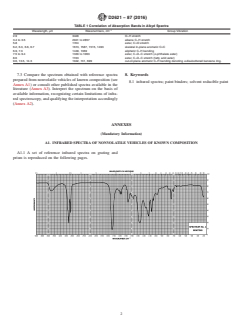
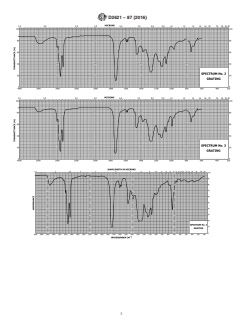
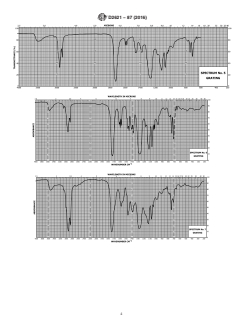
A1.1 A set of reference infrared spectra on grating and
prism is reproduced on the following pages.
D2621 − 87 (2016)
D2621 − 87 (2016)
D2621 − 87 (2016)
D2621 − 87 (2016)
D2621 − 87 (2016)
D2621 − 87 (2016)
D2621 − 87 (2016)
D2621 − 87 (2016)
D2621 − 87 (2016)
D2621 − 87 (2016)
D2621 − 87 (2016)
D2621 − 87 (2016)
D2621 − 87 (2016)
D2621 − 87 (2016)
D2621 − 87 (2016)
D2621 − 87 (2016)
D2621 − 87 (2016)
D2621 − 87 (2016)
A2. CONSIDERATIONS IN THE INTERPRETATION OF INFRARED SPECTRA OF NONVOLATILE VEHICLES SEPARATED
FROM SOLVENT-TYPE PAINTS
INTRODUCTION
The infrared spectra of vehicles recovered from whole paint are presented in Annex A1. The aim
of this compilation is to aid those using this test method in the practical interpretation of the spectra
they obtain.
Thespectraarecompiledwithonerepresentativespectrumofeachvehiclepresentedinbothaprism
and a grating format. In the discussion of the spectra, the general assignment refers to the first
spectrum. The subsequent spectra discussion will include only those bands which aid in the
identification of the particular modifications being illustrated. In addition, some practical information
is provided where it is believed to be helpful to the analyst. In general, previously noted band
assignments are not repeated.
The data compiled here were obtained from spectra prepared on very carefully calibrated
instruments. In comparing them to spectra prepared in any given laboratory, it is expected that the
wavelength values of absorption bands may differ slightly depending upon the calibration of the
instrument used.
GROUP I-ALKYDS
−1
A2.1 Spectrum 1: Ortho-Phthalic Alkyd, Medium Oil A2.1.3 5to6-µmRegion(2000to1667cm )—The5.8-µm
Length band in alkyds is due to the combined C=O stretch of the
−1 phthalateandfattyacidesters.Unreactedphthalicanhydride,if
A2.1.1 2.9-µm Region (3448 cm )—The 2.9-µm band in
present, may be detected by the appearance of a sharp
alkyds is due to the O—H stretching vibration. This is usually
−1
absorption band at approximately 5.6 µm (1786 cm ). Free
attributed to the unesterified hydroxyl OH on the polyhydric
carboxyl groups (due to unreacted fatty acid or incompletely
alcohol used in manufacturing the alkyd. This absorption is
reactedphthalicacid)mayoftenbedetectedbytheappearance
knowntoincreaseondryingofunsaturatedoilmodifiedalkyds
of a shoulder on the high wavelength (low frequency) side of
duetooxidationofthedoublebonds.Thisabsorptionbandcan
the ester carbonyl band.
be used to determine the hydroxyl number of alkyds.
−1 −1
A2.1.2 3.3 to 3.6-µm Region (3030 to 2778 cm )—The A2.1.4 6.2 to 6.4-µm Region (1613 to 1563 cm )—The
bands in this area are all due to aromatic and aliphatic C–H doublet appearing in this region of the spectrum is due to
stretching vibrations. vibrations associated with the double bonds in an aromatic
D2621 − 87 (2016)
ring. The band shape and position of this doublet is character- A2.4 Spectrum 4: Ortho-Isophthalic Alkyd
istic of non-oil modified, o-phthalic alkyds.
−1
A2.4.1 7.8 µm (1282 cm ) isophthalate ester C—O—C
−1
A2.1.5 6.8 to 6.9-µm Region (1470 to 1449 cm )—This
−1
A2.4.2 8.2 µm (1220 cm ) isophthalate ester C—O—C
absorption is produced by C–H bending vibrations of methyl-
−1
ene (scissoring deformation) and methyl (asymmetrical defor-
A2.4.3 8.9 µm (1124 cm ) isophthalate ester C—O—C
mation) groups in the alkyd. The intensity of this absorption
−1
A2.4.4 13.7µm(730cm )meta-disubstitutedbenzenering
band will vary with oil length.
−1 A2.4.5 Comments—The spectrum of this alkyd is typical of
A2.1.6 7.2 to 7.3-µm Region (1389 to 1370 cm )—This
an isophthalic alkyd. The major band that identifies this as an
absorption band is due to the C—CH symmetrical deforma-
−1
isophthalate is the 13.7-µm (730-cm ) band. The presence of
tion vibration, and is produced by the methyl groups on the
orthophthalic alkyd can be suspected by comparison to a
fatty acid chains.
straight isophthalic alkyd spectrum (see following) and noting
−1
−1
A2.1.7 7.5 to 10.0-µm Region (1333 to 1000 cm )—The
the influence of the ortho-phthalate at 7.9 µm (1266 cm ), 9.0
−1 −1
absorption bands in this region are due to the C—O—C
µm (1111 cm ), 9.4 µm (1064 cm ), and at 14.2 µm (704
−1
stretching vibrations of the phthalate ester. These absorptions
cm ).
are most strongly influenced by the acid portion of the ester
A2.5 Spectrum 5: Ortho-Phthalic Alkyd, Benzoic Acid
rather than the alcoholic portion.
Modified
−1
A2.1.8 13.5 and 14.2-µm Regions (741 and 704 cm )—
−1
These two bands are due to out-of-plane bending vibrations of A2.5.1 14.0 to 14.1 µm (714 to 709 cm ); aromatic ring
vibrationwhereringcontainsfiveadjacenthydrogens.Position
ring hydrogens of aromatic compounds having four adjacent
hydrogens (orthodisubstitution). is characteristic of benzoate esters.
A2.1.9 Comments: A2.5.2 Comments—The band at approximately 14.0 µm
−1
(714 cm ) is the identifying peak for this modification.
A2.1.9.1 Note that in oil-modified alkyds, the intensity of
−1
−1
Because of the o-disubstitution peak at 14.3µ m (699 cm )
the absorption at 8.6 µm (1163 cm ) is indicative of the
present in o-phthalates, it is difficult to observe this band when
amount of oil modification or oil length of the alkyd. In
the benzoic acid modification drops below 3%.
unmodified alkyds, this band may be little more than a side
−1
shoulderonthe8.9-µm(1124-cm )C—O—Cabsorption.The
A2.6 Spectrum 6: Ortho-Phthalic Alkyd, Para-Tertiary
correlationtooillengthisonlyaverygeneraloneinthatwithin
Butyl Benzoic Acid Modified
a given group of alkyds one may say a sample is a “short,”
−1
“medium,” or “long” oil type.
A2.6.1 8.4µm(1190cm )C—O—Cp-tert.butylbenzoate
A2.1.9.2 Alkyd spectra generally reveal little or no infor-
−1
A2.6.2 9.6µm(1042cm )C—O—Cp-tert.butylbenzoate
mation concerning the type of combined oil or polyol present.
−1
A2.6.3 9.8µm(1020cm )C—O—Cp-tert.butylbenzoate
A2.1.9.3 Identification of polyol and unsaponifiables may
usually be accomplished by infrared examination of saponifi- −1
A2.6.4 11.7 µm (855 cm ) aromatic ring substitution pat-
cation fractions. Identification of the oil acids used usually
terns
requires gas chromatographic analysis of the methylated fatty
−1
A2.6.5 12.9 µm (775 cm ) aromatic ring substitution pat-
acids recovered by saponific
...