

ASTM C97/C97M-18
(Test Method)Standard Test Methods for Absorption and Bulk Specific Gravity of Dimension Stone
General Information
- Abstract
SIGNIFICANCE AND USE
4.1 These test methods are useful in indicating the differences in absorption between the various dimension stones. These test methods also provide one element in comparing stones of the same type.
SCOPE
1.1 These test methods cover the tests for determining the absorption and bulk specific gravity of all types of dimension stone, except slate.
1.2 The values stated in either SI units or inch-pound units are to be regarded separately as standard. The values stated in each system may not be exact equivalents; therefore, each system shall be used independently of the other. Combining values from the two systems may result in non-conformance with the standard.
1.3 This standard does not purport to address all of the safety concerns, if any, associated with its use. It is the responsibility of the user of this standard to establish appropriate safety, health, and environmental practices and determine the applicability of regulatory limitations prior to use.
1.4 This international standard was developed in accordance with internationally recognized principles on standardization established in the Decision on Principles for the Development of International Standards, Guides and Recommendations issued by the World Trade Organization Technical Barriers to Trade (TBT) Committee.
- Status
- Published
- Publication Date
- 30-Apr-2018
- Technical Committee
- C18 - Dimension Stone
- Drafting Committee
- C18.01 - Test Methods
Buy Documents

ASTM C97/C97M-18 - Standard Test Methods for Absorption and Bulk Specific Gravity of Dimension Stone
REDLINE ASTM C97/C97M-18 - Standard Test Methods for Absorption and Bulk Specific Gravity of Dimension Stone
Overview
ASTM C97/C97M-18 - Standard Test Methods for Absorption and Bulk Specific Gravity of Dimension Stone - is an internationally recognized standard developed by ASTM International. This document establishes procedures for determining the water absorption and bulk specific gravity of all types of dimension stone, except slate. The test methods are fundamental in identifying differences in absorption properties across various dimension stones, allowing meaningful comparison within and between stone types.
These tests apply to construction, architectural, and structural applications, providing essential data for selecting and specifying dimension stone in projects that require reliable performance, durability, and quality control. The standard includes clear guidance on specimen sampling, preparation, testing, and reporting.
Key Topics
Scope and Applicability
- Applies to all dimension stone types except slate
- Covers both SI and inch-pound measurement units
- Provides requirements for safety, health, and environmental practices
Test Methodology
- Outlines sample selection criteria for representativeness of supplied stone
- Specifies specimen size, shape (cube, prism, cylinder), and surface finish conditions
- Describes detailed drying, soaking, and weighing procedures for reliable results
- Allows determination of both water absorption and bulk specific gravity on the same or separate specimens
Calculation and Reporting
- Defines methods for calculating absorption as a weight percentage and bulk specific gravity
- Establishes requirements for reporting both individual and average values, along with standard deviation
- Lists identification and descriptive information to be included in reports, such as sample source, stone name, and testing personnel
Quality and Consistency
- Provides guidance to ensure repeatability and reproducibility of results
- Requires clear documentation of any procedural deviations
Applications
Adhering to ASTM C97/C97M-18 is vital in several key industry applications:
Quality Control for Stone Suppliers
- Ensures stone products meet specified criteria for absorption and density
- Supports consistent production and supply chain validation
Architectural and Structural Design
- Informs material selection based on absorption and strength properties
- Helps in assessing durability for exterior cladding, flooring, monuments, and paving
Project Specification and Compliance
- Enables project owners, specifiers, and contractors to reference standardized test results
- Facilitates regulatory and procurement compliance for public and private sector projects
Comparative Assessment
- Allows side-by-side evaluation of stones within the same type or across different types for suitability in various environments and applications
Related Standards
ASTM C119: Terminology Relating to Dimension Stone
Provides terminology and definitions for clarity in stone-related standards.ASTM C1799: Guide to Dimension Stone Test Specimen Sampling and Preparation
Offers guidance on how to properly sample and prepare stone specimens for testing.Other Relevant ASTM Standards:
Review additional ASTM standards on stone and material testing where dimensional stability, strength, and durability are critical.
Keywords: ASTM C97, dimension stone testing, absorption test, bulk specific gravity, stone quality control, stone grading, stone selection, ASTM stone standards, architectural stone durability, stone test methods.
Relations
- Replaces
ASTM C97/C97M-15 - Standard Test Methods for Absorption and Bulk Specific Gravity of Dimension Stone - Effective Date
- 01-May-2018
- Effective Date
- 01-May-2019
- Effective Date
- 01-May-2016
- Effective Date
- 01-Dec-2014
- Effective Date
- 01-Dec-2014
- Effective Date
- 15-Jun-2011
- Effective Date
- 01-Feb-2008
- Effective Date
- 01-Feb-2008
- Effective Date
- 01-Feb-2008
- Effective Date
- 01-Feb-2008
- Effective Date
- 01-Aug-2007
- Effective Date
- 01-Jun-2007
- Effective Date
- 01-Apr-2006
- Effective Date
- 01-Nov-2005
- Effective Date
- 15-May-2005
Buy Documents
ASTM C97/C97M-18 - Standard Test Methods for Absorption and Bulk Specific Gravity of Dimension Stone
REDLINE ASTM C97/C97M-18 - Standard Test Methods for Absorption and Bulk Specific Gravity of Dimension Stone
Get Certified
Connect with accredited certification bodies for this standard

DIBt (Deutsches Institut für Bautechnik)
German Institute for Building Technology.
DIN CERTCO
DIN Group product certification.

Aboma Certification B.V.
Specialized in construction, metal, and transport sectors.
Sponsored listings
Frequently Asked Questions
ASTM C97/C97M-18 is a standard published by ASTM International. Its full title is "Standard Test Methods for Absorption and Bulk Specific Gravity of Dimension Stone". This standard covers: SIGNIFICANCE AND USE 4.1 These test methods are useful in indicating the differences in absorption between the various dimension stones. These test methods also provide one element in comparing stones of the same type. SCOPE 1.1 These test methods cover the tests for determining the absorption and bulk specific gravity of all types of dimension stone, except slate. 1.2 The values stated in either SI units or inch-pound units are to be regarded separately as standard. The values stated in each system may not be exact equivalents; therefore, each system shall be used independently of the other. Combining values from the two systems may result in non-conformance with the standard. 1.3 This standard does not purport to address all of the safety concerns, if any, associated with its use. It is the responsibility of the user of this standard to establish appropriate safety, health, and environmental practices and determine the applicability of regulatory limitations prior to use. 1.4 This international standard was developed in accordance with internationally recognized principles on standardization established in the Decision on Principles for the Development of International Standards, Guides and Recommendations issued by the World Trade Organization Technical Barriers to Trade (TBT) Committee.
SIGNIFICANCE AND USE 4.1 These test methods are useful in indicating the differences in absorption between the various dimension stones. These test methods also provide one element in comparing stones of the same type. SCOPE 1.1 These test methods cover the tests for determining the absorption and bulk specific gravity of all types of dimension stone, except slate. 1.2 The values stated in either SI units or inch-pound units are to be regarded separately as standard. The values stated in each system may not be exact equivalents; therefore, each system shall be used independently of the other. Combining values from the two systems may result in non-conformance with the standard. 1.3 This standard does not purport to address all of the safety concerns, if any, associated with its use. It is the responsibility of the user of this standard to establish appropriate safety, health, and environmental practices and determine the applicability of regulatory limitations prior to use. 1.4 This international standard was developed in accordance with internationally recognized principles on standardization established in the Decision on Principles for the Development of International Standards, Guides and Recommendations issued by the World Trade Organization Technical Barriers to Trade (TBT) Committee.
ASTM C97/C97M-18 is classified under the following ICS (International Classification for Standards) categories: 91.100.15 - Mineral materials and products. The ICS classification helps identify the subject area and facilitates finding related standards.
ASTM C97/C97M-18 has the following relationships with other standards: It is inter standard links to ASTM C97/C97M-15, ASTM C119-19, ASTM C119-16, ASTM C119-14, ASTM C119-14e1, ASTM C119-11, ASTM C119-08e2, ASTM C119-08e1, ASTM C119-08e3, ASTM C119-08, ASTM C119-07a, ASTM C119-07, ASTM C119-06, ASTM C119-05a, ASTM C119-05. Understanding these relationships helps ensure you are using the most current and applicable version of the standard.
ASTM C97/C97M-18 is available in PDF format for immediate download after purchase. The document can be added to your cart and obtained through the secure checkout process. Digital delivery ensures instant access to the complete standard document.
Standards Content (Sample)
This international standard was developed in accordance with internationally recognized principles on standardization established in the Decision on Principles for the
Development of International Standards, Guides and Recommendations issued by the World Trade Organization Technical Barriers to Trade (TBT) Committee.
Designation:C97/C97M −18
Standard Test Methods for
Absorption and Bulk Specific Gravity of Dimension Stone
This standard is issued under the fixed designation C97/C97M; the number immediately following the designation indicates the year of
original adoption or, in the case of revision, the year of last revision.Anumber in parentheses indicates the year of last reapproval.A
superscript epsilon (´) indicates an editorial change since the last revision or reapproval.
1. Scope These test methods also provide one element in comparing
stones of the same type.
1.1 These test methods cover the tests for determining the
absorption and bulk specific gravity of all types of dimension
5. Sampling
stone, except slate.
5.1 The sample shall be selected to represent a true average
1.2 The values stated in either SI units or inch-pound units
of the type or grade of stone under consideration and shall be
are to be regarded separately as standard. The values stated in
ofthequalitysuppliedtothemarketunderthetypedesignation
each system may not be exact equivalents; therefore, each
to be tested. The sample may be selected by the purchaser or
system shall be used independently of the other. Combining
his authorized representative from the quarried stone or taken
values from the two systems may result in non-conformance
from the natural ledge and shall be of adequate size to permit
with the standard.
the preparation of at least five test specimens. When percep-
1.3 This standard does not purport to address all of the
tible variations occur, the purchaser may select as many
safety concerns, if any, associated with its use. It is the
samples as are necessary for determining the range in proper-
responsibility of the user of this standard to establish appro-
ties.
priate safety, health, and environmental practices and deter-
NOTE1—RefertoGuideC1799foradditionalinformationonselecting,
mine the applicability of regulatory limitations prior to use.
preparing, and conditioning test specimens.
1.4 This international standard was developed in accor-
dance with internationally recognized principles on standard-
6. Test Specimens
ization established in the Decision on Principles for the
Development of International Standards, Guides and Recom- 6.1 The specimens may be cubes, prisms, cylinders, or any
regular form with least dimension not under 2 in. [50 mm] and
mendations issued by the World Trade Organization Technical
Barriers to Trade (TBT) Committee. greatest dimension not over 3 in. [75 mm] but the ratio of
volume to surface area shall not be less than 0.3 nor greater
2. Referenced Documents
than0.5whenmeasuringininches[8and12.5whenmeasuring
2.1 ASTM Standards:
in millimetres]. All surfaces shall be reasonably smooth. Saw
C119Terminology Relating to Dimension Stone
or core drill surfaces are considered satisfactory, but rougher
C1799Guide to Dimension Stone Test Specimen Sampling
surfaces shall be finished with No. 80 abrasive. No chisels or
and Preparation
similar tools shall be used at any stage of preparing the
specimens.
3. Terminology
6.2 Prepare at least five specimens from each sample.
3.1 Definitions—All definitions are in accordance with Ter-
minology C119.
6.3 The same specimens may be used to determine both
water absorption and bulk specific gravity. In this case, follow
4. Significance and Use
the procedures in 7.1 – 7.3 and 8.1, and issue a single report
4.1 These test methods are useful in indicating the differ-
containing all information required in Sections 10 and 11.
ences in absorption between the various dimension stones.
Alternatively, separate specimens may be prepared from the
same or different samples. In this case, follow the applicable
These test methods are under the jurisdiction of ASTM Committee C18 on
procedure for separate determination and reporting of water
Dimension Stone and are the direct responsibility of Subcommittee C18.01 on Test
Methods. absorption or bulk specific gravity, or both.
Current edition approved May 1, 2018. Published June 2018. Originally
approved in 1930. Last previous edition approved in 2015 as C97/C97M–15. DOI:
7. Procedure – Absorption
10.1520/C0097_C0097M-18.
For referenced ASTM standards, visit the ASTM website, www.astm.org, or
7.1 Dry the specimens for 48 h in a ventilated oven at a
contact ASTM Customer Service at service@astm.org. For Annual Book of ASTM
temperature of 140 6 4°F [60 6 2°C]. At the 46th, 47th, and
Standards volume information, refer to the standard’s Document Summary page on
the ASTM website. 48th hour, weigh the specimens to ensure that the weight is the
Copyright © ASTM International, 100 Barr Harbor Drive, PO Box C700, West Conshohocken, PA 19428-2959. United States
C97/C97M−18
same. If the weight continues to drop, continue to dry the
specimensuntiltherearethreesuccessivehourlyreadingswith
the same weight.
7.2 After drying, cool the specimens in the room for 30 min
and weigh. When the specimens cannot be weighed immedi-
ately after cooling, store them in a desiccator. Determine the
weights to the nearest 0.0005 oz [0.01 g].
7.3 Immerse the specimens completely in filtered or dis-
tilled water at 72 6 4°F [22 6 2°C] for 48 h.At the end of this
period remove them from the water bath one at a time, surface
dry with a damp cloth, and weigh to the nearest 0.0005 oz
[0.01g].
8. Procedure – Bulk Specific Gravity
8.1 Whenbothabsorptionandbulkspecificgravityaretobe
determined on the same specimens, weigh the saturated speci-
menssuspendedinfilteredordistilledwaterat72 64°F[22 6
2°C] immediately after the absorption tests are completed.
Determine the suspended weights to the nearest 0.0005oz
[0.01 g].
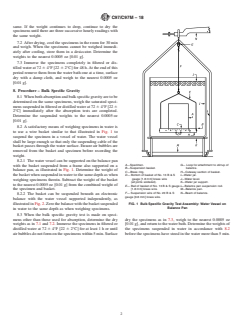
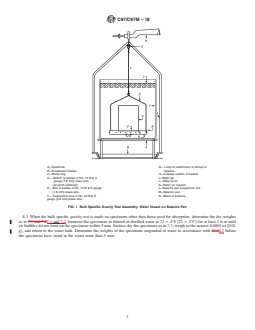
8.2 Asatisfactory means of weighing specimens in water is
to use a wire basket similar to that illustrated in Fig. 1 to
suspend the specimen in a vessel of water. The water vessel
shall be large enough so that only the suspending cable of the
basketpassesthroughthewatersurface.Ensureairbubblesare
removed from the basket and specimen before recording the
weight.
8.2.1 The water vessel can be supported on the balance pan
A—Specimen. G— Loop for attachment to stirrup of
w
...
This document is not an ASTM standard and is intended only to provide the user of an ASTM standard an indication of what changes have been made to the previous version. Because
it may not be technically possible to adequately depict all changes accurately, ASTM recommends that users consult prior editions as appropriate. In all cases only the current version
of the standard as published by ASTM is to be considered the official document.
Designation: C97/C97M − 15 C97/C97M − 18
Standard Test Methods for
Absorption and Bulk Specific Gravity of Dimension Stone
This standard is issued under the fixed designation C97/C97M; the number immediately following the designation indicates the year of
original adoption or, in the case of revision, the year of last revision. A number in parentheses indicates the year of last reapproval. A
superscript epsilon (´) indicates an editorial change since the last revision or reapproval.
1. Scope
1.1 These test methods cover the tests for determining the absorption and bulk specific gravity of all types of dimension stone,
except slate.
1.2 The values stated in either SI units or inch-pound units are to be regarded separately as standard. The values stated in each
system may not be exact equivalents; therefore, each system shall be used independently of the other. Combining values from the
two systems may result in non-conformance with the standard.
1.3 This standard does not purport to address all of the safety concerns, if any, associated with its use. It is the responsibility
of the user of this standard to establish appropriate safety safety, health, and healthenvironmental practices and determine the
applicability of regulatory limitations prior to use.
1.4 This international standard was developed in accordance with internationally recognized principles on standardization
established in the Decision on Principles for the Development of International Standards, Guides and Recommendations issued
by the World Trade Organization Technical Barriers to Trade (TBT) Committee.
2. Referenced Documents
2.1 ASTM Standards:
C119 Terminology Relating to Dimension Stone
C1799 Guide to Dimension Stone Test Specimen Sampling and Preparation
3. Terminology
3.1 Definitions—All definitions are in accordance with Terminology C119.
4. Significance and Use
4.1 These test methods are useful in indicating the differences in absorption between the various dimension stones. These test
methods also provide one element in comparing stones of the same type.
5. Sampling
5.1 The sample shall be selected to represent a true average of the type or grade of stone under consideration and shall be of
the quality supplied to the market under the type designation to be tested. The sample may be selected by the purchaser or his
authorized representative from the quarried stone or taken from the natural ledge and shall be of adequate size to permit the
preparation of at least five test specimens. When perceptible variations occur, the purchaser may select as many samples as are
necessary for determining the range in properties.
NOTE 1—Refer to Guide C1799 for additional information on selecting, preparing, and conditioning test specimens.
6. Test Specimens
6.1 The specimens may be cubes, prisms, cylinders, or any regular form with least dimension not under 2 in. [50 mm] and
greatest dimension not over 3 in. [75 mm] but the ratio of volume to surface area shall not be less than 0.3 nor greater than 0.5
when measuring in inches [8 and 12.5 when measuring in millimetres]. All surfaces shall be reasonably smooth. Saw or core drill
These test methods are under the jurisdiction of ASTM Committee C18 on Dimension Stone and are the direct responsibility of Subcommittee C18.01 on Test Methods.
Current edition approved May 1, 2015May 1, 2018. Published July 2015June 2018. Originally approved in 1930. Last previous edition approved in 20092015 as
C97C97/C97M–09.–15. DOI: 10.1520/C0097_C0097M-15.10.1520/C0097_C0097M-18.
For referenced ASTM standards, visit the ASTM website, www.astm.org, or contact ASTM Customer Service at service@astm.org. For Annual Book of ASTM Standards
volume information, refer to the standard’s Document Summary page on the ASTM website.
Copyright © ASTM International, 100 Barr Harbor Drive, PO Box C700, West Conshohocken, PA 19428-2959. United States
C97/C97M − 18
surfaces are considered satisfactory, but rougher surfaces shall be finished with No. 80 abrasive. No chisels or similar tools shall
be used at any stage of preparing the specimens.
6.2 Prepare at least five specimens from each sample.
6.3 The same specimens may be used to determine both water absorption and bulk specific gravity. In this case, follow the
procedures in 7.1 – 7.3 and 10.18.1, and issue a single report containing all information required in Sections 910 and 1311.
Alternatively, separate specimens may be prepared from the same or different samples. In this case, follow the applicable procedure
for separate determination and reporting of water absorption or bulk specific gravity, or both.
7. Procedure – Absorption
7.1 Dry the specimens for 48 h in a ventilated oven at a temperature of 140 6 4°F [60 6 2°C]. At the 46th, 47th, and 48th hour,
weigh the specimens to ensure that the weight is the same. If the weight continues to drop, continue to dry the specimens until
there are three successive hourly readings with the same weight.
7.2 After drying, cool the specimens in the room for 30 min and weigh. When the specimens cannot be weighed immediately
after cooling, store them in a desiccator. Determine the weights to the nearest 0.0005 oz [0.01 g].
7.3 Immerse the specimens completely in filtered or distilled water at 72 6 4°F [22 6 2°C] for 48 h. At the end of this period
remove them from the water bath one at a time, surface dry with a damp cloth, and weigh to the nearest 0.0005 oz [0.01 g].
8. Calculation and Report
8.1 Calculate the weight percentage absorption (Note 2) for each specimen as follows:
Absorption, weight %5 B 2 A /A 3100 (1)
@~ ! #
where:
A = weight of the dried specimen, oz [g], and
B = weight of the specimen after immersion, oz [g].
NOTE 2—If the percentage of absorption by volume is desired it will be necessary to determine the bulk specific gravity and multiply each value of
percentage absorption by weight by the corresponding bulk specific gravity value.
8.2 Calculate the mean water absorption of the sample as the average of the weight percentage absorption for all specimens.
9. Report
9.1 The report shall contain the following information:
9.1.1 Identity of party providing the sample.
9.1.2 Name of stone.
9.1.3 Identity of sample.
9.1.4 Mean water absorption of sample.
9.1.5 Any variations to the procedure, including specimen dimensions, given in this standard
9.2 The report shall also contain the following information for each specimen:
9.2.1 Weight of dried specimen
9.2.2 Weight of soaked and surface-dried specimen in air.
9.2.3 Percentage water absorption by weight of specimen.
BULK SPECIFIC GRAVITY
8. Procedure – Bulk Specific Gravity
8.1 When both absorption and bulk specific gravity are to be determined on the same specimens, weigh the saturated specimens
suspended in filtered or distilled water at 72 6 4°F [22 6 2°C] immediately after the absorption tests are completed. Determine
the suspended weights to the nearest 0.0005 oz [0.01 g].
8.2 A satisfactory means of weighing specimens in water is to use a wire basket similar to that illustrated in Fig. 1 to suspend
the specimen in a vessel of water. The water vessel shall be large enough so that only the suspending cable of the basket passes
through the water surface. Ensure air bubbles are removed from the basket and specimen before
...