

ASTM B842-23
(Specification)Standard Specification for Electrodeposited Coatings of Zinc Iron Alloy Deposits
General Information
- Abstract
SCOPE
1.1 This specification covers the requirements for electrodeposited zinc iron alloy coatings on metals.
1.2 Units—The values stated in SI units are to be regarded as standard. No other units of measurement are included in this standard.
1.3 The following precautionary caveat pertains to the test method portion only, Section 8, of this specification: This standard does not purport to address all of the safety concerns, if any, associated with its use. It is the responsibility of the user of this standard to establish appropriate safety, health, and environmental practices and determine the applicability of regulatory limitations prior to use.
1.4 This international standard was developed in accordance with internationally recognized principles on standardization established in the Decision on Principles for the Development of International Standards, Guides and Recommendations issued by the World Trade Organization Technical Barriers to Trade (TBT) Committee.
- Status
- Published
- Publication Date
- 30-Apr-2023
- Technical Committee
- B08 - Metallic and Inorganic Coatings
- Drafting Committee
- B08.06 - Soft Metals
Buy Documents
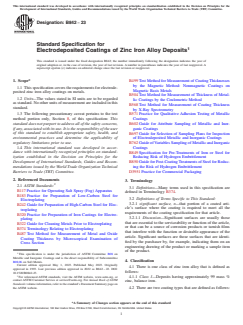
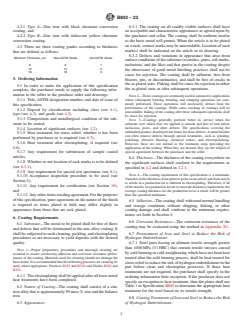
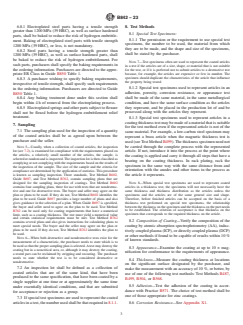
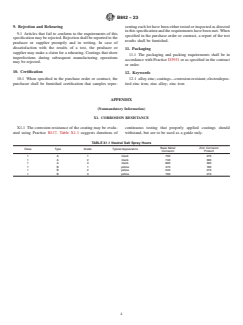
ASTM B842-23 - Standard Specification for Electrodeposited Coatings of Zinc Iron Alloy Deposits
REDLINE ASTM B842-23 - Standard Specification for Electrodeposited Coatings of Zinc Iron Alloy Deposits
Overview
ASTM B842-23: Standard Specification for Electrodeposited Coatings of Zinc Iron Alloy Deposits establishes the requirements and guidelines for applying electrodeposited zinc-iron alloy coatings on metal substrates. Developed by ASTM International, this standard specifies coating composition, methods of preparation and treatment, essential attributes of the deposit, and inspection protocols. The use of only SI units ensures measurement consistency. This standard promotes corrosion protection and functional performance of coated metal parts in diverse industries, aligning with international guidelines for global trade and materials engineering.
Key Topics
Coating Composition and Classes
- One class is defined: approximately 99% zinc with the balance as iron.
- Two types of chromate conversion finishes are recognized:
- Type A: Black chromate conversion coating.
- Type B: Iridescent yellow chromate conversion coating.
- Three coating thickness grades: 6 μm, 12 μm, and 18 μm.
Surface Preparation
- The substrate must be meticulously cleaned and prepared according to referenced standards to ensure strong adhesion and reliable corrosion resistance.
- Only basis metal free from detrimental flaws is suitable for coating.
Performance Requirements
- Coating must be uniform, adherent, and free from surface defects such as blisters, pits, or cracks.
- Minimum coating thickness must be maintained across all significant surfaces as specified.
- The standard outlines requirements for appearance, adhesion, and corrosion resistance.
Testing and Inspection
- Specifies accepted test methods for thickness (magnetic, X-ray, microscopical, coulometric), adhesion, and corrosion resistance.
- Sampling plans for inspection are based on mutually agreed methods or referenced ASTM standards.
- Special test specimens may be designated if required.
Hydrogen Embrittlement Prevention
- Pre- and post-coating treatments for high-strength steels are detailed to minimize hydrogen embrittlement risk, critical for structural or load-bearing components.
Applications
ASTM B842-23 is widely used for providing corrosion-resistant zinc-iron alloy coatings on various metal components, with particular relevance in:
Automotive Industry
- Fasteners, brackets, and structural parts exposed to harsh conditions often utilize zinc-iron coatings to extend lifespan and resist corrosion, especially where additional forming or bending operations occur post-coating.
Electrical and Electronics
- Metal connectors and housings that demand a controlled, corrosion-resistant surface.
General Manufacturing
- Hardware, tools, and metal fittings requiring a durable yet cost-effective protective coating.
Construction and Infrastructure
- Components where enhanced corrosion resistance and consistent surface appearance are necessary for reliability and aesthetics.
Zinc-iron alloy coatings offer an optimal balance between cost, performance, and process versatility, meeting demanding functional and regulatory requirements across sectors.
Related Standards
ASTM B842-23 works alongside several referenced and related ASTM standards, including:
- ASTM B117 - Practice for Operating Salt Spray (Fog) Apparatus, for corrosion testing
- ASTM B183, B242, B320, B322 - Practices and guides for preparing various steel substrates and cleaning metals before electroplating
- ASTM B374 - Terminology relating to electroplating
- ASTM B487, B499, B504, B568 - Measurement methods for coating thickness
- ASTM B571 - Practice for qualitative adhesion testing of metallic coatings
- ASTM B849, B850 - Guidelines for reducing the risk of hydrogen embrittlement in steel parts
- ASTM D3951 - Practice for commercial packaging
Adherence to these connected standards ensures comprehensive control over the coating process, product quality, and safety, supporting best practices in metal finishing and surface protection.
Relations
- Effective Date
- 01-Nov-2023
- Effective Date
- 01-Nov-2023
- Effective Date
- 01-Oct-2023
- Effective Date
- 01-Apr-2019
- Effective Date
- 01-Apr-2019
- Effective Date
- 01-Aug-2018
- Effective Date
- 01-May-2018
- Effective Date
- 01-Dec-2015
- Effective Date
- 01-Nov-2014
- Effective Date
- 01-Nov-2014
- Effective Date
- 01-Dec-2013
- Effective Date
- 01-Dec-2013
- Effective Date
- 01-May-2013
- Effective Date
- 01-Oct-2011
- Effective Date
- 01-Oct-2011
Buy Documents
ASTM B842-23 - Standard Specification for Electrodeposited Coatings of Zinc Iron Alloy Deposits
REDLINE ASTM B842-23 - Standard Specification for Electrodeposited Coatings of Zinc Iron Alloy Deposits
Get Certified
Connect with accredited certification bodies for this standard

DVS-ZERT GmbH
German welding certification society.
CARES (UK Certification Authority for Reinforcing Steels)
UK certification for reinforcing steels and construction.
EWF/IIW (European/International Welding Federation)
International welding personnel certification.
Sponsored listings
Frequently Asked Questions
ASTM B842-23 is a technical specification published by ASTM International. Its full title is "Standard Specification for Electrodeposited Coatings of Zinc Iron Alloy Deposits". This standard covers: SCOPE 1.1 This specification covers the requirements for electrodeposited zinc iron alloy coatings on metals. 1.2 Units—The values stated in SI units are to be regarded as standard. No other units of measurement are included in this standard. 1.3 The following precautionary caveat pertains to the test method portion only, Section 8, of this specification: This standard does not purport to address all of the safety concerns, if any, associated with its use. It is the responsibility of the user of this standard to establish appropriate safety, health, and environmental practices and determine the applicability of regulatory limitations prior to use. 1.4 This international standard was developed in accordance with internationally recognized principles on standardization established in the Decision on Principles for the Development of International Standards, Guides and Recommendations issued by the World Trade Organization Technical Barriers to Trade (TBT) Committee.
SCOPE 1.1 This specification covers the requirements for electrodeposited zinc iron alloy coatings on metals. 1.2 Units—The values stated in SI units are to be regarded as standard. No other units of measurement are included in this standard. 1.3 The following precautionary caveat pertains to the test method portion only, Section 8, of this specification: This standard does not purport to address all of the safety concerns, if any, associated with its use. It is the responsibility of the user of this standard to establish appropriate safety, health, and environmental practices and determine the applicability of regulatory limitations prior to use. 1.4 This international standard was developed in accordance with internationally recognized principles on standardization established in the Decision on Principles for the Development of International Standards, Guides and Recommendations issued by the World Trade Organization Technical Barriers to Trade (TBT) Committee.
ASTM B842-23 is classified under the following ICS (International Classification for Standards) categories: 25.220.40 - Metallic coatings. The ICS classification helps identify the subject area and facilitates finding related standards.
ASTM B842-23 has the following relationships with other standards: It is inter standard links to ASTM B571-23, ASTM B849-02(2023), ASTM D3951-18(2023), ASTM B320-60(2019), ASTM B849-02(2019), ASTM B571-18, ASTM D3951-18, ASTM D3951-15, ASTM B242-99(2014), ASTM B183-79(2014), ASTM B571-97(2013), ASTM B320-60(2013), ASTM B849-02(2013), ASTM B504-90(2011), ASTM B117-11. Understanding these relationships helps ensure you are using the most current and applicable version of the standard.
ASTM B842-23 is available in PDF format for immediate download after purchase. The document can be added to your cart and obtained through the secure checkout process. Digital delivery ensures instant access to the complete standard document.
Standards Content (Sample)
This international standard was developed in accordance with internationally recognized principles on standardization established in the Decision on Principles for the
Development of International Standards, Guides and Recommendations issued by the World Trade Organization Technical Barriers to Trade (TBT) Committee.
Designation: B842 − 23
Standard Specification for
Electrodeposited Coatings of Zinc Iron Alloy Deposits
This standard is issued under the fixed designation B842; the number immediately following the designation indicates the year of
original adoption or, in the case of revision, the year of last revision. A number in parentheses indicates the year of last reapproval. A
superscript epsilon (´) indicates an editorial change since the last revision or reapproval.
1. Scope* B499 Test Method for Measurement of Coating Thicknesses
by the Magnetic Method: Nonmagnetic Coatings on
1.1 This specification covers the requirements for electrode-
Magnetic Basis Metals
posited zinc iron alloy coatings on metals.
B504 Test Method for Measurement of Thickness of Metal-
1.2 Units—The values stated in SI units are to be regarded
lic Coatings by the Coulometric Method
as standard. No other units of measurement are included in this
B568 Test Method for Measurement of Coating Thickness
standard.
by X-Ray Spectrometry
1.3 The following precautionary caveat pertains to the test B571 Practice for Qualitative Adhesion Testing of Metallic
method portion only, Section 8, of this specification: This
Coatings
standard does not purport to address all of the safety concerns, B602 Guide for Attribute Sampling of Metallic and Inor-
if any, associated with its use. It is the responsibility of the user
ganic Coatings
of this standard to establish appropriate safety, health, and B697 Guide for Selection of Sampling Plans for Inspection
environmental practices and determine the applicability of
of Electrodeposited Metallic and Inorganic Coatings
regulatory limitations prior to use. B762 Guide of Variables Sampling of Metallic and Inorganic
1.4 This international standard was developed in accor-
Coatings
dance with internationally recognized principles on standard- B849 Specification for Pre-Treatments of Iron or Steel for
ization established in the Decision on Principles for the
Reducing Risk of Hydrogen Embrittlement
Development of International Standards, Guides and Recom- B850 Guide for Post-Coating Treatments of Steel for Reduc-
mendations issued by the World Trade Organization Technical
ing the Risk of Hydrogen Embrittlement
Barriers to Trade (TBT) Committee. D3951 Practice for Commercial Packaging
2. Referenced Documents
3. Terminology
2.1 ASTM Standards:
3.1 Definitions—Many terms used in this specification are
B117 Practice for Operating Salt Spray (Fog) Apparatus
defined in Terminology B374.
B183 Practice for Preparation of Low-Carbon Steel for
3.2 Definitions of Terms Specific to This Standard:
Electroplating
3.2.1 significant surface, n—that portion of a coated arti-
B242 Guide for Preparation of High-Carbon Steel for Elec-
cle’s surface where the coating is required to meet all the
troplating
requirements of the coating specification for that article.
B320 Practice for Preparation of Iron Castings for Electro-
3.2.1.1 Discussion—Significant surfaces are usually those
plating
that are essential to the serviceability or function of the article,
B322 Guide for Cleaning Metals Prior to Electroplating
or that can be a source of corrosion products or tarnish films
B374 Terminology Relating to Electroplating
that interfere with the function or desirable appearance of the
B487 Test Method for Measurement of Metal and Oxide
article. Significant surfaces are those surfaces that are identi-
Coating Thickness by Microscopical Examination of
fied by the purchaser by, for example, indicating them on an
Cross Section
engineering drawing of the product or marking a sample item
of the product.
This specification is under the jurisdiction of ASTM Committee B08 on
Metallic and Inorganic Coatings and is the direct responsibility of Subcommittee
4. Classification
B08.06 on Soft Metals.
Current edition approved May 1, 2023. Published May 2023. Originally
4.1 There is one class of zinc iron alloy that is defined as
approved in 1993. Last previous edition approved in 2022 as B842 – 22. DOI:
follows:
10.1520/B0842-23.
For referenced ASTM standards, visit the ASTM website, www.astm.org, or 4.1.1 Class 1—Deposits having approximately 99 mass %
contact ASTM Customer Service at service@astm.org. For Annual Book of ASTM
zinc, balance iron.
Standards volume information, refer to the standard’s Document Summary page on
the ASTM website. 4.2 There are two coating types that are defined as follows:
*A Summary of Changes section appears at the end of this standard
Copyright © ASTM International, 100 Barr Harbor Drive, PO Box C700, West Conshohocken, PA 19428-2959. United States
B842 − 23
4.2.1 Type A—Zinc iron with black chromate conversion 6.3.1 The coating on all readily visible surfaces shall have
coating, and an acceptable and characteristic appearance as agreed upon by
4.2.2 Type B—Zinc iron with iridescent yellow chromate the purchaser and seller. The coating shall be uniform insofar
conversion coating. as the basis metal will permit. When the article is to be plated
on a rack, contact marks may be unavoidable. Location of such
4.3 There are three coating grades according to thickness
mark(s) shall be indicated on the article or its drawing.
that are defined as follows:
6.3.2 Defects and variations in appearance that arise from
Minimum Thickness, μm New ASTM Grade Old ASTM Grade
surface conditions of the substrate (scratches, pores, roll marks,
6 6 1
inclusions, and the like) and that persist in the coating despite
12 12 2
the observance of good metal finishing practices shall not be
18 18 3
cause for rejection. The coating shall be adherent, free from
5. Ordering Information blisters, pits, or discontinuities, and shall be free of cracks in
the as-plated state. Flaking shall be cause for rejection in either
5.1 In order to make the application of this specification
the as-plated state or after subsequent operations.
complete, the purchaser needs to supply the following infor-
mation to the seller in the purchase order and drawings:
NOTE 2—These coatings are commonly used in automotive applications
5.1.1 Title, ASTM designation number, and date of issue of
where subsequent forming, bending, and crimping operations are com-
monly performed. These operations will necessarily detract from the
this specification,
performance of the coatings. While some cracking of coatings will be
5.1.2 Deposit by classification including class (see 4.1),
unavoidable, flaking of the coating after these subsequent operations shall
type (see 4.2), and grade (see 4.3),
be cause for rejection.
5.1.3 Composition and metallurgical condition of the sub-
NOTE 3—Coatings generally perform better in service when the
strate to be coated,
substrate over which they are applied is smooth and free of torn metal,
inclusions, pores, and other defects. The specifications covering the
5.1.4 Location of significant surfaces (see 3.2),
unfinished product should provide limits for these defects. A metal finisher
5.1.5 Heat treatment for stress relief, whether it has been
can often remove defects through special treatments, such as grinding,
performed by purchaser or is required (see 6.7),
polishing, abrasive blasting, chemical etches, and electropolishing.
5.1.6 Heat treatment after electroplating, if required (see
However, these are not normal in the treatment steps preceding the
6.8),
application of the coating. When they are desired, they are the subject of
special agreement between the purchaser and the seller.
5.1.7 Any requirement for submission of sample coated
articles,
6.4 Thickness—The thickness of the coating everywhere on
5.1.8 Whether or not location of rack marks is to be defined
the significant surfaces shall conform to the requirements as
(see 6.3.1),
specified in 4.2 and defined in 3.2.1.
5.1.9 Any requirement for special test specimens (see 8.1),
NOTE 4—The coating requirement of this specification is a minimum.
5.1.10 Acceptance inspection procedure to be used (see
Variation in the thickness from point to point on an article and from article
Section 8),
to article in a production lot is inherent in electroplating. Therefore, if all
5.1.11 Any requirement for certification (see Section 10),
of the articles in a production lot are to meet the thickness requirement, the
and average coating thickness for the production lot as a whole will be greater
than the specified minimum.
5.1.12 Any other items needing agreement. For the purposes
of this specification, prior agreement on the nature of the finish
6.5 Adhesion—The coating shall withstand normal handling
is required as items plated in bulk may differ slightly in
and storage conditions without chipping, flaking, or other
appearance from those that are rack plated.
coating damage and shall conform to the minimum require-
ments set forth in Section 8.
6. Coating Requirements
6.6 Corrosion Resistance—The corrosion resistance of the
6.1 Substrate—The metal to be plated shall be free of flaws
coating may be evaluated using the method in Appendix X1.
and defects that will be detrimental to the zinc alloy coating. It
shall be subjected to such cleaning, pickling, and electroplating 6.7 Pretreatment of Iron and Steel to Reduce the Risk of
procedures as are necessary to yield deposits with the desired Hydrogen Embrittlement:
quality.
6.7.1 Steel parts having an ultimate tensile strength greater
than 1000 MPa (31 HRC) that contain tensile stresses caused
NOTE 1—Proper preparatory procedures and thorough cleaning are
by cold forming or cold straightening which have not been heat
essential to ensure satisfactory adhesion and corrosion resistance perfor-
mance of the coating. Materials used for cleaning should not damage the treated after the cold forming process, shall be heat treated for
basis metal. It is recommended that the following practices for cleaning be
stress relief to reduce the risk of hydrogen embrittlement in the
used, where appropriate: Practices B183 and B320, and Guides B242 and
part before clean and electroplate processes. If these heat
B322.
treatments are not required, the purchaser shall specify in the
6.1.1 The electroplating shall be applied after all basis metal
ordering information their exception. If the purchaser does not
heat treatments have been completed.
specify an exception to heat treatment, then the plater shall use
Table 1 in Specification B849 to determine the appropriate heat
6.2 Nature of Coating—The coating shall consist of a zinc
treatment for the steel based on its tensile strength.
iron alloy that is approximately 99 mass % zinc and the balance
iron.
6.8 Coating Treatments of Iron and Steel to Reduce the Risk
6.3
...
This document is not an ASTM standard and is intended only to provide the user of an ASTM standard an indication of what changes have been made to the previous version. Because
it may not be technically possible to adequately depict all changes accurately, ASTM recommends that users consult prior editions as appropriate. In all cases only the current version
of the standard as published by ASTM is to be considered the official document.
Designation: B842 − 22 B842 − 23
Standard Specification for
Electrodeposited Coatings of Zinc Iron Alloy Deposits
This standard is issued under the fixed designation B842; the number immediately following the designation indicates the year of
original adoption or, in the case of revision, the year of last revision. A number in parentheses indicates the year of last reapproval. A
superscript epsilon (´) indicates an editorial change since the last revision or reapproval.
1. Scope*
1.1 This specification covers the requirements for electrodeposited zinc iron alloy coatings on metals.
1.2 Units—The values stated in SI units are to be regarded as standard. No other units of measurement are included in this
standard.
1.3 The following precautionary caveat pertains to the test method portion only, Section 8, of this specification: This standard
does not purport to address all of the safety concerns, if any, associated with its use. It is the responsibility of the user of this
standard to establish appropriate safety, health, and environmental practices and determine the applicability of regulatory
limitations prior to use.
1.4 This international standard was developed in accordance with internationally recognized principles on standardization
established in the Decision on Principles for the Development of International Standards, Guides and Recommendations issued
by the World Trade Organization Technical Barriers to Trade (TBT) Committee.
2. Referenced Documents
2.1 ASTM Standards:
B117 Practice for Operating Salt Spray (Fog) Apparatus
B183 Practice for Preparation of Low-Carbon Steel for Electroplating
B242 Guide for Preparation of High-Carbon Steel for Electroplating
B320 Practice for Preparation of Iron Castings for Electroplating
B322 Guide for Cleaning Metals Prior to Electroplating
B374 Terminology Relating to Electroplating
B487 Test Method for Measurement of Metal and Oxide Coating Thickness by Microscopical Examination of Cross Section
B499 Test Method for Measurement of Coating Thicknesses by the Magnetic Method: Nonmagnetic Coatings on Magnetic Basis
Metals
B504 Test Method for Measurement of Thickness of Metallic Coatings by the Coulometric Method
B568 Test Method for Measurement of Coating Thickness by X-Ray Spectrometry
B571 Practice for Qualitative Adhesion Testing of Metallic Coatings
B602 Guide for Attribute Sampling of Metallic and Inorganic Coatings
B697 Guide for Selection of Sampling Plans for Inspection of Electrodeposited Metallic and Inorganic Coatings
B762 Guide of Variables Sampling of Metallic and Inorganic Coatings
B849 Specification for Pre-Treatments of Iron or Steel for Reducing Risk of Hydrogen Embrittlement
This specification is under the jurisdiction of ASTM Committee B08 on Metallic and Inorganic Coatings and is the direct responsibility of Subcommittee B08.06 on Soft
Metals.
Current edition approved Nov. 15, 2022May 1, 2023. Published December 2022May 2023. Originally approved in 1993. Last previous edition approved in 20162022 as
B842 – 99B842 – 22.(2016). DOI: 10.1520/B0842-22.10.1520/B0842-23.
For referenced ASTM standards, visit the ASTM website, www.astm.org, or contact ASTM Customer Service at service@astm.org. For Annual Book of ASTM Standards
volume information, refer to the standard’s Document Summary page on the ASTM website.
*A Summary of Changes section appears at the end of this standard
Copyright © ASTM International, 100 Barr Harbor Drive, PO Box C700, West Conshohocken, PA 19428-2959. United States
B842 − 23
B850 Guide for Post-Coating Treatments of Steel for Reducing the Risk of Hydrogen Embrittlement
D3951 Practice for Commercial Packaging
3. Terminology
3.1 Definitions—Many terms used in this specification are defined in Terminology B374.
3.2 Definitions of Terms Specific to This Standard:
3.2.1 significant surface, n—that portion of a coated article’s surface where the coating is required to meet all the requirements
of the coating specification for that article.
3.2.1.1 Discussion—
Significant surfaces are usually those that are essential to the serviceability or function of the article, or that can be a source of
corrosion products or tarnish films that interfere with the function or desirable appearance of the article. Significant surfaces are
those surfaces that are identified by the purchaser by, for example, indicating them on an engineering drawing of the product or
marking a sample item of the product.
4. Classification
4.1 There is one class of zinc iron alloy that is defined as follows:
4.1.1 Class 1—Deposits having approximately 99 mass % zinc, balance iron.
4.2 There are two coating types that are defined as follows:
4.2.1 Type A—Zinc iron with black chromate conversion coating, and
4.2.2 Type B—Zinc iron with iridescent yellow chromate conversion coating.
4.3 There are three coating grades according to thickness that are defined as follows:
Minimum Thickness, μm New ASTM Grade Old ASTM Grade
6 6 1
12 12 2
18 18 3
5. Ordering Information
5.1 In order to make the application of this specification complete, the purchaser needs to supply the following information to the
seller in the purchase order and drawings:
5.1.1 Title, ASTM designation number, and date of issue of this specification,
5.1.2 Deposit by classification including class (see 4.1), type (see 4.2), and grade (see 4.3),
5.1.3 Composition and metallurgical condition of the substrate to be coated,
5.1.4 Location of significant surfaces (see 3.2),
5.1.5 Heat treatment for stress relief, whether it has been performed by purchaser or is required (see 6.7),
5.1.6 Heat treatment after electroplating, if required (see 6.8),
5.1.7 Any requirement for submission of sample coated articles,
5.1.8 Whether or not location of rack marks is to be defined (see 6.3.1),
5.1.9 Any requirement for special test specimens (see 8.1),
B842 − 23
5.1.10 Acceptance inspection procedure to be used (see Section 8),
5.1.11 Any requirement for certification (see Section 10), and
5.1.12 Any other items needing agreement. For the purposes of this specification, prior agreement on the nature of the finish is
required as items plated in bulk may differ slightly in appearance from those that are rack plated.
6. Coating Requirements
6.1 Substrate—The metal to be plated shall be free of flaws and defects that will be detrimental to the zinc alloy coating. It shall
be subjected to such cleaning, pickling, and electroplating procedures as are necessary to yield deposits with the desired quality.
NOTE 1—Proper preparatory procedures and thorough cleaning are essential to ensure satisfactory adhesion and corrosion resistance performance of the
coating. Materials used for cleaning should not damage the basis metal. It is recommended that the following practices for cleaning be used, where
appropriate: Practices B183 and B320, and Guides B242 and B322.
6.1.1 The electroplating shall be applied after all basis metal heat treatments have been completed.
6.2 Nature of Coating—The coating shall consist of a zinc iron alloy that is approximately 99 mass % zinc and the balance iron.
6.3 Appearance:
6.3.1 The coating on all readily visible surfaces shall have an acceptable and characteristic appearance as agreed upon by the
purchaser and seller. The coating shall be uniform insofar as the basis metal will permit. When the article is to be plated on a rack,
contact marks may be unavoidable. Location of such mark(s) shall be indicated on the article or its drawing.
6.3.2 Defects and variations in appearance that arise from surface conditions of the substrate (scratches, pores, roll marks,
inclusions, and the like) and that persist in the coating despite the observance of good metal finishing practices shall not be cause
for rejection. The coating shall be adherent, free from blisters, pits, or discontinuities, and shall be free of cracks in the as-plated
state. Flaking shall be cause for rejection in either the as-plated state or after subsequent operations.
NOTE 2—These coatings are commonly used in automotive applications where subsequent forming, bending, and crimping operations are commonly
performed. These operations will necessarily detract from the performance of the coatings. While some cracking of coatings will be unavoidable, flaking
of the coating after these subsequent operations shall be cause for rejection.
NOTE 3—Coatings generally perform better in service when the substrate over which they are applied is smooth and free of torn metal, inclusions, pores,
and other defects. The specifications covering the unfinished product should provide limits for these defects. A metal finisher can often remove defects
through special treatments, such as grinding, polishing, abrasive blasting, chemical etches, and electropolishing. However, these are not normal in the
treatment steps preceding the application of the coating. When they are desired, they are the subject of special agreement between the purchaser and the
seller.
6.4 Thickness—The thickness of the coating everywhere on the significant surfaces shall conform to the requirements as specified
in 4.2 and defined in 3.2.1.
NOTE 4—The coating requirement of this specification is a minimum. Variation in the thickness from point to point on an article and from article to article
in a production lot is inherent in electroplating. Therefore, if all of the articles in a production lot are to meet the thickness requirement, the average coating
thickness for the production lot as a whole will be greater than the specified minimum.
6.5 Adhesion—The coating shall withstand normal handling and storage conditions without chipping, flaking, or other coating
damage and shall conform to the minimum requirements set forth in Section 8.
6.6 Corrosion Resistance—The corrosion resistance of the coating may be evaluated using the method in Appendix X1.
6.7 Pretreatment of Iron and Steel to Reduce the Risk of Hydrogen Embrittlement:
6.7.1 Steel parts having an ultimate tensile strength greater than 1000 MPa (31 HRC) that contain tensile stresses caused by cold
B842 − 23
forming or cold straightening which have not been heat treated after the cold forming process, shall be heat treated for stress relief
to reduce the risk of hydrogen embrittlement in the part before clean and electroplate processes. If these heat treatments are not
required, the purchaser shall specify in the ordering information their exception. If the purchaser does not specify an exception to
heat treatment, then the plater shall use Table 1 in Specification B849 to determine
...