

ASTM D1316-20
(Test Method)Standard Test Method for Fineness of Grind of Printing Inks By the NPIRI Grindometer
General Information
- Abstract
SIGNIFICANCE AND USE
5.1 Oversize particles in a printing ink may damage a printing plate, plug a cell, clog a nozzle and adversely affect the appearance of printed ink films. Fineness of grind measurements are useful for deciding when to stop the dispersion process and for determining if the test material meets specifications as agreed upon between the supplier and the customer.
SCOPE
1.1 This test method describes the procedure for determining the fineness of grind of printing inks using a NPIRI Grindometer. It evaluates the size of the largest particles in a finished dispersion but not average particle size or concentration of sizes.
1.2 This test method covers both manual and automatic drawdowns using an A1 scraper.
1.3 This test method is applicable to any dispersion that is fine enough to fall within the 0 to 25 μm range of the specified grind gauge. With a minor variation in procedure, it is applicable to both paste (nonvolatile) and liquid (volatile) inks.
Note 1: The 0 to 25 μm gauge specified in this test method is similar in principle to the 0 to 100 μm Hegman gauge described in Test Method D1210 and the various gauges described in ISO 1524:2000. Sieve analysis for concentration of particles above 45 μm is covered in Test Method D2067.
1.4 This standard does not purport to address all of the safety concerns, if any, associated with its use. It is the responsibility of the user of this standard to establish appropriate safety, health, and environmental practices and determine the applicability of regulatory limitations prior to use.
1.5 This international standard was developed in accordance with internationally recognized principles on standardization established in the Decision on Principles for the Development of International Standards, Guides and Recommendations issued by the World Trade Organization Technical Barriers to Trade (TBT) Committee.
- Status
- Published
- Publication Date
- 31-May-2020
- Technical Committee
- D01 - Paint and Related Coatings, Materials, and Applications
- Drafting Committee
- D01.56 - Printing Inks
Overview
ASTM D1316-20: Standard Test Method for Fineness of Grind of Printing Inks By the NPIRI Grindometer provides a precise method for evaluating the largest particle size in printing ink dispersions. This standard is essential for the printing industry as the presence of oversize particles can adversely impact print quality, damage printing plates, or clog print equipment. The test method uses a NPIRI Grindometer-a specialized precision gauge-to measure grind fineness of both paste and liquid inks within the 0 to 25 μm range.
This standard underpins quality control in ink manufacturing and ink formulation, ensuring that printing inks meet required specifications for optimal performance.
Key Topics
- Purpose: To determine the fineness of grind, focusing specifically on the largest particle size present in finished ink dispersions, not the average or concentration distribution.
- Equipment Used:
- NPIRI Grindometer: A precision gauge featuring tapered grooves with depth markings in both mils and NPIRI grind units (gu).
- A1 Scraper: A double-edged blade standardized for consistency with ASTM D1210.
- Automatic Drawdown Machine (ADM-1): Optional for automating sample drawdowns, particularly with paste inks.
- Test Applicability:
- Effective with dispersions suitable for the 0 to 25 μm NPIRI scale.
- Applicable to a broad range of ink types, including both paste and liquid inks, by slightly adjusting procedures.
- Procedure Highlights:
- Manual or automatic drawdown of ink across the grind gauge with an A1 scraper.
- Visual inspection for scratches and speckles indicating oversize particle presence.
- Results are recorded as the finest point at which set numbers of scratches or speckles are observed, with reporting to precise grind units or microns.
Applications
- Quality Control in Ink Manufacturing: Enables producers and users to monitor and control particle sizes in printing inks, minimizing risks of plate damage, nozzle clogging, or poor surface finish on printed materials.
- Supplier-Customer Specification Compliance: Helps in verifying that ink consignments meet agreed fineness requirements, thus preventing disputes and ensuring consistent print quality.
- Dispersion Process Optimization: Measurements inform decisions on when to stop milling or dispersion in ink production, balancing efficiency with product quality.
- Equipment Protection: Reduces wear and potential downtime caused by oversize particles that can harm precision printer components.
Related Standards
- ASTM D1210: Standard Test Method for Fineness of Dispersion of Pigment-Vehicle Systems by Hegman-Type Gauge. Offers a similar approach using a different gauge with a broader measurement range.
- ASTM D2067: Standard Test Method for Coarse Particles in Printing Ink Dispersions. Complements D1316-20 by addressing larger particles not measurable with the NPIRI Grindometer.
- ISO 1524:2000: Paints, varnishes, and printing inks-Determination of fineness of grind. An international reference for similar grind measurements.
- ASTM D6846: Practice for Preparing Prints of Paste Printing Inks with a Printing Gauge for further testing.
- ASTM E177 and ASTM E691: Statistical guides and practices for determining test precision and conducting interlaboratory studies.
Practical Value
Adopting ASTM D1316-20 in manufacturing or quality assurance:
- Enhances process reliability and product consistency in ink production.
- Promotes compliance with both internal and customer quality benchmarks.
- Minimizes operational risks related to print defects or equipment malfunction.
- Supports global trade by aligning with internationally recognized standardization principles.
For laboratories, manufacturers, and quality control teams, integrating ASTM D1316-20 fineness of grind testing ensures that printing inks deliver consistent, defect-free results, protecting both equipment and brand reputation.
Relations
- Effective Date
- 01-Jun-2020
- Effective Date
- 01-Jun-2020
- Effective Date
- 01-Jun-2020
- Effective Date
- 01-May-2014
- Effective Date
- 01-Jun-2013
- Effective Date
- 01-May-2013
- Effective Date
- 01-May-2013
- Effective Date
- 01-Jun-2012
- Effective Date
- 01-Nov-2011
- Effective Date
- 01-Oct-2010
- Effective Date
- 01-Feb-2010
- Effective Date
- 01-Nov-2008
- Effective Date
- 01-Nov-2008
- Effective Date
- 01-Oct-2008
- Effective Date
- 01-Oct-2008
Frequently Asked Questions
ASTM D1316-20 is a standard published by ASTM International. Its full title is "Standard Test Method for Fineness of Grind of Printing Inks By the NPIRI Grindometer". This standard covers: SIGNIFICANCE AND USE 5.1 Oversize particles in a printing ink may damage a printing plate, plug a cell, clog a nozzle and adversely affect the appearance of printed ink films. Fineness of grind measurements are useful for deciding when to stop the dispersion process and for determining if the test material meets specifications as agreed upon between the supplier and the customer. SCOPE 1.1 This test method describes the procedure for determining the fineness of grind of printing inks using a NPIRI Grindometer. It evaluates the size of the largest particles in a finished dispersion but not average particle size or concentration of sizes. 1.2 This test method covers both manual and automatic drawdowns using an A1 scraper. 1.3 This test method is applicable to any dispersion that is fine enough to fall within the 0 to 25 μm range of the specified grind gauge. With a minor variation in procedure, it is applicable to both paste (nonvolatile) and liquid (volatile) inks. Note 1: The 0 to 25 μm gauge specified in this test method is similar in principle to the 0 to 100 μm Hegman gauge described in Test Method D1210 and the various gauges described in ISO 1524:2000. Sieve analysis for concentration of particles above 45 μm is covered in Test Method D2067. 1.4 This standard does not purport to address all of the safety concerns, if any, associated with its use. It is the responsibility of the user of this standard to establish appropriate safety, health, and environmental practices and determine the applicability of regulatory limitations prior to use. 1.5 This international standard was developed in accordance with internationally recognized principles on standardization established in the Decision on Principles for the Development of International Standards, Guides and Recommendations issued by the World Trade Organization Technical Barriers to Trade (TBT) Committee.
SIGNIFICANCE AND USE 5.1 Oversize particles in a printing ink may damage a printing plate, plug a cell, clog a nozzle and adversely affect the appearance of printed ink films. Fineness of grind measurements are useful for deciding when to stop the dispersion process and for determining if the test material meets specifications as agreed upon between the supplier and the customer. SCOPE 1.1 This test method describes the procedure for determining the fineness of grind of printing inks using a NPIRI Grindometer. It evaluates the size of the largest particles in a finished dispersion but not average particle size or concentration of sizes. 1.2 This test method covers both manual and automatic drawdowns using an A1 scraper. 1.3 This test method is applicable to any dispersion that is fine enough to fall within the 0 to 25 μm range of the specified grind gauge. With a minor variation in procedure, it is applicable to both paste (nonvolatile) and liquid (volatile) inks. Note 1: The 0 to 25 μm gauge specified in this test method is similar in principle to the 0 to 100 μm Hegman gauge described in Test Method D1210 and the various gauges described in ISO 1524:2000. Sieve analysis for concentration of particles above 45 μm is covered in Test Method D2067. 1.4 This standard does not purport to address all of the safety concerns, if any, associated with its use. It is the responsibility of the user of this standard to establish appropriate safety, health, and environmental practices and determine the applicability of regulatory limitations prior to use. 1.5 This international standard was developed in accordance with internationally recognized principles on standardization established in the Decision on Principles for the Development of International Standards, Guides and Recommendations issued by the World Trade Organization Technical Barriers to Trade (TBT) Committee.
ASTM D1316-20 is classified under the following ICS (International Classification for Standards) categories: 87.080 - Inks. Printing inks. The ICS classification helps identify the subject area and facilitates finding related standards.
ASTM D1316-20 has the following relationships with other standards: It is inter standard links to ASTM D1316-06(2011), ASTM D6846-02(2020), ASTM D2067-97(2020), ASTM E177-14, ASTM D2067-97(2013), ASTM E177-13, ASTM E691-13, ASTM D6846-02(2012), ASTM E691-11, ASTM E177-10, ASTM D1210-05(2010), ASTM D2067-97(2008), ASTM D2067-97(2008)e1, ASTM E177-08, ASTM E691-08. Understanding these relationships helps ensure you are using the most current and applicable version of the standard.
ASTM D1316-20 is available in PDF format for immediate download after purchase. The document can be added to your cart and obtained through the secure checkout process. Digital delivery ensures instant access to the complete standard document.
Standards Content (Sample)
This international standard was developed in accordance with internationally recognized principles on standardization established in the Decision on Principles for the
Development of International Standards, Guides and Recommendations issued by the World Trade Organization Technical Barriers to Trade (TBT) Committee.
Designation:D1316 −20
Standard Test Method for
Fineness of Grind of Printing Inks By the NPIRI
Grindometer
This standard is issued under the fixed designation D1316; the number immediately following the designation indicates the year of
original adoption or, in the case of revision, the year of last revision. A number in parentheses indicates the year of last reapproval. A
superscript epsilon (´) indicates an editorial change since the last revision or reapproval.
1. Scope D1210 Test Method for Fineness of Dispersion of Pigment-
Vehicle Systems by Hegman-Type Gage
1.1 This test method describes the procedure for determin-
D2067 Test Method for Coarse Particles in Printing Ink
ing the fineness of grind of printing inks using a NPIRI
Dispersions
Grindometer. It evaluates the size of the largest particles in a
D6846 Practice for Preparing Prints of Paste Printing Inks
finished dispersion but not average particle size or concentra-
with a Printing Gage
tion of sizes.
E177 Practice for Use of the Terms Precision and Bias in
1.2 This test method covers both manual and automatic
ASTM Test Methods
drawdowns using an A1 scraper.
E691 Practice for Conducting an Interlaboratory Study to
Determine the Precision of a Test Method
1.3 This test method is applicable to any dispersion that is
fine enough to fall within the 0 to 25 µm range of the specified 2.2 ISO Standards:
ISO 1524:2000 Paints, varnishes and printing inks — Deter-
grind gauge. With a minor variation in procedure, it is
applicable to both paste (nonvolatile) and liquid (volatile) inks. mination of fineness of grind
NOTE 1—The 0 to 25 µm gauge specified in this test method is similar
3. Terminology
in principle to the 0 to 100 µm Hegman gauge described in Test Method
3.1 Definitions of Terms Specific to This Standard:
D1210andthevariousgaugesdescribedinISO1524:2000.Sieveanalysis
for concentration of particles above 45 µm is covered in Test Method
3.1.1 fineness of grind, n—a measure of the size and
D2067.
prevalence of oversize particles in a printing ink dispersion.
1.4 This standard does not purport to address all of the
3.1.2 NPIRI grind unit (gu), n—the distance equal to 2.5 µm
safety concerns, if any, associated with its use. It is the
or 0.1 mils on a grind gauge.
responsibility of the user of this standard to establish appro-
3.1.3 scratch, n—a depression at least 10 mm in length in
priate safety, health, and environmental practices and deter-
the surface of a grind gauge drawdown.
mine the applicability of regulatory limitations prior to use.
3.1.3.1 Discussion—A scratch develops when a particle (or
1.5 This international standard was developed in accor-
agglomerate) is trapped between the blade and the bottom of
dance with internationally recognized principles on standard-
the path and is drawn along by the blade.
ization established in the Decision on Principles for the
3.1.4 speckle, n—protuberance of particles above the sur-
Development of International Standards, Guides and Recom-
face of a grind gauge drawdown.
mendations issued by the World Trade Organization Technical
3.1.4.1 Discussion—Speckles occur at gauge depths greater
Barriers to Trade (TBT) Committee.
than those at which scratches occur and are caused by oversize
2. Referenced Documents
particles that are not hard enough or of the proper size to
2 produce scratches.
2.1 ASTM Standards:
4. Summary of Test Method
1 4.1 This test method utilizes a NPIRI Grindometer having
This test method is under the jurisdiction of ASTM Committee D01 on Paint
and Related Coatings, Materials, andApplications and is the direct responsibility of
twoprecisionmachinedgrooveseach25.4mm(1in.)wideand
Subcommittee D01.56 on Printing Inks.
witha0to25µm(0to1 mil) taper.The test specimen is drawn
Current edition approved June 1, 2020. Published June 2020. Originally
down the paths slowly if a nonvolatile (paste) ink, briskly if a
approved in 1954. Last previous edition approved in 2011 as D1316 – 06 (2011)
volatile(liquid)ink.Thedrawdownsareexaminedforthescale
which was withdrawn January 2020 and reinstated in June 2020. DOI: 10.1520/
D1316-20.
For referenced ASTM standards, visit the ASTM website, www.astm.org, or
contact ASTM Customer Service at service@astm.org. For Annual Book of ASTM Available from International Organization for Standardization (ISO), ISO
Standards volume information, refer to the standard’s Document Summary page on Central Secretariat, BIBC II, Chemin de Blandonnet 8, CP 401, 1214 Vernier,
the ASTM website. Geneva, Switzerland, http://www.iso.org.
Copyright © ASTM International, 100 Barr Harbor Drive, PO Box C700, West Conshohocken, PA 19428-2959. United States
D1316−20
readings at which four and ten scratches appear and at which a
preponderance of speckles disappear.Asingle determination of
fineness of grind requires readings from four paths and the
computation of an arithmetical mean.
5. Significance and Use
5.1 Oversize particles in a printing ink may damage a
printingplate,plugacell,cloganozzleandadverselyaffectthe
appearance of printed ink films. Fineness of grind measure-
ments are useful for deciding when to stop the dispersion
process and for determining if the test material meets specifi-
cations as agreed upon between the supplier and the customer.
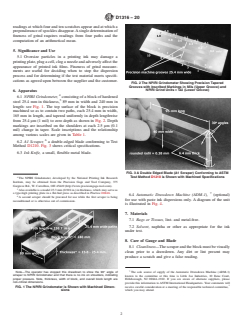
FIG. 2The NPIRI Grindometer Showing Precision Tapered
Grooves with Inscribed Markings in Mils (Upper Groove) and
6. Apparatus NPIRI Grind Units = GU (Lower Groove)
6.1 NPIRI Grindometer, consisting of a block of hardened
steel 25.4 mm in thickness, 89 mm in width and 240 mm in
length: see Fig. 1. The top surface of the block is precision
machined so as to contain two paths, each 25.4 mm in width,
165 mm in length, and tapered uniformly in depth lengthwise
from 25.4 µm (1 mil) to zero depth as shown in Fig. 2. Depth
markings are inscribed on the shoulders at each 2.5 µm (0.1
mil) change in taper. Scale inscriptions and the relationship
among various scales are given in Table 1.
6.2 A1 Scraper, a double-edged blade conforming to Test
Method D1210. Fig. 3 shows critical specifications.
6.3 Ink Knife, a small, flexible metal blade.
FIG. 3A Double Edged Blade (A1 Scraper) Conforming to ASTM
Test Method D1210 is Shown with Machined Specifications
The NPIRI Grindometer, developed by the National Printing Ink Research
Institute, may be obtained from the Precision Gage and Tool Company, 375
Gargrave Rd., W. Carrollton, OH 45449 (http://www.precisiongage-tool.com).
Also available is a model 23.3 mm (0.918 in.) in thickness, which may serve as
a type-high printing plate in a flat-bed press as described in Practice D6846.
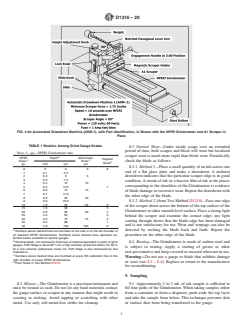
6.4 Automatic Drawdown Machine (ADM-1), (optional)
A second scraper should be procured for use while the first scraper is being
for use with paste ink dispersions only. A diagram of the unit
reconditioned or is otherwise out of commission.
is illustrated in Fig. 4.
7. Materials
7.1 Rags or Tissues, lint- and metal-free.
7.2 Solvent, naphtha or other as appropriate for the ink
under test.
8. Care of Gauge and Blade
8.1 Cleanliness—Thescraperandtheblockmustbevisually
clean prior to a drawdown. Any dirt or lint present may
produce a scratch and give a false reading.
Note—The operator has stopped this drawdown to show the 90° angle of The sole source of supply of the Automatic Drawdown Machine (ADM-1)
scraper to NPIRI Grindometer and that there is no ink on shoulders, indicating known to the committee at this time is Little Joe Industries, 10 Ilene Court,
proper pressure. Note, thickness, width of block, and overall block length are
Hillsborough, NJ 08844–1922. If you are aware of alternate suppliers, please
non-critical dimensions.
provide this information toASTM International Headquarters. Your comments will
FIG. 1The NPIRI Grindometer is Shown with Machined Dimen- receive careful consideration at a meeting of the responsible technical committee,
sions which you may attend.
D1316−20
FIG. 4An Automated Drawdown Machine (ADM-1), with Part Identification, is Shown with the NPIRI Grindometer and A1 Scraper in
Place
TABLE 1 Relation Among Grind Gauge Scales
8.3 Normal Wear—Under steady usage over an extended
period of time, both scraper and block will wear but localized
NOTE 1—gu—NPIRI Grindometer unit.
scraper wear is much more rapid than block wear. Periodically
B
NPIRI Depth Micrometer
Hegman
A C
Scale, Scale, check the blade as follows:
D
Scale
mils µm
gu µm
8.3.1 Method 1—Place a small quantity of an ink across one
00 0 0 8
end of a flat glass plate and make a drawdown. A uniform
1 0.1 2.5
20.2 5 5 drawdown indicates that the particular scraper edge is in good
3 0.3 7.5
condition.Astreak of ink or a heavier film of ink at the places
4 0.4 10 10
corresponding to the shoulders of the Grindometer is evidence
5 0.5 12.5 7
6 0.6 15 15
of blade damage or excessive wear. Repeat the drawdown with
7 0.7 17.5
the other edge of the blade.
8 0.8 20 20
9 0.9 22.5 8.3.2 Method 2 (from Test Method D1210)—Face one edge
10 1.0 25 25 6
of the scraper down across the bottom of the top surface of the
15 1.5 38 5
Grindometer or other smooth level surface. Place a strong light
20 2.0 50 50 4
25 2.5 63 3
behind the scraper and examine the contact edge; any light
30 3.0 75 75 2
coming through shows that the blade edge has been damaged
35 3.5 88 1
and is not satisfactory for use. Wear and warpage can also be
40 4.0 100 100 0
A
detected by rocking the blade back and forth. Repeat the
Numbers above dashed lines are inscribed on the side or on the left shoulder of
all standard NPIRI Grindometers. Numbers below dashed lines represent ex- procedure on the other edge of the blade.
tended scales available on special gauges.
B
Nominal depth, not necessarily thickness of material deposited in paths of grind
8.4 Rusting—The Grindometer is made of carbon steel and
gauges. Path fillage is about 80 % for a high viscosity (sheet-fed offset) ink; 60 %
is subject to rusting. Apply a coating of grease or other
for a low viscosity (letterpress news) ink. Path fillage is also decreased by fast
rust-preventative and keep covered or encased when not in use.
drawdowns.
C
Numbers above dashed lines are inscribed at every fifth calibration line on the
Warning—Do not use a gauge or blade that exhibits damage
right shoulder of newer NPIRI Grindometers.
or wear (see 8.2 – 8.4). Replace or return to the manufacturer
D
Paint Scale in Test Method D1210.
for reconditioning.
9. Sampling
8.2 Misuse—The Grindometer is a precision instrument and 9.1 Approximately 2 to 3 mL of ink sample is sufficient to
fill four paths of the Grindometer. When taking samples either
must be treated as such. Do not let any hard materials contact
the gauge surface or scraper in any manner that might result in from a container or from a disperser, push aside the top layer
and take the sample from below. This technique prevents skin
scarring or nicking. Avoid tapping or scratching with other
metal. Use only soft metal-free cloths for cleanup. or surface dust from being transferred to the gauge.
D1316−20
9.2 If the sample is a liquid ink, hand stir the sample 11.4 Place the clean scraper into the notch of the scraper
vigorously for 2 min, taking care that air bubbles are not holder and set the appropriate weight(s) onto the ADM-1
whipped in. hexagonal notched arm level. The torque selec
...