

ASTM D8020-15(2020)
(Test Method)Standard Test Method for Freeze-Thaw Viscosity Stability of Water-Based Inks and Ink Vehicles
General Information
- Abstract
SIGNIFICANCE AND USE
4.1 When waterborne inks and ink vehicles are shipped during cold weather, these materials may experience cycles of freezing and thawing. This can damage the material rendering it unusable.
4.2 Cycles of freezing and thawing can cause more damage to waterborne inks or ink vehicles than when the inks or ink vehicles are subjected to steady freezing.
SCOPE
1.1 This test method covers a procedure for evaluating the effect of freeze-thaw cycling on the properties of water-based inks and ink vehicles.
1.2 This test is based on a similar standard test for coatings; Test Method D2243.
1.3 The values stated in SI units are to be regarded as the standard. The values given in parentheses are for information only.
1.4 This standard does not purport to address all of the safety concerns, if any, associated with its use. It is the responsibility of the user of this standard to establish appropriate safety, health, and environmental practices and determine the applicability of regulatory limitations prior to use.
1.5 This international standard was developed in accordance with internationally recognized principles on standardization established in the Decision on Principles for the Development of International Standards, Guides and Recommendations issued by the World Trade Organization Technical Barriers to Trade (TBT) Committee.
- Status
- Published
- Publication Date
- 31-May-2020
- Technical Committee
- D01 - Paint and Related Coatings, Materials, and Applications
- Drafting Committee
- D01.37 - Ink Vehicles
Overview
ASTM D8020-15(2020), Standard Test Method for Freeze-Thaw Viscosity Stability of Water-Based Inks and Ink Vehicles, establishes a reliable method for assessing the effects of freeze-thaw cycles on water-based inks and ink vehicles. Developed by ASTM International, this test is essential for manufacturers, suppliers, and users who need to ensure product stability during transportation and storage, especially in cold climates. By evaluating changes in viscosity and physical condition, the standard helps determine the freeze-thaw resistance of these materials and their suitability for end-use.
Key Topics
- Freeze-thaw resistance: Evaluates how water-based inks and ink vehicles respond to repeated freezing and thawing, vital for maintaining usability after shipment or storage in cold conditions.
- Viscosity measurement: Outlines procedures for comparing the viscosity of test specimens subjected to freeze-thaw cycles against control specimens kept at room temperature.
- Assessment of physical stability: Addresses potential issues such as settling, gelation, and coagulation, which may develop during freeze-thaw cycles.
- Sampling and test conditions: Specifies the use of standardized containers, appropriate apparatus, and controlled environment for consistent results.
- Pass/fail criteria: Describes how a sample is considered stable if, after three freeze-thaw cycles, its viscosity does not more than double and no coagulation or gelation is observed.
Applications
ASTM D8020-15(2020) is widely applicable in the printing, packaging, and ink manufacturing sectors, where waterborne inks are commonly used. Key practical uses include:
- Product development: Assists formulators in designing inks and ink vehicles with enhanced freeze-thaw stability, ensuring consistent performance under variable environmental conditions.
- Quality control: Enables producers to test batches of inks before distribution, reducing the risk of product failure due to cold weather exposure.
- Transport and logistics: Offers shipping departments criteria for determining if ink products can safely endure cold climate transportation without loss of function or quality.
- Customer assurance: Provides a recognized testing method that suppliers can cite to demonstrate product reliability to customers and regulatory bodies.
Implementing this standard helps minimize product waste and costly recalls by catching potential freeze-thaw issues before inks reach end-users.
Related Standards
Several other ASTM standards are commonly referenced alongside ASTM D8020-15(2020) in the context of water-based coatings and inks:
- ASTM D2243: Test Method for Freeze-Thaw Resistance of Water-Borne Coatings, which served as the foundation for D8020.
- ASTM D2196: Test Methods for Rheological Properties of Non-Newtonian Materials by Rotational Viscometer, used for viscosity measurements.
- ASTM D4212: Test Method for Viscosity by Dip-Type Viscosity Cups, an alternative method for viscosity evaluation.
- ASTM E177: Practice for Use of the Terms Precision and Bias in ASTM Test Methods, providing guidance on statistical interpretation of results.
- ASTM E691: Practice for Conducting an Interlaboratory Study to Determine the Precision of a Test Method, referenced for precision and repeatability analysis.
By following these related standards, organizations can enhance their analytical capabilities and ensure compliance with internationally recognized quality requirements.
Keywords: ASTM D8020-15(2020), freeze-thaw stability, water-based ink, ink vehicles, viscosity stability, freeze-thaw resistance, quality control, ink testing standard, waterborne ink transport, ink manufacturing standards.
Relations
- Effective Date
- 01-Jun-2020
- Effective Date
- 01-Jun-2018
- Effective Date
- 01-Dec-2014
- Effective Date
- 01-May-2014
- Effective Date
- 01-May-2013
- Effective Date
- 01-May-2013
- Effective Date
- 01-Nov-2011
- Effective Date
- 01-Oct-2010
- Effective Date
- 01-Jul-2010
- Effective Date
- 01-Jul-2010
- Effective Date
- 01-Oct-2008
- Effective Date
- 01-Oct-2008
- Effective Date
- 01-Jun-2008
- Refers
ASTM E177-06b - Standard Practice for Use of the Terms Precision and Bias in ASTM Test Methods - Effective Date
- 15-Nov-2006
- Refers
ASTM E177-06a - Standard Practice for Use of the Terms Precision and Bias in ASTM Test Methods - Effective Date
- 01-Nov-2006
Frequently Asked Questions
ASTM D8020-15(2020) is a standard published by ASTM International. Its full title is "Standard Test Method for Freeze-Thaw Viscosity Stability of Water-Based Inks and Ink Vehicles". This standard covers: SIGNIFICANCE AND USE 4.1 When waterborne inks and ink vehicles are shipped during cold weather, these materials may experience cycles of freezing and thawing. This can damage the material rendering it unusable. 4.2 Cycles of freezing and thawing can cause more damage to waterborne inks or ink vehicles than when the inks or ink vehicles are subjected to steady freezing. SCOPE 1.1 This test method covers a procedure for evaluating the effect of freeze-thaw cycling on the properties of water-based inks and ink vehicles. 1.2 This test is based on a similar standard test for coatings; Test Method D2243. 1.3 The values stated in SI units are to be regarded as the standard. The values given in parentheses are for information only. 1.4 This standard does not purport to address all of the safety concerns, if any, associated with its use. It is the responsibility of the user of this standard to establish appropriate safety, health, and environmental practices and determine the applicability of regulatory limitations prior to use. 1.5 This international standard was developed in accordance with internationally recognized principles on standardization established in the Decision on Principles for the Development of International Standards, Guides and Recommendations issued by the World Trade Organization Technical Barriers to Trade (TBT) Committee.
SIGNIFICANCE AND USE 4.1 When waterborne inks and ink vehicles are shipped during cold weather, these materials may experience cycles of freezing and thawing. This can damage the material rendering it unusable. 4.2 Cycles of freezing and thawing can cause more damage to waterborne inks or ink vehicles than when the inks or ink vehicles are subjected to steady freezing. SCOPE 1.1 This test method covers a procedure for evaluating the effect of freeze-thaw cycling on the properties of water-based inks and ink vehicles. 1.2 This test is based on a similar standard test for coatings; Test Method D2243. 1.3 The values stated in SI units are to be regarded as the standard. The values given in parentheses are for information only. 1.4 This standard does not purport to address all of the safety concerns, if any, associated with its use. It is the responsibility of the user of this standard to establish appropriate safety, health, and environmental practices and determine the applicability of regulatory limitations prior to use. 1.5 This international standard was developed in accordance with internationally recognized principles on standardization established in the Decision on Principles for the Development of International Standards, Guides and Recommendations issued by the World Trade Organization Technical Barriers to Trade (TBT) Committee.
ASTM D8020-15(2020) is classified under the following ICS (International Classification for Standards) categories: 87.080 - Inks. Printing inks. The ICS classification helps identify the subject area and facilitates finding related standards.
ASTM D8020-15(2020) has the following relationships with other standards: It is inter standard links to ASTM D8020-15, ASTM D2196-18, ASTM D4212-10(2014), ASTM E177-14, ASTM E177-13, ASTM E691-13, ASTM E691-11, ASTM E177-10, ASTM D2196-10, ASTM D4212-10, ASTM E177-08, ASTM E691-08, ASTM D2243-95(2008), ASTM E177-06b, ASTM E177-06a. Understanding these relationships helps ensure you are using the most current and applicable version of the standard.
ASTM D8020-15(2020) is available in PDF format for immediate download after purchase. The document can be added to your cart and obtained through the secure checkout process. Digital delivery ensures instant access to the complete standard document.
Standards Content (Sample)
This international standard was developed in accordance with internationally recognized principles on standardization established in the Decision on Principles for the
Development of International Standards, Guides and Recommendations issued by the World Trade Organization Technical Barriers to Trade (TBT) Committee.
Designation:D8020 −15 (Reapproved 2020)
Standard Test Method for
Freeze-Thaw Viscosity Stability of Water-Based Inks and Ink
Vehicles
This standard is issued under the fixed designation D8020; the number immediately following the designation indicates the year of
original adoption or, in the case of revision, the year of last revision. A number in parentheses indicates the year of last reapproval. A
superscript epsilon (´) indicates an editorial change since the last revision or reapproval.
1. Scope E691 Practice for Conducting an Interlaboratory Study to
Determine the Precision of a Test Method
1.1 This test method covers a procedure for evaluating the
effect of freeze-thaw cycling on the properties of water-based
3. Summary of Test Method
inks and ink vehicles.
3.1 The waterborne ink or ink vehicle is placed into two
1.2 This test is based on a similar standard test for coatings;
237-mL plastic jars. One jar is stored at room temperature,
Test Method D2243.
while the other jar is subjected to cycles of freezing and
thawing. After cycling, the ink or ink vehicle is examined for
1.3 The values stated in SI units are to be regarded as the
standard. The values given in parentheses are for information changes in viscosity and uniformity.
only.
4. Significance and Use
1.4 This standard does not purport to address all of the
4.1 When waterborne inks and ink vehicles are shipped
safety concerns, if any, associated with its use. It is the
during cold weather, these materials may experience cycles of
responsibility of the user of this standard to establish appro-
freezing and thawing. This can damage the material rendering
priate safety, health, and environmental practices and deter-
it unusable.
mine the applicability of regulatory limitations prior to use.
1.5 This international standard was developed in accor- 4.2 Cycles of freezing and thawing can cause more damage
dance with internationally recognized principles on standard- to waterborne inks or ink vehicles than when the inks or ink
vehicles are subjected to steady freezing.
ization established in the Decision on Principles for the
Development of International Standards, Guides and Recom-
5. Apparatus
mendations issued by the World Trade Organization Technical
Barriers to Trade (TBT) Committee. 5.1 Test Chamber, a suitable cabinet, room, or enclosure
space large enough to contain the specimens to be tested
2. Referenced Documents permitting at least 25 mm (1 in.) of air space between the sides
2 of adjacent jars and capable of being maintained continuously
2.1 ASTM Standards:
at a temperature of –18°C (0°F).
D2243 Test Method for Freeze-Thaw Resistance of Water-
NOTE1—Althoughavariationofthetestchambertemperatureof 62°C
Borne Coatings
(3.5°F) is allowed, the test chamber temperature should be maintained as
D2196 Test Methods for Rheological Properties of Non-
near –18°C (0°F) as practicable and the amount of variation should be
Newtonian Materials by Rotational Viscometer recorded and reported.
D4212 Test Method for Viscosity by Dip-Type Viscosity
5.2 Viscometer, a dip-type viscosity cup as described in Test
Cups
Method D4212 or a Brookfield type viscometer as described in
E177 Practice for Use of the Terms Precision and Bias in
Test Methods D2196.
ASTM Test Methods
5.3 Recirculating Water Bath, capable of maintaining a
temperature of 25 6 1°C (77 61.8°F).
5.4 Cylindrical Container, with a capacity of 0.5-L (1-pt),
This test method is under the jurisdiction of ASTM Committee D01 on Paint
and Related Coatings, Materials, andApplications and is the direct responsibility of 85 mm (3 ⁄8 in.) diameter to contain the test specimen during
Subcommittee D01.37 on Ink Vehicles.
testing.
CurrenteditionapprovedJune1,2020.PublishedJuly2020.Originallyapproved
in 2015. Last previous edition approved in 2015 as D8020 – 15. DOI: 10.1520/ 5.5 Spatula.
D8020-15R20.
For referenced ASTM standards, visit the ASTM website, www.astm.org, or 6. Sampling and Test Specimens
contact ASTM Customer Service at service@astm.org. For Annual Book of ASTM
6.1 Ensure that the bulk sample from which the jars are
Standards volume information, refer to the standard’s Document Summary page on
the ASTM website. filled is well stirred and uniform, the containers used are clean,
Copyright © ASTM International, 100 Barr Harbor Drive, PO Box C700, West Conshohocken, PA 19428-2959. United States
D8020−15 (2020)
and the lids are applied promptly to the jars to prevent 9. Report
evaporation losses. Prepare two specimens for testing by filling
9.1 Report the following information:
0.5-L plastic jars with 400 mL of the ink or ink vehicle.
9.1.1 The condition of the ink or ink vehicle in the jar in
Identify one as the test specimen and the other as the control
accordance with 7.5 after each cycle.
specimen.
9.1.2 The change in viscosity between the test and control
inks or ink vehicles in accordance with 7.6.
7. Procedure
9.1.3 The number of cycles passed by the test specimen.
7.1 Stir the specimen by hand and measure its viscosity in
10. Precision and Bias
accordance with Test Methods D4212 or D2196.
10.1 The precision of this test method is based on an
7.2 Store the control specimen at room temperature.
interlaboratory study of ASTM D8020, Test Method for
7.3 Place the test specimen in the chamber maintained at
Freeze-Thaw Viscosity Stability of Water-Based Inks and Ink
–18°C (0°F) in such a manner that it does not touch the walls
Vehicles, conducted in 2013. A total of six laboratories tested
or bottom of the chamber and air circulates around it freely.
five different samples, using two methods. Every “test result”
Placing jars on racks that raise them off the bottom of the
representsanindividualdetermination,andoneparticipantwas
chamber or upon pieces of insulating board resting on the
asked to report duplicate test results. Practice E691 was
bottom is suggested. In the case of several test specimens,
followed for the design and analysis of the data; the details are
maintain a minimum of 25 mm (1 in.) of air space between
given in ASTM Research Report RR:D01-1180.
adjacent jars and between jars and the chamber walls.
10.1.1 Repeatability (r)—The difference between repetitive
7.4 Remove the test specimen from the chamber after 17 h.
results obtained by the same operator in a given laboratory
Place it adjacent to the control specimen and allow it to stand
applying the same test method with the same apparatus under
for 5 h undisturbed at room temperature, followed by2hina
constant operating conditions on identical test material within
recirculating water bath for a complete freeze-thaw cycle of
short intervals of time would in the long run, in the normal and
24 h.
correct operation of the test method, exceed the following
values only in one case in 20.
7.5 Examine both the test and control specimens for any
10.1.1.1 Repeatability can be interpreted as maximum dif-
evidence of settling, gelation, and coagulation.
ference between two results, obtained under repeatability
7.6 Stir the test and control ink or ink vehicle by hand using
conditions, that is accepted as plausible due to random causes
a spatula. Stir carefully so as to avoid air entrainment and
under normal and correct operation of the test method.
foam. Measure the viscosities in accordance withTest Methods
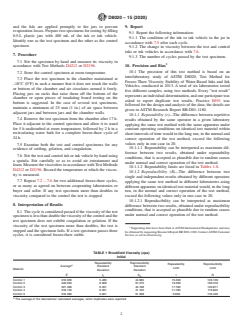
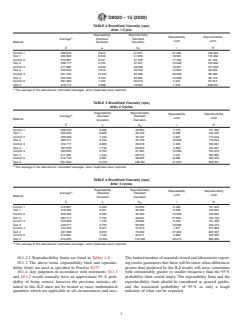
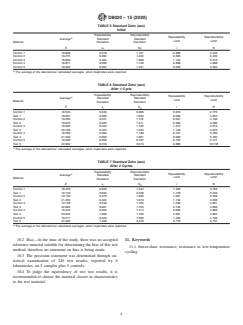
10.1.1.2 Repeatability limits are listed in Tables 1-8.
D4212 or D2196. Record the temperature at which the viscos-
10.1.2 Reproducibility (R)—The difference between two
ity is measured.
single and independent results obtained by different operators
7.7 Repeat 7.2 – 7.6 for two additional freeze-thaw cycles,
applying the same test method in different laboratories using
or as many as agreed on between cooperating laboratories or
different apparatus on identical test material would, in the long
buyer and seller. If any test specimen more than doubles in
run, in the normal and correct operation of the test method,
viscosity compared to the control the test is stopped.
exceed the following values only in one case in 20.
10.1.2.1 Reproducibility can be interpreted as maximum
8. Interpretation of Results
difference between two results, obtained under reproducibility
conditions, that is accepted as plausible due to random causes
8.1 The cycle is considered passed if the viscosity of the test
under normal and correct operation of the test method.
specimenislessthandoubletheviscosityofthecontrolandthe
test specimen does not ex
...