

ASTM D4815-22
(Test Method)Standard Test Method for Determination of MTBE, ETBE, TAME, DIPE, tertiary-Amyl Alcohol and C1 to C4 Alcohols in Gasoline by Gas Chromatography
General Information
- Abstract
SIGNIFICANCE AND USE
5.1 Ethers, alcohols, and other oxygenates can be added to gasoline to increase octane number and to reduce emissions. Type and concentration of various oxygenates are specified and regulated to ensure acceptable commercial gasoline quality. Drivability, vapor pressure, phase separation, exhaust, and evaporative emissions are some of the concerns associated with oxygenated fuels.
5.2 This test method is applicable to both quality control in the production of gasoline and for the determination of deliberate or extraneous oxygenate additions or contamination.
SCOPE
1.1 This test method covers the determination of ethers and alcohols in gasolines by gas chromatography. Specific compounds determined are methyl tert-butylether (MTBE), ethyl tert-butylether (ETBE), tert-amylmethylether (TAME), diisopropylether (DIPE), methanol, ethanol, isopropanol, n-propanol, isobutanol, tert-butanol, sec-butanol, n-butanol, and tert-pentanol (tert-amylalcohol).
1.2 Individual ethers are determined from 0.20 % to 20.0 % by mass. Individual alcohols are determined from 0.20 % to 12.0 % by mass. Equations used to convert to mass percent oxygen and to volume percent of individual compounds are provided. At concentrations 10 % by volume olefins, the interference may be >0.20 % by mass. Annex A1 gives a chromatogram showing the interference observed with a gasoline containing 10 % by volume olefins.
1.3 This test method includes a relative bias correlation for ethanol in spark-ignition engine fuels for the U.S. EPA regulations reporting based on Practice D6708 accuracy assessment between Test Method D4815 and Test Method D5599 as a possible Test Method D4815 alternative to Test Method D5599. The Practice D6708 derived correlation equation is only applicable for ethanol in fuels in the concentration range from 2.28 % to 14.42 % by mass as measured by Test Method D4815. The applicable Test Method D5599 range for ethanol is from 2.16 % to 14.39 % by mass as reported by Test Method D5599.
1.4 Alcohol-based fuels, such as M-85 and E-85, MTBE product, ethanol product, and denatured alcohol, are specifically excluded from this test method. The methanol content of M-85 fuel is considered beyond the operating range of the system.
1.5 Benzene, while detected, cannot be quantified using this test method and shall be analyzed by alternate methodology (see Test Method D3606).
1.6 The values stated in SI units are to be regarded as standard. Alternate units, in common usage, are also provided to increase clarity and aid the users of this test method.
1.7 This standard does not purport to address all of the safety concerns, if any, associated with its use. It is the responsibility of the user of this standard to establish appropriate safety, health, and environmental practices and determine the applicability of regulatory limitations prior to use.
1.8 This international standard was developed in accordance with internationally recognized principles on standardization established in the Decision on Principles for the Development of International Standards, Guides and Recommendations issued by the World Trade Organization Technical Barriers to Trade (TBT) Committee.
- Status
- Published
- Publication Date
- 31-Mar-2022
- Technical Committee
- D02 - Petroleum Products, Liquid Fuels, and Lubricants
- Drafting Committee
- D02.04.0L - Gas Chromatography Methods
Buy Documents
ASTM D4815-22 - Standard Test Method for Determination of MTBE, ETBE, TAME, DIPE, tertiary-Amyl Alcohol and C<inf>1</inf> to C<inf>4</inf> Alcohols in Gasoline by Gas Chromatography
REDLINE ASTM D4815-22 - Standard Test Method for Determination of MTBE, ETBE, TAME, DIPE, tertiary-Amyl Alcohol and C<inf>1</inf> to C<inf>4</inf> Alcohols in Gasoline by Gas Chromatography
Overview
ASTM D4815-22 is an internationally recognized standard test method developed by ASTM International. It outlines a highly specific procedure for the quantitative determination of selected oxygenates-ethers and alcohols-in gasoline using gas chromatography. The primary aim of the method is to ensure accurate measurement of compounds such as MTBE, ETBE, TAME, DIPE, methyl and ethyl alcohols, and C1 to C4 alcohols in gasoline. The information derived from this test procedure supports regulatory compliance, quality control, and detection of intentional or unintentional additions or contamination of oxygenates in fuel products.
Key Topics
- Scope of Measurement:
- Measurement of individual ethers (MTBE, ETBE, TAME, DIPE) and alcohols (methanol, ethanol, isopropanol, n-propanol, isobutanol, tert-butanol, sec-butanol, n-butanol, tert-pentanol/tert-amylalcohol) in gasoline.
- Applicable to concentrations from 0.20% to 20.0% by mass for ethers and 0.20% to 12.0% by mass for alcohols.
- Gas Chromatography Method:
- Use of a chromatographic system equipped with column switching and detectors such as flame ionization or thermal conductivity.
- Inclusion of calibration procedures and equations for translating results to oxygenate mass percent and volume percent.
- Regulatory and Safety Considerations:
- Developed following internationally accepted standards principles (WTO TBT Committee).
- Users must ensure adherence to safety, health, and environmental practices.
- Exclusions:
- Method not applicable to alcohol-based fuels like M-85, E-85, pure MTBE, pure ethanol, or denatured alcohol; benzene quantitation is excluded.
Applications
ASTM D4815-22 is widely used across various facets of the gasoline industry due to its precise and reliable measurement capabilities:
- Quality Control in Refining:
- Refineries use this method for ongoing analysis during gasoline production to ensure the specified oxygenate content.
- Regulatory Compliance:
- Assists fuel producers and distributors in meeting government regulations on oxygenate type and concentration to comply with environmental and fuel quality standards.
- Detection of Contaminants:
- Enables determination of both deliberate oxygenate additions and accidental contamination in gasoline, helping to identify and remediate off-spec products.
- Testing in Research and Development:
- Used in laboratories for fuel research, where understanding the effect of oxygenates on properties like octane number, drivability, vapor pressure, and emissions is essential.
Related Standards
For comprehensive fuel analysis and compliance with broader testing requirements, organizations may refer to other ASTM standards related to petroleum products and gas chromatography:
- ASTM D3606: Determination of Benzene and Toluene in Spark Ignition Fuels by Gas Chromatography
- ASTM D5599: Determination of Oxygenates in Gasoline by Gas Chromatography and Oxygen Selective Flame Ionization Detection
- ASTM D6052: (Refer for specific oxygenate and aromatic content analyses)
- ASTM D1298 and D4052: Methods for density and API gravity determination
- ASTM D4057 and D4177: Manual and automatic sampling practices for petroleum products
ASTM D4815-22 is an essential test method for the petrochemical sector, providing the reliable measurement of key oxygenates in motor gasoline necessary for maintaining product quality, regulatory compliance, and environmental protection. For accurate implementation, adherence to specified methods and safety practices ensures data reliability and operational safety.
Keywords: ASTM D4815-22, gasoline testing, gas chromatography, oxygenates determination, MTBE, ETBE, TAME, DIPE, alcohols in gasoline, fuel analysis, fuel quality control.
Relations
- Effective Date
- 01-Mar-2024
- Effective Date
- 01-Mar-2024
- Effective Date
- 01-Jan-2024
- Refers
ASTM D4175-23a - Standard Terminology Relating to Petroleum Products, Liquid Fuels, and Lubricants - Effective Date
- 15-Dec-2023
- Refers
ASTM D5842-23 - Standard Practice for Sampling and Handling of Fuels for Volatility Measurement - Effective Date
- 01-Oct-2023
- Refers
ASTM D4175-23e1 - Standard Terminology Relating to Petroleum Products, Liquid Fuels, and Lubricants - Effective Date
- 01-Jul-2023
- Refers
ASTM D5842-19 - Standard Practice for Sampling and Handling of Fuels for Volatility Measurement - Effective Date
- 01-Nov-2019
- Effective Date
- 01-May-2019
- Effective Date
- 01-Apr-2018
- Effective Date
- 01-May-2017
- Effective Date
- 01-Apr-2016
- Effective Date
- 01-Jan-2016
- Effective Date
- 01-Oct-2015
- Effective Date
- 01-Jul-2015
- Effective Date
- 01-Jun-2015
Buy Documents
ASTM D4815-22 - Standard Test Method for Determination of MTBE, ETBE, TAME, DIPE, tertiary-Amyl Alcohol and C<inf>1</inf> to C<inf>4</inf> Alcohols in Gasoline by Gas Chromatography
REDLINE ASTM D4815-22 - Standard Test Method for Determination of MTBE, ETBE, TAME, DIPE, tertiary-Amyl Alcohol and C<inf>1</inf> to C<inf>4</inf> Alcohols in Gasoline by Gas Chromatography
Get Certified
Connect with accredited certification bodies for this standard

Element Materials Technology
Materials testing and product certification.

ABS Group Brazil
ABS Group certification services in Brazil.

ABS Quality Evaluations Inc.
American Bureau of Shipping quality certification.
Sponsored listings
Frequently Asked Questions
ASTM D4815-22 is a standard published by ASTM International. Its full title is "Standard Test Method for Determination of MTBE, ETBE, TAME, DIPE, tertiary-Amyl Alcohol and C<inf>1</inf> to C<inf>4</inf> Alcohols in Gasoline by Gas Chromatography". This standard covers: SIGNIFICANCE AND USE 5.1 Ethers, alcohols, and other oxygenates can be added to gasoline to increase octane number and to reduce emissions. Type and concentration of various oxygenates are specified and regulated to ensure acceptable commercial gasoline quality. Drivability, vapor pressure, phase separation, exhaust, and evaporative emissions are some of the concerns associated with oxygenated fuels. 5.2 This test method is applicable to both quality control in the production of gasoline and for the determination of deliberate or extraneous oxygenate additions or contamination. SCOPE 1.1 This test method covers the determination of ethers and alcohols in gasolines by gas chromatography. Specific compounds determined are methyl tert-butylether (MTBE), ethyl tert-butylether (ETBE), tert-amylmethylether (TAME), diisopropylether (DIPE), methanol, ethanol, isopropanol, n-propanol, isobutanol, tert-butanol, sec-butanol, n-butanol, and tert-pentanol (tert-amylalcohol). 1.2 Individual ethers are determined from 0.20 % to 20.0 % by mass. Individual alcohols are determined from 0.20 % to 12.0 % by mass. Equations used to convert to mass percent oxygen and to volume percent of individual compounds are provided. At concentrations 10 % by volume olefins, the interference may be >0.20 % by mass. Annex A1 gives a chromatogram showing the interference observed with a gasoline containing 10 % by volume olefins. 1.3 This test method includes a relative bias correlation for ethanol in spark-ignition engine fuels for the U.S. EPA regulations reporting based on Practice D6708 accuracy assessment between Test Method D4815 and Test Method D5599 as a possible Test Method D4815 alternative to Test Method D5599. The Practice D6708 derived correlation equation is only applicable for ethanol in fuels in the concentration range from 2.28 % to 14.42 % by mass as measured by Test Method D4815. The applicable Test Method D5599 range for ethanol is from 2.16 % to 14.39 % by mass as reported by Test Method D5599. 1.4 Alcohol-based fuels, such as M-85 and E-85, MTBE product, ethanol product, and denatured alcohol, are specifically excluded from this test method. The methanol content of M-85 fuel is considered beyond the operating range of the system. 1.5 Benzene, while detected, cannot be quantified using this test method and shall be analyzed by alternate methodology (see Test Method D3606). 1.6 The values stated in SI units are to be regarded as standard. Alternate units, in common usage, are also provided to increase clarity and aid the users of this test method. 1.7 This standard does not purport to address all of the safety concerns, if any, associated with its use. It is the responsibility of the user of this standard to establish appropriate safety, health, and environmental practices and determine the applicability of regulatory limitations prior to use. 1.8 This international standard was developed in accordance with internationally recognized principles on standardization established in the Decision on Principles for the Development of International Standards, Guides and Recommendations issued by the World Trade Organization Technical Barriers to Trade (TBT) Committee.
SIGNIFICANCE AND USE 5.1 Ethers, alcohols, and other oxygenates can be added to gasoline to increase octane number and to reduce emissions. Type and concentration of various oxygenates are specified and regulated to ensure acceptable commercial gasoline quality. Drivability, vapor pressure, phase separation, exhaust, and evaporative emissions are some of the concerns associated with oxygenated fuels. 5.2 This test method is applicable to both quality control in the production of gasoline and for the determination of deliberate or extraneous oxygenate additions or contamination. SCOPE 1.1 This test method covers the determination of ethers and alcohols in gasolines by gas chromatography. Specific compounds determined are methyl tert-butylether (MTBE), ethyl tert-butylether (ETBE), tert-amylmethylether (TAME), diisopropylether (DIPE), methanol, ethanol, isopropanol, n-propanol, isobutanol, tert-butanol, sec-butanol, n-butanol, and tert-pentanol (tert-amylalcohol). 1.2 Individual ethers are determined from 0.20 % to 20.0 % by mass. Individual alcohols are determined from 0.20 % to 12.0 % by mass. Equations used to convert to mass percent oxygen and to volume percent of individual compounds are provided. At concentrations 10 % by volume olefins, the interference may be >0.20 % by mass. Annex A1 gives a chromatogram showing the interference observed with a gasoline containing 10 % by volume olefins. 1.3 This test method includes a relative bias correlation for ethanol in spark-ignition engine fuels for the U.S. EPA regulations reporting based on Practice D6708 accuracy assessment between Test Method D4815 and Test Method D5599 as a possible Test Method D4815 alternative to Test Method D5599. The Practice D6708 derived correlation equation is only applicable for ethanol in fuels in the concentration range from 2.28 % to 14.42 % by mass as measured by Test Method D4815. The applicable Test Method D5599 range for ethanol is from 2.16 % to 14.39 % by mass as reported by Test Method D5599. 1.4 Alcohol-based fuels, such as M-85 and E-85, MTBE product, ethanol product, and denatured alcohol, are specifically excluded from this test method. The methanol content of M-85 fuel is considered beyond the operating range of the system. 1.5 Benzene, while detected, cannot be quantified using this test method and shall be analyzed by alternate methodology (see Test Method D3606). 1.6 The values stated in SI units are to be regarded as standard. Alternate units, in common usage, are also provided to increase clarity and aid the users of this test method. 1.7 This standard does not purport to address all of the safety concerns, if any, associated with its use. It is the responsibility of the user of this standard to establish appropriate safety, health, and environmental practices and determine the applicability of regulatory limitations prior to use. 1.8 This international standard was developed in accordance with internationally recognized principles on standardization established in the Decision on Principles for the Development of International Standards, Guides and Recommendations issued by the World Trade Organization Technical Barriers to Trade (TBT) Committee.
ASTM D4815-22 is classified under the following ICS (International Classification for Standards) categories: 75.160.20 - Liquid fuels. The ICS classification helps identify the subject area and facilitates finding related standards.
ASTM D4815-22 has the following relationships with other standards: It is inter standard links to ASTM D6708-24, ASTM D3606-24, ASTM E203-24, ASTM D4175-23a, ASTM D5842-23, ASTM D4175-23e1, ASTM D5842-19, ASTM D6708-19, ASTM D6708-18, ASTM D5599-17, ASTM D6708-16a, ASTM D6708-16, ASTM D4307-99(2015), ASTM D6708-15, ASTM D5599-15. Understanding these relationships helps ensure you are using the most current and applicable version of the standard.
ASTM D4815-22 is available in PDF format for immediate download after purchase. The document can be added to your cart and obtained through the secure checkout process. Digital delivery ensures instant access to the complete standard document.
Standards Content (Sample)
This international standard was developed in accordance with internationally recognized principles on standardization established in the Decision on Principles for the
Development of International Standards, Guides and Recommendations issued by the World Trade Organization Technical Barriers to Trade (TBT) Committee.
Designation: D4815 − 22
Standard Test Method for
Determination of MTBE, ETBE, TAME, DIPE, tertiary-Amyl
Alcohol and C to C Alcohols in Gasoline by Gas
1 4
Chromatography
This standard is issued under the fixed designation D4815; the number immediately following the designation indicates the year of
original adoption or, in the case of revision, the year of last revision. A number in parentheses indicates the year of last reapproval. A
superscript epsilon (´) indicates an editorial change since the last revision or reapproval.
This standard has been approved for use by agencies of the U.S. Department of Defense.
1. Scope* cally excluded from this test method. The methanol content of
M-85 fuel is considered beyond the operating range of the
1.1 This test method covers the determination of ethers and
system.
alcohols in gasolines by gas chromatography. Specific com-
pounds determined are methyl tert-butylether (MTBE), ethyl 1.5 Benzene, while detected, cannot be quantified using this
tert-butylether (ETBE), tert-amylmethylether (TAME), diiso- test method and shall be analyzed by alternate methodology
propylether (DIPE), methanol, ethanol, isopropanol, (see Test Method D3606).
n-propanol, isobutanol, tert-butanol, sec-butanol, n-butanol,
1.6 The values stated in SI units are to be regarded as
and tert-pentanol (tert-amylalcohol).
standard. Alternate units, in common usage, are also provided
1.2 Individual ethers are determined from 0.20 % to 20.0 %
to increase clarity and aid the users of this test method.
by mass. Individual alcohols are determined from 0.20 % to
1.7 This standard does not purport to address all of the
12.0 % by mass. Equations used to convert to mass percent
safety concerns, if any, associated with its use. It is the
oxygen and to volume percent of individual compounds are
responsibility of the user of this standard to establish appro-
provided. At concentrations <0.20 % by mass, it is possible
priate safety, health, and environmental practices and deter-
that hydrocarbons may interfere with several ethers and alco-
mine the applicability of regulatory limitations prior to use.
hols. The reporting limit of 0.20 % by mass was tested for
1.8 This international standard was developed in accor-
gasolines containing a maximum of 10 % by volume olefins. It
dance with internationally recognized principles on standard-
maybepossiblethatforgasolinescontaining>10 %byvolume
ization established in the Decision on Principles for the
olefins, the interference may be >0.20 % by mass. Annex A1
Development of International Standards, Guides and Recom-
gives a chromatogram showing the interference observed with
mendations issued by the World Trade Organization Technical
a gasoline containing 10 % by volume olefins.
Barriers to Trade (TBT) Committee.
1.3 This test method includes a relative bias correlation for
2. Referenced Documents
ethanol in spark-ignition engine fuels for the U.S. EPA
regulationsreportingbasedonPracticeD6708accuracyassess-
2.1 ASTM Standards:
ment between Test Method D4815 and Test Method D5599 as
D1298 Test Method for Density, Relative Density, or API
a possible Test Method D4815 alternative to Test Method
Gravity of Crude Petroleum and Liquid Petroleum Prod-
D5599. The Practice D6708 derived correlation equation is
ucts by Hydrometer Method
only applicable for ethanol in fuels in the concentration range
D1744 Test Method for Determination of Water in Liquid
from 2.28 % to 14.42 % by mass as measured by Test Method
Petroleum Products by Karl Fischer Reagent (Withdrawn
D4815.TheapplicableTestMethodD5599rangeforethanolis
2016)
from 2.16 % to 14.39 % by mass as reported by Test Method
D3606 Test Method for Determination of Benzene and
D5599.
Toluene in Spark Ignition Fuels by Gas Chromatography
D4052 Test Method for Density, Relative Density, and API
1.4 Alcohol-based fuels, such as M-85 and E-85, MTBE
product, ethanol product, and denatured alcohol, are specifi-
1 2
This test method is under the jurisdiction of ASTM Committee D02 on For referenced ASTM standards, visit the ASTM website, www.astm.org, or
Petroleum Products, Liquid Fuels, and Lubricants and is the direct responsibility of contact ASTM Customer Service at service@astm.org. For Annual Book of ASTM
Subcommittee D02.04.0L on Gas Chromatography Methods. Standards volume information, refer to the standard’s Document Summary page on
Current edition approved April 1, 2022. Published April 2022. Originally the ASTM website.
approved in 1989. Last previous edition approved in 2019 as D4815 – 15b (2019). The last approved version of this historical standard is referenced on
DOI: 10.1520/D4815-22. www.astm.org.
*A Summary of Changes section appears at the end of this standard
Copyright © ASTM International, 100 Barr Harbor Drive, PO Box C700, West Conshohocken, PA 19428-2959. United States
D4815 − 22
Gravity of Liquids by Digital Density Meter 4. Summary of Test Method
D4057 Practice for Manual Sampling of Petroleum and
4.1 An appropriate internal standard, such as 1,2-
Petroleum Products
dimethoxyethane (ethylene glycol dimethyl ether), is added to
D4175 Terminology Relating to Petroleum Products, Liquid
the sample, which is then introduced into a gas chromatograph
Fuels, and Lubricants
equippedwithtwocolumnsandacolumnswitchingvalve.The
D4177 Practice for Automatic Sampling of Petroleum and
sample first passes onto a polar TCEP column, which elutes
Petroleum Products
lighter hydrocarbons to vent and retains the oxygenated and
D4307 Practice for Preparation of Liquid Blends for Use as
heavier hydrocarbons.
Analytical Standards
4.2 After methylcyclopentane, but before DIPE and MTBE
D4420 Test Method for Determination of Aromatics in
elute from the polar column, the valve is switched to backflush
Finished Gasoline by Gas Chromatography (Withdrawn
the oxygenates onto a WCOT nonpolar column. The alcohols
2004)
and ethers elute from the nonpolar column in boiling point
D5599 Test Method for Determination of Oxygenates in
order, before elution of any major hydrocarbon constituents.
Gasoline by Gas Chromatography and Oxygen Selective
Flame Ionization Detection
4.3 After benzene and TAME elute from the nonpolar
D5842 Practice for Sampling and Handling of Fuels for
column, the column switching valve is switched back to its
Volatility Measurement
original position to backflush the heavy hydrocarbons.
D6304 Test Method for Determination of Water in Petro-
4.4 The eluted components are detected by a flame ioniza-
leum Products, Lubricating Oils, and Additives by Cou-
tion or thermal conductivity detector. The detector response,
lometric Karl Fischer Titration
proportional to the component concentration, is recorded; the
D6708 Practice for StatisticalAssessment and Improvement
peak areas are measured; and the concentration of each
of Expected Agreement Between Two Test Methods that
componentiscalculatedwithreferencetotheinternalstandard.
Purport to Measure the Same Property of a Material
E203 Test Method for Water Using Volumetric Karl Fischer
5. Significance and Use
Titration
5.1 Ethers, alcohols, and other oxygenates can be added to
gasoline to increase octane number and to reduce emissions.
3. Terminology
Typeandconcentrationofvariousoxygenatesarespecifiedand
3.1 Definitions:
regulated to ensure acceptable commercial gasoline quality.
3.1.1 For definitions of terms used in this test method, refer
Drivability, vapor pressure, phase separation, exhaust, and
to Terminology D4175.
evaporativeemissionsaresomeoftheconcernsassociatedwith
3.2 Definitions of Terms Specific to This Standard:
oxygenated fuels.
3.2.1 low volume connector—a special union for connecting
5.2 This test method is applicable to both quality control in
two lengths of tubing 1.6 mm inside diameter and smaller.
Sometimes this is referred to as zero dead volume union. the production of gasoline and for the determination of
deliberate or extraneous oxygenate additions or contamination.
3.2.2 oxygenate—anyoxygen-containingorganiccompound
that can be used as a fuel or fuel supplement, for example,
6. Apparatus
various alcohols and ethers.
6.1 Chromatograph—While any gas chromatographic
3.2.3 split ratio—in capillary gas chromatography, the ratio
system,whichiscapableofadequatelyresolvingtheindividual
of the total flow of carrier gas to the sample inlet versus the
ethers and alcohols that are presented in Table 1, can be used
flow of the carrier gas to the capillary column, expressed by
for these analyses, a gas chromatographic instrument, which
split ratio 5 ~S1C!/C (1)
can be operated at the conditions given in Table 2 and has a
where: column switching and backflushing system equivalent to Fig.
1, has been found acceptable. Carrier gas flow controllers shall
S = flow rate at the splitter vent, and
be capable of precise control where the required flow rates are
C = flow rate at the column outlet.
low (see Table 2). Pressure control devices and gages shall be
3.2.4 tert-amyl alcohol—tert-pentanol.
capable of precise control for the typical pressures required.
3.3 Acronyms:
6.1.1 Detector—A thermal conductivity detector or flame
3.3.1 DIPE—diisopropylether.
ionization detector can be used. The system shall have suffi-
3.3.2 ETBE—ethyl tert-butylether.
cient sensitivity and stability to obtain a recorder deflection of
at least 2 mm at a signal-to-noise ratio of at least 5 to 1 for
3.3.3 MTBE—methyl tert-butylether.
0.005 % by volume concentration of an oxygenate.
3.3.4 TAME—tert-amyl methylether.
6.1.2 Switching and Backflushing Valve—A valve, to be
3.3.5 TCEP—1,2,3-tris-2-cyanoethoxypropane—a gas
located within the gas chromatographic column oven, capable
chromatographic liquid phase.
of performing the functions described in Section 11 and
3.3.6 WCOT—a type of capillary gas chromatographic col- illustrated in Fig. 1. The valve shall be of low volume design
umn prepared by coating the inside of the capillary with a thin and not contribute significantly to chromatographic deteriora-
film of stationary phase. tion.
D4815 − 22
TABLE 1 Pertinent Physical Constants and Retention
6.1.4.2 Microlitre syringes, automatic syringe injectors, and
Characteristics for TCEP/WCOT Column Set Conditions
liquid sampling valves have been used successfully for intro-
as in Table 2
ducing representative samples into the gas chromatographic
Relative Retention
Relative
inlet.
Time
Retention Molecular Density at
Component
Time, Min. Mass 15.56/
6.2 Data Presentation or Calculation, or Both:
(MTBE = (DME =
15.5 6 °C
1.00) 1.00)
6.2.1 Recorder—A recording potentiometer or equivalent
Water 2.90 0.58 0.43 18.0 1.000
with a full-scale deflection of 5 mV or less can be used to
Methanol 3.15 0.63 0.46 32.0 0.7963
monitor detector signal. Full-scale response time should be 1 s
Ethanol 3.48 0.69 0.51 46.1 0.7939
or less with sufficient sensitivity and stability to meet the
Isopropanol 3.83 0.76 0.56 60.1 0.7899
tert-Butanol 4.15 0.82 0.61 74.1 0.7922
requirements of 6.1.1.
n-Propanol 4.56 0.90 0.67 60.1 0.8080
6.2.2 Integrator or Computer—Means shall be provided for
MTBE 5.04 1.00 0.74 88.2 0.7460
determiningthedetectorresponse.Peakheightsorareascanbe
sec-Butanol 5.36 1.06 0.79 74.1 0.8114
DIPE 5.76 1.14 0.85 102.2 0.7282
measured by computer, electronic integration, or manual tech-
Isobutanol 6.00 1.19 0.88 74.1 0.8058
niques.
ETBE 6.20 1.23 0.91 102.2 0.7452
tert-Pentanol 6.43 1.28 0.95 88.1 0.8170
6.3 Columns, Two as Follows:
1,2-Dimethoxyethane 6.80 1.35 1.00 90.1 0.8720
6.3.1 Polar Column—Thiscolumnperformsapreseparation
(DME)
n-Butanol 7.04 1.40 1.04 74.1 0.8137 of the oxygenates from volatile hydrocarbons in the same
TAME 8.17 1.62 1.20 102.2 0.7758
boiling point range. The oxygenates and remaining hydrocar-
bons are backflushed onto the nonpolar column in 6.3.2. Any
column with equivalent or better chromatographic efficiency
TABLE 2 Chromatographic Operation Conditions
and selectivity to that described in 6.3.1.1 can be used. The
Temperatures Flows, mL/min Carrier Gas: Helium
column shall perform at the same temperature as required for
A
Column Oven 60 to injector 75 Sample size, µL 1.0–3.0
the column in 6.3.2, except if located in a separate auxiliary
Injector, °C 200 Column 5 Split ratio 15:1
oven as in 6.1.2.3.
Detector—TCD, °C 200 Auxiliary 3 Backflush, min 0.2–0.3
—FID, °C 250 Makeup 18 Valve reset time 8–10 min
6.3.1.1 TCEP Micro-Packed Column, 560 mm (22 in.) by
Valve °C 60 Total Analysis time 18–20 min
1.6 mm ( ⁄16 in.) outside diameter by 0.76 mm (0.030 in.)
A
Sample size shall be adjusted so that alcohols in the range of 0.1 % to 12.0 %
insidediameterstainlesssteeltubepackedwith0.14 gto0.15 g
by mass and ethers in the range of 0.1 % to 20.0 % by mass are eluted from the
of 20 % (mass/mass) TCEP on 80/100 mesh Chromosorb
column and measured linearly at the detector. A sample size of 1.0 µL has been
introduced in most cases.
P(AW). This column was used in the cooperative study to
provide the precision and bias data referred to in Section 15.
6.3.2 Nonpolar (Analytical) Column—Any column with
equivalent or better chromatographic efficiency and selectivity
tothatdescribedin6.3.2.1andillustratedinFig.2canbeused.
6.1.2.1 Valco Model No. A 4C10WP, 1.6 mm ( ⁄16 in.) fit-
6.3.2.1 WCOT Methyl Silicone Column, 30 m (1181 in.)
tings. This particular valve was used in the majority of the long by 0.53 mm (0.021 in.) inside diameter fused silica
analyses used for the development of Section 15.
WCOT column with a 2.6 µm film thickness of cross-linked
6.1.2.2 Valco Model No. C10W, 0.8 mm ( ⁄32 in.) fittings. methyl siloxane. This column was used in the cooperative
This valve is recommended for use with columns of 0.32 mm study to provide the precision and bias data referred to in
inside diameter and smaller. Section 15.
6.1.2.3 Some gas chromatographs are equipped with an
7. Reagents and Materials
auxiliary oven, which can be used to contain the valve and
7.1 Carrier Gas—Carrier gas appropriate to the type of
polar column. In such a configuration, the nonpolar column is
detector used. Helium has been used successfully. The mini-
located in the main oven and the temperature can be adjusted
mum purity of the carrier gas used shall be 99.95 mol %.
for optimum oxygenates resolution.
6.1.3 An automatic valve switching device shall be used to
7.2 Standards for Calibration and Identification—Standards
ensure repeatable switching times. Such a device should be of all components to be analyzed and the internal standard are
synchronized with injection and data collection times.
requiredforestablishingidentificationbyretentiontimeaswell
as calibration for quantitative measurements. These materials
6.1.4 Injection System—The chromatograph should be
equipped with a splitting-type inlet device if capillary columns shallbeofknownpurityandfreeoftheothercomponentstobe
or flame ionization detection are used. Split injection is analyzed. (Warning—These materials are flammable and can
necessary to maintain the actual chromatographed sample size be harmful or fatal if ingested or inhaled.)
within the limits of column and detector optimum efficiency
7.3 Methylene Chloride, used for column preparation, re-
and linearity.
agent grade, free of nonvolatile residue. (Warning—Harmful
6.1.4.1 Some gas chromatographs are equipped with on-
if inhaled. High concentrations may cause unconsciousness or
column injectors and autosamplers, which can inject small
death.)
samples sizes. Such injection systems can be used provided
8. Preparation of Column Packings
that sample size is within the limit of the column and detectors
optimum efficiency and linearity. 8.1 TCEP Column Packing:
D4815 − 22
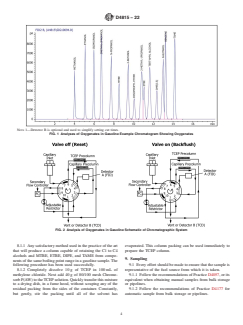
NOTE 1—Detector B is optional and used to simplify setting cut times.
FIG. 1 Analyses of Oxygenates in Gasoline Example Chromatogram Showing Oxygenates
FIG. 2 Analysis of Oxygenates in Gasoline Schematic of Chromatographic System
8.1.1 Any satisfactory method used in the practice of the art evaporated. This column packing can be used immediately to
that will produce a column capable of retaining the C1 to C4 prepare the TCEP column.
alcohols and MTBE, ETBE, DIPE, and TAME from compo-
9. Sampling
nents of the same boiling point range in a gasoline sample.The
following procedure has been used successfully. 9.1 Every effort should be made to ensure that the sample is
8.1.2 Completely dissolve 10 g of TCEP in 100 mL of representative of the fuel source from which it is taken.
methylene chloride. Next add 40 g of 80/100 mesh Chromo- 9.1.1 Follow the recommendations of Practice D4057,orits
sorbP(AW)totheTCEPsolution.Quicklytransferthismixture
equivalent when obtaining manual samples from bulk storage
to a drying dish, in a fume hood, without scraping any of the or pipelines.
residual packing from the sides of the container. Constantly,
9.1.2 Follow the recommendations of Practice D4177 for
but gently, stir the packing until all of the solvent has automatic sample from bulk storage or pipelines.
D4815 − 22
9.1.3 Follow the recommendations of Practice D5842 for 3.2 mL⁄min at the detector exit.When required for the particu-
sampling fuels for volatility measurements. lar instrumentation used, add makeup flow or TCD switching
flow to give a total of 21 mL⁄min at the detector exit.
9.2 Upon receipt in the laboratory, chill the sample in its
original container to 0 °C to 5 °C (32 °F to 40 °F) before any
11.4 When a thermal conductivity detector is used, turn on
subsampling is performed.
thefilamentcurrentandallowthedetectortoequilibrate.When
a flame ionization detector is used, set the hydrogen and air
9.3 If necessary, transfer the chilled sample to a vapor tight
flows and ignite the flame.
containerandstoreat0 °Cto5 °C(32 °Fto40 °F)untilneeded
for analysis.
11.5 Determine the Time to Backflush—The time to back-
flush will vary slightly for each column system and shall be
10. Preparation of Micro-Packed TCEP Column
determined experimentally as follows. The start time of the
10.1 Wash a straight 560 mm length of 1.6 mm outside
integrator and valve timer shall be synchronized with the
diameter (0.76 mm inside diameter) stainless steel tubing with
injection to accurately reproduce the backflush time.
methanol and dry with compressed nitrogen.
11.5.1 Initially assume a valve BACKFLUSH time of
10.2 Insert six to twelve strands of silvered wire, a small
0.23 min.With the valve RESET, inject 1 µLto 3 µLof a blend
mesh screen, or stainless steel frit inside one end of the tube.
containing at least 0.5 % or greater oxygenates (see 7.3), and
Slowly add 0.14 g to 0.15 g of packing material to the column
simultaneously begin timing the analysis. At 0.23 min, rotate
and gently vibrate to settle the packing inside the column.
the valve to the BACKFLUSH position and leave it there until
When strands of wire are used to retain the packing material
the complete elution of TAME is realized. Record this time as
inside the column, leave 6.0 mm (0.25 in.) of space at the top
the RESET time, which is the time at which the valve is
of the column.
returned to the RESET position. When all of the remaining
10.3 Column Conditioning—Both the TCEP and WCOT
hydrocarbons are backflushed, the signal will return to a stable
columns are to be briefly conditioned before use. Connect the
baseline and the system is ready for another analysis. The
columns to the valve (see 11.1) in the chromatographic oven.
chromatogram should appear similar to the one illustrated in
Adjustthecarriergasflowsasin11.3andplacethevalveinthe
Fig. 1.
RESET position. After several minutes, increase the column
11.5.1.1 Ensure that the BACKFLUSH time is sufficient to
oven temperature to 120 °C and maintain these conditions for
quantitatively transfer the higher concentrations of the ethers,
5 min to 10 min. Cool the columns below 60 °C before
specifically MTBE, into the nonpolar column.
shutting off the carrier flow.
11.5.2 It is necessary to optimize the valve BACKFLUSH
11. Preparation of Apparatus and Establishment of time by analyzing a standard blend containing oxygenates.The
correct BACKFLUSH time is determined experimentally by
Conditions
using valve switching times between 0.20 min and 0.35 min.
11.1 Assembly—Connect the WCOT column to the valve
When the valve is switched too soon, C5 and lighter hydro-
system using low volume connectors and narrow bore tubing.
carbons are backflushed and are co-eluted in the C4 alcohol
It is important to minimize the volume of the chromatographic
sectionofthechromatogram.WhenthevalveBACKFLUSHis
system that comes in contact with the sample; otherwise, peak
switched too late, part or all of the ether component is vented,
broadening will occur.
resulting in an incorrect ether measurement. DIPE is the first
11.2 Adjust the operating conditions to those listed in Table
component to be vented, followed by ETBE, MTBE, and
2, but do not turn on the detector circuits. Check the system for
TAME, respectively.
leaks before proceeding further.
11.5.2.1 DIPE may require a BACKFLUSH time slightly
11.2.1 If different polar and nonpolar columns or capillary
shorter than the other ethers. The system may require reopti-
columns of smaller ID, or both, are used it can be necessary to
mization if the analysis of DIPE is required.
use different optimum flows and temperatures.
11.5.3 To facilitate setting BACKFLUSH time, the column
11.3 Flow Rate Adjustment:
vent in Fig. 1 can be connected to a second detector (TCD or
11.3.1 Attach a flow measuring device to the column vent
FID), as described in Test Method D4420, and used to set
withthevalveintheRESETpositionandadjustthepressureto
BACKFLUSH TIME based on the oxygenates standard con-
the injection port to give 5.0 mL⁄min flow (14 psig). Soap
taining the ethers of interest.
bubble flow meters are suitable.
11.3.2 Attach a flow measuring device to the split injector
12. Calibration and Standardization
vent and adjust the flow from the split vent using the A flow
12.1 Identification—Determine the retention time of each
controller to give a flow of 70 mL⁄min. Recheck the column
component either by injecting small amounts separately, in
vent flow set in 11.3.1 and adjust if necessary.
known mixtures, or by comparing the relative retention times
11.3.3 Switch the valve to the BAC
...
This document is not an ASTM standard and is intended only to provide the user of an ASTM standard an indication of what changes have been made to the previous version. Because
it may not be technically possible to adequately depict all changes accurately, ASTM recommends that users consult prior editions as appropriate. In all cases only the current version
of the standard as published by ASTM is to be considered the official document.
Designation: D4815 − 15b (Reapproved 2019) D4815 − 22
Standard Test Method for
Determination of MTBE, ETBE, TAME, DIPE, tertiary-Amyl
Alcohol and C to C Alcohols in Gasoline by Gas
1 4
Chromatography
This standard is issued under the fixed designation D4815; the number immediately following the designation indicates the year of
original adoption or, in the case of revision, the year of last revision. A number in parentheses indicates the year of last reapproval. A
superscript epsilon (´) indicates an editorial change since the last revision or reapproval.
This standard has been approved for use by agencies of the U.S. Department of Defense.
1. Scope Scope*
1.1 This test method covers the determination of ethers and alcohols in gasolines by gas chromatography. Specific compounds
determined are methyl tert-butylether (MTBE), ethyl tert-butylether (ETBE), tert-amylmethylether (TAME), diisopropylether
(DIPE), methanol, ethanol, isopropanol, n-propanol, isobutanol, tert-butanol, sec-butanol, n-butanol, and tert-pentanol (tert-
amylalcohol).
1.2 Individual ethers are determined from 0.20 % to 20.0 % by mass. Individual alcohols are determined from 0.20 % to 12.0 %
by mass. Equations used to convert to mass %mass percent oxygen and to volume %volume percent of individual compounds are
provided. At concentrations <0.20 % by mass, it is possible that hydrocarbons may interfere with several ethers and alcohols. The
reporting limit of 0.20 % by mass was tested for gasolines containing a maximum of 10 % by volume olefins. It may be possible
that for gasolines containing >10 % by volume olefins, the interference may be >0.20 % by mass. Annex A1 gives a chromatogram
showing the interference observed with a gasoline containing 10 % by volume olefins.
1.3 This test method includes a relative bias correlation for ethanol in spark-ignition engine fuels for the U.S. EPA regulations
reporting based on Practice D6708 accuracy assessment between Test Method D4815 and Test Method D5599 as a possible Test
Method D4815 alternative to Test Method D5599. The Practice D6708 derived correlation equation is only applicable for ethanol
in fuels in the concentration range from 2.28 % to 14.42 % by mass as measured by Test Method D4815. The applicable Test
Method D5599 range for ethanol is from 2.16 % to 14.39 % by mass as reported by Test Method D5599.
1.4 Alcohol-based fuels, such as M-85 and E-85, MTBE product, ethanol product, and denatured alcohol, are specifically excluded
from this test method. The methanol content of M-85 fuel is considered beyond the operating range of the system.
1.5 Benzene, while detected, cannot be quantified using this test method and mustshall be analyzed by alternate methodology (see
Test Method D3606).
1.6 The values stated in SI units are to be regarded as standard. Alternate units, in common usage, are also provided to increase
clarity and aid the users of this test method.
This test method is under the jurisdiction of ASTM Committee D02 on Petroleum Products, Liquid Fuels, and Lubricants and is the direct responsibility of Subcommittee
D02.04.0L on Gas Chromatography Methods.
Current edition approved Dec. 1, 2019April 1, 2022. Published December 2019April 2022. Originally approved in 1989. Last previous edition approved in 20152019 as
D4815 – 15b.D4815 – 15b (2019). DOI: 10.1520/D4815-15BR19.10.1520/D4815-22.
*A Summary of Changes section appears at the end of this standard
Copyright © ASTM International, 100 Barr Harbor Drive, PO Box C700, West Conshohocken, PA 19428-2959. United States
D4815 − 22
1.7 This standard does not purport to address all of the safety concerns, if any, associated with its use. It is the responsibility
of the user of this standard to establish appropriate safety, health, and environmental practices and determine the applicability of
regulatory limitations prior to use.
1.8 This international standard was developed in accordance with internationally recognized principles on standardization
established in the Decision on Principles for the Development of International Standards, Guides and Recommendations issued
by the World Trade Organization Technical Barriers to Trade (TBT) Committee.
2. Referenced Documents
2.1 ASTM Standards:
D1298 Test Method for Density, Relative Density, or API Gravity of Crude Petroleum and Liquid Petroleum Products by
Hydrometer Method
3 3
D1744 Test Method for Determination of Water in Liquid Petroleum Products by Karl Fischer Reagent (Withdrawn 2016)
D3606 Test Method for Determination of Benzene and Toluene in Spark Ignition Fuels by Gas Chromatography
D4052 Test Method for Density, Relative Density, and API Gravity of Liquids by Digital Density Meter
D4057 Practice for Manual Sampling of Petroleum and Petroleum Products
D4175 Terminology Relating to Petroleum Products, Liquid Fuels, and Lubricants
D4177 Practice for Automatic Sampling of Petroleum and Petroleum Products
D4307 Practice for Preparation of Liquid Blends for Use as Analytical Standards
D4420 Test Method for Determination of Aromatics in Finished Gasoline by Gas Chromatography (Withdrawn 2004)
D5599 Test Method for Determination of Oxygenates in Gasoline by Gas Chromatography and Oxygen Selective Flame
Ionization Detection
D5842 Practice for Sampling and Handling of Fuels for Volatility Measurement
D6304 Test Method for Determination of Water in Petroleum Products, Lubricating Oils, and Additives by Coulometric Karl
Fischer Titration
D6708 Practice for Statistical Assessment and Improvement of Expected Agreement Between Two Test Methods that Purport
to Measure the Same Property of a Material
E203 Test Method for Water Using Volumetric Karl Fischer Titration
3. Terminology
3.1 Definitions:
3.1.1 For definitions of terms used in this test method, refer to Terminology D4175.
3.2 Definitions of Terms Specific to This Standard:
3.2.1 low volume connector—a special union for connecting two lengths of tubing 1.6 mm inside diameter and smaller. Sometimes
this is referred to as zero dead volume union.
3.2.2 oxygenate—any oxygen-containing organic compound that can be used as a fuel or fuel supplement, for example, various
alcohols and ethers.
3.2.3 split ratio—in capillary gas chromatography, the ratio of the total flow of carrier gas to the sample inlet versus the flow of
the carrier gas to the capillary column, expressed by
split ratio 5 S1C /C (1)
~ !
where:
S = flow rate at the splitter vent, and
C = flow rate at the column outlet.
3.2.4 tert-amyl alcohol—tert-pentanol.
3.3 Acronyms:
3.3.1 DIPE—diisopropylether.
For referenced ASTM standards, visit the ASTM website, www.astm.org, or contact ASTM Customer Service at service@astm.org. For Annual Book of ASTM Standards
volume information, refer to the standard’s Document Summary page on the ASTM website.
The last approved version of this historical standard is referenced on www.astm.org.
D4815 − 22
3.3.2 ETBE—ethyl tert-butylether.
3.3.3 MTBE—methyl tert-butylether.
3.3.4 TAME—tert-amyl methylether.
3.3.5 TCEP—1,2,3-tris-2-cyanoethoxypropane—a gas chromatographic liquid phase.
3.3.6 WCOT—a type of capillary gas chromatographic column prepared by coating the inside of the capillary with a thin film of
stationary phase.
4. Summary of Test Method
4.1 An appropriate internal standard, such as 1,2-dimethoxyethane (ethylene glycol dimethyl ether), is added to the sample, which
is then introduced into a gas chromatograph equipped with two columns and a column switching valve. The sample first passes
onto a polar TCEP column, which elutes lighter hydrocarbons to vent and retains the oxygenated and heavier hydrocarbons.
4.2 After methylcyclopentane, but before DIPE and MTBE elute from the polar column, the valve is switched to backflush the
oxygenates onto a WCOT nonpolar column. The alcohols and ethers elute from the nonpolar column in boiling point order, before
elution of any major hydrocarbon constituents.
4.3 After benzene and TAME elute from the nonpolar column, the column switching valve is switched back to its original position
to backflush the heavy hydrocarbons.
4.4 The eluted components are detected by a flame ionization or thermal conductivity detector. The detector response, proportional
to the component concentration, is recorded; the peak areas are measured; and the concentration of each component is calculated
with reference to the internal standard.
5. Significance and Use
5.1 Ethers, alcohols, and other oxygenates can be added to gasoline to increase octane number and to reduce emissions. Type and
concentration of various oxygenates are specified and regulated to ensure acceptable commercial gasoline quality. Drivability,
vapor pressure, phase separation, exhaust, and evaporative emissions are some of the concerns associated with oxygenated fuels.
5.2 This test method is applicable to both quality control in the production of gasoline and for the determination of deliberate or
extraneous oxygenate additions or contamination.
6. Apparatus
6.1 Chromatograph—While any gas chromatographic system, which is capable of adequately resolving the individual ethers and
alcohols that are presented in Table 1, can be used for these analyses, a gas chromatographic instrument, which can be operated
at the conditions given in Table 2 and has a column switching and backflushing system equivalent to Fig. 1, has been found
acceptable. Carrier gas flow controllers shall be capable of precise control where the required flow rates are low (see Table 2).
Pressure control devices and gages shall be capable of precise control for the typical pressures required.
6.1.1 Detector—A thermal conductivity detector or flame ionization detector can be used. The system shall have sufficient
sensitivity and stability to obtain a recorder deflection of at least 2 mm at a signal-to-noise ratio of at least 5 to 1 for 0.005 % by
volume concentration of an oxygenate.
6.1.2 Switching and Backflushing Valve—A valve, to be located within the gas chromatographic column oven, capable of
performing the functions described in Section 11 and illustrated in Fig. 1. The valve shall be of low volume design and not
contribute significantly to chromatographic deterioration.
6.1.2.1 Valco Model No. A 4C10WP, 1.6 mm ( ⁄16 in.) fittings. This particular valve was used in the majority of the analyses used
for the development of Section 15.
D4815 − 22
TABLE 1 Pertinent Physical Constants and Retention
Characteristics for TCEP/WCOT Column Set Conditions
as in Table 2
Relative Retention
Relative
Time
Retention Molecular Density at
Component
Time, Min. Mass 15.56/
(MTBE = (DME =
15.5 6 °C
1.00) 1.00)
Water 2.90 0.58 0.43 18.0 1.000
Methanol 3.15 0.63 0.46 32.0 0.7963
Ethanol 3.48 0.69 0.51 46.1 0.7939
Isopropanol 3.83 0.76 0.56 60.1 0.7899
tert-Butanol 4.15 0.82 0.61 74.1 0.7922
n-Propanol 4.56 0.90 0.67 60.1 0.8080
MTBE 5.04 1.00 0.74 88.2 0.7460
sec-Butanol 5.36 1.06 0.79 74.1 0.8114
DIPE 5.76 1.14 0.85 102.2 0.7282
Isobutanol 6.00 1.19 0.88 74.1 0.8058
ETBE 6.20 1.23 0.91 102.2 0.7452
tert-Pentanol 6.43 1.28 0.95 88.1 0.8170
1,2-Dimethoxyethane 6.80 1.35 1.00 90.1 0.8720
(DME)
n-Butanol 7.04 1.40 1.04 74.1 0.8137
TAME 8.17 1.62 1.20 102.2 0.7758
TABLE 2 Chromatographic Operation Conditions
Temperatures Flows, mL/min Carrier Gas: Helium
A
Column Oven 60 to injector 75 Sample size, μL 1.0–3.0
Injector, °C 200 Column 5 Split ratio 15:1
Detector—TCD, °C 200 Auxiliary 3 Backflush, min 0.2–0.3
—FID, °C 250 Makeup 18 Valve reset time 8–10 min
Valve °C 60 Total Analysis time 18–20 min
A
Sample size mustshall be adjusted so that alcohols in the range of 0.1 % to
12.0 % by mass and ethers in the range of 0.1 % to 20.0 % by mass are eluted
from the column and measured linearly at the detector. A sample size of 1.0 μL has
been introduced in most cases.
6.1.2.2 Valco Model No. C10W, 0.8 mm ( ⁄32 in.) fittings. This valve is recommended for use with columns of 0.32 mm inside
diameter and smaller.
6.1.2.3 Some gas chromatographs are equipped with an auxiliary oven, which can be used to contain the valve and polar column.
In such a configuration, the nonpolar column is located in the main oven and the temperature can be adjusted for optimum
oxygenates resolution.
6.1.3 An automatic valve switching device mustshall be used to ensure repeatable switching times. Such a device should be
synchronized with injection and data collection times.
6.1.4 Injection System—The chromatograph should be equipped with a splitting-type inlet device if capillary columns or flame
ionization detection are used. Split injection is necessary to maintain the actual chromatographed sample size within the limits of
column and detector optimum efficiency and linearity.
6.1.4.1 Some gas chromatographs are equipped with on-column injectors and autosamplers, which can inject small samples sizes.
Such injection systems can be used provided that sample size is within the limit of the column and detectors optimum efficiency
and linearity.
6.1.4.2 Microlitre syringes, automatic syringe injectors, and liquid sampling valves have been used successfully for introducing
representative samples into the gas chromatographic inlet.
6.2 Data Presentation or Calculation, or Both:
6.2.1 Recorder—A recording potentiometer or equivalent with a full-scale deflection of 5 mV or less can be used to monitor
detector signal. Full-scale response time should be 1 s or less with sufficient sensitivity and stability to meet the requirements of
6.1.1.
D4815 − 22
NOTE 1—Detector B is optional and used to simplify setting cut times.
FIG. 1 AnalysisAnalyses of Oxygenates in Gasoline Schematic of Chromatographic SystemExample Chromatogram Showing Oxygen-
ates
6.2.2 Integrator or Computer—Means shall be provided for determining the detector response. Peak heights or areas can be
measured by computer, electronic integration, or manual techniques.
6.3 Columns, Two as Follows:
6.3.1 Polar Column—This column performs a preseparation of the oxygenates from volatile hydrocarbons in the same boiling
point range. The oxygenates and remaining hydrocarbons are backflushed onto the nonpolar column in 6.3.2. Any column with
equivalent or better chromatographic efficiency and selectivity to that described in 6.3.1.1 can be used. The column shall perform
at the same temperature as required for the column in 6.3.2, except if located in a separate auxiliary oven as in 6.1.2.3.
6.3.1.1 TCEP Micro-Packed Column, 560 mm (22 in.) by 1.6 mm ( ⁄16 in.) outside diameter by 0.76 mm (0.030 in.) inside
diameter stainless steel tube packed with 0.14 g to 0.15 g of 20 % (mass/mass) TCEP on 80/100 mesh Chromosorb P(AW). This
column was used in the cooperative study to provide the precision and bias data referred to in Section 15.
6.3.2 Nonpolar (Analytical) Column—Any column with equivalent or better chromatographic efficiency and selectivity to that
described in 6.3.2.1 and illustrated in Fig. 2 can be used.
6.3.2.1 WCOT Methyl Silicone Column, 30 m (1181 in.) long by 0.53 mm (0.021 in.) inside diameter fused silica WCOT column
with a 2.6 μm film thickness of cross-linked methyl siloxane. This column was used in the cooperative study to provide the
precision and bias data referred to in Section 15.
7. Reagents and Materials
7.1 Carrier Gas—Carrier gas appropriate to the type of detector used. Helium has been used successfully. The minimum purity
of the carrier gas used mustshall be 99.95 mol %.
7.2 Standards for Calibration and Identification—Standards of all components to be analyzed and the internal standard are
required for establishing identification by retention time as well as calibration for quantitative measurements. These materials shall
be of known purity and free of the other components to be analyzed. (Warning—These materials are flammable and can be
harmful or fatal if ingested or inhaled.)
D4815 − 22
FIG. 2 AnalysesAnalysis of Oxygenates in Gasoline Example Chromatogram Showing OxygenatesSchematic of Chromatographic Sys-
tem
7.3 Methylene Chloride, used for column preparation, reagent grade, free of nonvolatile residue. (Warning—Harmful if inhaled.
High concentrations may cause unconsciousness or death.)
8. Preparation of Column Packings
8.1 TCEP Column Packing:
8.1.1 Any satisfactory method used in the practice of the art that will produce a column capable of retaining the C1 to C4 alcohols
and MTBE, ETBE, DIPE, and TAME from components of the same boiling point range in a gasoline sample. The following
procedure has been used successfully.
8.1.2 Completely dissolve 10 g of TCEP in 100 mL of methylene chloride. Next add 40 g of 80/100 mesh Chromosorb P(AW) to
the TCEP solution. Quickly transfer this mixture to a drying dish, in a fume hood, without scraping any of the residual packing
from the sides of the container. Constantly, but gently, stir the packing until all of the solvent has evaporated. This column packing
can be used immediately to prepare the TCEP column.
9. Sampling
9.1 Every effort should be made to ensure that the sample is representative of the fuel source from which it is taken. Follow the
recommendations of Practice D4057, or its equivalent, when obtaining samples from bulk storage or pipelines.
9.1.1 Follow the recommendations of Practice D4057, or its equivalent when obtaining manual samples from bulk storage or
pipelines.
9.1.2 Follow the recommendations of Practice D4177 for automatic sample from bulk storage or pipelines.
9.1.3 Follow the recommendations of Practice D5842 for sampling fuels for volatility measurements.
9.2 Upon receipt in the laboratory, chill the sample in its original container to 0 °C to 5 °C (32 °F to 40 °F) before any subsampling
is performed.
9.3 If necessary, transfer the chilled sample to a vapor tight container and store at 0 °C to 5 °C (32 °F to 40 °F) until needed for
analysis.
D4815 − 22
10. Preparation of Micro-Packed TCEP Column
10.1 Wash a straight 560 mm length of 1.6 mm outside diameter (0.76 mm inside diameter) stainless steel tubing with methanol
and dry with compressed nitrogen.
10.2 Insert six to twelve strands of silvered wire, a small mesh screen, or stainless steel frit inside one end of the tube. Slowly
add 0.14 g to 0.15 g of packing material to the column and gently vibrate to settle the packing inside the column. When strands
of wire are used to retain the packing material inside the column, leave 6.0 mm (0.25 in.) of space at the top of the column.
10.3 Column Conditioning—Both the TCEP and WCOT columns are to be briefly conditioned before use. Connect the columns
to the valve (see 11.1) in the chromatographic oven. Adjust the carrier gas flows as in 11.3 and place the valve in the RESET
position. After several minutes, increase the column oven temperature to 120 °C and maintain these conditions for 5 min to 10 min.
Cool the columns below 60 °C before shutting off the carrier flow.
11. Preparation of Apparatus and Establishment of Conditions
11.1 Assembly—Connect the WCOT column to the valve system using low volume connectors and narrow bore tubing. It is
important to minimize the volume of the chromatographic system that comes in contact with the sample; otherwise, peak
broadening will occur.
11.2 Adjust the operating conditions to those listed in Table 2, but do not turn on the detector circuits. Check the system for leaks
before proceeding further.
11.2.1 If different polar and nonpolar columns or capillary columns of smaller ID, or both, are used it can be necessary to use
different optimum flows and temperatures.
11.3 Flow Rate Adjustment:
11.3.1 Attach a flow measuring device to the column vent with the valve in the RESET position and adjust the pressure to the
injection port to give 5.0 mL ⁄min flow (14 psig). Soap bubble flow meters are suitable.
11.3.2 Attach a flow measuring device to the split injector vent and adjust the flow from the split vent using the A flow controller
to give a flow of 70 mL ⁄min. Recheck the column vent flow set in 11.3.1 and adjust if necessary.
11.3.3 Switch the valve to the BACKFLUSH position and adjust the variable restrictor to give the same column vent flow set in
11.3.1. This is necessary to minimize flow changes when the valve is switched.
11.3.4 Switch the valve to the inject position RESET and adjust the B flow controller to give a flow of 3.0 mL ⁄min to 3.2 mL ⁄min
at the detector exit. When required for the particular instrumentation used, add makeup flow or TCD switching flow to give a total
of 21 mL ⁄min at the detector exit.
11.4 When a thermal conductivity detector is used, turn on the filament current and allow the detector to equilibrate. When a flame
ionization detector is used, set the hydrogen and air flows and ignite the flame.
11.5 Determine the Time to Backflush—The time to backflush will vary slightly for each column system and mustshall be
determined experimentally as follows. The start time of the integrator and valve timer mustshall be synchronized with the injection
to accurately reproduce the backflush time.
11.5.1 Initially assume a valve BACKFLUSH time of 0.23 min. With the valve RESET, inject 1 μL to 3 μL of a blend containing
at least 0.5 % or greater oxygenates (see 7.3), and simultaneously begin timing the analysis. At 0.23 min, rotate the valve to the
BACKFLUSH position and leave it there until the complete elution of TAME is realized. Record this time as the RESET time,
which is the time at which the valve is returned to the RESET position. When all of the remaining hydrocarbons are backflushed,
the signal will return to a stable baseline and the system is ready for another analysis. The chromatogram should appear similar
to the one illustrated in Fig. 21.
D4815 − 22
11.5.1.1 Ensure that the BACKFLUSH time is sufficient to quantitatively transfer the higher concentrations of the ethers,
specifically MTBE, into the nonpolar column.
11.5.2 It is necessary to optimize the valve BACKFLUSH time by analyzing a standard blend containing oxygenates. The correct
BACKFLUSH time is determined experimentally by using valve switching times between 0.20 min and 0.35 min. When the valve
is switched too soon, C5 and lighter hydrocarbons are backflushed and are co-eluted in the C4 alcohol section of the chromatogram.
When the valve BACKFLUSH is switched too late, part or all of the ether component (MTBE, ETBE, or TAME) is vented,
resulting in an incorrect ether measurement. DIPE is the first component to be vented, followed by ETBE, MTBE, and TAME,
respectively.
11.5.2.1 DIPE may require a BACKFLUSH time slightly shorter than the other ethers. The system may require reoptimization if
the analysis of DIPE is required.
11.5.3 To facilitate setting BACKFLUSH time, the column vent in Fig. 1 can be connected to a second detector (TCD or FID),
as described in Test Method D4420, and used to set BACKFLUSH TIME based on the oxygenates standard containing the ethers
of interest.
12. Calibration and Standardization
12.1 Identification—Determine the retention time of each component either by injecting small amounts separately, in known
mixtures, or by comparing the relative retention times with those in Table 1.
12.1.1 To ensure minimum interference from hydrocarbons, it is strongly recommended that a fuel devoid of oxygenates be
chromatographed to determine the level of any hydrocarbon interference.
12.2 Preparation of Calibration Samples—Prepare multi-component calibration standards of the oxygenates and concentration
ranges of interest, by mass, in accordance with Practice D4307.
12.2.1 For each oxygenate, prepare a minimum of five
...