

ASTM F2352-14(2022)
(Specification)Standard Specification for Design and Performance of Light Sport Gyroplane Aircraft
General Information
- Abstract
ABSTRACT
This specification covers the manufacture of gyroplanes and includes design and performance requirements for light sport gyroplane aircraft. A gyroplane is a rotorcraft to be used for day visual flight rules (VFR) only, with rotor blades that are not engine-driven in flight and are supported in flight by the reaction of the air on a single rotor that rotates freely on a substantially vertical axis when the aircraft is in horizontal flight. Aircraft having the following basic features will be so regarded: rotors of either fixed collective pitch or collective pitch control that are not adjustable in flight, single engine with fixed or ground adjustable pitch propeller, no more than two occupant seats, and a maximum gross weight of some value. For compliance, the following flight requirements should be met: load distribution limit, weight limit, empty weight, removable ballast, and rotor speed limit. In order to comply in terms of performance, the requirements for the following shall be evaluated: takeoff, climb, glide, never exceed airspeed, minimum controllable airspeed for level flight, best rate of climb airspeed, landing distance, maximum operating altitude, and height/velocity envelope. The gyroplane must be safely controllable and maneuverable with sufficient margin of control movement and blade freedom to correct for atmospheric turbulence and permit control of the attitude of the gyroplane at all power settings at the critical weight and balance at sea level and at the maximum operating altitude. The evaluation of the gyroplane's longitudinal lateral and directional control and stability shall be discussed. In terms of structure requirements, the following should be taken into consideration: flight loads, engine torque, control system loads, stabilizing and control surfaces, ground loads, main component requirements, emergency landing conditions, and other loads.
SCOPE
1.1 This specification covers the manufacture of gyroplanes. This specification includes design and performance requirements for light sport gyroplane aircraft.
1.2 This specification applies to light gyroplane aircraft seeking civil aviation authority approval in the form of flight certificates, flight permits, or other like documentation.
1.3 A gyroplane for the purposes of this specification is defined as a rotorcraft to be used for day VFR only, with rotor blades that are not engine-driven in flight and are supported in flight by the reaction of the air on a single rotor that rotates freely on a substantially vertical axis when the aircraft is in horizontal flight.
1.4 These requirements apply to light gyroplanes of orthodox design. Aircraft having the following basic features will be so regarded:
1.4.1 Rotors of either fixed collective pitch or collective pitch control that are not adjustable in flight,
1.4.2 Single engine with fixed or ground adjustable pitch propeller,
1.4.3 No more than two occupant seats, and
1.4.4 A maximum gross weight (MGW) of 725 kg (1600 lb) or less.
1.5 Where it can be shown that a particular feature is similar in all significant respects to a feature that has historically demonstrated compliance with this specification and can be considered a separate entity in terms of its operation, that feature shall be deemed to be applicable and in compliance with this specification.
1.6 Where these requirements are inappropriate to particular design and construction features, it will be necessary to submit an appropriate amendment of this specification to ASTM Committee F37 on Light Sport Aircraft for consideration and approval.
1.7 The values stated in SI units are to be regarded as standard. The values given in parentheses are for information only.
1.8 This standard does not purport to address all of the safety concerns, if any, associated with its use. It is the responsibility of the user of this standard to establish appropriate safety, health, and environmental practices an...
- Status
- Published
- Publication Date
- 30-Sep-2022
- Technical Committee
- F37 - Light Sport Aircraft
- Drafting Committee
- F37.50 - Gyroplane
Overview
ASTM F2352-14(2022): Standard Specification for Design and Performance of Light Sport Gyroplane Aircraft establishes essential requirements for the manufacture, design, and operational performance of light sport gyroplanes. Developed by ASTM Committee F37 on Light Sport Aircraft, this internationally recognized standard aims to assist manufacturers, aviation authorities, and operators in producing safe and reliable gyroplanes that comply with day visual flight rules (VFR) and meet civil aviation certification or flight permit requirements.
A gyroplane (or gyrocopter) is a type of rotorcraft where the main rotor is not engine-driven during flight but rotates freely by the action of air as the aircraft moves forward. This standard applies to orthodox light gyroplanes with no more than two seats, a single engine, fixed or ground adjustable propeller, and a maximum gross weight (MGW) of 725 kg (1600 lb) or less.
Key Topics
ASTM F2352-14(2022) specifies requirements in several core areas critical to light sport gyroplane aircraft safety and performance:
Design and Construction Features:
- Fixed or collective pitch rotors (not adjustable in flight)
- Single-engine configuration
- Maximum two occupant seats
- Gross weight limit of 725 kg
Performance Requirements:
- Takeoff and landing distances
- Climb performance (including rate and time to altitude)
- Glide characteristics
- Minimum and never-exceed airspeeds (Vmin, Vne)
- Height/velocity envelope
- Maximum operating altitude
- Best rate of climb and minimum controllable airspeeds
Flight and Structural Requirements:
- Load distribution and weight limits (including ballast)
- Rotor speed stability and control margins
- Airframe and rotor load factor compliance
- Vibration, stability, and controllability under varying conditions
- Structure must meet limit and ultimate loads with defined safety factors
Control and Stability:
- Longitudinal, lateral, and directional control in all typical flight situations
- Adequate margin for atmospheric turbulence and critical weight and balance
- Positive static and dynamic stability, including requirements for damping and oscillations
Ground Handling and Emergency Landing:
- Taxi, takeoff, and landing handling characteristics
- Emergency landing loads and occupant protection
- Requirements for landing gear shock absorption and main structural integrity
Applications
ASTM F2352-14(2022) serves as a foundational reference for:
- Aircraft Manufacturers: Guidance on acceptable design and testing methods, supporting the approval process for new gyroplane models.
- Civil Aviation Authorities: Establishing criteria for issuing flight certificates or permits for light sport gyroplanes.
- Operators and Pilots: Understanding weight, balance, and performance envelopes for safe operation.
- Maintenance Providers: Defining minimum structural, control, and system requirements that affect ongoing airworthiness.
Compliance with this standard facilitates acceptance by various civil aviation bodies, ensuring gyroplanes are built and operated to widely recognized safety and quality benchmarks.
Related Standards
Light sport gyroplane manufacturers and regulators may also reference:
- ASTM F2339: Practice for design and manufacture of reciprocating spark ignition engines for light sport aircraft.
- ASTM F2483: Practice addressing maintenance and manuals for light sport aircraft.
- ASTM F2972: Specification for light sport aircraft manufacturer’s quality assurance systems.
- Civil Aviation Authority (CAA) CAP 643, Section T: British standard for light gyroplane airworthiness requirements.
- FAA FAR-33: Airworthiness standards for aircraft engines.
- Joint Aviation Regulations (JAR) CS-22 and CS-E: European Certification Standards for sailplanes, powered sailplanes, and engines.
Practical Value
By adhering to ASTM F2352-14(2022), stakeholders in the light sport aviation industry can ensure:
- Higher levels of safety, reliability, and performance for gyroplanes
- Streamlined approval and certification with civil aviation authorities
- Enhanced consumer and operator confidence in compliant gyroplane models
- Global recognition through alignment with the World Trade Organization Technical Barriers to Trade (TBT) principles
Keywords: ASTM gyroplane standard, light sport aircraft, rotorcraft design, gyroplane performance requirements, aviation safety standards, ASTM F2352-14(2022), gyroplane certification.
Relations
- Effective Date
- 01-Nov-2019
- Effective Date
- 01-Apr-2019
- Effective Date
- 01-Mar-2018
- Effective Date
- 01-Mar-2018
- Effective Date
- 01-Dec-2017
- Effective Date
- 01-Dec-2015
- Effective Date
- 01-Nov-2014
- Effective Date
- 01-Nov-2014
- Effective Date
- 01-Dec-2012
- Effective Date
- 01-Nov-2012
- Effective Date
- 01-Jan-2009
- Effective Date
- 01-Jun-2006
- Effective Date
- 01-Oct-2005
- Effective Date
- 06-Apr-2005
- Effective Date
- 01-Aug-2004
Get Certified
Connect with accredited certification bodies for this standard

BSI Group
BSI (British Standards Institution) is the business standards company that helps organizations make excellence a habit.

Bureau Veritas
Bureau Veritas is a world leader in laboratory testing, inspection and certification services.

DNV
DNV is an independent assurance and risk management provider.
Sponsored listings
Frequently Asked Questions
ASTM F2352-14(2022) is a technical specification published by ASTM International. Its full title is "Standard Specification for Design and Performance of Light Sport Gyroplane Aircraft". This standard covers: ABSTRACT This specification covers the manufacture of gyroplanes and includes design and performance requirements for light sport gyroplane aircraft. A gyroplane is a rotorcraft to be used for day visual flight rules (VFR) only, with rotor blades that are not engine-driven in flight and are supported in flight by the reaction of the air on a single rotor that rotates freely on a substantially vertical axis when the aircraft is in horizontal flight. Aircraft having the following basic features will be so regarded: rotors of either fixed collective pitch or collective pitch control that are not adjustable in flight, single engine with fixed or ground adjustable pitch propeller, no more than two occupant seats, and a maximum gross weight of some value. For compliance, the following flight requirements should be met: load distribution limit, weight limit, empty weight, removable ballast, and rotor speed limit. In order to comply in terms of performance, the requirements for the following shall be evaluated: takeoff, climb, glide, never exceed airspeed, minimum controllable airspeed for level flight, best rate of climb airspeed, landing distance, maximum operating altitude, and height/velocity envelope. The gyroplane must be safely controllable and maneuverable with sufficient margin of control movement and blade freedom to correct for atmospheric turbulence and permit control of the attitude of the gyroplane at all power settings at the critical weight and balance at sea level and at the maximum operating altitude. The evaluation of the gyroplane's longitudinal lateral and directional control and stability shall be discussed. In terms of structure requirements, the following should be taken into consideration: flight loads, engine torque, control system loads, stabilizing and control surfaces, ground loads, main component requirements, emergency landing conditions, and other loads. SCOPE 1.1 This specification covers the manufacture of gyroplanes. This specification includes design and performance requirements for light sport gyroplane aircraft. 1.2 This specification applies to light gyroplane aircraft seeking civil aviation authority approval in the form of flight certificates, flight permits, or other like documentation. 1.3 A gyroplane for the purposes of this specification is defined as a rotorcraft to be used for day VFR only, with rotor blades that are not engine-driven in flight and are supported in flight by the reaction of the air on a single rotor that rotates freely on a substantially vertical axis when the aircraft is in horizontal flight. 1.4 These requirements apply to light gyroplanes of orthodox design. Aircraft having the following basic features will be so regarded: 1.4.1 Rotors of either fixed collective pitch or collective pitch control that are not adjustable in flight, 1.4.2 Single engine with fixed or ground adjustable pitch propeller, 1.4.3 No more than two occupant seats, and 1.4.4 A maximum gross weight (MGW) of 725 kg (1600 lb) or less. 1.5 Where it can be shown that a particular feature is similar in all significant respects to a feature that has historically demonstrated compliance with this specification and can be considered a separate entity in terms of its operation, that feature shall be deemed to be applicable and in compliance with this specification. 1.6 Where these requirements are inappropriate to particular design and construction features, it will be necessary to submit an appropriate amendment of this specification to ASTM Committee F37 on Light Sport Aircraft for consideration and approval. 1.7 The values stated in SI units are to be regarded as standard. The values given in parentheses are for information only. 1.8 This standard does not purport to address all of the safety concerns, if any, associated with its use. It is the responsibility of the user of this standard to establish appropriate safety, health, and environmental practices an...
ABSTRACT This specification covers the manufacture of gyroplanes and includes design and performance requirements for light sport gyroplane aircraft. A gyroplane is a rotorcraft to be used for day visual flight rules (VFR) only, with rotor blades that are not engine-driven in flight and are supported in flight by the reaction of the air on a single rotor that rotates freely on a substantially vertical axis when the aircraft is in horizontal flight. Aircraft having the following basic features will be so regarded: rotors of either fixed collective pitch or collective pitch control that are not adjustable in flight, single engine with fixed or ground adjustable pitch propeller, no more than two occupant seats, and a maximum gross weight of some value. For compliance, the following flight requirements should be met: load distribution limit, weight limit, empty weight, removable ballast, and rotor speed limit. In order to comply in terms of performance, the requirements for the following shall be evaluated: takeoff, climb, glide, never exceed airspeed, minimum controllable airspeed for level flight, best rate of climb airspeed, landing distance, maximum operating altitude, and height/velocity envelope. The gyroplane must be safely controllable and maneuverable with sufficient margin of control movement and blade freedom to correct for atmospheric turbulence and permit control of the attitude of the gyroplane at all power settings at the critical weight and balance at sea level and at the maximum operating altitude. The evaluation of the gyroplane's longitudinal lateral and directional control and stability shall be discussed. In terms of structure requirements, the following should be taken into consideration: flight loads, engine torque, control system loads, stabilizing and control surfaces, ground loads, main component requirements, emergency landing conditions, and other loads. SCOPE 1.1 This specification covers the manufacture of gyroplanes. This specification includes design and performance requirements for light sport gyroplane aircraft. 1.2 This specification applies to light gyroplane aircraft seeking civil aviation authority approval in the form of flight certificates, flight permits, or other like documentation. 1.3 A gyroplane for the purposes of this specification is defined as a rotorcraft to be used for day VFR only, with rotor blades that are not engine-driven in flight and are supported in flight by the reaction of the air on a single rotor that rotates freely on a substantially vertical axis when the aircraft is in horizontal flight. 1.4 These requirements apply to light gyroplanes of orthodox design. Aircraft having the following basic features will be so regarded: 1.4.1 Rotors of either fixed collective pitch or collective pitch control that are not adjustable in flight, 1.4.2 Single engine with fixed or ground adjustable pitch propeller, 1.4.3 No more than two occupant seats, and 1.4.4 A maximum gross weight (MGW) of 725 kg (1600 lb) or less. 1.5 Where it can be shown that a particular feature is similar in all significant respects to a feature that has historically demonstrated compliance with this specification and can be considered a separate entity in terms of its operation, that feature shall be deemed to be applicable and in compliance with this specification. 1.6 Where these requirements are inappropriate to particular design and construction features, it will be necessary to submit an appropriate amendment of this specification to ASTM Committee F37 on Light Sport Aircraft for consideration and approval. 1.7 The values stated in SI units are to be regarded as standard. The values given in parentheses are for information only. 1.8 This standard does not purport to address all of the safety concerns, if any, associated with its use. It is the responsibility of the user of this standard to establish appropriate safety, health, and environmental practices an...
ASTM F2352-14(2022) is classified under the following ICS (International Classification for Standards) categories: 49.020 - Aircraft and space vehicles in general. The ICS classification helps identify the subject area and facilitates finding related standards.
ASTM F2352-14(2022) has the following relationships with other standards: It is inter standard links to ASTM F2339-19a, ASTM F2339-19, ASTM F2483-18, ASTM F2483-18e1, ASTM F2339-17, ASTM F2972-15, ASTM F2972-14, ASTM F2972-14e1, ASTM F2972-12, ASTM F2483-12, ASTM F2339-06(2009), ASTM F2339-06, ASTM F2339-05, ASTM F2483-05, ASTM F2339-04. Understanding these relationships helps ensure you are using the most current and applicable version of the standard.
ASTM F2352-14(2022) is available in PDF format for immediate download after purchase. The document can be added to your cart and obtained through the secure checkout process. Digital delivery ensures instant access to the complete standard document.
Standards Content (Sample)
This international standard was developed in accordance with internationally recognized principles on standardization established in the Decision on Principles for the
Development of International Standards, Guides and Recommendations issued by the World Trade Organization Technical Barriers to Trade (TBT) Committee.
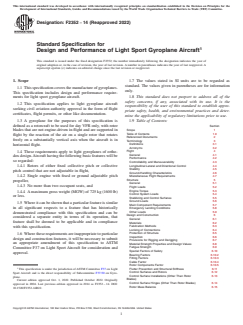
Designation:F2352 −14 (Reapproved 2022)
Standard Specification for
Design and Performance of Light Sport Gyroplane Aircraft
This standard is issued under the fixed designation F2352; the number immediately following the designation indicates the year of
original adoption or, in the case of revision, the year of last revision.Anumber in parentheses indicates the year of last reapproval.A
superscript epsilon (´) indicates an editorial change since the last revision or reapproval.
1. Scope 1.7 The values stated in SI units are to be regarded as
standard. The values given in parentheses are for information
1.1 Thisspecificationcoversthemanufactureofgyroplanes.
only.
This specification includes design and performance require-
1.8 This standard does not purport to address all of the
ments for light sport gyroplane aircraft.
safety concerns, if any, associated with its use. It is the
1.2 This specification applies to light gyroplane aircraft
responsibility of the user of this standard to establish appro-
seeking civil aviation authority approval in the form of flight
priate safety, health, and environmental practices and deter-
certificates, flight permits, or other like documentation.
mine the applicability of regulatory limitations prior to use.
1.3 A gyroplane for the purposes of this specification is
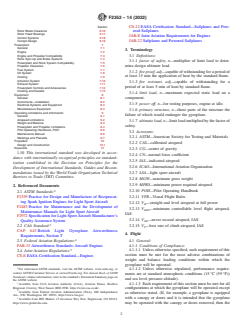
1.9 Table of Contents:
defined as a rotorcraft to be used for day VFR only, with rotor
Section
blades that are not engine-driven in flight and are supported in Scope 1
Table of Contents 1.9
flight by the reaction of the air on a single rotor that rotates
Referenced Documents 2
freely on a substantially vertical axis when the aircraft is in
Terminology 3
Definitions 3.1
horizontal flight.
Acronyms 3.2
1.4 These requirements apply to light gyroplanes of ortho- Flight 4
General 4.1
doxdesign.Aircrafthavingthefollowingbasicfeatureswillbe
Performance 4.2
so regarded:
Controllability and Maneuverability 4.3
Longitudinal Lateral and Directional Control 4.4
1.4.1 Rotors of either fixed collective pitch or collective
Stability 4.5
pitch control that are not adjustable in flight,
Ground-Handling Characteristics 4.6
1.4.2 Single engine with fixed or ground adjustable pitch Miscellaneous Flight Requirements 4.7
Structure 5
propeller,
General 5.1
1.4.3 No more than two occupant seats, and
Flight Loads 5.2
Engine Torque 5.3
1.4.4 Amaximumgrossweight(MGW)of725kg(1600lb)
Control System Loads 5.4
or less.
Stabilizing and Control Surfaces 5.5
Ground Loads 5.6
1.5 Whereitcanbeshownthataparticularfeatureissimilar
Main Component Requirements 5.7
in all significant respects to a feature that has historically
Emergency Landing Conditions 5.8
Other Loads 5.9
demonstrated compliance with this specification and can be
Design and Construction 6
considered a separate entity in terms of its operation, that
General 6.1
feature shall be deemed to be applicable and in compliance
Materials 6.2
Fabrication Methods 6.3
with this specification.
Locking of Connections 6.4
Protection of Structure 6.5
1.6 Wheretheserequirementsareinappropriatetoparticular
Inspection 6.6
designandconstructionfeatures,itwillbenecessarytosubmit
Provisions for Rigging and Derigging 6.7
an appropriate amendment of this specification to ASTM
Material Strength Properties and Design Values 6.8
Fatigue Strength 6.9
Committee F37 on Light Sport Aircraft for consideration and
Special Factors of Safety 6.10
approval.
Bearing Factors 6.10.2
Fitting Factors 6.10.3
Cable Factor 6.10.4
Rotor Components Factor 6.10.5
Flutter Prevention and Structural Stiffness 6.11
This specification is under the jurisdiction ofASTM Committee F37 on Light
Control Surfaces and Rotors 6.12
Sport Aircraft and is the direct responsibility of Subcommittee F37.50 on Gyro-
Control Surface Installations (Other Than Rotor 6.13
plane.
Blades)
Current edition approved Oct. 1, 2022. Published October 2022. Originally
Control Surface Hinges (Other Than Rotor Blades) 6.14
approved in 2004. Last previous edition approved in 2014 as F2352–14. DOI:
Rotor Mass Balance 6.15
10.1520/F2352-14R22.
Copyright © ASTM International, 100 Barr Harbor Drive, PO Box C700, West Conshohocken, PA 19428-2959. United States
F2352−14 (2022)
CS-22EASA Certification Standard—Sailplanes and Pow-
Section
Rotor Blade Clearance 6.16
ered Sailplanes
Rotor Head Bearings 6.17
JAR-EJoint Aviation Requirements for Engines
Control Systems 6.18
JAR-22Sailplanes and Powered Sailplanes
Cockpit Design 6.19
Powerplant 7
General 7.1
3. Terminology
Engine 7.2
Engine and Propeller Compatibility 7.3
3.1 Definitions:
Rotor Spin-Up and Brake Systems 7.4
3.1.1 factor of safety, n—multiplier of limit load to deter-
Powerplant and Rotor System Compatibility 7.5
mine design ultimate load.
Propeller Clearance 7.6
Fuel System 7.7
3.1.2 fire proof, adj—capableofwithstandingforaperiodof
Oil System 7.8
at least 15 min the application of heat by the standard flame.
Cooling 7.9
Induction System 7.10
3.1.3 fire resistant, adj—capable of withstanding for a
Exhaust System 7.11
period of at least 5 min of heat by standard flame.
Powerplant Controls and Accessories 7.12
Cowling and Nacelle 7.13
3.1.4 limit load, n—maximum expected static load on a
Equipment 8
component.
General 8.1
Instruments—Installation 8.2
3.1.5 power off, n—for testing purposes, engine at idle.
Electrical Systems and Equipment 8.3
Miscellaneous Equipment 8.4
3.1.6 primary structure, n—those parts of the structure the
Operating Limitations and Information 9
failure of which would endanger the gyroplane.
General 9.1
Airspeed Limitations 9.2
3.1.7 ultimate load, n—limitloadmultipliedbythefactorof
Weight and Balance 9.3
safety.
Powerplant and Propeller Limitations 9.4
Pilot Operating Handbook, POH 9.5
3.2 Acronyms:
Maintenance Manual 9.6
3.2.1 ASTM—American Society for Testing and Materials
Markings and Placards 9.7
Propellers 10
3.2.2 CAS—calibrated airspeed
Design and Construction 10.1
Keywords 12
3.2.3 CG—center of gravity
1.10 This international standard was developed in accor-
3.2.4 CN—normal force coefficient
dance with internationally recognized principles on standard-
3.2.5 IAS—indicated airspeed
ization established in the Decision on Principles for the
3.2.6 ICAO—International Aviation Organization
Development of International Standards, Guides and Recom-
mendations issued by the World Trade Organization Technical
3.2.7 LSA—light sport aircraft
Barriers to Trade (TBT) Committee.
3.2.8 MGW—maximum gross weight
3.2.9 MPRS—minimum power required airspeed
2. Referenced Documents
2 3.2.10 POH—Pilot Operating Handbook
2.1 ASTM Standards:
F2339Practice for Design and Manufacture of Reciprocat- 3.2.11 VFR—Visual Flight Rules
ing Spark Ignition Engines for Light Sport Aircraft
3.2.12 V —straight and level airspeed at full power
H
F2483Practice for Maintenance and the Development of
3.2.13 V —minimum controllable level flight airspeed,
MIN
Maintenance Manuals for Light Sport Aircraft
IAS
F2972Specification for Light SportAircraft Manufacturer’s
3.2.14 V —never exceed airspeed, IAS
NE
Quality Assurance System
3.2.15 V —best rate of climb airspeed, IAS
2.2 CAA Standard: Y
CAP 643 British Light Gyroplane Airworthiness
4. Flight
Requirements, Section T
4.1 General:
2.3 Federal Aviation Regulations:
4.1.1 Conditions of Compliance:
FAR-33Airworthiness Standards: Aircraft Engines
4.1.1.1 Unless otherwise specified, each requirement of this
2.4 Joint Aviation Regulations:
section must be met for the most adverse combinations of
CS-EEASA Certification Standard—Engines
weight and balance loading conditions within which the
gyroplane will be operated.
For referenced ASTM standards, visit the ASTM website, www.astm.org, or
4.1.1.2 Unless otherwise stipulated, performance require-
contact ASTM Customer Service at service@astm.org. For Annual Book of ASTM
ments are at standard atmospheric conditions (15°C (59°F))
Standards volume information, refer to the standard’s Document Summary page on
and sea level pressure altitude).
the ASTM website.
4.1.1.3 Each requirement of this section must be met for all
Available from Civil Aviation Authority (CAA), Aviation House, Beehive
Ringroad, Crawley, West Sussex RH6 0YR, https://www.caa.co.uk/.
configurations at which the gyroplane will be operated except
Available from Federal Aviation Administration (FAA), 800 Independence
as otherwise stated. (If, for example, a gyroplane is equipped
Ave., SW, Washington, DC 20591, https://www.faa.gov.
with a canopy or doors and it is intended that the gyroplane
Available from IHS Market, 15 Inverness Way East, Englewood, CO 80112,
https://www.global.ihs.com. may be operated with the canopy or doors removed, then the
F2352−14 (2022)
gyroplane must meet the requirements both with and without 4.2.1.3 Speeds shall be given in indicated (IAS) and cali-
the canopy or doors installed.) brated (CAS) airspeeds;
4.1.2 Load Distribution Limits—A method must be speci- 4.2.1.4 At the most critical weight and CG combination;
fied to determine the range of weight and balance of the pilot, 4.2.1.5 At the most unfavorable center of gravity for each
passenger, and fuel (and ballast if required) that ensures condition; and
satisfactorycontrolandsafetymargins.Therangeofbalanceis 4.2.1.6 Using engine power not in excess of the maximum
normally determined by a “hang test” with specified angular declaredfortheenginetypeandwithoutexceedingpowerplant
limits between a fixed airframe component and a horizontal and propeller limitations in accordance with 9.4.
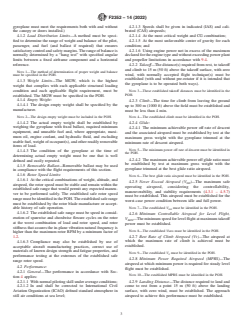
reference. 4.2.2 Takeoff—The distance(s) required from rest, to takeoff
and climb to 15 m (50 ft) above the takeoff surface, with zero
NOTE 1—The method of determination of proper weight and balance
wind, with normally accepted flight technique(s) must be
must be specified in the POH.
established (with and without pre-rotator if it is intended that
4.1.3 Weight Limits—The MGW, which is the highest
the gyroplane is to be operated both ways).
weight that complies with each applicable structural loading
condition and each applicable flight requirement, must be NOTE 3—These established takeoff distances must be identified in the
POH.
established. The MGW must be specified in the POH.
4.1.4 Empty Weight:
4.2.3 Climb—The time for climb from leaving the ground
4.1.4.1 The design empty weight shall be specified by the
up to 300 m (1000 ft) above the field must be established and
manufacturer.
must be less than 4 min.
NOTE 2—The design empty weight must be included in the POH.
NOTE 4—The established climb must be identified in the POH.
4.1.4.2 The actual empty weight shall be established by
4.2.4 Glide:
weighing the gyroplane with fixed ballast, required minimum
4.2.4.1 The minimum achievable power off rate of descent
equipment, and unusable fuel and, where appropriate, maxi-
and the associated airspeed must be established by test at the
mum oil, engine coolant, and hydraulic fluid, and excluding
maximum gross weight with the gyroplane trimmed at the
usablefuel,weightofoccupant(s),andotherreadilyremovable
minimum rate of descent airspeed.
items of load.
NOTE 5—The minimum power off rate of descent must be identified in
4.1.4.3 The condition of the gyroplane at the time of
the POH.
determining actual empty weight must be one that is well
4.2.4.2 Themaximumachievablepoweroffglideratiomust
defined and easily repeated.
be established by test at maximum gross weight with the
4.1.5 Removable Ballast—Removable ballast may be used
gyroplane trimmed at the best glide ratio airspeed.
in compliance with the flight requirements of this section.
4.1.6 Rotor Speed Limits:
NOTE 6—The best glide ratio airspeed must be identified in the POH.
4.1.6.1 At the critical combinations of weight, altitude, and
4.2.5 Never Exceed Airspeed (V )—The maximum safe
NE
airspeed, the rotor speed must be stable and remain within the
operating airspeed, considering the controllability,
established safe range that would permit any expected maneu-
maneuverability, and stability requirements (4.3.1 – 4.5.7)
ver to be performed safely. The established safe rotor speed
must be established. This airspeed must be established for the
rangemustbeidentifiedinthePOH.Theestablishedsaferange
worst-case power condition between idle and full power.
must be established by the rotor blade manufacture or accept-
NOTE 7—The established V must be identified in the POH.
able history of safe operation.
NE
4.1.6.2 The established safe range must be speed in consid-
4.2.6 Minimum Controllable Airspeed for Level Flight,
eration of spanwise and chordwise flexure cycles on the rotor
V —Theminimumspeedforlevelflightatmaximumtakeoff
MIN
at the worst combination of load and rotor speed, and rotor
power must be established.
stiffnessthatassuresthein-planevibrationnaturalfrequencyis
NOTE 8—The established V must be identified in the POH.
MIN
higher than the maximum rotor RPM by a minimum factor of
4.2.7 Best Rate of Climb Airspeed (V )—The airspeed at
1.2.
Y
which the maximum rate of climb is achieved must be
4.1.6.3 Compliance may also be established by use of
established.
acceptable aircraft manufacturing practices, correct use of
materials of known design strength and fatigue properties, and
NOTE 9—The established V must be identified in the POH.
Y
performance testing at the extremes of the established safe
4.2.8 Minimum Power Required Airspeed (MPRS)—The
range rotor speed.
airspeed at which minimum power is required for steady level
4.2 Performance:
flight must be established.
4.2.1 General—The performance in accordance with Sec-
NOTE 10—The established MPRS must be identified in the POH.
tion 4 applies:
4.2.1.1 Withnormalpilotingskillunderaverageconditions; 4.2.9 Landing Distance—The distance required to land and
4.2.1.2 In and shall be corrected to International Civil come to rest from a point 15 m (50 ft) above the landing
Aviation Organization (ICAO) defined standard atmosphere in surface, with zero wind, must be established. The approach
still air conditions at sea level; airspeed to achieve this performance must be established.
F2352−14 (2022)
NOTE11—Thislandingdistanceandtheapproachspeedtoachievethis
4.3.5 The gyroplane shall not require unusual attention to
landing distance must be identified in the POH.
prevent or stop any pitch oscillation at any and all power
settingsatthemostcriticalweightandCGcombinationatboth
4.2.10 Maximum Operating Altitude—The maximum safe
operating altitude considering the controllability, sea level and at the maximum operating altitude:
maneuverability, and stability requirements (4.3.1 – 4.5.7) 4.3.5.1 During steady flight at speeds up to V ,
NE
must be established, except that demonstrating safe operating
4.3.5.2 During airspeed changes, including:
pressure altitudes in excess of 3000 m (10000 ft) is not
4.3.5.3 During changes of engine power (including sudden
required.
loss of engine power), and
4.3.5.4 During any maneuver appropriate to the type, in-
NOTE 12—The maximum operating altitude must be identified in the
cluding:
POH.
(1)Takeoff,
4.2.11 Height/Velocity Envelope—The combinations of
(2)Climb,
height and forward airspeed from which a safe landing cannot
(3)Turning flight,
be made following engine failure must be established as a
(4)Descent (power on and off),
limiting height-speed envelope (graph).
(5)Landing (power on and off),
NOTE 13—The height-speed envelope graph must be included in the (6)Recovery to power-on flight from an aborted landing,
POH.
and
(7)Dynamic maneuvers including steep turns, straight
4.3 Controllability and Maneuverability:
pullouts, and roll reversals.
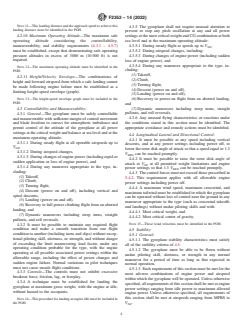
4.3.1 General—The gyroplane must be safely controllable
and maneuverable with sufficient margin of control movement 4.3.6 Any unusual flying characteristics or reactions under
the conditions stated in this section must be identified. The
and blade freedom to correct for atmospheric turbulence and
permit control of the attitude of the gyroplane at all power appropriate avoidance and remedy actions must be identified.
settingsatthecriticalweightandbalanceatsealevelandatthe
4.4 Longitudinal Lateral and Directional Control:
maximum operating altitude:
4.4.1 It must be possible at any speed including vertical
4.3.1.1 During steady flight at all operable airspeeds up to
descents, and at any power settings including power off, to
V ,
NE
lower the rotor disk angle of attack so that a speed equal to 1.3
4.3.1.2 During airspeed changes,
V can be reached promptly.
MIN
4.3.1.3 During changes of engine power (including rapid or
4.4.2 It must be possible to raise the rotor disk angle of
sudden application or loss of engine power), and
attack at V at all permitted weight limitations and engine
NE
4.3.1.4 During any maneuver appropriate to the type, in-
power settings so that 1.3 V can be reached promptly.
MIN
cluding:
4.4.3 Thecontrolforcesmustnotexceedthoseprescribedin
(1)Takeoff,
5.4.2. This requirement applies with all allowable engine
(2)Climb,
power settings including power off.
(3)Turning flight,
4.4.4 A maximum wind speed, maximum crosswind, and
(4)Descent (power on and off), including vertical and
maximum tailwind must be established in which the gyroplane
spiral descents,
can be operated without loss of control near the ground in any
(5)Landing (power on and off),
maneuver appropriate to the type (such as crosswind takeoffs
(6)Recovery to full power climbing flight from an aborted
and landings) without undue piloting skills and with:
landing, and
4.4.4.1 Most critical weight, and
(7)Dynamic maneuvers including steep turns, straight
4.4.4.2 Most critical center of gravity.
pullouts, and roll reversals.
NOTE 15—These wind velocities must be identified in the POH.
4.3.2 It must be possible to maintain any required flight
condition and make a smooth transition from one flight
4.5 Stability:
condition to another (including turns and slips) without excep-
4.5.1 General:
tional piloting skill, alertness, or strength, and without danger
4.5.1.1 The gyroplane stability characteristics must satisfy
of exceeding the limit maneuvering load factor, under any
all of the stability criteria of 4.5.
operating condition probable for the type, with the engine
4.5.1.2 The gyroplane must be able to be flown without
operating at all possible associated power settings within the
undue piloting skill, alertness, or strength in any normal
allowable range, including the effect of power changes and
maneuver for a period of time as long as that expected in
sudden engine failure. Normal variations in pilot techniques
normal operation.
must not cause unsafe flight conditions.
4.5.1.3 Eachrequirementofthissectionmustbemetforthe
4.3.3 Controls—The controls must not exhibit excessive
most adverse combinations of engine power and airspeed
breakout force, friction, lag, or freeplay.
within which the gyroplane will be operated. Unless otherwise
4.3.4 A technique must be established for landing the
specified,allrequirementsofthissectionshallbemetatengine
gyroplane at maximum gross weight, with the engine at idle,
power settings ranging from idle power to maximum allowed
without hazard to the occupants.
engine power. Unless otherwise specified, all requirements of
this section shall be met at airspeeds ranging from MPRS to
NOTE14—Thisprocedureforlandingatengineidlemustbeincludedin
the POH. V .
NE
F2352−14 (2022)
4.5.2 Longitudinal Power Response: following fixed stick conditions the airspeed shall return to
within 10% of the initial fixed stick steady state airspeed; and
4.5.2.1 Apower change from trimmed MPRS level flight at
(2) with constant engine power and with airspeed temporarily
MPRSpowermustresultinasteadystatetrimmedairspeednot
decreasedatleast20%belowtrimmedairspeed,uponreturnto
to differ by more than 25% from the initial trimmed MPRS
the following fixed stick conditions the airspeed shall return to
airspeed for the following conditions:
within 10% of the initial fixed stick steady state airspeed.
(1)In level flight, MPRS power increased to full power.
Initial and return fixed stick conditions:
(2)In level flight, MPRS power reduced to engine off.
(1)Steady altitude at MPRS,
(3)Conductedwithacyclicstickfixedinpitchattheinitial
(2)Full power at 80 % V ,
MPRS stick position. NE
(3)Engine idle at MPRS, and
(4)Conducted with a the cyclic stick free in pitch at the
(4)Engine idle at 80 % V .
initial MPRS pitch trim.
NE
4.5.4 Static Longitudinal Maneuvering (G-Load) Stability:
4.5.2.2 Without trim adjustment, the cyclic pitch control
4.5.4.1 The pitch control forces during turns or load factor
range must be adequate to reduce airspeed from trimmed V
NE
maneuvers greater than 1.0 g must be such that an increase in
to V airspeedwithoutexcessiveforcesonthecycliccontrol
MIN
load factor is associated with an increase in aft pilot control
system at the following conditions:
force, and a decrease in load factor is associated with a
(1)From V to V with engine power off.
NE MIN
decrease in aft pilot control force for the following initial
(2)From V to V with engine at full power.
NE MIN
trimmed conditions:
4.5.2.3 A rapid power change from trimmed MPRS level
(1)Steady altitude at MPRS,
flight at MPRS power must result in an airframe pitch attitude
(2)Full power at the lesser of V or V ,
H NE
rate of change not to exceed 5° per second for the following
(3)Engine idle at MPRS, and
conditions.
(4)Engine idle at 80 % V .
(1)MPRS power rapidly increased to full power. NE
4.5.4.2 The airspeed during turns or load factor maneuvers
(2)MPRS power rapidly reduced to idle power.
greater than 1.0g at a fixed cyclic pitch position must be such
(3)Conductedwithacyclicstickfixedinpitchattheinitial
that an increase in load factor is associated with an increase in
MPRS stick position.
airspeed, and a decrease in load factor is associated with a
(4)Conducted with a the cyclic stick free in pitch at the
decrease in airspeed for the following initial fixed stick
initial MPRS pitch trim.
conditions:
4.5.3 Static Longitudinal Airspeed Stability:
(1)Steady altitude at MPRS,
4.5.3.1 The longitudinal control must be such that: (1) with
(2)Full power at the lesser of V or of V ,
H NE
constantenginepower,anaftforceandmovementofthecyclic
(3)Engine idle at MPRS, and
control is necessary to achieve an airspeed less than any
(4)Engine idle at 80% V .
NE
available trim airspeed; and (2) with constant engine power, a
4.5.5 Static Spiral Divergence:
forward force and movement of the control is necessary to
4.5.5.1 For banked turns up to 1.5 g or 30° of bank with the
achieve an airspeed greater than any available trim airspeed.
stick fixed, there must be no tendency for the gyroplane to
The control force slope must not reverse during any progres-
increasetheturnraterapidlyatallallowablepowersettingsfor
sive application of control movement at airspeeds greater than
the following conditions:
V up to V . Static longitudinal airspeed stability must be
MIN NE
(1)Level 30° banking turn at straight and level MPRS
met at the following power and trimmed airspeed conditions:
airspeed,
(1)Steady altitude at MPRS,
(2)30° banking turn at full engine power, and
(2)Full power at V ,
NE
(3)Descending 30° turn at MPRS at engine idle.
(3)Full power at V ,
MIN
4.5.6 Lateral and Directional Stability:
(4)Engine idle at MPRS,
4.5.6.1 Following an initial yaw disturbance, with the yaw
(5)Engine idle at 80% V , and
NE
controls fixed or free and other controls held fixed, the
(6)Engine idle at V .
MIN
gyroplaneshalltendtocorrectautomaticallyfordisturbancein
4.5.3.2 The longitudinal control must be such that, with
yaw within three cycles.
constantenginepowerandwithairspeedtemporarilyincreased
4.5.6.2 The directional and lateral stability should be suffi-
at least 20% above trimmed airspeed, upon release of the
cient to prevent dangerous flight conditions following abrupt
cyclic pitch control the airspeed shall not diverge and shall
pedal displacements.
return to within 10% of the following initially trimmed
airspeedconditionwiththecyclicpitchcontrolfree.Initialand 4.5.6.3 Positive directional (yaw) static stability shall be
return trimmed conditions: demonstrated by the requirement for increasing rudder pedal
force and displacement with increasing sideslip.
(1)Steady altitude at MPRS,
(2)Full power at 80 % V ,
4.5.6.4 No lateral or directional oscillations with periods
NE
(3)Engine idle at MPRS, and less than 5s shall be exhibited with primary cyclic controls
(4)Engine idle at 80 % V .
fixed, and with primary cyclic controls free.
NE
4.5.3.3 The longitudinal control must be such that: (1) with 4.5.6.5 Conditions—Lateral and directional stability must
constantenginepowerandwithairspeedtemporarilyincreased be met at the following power and trimmed airspeed condi-
at least 20% above trimmed airspeed, upon return to the tions:
F2352−14 (2022)
(1)Steady altitude at MPRS, 5. Structure
(2)Full power at the lesser of V or of V ,
H NE
5.1 General—Evidence of compliance with the Structures
(3)Engine idle at MPRS, and
Sub-Section C of CAP 643 shall be accepted in lieu of
(4)Engine idle at 80 % V .
NE
compliance with Section 5 of this specification.
4.5.7 Dynamic Longitudinal Stability:
5.1.1 Loads:
4.5.7.1 The gyroplane under moderately turbulent air con-
5.1.1.1 Strength requirements are stated as limit loads (the
ditions must exhibit no dangerous or divergent behavior with
maximum static load to be expected in service) and ultimate
cyclic pitch control fixed or with cyclic pitch control free for
loads (limit loads multiplied by factors of safety). Unless
the following conditions:
otherwise stated, loads given are limit loads.
(1)Steady altitude at MPRS,
5.1.1.2 If deflections under load would significantly change
(2)Full power at V ,
NE
the distribution of external or internal loads, this redistribution
(3)Engine idle at MPRS,
must be taken into account.
(4)Engine idle at 80 % V , and
NE
5.1.2 Factor of Safety—The strength of any safety critical
(5)Engine idle at V .
MIN
part must have a safety factor of 1.5 for the application.
4.5.7.2 Longitudinal Oscillation Damping:
5.1.3 Strength and Deformation:
(1)Any excitable longitudinal oscillations with periods
5.1.3.1 The structure and control systems must be able to
lessthan5smustdamptoonehalfamplitudeinnotmorethan
support limit loads for at least 3s without detrimental or
one cycle with cyclic pitch control fixed or with cyclic pitch
permanent deformation. At any load up to limit loads, the
control free. There should be no tendency for undamped small
deformation must not interfere with safe operation.
amplitude oscillations to persist for more than 2 cycles with
5.1.3.2 The structure must be able to support ultimate loads
cyclic pitch control fixed or with cyclic pitch control free.
without failure for at least 3s.
(2)Any excitable longitudinal oscillations with periods
5.1.4 Design Conditions—The structural requirements of
between 5s and 10s should damp to one half amplitude in not
5.1 must be met for all allowable combinations of:
more than two cycles. There should be no tendency for
5.1.4.1 The maximum gross weight,
detectable undamped small oscillations to persist for longer
5.1.4.2 Airspeeds up to V ,
NE
than 20s.
5.1.4.3 The balance limitations, and
(3)Any excitable longitudinal oscillations with periods
5.1.4.4 The positive limit maneuvering load factor.
between 10s and 20s should be damped, and in no circum-
stancesshouldalongitudinaloscillationhavingaperiodlonger 5.2 Flight Loads:
than 20s achieve more than double amplitude in less than 5.2.1 General:
20s.Conditions:
5.2.1.1 Airframeflightloadfactorsrepresenttheratioofthe
(a) Steady altitude at MPRS,
rotoraerodynamicthrust(actingattherotorattachpointonthe
(b)Full power at V ,
airframe) to the weight of the airframe. A positive flight load
NE
(c) Engine idle at MPRS,
factor on the airframe is one in which the rotor thrust acts
(d)Engine idle at 80 % V , and
upward with respect to the gyroplane.
NE
(e)Engine idle at V .
5.2.1.2 Rotor flight load factors represent the ratio of the
MIN
rotoraerodynamicthrust(actingattherotorattachpointonthe
4.6 Ground-Handling Characteristics:
airframe) to the axial load presented by the airframe in flight.
4.6.1 Directional Stability and Control—The gyroplane
A positive flight load factor on the rotor is one in which the
musthavesatisfactoryground-handlingcharacteristics,includ-
axial load presented by the airframe acts generally downward,
ing freedom from uncontrolled tendencies in any condition
with respect to the rotor. The flight load requirements apply at
expected in operation, particularly in all takeoff conditions.
each practicable combination of weight and disposable load.
4.6.2 Taxiing Condition:
5.2.2 Limit Maneuvering Load Factors:
4.6.2.1 The gyroplane must be safely controllable and
5.2.2.1 The gyroplane’s rotor must be designed for positive
maneuverable when it is taxied over the roughest ground that
limit maneuvering load factor of 3.0 at all forward airspeeds
may reasonably be expected in normal operation.
from zero to the never exceed airspeed, V .
NE
4.6.2.2 The ground speeds up to which it is safe to taxi,
5.2.2.2 The rest of the gyroplane must be designed for
takeoff, and touch down must be established.
positive and negative limit maneuvering load factors of +3.0
and –0.5, respectively, at all forward speeds from zero to the
NOTE 16—The established maximum ground speeds must be identified
never exceed airspeed, V .
in the POH.
NE
5.2.3 Resulting Limit Maneuvering Loads—The loads re-
4.6.2.3 The gyroplane should at least be suitable for opera-
sulting from the application of limit maneuvering load factors
tion from surfaces with short grass.
are assumed to act at the center of the rotor hub and to act in
4.7 Miscellaneous Flight Requirements: directions so as to represent each critical maneuvering condi-
tion.
4.7.1 Vibration—Each part of the gyroplane must be free
from excessive vibration under each appropriate combination 5.2.4 Yawing Conditions:
of airspeed and engine power in all normal flight and ground 5.2.4.1 Thegyroplanemustbedesignedforyawingloadson
operations. the vertical tail surface at the maximum achievable yaw rate.
F2352−14 (2022)
5.2.4.2 The engine mount and its supporting structure must 5.5.1.1 Gust loads of 15 lb/ft distributed over surface area,
be designed for precession yawing loads at maximum achiev- 5.5.1.2 Stabilizing static loads,
able yaw rates.
5.5.1.3 Propwash turbulence loads, and
5.5.1.4 Air loads shall be distributed chordwise and cen-
5.3 Engine Torque:
tered at the:
5.3.1 Theenginemountanditssupportingstructuremustbe
(1)25% chord line for symmetrical airfoils,
designedfortheeffectsofthelimittorquecorrespondingtothe
(2)Hinge line for flapped airfoils, and
maximumcontinuouspowerandpropellerspeed,actingsimul-
(3)Chordlinedeterminedbyrationalcalculationortestfor
taneously in accordance with the limit loads of 5.2.2.
cambered airfoils.
5.3.2 Engine Mount Torque Pulse Factor—Forconventional
reciprocating engines, the limit torque to be accounted for is 5.6 Ground Loads:
obtained by multiplying the engine mean torque by the
5.6.1 General—The limit ground loads specified in this
propeller speed reduction factor and by one of the following
section are considered to be external loads and inertia forces
factors.
that act upon a gyroplane structure.
5.3.2.1 For four-stroke engines:
5.6.2 Main Landing Gear—Shock Absorption—To mini-
(1)1.33 for engines with five or more cylinders;
mize pilot injury, the landing gear shall be capable of
(2)2, 3, 4, or 8 for engines with four, three, two, or one
withstanding, without permanent deformation or flight critical
cylinders, respectively.
damage, an impact with the ground under the following
5.3.2.2 For two-stroke engines:
conditions:
(1)2 for engines with three or more cylinders; or
5.6.2.1 On a flat solid surface,
(2) 3 or 6 for engines with two or one cylinders, respec-
5.6.2.2 At MGW,
tively.
5.6.2.3 With rotor installed or with a simulated rotor weight
at the rotor attach point,
5.4 Control System Loads:
5.6.2.4 With initial impact on the main wheels in a normal
5.4.1 Primary Control System:
landing attitude, and
5.4.1.1 The part of each control system from the pilot’s
5.6.2.5 Impact with the ground at a vertical velocity equal-
controls to the control stops must be designed to withstand
ing that achieved in a free fall:
pilot forces of not less than the forces specified in 5.4.2.
(1)From a normal landing attitude, and
5.4.1.2 The part of each control system from the control
(2)From a height at which the main wheels are 16.5 cm
stops to the attachment to the rotor hub (or control areas) must
(6.5 in.) above the ground when in the normal position for
be designed to at least:
landing and bearing no weight.
(1)From pilot input forces, withstand the maximum pilot
forces obtainable in normal operation;
5.7 Main Component Requirements:
(2)Without yielding, the cyclic or rudder control mechani-
5.7.1 Rotor Structure:
cal limits shall support 1.6× the equivalent 5.4.2 limit pilot
5.7.1.1 Each rotor assembly (including the rotor hub and
forces presented on those control limits by any control surface
blades) must be designed as in accordance with 5.7.1.
or by the rotor from ground gusts or control inertia.
5.7.1.2 The rotor structure must be designed to withstand
5.4.2 Limit Pilot Forces—For primary flight controls, the
the critical flight loads in accordance with 5.2.2 and 5.2.3.
limit pilot forces are as follows:
5.7.1.3 The rotor structure must be designed to withstand
5.4.2.1 For foot controls, 59kg (130lb) force, and
loads simulating, for the rotor blades and hub bar, any normal
5.4.2.2 For stick controls, 45kg (100lb) force fore and aft
expectedimpactforcesofeachbladeagainstitsteeteringstops
and 18kg (40lb) force laterally.
during ground operation.
5.4.3 Dual Control Systems—Dual control systems must be
5.7.1.4 Therotorsandrotorheadstructuremustbedesigned
designed to withstand the loads that result when each pilot
towithstandthemaximumlimittorquelikelytobetransmitted
applies 0.75 times the load specified in 5.4.2 with:
by any rotor spin-up device or rotor brake at all speeds from
5.4.3.1 The pilots acting together in the same direction, and
zero to maximum at which the device is designed to be
5.4.3.2 The pilots acting in opposition.
engaged.
5.4.4 Secondary Control Systems—Secondary control sys-
5.7.2 Fuselage, Landing Gear, and Rotor Pylon Structures:
tems such as those for brakes, throttles, trim controls, and so
5.7.2.1 Eachfuselage,landinggear,andmaststructuremust
forthmustbedesignedforsupportingthemaximumforcesthat
bedesignedasprescribedinthissection.Resultantrotorforces
a pilot is likely to apply to those controls.
may be represented as a single force applied at the rotor hub
bar attachment point (teeter bolt).
5.5 Stabilizing and Control Surfaces:
5.5.1 Control and Stabilizing Surface Loads—The maxi- 5.7.2.2 Each structure must be designed to withstand:
(1)The critical loads prescribed in 5.2.2 and 5.2.3,
mum limit loads for each stabilizing and control surface (other
than the rotor blades), and its supporting structure, must be (2)The applicable ground loads in accordance with 5.6.1
determined by testing or other rational analysis for the follow- and 5.2.2, and
ing loads: (3)The loads prescribed in 5.7.1.3 and 5.7.1.4.
F2352−14 (2022)
5.8 Emergency Landing Conditions: extremelyremoteasshownbytest,analysis,servicehistory,or
5.8.1 General: manufacturer certification.
5.8.1.1 The gyroplane, although it may be damaged in
6.3 Fabrication Methods:
emergencylandingconditions,mustbedesignedinaccordance
6.3.1 Workmanship of manufactured parts, assemblies, and
with 5.8.1 to protect each occupant under those conditions.
aircraft shall be of high standard.
5.8.1.2 The gyroplane should be capable, in an emergency
6.3.2 Methods of fabrication shall produce consistently
landing, to reduce its forward airspeed to near zero and
sound structures.
subsequently contact the ground in a near vertical direction in
6.3.3 Process specifications shall be followed where re-
a near level attitude, thereby minimizing load factors in the
quired.
forward direction.
6.4 Locking of Connections—An acceptable means of lock-
5.8.1.3 The structure must be designed to give each occu-
ingmustbeprovidedonallconnectingelementsintheprimary
pant every reasonable chance of escaping serious injury in a
structure and in control and other mechanical systems that are
landing incident, when proper use is made of belts and
essential to safe operation of the gyroplane. In particular,
harnesses provided for in the design, in the following condi-
self-locking nuts must not be used on any bolt subject to
tions:
rotationinoperationunlessapositivelockingdeviceisusedin
(1)Each occupant experiences ultimate inertial forces cor-
addition to the self-locking device.
responding to the load factors in Table 1.
(2)These forces are independent of each other and are
6.5 Protection of Structure—Protection of the structure
relative to the surrounding structure. againstweathering,corrosion,andabrasion,aswellassuitable
5.8.1.4 The supporting structure must be designed to
ventilation and drainage, shall be provided.
restrain, under loads up to those specified in 5.7.2.2, each item
6.6 Inspection—Means must be provided to allow inspec-
of mass that could injure an occupant if it came loose in a
tion (including inspection of principal fixed and rotating
minor crash landing.
structural elements and control systems), close examination,
5.8.1.5 For a gyroplane with the engine located behind an
repair, and replacement of each part requiring periodic
occupant’s seat, the engine mounting structure must be able to
inspection,maintenance,adjustmentsforproperalignmentand
restraintheengine,propeller,andanyotheritemssupportedby
function, lubrication, or servicing.
the engine mounting structure, when they experience the
6.7 ProvisionsforRiggingandDerigging—Thedesignmust
forward inertial force above with a load factor of five.
be such that where any rigging and derigging may be expected
5.8.1.6 Fueltanks,fuellines,oiltanks,andoillinesmustbe
to be carried out on a routine basis, the probability of damage
capable of retaining their contents under the inertial forces
or incorrect assembly is eliminated. It must be possible to
above without rupture.
inspect the gyroplane easily for correct assembly.
5.9 Other Loads:
6.8 Material Strength Properties and Design Values—
5.9.1 Loads from Single Masses—The attachment means
Materials must meet design strength values at ambient air
that all single masses, which are part of the equipment of the
temperatures between –5°C and 54°C.
gyroplane, including ballast, must be designed to withstand
loads corresponding to the maximum design load factors to be
6.9 Fatigue Strength:
expected from the established flight and ground loads, includ-
6.9.1 The detail design of the blade and hub bar of the
ing the emergency landing conditions of 5.8.1.
gyroplane should be such that as far as reasonably practicable
features that cause high stresses are avoided, especially if it
6. Design and Construction
cannot be shown that features of a similar design have
accumulated considerable satisfactory service experience in a
6.1 General—Evidence of compliance with the Design and
similar application.
Construction Sub-Section D of CAP 643 shall be accepted in
6.9.2 Theprimarystructuresoftheairframeorrotorshallbe
lieuofcompliancewithSection6,DesignandConstruction,of
designed in consideration of the spanwise and chordwise
this specification.
flexure cycles on the rotor at the worst combination of load,
6.1.1 The strength of any part must have a safety factor of
rotor speed and airspeed. All parts of the primary structure
1.5 for the application.
shall be easily accessible for inspection.
6.2 Materials—Materials shall be suitable and durable for
6.10 Special Factors of Safety—The factor of safety pre-
the intended use, and design values (strength) must be chosen
scribed in 5.1.2 must be increased to the special factors
so that structural deficiency because of material variations is
prescribed in this paragraph.
6.10.1 Casting Factors—Forcastings,thestrengthofwhich
is substantiated by at least one static test and which are
TABLE 1 Load Factors
inspected by visual methods, a casting factor of safety of 3.0
Direction Load Factor mustbeapplied.Thisfactormaybereducedto1.25,providing
Upward 1.5 the reduction is substantiated by tests on not less than three
Forward 3.0
sample castings, and if these and all production castings are
Sideward 3.0
subjected to an approved visual and radiographic inspection or
Downward 4.5
an accepted equivalent nondestructive inspection method.
F2352−14 (2022)
6.10.2 Bearing Factors: 6.12.1 Drainage—For each rotor blade:
6.10.2.1 The factor of safety for bearing loads at bolted or 6.12.1.1 Internal air pressure must be either vented if
pinnedjointsmustbemultipliedbyaspecialfactorofsafetyof necessary to prevent deformation or structural compromise, or
3.0 to provide for: 6.12.1.2 The blade must be designed to prevent water from
(1)Relative motion in operation, and becoming trapped in it.
(2)Joints with clearance (free fit) subject to pounding or 6.12.1.3 Sections 6.12.1.1 and 6.12.1.2 do not apply to
vibration, or both. sealed blades capable of withstanding the maximum pressure
6.10.2.2 For control surface hinges and control system differentials expected in service.
joints, comply with the factors prescribed in 6.14 and 6.18.8,
6.13 Control Surface Installations (Other Than Rotor
respectively.
Blades):
6.10.3 Fitting Factors—For each fitting (a part or terminal
6.13.1 Movable control surfaces must be installed so that
used to join one structural member to another), the following
there is no interference between any surfaces or their bracings
apply:
when one surface is held in any position and the others are
6.10.3.1 For each fitting whose strength is not proven by
operated through their full angular movement. This require-
limit and ultimate load tests in which actual stress conditions
ment must be met:
are simulated in the fitting and surrounding structures, a fitting
6.13.1.1 Under limit load conditions for all control surfaces
factor of safety of at least 1.8 must be applied to each part of:
through their full angular range, and
(1)The fitting,
6.13.1.2 Under limit load on the gyroplane structure other
(2)The means of attachment, and
than the control surfaces.
(3)The bearing on the joined members.
6.13.1.3 If a ground adjustable stabilizer is used, it must
6.10.3.2 No fitting factor need be used for joint designs
havestopsthatwilllimititsrangeoftraveltothatallowingsafe
based on comprehensive test data (such as continuous joints in
flight and landing.
metal plating, welded joints, and scarf joints in wood).
6.14 Control Surface Hinges (Other Than Rotor Blades):
6.10.3.3 For each integral fitting, the part must be treated as
6.14.1 Control surface hinges, except ball, roller, and
a fitting up to the point at which the section properties become
spherical bearing hinges, must have a factor of safety of not
typical of the member.
less than 6.67 with respect to the ultimate bearing strength of
6.10.3.4 Local attachments in the load path between the
the softest material used as a bearing.
safetybeltorharnessandthemaingyroplanestructuremustbe
6.14.2 For ball, roller, or spherical bearing hinges, the
shown by analysis, test, or both to be not less strong than the
approved rating of the bearing must not be exceeded.
strength necessary for 3.0 times the loads corresponding to the
6.14.2.1 Mechanicallimitsofrod-endsphericalballbearing
emergency landing inertia loads of 5.8.1.
hinges must not exceed the mechanical design limits of the
6.10.3.5 When using only two hinges at each control
joint in accordance with the requirements of 6.18.8.
surface,thesafetyfactorforthesehingesandtheattachedparts
6.15 Rotor Mass Balance:
of the primary structure must be multiplied by a factor of 1.5.
6.15.1 The spanwise balance of the rotor blades must be
6.10.4 Cable Factor—A factor of safety of 2.0 on nominal
such that excessive out-of-balance vibration is prevented.
cable strength must be applied to cables used for structural
6.15.2 The chordwise balance of the blades must be such
applications and for all primary control systems.
that the blades cannot be induced to flutter or weave in al
...