

ASTM F2483-18e1
(Practice)Standard Practice for Maintenance and the Development of Maintenance Manuals for Light Sport Aircraft
General Information
- Abstract
SIGNIFICANCE AND USE
4.1 The purpose of this practice is to provide guidance to owners, mechanics, airports, regulatory officials, and aircraft and component manufacturers who may accomplish maintenance, repairs, and alterations on a light sport aircraft. In addition, this practice covers the format and content of maintenance manuals and instructions for the maintenance, repair, and alteration of an LSA.
SCOPE
1.1 This practice provides guidelines for the qualifications to accomplish the various levels of maintenance on U.S.-certificated experimental and special light sport aircraft. In addition, it provides the content and structure of maintenance manuals for aircraft and their components that are operated as light sport aircraft.
1.2 This standard does not purport to address all of the safety concerns, if any, associated with its use. It is the responsibility of the user of this standard to establish appropriate safety, health, and environmental practices and determine the applicability of regulatory limitations prior to use.
1.3 This international standard was developed in accordance with internationally recognized principles on standardization established in the Decision on Principles for the Development of International Standards, Guides and Recommendations issued by the World Trade Organization Technical Barriers to Trade (TBT) Committee.
- Status
- Published
- Publication Date
- 28-Feb-2018
- Technical Committee
- F37 - Light Sport Aircraft
- Drafting Committee
- F37.70 - Cross Cutting
Overview
ASTM F2483-18e1: Standard Practice for Maintenance and the Development of Maintenance Manuals for Light Sport Aircraft establishes essential guidance for the maintenance, repair, and alteration of Light Sport Aircraft (LSA). Developed by ASTM International, this practice standardizes the qualifications required for different maintenance tasks and outlines the recommended format and content of maintenance manuals for LSA and their components. This standard is relevant to owners, operators, mechanics, airports, regulatory officials, and manufacturers involved in the operation or maintenance of U.S.-certificated special or experimental light sport aircraft.
Key Topics
- Qualifications for Maintenance Personnel: Guidance on who may perform various levels of maintenance on LSAs, referencing FAA and international requirements.
- Maintenance Manual Structure: Detailed recommendations for the sections and content that should be included, such as general maintenance information, inspections, instructions for systems (engine, fuel, electrical, instruments), and revision history.
- Task Classification:
- Line Maintenance: Routine tasks and minor repairs that can be carried out by owners or repairman, such as inspections or fluid servicing.
- Heavy Maintenance: Complex repairs or component overhauls requiring qualified personnel with additional training.
- Overhaul: Reserved for the manufacturer or authorized facilities, backed by a dedicated overhaul manual.
- Major Repairs and Alterations: Procedures for significant modifications, including mandated documentation (e.g., Major Repair and Alteration or MRA form) and ongoing compliance with ASTM requirements.
- Safety Directives: Manufacturer-issued mandatory instructions to maintain aircraft safety and regulatory compliance.
- Inspection Procedures: Checklists and requirements in line with federal aviation regulations (e.g., 14 CFR), covering annual and 100-hour inspections.
Applications
ASTM F2483-18e1 is used to:
- Develop and Audit Maintenance Manuals: Aircraft and component manufacturers can use this practice to ensure manuals are comprehensive, easy to follow, and compliant with both regulatory and consensus standards.
- Standardize Maintenance Procedures: Airports, repair stations, and maintenance personnel apply the guidelines to conduct consistent inspections, repairs, and alterations across the LSA fleet.
- Improve Aircraft Safety and Airworthiness: By following standardized protocols for inspections, repairs, and safety directive compliance, operators and owners support safer, more reliable operation of light sport aircraft.
- Ensure Regulatory Alignment: The standard aligns with FAA regulations and international principles, supporting manufacturers and operators in meeting legal obligations for ongoing airworthiness.
Related Standards
ASTM F2483-18e1 references and complements several other standards and regulations, including:
- ASTM F2245: Specification for Design and Performance of a Light Sport Airplane
- ASTM F2295: Practice for Continued Operational Safety Monitoring of a Light Sport Aircraft
- ASTM F2352: Specification for Design and Performance of Light Sport Gyroplane Aircraft
- ASTM F2415: Practice for Continued Airworthiness System for Light Sport Gyroplane Aircraft
- ASTM F2241: Specification for Continued Airworthiness System for Powered Parachute Aircraft
- 14 CFR Part 21, 43, and 65: Federal Aviation Regulations relating to airworthiness certification, maintenance, and the certification of airmen
Practical Value
Adopting ASTM F2483-18e1 helps manufacturers, repair stations, and regulatory authorities streamline aircraft maintenance processes, develop effective documentation, clarify personnel roles/responsibilities, and ultimately uphold the highest standards of safety and reliability for the growing light sport aircraft community. Using this standard, stakeholders ensure that every light sport aircraft remains airworthy and that maintenance actions, including major repair or alteration, are performed only by qualified personnel following industry best practices.
Relations
- Effective Date
- 01-Mar-2018
- Effective Date
- 01-Dec-2016
- Effective Date
- 01-Nov-2016
- Effective Date
- 01-Jun-2016
- Effective Date
- 01-Mar-2016
- Effective Date
- 01-Sep-2015
- Effective Date
- 01-Sep-2014
- Effective Date
- 01-Sep-2013
- Effective Date
- 01-Jun-2013
- Effective Date
- 01-Jun-2013
- Effective Date
- 01-May-2013
- Effective Date
- 01-Mar-2013
- Effective Date
- 01-Dec-2012
- Effective Date
- 01-Nov-2012
- Effective Date
- 01-Oct-2012
Get Certified
Connect with accredited certification bodies for this standard

BSI Group
BSI (British Standards Institution) is the business standards company that helps organizations make excellence a habit.

Bureau Veritas
Bureau Veritas is a world leader in laboratory testing, inspection and certification services.

DNV
DNV is an independent assurance and risk management provider.
Sponsored listings
Frequently Asked Questions
ASTM F2483-18e1 is a standard published by ASTM International. Its full title is "Standard Practice for Maintenance and the Development of Maintenance Manuals for Light Sport Aircraft". This standard covers: SIGNIFICANCE AND USE 4.1 The purpose of this practice is to provide guidance to owners, mechanics, airports, regulatory officials, and aircraft and component manufacturers who may accomplish maintenance, repairs, and alterations on a light sport aircraft. In addition, this practice covers the format and content of maintenance manuals and instructions for the maintenance, repair, and alteration of an LSA. SCOPE 1.1 This practice provides guidelines for the qualifications to accomplish the various levels of maintenance on U.S.-certificated experimental and special light sport aircraft. In addition, it provides the content and structure of maintenance manuals for aircraft and their components that are operated as light sport aircraft. 1.2 This standard does not purport to address all of the safety concerns, if any, associated with its use. It is the responsibility of the user of this standard to establish appropriate safety, health, and environmental practices and determine the applicability of regulatory limitations prior to use. 1.3 This international standard was developed in accordance with internationally recognized principles on standardization established in the Decision on Principles for the Development of International Standards, Guides and Recommendations issued by the World Trade Organization Technical Barriers to Trade (TBT) Committee.
SIGNIFICANCE AND USE 4.1 The purpose of this practice is to provide guidance to owners, mechanics, airports, regulatory officials, and aircraft and component manufacturers who may accomplish maintenance, repairs, and alterations on a light sport aircraft. In addition, this practice covers the format and content of maintenance manuals and instructions for the maintenance, repair, and alteration of an LSA. SCOPE 1.1 This practice provides guidelines for the qualifications to accomplish the various levels of maintenance on U.S.-certificated experimental and special light sport aircraft. In addition, it provides the content and structure of maintenance manuals for aircraft and their components that are operated as light sport aircraft. 1.2 This standard does not purport to address all of the safety concerns, if any, associated with its use. It is the responsibility of the user of this standard to establish appropriate safety, health, and environmental practices and determine the applicability of regulatory limitations prior to use. 1.3 This international standard was developed in accordance with internationally recognized principles on standardization established in the Decision on Principles for the Development of International Standards, Guides and Recommendations issued by the World Trade Organization Technical Barriers to Trade (TBT) Committee.
ASTM F2483-18e1 is classified under the following ICS (International Classification for Standards) categories: 49.020 - Aircraft and space vehicles in general. The ICS classification helps identify the subject area and facilitates finding related standards.
ASTM F2483-18e1 has the following relationships with other standards: It is inter standard links to ASTM F2483-18, ASTM F2245-16c, ASTM F2245-16b, ASTM F2245-16a, ASTM F2245-16, ASTM F2245-15, ASTM F2245-14, ASTM F2245-13b, ASTM F2241-13, ASTM F2244-13, ASTM F2245-13a, ASTM F2245-13, ASTM F2245-12d, ASTM F2245-12c, ASTM F2245-12b. Understanding these relationships helps ensure you are using the most current and applicable version of the standard.
ASTM F2483-18e1 is available in PDF format for immediate download after purchase. The document can be added to your cart and obtained through the secure checkout process. Digital delivery ensures instant access to the complete standard document.
Standards Content (Sample)
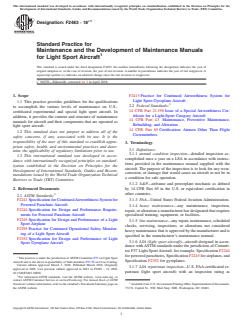
This international standard was developed in accordance with internationally recognized principles on standardization established in the Decision on Principles for the
Development of International Standards, Guides and Recommendations issued by the World Trade Organization Technical Barriers to Trade (TBT) Committee.
´1
Designation: F2483 − 18
Standard Practice for
Maintenance and the Development of Maintenance Manuals
for Light Sport Aircraft
This standard is issued under the fixed designation F2483; the number immediately following the designation indicates the year of
original adoption or, in the case of revision, the year of last revision. A number in parentheses indicates the year of last reapproval. A
superscript epsilon (´) indicates an editorial change since the last revision or reapproval.
ε NOTE—Editorially corrected A1.3 in April 2018.
1. Scope F2415 Practice for Continued Airworthiness System for
Light Sport Gyroplane Aircraft
1.1 This practice provides guidelines for the qualifications
2.2 Federal Standards:
to accomplish the various levels of maintenance on U.S.-
14 CFR Part 21.190 Issue of a Special Airworthiness Cer-
certificated experimental and special light sport aircraft. In
tificate for a Light-Sport Category Aircraft
addition, it provides the content and structure of maintenance
14 CFR Part 43 Maintenance, Preventive Maintenance,
manuals for aircraft and their components that are operated as
Rebuilding, and Alteration
light sport aircraft.
14 CFR Part 65 Certification: Airmen Other Than Flight
1.2 This standard does not purport to address all of the
Crewmembers
safety concerns, if any, associated with its use. It is the
responsibility of the user of this standard to establish appro-
3. Terminology
priate safety, health, and environmental practices and deter-
3.1 Definitions:
mine the applicability of regulatory limitations prior to use.
3.1.1 annual condition inspection—detailed inspection ac-
1.3 This international standard was developed in accor-
complished once a year on a LSA in accordance with instruc-
dance with internationally recognized principles on standard-
tions provided in the maintenance manual supplied with the
ization established in the Decision on Principles for the
aircraft. The purpose of the inspection is to look for any wear,
Development of International Standards, Guides and Recom-
corrosion, or damage that would cause an aircraft to not be in
mendations issued by the World Trade Organization Technical
a condition for safe operation.
Barriers to Trade (TBT) Committee.
3.1.2 A&P—airframe and powerplant mechanic as defined
by 14 CFR Part 65 in the U.S. or equivalent certification in
2. Referenced Documents
2 other countries.
2.1 ASTM Standards:
3.1.3 FAA—United States Federal Aviation Administration.
F2241 SpecificationforContinuedAirworthinessSystemfor
Powered Parachute Aircraft
3.1.4 heavy maintenance—any maintenance, inspection,
F2244 Specification for Design and Performance Require-
repair, or alteration a manufacturer has designated that requires
ments for Powered Parachute Aircraft
specialized training, equipment, or facilities.
F2245 Specification for Design and Performance of a Light
3.1.5 line maintenance—any repair, maintenance, scheduled
Sport Airplane
checks, servicing, inspections, or alterations not considered
F2295 Practice for Continued Operational Safety Monitor-
heavy maintenance that is approved by the manufacturer and is
ing of a Light Sport Aircraft
specified in the manufacturer’s maintenance manual.
F2352 Specification for Design and Performance of Light
3.1.6 LSA (light sport aircraft)—aircraft designed in accor-
Sport Gyroplane Aircraft
dance withASTM standards under the jurisdiction of Commit-
tee F37 Light SportAircraft, for example, Specification F2244
for powered parachutes, Specification F2245 for airplanes, and
This practice is under the jurisdiction ofASTM Committee F37 on Light Sport
Specification F2352 for gyroplanes.
Aircraft and is the direct responsibility of Subcommittee F37.70 on Cross Cutting.
Current edition approved March 1, 2018. Published March 2018. Originally
3.1.7 LSA repairman inspection—U.S. FAA-certificated re-
approved in 2005. Last previous edition approved in 2012 as F2483 – 12. DOI:
pairman (light sport aircraft) with an inspection rating as
10.1520/F2483-18E01.
For referenced ASTM standards, visit the ASTM website, www.astm.org, or
contact ASTM Customer Service at service@astm.org. For Annual Book of ASTM
Standards volume information, refer to the standard’s Document Summary page on AvailablefromU.S.GovernmentPrintingOfficeSuperintendentofDocuments,
the ASTM website. 732 N. Capitol St., NW, Mail Stop: SDE, Washington, DC 20401.
Copyright © ASTM International, 100 Barr Harbor Drive, PO Box C700, West Conshohocken, PA 19428-2959. United States
´1
F2483 − 18
turers of SLSAand ELSAKits for sale in the U.S. are required to provide
defined by 14 CFR Part 65, authorized to perform the annual
a maintenance manual for each aircraft in accordance with 14 CFR Part
condition inspection on experimental light sport aircraft, or an
21.190. These manuals do not require any type of approval from the FAA
equivalent rating issued by other civil aviation authorities.
or other government entity; however, the regulations do require the
3.1.7.1 Discussion—Experimental LSA do not require the
manual to be developed in accordance with industry consensus standards.
individual performing maintenance to hold any FAA airman
5.1 Format—The maintenance manual shall have the fol-
certificate in the U.S.
lowing sections:
3.1.8 LSA repairman maintenance—U.S. FAA-certificated
5.1.1 General—Listings of general specifications,
repairman (light sport aircraft) with a maintenance rating as
capacities, and instructions on ground handling, servicing, and
defined by 14 CFR Part 65, authorized to perform line
lubrication such as:
maintenance on aircraft certificated as special LSA aircraft.
5.1.1.1 Equipment list,
Authorized to perform the annual condition/100-h inspection
5.1.1.2 Sources to purchase parts,
on an LSA, or an equivalent rating issued by other civil
5.1.1.3 List of disposable replacement parts, for example,
aviation authorities.
air filters, fuel filters, oil filters, and tires,
3.1.9 maintenance manual(s)—manual provided by an LSA
5.1.1.4 Engine specifications,
manufacturerorsupplierthatspecifiesallmaintenance,repairs, 5.1.1.5 Weight and balance information,
and alterations authorized by the manufacturer.
5.1.1.6 Tire inflation pressures,
5.1.1.7 Approved oils and capacities,
3.1.10 major repair, alteration, or maintenance—any repair,
5.1.1.8 Recommended fastener torque values,
alteration, or maintenance for which instructions to complete
5.1.1.9 General safety information, and
the task excluded from the maintenance manual(s) supplied to
5.1.1.10 Instructions for reporting possible safety of flight
the consumer are considered major.
concerns found during inspection/maintenance.
3.1.11 manufacturer—any entity engaged in the production
5.1.2 Inspections—Instructions on and checklists for the
of an LSA or component used on an LSA.
completionofperiodicandannualcondition/100-hinspections,
3.1.12 minor repair, alteration, or maintenance—any repair,
as appropriate.
alteration, or maintenance for which instructions provided for
5.1.3 Structures—A description of and instructions for the
in the maintenance manual(s) supplied to the consumer of the
maintenance, repair, and alteration of the aircraft primary
product are considered minor.
structures such as:
3.1.13 overhaul—maintenance, inspection, repair, or altera- 5.1.3.1 Wing (fixed, rotary, or inflatable),
tions that are only to be accomplished by the original manu-
5.1.3.2 Empennage (or cart),
facturer or a facility approved by the original manufacturer of 5.1.3.3 Landing gear, and
the product.
5.1.3.4 Structural control surfaces, for example, elevator (if
applicable).
3.1.14 overhaul facility—facility specifically authorized by
5.1.4 Engine—A description of and instruction for the
the aircraft or component manufacturer to overhaul the product
maintenance, repair, and overhaul of the aircraft’s engine if the
originally produced by that manufacturer.
aircraft is powered.
3.1.15 repair facility—facility specifically authorized by the
aircraft or component manufacturer to repair the product
NOTE 2—An LSA manufacturer may defer to the engine manufacturer
for the required maintenance, repair, and overhaul instructions.
originally produced by that manufacturer.
5.1.5 Fuel System—A description of the system, schematic
3.1.16 14 CFR—Code of Federal Regulations Title 14
diagram, and instructions for the maintenance and repair of the
Aeronautics and Space also known as the “FARs” or Federal
aircraft fuel system, if a powered aircraft.
Aviation Regulations.
5.1.6 Propeller—A description of and instructions for the
3.1.17 100-h inspection—sameasan annual condition
maintenance and repair of the propeller, if a powered aircraft.
inspection, except the interval of inspection is 100 h of
operation instead of 12 calendar months. This inspection is
NOTE 3—An LSA manufacturer may defer to the propeller manufac-
turer for the required maintenance, repair, and overhaul instructions.
utilized when the LSAis being used for commercial operations
such as flight instruction or rental, or both.
5.1.7 Utility Systems—A description of the systems and
instructions for the maintenance and repair of utility systems
4. Significance and Use
such as heating, vent, and air-conditioning, if installed.
4.1 The purpose of this practice is to provide guidance to
5.1.8 Instruments and Avionics—A description of and in-
owners, mechanics, airports, regulatory officials, and aircraft
structions for the maintenance, repair, replacement, and instal-
and component manufacturers who may accomplish
lation of existing and additional instruments and avionics, as
maintenance,repairs,andalterationsonalightsportaircraft.In
applicable.
addition, this practice covers the format and content of main-
5.1.9 Electrical System—A description of the system, sche-
tenance manuals and instructions for the maintenance, repair,
matic diagram, and instructions for the maintenance, repair,
and alteration of an LSA.
and alteration, as appropriate.
5.1.10 Structural Repair—A description of the structural
5. Aircraft Maintenance Manual
repairsthatareauthorizedwithoutfurtherconsultationwiththe
NOTE 1—This practice provides the information needed to comply with
the requirement of what the maintenance manual will contain. Manufac- manufacturer.
´1
F2483 − 18
5.1.11 Painting and Coatings—A description for the repair, required for the replacement of a piston engine valve, “A&Por
replacement, or alteration, or a combination thereof, of paint or LSA Repairman Maintenance Task-Specific.”
coatings used on the aircraft.
6. Line Maintenance, Repairs, and Alterations
5.1.12 Revisions—Asection, such as a change history table,
6.1 Authorization to Perform—TheholderofanLSArepair-
for the listing of any revisions to the maintenance manual by
the manufacturer. man certificate with either an inspection or maintenance rating
is generally considered the minimum level of certification to
5.1.13 Feedback Form—A form for the aircraft owner or
perform line maintenance of LSA.
maintainer to provide notification to the manufacturer about
NOTE 5—Many of the tasks listed are also authorized by the FAAto be
issues and anomalies identified during the operation or main-
performed by the owner of the SLSA who holds a sport pilot certificate.
tenance of the aircraft or in the content of the manual.
Theexampleslistedbelowshouldnotbeconsideredasrestrictionsagainst
theperformanceofthetasksbyanownerthatisauthorizedtoperformsaid
5.2 Inspection, Repair, and Alterations—Each of the
task by the FAA.
inspections,repairs,andalterationsoutlinedinthemaintenance
manual shall specifically list: 6.2 TypicalTasksConsideredasLineMaintenanceforLSA’s
Include:
(1) Recommended special tools to accomplish the task,
(2) The parts needed to perform the task, 6.2.1 100-h inspection,
6.2.2 Annual condition inspection,
(3) Type of maintenance, for example, line, heavy, or
overhaul, 6.2.3 Servicing of fluids,
(4) Thelevelofcertificationneededtoaccomplishthetask, 6.2.4 Removal and replacement of components for which
for example, owner, A&P, repairman (light sport aircraft) instructions are provided in the maintenance manual such as:
inspection, and repair station, 6.2.4.1 Fuel pumps,
(5) Detailed instructions and diagrams as needed to per- 6.2.4.2 Batteries,
form the task, and 6.2.4.3 Instruments, switches, lights, and circuit breakers,
6.2.4.4 Starters/generators/alternators,
(6) Method to test/inspect to verify the task was accom-
plished properly. 6.2.4.5 Exhaust manifolds/mufflers,
6.2.4.6 Wheel and brake assemblies,
5.2.1 Repairs and Alterations—Manufacturers may refer to
6.2.4.7 Propellers,
other repair and alteration manuals such as the FAA’s AC for
6.2.4.8 Sparkplugs, ignition wires, and electronic ignition
the detailed instructions to accomplish tasks outlined in the
models/components limited to the use of mechanical
maintenance manual.
connections,
5.3 Level of Certification—When listing the level of certi-
6.2.4.9 Hoses and lines,
fication needed to perform a task, the manufacturer shall use
6.2.4.10 Sailcloth covering,
one of the following descriptors.
6.2.4.11 Ballistic recovery system,
5.3.1 Owner—Items that can be expected to be completed
6.2.4.12 Floats, and
by a responsible owner who holds a pilot certificate but who
6.2.4.13 Skis.
has not received any specific authorized training.
6.2.5 Repair of components and structure for which instruc-
NOTE 4—FAAregulations authorize SLSAaircraft owners who hold at tionsareprovidedinthemaintenancemanualandwhichdonot
leastasportpilotcertificatetoperformmaintenanceasoutlinedin14CFR
require additional specialized training, such as:
Part 43.
6.2.5.1 Patching of a hole in a fabric, metal, or composite
5.3.2 LSA Repairman Inspection—Items that can be ex- non-structural component, and
pected to be completed on an ELSA by a responsible owner, 6.2.5.2 Stop-drilling of cracks.
which holds an FAArepairman certificate (light sport aircraft), 6.2.6 Alterations for which specific instruction are provided
in the maintenance manual, such as:
with an inspection rating or equivalent.
6.2.6.1 Installation of a communications radio, transponder,
5.3.3 LSA Repairman Maintenance—Items that can be ex-
GPS, and antenna,
pected to be completed on a SLSAby a responsible individual,
6.2.6.2 Installation of a strobe light system, and
which holds a FAA repairman certificate (light sport aircraft),
6.2.6.3 Compliance with a manufacturer service directive
with a maintenance rating or equivalent.
when the repairman is listed as an authorized person to
5.3.4 A&P—Items that can be expected to be completed by
accomplish the alteration.
a responsible individual who holds a mechanic certificate with
airframe or powerplant ratings, or both, or equivalent.
7. Heavy Maintenance, Repairs, and Alterations
5.3.5 Task Specific—Items that can be expected to be
7.1 Authorization to Perform—The holder of a mechanic
completed by a responsible individual who holds either a
certificate with airframe or powerplant rating(s), or both, or an
mechanic certificate or a repairman certificate and has received
LSA Repairman maintenance that has received additional task
task specific training to perform the task.
specific training for the function to be performed is generally
5.3.5.1 When specifying the “task specific” level of
consideredtheminimumlevelofcertificationtoperformheavy
certification, the manufacturer must also specify the specific
maintenance of LSA.
training required.
5.3.6 Multiple descriptors and modifiers may be used. For 7.2 Typical Tasks Considered as Heavy Maintenance for
example, a manufacturer may list under level of certification SLSA’s Include:
´1
F2483 − 18
7.2.1 Removal and replacement of components for which 9.3.1 Theinstructionsmustincludegroundandflighttesting
instructions are provided in the maintenance manual or service that complies with the original ASTM production acceptance
directive instructions, such as: testing standard, as appropriate, to verify the alteration was
7.2.1.1 Complete engine removal and reinstallation in sup- performed correctly and the aircraft is in a condition for safe
port of an engine overhaul or to install a new engine, operation.
7.2.1.2 Remove and replacement of engine cylinders, 9.3.2 The instructions and diagrams provided to the S-LSA
pistons, or valve assemblies, or a combination thereof, owner or mechanic shall be documented on an LSA Major
7.2.1.3 Primary flight control cables/components, and Repair and Alterations (MRA) form as defined in Annex A1.
7.2.1.4 Landing gear assemblies.
9.4 The manufacturer or other entity that performs the
7.2.2 Repair of components or aircraft structure, or both, for
evaluation shall provide information to the owner of the
which instructions are provided in the maintenance manual or
aircraft for the documentation of the alteration in the aircraft’s
service directive instructions, such as:
records.
7.2.2.1 Repainting of control surfaces,
7.2.2.2 Structural repairs, and
10. Task-Specific Training
7.2.2.3 Recovering of a dope and fabric covered aircraft.
10.1 Amanufacturer of a product may require type-specific
7.2.3 Alterations of components or aircraft structure, or
training in order to accomplish a task in either the maintenance
both, for which instructions are provided in the maintenance
manual or in an authorization for a major repair, maintenance,
manual or service directive instruction, such as:
or alteration. The FAA does not give approval to these
7.2.3.1 Initial installation of skis, and
task-specific training programs for SLSA.Amanufacturer may
7.2.3.2 Installation of new additional pitot static instru-
specifyanytask-specifictrainingitdeterminesisappropriateto
ments.
accomplish a task.
8. Overhaul
10.2 Examples of task-specific training include:
10.2.1 Engine manufacturer heavy maintenance or overhaul
8.1 Authorization to Perform—Only the manufacturer of an
school, or both,
LSA or the component to be overhauled on an LSA may
10.2.2 EAA Sport Air Fabric Covering School,
perform or authorize to be performed the overhaul of an LSA
10.2.3 Parachute manufacturer repair course, and
component.
10.2.4 Aircraft manufacturer course.
NOTE 6—In the U.S., no FAA certification is given to be an LSA
approved overhaul facility.
11. Safety Directives
8.2 Overhaul Manual—A separate overhaul manual in ad-
dition to the manufacturer’s maintenance manual is required to
11.1 An SLSAmay have a safety directive issued against an
perform the overhaul of an LSA or LSA component.
aircraft or component part. The original aircraft manufacturer
NOTE7—Theformandcontentofsuchamanualisnotgovernedbythis
issues the directive as outlined in the applicable ASTM
practice or by any FAA regulation.
continued airworthiness specification.
NOTE 8—Specific form and content guidelines have not been promul-
NOTE 9—SLSA and components installed on SLSA’s do not have
gated here as type-specific training and authorization is required from the
airworthiness directives issued against them. If an AD is issued against a
manufacturer in order to overhaul an SLSA or component.
type-certificated product that may be incorporated into special light sport
8.3 Typical components that are overhauled include:
aircraft, the manufacturer of the aircraft is required in accordance with
8.3.1 Engines, Practices F2295 and F2415, and Specification F2241 to issue a safety
directive providing instruction on how to address the safety defect
8.3.2 Carburetors/fuel injection systems,
outlined in the AD on the specific SLSA.
8.3.3 Starters/alternators/generators, and
11.2 The original LSA manufacturer is responsible for
8.3.4 Instruments.
providing the applicable instructions to comply with any safety
directive, which will include:
9. Major Repairs and Alterations
11.2.1 A list of the tools needed to accomplish the task,
9.1 All major repairs or alterations made to aircraft subse-
11.2.2 A list of the parts needed to perform the task,
quent to its initial design and production acceptance testing to
11.2.3 Type of maintenance, for example, line, heavy,
applicable ASTM standards and sale to a consumer must be
overhaul,
evaluated relative to the requirements of the applicableASTM
11.2.4 The level of certification needed to accomplish the
design and production acceptance specification(s).
task, for example, A&P, repairman inspection,
9.2 The manufacturer or other entity that performs the
11.2.5 Detailed instructions and diagrams as needed to
evaluation of an alteration or repair shall provide a written
perform the task, and
affidavit that the aircraft being altered will still meet the
11.2.6 Method to test/inspect to verify the task was accom-
requirements of the applicabl
...