

ASTM D6638-18
(Test Method)Standard Test Method for Determining Connection Strength Between Geosynthetic Reinforcement and Segmental Concrete Units (Modular Concrete Blocks)
General Information
- Abstract
SIGNIFICANCE AND USE
5.1 The connection strength between geosynthetic reinforcement and segmental concrete block units is used in design of reinforced soil retaining walls.
5.2 This test is used to determine the connection strength for the design of the connection system formed by segmental concrete block units and geosynthetic reinforcement layers in reinforced soil retaining walls. Performing a series of these connection tests at varying normal loads permits development of a relationship between connection strength and normal load. This relationship may be linear, bilinear, or some other complex mathematical expression.
5.3 This connection strength test is meant to be a performance test (laboratory or field); therefore, it should be conducted using full-scale system components. The conditions for the test are selected by the user and are not for routine testing.
5.4 As a performance test on full-scale system components, it accounts for some of the variables in construction procedures and materials tolerance normally present for these types of retaining wall systems.
SCOPE
1.1 This test method is used to determine the connection properties between a layer of geosynthetic reinforcement and segmental concrete block units used in construction of reinforced soil retaining walls. The test is carried out under conditions determined by the user that reproduce the connection system at full scale. The results of a series of tests are used to define a relationship between connection strength for a segmental unit-geosynthetic connection system and normal load.
1.2 This is a performance test used to determine properties for design of retaining wall systems utilizing segmental concrete units and soil reinforcing geosynthetics, either geotextiles or geogrids. The test is performed on a full-scale construction of the connection and may be run in a laboratory or the field.
1.3 The values stated in SI units are regarded as the standard. The values stated in inch-pound units are provided for information only.
1.4 This standard does not purport to address all of the safety concerns, if any, associated with its use. It is the responsibility of the user of this standard to establish appropriate safety, health, and environmental practices and determine the applicability of regulatory limitations prior to use.
1.5 This international standard was developed in accordance with internationally recognized principles on standardization established in the Decision on Principles for the Development of International Standards, Guides and Recommendations issued by the World Trade Organization Technical Barriers to Trade (TBT) Committee.
- Status
- Published
- Publication Date
- 14-Jul-2018
- Technical Committee
- D35 - Geosynthetics
- Drafting Committee
- D35.01 - Mechanical Properties
Buy Documents
ASTM D6638-18 - Standard Test Method for Determining Connection Strength Between Geosynthetic Reinforcement and Segmental Concrete Units (Modular Concrete Blocks)
REDLINE ASTM D6638-18 - Standard Test Method for Determining Connection Strength Between Geosynthetic Reinforcement and Segmental Concrete Units (Modular Concrete Blocks)
Overview
ASTM D6638-18 is the internationally recognized standard test method for determining the connection strength between geosynthetic reinforcement and segmental concrete units (often called modular concrete blocks). This test method is essential for engineers and designers involved in the construction of reinforced soil retaining walls that utilize geosynthetic reinforcement such as geotextiles and geogrids together with segmental concrete block units.
This standard establishes a performance test to assess the mechanical connection properties under user-defined conditions that simulate full-scale, real-world construction. Results from this test are critical for ensuring wall integrity and for optimizing the design of reinforced soil structures in civil engineering projects.
Key Topics
- Full-Scale Connection Testing: The method requires testing with full-size system components to closely replicate actual construction conditions in retaining walls, including normal construction variations and material tolerances.
- Connection Strength Evaluation: Tests determine both the peak tensile capacity and service-state tensile capacity between the geosynthetic reinforcement and the segmental concrete blocks.
- Normal Load Relationship: By performing tests at various normal loads, this method helps establish the relationship between connection strength and normal load, which is essential for structural analysis and wall design.
- Geosynthetic Materials Covered: Both geotextiles and geogrids as soil reinforcement options are addressed.
- Performance-Based Approach: The standard is designed for performance-based evaluation rather than routine quality control, making it suitable for both laboratory and field testing.
Applications
ASTM D6638-18 is widely used in:
- Retaining Wall Design: Results from this standard are used by civil and geotechnical engineers to design secure and durable reinforced soil retaining walls, particularly those constructed from modular concrete blocks and geosynthetic reinforcement.
- Quality Assurance: While not a routine quality control or product specification test, the method helps verify that selected components and construction practices yield the desired connection strength for the intended application.
- System Optimization: Designers and manufacturers use the data from this performance test to optimize connections, select compatible materials, and improve construction detailing, leading to more resilient retaining wall systems.
- Regulatory Compliance: The method helps meet international best practices and regulatory requirements for the engineering and construction of soil-reinforced retaining structures.
Related Standards
- ASTM D448 - Classification for Sizes of Aggregate for Road and Bridge Construction
- ASTM D4354 - Practice for Sampling of Geosynthetics and Rolled Erosion Control Products (RECPs) for Testing
- ASTM D4439 - Terminology for Geosynthetics
- ASTM D4495 - Test Method for Impact Resistance of Poly(Vinyl Chloride) (PVC) Rigid Profiles by Means of a Falling Weight
- ASTM D6637/D6637M - Test Methods for Determining Tensile Properties of Geogrids by the Single or Multi-Rib Tensile Method
Keywords: ASTM D6638-18, geosynthetic reinforcement, segmental concrete units, connection strength, retaining walls, geogrid, geotextile, modular concrete blocks, performance test, soil reinforcement
By adhering to ASTM D6638-18, professionals in the geotechnical and civil engineering fields can ensure their reinforced soil retaining walls meet the highest standards for safety, performance, and durability, with proven test methods for evaluating critical connection strengths.
Relations
- Effective Date
- 15-Jul-2018
- Effective Date
- 01-Feb-2024
- Effective Date
- 15-Nov-2023
- Effective Date
- 01-May-2020
- Effective Date
- 15-Apr-2018
- Effective Date
- 01-Aug-2017
- Effective Date
- 01-Sep-2015
- Effective Date
- 15-Jul-2015
- Effective Date
- 01-Jul-2015
- Effective Date
- 01-Mar-2014
- Refers
ASTM D448-12 - Standard Classification for Sizes of Aggregate for Road and Bridge Construction - Effective Date
- 01-Dec-2012
- Effective Date
- 01-Jul-2012
- Effective Date
- 01-May-2012
- Effective Date
- 01-Oct-2011
- Effective Date
- 15-Jan-2009
Buy Documents
ASTM D6638-18 - Standard Test Method for Determining Connection Strength Between Geosynthetic Reinforcement and Segmental Concrete Units (Modular Concrete Blocks)
REDLINE ASTM D6638-18 - Standard Test Method for Determining Connection Strength Between Geosynthetic Reinforcement and Segmental Concrete Units (Modular Concrete Blocks)
Get Certified
Connect with accredited certification bodies for this standard

DIBt (Deutsches Institut für Bautechnik)
German Institute for Building Technology.
DIN CERTCO
DIN Group product certification.

Aboma Certification B.V.
Specialized in construction, metal, and transport sectors.
Sponsored listings
Frequently Asked Questions
ASTM D6638-18 is a standard published by ASTM International. Its full title is "Standard Test Method for Determining Connection Strength Between Geosynthetic Reinforcement and Segmental Concrete Units (Modular Concrete Blocks)". This standard covers: SIGNIFICANCE AND USE 5.1 The connection strength between geosynthetic reinforcement and segmental concrete block units is used in design of reinforced soil retaining walls. 5.2 This test is used to determine the connection strength for the design of the connection system formed by segmental concrete block units and geosynthetic reinforcement layers in reinforced soil retaining walls. Performing a series of these connection tests at varying normal loads permits development of a relationship between connection strength and normal load. This relationship may be linear, bilinear, or some other complex mathematical expression. 5.3 This connection strength test is meant to be a performance test (laboratory or field); therefore, it should be conducted using full-scale system components. The conditions for the test are selected by the user and are not for routine testing. 5.4 As a performance test on full-scale system components, it accounts for some of the variables in construction procedures and materials tolerance normally present for these types of retaining wall systems. SCOPE 1.1 This test method is used to determine the connection properties between a layer of geosynthetic reinforcement and segmental concrete block units used in construction of reinforced soil retaining walls. The test is carried out under conditions determined by the user that reproduce the connection system at full scale. The results of a series of tests are used to define a relationship between connection strength for a segmental unit-geosynthetic connection system and normal load. 1.2 This is a performance test used to determine properties for design of retaining wall systems utilizing segmental concrete units and soil reinforcing geosynthetics, either geotextiles or geogrids. The test is performed on a full-scale construction of the connection and may be run in a laboratory or the field. 1.3 The values stated in SI units are regarded as the standard. The values stated in inch-pound units are provided for information only. 1.4 This standard does not purport to address all of the safety concerns, if any, associated with its use. It is the responsibility of the user of this standard to establish appropriate safety, health, and environmental practices and determine the applicability of regulatory limitations prior to use. 1.5 This international standard was developed in accordance with internationally recognized principles on standardization established in the Decision on Principles for the Development of International Standards, Guides and Recommendations issued by the World Trade Organization Technical Barriers to Trade (TBT) Committee.
SIGNIFICANCE AND USE 5.1 The connection strength between geosynthetic reinforcement and segmental concrete block units is used in design of reinforced soil retaining walls. 5.2 This test is used to determine the connection strength for the design of the connection system formed by segmental concrete block units and geosynthetic reinforcement layers in reinforced soil retaining walls. Performing a series of these connection tests at varying normal loads permits development of a relationship between connection strength and normal load. This relationship may be linear, bilinear, or some other complex mathematical expression. 5.3 This connection strength test is meant to be a performance test (laboratory or field); therefore, it should be conducted using full-scale system components. The conditions for the test are selected by the user and are not for routine testing. 5.4 As a performance test on full-scale system components, it accounts for some of the variables in construction procedures and materials tolerance normally present for these types of retaining wall systems. SCOPE 1.1 This test method is used to determine the connection properties between a layer of geosynthetic reinforcement and segmental concrete block units used in construction of reinforced soil retaining walls. The test is carried out under conditions determined by the user that reproduce the connection system at full scale. The results of a series of tests are used to define a relationship between connection strength for a segmental unit-geosynthetic connection system and normal load. 1.2 This is a performance test used to determine properties for design of retaining wall systems utilizing segmental concrete units and soil reinforcing geosynthetics, either geotextiles or geogrids. The test is performed on a full-scale construction of the connection and may be run in a laboratory or the field. 1.3 The values stated in SI units are regarded as the standard. The values stated in inch-pound units are provided for information only. 1.4 This standard does not purport to address all of the safety concerns, if any, associated with its use. It is the responsibility of the user of this standard to establish appropriate safety, health, and environmental practices and determine the applicability of regulatory limitations prior to use. 1.5 This international standard was developed in accordance with internationally recognized principles on standardization established in the Decision on Principles for the Development of International Standards, Guides and Recommendations issued by the World Trade Organization Technical Barriers to Trade (TBT) Committee.
ASTM D6638-18 is classified under the following ICS (International Classification for Standards) categories: 91.100.50 - Binders. Sealing materials. The ICS classification helps identify the subject area and facilitates finding related standards.
ASTM D6638-18 has the following relationships with other standards: It is inter standard links to ASTM D6638-11, ASTM D4439-24, ASTM D6637/D6637M-15(2023), ASTM D4354-12(2020), ASTM D4439-18, ASTM D4439-17, ASTM D4439-15a, ASTM D6637/D6637M-15, ASTM D4439-15, ASTM D4439-14, ASTM D448-12, ASTM D4354-12, ASTM D4495-12, ASTM D4439-11, ASTM D4354-99(2009). Understanding these relationships helps ensure you are using the most current and applicable version of the standard.
ASTM D6638-18 is available in PDF format for immediate download after purchase. The document can be added to your cart and obtained through the secure checkout process. Digital delivery ensures instant access to the complete standard document.
Standards Content (Sample)
This international standard was developed in accordance with internationally recognized principles on standardization established in the Decision on Principles for the
Development of International Standards, Guides and Recommendations issued by the World Trade Organization Technical Barriers to Trade (TBT) Committee.
Designation: D6638 − 18
Standard Test Method for
Determining Connection Strength Between Geosynthetic
Reinforcement and Segmental Concrete Units (Modular
Concrete Blocks)
This standard is issued under the fixed designation D6638; the number immediately following the designation indicates the year of
original adoption or, in the case of revision, the year of last revision. A number in parentheses indicates the year of last reapproval. A
superscript epsilon (´) indicates an editorial change since the last revision or reapproval.
1. Scope 2. Referenced Documents
1.1 This test method is used to determine the connection 2.1 ASTM Standards:
properties between a layer of geosynthetic reinforcement and D448 Classification for Sizes of Aggregate for Road and
segmental concrete block units used in construction of rein- Bridge Construction
forced soil retaining walls. The test is carried out under D4354 Practice for Sampling of Geosynthetics and Rolled
conditions determined by the user that reproduce the connec- Erosion Control Products (RECPs) for Testing
tion system at full scale.The results of a series of tests are used D4439 Terminology for Geosynthetics
to define a relationship between connection strength for a D4495 Test Method for Impact Resistance of Poly(Vinyl
segmental unit-geosynthetic connection system and normal Chloride) (PVC) Rigid Profiles by Means of a Falling
load. Weight
D6637/D6637M Test Method for Determining Tensile Prop-
1.2 This is a performance test used to determine properties
erties of Geogrids by the Single or Multi-Rib Tensile
for design of retaining wall systems utilizing segmental con-
Method
crete units and soil reinforcing geosynthetics, either geotextiles
or geogrids. The test is performed on a full-scale construction
3. Terminology
of the connection and may be run in a laboratory or the field.
3.1 Definitions:
1.3 The values stated in SI units are regarded as the
3.1.1 displacement criteria, n—a user-prescribed maximum
standard. The values stated in inch-pound units are provided
movement, mm (in.), of the geosynthetic reinforcement out
for information only.
from the back of segmental concrete units.
1.4 This standard does not purport to address all of the
3.1.2 geosynthetic, n—a planar product manufactured from
safety concerns, if any, associated with its use. It is the
polymeric material used with soil, rock, earth, or other geo-
responsibility of the user of this standard to establish appro-
technical engineering-related material as an integral part of a
priate safety, health, and environmental practices and deter-
manmade project, structure, or system. D4439
mine the applicability of regulatory limitations prior to use.
3.1.3 granular infill, n—coarse-grained soil aggregate used
1.5 This international standard was developed in accor-
to fill the voids in and between segmental concrete units.
dance with internationally recognized principles on standard-
3.1.4 peak connection strength, n—the maximum tensile
ization established in the Decision on Principles for the
capacity of the connection between geosynthetic reinforcement
Development of International Standards, Guides and Recom-
and segmental concrete units.
mendations issued by the World Trade Organization Technical
Barriers to Trade (TBT) Committee.
3.1.5 segmental concrete unit (modular concrete block),
n—a concrete unit manufactured specifically for mortarless,
dry-stack retaining wall construction.
This test method is under the jurisdiction of ASTM Committee D35 on
Geosynthetics and is the direct responsibility of Subcommittee D35.01 on Mechani-
cal Properties For referenced ASTM standards, visit the ASTM website, www.astm.org, or
Current edition approved July 15, 2018. Published August 2018. Originally contact ASTM Customer Service at service@astm.org. For Annual Book of ASTM
approved in 2001. Last previous edition approved in 2011 as D6638 – 11. DOI: Standards volume information, refer to the standard’s Document Summary page on
10.1520/D6638-18. the ASTM website.
Copyright © ASTM International, 100 Barr Harbor Drive, PO Box C700, West Conshohocken, PA 19428-2959. United States
D6638 − 18
3.1.6 segmental concrete unit width, n—the segmental con- This relationship may be linear, bilinear, or some other
crete unit dimension parallel to the wall face and coincident complex mathematical expression.
with the geosynthetic reinforcement test specimen width.
5.3 This connection strength test is meant to be a perfor-
3.1.7 service-state connection strength, n—the connection
mance test (laboratory or field); therefore, it should be con-
tensile capacity at a service-state displacement criterion be-
ducted using full-scale system components. The conditions for
tween geosynthetic reinforcement and segmental concrete
the test are selected by the user and are not for routine testing.
units.
5.4 As a performance test on full-scale system components,
3.2 For definitions of other terms relating to geosynthetics,
itaccountsforsomeofthevariablesinconstructionprocedures
refer to Terminology D4439.
and materials tolerance normally present for these types of
retaining wall systems.
4. Summary of Test Method
6. Apparatus
4.1 One end of a wide geosynthetic reinforcement test
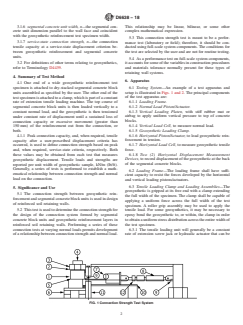
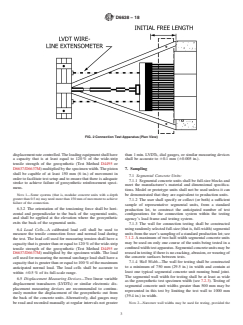
6.1 Testing System—An example of a test apparatus and
specimen is attached to dry-stacked segmental concrete block
setup is illustrated in Figs. 1 and 2. The principal components
units assembled as specified by the user. The other end of the
of the test apparatus are:
testspecimenisattachedtoaclamp,whichispartofaconstant
6.1.1 Loading Frame.
rate of extension tensile loading machine. The top course of
6.1.2 Normal Load Piston/Actuator.
segmental concrete block units is then loaded vertically to a
constant normal load, and the geosynthetic is then tensioned 6.1.3 Vertical Loading Platen, with stiff rubber mat or
airbag to apply uniform vertical pressure to top of concrete
under constant rate of displacement until a sustained loss of
connection capacity or excessive movement (greater than blocks.
6.1.4 Vertical Load Cell, to measure normal load.
150 mm) of the reinforcement out from the connection, or
6.1.5 Geosynthetic Loading Clamp.
both.
6.1.6 Horizontal Piston/Actuator, to load geosynthetic rein-
4.1.1 Peak connection capacity, and, when required, tensile
forcement in tension.
capacity after a user-prescribed displacement criteria has
6.1.7 Horizontal Load Cell, to measure geosynthetic tensile
occurred, is used to define connection strength based on peak
force.
and, when required, service-state criteria, respectively. Both
6.1.8 Two (2) Horizontal Displacement Measurement
these values may be obtained from each test that measures
Devices, to record displacement of the geosynthetic at the back
geosynthetic displacement. Tensile loads and strengths are
of the segmental concrete blocks.
reported per unit width of geosynthetic sample, kN/m (lb/ft).
Generally, a series of tests is performed to establish a math-
6.2 Loading Frame—The loading frame shall have suffi-
ematical relationship between connection strength and normal
cient capacity to resist the forces developed by the horizontal
load on the connection.
and vertical loading pistons/actuators.
6.3 Tensile Loading Clamp and Loading Assemblies—The
5. Significance and Use
geosynthetic is gripped at its free end with a clamp extending
5.1 The connection strength between geosynthetic rein-
the full width of the specimen. The clamp shall be capable of
forcement and segmental concrete block units is used in design
applying a uniform force across the full width of the test
of reinforced soil retaining walls.
specimen. A roller grip assembly may be used to apply the
5.2 Thistestisusedtodeterminetheconnectionstrengthfor tensile load. For some geosynthetics, it may be necessary to
the design of the connection system formed by segmental epoxy bond the geosynthetic to, or within, the clamp in order
concrete block units and geosynthetic reinforcement layers in toobtainauniformstressdistributionacrosstheentirewidthof
reinforced soil retaining walls. Performing a series of these the test specimen.
connection tests at varying normal loads permits development 6.3.1 The tensile loading unit will generally be a constant
of a relationship between connection strength and normal load. rate of extension screw jack or hydraulic actuator that can be
FIG. 1 Connection Strength Test System
D6638 − 18
FIG. 2 Connection Test Apparatus (Plan View)
displacementratecontrolled.Theloadingequipmentshallhave than 1 min. LVDTs, dial gauges, or similar measuring devices
a capacity that is at least equal to 120 % of the wide-strip shall be accurate to 60.1 mm (60.005 in.).
tensile strength of the geosynthetic (Test Method D4495 or
D6637/D6637M)multipliedbythespecimenwidth.Thepiston
7. Sampling
shall be capable of at least 150 mm (6 in.) of movement in
7.1 Segmental Concrete Units:
order to facilitate test setup and to ensure that there is adequate
7.1.1 Segmental concrete units shall be full-size blocks and
stroke to achieve failure of geosynthetic reinforcement speci-
meet the manufacturer’s material and dimensional specifica-
mens.
tions. Model or prototype units shall not be used unless it can
NOTE 1—Some systems (that is, modular concrete units with a depth be demonstrated that they are equivalent to production units.
greater than 0.5 m) may need more than 150 mm of movement to achieve
7.1.2 The user shall specify or collect (or both) a sufficient
failure of the connection.
sample of representative segmental units, from a standard
6.3.2 The orientation of the tensioning force shall be hori-
production lot, to construct the anticipated number of test
zontal and perpendicular to the back of the segmental units,
configurations for the connection system within the testing
and shall be applied at the elevation where the geosynthetic
agency’s load frame and testing system.
exits the back of the segmental units.
7.1.3 The wall for connection testing shall be constructed
usingrandomlyselectedfull-size(thatis,full-width)segmental
6.4 Load Cells—A calibrated load cell shall be used to
units from the user’s sampling of a standard production lot; see
measure the tensile connection force and normal load during
7.1.2. A maximum of two half-width segmental concrete units
the test. The load cell used for measuring tension shall have a
may be used on only one course of the units being tested in a
capacity that is greater than or equal to 120 % of the wide-strip
confinedwidthtestapparatus.Segmentalconcreteunitsmaybe
tensile strength of the geosynthetic (Test Method D4495 or
reused in testing if there is no cracking, abrasion, or wearing of
D6637/D6637M) multiplied by the specimen width. The load
the concrete surfaces between tests.
cell used for measuring the normal surcharge load shall have a
7.1.4 Wall Width—The wall for testing shall be constructed
capacity that is greater than or equal to 100 % of the maximum
to a minimum of 750 mm (29.5 in.) in width and contain at
anticipated normal load. The load cells shall be accurate to
least one typical segmental concrete unit running bond joint.
within 60.5 % of its full-scale range.
The segmental wall width for testing shall be at least as wide
6.5 Displacement Measuring Devices—Two linear variable
as the geosynthetic test specimen width (see 7.2.3). Testing of
displacement transducers (LVDTs) or similar electronic dis-
segmental concrete unit widths greater than 500 mm may be
placement measuring devices are recommended to continu-
represented in this test by limiting the test wall to 1000 mm
ously monitor the displacement of the geosynthetic out from
(39.4 in.) in width.
the back of the concrete units. Alternatively, dial gauges may
be read and recorded manually at regular intervals not greater NOTE 2—Narrower wall widths may be used for testing, provided the
D6638 − 18
connection strength is proven to be unaffected by this reduction (see
least three tests at one normal load level for a specific
7.2.3).
segmental concrete units and geosynthetic reinforcement sys-
7.1.5 Conditioning—The segmental concrete unit test speci-
tem. The general range for repeatability of peak connection
men shall be brought to standard temperature and relative
strength of these three nominally identical tests is 610 % from
humidityconditionsfortestinginalaboratory.Thetemperature
the mean of the three tests (see reference in X1.1). If the test
is to be 21 6 2 °C (70 6 4 °F) and the relative humidity 65 6
results are outside of this range, it shall be duly noted on the
10 %. For field testing, the specimen shall be brought to
report.
ambient conditions for not less than 1 h. The temperature and
humidity at the start and end of the test shall be recorded for
8. Test Procedure
field testing.
8.1 Install and brace lower course of concrete segmental
7.2 Geosynthetic:
units. Place the units such that a running joint will be
7.2.1 Sampling Requirements—The latest version ofASTM
coincident with the center of pull for the geosynthetic rein-
sampling protocol for geotextiles (Practice D4354) shall be
forcement test specimen, on either this course or the course
used for the geosynthetic reinforcement material.
above.
7.2.2 Conditioning—The geosynthetic reinforcement test
8.1.1 The connection shall be constructed using the geosyn-
specimen shall be brought to standard temperature and relative
thetic reinforcement, granular infill, full-scale segmental con-
humidityconditionsfortestinginalaboratory.Thetemperature
crete block units, and connectors specified by the user. The
is to be 21 6 2 °C (70 6 4 °F) and the relative humidity 60 6
number, type, and arrangement of mechanical connectors shall
10 %. For field testing, the specimen shall be brought to
also be specified by the user.
ambient conditions for not less than 1 h. The temperature and
8.1.2 A single course of segmental units shall be placed on
humidity at the start and end of the test shall be recorded for
a rigid base.Asecond course of segmental units will later (see
field testing.
8.5) be placed over the bottom course of units, with the
7.2.3 Specimen Width—The geosynthetic reinforcement test
geosynthetic reinforcement located and placed between these
specimen shall be a minimum of 750 mm (29.5 in.) in width.
courses as described by the user or in the same manner
For tests that use two or more full segmental retaining wall
anticipated for field construction. Both courses of segmental
units on the bottom course, the geosynthetic shall be an exact
concrete units shall be rigidly braced to prevent lateral move-
multiple of the segmental retaining wall unit width totaling
ment of the units during geosynthetic tension testing.
closest to but exceeding 750 mm (29.5 in.) in width. For
8.1.3 The minimum width of the bottom course of concrete
segmental retaining wall unit widths greater than 500 mm
units shall be at least the geosynthetic reinforcement specimen
(19.7 in.), a geosynthetic specimen width of 1000 mm
width (see 7.2.3), and it must fully support the top course of
(39.4 in.) may be used.
segmental concrete units. Small wall widths are permissible
NOTE 3—Narrower geosynthetic reinforcement specimen widths may
(see 7.1.4 and 7.2.3). Reducing the width of segmental con-
be used for a specific concrete unit, provided that sufficient testing
crete units by cutting with a concrete/masonry saw is
demonstrates that narrower samples provide an evaluation of connection
permissible, provided that the cut (rough) edges are located
performance that is equivalent to the minimum 750 mm (29.5 in.) width
beyond the edge of the geosynthetic sample.
sample. This procedure may be appropriate for wall connections that are
primarily mechanical (non-frictional) in nature. 8.1.4 Arrange the lower course units such that a minimum
ofone“as-manufactured”runningbondjointshallbelocatedat
7.2.4 Specimen Length—The geosynthetic specimen shall
the centerline of pull for the geosynthetic reinforcement test
have sufficient length to cover the interface surface as specified
specimenoneitherthetoporbottomcourseofsegmentalunits.
by the user. The specimen must be trimmed to
...
This document is not an ASTM standard and is intended only to provide the user of an ASTM standard an indication of what changes have been made to the previous version. Because
it may not be technically possible to adequately depict all changes accurately, ASTM recommends that users consult prior editions as appropriate. In all cases only the current version
of the standard as published by ASTM is to be considered the official document.
Designation: D6638 − 11 D6638 − 18
Standard Test Method for
Determining Connection Strength Between Geosynthetic
Reinforcement and Segmental Concrete Units (Modular
Concrete Blocks)
This standard is issued under the fixed designation D6638; the number immediately following the designation indicates the year of
original adoption or, in the case of revision, the year of last revision. A number in parentheses indicates the year of last reapproval. A
superscript epsilon (´) indicates an editorial change since the last revision or reapproval.
1. Scope
1.1 This test method is used to determine the connection properties between a layer of geosynthetic reinforcement and
segmental concrete block units used in construction of reinforced soil retaining walls. The test is carried out under conditions
determined by the user that reproduce the connection system at full-scale. full scale. The results of a series of tests are used to
define a relationship between connection strength for a segmental unit-geosynthetic connection system and normal load.
1.2 This is a performance test used to determine properties for design of retaining wall systems utilizing segmental concrete
units and soil reinforcing geosynthetics, either geotextiles or geogrids. The test is performed on a full-scale construction of the
connection and may be run in a laboratory or the field.
1.3 The values stated in SI units are regarded as the standard. The values stated in inch-pound units are provided for information
only.
1.4 This standard may involve hazardous materials, operations, and equipment. This standard does not purport to address all
of the safety concerns, if any, associated with its use. It is the responsibility of the user of this standard to establish appropriate
safety safety, health, and healthenvironmental practices and determine the applicability of regulatory limitations prior to use.
1.5 This international standard was developed in accordance with internationally recognized principles on standardization
established in the Decision on Principles for the Development of International Standards, Guides and Recommendations issued
by the World Trade Organization Technical Barriers to Trade (TBT) Committee.
2. Referenced Documents
2.1 ASTM Standards:
D448 Classification for Sizes of Aggregate for Road and Bridge Construction
D4354 Practice for Sampling of Geosynthetics and Rolled Erosion Control Products (RECPs) for Testing
D4439 Terminology for Geosynthetics
D4495 Test Method for Impact Resistance of Poly(Vinyl Chloride) (PVC) Rigid Profiles by Means of a Falling Weight
D6637D6637/D6637M Test Method for Determining Tensile Properties of Geogrids by the Single or Multi-Rib Tensile Method
3. Terminology
3.1 Definitions:
3.1.1 displacement criteria, n—a user prescribed user-prescribed maximum movement, mm (in.), of the geosynthetic
reinforcement out from the back of segmental concrete units.
3.1.2 geosynthetic, n—a planar product manufactured from polymeric material used with soil, rock, earth, or other geotechnical
engineering related engineering-related material as an integral part of a man-mademanmade project, structure, or system. (D4439)
3.1.3 granular infill, n—coarse grained coarse-grained soil aggregate used to fill the voids in and between segmental concrete
units.
This test method is under the jurisdiction of ASTM Committee D35 on Geosynthetics and is the direct responsibility of Subcommittee D35.01 on Mechanical Properties
Current edition approved June 1, 2011July 15, 2018. Published July 2011August 2018. Originally approved in 2001. Last previous edition approved in 20072011 as
D6638 – 07.D6638 – 11. DOI: 10.1520/D6638-11.10.1520/D6638-18.
For referenced ASTM standards, visit the ASTM website, www.astm.org, or contact ASTM Customer Service at service@astm.org. For Annual Book of ASTM Standards
volume information, refer to the standard’s Document Summary page on the ASTM website.
Copyright © ASTM International, 100 Barr Harbor Drive, PO Box C700, West Conshohocken, PA 19428-2959. United States
D6638 − 18
3.1.4 peak connection strength, n—the maximum tensile capacity of the connection between geosynthetic reinforcement and
segmental concrete units.
3.1.5 segmental concrete unit (modular concrete block), n—a concrete unit manufactured specifically for mortarless, dry-stack
retaining wall construction.
3.1.6 segmental concrete unit width, n—the segmental concrete unit dimension parallel to the wall face and coincident with the
geosynthetic reinforcement test specimen width.
3.1.7 service state service-state connection strength, n—the connection tensile capacity at a service state service-state
displacement criterion between geosynthetic reinforcement and segmental concrete units.
3.2 For definitiondefinitions of other terms relating to geosynthetics, refer to Terminology D4439.
4. Summary of Test Method
4.1 One end of a wide geosynthetic reinforcement test specimen is attached to dry stacked dry-stacked segmental concrete block
units assembled as specified by the user. The other end of the test specimen is attached to a clamp, which is part of a constant rate
of extension tensile loading machine. The top course of segmental concrete block units is then loaded vertically to a constant
normal load, and the geosynthetic is then tensioned under constant rate of displacement until a sustained loss of connection
capacity and/oror excessive movement (greater than 150 mm) 150 mm) of the reinforcement out from the connection.connection,
or both.
4.1.1 Peak connection capacity, and and, when required, tensile capacity after a user prescribed user-prescribed displacement
criteria has occurred, is used to define connection strength based on peak and service state criteria and, when required, service-state
criteria, respectively. Both these values may be obtained from each test that measures geosynthetic displacement. Tensile loads and
strengths are reported per unit width of geosynthetic sample, kN/m (lb /ft). Generally (lb/ft). Generally, a series of tests areis
performed to establish a mathematical relationship between connection strength and normal load on the connection.
5. Significance and Use
5.1 The connection strength between geosynthetic reinforcement and segmental concrete block units is used in design of
reinforced soil retaining walls.
5.2 This test is used to determine the connection strength for the design of the connection system formed by segmental concrete
block units and geosynthetic reinforcement layers in reinforced soil retaining walls. Performing a series of these connection tests
at varying normal loads permits development of a relationship between connection strength and normal load. This relationship may
be linear, bi-linear,bilinear, or some other complex mathematical expression.
5.3 This connection strength test is meant to be a performance test (laboratory or field),field); therefore, it should be conducted
using full-scale system components. The conditions for the test are selected by the user and are not for routine testing.
5.4 As a performance test on full-scale system components, it accounts for some of the variables in construction procedures and
materials tolerance normally present for these types of retaining wall systems.
6. Apparatus
6.1 Testing System—An example of a test apparatus and setup is illustrated in Figs. 1 and 2. The principal components of the
test apparatus are:
6.1.1 loading frame,Loading Frame.
6.1.2 normal load piston/actuator, Normal Load Piston/Actuator.
6.1.3 Vertical Loading Platen, vertical loading platen,with stiff rubber mat or airbag to apply uniform vertical pressure to top
of concrete blocksblocks.
6.1.4 Vertical Load Cell, vertical load cell,to measure normal loadload.
FIG. 1 Connection Strength Test System
D6638 − 18
FIG. 2 Connection Test Apparatus (Plan View)
6.1.5 geosynthetic loading clamp,Geosynthetic Loading Clamp.
6.1.6 Horizontal Piston/Actuator, horizontal piston/actuator,to load geosynthetic reinforcement in tensiontension.
6.1.7 Horizontal Load Cell, horizontal load cellto measure geosynthetic tensile force, and force.
6.1.8 Two (2) Horizontal Displacement Measurement Devices, two (2) horizontal displacement measurement devices,to record
displacement of the geosynthetic at the back of the segmental concrete blocks.
6.2 Loading Frame—The loading frame shall have sufficient capacity to resist the forces developed by the horizontal and
vertical loading pistons/actuators.
6.3 Tensile Loading Clamp and Loading Assemblies —Assemblies—The geosynthetic is gripped at its free end with a clamp
extending the full width of the specimen. The clamp shall be capable of applying a uniform force across the full width of the test
specimen. A roller grip assembly may be used to apply the tensile load. For some geosynthetics, it may be necessary to epoxy bond
the geosynthetic to, or within, the clamp in order to obtain a uniform stress distribution across the entire width of the test specimen.
6.3.1 The tensile loading unit will generally be a constant rate of extension screw jack or hydraulic actuator that can be
displacement rate controlled. The loading equipment shall have a capacity that is at least equal to 120 % of the wide strip wide-strip
tensile strength of the geosynthetic (Test MethodsMethod D4495 or D6637D6637/D6637M) multiplied by the specimen width.
The piston shall be capable of at least 150 mm (6 inches)in.) of movement in order to facilitate test set up setup and to ensure that
there is adequate stroke to achieve failure of geosynthetic reinforcement specimens.
NOTE 1—Some systems (that is, modular concrete units with a depth greater than 0.5 m) may need more than 150 mm of movement to achieve failure
of the connection.
6.3.2 The orientation of the tensioning force shall be horizontal and perpendicular to the back of the segmental units, and shall
be applied at the elevation where the geosynthetic exits the back of the segmental units.
6.4 Load Cells—A calibrated load cell shall be used to measure the tensile connection force and normal load during the test.
The load cell used for measuring tension shall have a capacity that is greater than or equal to 120 % of the wide strip wide-strip
tensile strength of the geosynthetic (Test MethodsMethod D4495 or D6637D6637/D6637M) multiplied by the specimen width.
The load cell used for measuring the normal surcharge load shall have a capacity that is greater than or equal to 100 % of the
maximum anticipated normal load. The load cells shall be accurate to within 6 0.5 % 60.5 % of its full-scale range.
6.5 Displacement Measuring Devices—Two linear variable displacement transducers (LVDTs) or similar electronic displace-
ment measuring devices are recommended to continuously monitor the displacement of the geosynthetic out from the back of the
concrete units. Alternatively, dial gauges may be read and recorded manually at regular intervals not greater than one minute.
1 min. LVDTs, dial gauges, or similar measuring devices shall be accurate to 6 0.1 60.1 mm (60.005 in.).
7. Sampling
7.1 Segmental Concrete UnitsUnits:
D6638 − 18
7.1.1 Segmental concrete units shall be full-size blocks and meet the manufacturer’s material and dimensional specifications.
Model or prototype units shall not be used unless it can be demonstrated that they are equivalent to production units.
7.1.2 The user shall specify and/oror collect (or both) a sufficient sample of representative segmental units, from a standard
production lot, to construct the anticipated number of test configurations for the connection system within the testing agency’s load
frame and testing system.
7.1.3 The wall for connection testing shall be constructed using randomly selected full-size (that is, full width) full-width)
segmental units from the usersuser’s sampling of a standard production lot,lot; see section 7.1.2. A maximum of two half width
half-width segmental concrete units may be used on only one course of the units being tested in a confined width test apparatus.
Segmental concrete units may be re-usedreused in testing if there is no cracking, abrasion, or wearing of the concrete surfaces
between tests.
7.1.4 Wall Width—The wall for testing shall be constructed to a minimum of 750 mm (29.5 in.) in width and contain at least
one typical segmental concrete unit running bond joint. The segmental wall width for testing shall be at least as wide as the
geosynthetic test specimen width (see 7.2.3). Testing of segmental concrete unit widths greater than 500 mm,mm may be
represented in this test by limiting the test wall to 1000 mm (39.4 in.) in width.
NOTE 2—Narrower wall widths may be used for testing, provided the connection strength is proven to be unaffected by this reduction (see section
7.2.3).
7.1.5 Conditioning—The segmental concrete unit test specimen shall be brought to standard temperature and relative humidity
conditions for testing in a laboratory. The temperature is to be 21 6 2°C2 °C (70 6 4°F)4 °F) and the relative humidity of 65 6
10 %. For field-testing field testing, the specimen shall be brought to ambient conditions for not less than one hour. 1 h. The
temperature and humidity at the start and end of the test shall be recorded for field-testing.field testing.
7.2 GeosyntheticGeosynthetic:
7.2.1 Sampling Requirements—The latest version of ASTM sampling protocol for geotextiles (Practice D4354) shall be used for
the geosynthetic reinforcement material.
7.2.2 Conditioning—The geosynthetic reinforcement test specimen shall be brought to standard temperature and relative
humidity conditions for testing in a laboratory. The temperature is to be 21 6 2°C2 °C (70 6 4°F)4 °F) and the relative humidity
of 60 6 10 %. For field-testing field testing, the specimen shall be brought to ambient conditions for not less than one hour. 1 h.
The temperature and humidity at the start and end of the test shall be recorded for field-testing.field testing.
7.2.3 Specimen Width—The geosynthetic reinforcement test specimen shall be a minimum of 750 mm (29.5 in.) in width. For
tests that use two or more full segmental retaining wall units on the bottom course, the geosynthetic shall be an exact multiple of
the segmental retaining wall unit width totaling closest to,to but exceeding 750 mm (29.5 in.) in width. For segmental retaining
wall unit widths greater than 500 mm (19.7 in.) (19.7 in.), a geosynthetic specimen width of 1000 mm (39.4 in.) (39.4 in.) may
be used.
NOTE 3—Narrower geosynthetic reinforcement specimen widths may be used for a specific concrete unit, provided that sufficient testing demonstrates
that narrower samples provide an evaluation of connection performance that is equivalent to the minimum 750 mm (29.5 in.) width sample. This
procedure may be appropriate for wall connections that are primarily mechanical (non-frictional) in nature.
7.2.4 Specimen Length—The geosynthetic specimen shall have sufficient length to cover the interface surface as specified by
the user. The specimen must be trimmed to provide sufficient anchorage at the geosynthetic loading clamp and a free length
between the back of the concrete blocks and loading clamp ranging from a minimum of 200 mm (7.9 in.) to a maximum of 600
mm (23.6 in.),in.). The geosynthetic reinforcement specimen shall be placed between the stacked segmental concrete units to cover
the same area that will be used in field construction of the connection, or as determined by the user.
7.2.5 A new geosynthetic reinforcement test specimen shall be used for each test.
7.2.6 Number of Tests—A sufficient number of tests shall be conducted to adequately define a relationship between connection
strength and normal load applied to the connection. Tests shall be conducted at a minimum of five (5) unique normal loads within
the range of loads typical of wall design, as directed by the user. Additionally, at least two more tests at one normal load will be
necessary to verify repeatability (see section 7.2.7).
7.2.7 Repeatability of Test Results—The testing agency shall provide evidence of test results repeatability by conducting at least
three tests at one normal load level for a specific segmental concrete units and geosynthetic reinforcement system. The general
range for repeatability of peak connection strength of these three nominally identical tests is 6 10 % 610 % from the mean of the
three tests (see reference in X1.1). If the test results are outside of this range, it shall be duly noted on the report.
8. Test Procedure
8.1 Install and brace lower course of concrete segmental units. Place the units such that a running joint will be coincident with
the center of pull for the geosynthetic reinforcement test specimen, on either this course or the course above.
8.1.1 The connection shall be constructed using the geosynthetic reinforcement, granular infill, full-scale segmental concrete
block units, and connectors specified by the user. The number, type, and arrangement of mechanical connectors shall also be
specified by the user.
D6638 − 18
8.1.2 A single course of segmental units shall be placed on a rigid base
...