

ASTM D6392-23
(Test Method)Standard Test Method for Determining the Integrity of Nonreinforced Geomembrane Seams Produced Using Thermo-Fusion Methods
General Information
- Abstract
SIGNIFICANCE AND USE
4.1 The use of geomembranes as barrier materials to restrict liquid migration from one location to another in soil and rock has created a need for a standard test method to evaluate the quality of geomembrane seams produced by thermo-fusion methods. In the case of geomembranes, it has become evident that geomembrane seams can exhibit separation in the field under certain conditions. Although this is an index-type test method used for quality assurance and quality control purposes, it is also intended to provide the quality assurance engineer with sufficient seam peel and shear data to evaluate seam quality. Recording and reporting data, such as separation that occurs during the peel test and elongation during the shear test, will allow the quality assurance engineer to take measures necessary to ensure the repair of inferior seams during facility construction, and therefore, minimize the potential for seam separation in service.
SCOPE
1.1 This test method describes destructive quality control and quality assurance tests used to determine the integrity of geomembrane seams produced by thermo-fusion methods. This test method presents the procedures used for determining the quality of nonbituminous bonded seams subjected to both peel and shear tests. These test procedures are intended for nonreinforced geomembranes only.
1.2 The types of thermal field seaming techniques used to construct geomembrane seams include the following:
1.2.1 Hot Air—This technique introduces high-temperature air or gas between two geomembrane surfaces to facilitate melting. Pressure is applied to the top or bottom geomembrane, forcing together the two surfaces to form a continuous bond.
1.2.2 Hot Wedge (or Knife)—This technique melts the two geomembrane surfaces to be seamed by running a hot metal wedge between them. Pressure is applied to the top or bottom geomembrane, or both, to form a continuous bond. Some seams of this kind are made with dual bond tracks separated by a nonbonded gap. These seams are sometimes referred to as dual hot wedge seams or double-track seams.
1.2.3 Extrusion—This technique encompasses extruding molten resin between two geomembranes or at the edge of two overlapped geomembranes to effect a continuous bond.
1.3 The types of materials covered by this test method include the following:
1.3.1 Very low-density polyethylene (VLDPE).
1.3.2 Linear low-density polyethylene (LLDPE).
1.3.3 Very flexible polyethylene (VFPE).
1.3.4 Linear medium-density polyethylene (LMDPE).
1.3.5 High-density polyethylene (HDPE).
1.3.6 Polyvinyl chloride (PVC).
1.3.7 Flexible polypropylene (fPP).
Note 1: The polyethylene identifiers presented in 1.3.1 – 1.3.5 describe the types of materials typically tested using this test method. These are industry-accepted trade descriptions and are not technical material classifications based upon material density.
1.4 This standard does not purport to address all of the safety concerns, if any, associated with its use. It is the responsibility of the user of this standard to establish appropriate safety, health, and environmental practices and determine the applicability of regulatory limitations prior to use.
1.5 This international standard was developed in accordance with internationally recognized principles on standardization established in the Decision on Principles for the Development of International Standards, Guides and Recommendations issued by the World Trade Organization Technical Barriers to Trade (TBT) Committee.
- Status
- Published
- Publication Date
- 31-Oct-2023
- Technical Committee
- D35 - Geosynthetics
- Drafting Committee
- D35.10 - Geomembranes
Buy Documents
ASTM D6392-23 - Standard Test Method for Determining the Integrity of Nonreinforced Geomembrane Seams Produced Using Thermo-Fusion Methods
REDLINE ASTM D6392-23 - Standard Test Method for Determining the Integrity of Nonreinforced Geomembrane Seams Produced Using Thermo-Fusion Methods
Overview
ASTM D6392-23: Standard Test Method for Determining the Integrity of Nonreinforced Geomembrane Seams Produced Using Thermo-Fusion Methods establishes procedures for evaluating the quality and integrity of seams in nonreinforced geomembranes manufactured using thermal fusion techniques. As geomembranes play a critical role as barriers to liquid migration in containment facilities, this ASTM standard serves as an essential quality assurance and quality control tool in construction, environmental engineering, and waste management projects.
The test method focuses on destructive testing-specifically seam peel and shear tests-to assess seam strength, providing quantitative data for engineers and contractors to verify the durability and performance of geomembrane installations.
Key Topics
- Applicable Materials
- Very low-density polyethylene (VLDPE)
- Linear low-density polyethylene (LLDPE)
- Very flexible polyethylene (VFPE)
- Linear medium-density polyethylene (LMDPE)
- High-density polyethylene (HDPE)
- Polyvinyl chloride (PVC)
- Flexible polypropylene (fPP)
- Thermo-Fusion Seaming Techniques
- Hot Air (high-temperature air or gas application)
- Hot Wedge or Knife (heated metal insertion)
- Extrusion Welding (molten resin bonding)
- Test Methods
- Peel Test: Measures the resistance of a seam when subjected to a pulling force perpendicular to the seam plane.
- Shear Test: Measures the resistance of a seam under forces parallel to the seam.
- Quality Control Measures
- Assessment of seam separation and elongation to detect potential weaknesses
- Data documentation for maximum tension, elongation, rupture mode, and crosshead speed
- Index-Type Testing
- The standard is primarily intended for quality control and quality assurance, rather than performance prediction under field conditions.
Applications
ASTM D6392-23 is widely used in a variety of applications where geomembrane liners are employed as liquid or vapor barriers, most notably in:
- Landfill Liners and Caps: Verifying seam quality for effective waste isolation
- Wastewater and Water Reservoirs: Ensuring leak-proof containment of liquids
- Mining Operations: Lining tailings ponds and heap leach pads
- Environmental Protection: Secondary containment for hazardous materials
- Canal and Tunnel Linings: Preventing water seepage and soil erosion
By adhering to ASTM D6392-23, project teams minimize the risk of seam failure, which can lead to costly repairs, environmental contamination, or regulatory non-compliance. The standard helps identify inferior seams during installation, allowing for remedial action before systems are placed in service.
Related Standards
For comprehensive geomembrane project quality assurance, the following standards are commonly referenced alongside ASTM D6392-23:
- ASTM D638: Test Method for Tensile Properties of Plastics
- ASTM D4439: Terminology for Geosynthetics
- ASTM D5199: Test Method for Measuring Nominal Thickness of Geosynthetics
- ASTM D5994/D5994M: Test Method for Measuring Core Thickness of Textured Geomembranes
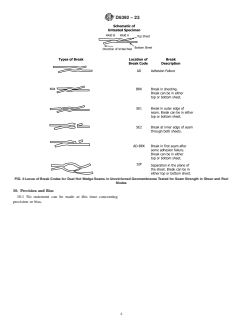
- EPA/600/2-88/052: Lining of Waste Containment and Other Facilities (Locus of Break Codes)
Practical Value
Implementing ASTM D6392-23 ensures:
- Reliable verification of seam strength in nonreinforced geomembrane systems
- Consistent documentation and traceability for construction QA/QC reports
- Enhanced environmental safety by reducing risks of containment breach
- Compliance with industry best practices and regulatory requirements
This standard is essential for anyone involved in the installation, design, quality assurance, or inspection of geomembrane-lined containment systems, supporting long-term project success and environmental stewardship.
Relations
- Effective Date
- 01-Nov-2023
- Effective Date
- 01-Feb-2024
- Effective Date
- 15-Jul-2023
- Effective Date
- 01-Nov-2023
- Effective Date
- 01-Nov-2023
- Referred By
ASTM D8269-21 - Standard Guide for the Use of Geocells in Geotechnical and Roadway Projects - Effective Date
- 01-Nov-2023
Buy Documents
ASTM D6392-23 - Standard Test Method for Determining the Integrity of Nonreinforced Geomembrane Seams Produced Using Thermo-Fusion Methods
REDLINE ASTM D6392-23 - Standard Test Method for Determining the Integrity of Nonreinforced Geomembrane Seams Produced Using Thermo-Fusion Methods
Get Certified
Connect with accredited certification bodies for this standard

DIBt (Deutsches Institut für Bautechnik)
German Institute for Building Technology.
DIN CERTCO
DIN Group product certification.

Aboma Certification B.V.
Specialized in construction, metal, and transport sectors.
Sponsored listings
Frequently Asked Questions
ASTM D6392-23 is a standard published by ASTM International. Its full title is "Standard Test Method for Determining the Integrity of Nonreinforced Geomembrane Seams Produced Using Thermo-Fusion Methods". This standard covers: SIGNIFICANCE AND USE 4.1 The use of geomembranes as barrier materials to restrict liquid migration from one location to another in soil and rock has created a need for a standard test method to evaluate the quality of geomembrane seams produced by thermo-fusion methods. In the case of geomembranes, it has become evident that geomembrane seams can exhibit separation in the field under certain conditions. Although this is an index-type test method used for quality assurance and quality control purposes, it is also intended to provide the quality assurance engineer with sufficient seam peel and shear data to evaluate seam quality. Recording and reporting data, such as separation that occurs during the peel test and elongation during the shear test, will allow the quality assurance engineer to take measures necessary to ensure the repair of inferior seams during facility construction, and therefore, minimize the potential for seam separation in service. SCOPE 1.1 This test method describes destructive quality control and quality assurance tests used to determine the integrity of geomembrane seams produced by thermo-fusion methods. This test method presents the procedures used for determining the quality of nonbituminous bonded seams subjected to both peel and shear tests. These test procedures are intended for nonreinforced geomembranes only. 1.2 The types of thermal field seaming techniques used to construct geomembrane seams include the following: 1.2.1 Hot Air—This technique introduces high-temperature air or gas between two geomembrane surfaces to facilitate melting. Pressure is applied to the top or bottom geomembrane, forcing together the two surfaces to form a continuous bond. 1.2.2 Hot Wedge (or Knife)—This technique melts the two geomembrane surfaces to be seamed by running a hot metal wedge between them. Pressure is applied to the top or bottom geomembrane, or both, to form a continuous bond. Some seams of this kind are made with dual bond tracks separated by a nonbonded gap. These seams are sometimes referred to as dual hot wedge seams or double-track seams. 1.2.3 Extrusion—This technique encompasses extruding molten resin between two geomembranes or at the edge of two overlapped geomembranes to effect a continuous bond. 1.3 The types of materials covered by this test method include the following: 1.3.1 Very low-density polyethylene (VLDPE). 1.3.2 Linear low-density polyethylene (LLDPE). 1.3.3 Very flexible polyethylene (VFPE). 1.3.4 Linear medium-density polyethylene (LMDPE). 1.3.5 High-density polyethylene (HDPE). 1.3.6 Polyvinyl chloride (PVC). 1.3.7 Flexible polypropylene (fPP). Note 1: The polyethylene identifiers presented in 1.3.1 – 1.3.5 describe the types of materials typically tested using this test method. These are industry-accepted trade descriptions and are not technical material classifications based upon material density. 1.4 This standard does not purport to address all of the safety concerns, if any, associated with its use. It is the responsibility of the user of this standard to establish appropriate safety, health, and environmental practices and determine the applicability of regulatory limitations prior to use. 1.5 This international standard was developed in accordance with internationally recognized principles on standardization established in the Decision on Principles for the Development of International Standards, Guides and Recommendations issued by the World Trade Organization Technical Barriers to Trade (TBT) Committee.
SIGNIFICANCE AND USE 4.1 The use of geomembranes as barrier materials to restrict liquid migration from one location to another in soil and rock has created a need for a standard test method to evaluate the quality of geomembrane seams produced by thermo-fusion methods. In the case of geomembranes, it has become evident that geomembrane seams can exhibit separation in the field under certain conditions. Although this is an index-type test method used for quality assurance and quality control purposes, it is also intended to provide the quality assurance engineer with sufficient seam peel and shear data to evaluate seam quality. Recording and reporting data, such as separation that occurs during the peel test and elongation during the shear test, will allow the quality assurance engineer to take measures necessary to ensure the repair of inferior seams during facility construction, and therefore, minimize the potential for seam separation in service. SCOPE 1.1 This test method describes destructive quality control and quality assurance tests used to determine the integrity of geomembrane seams produced by thermo-fusion methods. This test method presents the procedures used for determining the quality of nonbituminous bonded seams subjected to both peel and shear tests. These test procedures are intended for nonreinforced geomembranes only. 1.2 The types of thermal field seaming techniques used to construct geomembrane seams include the following: 1.2.1 Hot Air—This technique introduces high-temperature air or gas between two geomembrane surfaces to facilitate melting. Pressure is applied to the top or bottom geomembrane, forcing together the two surfaces to form a continuous bond. 1.2.2 Hot Wedge (or Knife)—This technique melts the two geomembrane surfaces to be seamed by running a hot metal wedge between them. Pressure is applied to the top or bottom geomembrane, or both, to form a continuous bond. Some seams of this kind are made with dual bond tracks separated by a nonbonded gap. These seams are sometimes referred to as dual hot wedge seams or double-track seams. 1.2.3 Extrusion—This technique encompasses extruding molten resin between two geomembranes or at the edge of two overlapped geomembranes to effect a continuous bond. 1.3 The types of materials covered by this test method include the following: 1.3.1 Very low-density polyethylene (VLDPE). 1.3.2 Linear low-density polyethylene (LLDPE). 1.3.3 Very flexible polyethylene (VFPE). 1.3.4 Linear medium-density polyethylene (LMDPE). 1.3.5 High-density polyethylene (HDPE). 1.3.6 Polyvinyl chloride (PVC). 1.3.7 Flexible polypropylene (fPP). Note 1: The polyethylene identifiers presented in 1.3.1 – 1.3.5 describe the types of materials typically tested using this test method. These are industry-accepted trade descriptions and are not technical material classifications based upon material density. 1.4 This standard does not purport to address all of the safety concerns, if any, associated with its use. It is the responsibility of the user of this standard to establish appropriate safety, health, and environmental practices and determine the applicability of regulatory limitations prior to use. 1.5 This international standard was developed in accordance with internationally recognized principles on standardization established in the Decision on Principles for the Development of International Standards, Guides and Recommendations issued by the World Trade Organization Technical Barriers to Trade (TBT) Committee.
ASTM D6392-23 is classified under the following ICS (International Classification for Standards) categories: 91.100.50 - Binders. Sealing materials. The ICS classification helps identify the subject area and facilitates finding related standards.
ASTM D6392-23 has the following relationships with other standards: It is inter standard links to ASTM D6392-12(2018), ASTM D4439-24, ASTM D4439-23b, ASTM D7700-22, ASTM D7982-15(2021), ASTM D8269-21. Understanding these relationships helps ensure you are using the most current and applicable version of the standard.
ASTM D6392-23 is available in PDF format for immediate download after purchase. The document can be added to your cart and obtained through the secure checkout process. Digital delivery ensures instant access to the complete standard document.
Standards Content (Sample)
This international standard was developed in accordance with internationally recognized principles on standardization established in the Decision on Principles for the
Development of International Standards, Guides and Recommendations issued by the World Trade Organization Technical Barriers to Trade (TBT) Committee.
Designation: D6392 − 23
Standard Test Method for
Determining the Integrity of Nonreinforced Geomembrane
Seams Produced Using Thermo-Fusion Methods
This standard is issued under the fixed designation D6392; the number immediately following the designation indicates the year of
original adoption or, in the case of revision, the year of last revision. A number in parentheses indicates the year of last reapproval. A
superscript epsilon (´) indicates an editorial change since the last revision or reapproval.
These are industry-accepted trade descriptions and are not technical
1. Scope
material classifications based upon material density.
1.1 This test method describes destructive quality control
1.4 This standard does not purport to address all of the
and quality assurance tests used to determine the integrity of
safety concerns, if any, associated with its use. It is the
geomembrane seams produced by thermo-fusion methods.
responsibility of the user of this standard to establish appro-
This test method presents the procedures used for determining
priate safety, health, and environmental practices and deter-
the quality of nonbituminous bonded seams subjected to both
mine the applicability of regulatory limitations prior to use.
peel and shear tests. These test procedures are intended for
1.5 This international standard was developed in accor-
nonreinforced geomembranes only.
dance with internationally recognized principles on standard-
1.2 The types of thermal field seaming techniques used to
ization established in the Decision on Principles for the
construct geomembrane seams include the following:
Development of International Standards, Guides and Recom-
1.2.1 Hot Air—This technique introduces high-temperature
mendations issued by the World Trade Organization Technical
air or gas between two geomembrane surfaces to facilitate
Barriers to Trade (TBT) Committee.
melting. Pressure is applied to the top or bottom geomembrane,
2. Referenced Documents
forcing together the two surfaces to form a continuous bond.
1.2.2 Hot Wedge (or Knife)—This technique melts the two
2.1 ASTM Standards:
geomembrane surfaces to be seamed by running a hot metal
D638 Test Method for Tensile Properties of Plastics
wedge between them. Pressure is applied to the top or bottom
D4439 Terminology for Geosynthetics
geomembrane, or both, to form a continuous bond. Some
D5199 Test Method for Measuring the Nominal Thickness
seams of this kind are made with dual bond tracks separated by
of Geosynthetics
a nonbonded gap. These seams are sometimes referred to as
D5994/D5994M Test Method for Measuring Core Thickness
dual hot wedge seams or double-track seams.
of Textured Geomembranes
1.2.3 Extrusion—This technique encompasses extruding
2.2 EPA Standard:
molten resin between two geomembranes or at the edge of two
EPA/600/2-88/052 Lining of Waste Containment and Other
overlapped geomembranes to effect a continuous bond.
Containment Facilities, Appendix N—Locus of Break
1.3 The types of materials covered by this test method Codes for Various Types of FML Seams
include the following:
3. Terminology
1.3.1 Very low-density polyethylene (VLDPE).
1.3.2 Linear low-density polyethylene (LLDPE). 3.1 Definitions of Terms Specific to This Standard:
1.3.3 Very flexible polyethylene (VFPE).
3.1.1 geomembrane, n—essentially impermeable geosyn-
1.3.4 Linear medium-density polyethylene (LMDPE). thetic composed of one or more synthetic sheets.
1.3.5 High-density polyethylene (HDPE).
3.1.2 quality assurance, n—all planned and systematic ac-
1.3.6 Polyvinyl chloride (PVC).
tions necessary to provide adequate confidence that an item or
1.3.7 Flexible polypropylene (fPP).
a facility will perform satisfactorily in service.
NOTE 1—The polyethylene identifiers presented in 1.3.1 – 1.3.5
3.1.3 quality control, n—the operational techniques and the
describe the types of materials typically tested using this test method.
activities which sustain a quality of material, product, system,
1 2
This test method is under the jurisdiction of ASTM Committee D35 on For referenced ASTM standards, visit the ASTM website, www.astm.org, or
Geosynthetics and is the direct responsibility of Subcommittee D35.10 on Geomem- contact ASTM Customer Service at service@astm.org. For Annual Book of ASTM
branes. Standards volume information, refer to the standard’s Document Summary page on
Current edition approved Nov. 1, 2023. Published November 2023. Originally the ASTM website.
approved in 1999. Last previous edition approved in 2018 as D6392 – 12 (2018). Available from the Superintendent of Documents, US Government Printing
DOI: 10.1520/D6392-23. Office, Washington, DC 20402.
Copyright © ASTM International, 100 Barr Harbor Drive, PO Box C700, West Conshohocken, PA 19428-2959. United States
D6392 − 23
or service that will satisfy given needs; also the use of such
techniques and activities.
4. Significance and Use
4.1 The use of geomembranes as barrier materials to restrict
liquid migration from one location to another in soil and rock
has created a need for a standard test method to evaluate the
quality of geomembrane seams produced by thermo-fusion
methods. In the case of geomembranes, it has become evident
that geomembrane seams can exhibit separation in the field
under certain conditions. Although this is an index-type test
method used for quality assurance and quality control
purposes, it is also intended to provide the quality assurance
engineer with sufficient seam peel and shear data to evaluate
seam quality. Recording and reporting data, such as separation
that occurs during the peel test and elongation during the shear
test, will allow the quality assurance engineer to take measures
necessary to ensure the repair of inferior seams during facility
construction, and therefore, minimize the potential for seam
FIG. 1 Seam Sample
separation in service.
5. Apparatus
5.1 Tensile instrumentation shall meet the requirements
outlined in Test Method D638.
5.2 Grip Faces—Grip faces shall be 25 mm (1 in.) wide and
a minimum of 25 mm (1 in.) in length. Smooth rubber, fine
serrated, or coarse serrated grip faces have all been found to be
suitable for testing geomembrane seams.
6. Sample and Specimen Preparation
6.1 Seam Samples—Cut a portion of the fabricated seam
sample from the installed liner in accordance with the project
specifications. It is recommended that the cutout sample be
0.3 m (1 ft) wide and 0.45 m (1.5 ft) in length with the seam
centered in the middle.
6.2 Specimen Preparation—Ten specimens shall be cut
from the sample submittal. The specimens shall be die cut
using a 25 mm (nominal 1 in.) wide by a minimum of 150 mm
(nominal 6 in.) long die. Specimens that will be subjected to
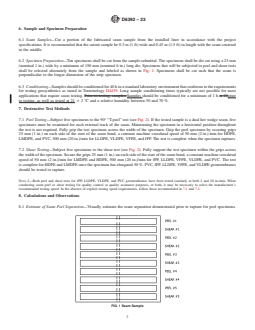
peel and shear tests shall be selected alternately from the
sample and labeled as shown in Fig. 1. Specimens shall be cut
such that the seam is perpendicular to the longer dimension of
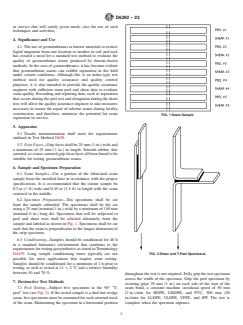
the strip specimen.
6.3 Conditioning—Samples should be conditioned for 40 h
in a standard laboratory environment that conforms to the
requirements for testing geosynthetics as stated in Terminology
D4439. Long sample conditioning times typically are not FIG. 2 Shear and T-Peel Specimens
possible for most applications that require seam testing.
Samples should be conditioned for a minimum of 1 h prior to
testing, as well as tested at 21 6 2 °C and a relative humidity
between 50 and 70 %.
throughout the test is not required. Fully grip the test specimen
across the width of the specimen. Grip the peel specimen by
7. Destructive Test Methods
securing grips 25 mm (1 in.) on each side of the start of the
7.1 Peel Testing—Subject five specimens to the 90° “T- seam bond, a constant machine crosshead speed of 50 mm
peel” test (see Fig. 2). If the tested sample is a dual hot wedge (2 in.) ⁄min for HDPE, LMDPE, and PVC, 500 mm (20
seam, five specimens must be examined for each external track in.)/min for LLDPE, VLDPE, VFPE, and fPP. The test is
of the seam. Maintaining the specimen in a horizontal position complete when the specimen ruptures.
...
This document is not an ASTM standard and is intended only to provide the user of an ASTM standard an indication of what changes have been made to the previous version. Because
it may not be technically possible to adequately depict all changes accurately, ASTM recommends that users consult prior editions as appropriate. In all cases only the current version
of the standard as published by ASTM is to be considered the official document.
Designation: D6392 − 12 (Reapproved 2018) D6392 − 23
Standard Test Method for
Determining the Integrity of Nonreinforced Geomembrane
Seams Produced Using Thermo-Fusion Methods
This standard is issued under the fixed designation D6392; the number immediately following the designation indicates the year of
original adoption or, in the case of revision, the year of last revision. A number in parentheses indicates the year of last reapproval. A
superscript epsilon (´) indicates an editorial change since the last revision or reapproval.
1. Scope
1.1 This test method describes destructive quality control and quality assurance tests used to determine the integrity of
geomembrane seams produced by thermo-fusion methods. This test method presents the procedures used for determining the
quality of nonbituminous bonded seams subjected to both peel and shear tests. These test procedures are intended for nonreinforced
geomembranes only.
1.2 The types of thermal field seaming techniques used to construct geomembrane seams include the following:
1.2.1 Hot Air—This technique introduces high-temperature air or gas between two geomembrane surfaces to facilitate melting.
Pressure is applied to the top or bottom geomembrane, forcing together the two surfaces to form a continuous bond.
1.2.2 Hot Wedge (or Knife)—This technique melts the two geomembrane surfaces to be seamed by running a hot metal wedge
between them. Pressure is applied to the top or bottom geomembrane, or both, to form a continuous bond. Some seams of this kind
are made with dual bond tracks separated by a nonbonded gap. These seams are sometimes referred to as dual hot wedge seams
or double-track seams.
1.2.3 Extrusion—This technique encompasses extruding molten resin between two geomembranes or at the edge of two
overlapped geomembranes to effect a continuous bond.
1.3 The types of materials covered by this test method include the following:
1.3.1 Very low-density polyethylene (VLDPE).
1.3.2 Linear low-density polyethylene (LLDPE).
1.3.3 Very flexible polyethylene (VFPE).
1.3.4 Linear medium-density polyethylene (LMDPE).
1.3.5 High-density polyethylene (HDPE).
1.3.6 Polyvinyl chloride (PVC).
This test method is under the jurisdiction of ASTM Committee D35 on Geosynthetics and is the direct responsibility of Subcommittee D35.10 on Geomembranes.
Current edition approved Feb. 1, 2018Nov. 1, 2023. Published February 2018November 2023. Originally approved in 1999. Last previous edition approved in 20122018
as D6392 – 12.D6392 – 12 (2018). DOI: 10.1520/D6392-12R18.10.1520/D6392-23.
Copyright © ASTM International, 100 Barr Harbor Drive, PO Box C700, West Conshohocken, PA 19428-2959. United States
D6392 − 23
1.3.7 Flexible polypropylene (fPP).
NOTE 1—The polyethylene identifiers presented in 1.3.1 – 1.3.5 describe the types of materials typically tested using this test method. These are
industry-accepted trade descriptions and are not technical material classifications based upon material density.
1.4 This standard does not purport to address all of the safety concerns, if any, associated with its use. It is the responsibility
of the user of this standard to establish appropriate safety, health, and environmental practices and determine the applicability of
regulatory limitations prior to use.
1.5 This international standard was developed in accordance with internationally recognized principles on standardization
established in the Decision on Principles for the Development of International Standards, Guides and Recommendations issued
by the World Trade Organization Technical Barriers to Trade (TBT) Committee.
2. Referenced Documents
2.1 ASTM Standards:
D638 Test Method for Tensile Properties of Plastics
D4439 Terminology for Geosynthetics
D5199 Test Method for Measuring the Nominal Thickness of Geosynthetics
D5994/D5994M Test Method for Measuring Core Thickness of Textured Geomembranes
2.2 EPA Standard:
EPA/600/2-88/052 Lining of Waste Containment and Other Containment Facilities, Appendix N—Locus of Break Codes for
Various Types of FML Seams
3. Terminology
3.1 Definitions of Terms Specific to This Standard:
3.1.1 geomembrane, n—essentially impermeable geosynthetic composed of one or more synthetic sheets.
3.1.2 quality assurance, n—all planned and systematic actions necessary to provide adequate confidence that an item or a facility
will perform satisfactorily in service.
3.1.3 quality control, n—the operational techniques and the activities which sustain a quality of material, product, system, or
service that will satisfy given needs; also the use of such techniques and activities.
4. Significance and Use
4.1 The use of geomembranes as barrier materials to restrict liquid migration from one location to another in soil and rock has
created a need for a standard test method to evaluate the quality of geomembrane seams produced by thermo-fusion methods. In
the case of geomembranes, it has become evident that geomembrane seams can exhibit separation in the field under certain
conditions. Although this is an index-type test method used for quality assurance and quality control purposes, it is also intended
to provide the quality assurance engineer with sufficient seam peel and shear data to evaluate seam quality. Recording and reporting
data, such as separation that occurs during the peel test and elongation during the shear test, will allow the quality assurance
engineer to take measures necessary to ensure the repair of inferior seams during facility construction, and therefore, minimize the
potential for seam separation in service.
5. Apparatus
5.1 Tensile instrumentation shall meet the requirements outlined in Test Method D638.
5.2 Grip Faces—Grip faces shall be 25 mm (1 in.) wide and a minimum of 25 mm (1 in.) in length. Smooth rubber, fine serrated,
or coarse serrated grip faces have all been found to be suitable for testing geomembrane seams.
For referenced ASTM standards, visit the ASTM website, www.astm.org, or contact ASTM Customer Service at service@astm.org. For Annual Book of ASTM Standards
volume information, refer to the standard’s Document Summary page on the ASTM website.
Available from the Superintendent of Documents, US Government Printing Office, Washington, DC 20402.
D6392 − 23
6. Sample and Specimen Preparation
6.1 Seam Samples—Cut a portion of the fabricated seam sample from the installed liner in accordance with the project
specifications. It is recommended that the cutout sample be 0.3 m (1 ft) wide and 0.45 m (1.5 ft) in length with the seam centered
in the middle.
6.2 Specimen Preparation—Ten specimens shall be cut from the sample submittal. The specimens shall be die cut using a 25 mm
(nominal 1 in.) wide by a minimum of 150 mm (nominal 6 in.) long die. Specimens that will be subjected to peel and shear tests
shall be selected alternately from the sample and labeled as shown in Fig. 1. Specimens shall be cut such that the seam is
perpendicular to the longer dimension of the strip specimen.
6.3 Conditioning—Samples should be conditioned for 40 h in a standard laboratory environment that conforms to the requirements
for testing geosynthetics as stated in Terminology D4439. Long sample conditioning times typically are not possible for most
applications that require seam testing. Prior to testing, samples Samples should be conditioned for a minimum of 1 h at 23prior
to testing, as well as tested at 21 6 2 °C and a relative humidity between 50 and 70 %.
7. Destructive Test Methods
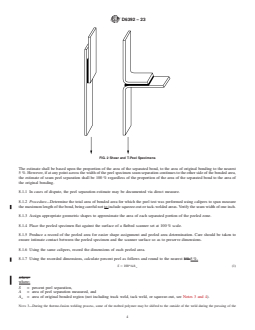
7.1 Peel Testing—Subject five specimens to the 90° “T-peel” test (see Fig. 2). If the tested sample is a dual hot wedge seam, five
specimens must be examined for each external track of the seam. Maintaining the specimen in a horizontal position throughout
the test is not required. Fully grip the test specimen across the width of the specimen. Grip the peel specimen by securing grips
25 mm (1 in.) on each side of the start of the seam bond, a constant machine crosshead speed of 50 mm (2 in.) ⁄min for HDPE,
LMDPE, and PVC, 500 mm (20 in.)/min for LLDPE, VLDPE, VFPE, and fPP. The test is complete when the specimen ruptures.
7.2 Shear Testing—Subject five specimens to the shear te
...