

ASTM D5956-21
(Guide)Standard Guide for Sampling Strategies for Heterogeneous Wastes
General Information
- Abstract
SIGNIFICANCE AND USE
4.1 This guide is suitable for sampling heterogeneous wastes.
4.2 The focus of this guidance is on wastes; however, the approach described in this guide may be applicable to non-waste populations as well.
4.3 Sections 5 – 10 describe a guide for the sampling of heterogeneous waste according to project objectives. Appendix X1 describes an application of the guide to heterogeneous wastes. The user is strongly advised to read Annex A1 prior to reading and employing Sections 5 – 10 of this guide.
4.4 Annex A1 contains an introductory discussion of heterogeneity, stratification, and the relationship of samples and populations.
4.5 This guide is intended for those who manage, design, or implement sampling and analytical plans for the characterization of heterogeneous wastes.
SCOPE
1.1 This guide is a practical, nonmathematical discussion for heterogeneous waste sampling strategies. This guide is consistent with the particulate material sampling theory as well as inferential statistics, and may serve as an introduction to the statistical treatment of sampling issues.
1.2 This guide does not provide comprehensive sampling procedures, nor does it serve as a guide to any specification. It is the responsibility of the user to ensure appropriate procedures are used.
1.3 Units—The values stated in SI units are to be regarded as standard. No other units of measurement are included in this standard. All observed and calculated values shall conform to the guidelines for significant digits and rounding established in Practice D6026. Reporting of test results in units other than SI shall not be regarded as nonconformance with this standard.
1.4 This standard does not purport to address all of the safety concerns, if any, associated with its use. It is the responsibility of the user of this standard to establish appropriate safety, health, and environmental practices and determine the applicability of regulatory limitations prior to use.
1.5 This international standard was developed in accordance with internationally recognized principles on standardization established in the Decision on Principles for the Development of International Standards, Guides and Recommendations issued by the World Trade Organization Technical Barriers to Trade (TBT) Committee.
- Status
- Published
- Publication Date
- 30-Sep-2021
- Technical Committee
- D34 - Waste Management
- Drafting Committee
- D34.01.01 - Planning for Sampling
Overview
ASTM D5956-21: Standard Guide for Sampling Strategies for Heterogeneous Wastes provides essential guidance for planning and implementing sampling strategies specifically for heterogeneous wastes. Developed by ASTM International, this guide is intended for professionals involved in the management, design, or execution of waste characterization programs. The standard covers practical, non-mathematical approaches to sampling, aligning with particulate material sampling theory and inferential statistics. While the guide primarily addresses waste, its principles may be applicable to other heterogeneous populations.
The focus is on understanding waste heterogeneity, stratification, and the sampling process to ensure data collected reflects the true characteristics of waste populations. The guide emphasizes the importance of adapting sampling strategies to address various challenges that arise due to differences in composition, particle size, and distribution within a waste population.
Key Topics
- Waste Heterogeneity: The guide discusses the nature of heterogeneous waste populations, where items differ significantly in composition or physical characteristics such as size and type.
- Stratification: It explains the concept of dividing a waste population into specific strata (by space, time, component, or source) to improve the accuracy and representativeness of sample data.
- Sampling Difficulties: The standard identifies typical challenges in waste sampling, including access issues, collection difficulties due to physical properties (e.g., large or viscous items), limited knowledge about the waste, and budget constraints.
- Data Quality Objectives (DQOs): The guide recommends the use of DQO processes for structured planning, which helps to clarify sampling goals, decision criteria, and acceptable error rates.
- Sampling Approaches: Strategies for dealing with highly stratified wastes are outlined, including modifications to sampling, sample preparation, and analytical methods.
- Representative Sampling: The goal is to obtain samples that accurately reflect the characteristics of interest in the overall population, considering both physical and chemical heterogeneity.
Applications
ASTM D5956-21 is a valuable reference for:
- Environmental Consultants and Waste Managers who design and implement sampling and analysis plans for environmental site assessments, landfill characterization, and hazardous waste investigations.
- Regulatory Compliance: The guide supports meeting regulatory requirements by ensuring waste samples provide representative and reliable data.
- Industrial Facilities: Facilities generating complex wastes (e.g., manufacturing, chemical processing) can use this standard to design sampling protocols that account for variable waste streams.
- Sampling Design: Organizations planning site remediation, treatment, or disposal projects benefit by optimizing sample collection based on waste variability and project objectives.
- Non-Waste Applications: Although focused on waste, the principles can extend to other heterogeneous material populations that require systematic sampling.
Related Standards
- ASTM D5681: Terminology for Waste and Waste Management, providing definitions for terms used in waste sampling and management.
- ASTM D6026: Practice for Using Significant Digits and Data Records in Geotechnical Data, referenced for data recording and reporting conventions.
- International Standards: ASTM D5956-21 was developed in accordance with internationally recognized principles, aligning with guidelines established by the World Trade Organization (WTO) Technical Barriers to Trade (TBT) Committee.
Keywords: ASTM D5956-21, heterogeneous waste sampling, waste characterization, stratified sampling, representative sample, waste management, sampling strategies, data quality objectives, environmental sampling, landfill sampling protocol.
By providing structured guidance on sampling heterogeneous wastes, ASTM D5956-21 helps professionals design more accurate and cost-effective sampling programs while supporting regulatory compliance and environmental stewardship.
Relations
- Effective Date
- 01-Nov-2023
- Effective Date
- 01-Nov-2018
- Effective Date
- 01-Sep-2017
- Effective Date
- 01-Nov-2016
- Effective Date
- 01-Feb-2016
- Effective Date
- 01-Feb-2013
- Effective Date
- 01-Jul-2009
- Effective Date
- 01-Sep-2008
- Effective Date
- 01-Nov-2006
- Effective Date
- 01-Sep-2004
- Effective Date
- 01-Sep-2004
- Effective Date
- 10-Nov-2001
- Effective Date
- 10-Dec-1999
- Effective Date
- 10-Jun-1998
- Effective Date
- 10-Jun-1998
Get Certified
Connect with accredited certification bodies for this standard

CIS Institut d.o.o.
Personal Protective Equipment (PPE) certification body. Notified Body NB-2890 for EU Regulation 2016/425 PPE.

Kiwa BDA Testing
Building and construction product certification.
Kmetijski inštitut Slovenije
Agricultural Institute of Slovenia. Soil testing, plant health, agricultural product analysis.
Sponsored listings
Frequently Asked Questions
ASTM D5956-21 is a guide published by ASTM International. Its full title is "Standard Guide for Sampling Strategies for Heterogeneous Wastes". This standard covers: SIGNIFICANCE AND USE 4.1 This guide is suitable for sampling heterogeneous wastes. 4.2 The focus of this guidance is on wastes; however, the approach described in this guide may be applicable to non-waste populations as well. 4.3 Sections 5 – 10 describe a guide for the sampling of heterogeneous waste according to project objectives. Appendix X1 describes an application of the guide to heterogeneous wastes. The user is strongly advised to read Annex A1 prior to reading and employing Sections 5 – 10 of this guide. 4.4 Annex A1 contains an introductory discussion of heterogeneity, stratification, and the relationship of samples and populations. 4.5 This guide is intended for those who manage, design, or implement sampling and analytical plans for the characterization of heterogeneous wastes. SCOPE 1.1 This guide is a practical, nonmathematical discussion for heterogeneous waste sampling strategies. This guide is consistent with the particulate material sampling theory as well as inferential statistics, and may serve as an introduction to the statistical treatment of sampling issues. 1.2 This guide does not provide comprehensive sampling procedures, nor does it serve as a guide to any specification. It is the responsibility of the user to ensure appropriate procedures are used. 1.3 Units—The values stated in SI units are to be regarded as standard. No other units of measurement are included in this standard. All observed and calculated values shall conform to the guidelines for significant digits and rounding established in Practice D6026. Reporting of test results in units other than SI shall not be regarded as nonconformance with this standard. 1.4 This standard does not purport to address all of the safety concerns, if any, associated with its use. It is the responsibility of the user of this standard to establish appropriate safety, health, and environmental practices and determine the applicability of regulatory limitations prior to use. 1.5 This international standard was developed in accordance with internationally recognized principles on standardization established in the Decision on Principles for the Development of International Standards, Guides and Recommendations issued by the World Trade Organization Technical Barriers to Trade (TBT) Committee.
SIGNIFICANCE AND USE 4.1 This guide is suitable for sampling heterogeneous wastes. 4.2 The focus of this guidance is on wastes; however, the approach described in this guide may be applicable to non-waste populations as well. 4.3 Sections 5 – 10 describe a guide for the sampling of heterogeneous waste according to project objectives. Appendix X1 describes an application of the guide to heterogeneous wastes. The user is strongly advised to read Annex A1 prior to reading and employing Sections 5 – 10 of this guide. 4.4 Annex A1 contains an introductory discussion of heterogeneity, stratification, and the relationship of samples and populations. 4.5 This guide is intended for those who manage, design, or implement sampling and analytical plans for the characterization of heterogeneous wastes. SCOPE 1.1 This guide is a practical, nonmathematical discussion for heterogeneous waste sampling strategies. This guide is consistent with the particulate material sampling theory as well as inferential statistics, and may serve as an introduction to the statistical treatment of sampling issues. 1.2 This guide does not provide comprehensive sampling procedures, nor does it serve as a guide to any specification. It is the responsibility of the user to ensure appropriate procedures are used. 1.3 Units—The values stated in SI units are to be regarded as standard. No other units of measurement are included in this standard. All observed and calculated values shall conform to the guidelines for significant digits and rounding established in Practice D6026. Reporting of test results in units other than SI shall not be regarded as nonconformance with this standard. 1.4 This standard does not purport to address all of the safety concerns, if any, associated with its use. It is the responsibility of the user of this standard to establish appropriate safety, health, and environmental practices and determine the applicability of regulatory limitations prior to use. 1.5 This international standard was developed in accordance with internationally recognized principles on standardization established in the Decision on Principles for the Development of International Standards, Guides and Recommendations issued by the World Trade Organization Technical Barriers to Trade (TBT) Committee.
ASTM D5956-21 is classified under the following ICS (International Classification for Standards) categories: 13.030.40 - Installations and equipment for waste disposal and treatment. The ICS classification helps identify the subject area and facilitates finding related standards.
ASTM D5956-21 has the following relationships with other standards: It is inter standard links to ASTM D5681-23, ASTM D5681-18, ASTM D5681-17, ASTM D5681-16a, ASTM D5681-16, ASTM D5681-13, ASTM D5681-09, ASTM D5681-08, ASTM D6026-06, ASTM D5681-98a(2004)e1, ASTM D5681-98a(2004), ASTM D6026-01e1, ASTM D6026-99, ASTM D5681-98ae1, ASTM D5681-98a. Understanding these relationships helps ensure you are using the most current and applicable version of the standard.
ASTM D5956-21 is available in PDF format for immediate download after purchase. The document can be added to your cart and obtained through the secure checkout process. Digital delivery ensures instant access to the complete standard document.
Standards Content (Sample)
This international standard was developed in accordance with internationally recognized principles on standardization established in the Decision on Principles for the
Development of International Standards, Guides and Recommendations issued by the World Trade Organization Technical Barriers to Trade (TBT) Committee.
Designation: D5956 − 21
Standard Guide for
Sampling Strategies for Heterogeneous Wastes
This standard is issued under the fixed designation D5956; the number immediately following the designation indicates the year of
original adoption or, in the case of revision, the year of last revision. A number in parentheses indicates the year of last reapproval. A
superscript epsilon (´) indicates an editorial change since the last revision or reapproval.
1. Scope 3. Terminology
1.1 This guide is a practical, nonmathematical discussion 3.1 Definitions—For definitions of terms used in this
for heterogeneous waste sampling strategies. This guide is standard, see Terminology D5681.
consistentwiththeparticulatematerialsamplingtheoryaswell
3.2 Definitions of Terms Specific to This Standard:
as inferential statistics, and may serve as an introduction to the
3.2.1 component, n—aneasilyidentifieditemsuchasalarge
statistical treatment of sampling issues.
crystal, an agglomerate, rod, container, block, glove, piece of
1.2 This guide does not provide comprehensive sampling wood, or concrete.
procedures, nor does it serve as a guide to any specification. It
3.2.2 composite sample, n—a combination of two or more
is the responsibility of the user to ensure appropriate proce-
samples.
dures are used.
3.2.2.1 Discussion—When compositing samples to detect
1.3 Units—The values stated in SI units are to be regarded hot spots or whenever there may be a reason to determine
as standard. No other units of measurement are included in this which of the component samples that constitute the composite
standard. All observed and calculated values shall conform to are the source of the detected contaminant, it can be helpful to
the guidelines for significant digits and rounding established in composite only portions of the component samples. The
Practice D6026. Reporting of test results in units other than SI remainders of the component samples then can be archived for
shall not be regarded as nonconformance with this standard. future reference and analysis. This approach is particularly
helpful when sampling is expensive, hazardous, or difficult.
1.4 This standard does not purport to address all of the
safety concerns, if any, associated with its use. It is the
3.2.3 correlation, n—the mutual relation of two or more
responsibility of the user of this standard to establish appro- things.
priate safety, health, and environmental practices and deter-
3.2.4 item, n—a distinct part of a population (for example,
mine the applicability of regulatory limitations prior to use.
microscopic particles, macroscopic particles, and 20-ft long
1.5 This international standard was developed in accor-
steel beams).
dance with internationally recognized principles on standard-
3.2.4.1 Discussion—Theterm componentdefinesasubsetof
ization established in the Decision on Principles for the
items. Components are those items that are easily identified as
Development of International Standards, Guides and Recom-
being different from the remainder of items that constitute the
mendations issued by the World Trade Organization Technical
population.The identification of components may facilitate the
Barriers to Trade (TBT) Committee.
stratification and sampling of a highly stratified population
when the presence of the characteristic of interest is correlated
2. Referenced Documents
with a specific component.
2.1 ASTM Standards:
3.2.5 practical homogeneity, n—the condition of the popu-
D5681 Terminology for Waste and Waste Management
lation under which all items of the population are not identical.
D6026 Practice for Using Significant Digits and Data Re-
For the characteristic of interest, however, the differences
cords in Geotechnical Data
between individual physical samples are not measurable or
significant relative to project objectives.
3.2.5.1 Discussion—For practical purposes, the population
This guide is under the jurisdiction of ASTM Committee D34 on Waste
is homogeneous.
Management and is the direct responsibility of Subcommittee D34.01.01 on
Planning for Sampling.
3.2.6 random, n—lack of order or patterns in a population
Current edition approved Oct. 1, 2021. Published October 2021. Originally
whose items have an equal probability of occurring.
approved in 1996. Last previous edition approved in 2015 as D5956 – 15. DOI:
10.1520/D5956-21.
3.2.6.1 Discussion—The word random is used in two dif-
For referenced ASTM standards, visit the ASTM website, www.astm.org, or
ferent contexts in this guide. In relation to sampling, random
contact ASTM Customer Service at service@astm.org. For Annual Book of ASTM
means that all items of a population have an equal probability
Standards volume information, refer to the standard’s Document Summary page on
the ASTM website. of being sampled. In relation to the distribution of a population
Copyright © ASTM International, 100 Barr Harbor Drive, PO Box C700, West Conshohocken, PA 19428-2959. United States
D5956 − 21
characteristic, random means that the characteristic has an addressed or the resulting limitations well documented.Afield
equal probability of occurring in any and all items of the notebook is likely to describe difficulties in collecting large
population. items or the fact that the center of a waste pile could not be
accessed.
3.2.7 sample variance, n—a measure of the dispersion of a
set of results. Variance is the sum of the squares of the
5.4 Population size, heterogeneity, and item size have a
individual deviations from the sample mean divided by one
substantial impact on sampling. The cost and difficulty of
less than the number of results involved. It may be expressed
accurately sampling a population usually is correlated with the
2 2
as s 5 ~x 2x¯! /~n21!.
( knowledge of these population attributes and characteristics.
i
The least understood population attribute is heterogeneity of
4. Significance and Use
the characteristic of interest. If heterogeneity is not known
through process knowledge, then some level of preliminary
4.1 This guide is suitable for sampling heterogeneous
sampling or field analysis is often required prior to sampling
wastes.
design.
4.2 The focus of this guidance is on wastes; however, the
5.5 Sampling of any population may be difficult. However,
approach described in this guide may be applicable to non-
with all other variables being the same, nonrandom heteroge-
waste populations as well.
neous populations are usually more difficult to sample. The
4.3 Sections5–10 describe a guide for the sampling of
increased difficulty in sampling nonrandom heterogeneous
heterogeneouswasteaccordingtoprojectobjectives.Appendix
populations is due to the existence of unidentified or numerous
X1 describes an application of the guide to heterogeneous
strata, or both. If the existence of strata is not considered when
wastes. The user is strongly advised to read AnnexA1 prior to
sampling a nonrandom heterogeneous population, the resulting
reading and employing Sections5–10 of this guide.
data will average the measured characteristics of the individual
4.4 Annex A1 contains an introductory discussion of
strata over the entire population. If the different strata are
heterogeneity, stratification, and the relationship of samples
relatively similar in composition, then the mean characteristic
and populations.
of the population may be a good predictor for portions of the
population and will often allow the project-specific objectives
4.5 This guide is intended for those who manage, design, or
to be achieved. As the difference in composition between
implement sampling and analytical plans for the characteriza-
different strata increases, average population characteristics
tion of heterogeneous wastes.
become less useful in predicting composition or properties of
individual portions of the population. In this latter case, when
5. Sampling Difficulties
possible, it is advantageous to sample the individual strata
5.1 There are numerous difficulties that can complicate
separately and, if an overall average of a population charac-
efforts to sample a population. These difficulties can be
teristic is needed, it can be calculated mathematically using the
classified into four general categories:
weighted averages of the sampling stratum means (1).
5.1.1 Population access problems making it difficult to
sample all or portions of the population;
6. Stratification
5.1.2 Sample collection difficulties due to physical proper-
6.1 Strata can be thought of as different portions of a
ties of the population (for example, unwieldy large items or
population which may be separated in time or space, with each
high viscosity);
portion having internally similar concentrations or properties,
5.1.3 Planning difficulties caused by insufficient knowledge
which are different from adjacent portions of the population
regarding population size, heterogeneity of the contaminant of
(that is, concentrations/properties are correlated with space,
interest, item size, or a combination thereof; and
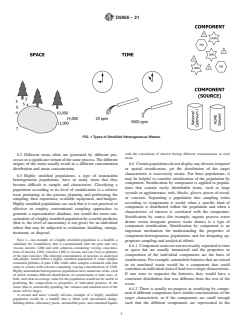
time, component, or source). Fig. 1 is a graphical depiction of
5.1.4 Budget problems that prevent implementation of a
different types of strata.
workable, but too costly, sampling design.
6.1.1 A landfill may display spatially separated strata since
5.2 The difficulties included in the first three categories are
old cells may contain different wastes than new cells (stratifi-
a function of the physical properties of the population being
cation over space).
sampled. The last sampling difficulty category is a function of
6.1.2 A waste pipe may discharge temporally separated
budget restraints that dictate a less costly sampling approach
strata if night-shift production varies from the day shift
thatoftenresultsinareducednumberofsamplesandareduced
(stratification over time).
certainty in the estimates of population characteristics. Budget
6.1.3 Lead-acid batteries will constitute a strata separate
restraints can make it difficult to balance costs with the levels
from commingled soil if lead is the characteristic of interest
of confidence needed in decision-making. These difficulties
(stratification by component).
may be resolved by changing the objectives or sampling/
6.1.4 Drums from an inorganic process may constitute a
analytical plans since population attributes or physical proper-
different strata from those co-disposed drums generated by an
ties of the population can seldom be altered. Documents on
organic process (a subtype of stratification by component
DQOs discuss a process for balancing budgets with needed
referred to as stratification by source).
levels of confidence.
5.3 Population access and sample collection difficulties
The boldface numbers in parentheses refer to the list of references at the end of
often are obvious and, therefore, more likely either to be this standard.
D5956 − 21
FIG. 1 Types of Stratified Heterogeneous Wastes
with the constituent of interest having different concentrations in each
6.2 Different strata often are generated by different pro-
strata.
cessesorasignificantvariantofthesameprocess.Thedifferent
origins of the strata usually result in a different concentration 6.4 Certainpopulationsdonotdisplayanyobvioustemporal
distribution and mean concentration. or spatial stratification, yet the distribution of the target
characteristic is excessively erratic. For these populations, it
6.3 Highly stratified populations, a type of nonrandom
may be helpful to consider stratification of the population by
heterogeneous populations, have so many strata that they
component. Stratification by component is applied to popula-
become difficult to sample and characterize. Classifying a
tions that contain easily identifiable items, such as large
population according to its level of stratification is a relative
crystals or agglomerates, rods, blocks, gloves, pieces of wood,
issue pertaining to the persons planning and performing the
or concrete. Separating a population into sampling strata
sampling, their experience, available equipment, and budgets.
according to components is useful when a specific kind of
Highly stratified populations are such that it is not practical or
component is distributed within the population and when a
effective to employ conventional sampling approaches to
characteristic of interest is correlated with the component.
generate a representative database, nor would the mean con-
Stratification by source (for example, organic process waste
centrationofahighlystratifiedpopulationbeausefulpredictor
drums versus inorganic process waste drums) is a type of
(that is, the level of uncertainty is too great) for an individual
component stratification. Stratification by component is an
subset that may be subjected to evaluation, handling, storage,
important mechanism for understanding the properties of
treatment, or disposal.
component-heterogeneous populations and for designing ap-
NOTE 1—An example of a highly stratified population is a landfill, a
propriate sampling and analytical efforts.
candidate for remediation, that is contaminated with the pure and very
6.4.1 Componentstrataarenotnecessarilyseparatedintime
viscous Aroclor 1260 and with solutions containing varying concentra-
or space but are usually intermixed and the properties or
tions ofAroclor 1260. (Aroclor 1260 is viscous and can exist as globules
composition of the individual components are the basis of
of the pure Aroclor.) The detected concentration of Aroclors in analytical
subsamples would reflect a highly stratified population if some samples
stratification. For example, automobile batteries that are mixed
contained globules of pure 1260, while other samples contained soils that
in an unrelated waste would be a component that could
came in contact with solvents containing varying concentrations of 1260.
constituteanindividualstrataifleadwasatargetcharacteristic.
Highly nonrandom heterogeneous populations have numerous strata, each
If one were to sequester the batteries, they would have a
of which contains different distributions of contaminants or item sizes, or
both, such that an average value for the population would not be useful in consistent distribution that was different from the rest of the
predicting the composition or properties of individual portions of the
waste.
waste (that is, statistically speaking, the variance and standard error of the
6.4.2 There is usually no purpose in stratifying by compo-
mean will be large).
nent if different components have similar concentrations of the
A second and more visually obvious example of a highly stratified
target characteristic or if the components are small enough
population would be a landfill that is filled with unconfined sludge,
building debris, laboratory packs, automobile parts, and contained liquids such that the different components are represented in the
D5956 − 21
chosen sample size. Even when components have similar objectives, waste handling, or disposal methods, and some
composition, however, stratification and use of separate sam- require compromises, but all approaches require the above
plingstrategiesbycomponentmaybeusefulwhenthedifferent types of information.
components are so physically different that they cannot all be
7.6 Heterogeneity is a necessary condition for the existence
sampled with the same technique.
of strata. Wastes can be heterogeneous in particle size or in
6.4.3 A primary objective for employing a stratified sam-
composition, or both, allowing for the existence of the follow-
pling strategy is to improve the precision of population
ing:
parameters such as population means by dividing the popula-
7.6.1 Strata of different-sized items of similar composition,
tion into homogeneous strata. The precision of the population
7.6.2 Strata of similar-sized items of different composition,
parameters will increase as the sampling strata boundaries,
and,
chosen by the sampling team, more closely overlay the actual
7.6.3 Strata of different-sized items and different composi-
physical strata that exist within the population.
tion.
8. Strata of Different-Sized Items with Similar
7. Sampling of Highly Stratified Heterogeneous Wastes
Composition
7.1 Sections 7–10 focus on the sampling of highly
8.1 Wastes having stratification due only to different-sized
stratified wastes, a type of heterogeneous waste. It is strongly
items will by definition have the same composition or property
advised that Annex A1 be read and studied prior to the use of
(that is, for compositional characteristics there is no significant
this guide. AnnexA1 discusses heterogeneity and the relation-
intersample variance and no correlation with space, time, or
ship between samples and populations.
component) throughout its different strata. The different-sized
7.2 Nonrandom heterogeneous wastes contain two or more
items may be separated in space or in time. Unless one is
strata. Stratification of a waste does not always complicate the
attempting to measure particle size for which there is signifi-
sampling process; at times, it could simplify sampling. Highly
cant intersample variance, this type of population is the
stratified populations, however, contain such a large number of
simplest of the highly stratified waste types to characterize.All
strata that they become difficult to sample and characterize.
items in these types of wastes usually are generated by the
Use of the word highly and the classification of wastes
same process (for example, the discussion of silver nitrate
according to their level of stratification is a relative issue
powder and crystals in Annex A1), which is the reason for
pertaining to the persons planning and performing the
similar composition across all item sizes. These types of
sampling, their experience, available equipment, budgets, and
wastes, which are compositionally homogeneous and only
objectives. Highly stratified wastes are such that it is not
heterogeneous in item size, are not commonly encountered.
practical or effective to employ conventional sampling
8.2 The complexity of dealing with these types of wastes is
approaches, nor would the mean concentration of a highly
in proving that the waste has similar composition across the
stratified waste be a useful predictor (that is, the level of
varying item sizes. This determination can be made by using
uncertainty is too great) for an individual subset that may be
process knowledge or by sampling the different-sized items to
subjected to evaluation, handling, storage, treatment, or dis-
determine if there are significant compositional differences. If
posal.
the determination is made using knowledge of the waste, it is
7.3 Astructured approach to sampling planning, such as the
advisable to perform limited sampling to confirm the determi-
DQO process, is a useful approach for the sampling of all
nation. The characterization process is greatly simplified once
wastes regardless of their level of heterogeneity. The first step
a determination has been made that the waste has similar
in characterizing any heterogeneous waste is to gather all
composition or properties across the various item sizes. The
available information, such as the need for waste sampling;
sampling and subsequent analysis can be performed on items
objectives of waste sampling; pertinent regulations, consent
that are readily amenable to the sampling and analytical
orders, and liabilities; sampling, shipping, laboratory, health,
process, and the resulting data can be used to characterize the
and safety issues; generation, handling, treatment, and storage
waste in its entirety.
of the waste; existing analytical data and exacting details on
8.3 It is important to periodically verify the assumption that
how it was generated; and treatment and disposal alternatives.
the different-sized items are composed of materials having the
This information will be used in the planning of the sampling
same concentration levels and distributions of the contaminant
and analytical effort.
of interest. This verification is especially important when there
7.4 If enough information is available, the planning process
are any changes to the waste generation, storage, treatment, or
may uncover the existence of stratification that may prevent
disposal processes. Similarity of composition between items
achievement of objectives. If information is lacking, a prelimi-
has to be verified for each characteristic of interest. The effect
nary sampling/analytical effort may identify and evaluate
of different-sized items also must be considered when measur-
variability. It is not cost effective to characterize highly
ing properties such as the leachability of waste components.
stratified waste by conventional methods, which becomes
apparent during the planning process.
9. Strata of Similar-Sized Items and Different
Composition
7.5 Sections 8–10 consider approaches that lessen the
impact of stratification and allow for more cost-effective 9.1 Stratification due only to composition or property (that
sampling. Some of these approaches require changes in is, there is a correlation of composition or property with time,
D5956 − 21
space, or component) by definition necessitates that item sizes space, or component) are usually the most difficult wastes to
will be consistent across different strata. The strata may be characterize. The difficulty in sampling highly stratified waste
separable in space, time, or by component or source. Identify- can result from:
ing and sampling the individual strata may simplify the 10.1.1 Various item sizes and waste consistency that makes
characterization process. An example of this waste type is a sampling difficult and conventional sampling approaches cost
long-term accumulation of wastewater sludge produced by the prohibitive;
processing of materials having different composition, through
10.1.2 Extraordinary concentration gradients between dif-
the same waste-generation process (that is, batch processing ferent components or innumerable strata that lead to such
that results in waste having uniform item size but different
excessivevarianceinthedata,thatprojectobjectivescannotbe
composition from batch to batch). achieved; and
10.1.3 Wastes that exhibit the properties in 10.1.1 and
9.2 Wastes having uniform item size and different compo-
10.1.2.
sition or properties can be sampled using the same strategy as
described for waste containing strata having different compo-
10.2 Fig. 2 summarizes an approach to characterizing these
sition and different item size (see Section 10). types of highly stratified wastes. If a waste is highly stratified,
conventional methods of sampling will not allow objectives to
10. Strata of Different-Sized Items and Different
beachievedcosteffectively.Tosamplecosteffectivelyahighly
Composition
stratified waste, one must use a nonconventional approach,
10.1 Wastes having excessive stratification due to both such as modification of the sampling, sample preparation, or
composition/property and item size (that is, particle size and analyticalphaseoftheprocess.Ifaftermodifyingthesampling
composition or property, or both, are correlated with time, and analysis the objectives still cannot be achieved in a
FIG. 2 Approach for the Characterization of Heterogeneous Wastes
D5956 − 21
cost-effective manner, then the original plan of waste handling, 10.4.3 Regarding subsampling, the previously discussed
treatment, or disposal has to be examined and changed so the logic for field sampling (see 10.3) is applicable also for the
waste can be characterized according to new and achievable generation of analytical subsamples. Knowledge of concentra-
objectives. tion distributions within the waste can be used to simplify
subsampling by considering the following:
10.3 Design of the Sampling Approach:
10.4.3.1 Usingprocessknowledgeortheresultsoftestingto
10.3.1 The first efforts to resolve the difficulty in character-
eliminateanywastecomponentsorstratathatdonotcontribute
izing a highly stratified waste are focused usually on sampling.
significantly to the concentration of the target compound;
A strategy for designing a sampling plan for such highly
10.4.3.2 Usingprocessknowledgeortheresultsoftestingto
stratified waste may include the following five steps:
discriminate against large items, and only select small items
10.3.1.1 UseaplanningprocesssuchastheDQOprocessto
when small items represent the waste, as well as the large
identify the target characteristics, the population boundaries,
items; and
the statistic of interest, confidence levels, and other critical
10.4.3.3 Usingprocessknowledgeortheresultsoftestingto
issues.
restrict sampling to surface wipes of larger items and the
10.3.1.2 Determine whether characteristics of interest are
extraction or digestion of fines if surface contamination is the
correlated with item size, space, time, components, or sources.
source of the target characteristic.
10.3.1.3 Determineifanywastecomponentsorstratacanbe
10.4.4 If the approaches in 10.4.3.1 – 10.4.3.3 are not
eliminated from consideration during sampling because they
applicable to a field sample, the field sample will have to be
do not contribute significantly to the target characteristic.
subjected to particle size reduction (PSR) prior to subsampling
10.3.1.4 Determine if small items in a stratum represent the
or the sample preparation method will have to be modified to
stratum, as well as large, more difficult-to-sample items. If yes,
accommodate the entire field sample.
sample the smaller items and only track the volume/mass
contribution of the larger items.
NOTE 2—Prior to modifying a sample preparatory method, it is
10.3.1.5 Determine if the target characteristic is innate or
advisable to consult the end user of the data to see if modifications could
have any adverse effects. For example, PSR could dramatically alter
surface adsorbed. Is the target characteristic surface adsorbed,
leaching data.
which would allow the material to be sampled representatively
by wipe sampling? Can large items be wiped and smaller items
10.4.5 The PSR is useful for handling field samples, which
extracted, leached, or digested? Can waste be stratified accord-
have items too large for proper representation in an analytical
ing to impervious and nonimpervious waste and sampled and
subsample.TheintentofPSRistodecreasethemaximumitem
analyzed accordingly?
sizeofthefieldsamplesothatthefieldsamplethencanbesplit
10.3.1.6 It is essential that all assumptions (that is, any
orsubsampled,orboth,togeneratearepresentativesubsample.
correlations) be verified at least by knowledge of the waste,
The difficulties in applying PSR to waste samples are the
and preferably confirmed by sampling and analysis.
following:
10.3.2 All steps taken to optimize sampling should be well
10.4.5.1 Not all materials are easily amenable to PSR (for
documented.
example, stainless steel artifacts);
10.3.3 Appendix X1 contains a case study that applies the
10.4.5.2 Adequate PSR capabilities and capacities do not
above process for optimizing sampling to highly stratified
exist in all laboratories;
waste. If optimization of sampling design is not sufficient by
10.4.5.3 The PSR can change the properties of material (for
itself to allow the project objectives to be met cost effectively,
example, leachability);
changes to sample preparation or analysis should be consid-
10.4.5.4 The PSR can be a source of cross-contamination;
ered.
10.4.5.5 The PSR often is not applicable to volatile and
labile compounds; and
10.4 Modification of the Sample Preparation Method:
10.4.1 Information gleaned from the analysis of samples is 10.4.5.6 Large mass/volumes may have to be shipped,
handled, and disposed.
used to make inferences regarding population attributes. The
perception of population homogeneity, as indicated by no 10.4.6 Modification of sample preparative methods can
significant intersample variance, or the perception of popula- include the extraction, digestion, or leaching of much larger
tion heterogeneity (that is, as indicated by significant inter- sample masses than specified. The advantage of this approach
sample variance) is analytical sample-mass dependent. is that the characteristic of interest from a larger and more
Usually, the larger the sample mass/volume subjected to representative sample mass is dissolved into a relative homo-
analysis the more representative the analytical sample. To geneous extract or digestate that is more suitable for subsam-
improve representativeness of analytical samples and to ac- pling. This approach is particularly important for volatile
commodatelarge-sizeditems,conventionalsamplepreparatory organic compounds that may suffer from substantial losses if
methodscanbealtered.Allmodificationsofmethodsshouldbe subjected to PSR. For volatile organic compound analysis,
well documented.
larger portions of the wastes can be subjected to methanol
10.4.2 In the laboratory, the term sample preparation is extraction or possibly the entire field sample can be subjected
commonly meant to include two separate steps: (1) the to heated headspace analysis as one sample or as a series of
subsamplingofafieldsampletogenerateananalyticalsample, large aliquots, or possibly the entire field sample can be
and (2) the preparation of the analytical sample for subsequent preserved in the field with an equal volume of methanol or
analysis. methanol/water solution.
D5956 − 21
10.5 Modification of Analytical Method: effectively, then the reasoning behind the original program
10.5.1 The analytical phase of a sampling and analytical must be reconsidered. It may be possible to achieve the
program allows another opportunity to simplify the character- program objectives by means of an alternative approach. For
ization of a highly stratified waste. Examples of different example, a change in waste treatment, handling, or disposal
classes of analytical methods are:
technologies may require analysis for different characteristics
10.5.1.1 Screening methods, or may allow for simplified sampling. Alternatively, the waste
10.5.1.2 Portable methods,
population could be defined differently by employing smaller
10.5.1.3 Field laboratories methods, remediation or exposure units that would be sampled sepa-
10.5.1.4 Nonintrusive methods,
rately as opposed to characterizing the entire population. The
10.5.1.5 Nondestructive methods, need behind the waste characterization objectives has to be
10.5.1.6 Innovative methods, and
examined and an approach for simplifying the characterization
10.5.1.7 Fixed laboratory methods.
process devised. This process is addressed in the optimization
10.5.2 Screening, portable, and field laboratory methods
step of the planning process.
have the distinct advantage that they allow for the cost-
10.6.2 For example, consider a hypothetical waste that must
effective analysis of more samples. These methods generate
be evaluated prior to waste disposal to determine if it is
more data, making it easier to detect correlations between
hazardous.An initial attempt to characterize the waste failed to
concentration levels and waste strata or components. Also,
meet the objective, indicated that the waste was highly
some screening methods may analyze a larger sample volume
stratified, and proved that portions of the waste are hazardous.
than what is traditionally analyzed in a fixed laboratory.
After reviewing this preliminary information and the costs to
10.5.3 Nonintrusive methods (for example, geophysical
attempt a defensible characterization of the waste, it could be
methods) can be useful when there are health and safety issues
decided that it is resourceful and cost effective to consider all
regarding exposure to the waste. These methods also may be
the waste hazardous and treat it as a hazardous waste by
used to evaluate large-volume wastes qualitatively or semi-
incineration. Under this scenario, the sampling and analytical
quantitatively.
requirements change, requiring simplified testing for general
10.5.4 Nondestructive methods are useful in that the integ-
characteristics prior to incineration, and more comprehensive
rity of the samples is maintained for additional analyses or
analysis of the less heterogeneous and more easily sampled
evidence, or both.
incinerator ash to determine if it is within compliance.
10.5.5 Innovative methods may provide more cost-effective
10.7 Changing Objectives—If the project objectives are not
or timely results or improve sensitivity or accommodate larger
met and none of the strategies can be changed or modified, the
and more representative sample sizes.
objectives need to be reconsidered. After changing the
10.5.6 Fixedlaboratorymethodsusuallyhavetheadvantage
of regulatory approval, established quality assurance/quality objectives, the sampling and analysis plans also should be
adjusted. These iterations will continue until the project objec-
control requirements, and often greater sensitivity than that
tives can be met.
achiev
...
This document is not an ASTM standard and is intended only to provide the user of an ASTM standard an indication of what changes have been made to the previous version. Because
it may not be technically possible to adequately depict all changes accurately, ASTM recommends that users consult prior editions as appropriate. In all cases only the current version
of the standard as published by ASTM is to be considered the official document.
Designation: D5956 − 15 D5956 − 21
Standard Guide for
Sampling Strategies for Heterogeneous Wastes
This standard is issued under the fixed designation D5956; the number immediately following the designation indicates the year of
original adoption or, in the case of revision, the year of last revision. A number in parentheses indicates the year of last reapproval. A
superscript epsilon (´) indicates an editorial change since the last revision or reapproval.
1. Scope
1.1 This guide is a practical, nonmathematical discussion for heterogeneous waste sampling strategies. This guide is consistent
with the particulate material sampling theory,theory as well as inferential statistics, and may serve as an introduction to the
statistical treatment of sampling issues.
1.2 This guide does not provide comprehensive sampling procedures, nor does it serve as a guide to any specification. It is the
responsibility of the user to ensure appropriate procedures are used.
1.3 Units—The values stated in SI units are to be regarded as standard. No other units of measurement are included in this
standard. All observed and calculated values shall conform to the guidelines for significant digits and rounding established in
Practice D6026. Reporting of test results in units other than SI shall not be regarded as nonconformance with this standard.
1.4 This standard does not purport to address all of the safety concerns, if any, associated with its use. It is the responsibility
of the user of this standard to establish appropriate safety safety, health, and healthenvironmental practices and determine the
applicability of regulatory limitations prior to use.
1.5 This international standard was developed in accordance with internationally recognized principles on standardization
established in the Decision on Principles for the Development of International Standards, Guides and Recommendations issued
by the World Trade Organization Technical Barriers to Trade (TBT) Committee.
2. Referenced Documents
2.1 ASTM Standards:
D5681 Terminology for Waste and Waste Management
D6026 Practice for Using Significant Digits and Data Records in Geotechnical Data
3. Terminology
3.1 Definitions—For definitions of terms used in this standard, see Terminology D5681.
3.2 Definitions of Terms Specific to This Standard:
2.1.1 attribute, n—a quality of samples or a population.
This guide is under the jurisdiction of ASTM Committee D34 on Waste Management and is the direct responsibility of Subcommittee D34.01.01 on Planning for
Sampling.
Current edition approved May 1, 2015Oct. 1, 2021. Published May 2015October 2021. Originally approved in 1996. Last previous edition approved in 20062015 as
D5956 – 96 (2006)D5956 – 15., which was withdrawn in January 2015 and reinstated in May 2015. DOI: 10.1520/D5956-15. DOI: 10.1520/D5956-21.
For referenced ASTM standards, visit the ASTM website, www.astm.org, or contact ASTM Customer Service at service@astm.org. For Annual Book of ASTM Standards
volume information, refer to the standard’s Document Summary page on the ASTM website.
Copyright © ASTM International, 100 Barr Harbor Drive, PO Box C700, West Conshohocken, PA 19428-2959. United States
D5956 − 21
2.1.1.1 Discussion—
Homogeneity, heterogeneity, and practical homogeneity are population attributes. Representativeness and intersample variance are
sample attributes.
2.1.2 characteristic, n—a property of items, a sample or population that can be measured, counted, or otherwise observed.
2.1.2.1 Discussion—
A characteristic of interest may be the cadmium concentration or ignitability of a population.
3.2.1 component, n—an easily identified item such as a large crystal, an agglomerate, rod, container, block, glove, piece of wood,
or concrete.
3.2.2 composite sample, n—a combination of two or more samples.
3.2.2.1 Discussion—
When compositing samples to detect hot spots or whenever there may be a reason to determine which of the component samples
that constitute the composite are the source of the detected contaminant, it can be helpful to composite only portions of the
component samples. The remainders of the component samples then can be archived for future reference and analysis. This
approach is particularly helpful when sampling is expensive, hazardous, or difficult.
3.2.3 correlation, n—the mutual relation of two or more things.
2.1.6 database, n—a comprehensive collection of related data organized for quick access.
2.1.6.1 Discussion—
Database as used in this guide refers to a collection of data generated by the collection and analysis of more than one physical
sample.
2.1.7 data quality objectives (DQO), n—DQOs are qualitative and quantitative statements derived from the DQO process
describing the decision rules and the uncertainties of the decision(s) within the context of the problem(s).
2.1.8 data quality objective process, n—a quality management tool based on the scientific method and developed by the U.S.
Environmental Protection Agency to facilitate the planning of environmental data collection activities.
2.1.8.1 Discussion—
The DQO process enables planners to focus their planning efforts by specifying the use of the data (the decision), the decision
criteria (action level) and the decision maker’s acceptable decision error rates. The products of the DQO process are the DQOs.
2.1.9 heterogeneity, n—the condition of the population under which items of the population are not identical with respect to the
characteristic of interest.
2.1.10 homogeneity, n—the condition of the population under which all items of the population are identical with respect to the
characteristic of interest.
2.1.10.1 Discussion—
Homogeneity is a word that has more than one meaning. In statistics, a population may be considered homogeneous when it has
one distribution (for example, if the concentration of lead varies between the different items that constitute a population and the
varying concentrations can be described by a single distribution and mean value, then the population would be considered
homogeneous). A population containing different strata would not have a single distribution throughout, and in statistics, may be
considered to be heterogeneous. The terms homogeneity and heterogeneity as used in this guide, however, reflect the understanding
more common to chemists, geologists, and engineers. The terms are used as described in the previous definitions and refer to the
similarity or dissimilarity of items that constitute the population. According to this guide, a population that has dissimilar items
would be considered heterogeneous regardless of the type of distribution.
3.2.4 item, n—a distinct part of a population (for example, microscopic particles, macroscopic particles, and 20-ft long steel
beams).
3.2.4.1 Discussion—
The term component defines a subset of items. Components are those items that are easily identified as being different from the
remainder of items that constitute the population. The identification of components may facilitate the stratification and sampling
of a highly stratified population when the presence of the characteristic of interest is correlated with a specific component.
D5956 − 21
2.1.12 population, n—the totality of items or units under consideration.
3.2.5 practical homogeneity, n—the condition of the population under which all items of the population are not identical. For the
characteristic of interest, however, the differences between individual physical samples are not measurable or significant relative
to project objectives.
3.2.5.1 Discussion—
For practical purposes, the population is homogeneous.
3.2.6 random, n—lack of order or patterns in a population whose items have an equal probability of occurring.
3.2.6.1 Discussion—
The word random is used in two different contexts in this guide. In relation to sampling, random means that all items of a
population have an equal probability of being sampled. In relation to the distribution of a population characteristic, random means
that the characteristic has an equal probability of occurring in any and all items of the population.
2.1.15 representative sample, n—a sample collected in such a manner that it reflects one or more characteristics of interest (as
defined by the project objectives) of a population from which it was collected.
2.1.15.1 Discussion—
A representative sample can be (1) a single sample, (2) a set of samples, or (3) one or more composite samples.
2.1.16 sample, n—a portion of material that is taken for testing or for record purposes.
2.1.16.1 Discussion—
Sample is a term with numerous meanings. The scientist collecting physical samples (for example, from a landfill, drum, or waste
pipe) or analyzing samples, considers a sample to be that unit of the population collected and placed in a container. In statistics,
a sample is considered to be a subset of the population, and this subset may consist of one or more physical samples. To minimize
confusion the term physical sample is a reference to the sample held in a sample container or that portion of the population that
is subjected to in situ measurements. One or more physical samples, discrete samples, or aliquots are combined to form a composite
sample. The term sample size has more than one meaning and may mean different things to the scientist and the statistician. To
avoid confusion, terms such as sample mass or sample volume and number of samples are used instead of sample size.
3.2.7 sample variance, n—a measure of the dispersion of a set of results. Variance is the sum of the squares of the individual
deviations from the sample mean divided by one less than the number of results involved. It may be expressed as s 5 x
~
(
i
2x¯ / n21 .
! ~ !
2.1.18 sampling, n—obtaining a portion of the material concerned.
2.1.19 stratum, n—a subgroup of a population separated in space or time, or both, from the remainder of the population, being
internally consistent with respect to a target constituent or property of interest, and different from adjacent portions of the
population.
2.1.19.1 Discussion—
A landfill may display spatially separated strata since old cells may contain different wastes than new cells. A waste pipe may
discharge temporally separated strata if night-shift production varies from the day shift. Also, a waste may have a contaminant of
interest associated with a particular component in the population, such as lead exclusively associated with a certain particle size.
2.1.19.2 Discussion—
Highly stratified populations consist of such a large number of strata that it is not practical or effective to employ conventional
sampling approaches, nor would the mean concentration of a highly stratified population be a useful predictor (that is, the level
of uncertainty is too great) for an individual subset that may be subjected to evaluation, handling, storage, treatment, or disposal.
Highly stratified is a relative term used to identify certain types of nonrandom heterogeneous populations. Classifying a population
according to its level of stratification is relative to the persons planning and performing the sampling, their experience, available
equipment, budgets, and sampling objectives. Under one set of circumstances a population could be considered highly stratified,
while under a different context the same population may be considered stratified.
2.1.19.3 Discussion—
The terms stratum and strata are used in two different contexts in this guide. In relation to the population of interest, stratum refers
to the actual subgroup of the population (for example, a single truck load of lead-acid batteries dumped in the northeast corner of
a landfill cell). In relation to sampling, stratum or strata refers to the subgroups or divisions of the population as assigned by the
sampling team. When assigning sampling strata, the sampling team should maximize the correlation between the boundaries of the
D5956 − 21
assigned sampling strata and the actual strata that exist within the population. To minimize confusion in this guide, those strata
assigned by the sampling team will be referred to as sampling strata.
4. Significance and Use
4.1 This guide is suitable for sampling heterogeneous wastes.
4.2 The focus of this guidance is on wastes; however, the approach described in this guide may be applicable to non-waste
populations,populations as well.
4.3 Sections 45 – 910 describe a guide for the sampling of heterogeneous waste according to project objectives. Appendix X1
describes an application of the guide to heterogeneous wastes. The user is strongly advised to read Annex A1 prior to reading and
employing Sections 45 – 910 of this guide.
4.4 Annex A1 contains an introductory discussion of heterogeneity, stratification, and the relationship of samples and populations.
4.5 This guide is intended for those who manage, design, or implement sampling and analytical plans for the characterization of
heterogeneous wastes.
5. Sampling Difficulties
5.1 There are numerous difficulties that can complicate efforts to sample a population. These difficulties can be classified into four
general categories:
5.1.1 Population access problems making it difficult to sample all or portions of the population;
5.1.2 Sample collection difficulties due to physical properties of the population (for example, unwieldy large items or high
viscosity);
5.1.3 Planning difficulties caused by insufficient knowledge regarding population size, heterogeneity of the contaminant of
interest, or item size, or a combination thereof; and,and
5.1.4 Budget problems that prevent implementation of a workable, but too costly, sampling design.
5.2 The difficulties included in the first three categories are a function of the physical properties of the population being sampled.
The last sampling difficulty category is a function of budget restraints that dictate a less-costly less costly sampling approach that
often results in a reduced number of samples and a reduced certainty in the estimates of population characteristics. Budget
restraints can make it difficult to balance costs with the levels of confidence needed in decision making. decision-making. These
difficulties may be resolved by changing the objectives or sampling/analytical plans since population attributes or physical
properties of the population can seldom be altered. Documents on DQOs discuss a process for balancing budgets with needed
levels of confidence.
5.3 Population access and sample collection difficulties often are obvious, andobvious and, therefore, more likely either to be
addressed or the resulting limitations well-documented. well documented. A field notebook is likely to describe difficulties in
collecting large items or the fact that the center of a waste pile could not be accessed.
5.4 Population size, heterogeneity, and item size have a substantial impact on sampling. The cost and difficulty of accurately
sampling a population usually is correlated with the knowledge of these population attributes and characteristics. The least
understood population attribute is heterogeneity of the characteristic of interest. If heterogeneity is not known through process
knowledge, then some level of preliminary sampling or field analysis is often required prior to sampling design.
5.5 Sampling of any population may be difficult. However, with all other variables being the same, nonrandom heterogeneous
populations are usually more difficult to sample. The increased difficulty in sampling nonrandom heterogeneous populations is due
to the existence of unidentified or numerous strata, or both. If the existence of strata areis not considered when sampling a
nonrandom heterogeneous population, the resulting data will average the measured characteristics of the individual strata over the
entire population. If the different strata are relatively similar in composition, then the mean characteristic of the population may
D5956 − 21
be a good predictor for portions of the population and will often allow the project-specific objectives to be achieved. As the
difference in composition between different strata increases, average population characteristics become less useful in predicting
composition or properties of individual portions of the population. In this latter case, when possible, it is advantageous to sample
the individual strata separately, andseparately and, if an overall average of a population characteristic is needed, it can be calculated
mathematically using the weighted averages of the sampling stratum means (1).
6. Stratification
6.1 Strata can be thought of as different portions of a population,population which may be separated in time or space, with each
portion having internally similar concentrations or properties, which are different from adjacent portions of the population (that
is, concentrations/properties are correlated with space, time, component, or source). Fig. 1 is a graphical depiction of different types
of strata.
6.1.1 A landfill may display spatially separated strata since old cells may contain different wastes than new cells (stratification over
space);space).
6.1.2 A waste pipe may discharge temporally separated strata if night-shift production varies from the day shift (stratification over
time);time).
6.1.3 Lead-acid batteries will constitute a strata separate from commingled soil if lead is the characteristic of interest (stratification
by component); and,component).
6.1.4 Drums from an inorganic process may constitute a different strata from those co-disposed drums generated by an organic
process (a subtype of stratification by component referred to as stratification by source).
6.2 Different strata often are generated by different processes or a significant variant of the same process. The different origins of
the strata usually result in a different concentration distribution and mean concentration.
6.3 Highly stratified populations, a type of nonrandom heterogeneous populations, have so many strata that they become difficult
to sample and characterize. Classifying a population according to its level of stratification is a relative issue pertaining to the
FIG. 1 Types of Stratified Heterogeneous Wastes
The boldface numbers in parentheses refer to the list of references at the end of this standard.
D5956 − 21
persons planning and performing the sampling, their experience, available equipment, and budgets. Highly stratified populations
are such that it is not practical or effective to employ conventional sampling approaches to generate a representative database, nor
would the mean concentration of a highly stratified population be a useful predictor (that is, the level of uncertainty is too great)
for an individual subset that may be subjected to evaluation, handling, storage, treatment, or disposal.
NOTE 1—An example of a highly stratified population is a landfill, a candidate for remediation, that is contaminated with the pure and very viscous Aroclor
1260 and with solutions containing varying concentrations of Aroclor 1260. (Aroclor 1260 is viscous and can exist as globules of the pure Aroclor.) The
detected concentration of Aroclors in analytical subsamples would reflect a highly stratified population if some samples contained globules of pure 1260,
while other samples contained soils that came in contact with solvents containing varying concentrations of 1260. Highly nonrandom heterogeneous
populations have numerous strata, each of which containcontains different distributions of contaminants or item sizes, or both, such that an average value
for the population would not be useful in predicting the composition or properties of individual portions of the waste (that is, statistically speaking, the
variance and standard error of the mean will be large).
A second and more visually obvious example of a highly stratified population would be a landfill that is filled with unconfined sludge, building debris,
laboratory packs, automobile parts, and contained liquids with the constituent of interest having different concentrations in each strata.
6.4 Certain populations do not display any obvious temporal or spatial stratification, yet the distribution of the target characteristic
is excessively erratic. For these populations, it may be helpful to consider stratification of the population by component.
Stratification by component is applied to populations that contain easily identifiable items, such as large crystals or agglomerates,
rods, blocks, gloves, pieces of wood, or concrete. Separating a population into sampling strata according to components is useful
when a specific kind of component is distributed within the population and when a characteristic of interest is correlated with the
component. Stratification by source (for example, organic process waste drums versus inorganic process waste drums) is a type
of component stratification. Stratification by component is an important mechanism for understanding the properties of
component-heterogeneous populations and for designing appropriate sampling and analytical efforts.
6.4.1 Component strata are not necessarily separated in time or space but are usually intermixed and the properties or composition
of the individual components are the basis of stratification. For example, automobile batteries that are mixed in an unrelated waste
would be a component that could constitute an individual strata if lead was a target characteristic. If one were to sequester the
batteries, they would have a consistent distribution that was different from the rest of the waste.
6.4.2 There is usually no purpose in stratifying by component if different components have similar concentrations of the target
characteristic or if the components are small enough such that the different components are represented in the chosen sample size.
Even when components have similar composition, however, stratification and use of separate sampling strategies by component
may be useful when the different components are so physically different that they cannot all be sampled with the same technique.
6.4.3 A primary objective for employing a stratified sampling strategy is to improve the precision of population parameters such
as population means by dividing the population into homogeneous strata. The precision of the population parameters will increase
as the sampling strata boundaries, chosen by the sampling team, more closely overlay the actual physical strata that exist within
the population.
7. Sampling of Highly Stratified Heterogeneous Wastes
7.1 Sections 67 – 910 focus on the sampling of highly stratified wastes, a type of heterogeneous waste. It is strongly advised that
Annex A1 be read and studied prior to the use of this guide. Annex A1 discusses heterogeneity and the relationship between
samples and populations.
7.2 Nonrandom heterogeneous wastes contain two or more strata. Stratification of a waste does not always complicate the
sampling process; at times, it could simplify sampling. Highly stratified populations, however, contain such a large number of strata
that they become difficult to sample and characterize. Use of the word highly and the classification of wastes according to their
level of stratification is a relative issue pertaining to the persons planning and performing the sampling, their experience, available
equipment, budgets, and objectives. Highly stratified wastes are such that it is not practical or effective to employ conventional
sampling approaches, nor would the mean concentration of a highly stratified waste be a useful predictor (that is, the level of
uncertainty is too great) for an individual subset that may be subjected to evaluation, handling, storage, treatment, or disposal.
7.3 A structured approach to sampling planning, such as the DQO process, is a useful approach for the sampling of all wastes
regardless of their level of heterogeneity. The first step in characterizing any heterogeneous waste is to gather all available
information, such as the need for waste sampling; objectives of waste sampling; pertinent regulations, consent orders, and
liabilities; sampling, shipping, laboratory, health, and safety issues; generation, handling, treatment, and storage of the waste;
existing analytical data and exacting details on how it was generated; and treatment and disposal alternatives. This information will
be used in the planning of the sampling and analytical effort.
D5956 − 21
7.4 If enough information is available, the planning process may uncover the existence of stratification that may prevent
achievement of objectives. If information is lacking, a preliminary sampling/analytical effort may identify and evaluate variability.
It is not cost-effective cost effective to characterize highly stratified waste by conventional methods, which becomes apparent
during the planning process.
7.5 Sections 78 – 910 consider approaches that lessen the impact of stratification and allow for more cost-effective sampling. Some
of these approaches require changes in objectives, waste handling, or disposal methods, and some require compromises, but all
approaches require the above types of information.
7.6 Heterogeneity is a necessary condition for the existence of strata. Wastes can be heterogeneous in particle size or in
composition, or both, allowing for the existence of the following:
7.6.1 Strata of different-sized items of similar composition,
7.6.2 Strata of similar-sized items of different composition, and,
7.6.3 Strata of different-sized items and different composition.
8. Strata of Different-Sized Items Withwith Similar Composition
8.1 Wastes having stratification due only to different-sized items will by definition have the same composition or property (that
is, for compositional characteristics there is no significant intersample variance and no correlation with space, time, or component)
throughout its different strata. The different-sized items may be separated in space or in time. Unless one is attempting to measure
particle size for which there is significant intersample variance, this type of population is the simplest of the highly stratified waste
types to characterize. All items in these types of wastes usually are generated by the same process (for example, the discussion
of silver nitrate powder and crystals in Annex A1), which is the reason for similar composition across all item sizes. These types
of wastes, which are compositionally homogeneous and only heterogeneous in item size, are not commonly encountered.
8.2 The complexity of dealing with these types of wastes is in proving that the waste has similar composition across the varying
item sizes. This determination can be made by using process knowledge or by sampling the different-sized items to determine if
there are significant compositional differences. If the determination is made using knowledge of the waste, it is advisable to
perform limited sampling to confirm the determination. The characterization process is greatly simplified once a determination has
been made that the waste has similar composition or properties across the various item sizes. The sampling and subsequent analysis
can be performed on items that are readily amenable to the sampling and analytical process, and the resulting data can be used
to characterize the waste in its entirety.
8.3 It is important to periodically verify the assumption that the different-sized items are composed of materials having the same
concentration levels and distributions of the contaminant of interest. This verification is especially important when there are any
changes to the waste generation, storage, treatment, or disposal processes. Similarity of composition between items has to be
verified for each characteristic of interest. The effect of different-sized items also must be considered when measuring
properties,properties such as the leachability of waste components.
9. Strata of Similar-Sized Items and Different Composition
9.1 Stratification due only to composition or property (that is, there is a correlation of composition or property with time, space,
or component) by definition necessitates that item sizes will be consistent across different strata. The strata may be separable in
space, time, or by component or source. Identifying and sampling the individual strata may simplify the characterization process.
An example of this waste type is a long-term accumulation of wastewater sludge produced by the processing of materials having
different composition, through the same waste-generation process (that is, batch-processing batch processing that results in waste
having uniform item size but different composition from batch to batch).
9.2 Wastes having uniform item size and different composition or properties can be sampled using the same strategy as described
for waste containing strata having different composition and different item size (see Section 910).
D5956 − 21
10. Strata of Different-Sized Items and Different Composition
10.1 Wastes having excessive stratification due to both composition/property and item size (that is, particle size and composition
or property, or both, are correlated with time, space, or component) are usually the most difficult wastes to characterize. The
difficulty in sampling highly stratified waste can result from:
10.1.1 Various item sizes and waste consistency that makes sampling difficult and conventional sampling approaches cost
prohibitive;
10.1.2 Extraordinary concentration gradients between different components or innumerable strata that lead to such excessive
variance in the data, that project objectives cannot be achieved; and,and
10.1.3 Wastes that exhibit the properties in 9.1.1 and 9.1.210.1.1 and 10.1.2.
10.2 Fig. 2 summarizes an approach to characterizing these types of highly stratified wastes. If a waste is highly stratified,
conventional methods of sampling will not allow objectives to be achieved cost-effectively. cost effectively. To sample
cost-effectively cost effectively a highly stratified waste, one must use a nonconventional approach, such as modification of the
sampling, sample preparation, or analytical phase of the process. If after modifying the sampling and analysis,analysis the
FIG. 2 Approach for the Characterization of Heterogeneous Wastes
D5956 − 21
objectives still cannot be achieved in a cost-effective manner, then the original plan of waste handling, treatment, or disposal has
to be examined and changed so the waste can be characterized according to new and achievable objectives.
10.3 Design of the Sampling Approach:
10.3.1 The first efforts to resolve the difficulty in characterizing a highly stratified waste are focused usually on sampling. A
strategy for designing a sampling plan for such highly stratified waste may include the following five steps:
10.3.1.1 Use a planning process such as the DQO process to identify the target characteristics, the population boundaries, the
statistic of interest, confidence levels, and other critical issues.
10.3.1.2 Determine whether characteristics of interest are correlated with item size, space, time, components, or sources.
10.3.1.3 Determine if any waste components or strata can be eliminated from consideration during sampling because they do not
contribute significantly to the target characteristic.
10.3.1.4 Determine if small items in a stratum represent the stratum, as well as large more difficult to sample large, more
difficult-to-sample items. If yes, sample the smaller items,items and only track the volume/mass contribution of the larger items.
10.3.1.5 Determine if the target characteristic is innate or surface adsorbed. Is the target characteristic surface adsorbed, which
would allow the material to be sampled representatively by wipe sampling? Can large items be wiped and smaller items extracted,
leached, or digested? Can waste be stratified according to impervious and nonimpervious waste and sampled and analyzed
accordingly?
10.3.1.6 It is essential that all assumptions (that is, any correlations) be verified at least by knowledge of the waste, and preferably
confirmed by sampling and analysis.
10.3.2 All steps taken to optimize sampling should be welldocumented.well documented.
10.3.3 Appendix X1 contains a case study that applies the above process for optimizing sampling to highly stratified waste. If
optimization of sampling design is not sufficient by itself to allow the project objectives to be met cost-effectively, cost effectively,
changes to sample preparation or analysis should be considered.
10.4 Modification of the Sample Preparation Method:
10.4.1 Information gleaned from the analysis of samples is used to make inferences regarding population attributes. The
perception of population homogeneity, as indicated by no significant intersample variance, or the perception of population
heterogeneity (that is, as indicated by significant intersample variance) is analytical sample-mass dependent. Usually, the larger the
sample mass/volume subjected to analysis the more representative the analytical sample. To improve representativeness of
analytical samples and to accommodate large-sized items, conventional sample preparatory methods can be altered. All
modifications of methods should be well-documented.well documented.
10.4.2 In the laboratory, the term sample preparation is commonly meant to include two separate steps: (1) the subsampling of
a field sample to generate an analytical sample, and (2) the preparation of the analytical sample for subsequent analysis.
10.4.3 Regarding subsampling, the previously discussed logic for field sampling (see 9.310.3) is applicable also for the generation
of analytical subsamples. Knowledge of concentration distributions within the waste can be used to simplify subsampling by
considering the following:
10.4.3.1 Using process knowledge or the results of testing to eliminate any waste components or strata that do not contribute
significantly to the concentration of the target compound;
10.4.3.2 Using process knowledge or the results of testing to discriminate against large items, and only select small items when
small items represent the waste, as well as the large items; and,and
10.4.3.3 Using process knowledge or the results of testing to restrict sampling to surface wipes of larger items and the extraction
or digestion of fines if surface contamination is the source of the target characteristic.
D5956 − 21
10.4.4 If the approaches in 9.4.3.110.4.3.1 – 9.4.3.310.4.3.3 are not applicable to a field sample, the field sample will have to be
subjected to particle size reduction (PSR) prior to subsampling or the sample preparation method will have to be modified to
accommodate the entire field sample.
NOTE 2—Prior to modifying a sample preparatory method, it is advisable to consult the end user of the data to see if modifications could have any adverse
affects.effects. For example, PSR could dramatically alter leaching data.
10.4.5 The PSR is useful for handling field samples, which have items too large for proper representation in an analytical
subsample. The intent of PSR is to decrease the maximum item size of the field sample so that the field sample then can be split
or subsampled, or both, to generate a representative subsample. The difficulties in applying PSR to waste samples are the
following:
10.4.5.1 Not all materials are easily amenable to PSR (for example, stainless steel artifacts);
10.4.5.2 Adequate PSR capabilities and capacities do not exist in all laboratories;
10.4.5.3 The PSR can change the properties of material (for example, leachability);
10.4.5.4 The PSR can be a source of cross-contamination;
10.4.5.5 The PSR often is not applicable to volatile and labile compounds; and,and
10.4.5.6 Large mass/volumes may have to be shipped, handled, and disposed.
10.4.6 Modification of sample preparative methods can include the extraction, digestion, or leaching of much larger sample
masses than specified. The advantage of this approach is that the characteristic of interest from a larger and more representative
sample mass is dissolved into a relative homogeneous extract or digestate that is more suitable for subsampling. This approach is
particularly important for volatile organic compounds that may suffer from substantial losses if subjected to PSR. For volatile
organic compound analysis, larger portions of the wastes can be subjected to methanol extraction or possibly the entire field sample
can be subjected to heated headspace analysis as one sample or as a series of large aliquots, or possibly the entire field sample can
be preserved in the field with an equal volume of methanol or methanol/water solution.
10.5 Modification of Analytical Method:
10.5.1 The analytical phase of a sampling and analytical program allows another opportunity to simplify the characterization of
a highly stratified waste. Examples of different classes of analytical methods are:
10.5.1.1 Screening methods,
10.5.1.2 Portable methods,
10.5.1.3 Field laboratories methods,
10.5.1.4 Nonintrusive methods,
10.5.1.5 Nondestructive methods,
10.5.1.6 Innovative methods, and
10.5.1.7 Fixed laboratory methods.
10.5.2 Screening, portable, and field laboratory methods have the distinct advantage that they allow for the cost-effective analysis
of more samples. These methods generate more data, making it easier to detect correlations between concentration levels and waste
strata or components. Also, some screening methods may analyze a larger sample volume than what is traditionally analyzed in
a fixed laboratory.
D5956 − 21
10.5.3 Nonintrusive methods (for example, geophysical methods) can be useful when there are health and safety issues regarding
exposure to the waste. These methods also may be used to evaluate large-volume wastes qualitatively or semiquantitatively.
10.5.4 Nondestructive methods are useful in that the integrity of the samples is maintained for additional analyses or evidence,
or both.
10.5.5 Innovative methods may provide more cost-effective or timely results or improve sensitivity or accommodate larger and
more representative sample sizes.
10.5.6 Fixed laboratory methods usually have the advantage of regulatory approval, established quality assurance/quality control
requirements, and often greater sensitivity than that achievable by screening, portable, or field laboratory methods.
10.6 Modification of the Waste Handling, Treatment, Disposal Plan:
10.6.1 If modifications to sampling, sample preparation, and analysis are not appropriate for a given waste, or are appropriate but
still do not allow the objectives to be met cost-effectively, cost effectively, then the reasoning behind the original program must
be reconsidered. It may be possible to achieve the program objectives by means of an alternative approach. For example, a change
in waste treatment, handling, or disposal technologies may require analysis for different characteristics or may allow for simplified
sampling. Alternatively, the waste population could be defined differently by employing smaller remediation or exposure units that
would be sampled separately as opposed to characterizing the entire population. The need behind the waste characterization
objectives has to be examined and an approach for simplifying the characterization process devised. This process is addressed in
the optimization step of the planning process.
10.6.2 For example, consider a hypothetical waste that must be evaluated prior to waste disposal to determine if it is hazardous.
An initial attempt to characterize the waste failed to meet the objective, indicated that the waste was highly stratified, and proved
that portions of the waste are hazardous. After reviewing this preliminary information and the costs to attempt a defensible
characterization of the waste, it could be decided that it is resourceresourceful and cost-effective cost effective to consider all the
waste hazardous and treat it as a hazardous waste by incineration. Under this scenario, the sampling and analytical requirements
change, requiring simplified testing for general characteristics prior to incineration, and more comprehensive analysis of the less
heterogeneous and more easily sampled incinerator ash to determine if it is within compliance.
10.7 Changing Objectives—If the project objectives are not met and none of the strategies can be changed or modified, the
objectives need to be reconsidered. After changing the objectives, the sampling and analysis plans also should be adjusted. These
iterations will continue until the project objectives can be met.
11. Keywords
11.1 analysis; heterogeneity; homogeneity; nonrandom; populations; random; sample preparation; samples; sampling; strata;
stratified; stratum
ANNEX
(Mandatory Information)
A1. DISCUSSION OF HETEROGENEITY AND STRATIFICATION OF WASTES AND RELATIONSHIP OF SAMPLES AND
POPULATIONS
A1.1 Introduction—This annex contains a practical non-mathematical discussion of issues pertinent to heterogeneous waste
sampling. The discussion deals with heterogeneity, stratification, and the relationship of samples and populations in sampling
design. It is consistent with sampling theory and statistics and may serve as an introduction to the statistical treatment of sampling
issues (see Refs(2-10).). The content of this annex is applicable to the sampling of wastes regardless of their degree of
heterogeneity.
D5956 − 21
A1.2 Population Attributes:
A1.2.1 A population is the total collection of items to be studied. Theoretically, the classification of a population as being
homogeneous or heterogeneous is straightforward. If all of the items in the population are identical, then the population is
homogeneous. If one or more of the items are dissimilar, the population is heterogeneous. Theoretical homogeneity, the equivalent
to nonheterogeneity, is a unique state of absolute uniformity for all items in the population, while heterogeneity is a variable
attribute that can range from a population,population which is almost homogeneous (that is, homogeneous for applied purposes)
to a population that displays dissimilarity between all items of the population.
A1.2.2 According to the theoretical definition for homogeneity, virtually all real-world populations would be heterogeneous. From
a practical perspective, however, as the level of heterogeneity approaches the state of homogeneity, populations can be considered
homogeneous for applied purposes. References to the homogeneity of a population are usually made in light of this applied
meaning,meaning; that is, for practical purposes, the population is homogeneous (practical homogeneity).
A1.2.3 The attributes of homogeneity and heterogeneity are relative. Heterogeneity and homogeneity are a function of the
specified chemical constituent, property, particle size, visual appearance, sampling objectives, and the sample mass/volume. The
same population can be homogeneous with regards to one constituent or property, and at the same time be heterogeneous with
regards to another constituent or property.
A1.2.3.1 Consider a nonrandom mixture of silver nitrate, some of which is a powder and the remainder is in the form of large
crystals (see Fig. A1.1). The population is heterogeneous when considering particle size or homogeneous when silver content is
of interest.
A1.2.3.2 Following comprehensive emission spectroscopic and titrimetric analyses of uranium metal, a chemist may find the
235 238
population to be homogeneous while the nuclear chemist analyzing for U and U would find the same population to be
isotopically heterogeneous (see Fig. A1.2).
FIG. A1.1 Heterogeneity Relative to Objectives
D5956 − 21
FIG. A1.2 Heterogeneity Relative to Perspective
A1.2.3.3 Decisions regarding heterogeneity also can be a function of the analytical method used to process samples. If one method
(AAS-graphite furnace atomic absorption spectroscopy) is more sensitive and has method detection limits (MDL)(MDL
...