

ASTM E1780-12(2021)
(Guide)Standard Guide for Measuring Outdoor Sound Received from a Nearby Fixed Source
General Information
- Abstract
SIGNIFICANCE AND USE
4.1 Situations for which outdoor sound level data are required include, but are not limited to, comparison of sound levels with criteria or regulatory limits.
4.2 This guide provides information to (1) measure outdoor sound level in the vicinity of outdoor fixed noise sources, and (2) document other observations necessary for the measurements. This guide provides a standard procedure for a trained acoustical professional that will produce results and documentation which are consistent with the purposes cited in 1.1.1 – 1.1.5.
4.3 These sound measurements should be performed by or under the direction of a person experienced in the measurement and analysis of outdoor sound, and who is familiar with the use of the required equipment and techniques.
4.4 This guide can be used by individuals, regulatory agencies, or others as a measurement guide to collect data on the sound level received from a fixed source within the constraints cited in Section 8 and Appendix X1 and Appendix X2.
4.5 This guide can be used to establish compliance or noncompliance at the time, distance, and conditions during which the data were obtained. However, this guide is only a measurement procedure and does not address the problem of projecting the acquired data outside those conditions, other times of day, other distances, or comparison with specific criteria. In particular, for a given sound source level, distant noise levels will often be found to be greater at night than during the day.
SCOPE
1.1 This guide covers the measurement of outdoor sound due to a fixed sound source such as a siren, stationary pump, power plant, or music amphitheater. Procedures characterize the location, sound level, spectral content, and temporal characteristics of that sound source at the time of measurement. Users should be aware that wind and temperature gradients can cause significant variations in sound levels beyond 300 m. With appropriate caution, the use of measurements resulting from this guide include but are not limited to:
1.1.1 Assessing compliance with applicable regulations,
1.1.2 Monitoring the effectiveness of a noise reduction plan,
1.1.3 Verifying the effectiveness of measures for mitigation of noise impact,
1.1.4 Validating sound prediction models, and
1.1.5 Obtaining source data for use in sound prediction models.
1.2 This standard does not purport to address all of the safety concerns, if any, associated with its use. It is the responsibility of the user of this standard to establish appropriate safety, health, and environmental practices and determine the applicability of regulatory limitations prior to use.
1.3 This international standard was developed in accordance with internationally recognized principles on standardization established in the Decision on Principles for the Development of International Standards, Guides and Recommendations issued by the World Trade Organization Technical Barriers to Trade (TBT) Committee.
- Status
- Published
- Publication Date
- 31-Dec-2020
- Technical Committee
- E33 - Building and Environmental Acoustics
- Drafting Committee
- E33.09 - Community Noise
Overview
ASTM E1780-12(2021), titled Standard Guide for Measuring Outdoor Sound Received from a Nearby Fixed Source, is a widely recognized guide developed by ASTM International for measuring environmental sound emitted by stationary sources. This standard is valuable for professionals required to accurately document and analyze outdoor sound levels from fixed installations such as power plants, pumps, sirens, or music venues. Its procedures provide a standardized approach for acoustical professionals, regulatory bodies, and organizations to gather consistent and meaningful sound measurement data for compliance, monitoring, and planning purposes.
Key Topics
ASTM E1780-12(2021) addresses several fundamental areas related to outdoor sound measurements:
- Measurement Scope and Situations: The guide covers sound data collection from fixed sources to compare levels against regulatory limits or established criteria, monitor noise abatement plans, verify mitigation measures, validate prediction models, and collect data for modeling.
- Sound Level Documentation: It provides a step-by-step methodology for measuring and documenting sound levels, location, spectral content, and temporal characteristics.
- Competency and Procedures: Measurements must be performed or supervised by individuals experienced in outdoor sound measurement and familiar with using distance, frequency, and environmental analysis equipment.
- Environmental Variables: The guide highlights the influence of wind, temperature gradients, humidity, and ground conditions, especially at distances beyond 300 meters. It calls for detailed environmental observations to ensure data reliability.
- Instrumentation and Calibration: Requirements include precision sound level meters, windscreen-equipped microphones, tripods, calibrators, and, where necessary, headphones for monitoring.
- Measurement Planning: Guidance is provided to develop a measurement plan, select appropriate monitoring locations, document site and meteorological conditions, and describe measurement locations and timeframes.
- Data Integrity and Background Noise: The procedure advises on measuring and correcting for background noise, ensuring accurate attribution of the measured sound to the fixed source.
- Reporting and Documentation: The standard recommends thorough data logging, site mapping, and comprehensive reporting of conditions, instrument details, results, and any anomalies.
Applications
The practical value of ASTM E1780-12(2021) lies in its versatility for several applications in environmental acoustics and community noise assessment:
- Regulatory Compliance Assessments: Used by environmental consultants and agencies to determine whether a fixed source complies with noise regulations at specific distances, times, and meteorological conditions.
- Noise Mitigation Verification: Applied to measure the effectiveness of noise control measures or sound mitigation plans around industrial, civic, or entertainment facilities.
- Long-Term Monitoring: Suitable for continuous assessment of noise impact in sensitive areas or communities to respond to complaints or maintain quality-of-life standards.
- Environmental Impact Studies: Supports robust, standardized data collection for inclusion in environmental impact reports pertaining to new or existing stationary sources.
- Acoustic Modeling and Validation: Provides source data and real-world validation for predictive models of outdoor sound propagation, necessary in permitting, urban planning, and design phases.
- Community Acoustics Research: Facilitates research into noise annoyance, spectral content analysis, and the interplay of fixed-source noise with environmental factors.
Related Standards
Several standards complement ASTM E1780-12(2021) in the field of outdoor sound measurement and community noise assessment:
- ASTM E1014 - Guide for Measurement of Outdoor A-Weighted Sound Levels
- ASTM E1503 - Test Method for Conducting Outdoor Sound Measurements Using a Digital Statistical Sound Analysis System
- ANSI S1.4 - Specification for Sound Level Meters
- ANSI S1.11 - Specifications for Octave-Band and Fractional Octave-Band Filters
- ANSI S1.13 - Methods for the Measurement of Sound Pressure Levels in Air
- IEC 61672-1 - Electroacoustics - Sound Level Meters (International standard for sound level meter performance)
These documents collectively set the groundwork for standardized, accurate, and reliable outdoor sound measurements. Following them ensures meaningful, defensible data collection, vital for environmental compliance, community well-being, and informed decision-making in noise management.
Relations
- Effective Date
- 01-Sep-2013
- Effective Date
- 01-May-2012
- Effective Date
- 01-Dec-2011
- Effective Date
- 01-Sep-2010
- Effective Date
- 01-Jun-2010
- Effective Date
- 01-Apr-2009
- Effective Date
- 01-Sep-2008
- Effective Date
- 15-Mar-2008
- Effective Date
- 01-Mar-2008
- Effective Date
- 01-Sep-2006
- Effective Date
- 01-Apr-2005
- Effective Date
- 10-Apr-2002
- Effective Date
- 10-Apr-2002
- Effective Date
- 10-Jun-2001
- Effective Date
- 10-Jun-2001
Get Certified
Connect with accredited certification bodies for this standard

BSMI (Bureau of Standards, Metrology and Inspection)
Taiwan's standards and inspection authority.
Sponsored listings
Frequently Asked Questions
ASTM E1780-12(2021) is a guide published by ASTM International. Its full title is "Standard Guide for Measuring Outdoor Sound Received from a Nearby Fixed Source". This standard covers: SIGNIFICANCE AND USE 4.1 Situations for which outdoor sound level data are required include, but are not limited to, comparison of sound levels with criteria or regulatory limits. 4.2 This guide provides information to (1) measure outdoor sound level in the vicinity of outdoor fixed noise sources, and (2) document other observations necessary for the measurements. This guide provides a standard procedure for a trained acoustical professional that will produce results and documentation which are consistent with the purposes cited in 1.1.1 – 1.1.5. 4.3 These sound measurements should be performed by or under the direction of a person experienced in the measurement and analysis of outdoor sound, and who is familiar with the use of the required equipment and techniques. 4.4 This guide can be used by individuals, regulatory agencies, or others as a measurement guide to collect data on the sound level received from a fixed source within the constraints cited in Section 8 and Appendix X1 and Appendix X2. 4.5 This guide can be used to establish compliance or noncompliance at the time, distance, and conditions during which the data were obtained. However, this guide is only a measurement procedure and does not address the problem of projecting the acquired data outside those conditions, other times of day, other distances, or comparison with specific criteria. In particular, for a given sound source level, distant noise levels will often be found to be greater at night than during the day. SCOPE 1.1 This guide covers the measurement of outdoor sound due to a fixed sound source such as a siren, stationary pump, power plant, or music amphitheater. Procedures characterize the location, sound level, spectral content, and temporal characteristics of that sound source at the time of measurement. Users should be aware that wind and temperature gradients can cause significant variations in sound levels beyond 300 m. With appropriate caution, the use of measurements resulting from this guide include but are not limited to: 1.1.1 Assessing compliance with applicable regulations, 1.1.2 Monitoring the effectiveness of a noise reduction plan, 1.1.3 Verifying the effectiveness of measures for mitigation of noise impact, 1.1.4 Validating sound prediction models, and 1.1.5 Obtaining source data for use in sound prediction models. 1.2 This standard does not purport to address all of the safety concerns, if any, associated with its use. It is the responsibility of the user of this standard to establish appropriate safety, health, and environmental practices and determine the applicability of regulatory limitations prior to use. 1.3 This international standard was developed in accordance with internationally recognized principles on standardization established in the Decision on Principles for the Development of International Standards, Guides and Recommendations issued by the World Trade Organization Technical Barriers to Trade (TBT) Committee.
SIGNIFICANCE AND USE 4.1 Situations for which outdoor sound level data are required include, but are not limited to, comparison of sound levels with criteria or regulatory limits. 4.2 This guide provides information to (1) measure outdoor sound level in the vicinity of outdoor fixed noise sources, and (2) document other observations necessary for the measurements. This guide provides a standard procedure for a trained acoustical professional that will produce results and documentation which are consistent with the purposes cited in 1.1.1 – 1.1.5. 4.3 These sound measurements should be performed by or under the direction of a person experienced in the measurement and analysis of outdoor sound, and who is familiar with the use of the required equipment and techniques. 4.4 This guide can be used by individuals, regulatory agencies, or others as a measurement guide to collect data on the sound level received from a fixed source within the constraints cited in Section 8 and Appendix X1 and Appendix X2. 4.5 This guide can be used to establish compliance or noncompliance at the time, distance, and conditions during which the data were obtained. However, this guide is only a measurement procedure and does not address the problem of projecting the acquired data outside those conditions, other times of day, other distances, or comparison with specific criteria. In particular, for a given sound source level, distant noise levels will often be found to be greater at night than during the day. SCOPE 1.1 This guide covers the measurement of outdoor sound due to a fixed sound source such as a siren, stationary pump, power plant, or music amphitheater. Procedures characterize the location, sound level, spectral content, and temporal characteristics of that sound source at the time of measurement. Users should be aware that wind and temperature gradients can cause significant variations in sound levels beyond 300 m. With appropriate caution, the use of measurements resulting from this guide include but are not limited to: 1.1.1 Assessing compliance with applicable regulations, 1.1.2 Monitoring the effectiveness of a noise reduction plan, 1.1.3 Verifying the effectiveness of measures for mitigation of noise impact, 1.1.4 Validating sound prediction models, and 1.1.5 Obtaining source data for use in sound prediction models. 1.2 This standard does not purport to address all of the safety concerns, if any, associated with its use. It is the responsibility of the user of this standard to establish appropriate safety, health, and environmental practices and determine the applicability of regulatory limitations prior to use. 1.3 This international standard was developed in accordance with internationally recognized principles on standardization established in the Decision on Principles for the Development of International Standards, Guides and Recommendations issued by the World Trade Organization Technical Barriers to Trade (TBT) Committee.
ASTM E1780-12(2021) is classified under the following ICS (International Classification for Standards) categories: 17.140.01 - Acoustic measurements and noise abatement in general. The ICS classification helps identify the subject area and facilitates finding related standards.
ASTM E1780-12(2021) has the following relationships with other standards: It is inter standard links to ASTM C634-13, ASTM E1503-12, ASTM C634-11, ASTM C634-10a, ASTM C634-10, ASTM C634-09, ASTM C634-08a, ASTM C634-08, ASTM E1014-08, ASTM E1503-06, ASTM E1503-05, ASTM C634-02, ASTM C634-02e1, ASTM C634-00, ASTM C634-01. Understanding these relationships helps ensure you are using the most current and applicable version of the standard.
ASTM E1780-12(2021) is available in PDF format for immediate download after purchase. The document can be added to your cart and obtained through the secure checkout process. Digital delivery ensures instant access to the complete standard document.
Standards Content (Sample)
This international standard was developed in accordance with internationally recognized principles on standardization established in the Decision on Principles for the
Development of International Standards, Guides and Recommendations issued by the World Trade Organization Technical Barriers to Trade (TBT) Committee.
Designation: E1780 − 12 (Reapproved 2021)
Standard Guide for
Measuring Outdoor Sound Received from a Nearby Fixed
Source
This standard is issued under the fixed designation E1780; the number immediately following the designation indicates the year of
original adoption or, in the case of revision, the year of last revision.Anumber in parentheses indicates the year of last reapproval.A
superscript epsilon (´) indicates an editorial change since the last revision or reapproval.
INTRODUCTION
This is one of a series of standards and guidelines for measurement and evaluation of community
noise. Techniques and precautions in this guide are not fixed or mandatory and cannot replace the
judgment of acoustical professionals. Rather, this guide is a summary of processes found to be
productive and useful in ensuring that meaningful information will be gathered in an efficient manner
aboutfixedsourcesofnoiseinacommunityastheyeachmayexist.OthersinthisseriesincludeGuide
E1014, which covers manual A-Weighted measurements of outdoor noise using a simple meter, and
Test Method E1503. ANSI 12.18 provides a method of obtaining repeatable sound pressure level
measurementsofthesoundemittedbyasource.Thisdocumentdiffersinthatatmosphericandground
effects are not controlled. Thus, the results may not repeat if atmospheric conditions or ground
conditions between the source and the measurement position change. This guide provides only a
method of accurately documenting the sound levels occurring at the measurement position at the time
of measurement.
1. Scope priate safety, health, and environmental practices and deter-
mine the applicability of regulatory limitations prior to use.
1.1 This guide covers the measurement of outdoor sound
1.3 This international standard was developed in accor-
due to a fixed sound source such as a siren, stationary pump,
dance with internationally recognized principles on standard-
power plant, or music amphitheater. Procedures characterize
ization established in the Decision on Principles for the
the location, sound level, spectral content, and temporal
Development of International Standards, Guides and Recom-
characteristicsofthatsoundsourceatthetimeofmeasurement.
mendations issued by the World Trade Organization Technical
Usersshouldbeawarethatwindandtemperaturegradientscan
Barriers to Trade (TBT) Committee.
cause significant variations in sound levels beyond 300 m.
With appropriate caution, the use of measurements resulting
2. Referenced Documents
from this guide include but are not limited to:
1.1.1 Assessing compliance with applicable regulations,
2.1 ASTM Standards:
1.1.2 Monitoringtheeffectivenessofanoisereductionplan, C634Terminology Relating to Building and Environmental
1.1.3 Verifying the effectiveness of measures for mitigation Acoustics
of noise impact, E1014Guide for Measurement of Outdoor A-Weighted
Sound Levels
1.1.4 Validating sound prediction models, and
1.1.5 Obtaining source data for use in sound prediction E1503Test Method for Conducting Outdoor Sound Mea-
surements Using a Digital Statistical Sound Analysis
models.
System
1.2 This standard does not purport to address all of the
safety concerns, if any, associated with its use. It is the 2.2 ANSI Standards:
responsibility of the user of this standard to establish appro-
S1.4Specification for Sound Level Meters
1 2
This guide is under the jurisdiction ofASTM Committee E33 on Building and For referenced ASTM standards, visit the ASTM website, www.astm.org, or
EnvironmentalAcousticsandisthedirectresponsibilityofSubcommitteeE33.09on contact ASTM Customer Service at service@astm.org. For Annual Book of ASTM
Community Noise. Standards volume information, refer to the standard’s Document Summary page on
Current edition approved Jan. 1, 2021. Published February 2021. Originally the ASTM website.
approved in 1996. Last previous edition approved in 2012 as E1780–12. DOI: Available fromAmerican National Standards Institute (ANSI), 25 W. 43rd St.,
10.1520/E1780-12R21. 4th Floor, New York, NY 10036, http://www.ansi.org.
Copyright © ASTM International, 100 Barr Harbor Drive, PO Box C700, West Conshohocken, PA 19428-2959. United States
E1780 − 12 (2021)
S1.11Octave-band and Fractional Octave-band Analog and 4.5 This guide can be used to establish compliance or
Digital Filters, Specifications for noncompliance at the time, distance, and conditions during
S1.13Methods for the Measurement of Sound Pressure which the data were obtained. However, this guide is only a
Levels in Air measurement procedure and does not address the problem of
S1.14Recommendations For Specifying And Testing The projecting the acquired data outside those conditions, other
Susceptibility Of Acoustical Instruments To Radiated times of day, other distances, or comparison with specific
RadiofrequencyElectromagneticFields,25MhzTo1Ghz criteria. In particular, for a given sound source level, distant
S1.17Microphone Windscreens - Part 1: Measurements and noise levels will often be found to be greater at night than
Specification of Insertion Loss in Still or Slightly Moving during the day.
Air
S12.1GuidelinesforthePreparationofStandardProcedures 5. Apparatus
to Determine the Noise Emission from Sources
5.1 Acoustical Measurements:
S1.40Specification for Verification Procedures for Sound
5.1.1 Sound Level Meter—Use a Type 1 or Type 2
Calibrators
integrating,oraveragingsoundlevelmeterasdefinedbyANSI
S1.43Specifications for Integrating-Averaging Sound Level
S1.43 and IEC 61672–1 with statistical analysis and capability
Meters
and with a dynamic range of at least 60 dB.
S12.18ProceduresforOutdoorMeasurementofSoundPres-
5.1.1.1 The instrument should have a buffered AC signal
sure Level
output port to permit the use of headphones. If measurements
2.3 IEC Standard:
are to be made in fractional octave-bands, the system should
61672–1Electroacoustics - Sound Level Meters - Part 1:
include filter sets that fulfill the objectives of the measurement
Specifications
plan. Filters should meet the requirements of ANSI S1.11.
5.1.1.2 The instrument shall be equipped with an
3. Terminology
A-Weighting network. It is recommended that the instrument
alsobeequippedwithaC-weightingnetworkoraZ-weighting,
3.1 Fordefinitionsoftermsusedinthisguideincluding,but
or both.
not limited to, barrier, dummy microphone, equivalent sound
level, Leq, impulse sound, interference, measurement plan,
NOTE1—Z-weighingisanunweighted(flat)network,thatissometimes
measurement set, noise floor, self-noise, and time average
called “Linear” by manufacturers.
sound level, see Terminology C634.
5.1.1.3 If “fast” or “slow” response is used, it should be so
3.2 fixed source—any permanently installed equipment ca-
stated in the report.
pable of emitting sound on a regular basis such as a pump,
5.1.2 Outdoor Microphone System—At a minimum the
power station, warning siren or sound amplification system
outdoor microphone system should consist of the following:
permanently installed or stationary for a concert.
5.1.2.1 Microphone and preamplifier recommended by the
manufacturer of the measurement instrument, and compatible
4. Significance and Use
withandsupportingtheANSIType1orType2requirementof
the sound level meter portion of the system. The microphone
4.1 Situations for which outdoor sound level data are
should also meet the measurement requirements for frequency
required include, but are not limited to, comparison of sound
response, directional response and internal background noise
levels with criteria or regulatory limits.
(self-noise).
4.2 This guide provides information to (1) measure outdoor
5.1.2.2 The windscreen recommended by the manufacturer
sound level in the vicinity of outdoor fixed noise sources, and
may not be adequate in quiet environments with mild wind
(2) document other observations necessary for the measure-
conditions.
ments. This guide provides a standard procedure for a trained
5.1.2.3 The microphone system should include the follow-
acoustical professional that will produce results and documen-
ing features as appropriate for the time duration and weather
tation which are consistent with the purposes cited in 1.1.1 –
conditions expected during the measurement set.
1.1.5.
5.1.2.4 Microphone and preamplifier system that does not
4.3 These sound measurements should be performed by or
experience a sensitivity or frequency response change beyond
underthedirectionofapersonexperiencedinthemeasurement
ANSI Type 1 or Type 2 limits caused by moisture and
andanalysisofoutdoorsound,andwhoisfamiliarwiththeuse
temperature effects during the course of the measurement.
of the required equipment and techniques.
5.1.2.5 Microphone rain shield for use when applicable.
5.1.3 Tripod—A tripod of the type normally used for sup-
4.4 This guide can be used by individuals, regulatory
porting photographic equipment, a mast, or other support
agencies, or others as a measurement guide to collect data on
sufficiently strong to support the weight of the microphone,
the sound level received from a fixed source within the
possibly the sound level meter and attached protective equip-
constraints cited in Section 8 and Appendix X1 and Appendix
ment.
X2.
5.1.3.1 To prevent fouling of windscreens by roosting birds
during long term and unattended measurement, it is recom-
mendedthatabirdrepellantdevice,knownasa“birdspike”be
Available from International Electrotechnical Commission (IEC), 3, rue de
Varembé, P.O. Box 131, CH-1211 Geneva 20, Switzerland, http://www.iec.ch. installed on the windscreen.
E1780 − 12 (2021)
and humidity data when meteorological instruments are not available on
5.1.4 Acoustical calibrator (required), with adapters neces-
site.
sary to fit the microphone.
5.3.2 Site absolute atmospheric pressure may be required
5.1.5 Headphones (recommended)—Headphones for moni-
for the proper use of the microphone calibrator. See Appendix
toring the AC output of the sound level meter portion of the
X1.
analyzer should have the ability to exclude external sound and
prevent sound from the earphones from reaching the measure-
5.4 Photographs—A camera should be carried by the mea-
ment microphone. The headphones, with an appropriate
surement team for the purpose of documenting the equipment
battery-powered driver, should have sufficient frequency re-
setup and surroundings at least once at each measurement
sponse to permit detection of anomalies in the data caused by
location.
wind, humidity, and electrical interference. A frequency re-
sponse of 50–20000 Hz is adequate. The headphones or other 6. Calibration and Self-Noise
load should be correctly matched to the source impedance of
6.1 The measurement system should be calibrated and its
the sound level meter AC output port.
self-noise,alsoknownas“noisefloor”determinedaccordingto
Appendix X1.
NOTE 2—Caution: Headphone impedance may not be compatible with
theAC output port of some sound level meter instruments.An impedance
7. Interference from Airborne Sound and
matching amplifier (buffer) may be required. Failure to use such an
amplifier,whenneeded,cancausethemetertoproduceinaccurateresults. Electromagnetic Fields
Ifthesoundlevelmetercircuitismodifiedtouseheadphones,afunctional
7.1 Sound level meter measurements are subject to interfer-
check and calibration of that sound level meter must be performed by a
encefromanumberofsources,someofwhicharediscussedin
qualified technician before using that instrument.
Appendix X2. See also ANSI S1.14.
5.1.6 When there is likelihood of rain, extreme heat or
humidity, or of extreme cold conditions, an enclosure capable
8. Measurement Plan and Procedure
of protecting the critical components of the measurement
8.1 A measurement plan should be established to produce
instruments from causing measurement error should be pro-
accurate data according to the stated objectives of the test.
vided. (See 5.1.4 regarding protection for the microphone.)
These objectives should be coordinated with the sponsoring
5.2 Physical Measurements:
person or agency, and if possible with representatives of any
5.2.1 Distance—To ensure an accuracy of 1 dB in values
contending person or agency.
obtained from calculations that include the results of distance
8.2 Measurement Locations—Establish a source envelope
measurements, the accuracy of the distance measurements to
which just encloses the noise sources. This may be a rectangle
be used in calculations must be within 5%.AGlobal Position-
A×B, or any other appropriate shape around the fixed source
ingSystem(GPS)oranytechniquethatprovidesthisdegreeof
or source complex, for example, a pumping station or amphi-
accuracyissatisfactory.Ifthedataaretobeusedformodeling,
theatre.Prescribeameasurementsurfaceat10morsomeother
and if the study area is undulating in nature, and the variation
fixed distance from that inner surface and where there is
in elevation exceeds2m(6 ft), it is recommended that a
confidence that the measurements so made will be meaningful
topographical map be consulted for estimating elevation of
in representing the sound level in that azimuthal direction of
sound sources, potential receptors, and potential acoustical
that or other identical fixed noise sources in the foreseeable
barriers.
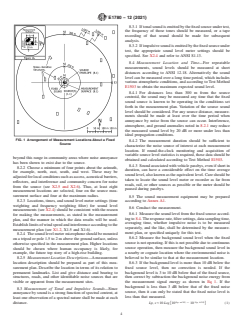
future. See Fig. 1. Sound level measurements should be made
5.2.2 Direction—A pocket compass should be used for site
on this source emission surface for reference in evaluating
layout work and a wind vane capable of measuring wind
sound level data obtained at greater distances.
direction in octants should be used for determination of wind
8.2.1 Use USGS or other satellite imagery topographic
direction.
maps or appropriate site plans as a graph layout medium.
5.2.3 Site Map—A scale map of the measurement site
Circumscribe circles outside and centered on the centroid of
environs should be available while preparing for measure-
the source envelope. The radius ranges selected should be
ments.Thefixedsourcepositionandallmeasurementlocations
divided into nominal logarithmic increments that result in
should be annotated on that map.
equal decibel level reductions with a minimum of two radii.
For example, the set of 30 m, 100 m, 300 m, and 1000 m will
5.3 Meteorological Observations:
produce level reductions of about 10 dB each over hard
5.3.1 Observeandrecordwindspeed,relativehumidity,and
ground, but any convenient values may be used. Over soft
temperature for potential effects on the sound level meter
ground, the decay of the first 30 m could be greater. It is
instruments, and these factors plus wind direction for potential
emphasized that at distances beyond 30 m and especially
effects on sound propagation from the fixed sound source to
beyond 300 m, the sound diminishment with distance will be
each measurement location. General accuracy meteorological
stronglyinfluencedbywind,temperaturegradients,andground
instruments should be available to measure:
conditions. In addition, the received level is modified by
5.3.1.1 Wind speed (5-km/h increments),
interference between the direct wave and the wave reflected
5.3.1.2 Wind direction,
from the ground. The maximum radius where measurements
5.3.1.3 Relative humidity (in 10% increments), and
will be significant is determined by a distance where back-
5.3.1.4 Dry bulb temperature (in 2°C increments).
ground sounds from other sources dominate over the sound
NOTE 3—NOAA weather reports may be used for wind, temperature, source of interest. Noise measurements may be conducted
E1780 − 12 (2021)
8.3.1 Iftonalsoundisemittedbythefixedsourceundertest,
the frequency of those tones should be measured, or a tape
recording of that sound should be made for subsequent
analysis.
8.3.2 Ifimpulsivesoundisemittedbythefixedsourceunder
test, the appropriate sound level meter settings should be
specified. See X2.4 and refer to ANSI S1.13.
8.4 Measurement Location and Time—For repeatable
measurements, sound levels should be measured at short
distances according to ANSI 12.18. Alternatively the sound
level can be measured over a long time period, which includes
various atmospheric conditions, and according to Test Method
E1503 to obtain the maximum expected sound level.
8.4.1 For distances less than 300 m from the source
centroid, the sound may be measured any time that the fixed
sound source is known to be operating in the conditions set
forth in the measurement plan. Variation of the source sound
level should be considered. For any source distance, measure-
ments should be made at least over the time period when
annoyance by noise from the source can occur. Interference,
atmosphere, and ground anomalies noted in 8.2.1 may reduce
the measured sound level by 20 dB or more under less than
ideal propagation conditions.
FIG. 1 Arrangement of Measurement Locations About a Fixed
8.4.2 The measurement duration should be sufficient to
Source
characterize the noise source of interest at each measurement
location. If round-the-clock monitoring and acquisition of
variable source level statistics is required, these data should be
beyond this range in community areas where noise annoyance
obtained and calculated according to Test Method E1503.
has been shown to exist due to the source.
8.4.3 Soundassociatedwithvehiclepassbys,evenifshortin
8.2.2 Choose a minimum of four points about the azimuth,
duration, can have a considerable effect on the time average
for example, north, east, south, and west. These may be
soundlevel,alsoknownastheequivalentlevel.Careshouldbe
adjustedforlocalconditionssuchasaccess,acousticalbarriers,
taken to locate the sound level meter or recorder as far from
reflectors, and interference and community concern for noise
roads, rail, or other sources as possible or the meter should be
from the source (see X2.5 and X2.6). Thus, at least eight
paused during passbys.
measurement locations are selected, four on the source mea-
surement surface and four at the maximum radius.
8.5 The sound measurement equipment may be prepared
8.2.3 Locations, times, and sound level meter settings (time
according to Annex A1.
weighting and frequency weighting filter) for sound level
8.6 Conduct the measurement.
measurements (see X2.4) should be consistent with the reason
8.6.1 Measurethesoundlevelfromthefixedsourceaccord-
for making the measurements, as stated in the measurement
ingto8.4.Theresponserate,filtersettings,datasamplingtime,
plan, and the manner in which the data results will be used.
averaging time, whether impulsive noise is to be measured
Establishlimitsofwindspeedandinterferenceaccordingtothe
separately, and the like, shall be determined by the measure-
measurement plan (see X1.2, X1.5 and X1.6).
ment plan, or specified uniquely for this test.
8.2.4 Thesoundlevelmetermicrophoneshouldbemounted
8.6.2 Measure the background sound level when the fixed
on a tripod or pole 1.5 to 2 m above the ground surface, unless
sourceisnotoperating.Ifthisisnotpossibleduetocontinuous
otherwise specified in the measurement plan. Higher locations
source operation, then measure the background sound level in
should be chosen where human occupancy is likely, for
a nearby or cognate location where the environmental noise is
example, the future top story of a high-rise building.
believed to be similar to that at the measurement location.
8.2.5 Measurement Location Descriptions—Ameasurement
location description should be prepared as part of this mea-
8.6.3 If the background level is more than 10 dB below the
surement plan. Describe the location in terms of its relation to fixed source level, then no correction is needed. If the
permanent landmarks. List and give distance and bearing to
background level is 3 to 10 dB below that of the fixed source,
structures, roads, and other identifiable noise sources that are then correct by subtraction the background noise energy from
visible or apparent from the measurement sites. the measurement signal energy as shown in Eq 1.Ifthe
background is less than 3 dB below that of the fixed noise
8.3 Measurement of Tonal and Impulsive Sounds—Since
source, then it can only be stated that the fixed noise level is
annoyance by sound is a strong function of spectral content, at
less than that measured.
leastoneobservationofaspectralnatureshallbemadeateach
~Lp, m/10! ~Lp, b/10!
distance. Lp, s'10 Log 10 210 (1)
@ #
E1780 − 12 (2021)
where: 9.2 This guide has no bias because the sound levels are
defined only in terms of this guide.
Lp,s = Sound Pressure Level in dB, fixed source
Lp,m = Sound Pressure Level in dB, measurement signal
9.3 Variability of Measurement Results:
Lp,b = Sound Pressure Level in dB, background noise
9.3.1 Atmospheric changes at or near the surface cause
NOTE 4—If it is necessary to evaluate the fixed noise source level even
whenlessthan3dBabovethebackground,itisrecommendedthataband
significant variations in the propagation of sound to locations
filterbeusedtoisolatetheprominentsourcenoisecomponentsfromother
100 m or more from the source. Critical variables are wind
environmental sounds. Alternatively, the broadband output audio may be
direction and vertical gradients of wind speed and of air
recorded over several minutes for subsequent spectral analysis.
temperature. The subsequent changes to the sound level will
8.7 Annex A2 provides guidance for keeping the measure-
increase with distance. At positions considerably greater than
ment log.
300 m from the source, the sound level received from the
8.8 AnnexA3providesguidanceforpreparingthemeasure-
source could change by as much as 20 dB or more from day to
ment agent.
night or from upwind versus downwind. Distant sound levels
are greater downwind and in the presence of a temperature
9. Precision and Bias
inversion (warmer air aloft).
9.1 The instrument precision of the data obtained using this
guide is a function of the acoustical instruments used. See
10. Keywords
ANSI S1.4. For steady noise, the precision for the measure-
10.1 community noise; fixed sound source; outdoor sound;
ment result of the set or subset will be 61 dB for a Type 1
meter and 62 dB for a Type 2 meter. sound measurement; sound survey
ANNEXES
(Mandatory Information)
A1. PREPARATION OF EQUIPMENT
A1.1 The following procedure has often been found to be outputs are being recorded electronically, it is recommended
helpful for producing reliable data in an expeditious fashion. thatatleastoneanalysischannelbeusedforA-weightedsound
level.
A1.1.1 Check the battery. The useful charge should be
A1.1.6 Set the averaging time and sample rate called for in
sufficient to complete the planned measurement.
the measurement plan. If applicable standards or regulations
A1.1.2 Calibrate the sound level meter in accordance with
require the use of slow response in collecting data, this
manufacturer’s instructions. See 5.3.2, X1.1, and X2.2. The
requirement should be followed.
calibration record for all measurements positions should be
A1.1.7 If a vehicle is used to shelter the operator or the test
used to standardize the data during subsequent data reduction
equipment,themicrophoneshouldbelocatedasfarawayfrom
and analysis. If manipulation of the calibration control
...