

ASTM E1289-08(2022)
(Specification)Standard Specification for Reference Specimen for Sound Transmission Loss
General Information
- Abstract
ABSTRACT
This specification describes the construction and installation of standard reference specimens for quality control of laboratory sound transmission loss measurements. The reference specimen is composed of framed steel panels. The required materials for fabrication and installation are as follows: galvanized sheets, frame, and panels. Four kinds of installation may be done: Installation A using a single layer reference specimen, Installation B using double layer reference specimen with a common plate, Installation C using double layer reference specimen with separate plates-empty cavity, and Installation D using double layer reference specimen with separate plates and added layer of sound-absorbing material in the cavity.
SCOPE
1.1 This specification describes the construction and installation of standard reference specimens for quality control of laboratory sound transmission loss measurements using Test Method E90.
1.2 Laboratories may choose to construct and test all of the reference specimens described here or only a subset. Specific specimens may be required by a test method or an accrediting agency.
1.3 The values stated in SI units are to be regarded as standard. The values given in parentheses are for information only.
1.4 This international standard was developed in accordance with internationally recognized principles on standardization established in the Decision on Principles for the Development of International Standards, Guides and Recommendations issued by the World Trade Organization Technical Barriers to Trade (TBT) Committee.
- Status
- Published
- Publication Date
- 31-Mar-2022
- Technical Committee
- E33 - Building and Environmental Acoustics
- Drafting Committee
- E33.03 - Sound Transmission
Overview
ASTM E1289-08(2022): Standard Specification for Reference Specimen for Sound Transmission Loss, established by ASTM International, provides a comprehensive framework for constructing and installing standardized reference specimens. These specimens are essential for the quality control of laboratory sound transmission loss measurements, primarily when testing building partitions and elements. The standard specifies materials, assembly procedures, and installation types to ensure consistent and reliable results when measuring airborne sound transmission loss using ASTM E90.
Key Topics
- Purpose: To support consistent, repeatable laboratory tests of sound transmission loss by defining the construction and installation of reference specimen panels.
- Specimen Composition: Reference specimens consist of galvanized steel sheets, steel frames, wood framing, and required fasteners.
- Material Specifications:
- Galvanized steel sheets: 1220 mm (4 ft) wide, approximately 0.63 mm thick, with a specified weight.
- Steel angles and frames, blind rivets, bolts, drywall screws, caulking, duct tape, and wood framing.
- Varieties of Installations:
- Installation A: Single layer steel panel construction.
- Installation B: Double layer, panels sharing a common plate.
- Installation C: Double layer, separate plates with an empty cavity.
- Installation D: Double layer, separate plates, with a cavity filled with sound-absorbing material like glass fibre batts.
- Measurement and Documentation: The physical properties of each component and the assembled specimen (including weighing and thickness measurements) must be recorded and kept for reference.
- Testing Guidance: Reference specimens are designed for airborn sound transmission loss tests according to ASTM E90 method, supporting data integrity and laboratory accreditation.
Applications
The ASTM E1289-08(2022) standard serves as a critical tool for:
- Laboratory Quality Control: Utilizing standard reference panels to verify and maintain the accuracy of airborne sound transmission loss testing equipment and procedures.
- Accreditation Compliance: Meeting the requirements of test methods or accrediting bodies which may demand specific reference specimens for validation and ongoing quality assurance.
- Research and Interlaboratory Comparisons: Providing a consistent basis for sound transmission studies and harmonizing data collection across multiple laboratories.
- Building Acoustics Testing: Assisting manufacturers, consultants, and testing facilities in evaluating partition elements' sound insulation characteristics through standardized reference specimens.
- Product Certification: Supporting the reliable measurement of sound transmission loss, crucial for demonstrating compliance of building materials and systems with acoustic performance standards.
Related Standards
For effective use of ASTM E1289-08(2022), familiarity with the following related standards is recommended:
- ASTM E90: Test Method for Laboratory Measurement of Airborne Sound Transmission Loss of Building Partitions and Elements - The principal test method referenced by ASTM E1289 for conducting sound transmission loss measurements.
- ASTM C634: Terminology Relating to Building and Environmental Acoustics - Provides definitions for terms used in acoustics standards and testing.
- International Standards: Developed in alignment with the World Trade Organization Technical Barriers to Trade (TBT) principles, ensuring global applicability and compatibility.
Keywords: sound transmission loss, reference specimen, ASTM E1289, laboratory acoustics testing, airborne sound insulation, quality control, building partition testing, standard panel construction, acoustic measurement, ASTM E90.
Relations
- Effective Date
- 01-Dec-2023
- Effective Date
- 01-Dec-2016
- Effective Date
- 01-Sep-2013
- Effective Date
- 01-Dec-2011
- Effective Date
- 01-Sep-2010
- Effective Date
- 01-Jun-2010
- Effective Date
- 01-Jul-2009
- Effective Date
- 01-Apr-2009
- Effective Date
- 01-Sep-2008
- Effective Date
- 15-Mar-2008
- Effective Date
- 01-Apr-2004
- Effective Date
- 10-May-2002
- Effective Date
- 10-Apr-2002
- Effective Date
- 10-Apr-2002
- Effective Date
- 10-Jun-2001
Get Certified
Connect with accredited certification bodies for this standard

BSMI (Bureau of Standards, Metrology and Inspection)
Taiwan's standards and inspection authority.
Sponsored listings
Frequently Asked Questions
ASTM E1289-08(2022) is a technical specification published by ASTM International. Its full title is "Standard Specification for Reference Specimen for Sound Transmission Loss". This standard covers: ABSTRACT This specification describes the construction and installation of standard reference specimens for quality control of laboratory sound transmission loss measurements. The reference specimen is composed of framed steel panels. The required materials for fabrication and installation are as follows: galvanized sheets, frame, and panels. Four kinds of installation may be done: Installation A using a single layer reference specimen, Installation B using double layer reference specimen with a common plate, Installation C using double layer reference specimen with separate plates-empty cavity, and Installation D using double layer reference specimen with separate plates and added layer of sound-absorbing material in the cavity. SCOPE 1.1 This specification describes the construction and installation of standard reference specimens for quality control of laboratory sound transmission loss measurements using Test Method E90. 1.2 Laboratories may choose to construct and test all of the reference specimens described here or only a subset. Specific specimens may be required by a test method or an accrediting agency. 1.3 The values stated in SI units are to be regarded as standard. The values given in parentheses are for information only. 1.4 This international standard was developed in accordance with internationally recognized principles on standardization established in the Decision on Principles for the Development of International Standards, Guides and Recommendations issued by the World Trade Organization Technical Barriers to Trade (TBT) Committee.
ABSTRACT This specification describes the construction and installation of standard reference specimens for quality control of laboratory sound transmission loss measurements. The reference specimen is composed of framed steel panels. The required materials for fabrication and installation are as follows: galvanized sheets, frame, and panels. Four kinds of installation may be done: Installation A using a single layer reference specimen, Installation B using double layer reference specimen with a common plate, Installation C using double layer reference specimen with separate plates-empty cavity, and Installation D using double layer reference specimen with separate plates and added layer of sound-absorbing material in the cavity. SCOPE 1.1 This specification describes the construction and installation of standard reference specimens for quality control of laboratory sound transmission loss measurements using Test Method E90. 1.2 Laboratories may choose to construct and test all of the reference specimens described here or only a subset. Specific specimens may be required by a test method or an accrediting agency. 1.3 The values stated in SI units are to be regarded as standard. The values given in parentheses are for information only. 1.4 This international standard was developed in accordance with internationally recognized principles on standardization established in the Decision on Principles for the Development of International Standards, Guides and Recommendations issued by the World Trade Organization Technical Barriers to Trade (TBT) Committee.
ASTM E1289-08(2022) is classified under the following ICS (International Classification for Standards) categories: 17.140.01 - Acoustic measurements and noise abatement in general. The ICS classification helps identify the subject area and facilitates finding related standards.
ASTM E1289-08(2022) has the following relationships with other standards: It is inter standard links to ASTM E90-23, ASTM E90-09(2016), ASTM C634-13, ASTM C634-11, ASTM C634-10a, ASTM C634-10, ASTM E90-09, ASTM C634-09, ASTM C634-08a, ASTM C634-08, ASTM E90-04, ASTM E90-02, ASTM C634-02, ASTM C634-02e1, ASTM C634-01. Understanding these relationships helps ensure you are using the most current and applicable version of the standard.
ASTM E1289-08(2022) is available in PDF format for immediate download after purchase. The document can be added to your cart and obtained through the secure checkout process. Digital delivery ensures instant access to the complete standard document.
Standards Content (Sample)
This international standard was developed in accordance with internationally recognized principles on standardization established in the Decision on Principles for the
Development of International Standards, Guides and Recommendations issued by the World Trade Organization Technical Barriers to Trade (TBT) Committee.
Designation:E1289 −08 (Reapproved 2022)
Standard Specification for
Reference Specimen for Sound Transmission Loss
This standard is issued under the fixed designation E1289; the number immediately following the designation indicates the year of
original adoption or, in the case of revision, the year of last revision. A number in parentheses indicates the year of last reapproval. A
superscript epsilon (´) indicates an editorial change since the last revision or reapproval.
1. Scope 4.1.1 The reference specimen is composed of framed steel
panels. The required materials for fabrication and installation
1.1 This specification describes the construction and instal-
are as follows:
lation of standard reference specimens for quality control of
Galvanized steel sheets—width, 1220 mm (4 ft); nominal thickness, 0.63 mm
laboratory sound transmission loss measurements using Test
(24 gauge). The weight of the sheets shall be 5.1 ± 0.7 kg/m (1.05 ± 0.15 lb/
Method E90.
ft ).
Steel right angles with 25-mm (1-in.) flanges—metal thickness, 3.2 mm ( ⁄8 in.).
1.2 Laboratories may choose to construct and test all of the
Blind rivets—diameter, 3.2 mm ( ⁄8 in. ).
reference specimens described here or only a subset. Specific
Duct tape, 50 mm (2 in.) wide.
specimens may be required by a test method or an accrediting Drywall screws, Type W—length, 32 mm (1.25 in.).
Bolts #10–24 —25 mm (1 in.) long with appropriate nuts and washers.
agency.
Fasteners, to hold wood frame to the perimeter of the test opening.
Non-hardening, caulking,
1.3 The values stated in SI units are to be regarded as
Nominal 2 by 4 in. wood framing, approximately 40 by 90 mm.
standard. The values given in parentheses are for information
NOTE 1—The quantity and length of each component needed depends
only.
on the size of the laboratory test opening.
1.4 This international standard was developed in accor-
NOTE 1—To simplify cleaning, the wood framing used to support the
dance with internationally recognized principles on standard-
steel panels may be painted.
ization established in the Decision on Principles for the
4.1.2 The weight of each component of the reference
Development of International Standards, Guides and Recom-
specimen and the assembled specimen shall be measured and
mendations issued by the World Trade Organization Technical
kept on record. In addition, the thickness of each of the steel
Barriers to Trade (TBT) Committee.
panels shall be measured in six locations. (See Appendix X1.)
2. Referenced Documents
4.2 Assembly:
2.1 ASTM Standards:
4.2.1 Galvanized Sheets—The length of each galvanized
C634 Terminology Relating to Building and Environmental
sheet shall be a few millimetres less than the height of the
Acoustics
laboratory test opening. The total width of all the sheets shall
E90 Test Method for Laboratory Measurement of Airborne
be a few millimetres less than the width of the laboratory test
Sound Transmission Loss of Building Partitions and
opening. This may require that one or more sheets be cut
Elements
lengthwise.The intent is that, when installed, the panels fill the
test opening completely.
3. Terminology
4.2.2 Frame—Cut steel right angles to size to form a frame
3.1 Definitions—For definitions of terms used in this
for each sheet; the frame shall have the same outside dimen-
specification, see Terminology C634.
sions as the sheets. Notch and weld the steel angles to form the
four corners of the frame as shown in Fig. 1. Alternatively,
4. Construction of Reference Specimen
miter the angles and weld similarly. Smooth corners after
4.1 General:
welding.
4.2.3 Panels—Construct a panel by riveting steel sheets to
1 the frames as follows:0
This specification is under the jurisdiction of ASTM Committee E33 on
Building and Environmental Acoustics and is the direct responsibility of Subcom-
4.2.3.1 Drill holes at 100 mm (4 in.) on-center around the
mittee E33.03 on Sound Transmission.
perimeterofthesheetsfortheinstallationoftheblindrivets.To
Current edition approved April 1, 2022. Published April 2022. Originally
ensure proper alignment of the sheets with the frame, it is
approved in 1989. Last previous edition approved in 2016 as E1289 – 08 (2016).
DOI: 10.1520/E1289-08R22.
recommended to drill a few holes and then install rivets to hold
For referenced ASTM standards, visit the ASTM website, www.astm.org, or
the sheet in place. Once this is done, the remaining holes may
contact ASTM Customer Service at service@astm.org. For Annual Book of ASTM
be drilled and the rivets installed. Position these holes to avoid
Standards volume information, refer to the standard’s Document Summary page on
the ASTM website. conflict with the clearance holes described in 4.2.3.2.
Copyright © ASTM International, 100 Barr Harbor Drive, PO Box C700, West Conshohocken, PA 19428-2959. United States
E1289−08 (2022)
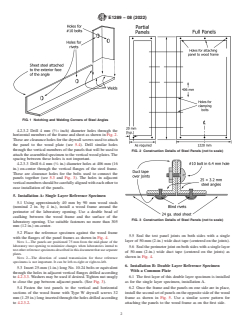
FIG. 1 Notching and Welding Corners of Steel Angles
4.2.3.2 Drill 4 mm ( ⁄32 inch) diameter holes through the
horizontal members of the frame and sheet as shown in Fig. 2.
These are clearance holes for the drywall screws used to attach
the panel to the wood plate (see 5.4). Drill similar holes
through the vertical members of the panels that will be used to
FIG. 2 Construction Details of Steel Panels (not to scale)
attach the assembled specimen to the vertical wood plates. The
spacing between these holes is not important.
4.2.3.3 Drill 6.4 mm ( ⁄4 in.) diameter holes at 406 mm (16
in.) on-center through the vertical flanges of the steel frame.
These are clearance holes for the bolts used to connect the
panels together (see 5.3 and Fig. 3). The holes in adjacent
verticalmembersshouldbecarefullyalignedwitheachotherto
ease installation of the panels.
5. Installation A: Single Layer Reference Specimen
5.1 Using approximately 40 mm by 90 mm wood studs
(nominal 2 in. by 4 in.), install a wood frame around the
perimeter of the laboratory opening. Use a double bead of
caulking between the wood frame and the surface of the
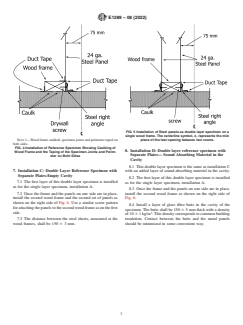
FIG. 3 Construction Details of Steel Panels (not to scale)
laboratory opening. Use suitable fasteners no more than 305
mm (12 in.) on-center.
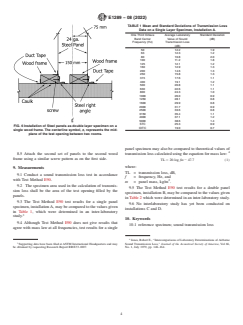
5.2 Place the reference specimen against the wood frame
5.5 Seal the test panel joints on both sides with a single
with the flanges of the panel frames as shown in Fig. 4.
layer of 50-mm (2-in.) wide duct tape (centered on the joints).
NOTE 1—The panels are positioned 75 mm from the mid-plane of the
laboratory test opening to minimize changes when laboratories intend to
5.6 Seal the perimeter joint on both sides with a single layer
testotherreferencespecimensdescribedinthisdocumentthatuseseparate
of 50-mm (2-in.) wide duct tape (centered on the joints) as
plates.
shown in Fig. 4.
NOTE 2—The direction of sound transmission for these reference
specimens is not important. It can be left-to-right or right-to-left.
6. Installation B: Double Layer Reference Specimen
5.3 Insert 25-mm (1-in.) l
...