

ASTM E1265-04(2021)
(Test Method)Standard Test Method for Measuring Insertion Loss of Pneumatic Exhaust Silencers
General Information
- Abstract
SIGNIFICANCE AND USE
5.1 This test method permits the evaluation of both the acoustical and mechanical performance of pneumatic exhaust silencers designed for quieting compressed gas exhausts (usually air). The data can be used by manufacturers to assess or improve their products, or by users to select or specify a silencer. The data acquired using this measurement method allow for performance comparisons of competitive products and aid in the selection of an appropriate device.
5.2 Flow rate is an important parameter to consider when the application involves machinery or equipment that requires compressed air or other gases to be exhausted rapidly. For example, in an automatic pneumatic press, compressed air must be exhausted rapidly to avoid a premature second cycle. For this reason, flow ratio is reported in addition to acoustical performance.
SCOPE
1.1 This test method covers the laboratory measurement of both the acoustical and mechanical performance of pneumatic exhaust silencers designed for quieting compressed gas (usually air) exhausts from orifices connected to pipe sizes up to 3/4 in. NPT. This test method is not applicable for exhausts performing useful work, such as part conveying, ejection, or cleaning. This test method evaluates acoustical performance using A-weighted sound level measurements.
1.2 The values stated in inch-pound units are to be regarded as standard. The values given in parentheses are mathematical conversions to SI units that are provided for information only and are not considered standard.
1.3 This standard does not purport to address all of the safety concerns, if any, associated with its use. It is the responsibility of the user of this standard to establish appropriate safety, health, and environmental practices and determine the applicability of regulatory limitations prior to use. Specific precautionary statements are given in Section 8.
1.4 This international standard was developed in accordance with internationally recognized principles on standardization established in the Decision on Principles for the Development of International Standards, Guides and Recommendations issued by the World Trade Organization Technical Barriers to Trade (TBT) Committee.
- Status
- Published
- Publication Date
- 31-Dec-2020
- Technical Committee
- E33 - Building and Environmental Acoustics
- Drafting Committee
- E33.08 - Mechanical and Electrical System Noise
Overview
ASTM E1265-04(2021), Standard Test Method for Measuring Insertion Loss of Pneumatic Exhaust Silencers, is developed by ASTM International to support accurate laboratory measurement of the acoustical and mechanical performance of pneumatic exhaust silencers. These devices are designed for noise reduction in compressed gas (primarily air) exhausts, connected to pipe sizes up to 3/4 in. NPT. This standard enables both manufacturers and users to assess, specify, or compare silencer products, focusing on the core metric of insertion loss- the difference in A-weighted sound levels measured with and without a silencer installed.
Key Topics
- Insertion Loss Measurement: Central to the standard, insertion loss is determined by comparing sound levels before and after installing a silencer on an exhaust pipe under controlled laboratory conditions.
- Flow Ratio Consideration: The standard requires reporting the flow ratio-the gas flow with the silencer installed relative to an unrestricted pipe-since rapid exhaust capability is vital in many pneumatic applications.
- Test Apparatus and Procedures: ASTM E1265 specifies the use of a reverberation room, appropriate piping systems, and “Type 1 Precision” sound level meters for accurate measurement. Special care is taken to minimize extraneous noise, turbulence, and flow restriction.
- Result Reporting: Performance data is tabulated and can be graphically presented with insertion loss plotted against flow ratio at multiple standard supply pressures.
- Safety Guidelines: The document underscores the importance of adhering to safety, health, and environmental requirements when working with compressed gases.
Applications
ASTM E1265-04(2021) finds practical application in the following areas:
- Silencer Selection and Specification: Provides users-such as maintenance engineers, plant managers, and purchasing agents-quantitative data to select the optimal pneumatic exhaust silencer for their equipment.
- Product Development and Quality Control: Enables manufacturers to benchmark their silencer designs, support quality assurance, and demonstrate product benefits relative to competitors.
- Facility Noise Control Compliance: Assists EHS specialists in ensuring industrial facilities meet noise exposure limits by allowing objective comparison of silencers' noise-reduction capabilities.
- Equipment Requiring Rapid Gas Exhaust: Especially relevant where fast air evacuation is necessary-such as in automatic pneumatic presses-since both acoustic performance and flow capacity are critical.
- Laboratory Performance Benchmarking: Ensures standardized, reproducible results that can be referenced across different testing sites and over time.
Related Standards
For comprehensive assessment of pneumatic silencers or compliant setup of testing facilities, the following standards are often referenced in conjunction with ASTM E1265:
- ASTM C634: Terminology Relating to Building and Environmental Acoustics
- ANSI S1.4: Specification for Sound Level Meters
- ANSI S1.13: Method for the Measurement of Sound Pressure Levels
- ANSI S1.33: Engineering Methods for the Determination of Sound Power Levels in Reverberation Rooms
- ANSI B2.1: Standard for Taper Pipe Threads (NPT)
- Federal OSHA Regulations: Rules for safe use of compressed air in workplace environments
Summary
ASTM E1265-04(2021) is the definitive standard test method for measuring insertion loss of pneumatic exhaust silencers, enabling informed decision-making in silencer selection and validation of acoustical performance in compressed air systems. By standardizing the process, it supports compliance, product improvement, and effective workplace noise control.
Relations
- Effective Date
- 01-Sep-2013
- Effective Date
- 01-Dec-2011
- Effective Date
- 01-Sep-2010
- Effective Date
- 01-Jun-2010
- Effective Date
- 01-Apr-2009
- Effective Date
- 01-Sep-2008
- Effective Date
- 15-Mar-2008
- Effective Date
- 10-Apr-2002
- Effective Date
- 10-Apr-2002
- Effective Date
- 10-Jun-2001
- Effective Date
- 10-Jun-2001
Get Certified
Connect with accredited certification bodies for this standard

BSMI (Bureau of Standards, Metrology and Inspection)
Taiwan's standards and inspection authority.
Sponsored listings
Frequently Asked Questions
ASTM E1265-04(2021) is a standard published by ASTM International. Its full title is "Standard Test Method for Measuring Insertion Loss of Pneumatic Exhaust Silencers". This standard covers: SIGNIFICANCE AND USE 5.1 This test method permits the evaluation of both the acoustical and mechanical performance of pneumatic exhaust silencers designed for quieting compressed gas exhausts (usually air). The data can be used by manufacturers to assess or improve their products, or by users to select or specify a silencer. The data acquired using this measurement method allow for performance comparisons of competitive products and aid in the selection of an appropriate device. 5.2 Flow rate is an important parameter to consider when the application involves machinery or equipment that requires compressed air or other gases to be exhausted rapidly. For example, in an automatic pneumatic press, compressed air must be exhausted rapidly to avoid a premature second cycle. For this reason, flow ratio is reported in addition to acoustical performance. SCOPE 1.1 This test method covers the laboratory measurement of both the acoustical and mechanical performance of pneumatic exhaust silencers designed for quieting compressed gas (usually air) exhausts from orifices connected to pipe sizes up to 3/4 in. NPT. This test method is not applicable for exhausts performing useful work, such as part conveying, ejection, or cleaning. This test method evaluates acoustical performance using A-weighted sound level measurements. 1.2 The values stated in inch-pound units are to be regarded as standard. The values given in parentheses are mathematical conversions to SI units that are provided for information only and are not considered standard. 1.3 This standard does not purport to address all of the safety concerns, if any, associated with its use. It is the responsibility of the user of this standard to establish appropriate safety, health, and environmental practices and determine the applicability of regulatory limitations prior to use. Specific precautionary statements are given in Section 8. 1.4 This international standard was developed in accordance with internationally recognized principles on standardization established in the Decision on Principles for the Development of International Standards, Guides and Recommendations issued by the World Trade Organization Technical Barriers to Trade (TBT) Committee.
SIGNIFICANCE AND USE 5.1 This test method permits the evaluation of both the acoustical and mechanical performance of pneumatic exhaust silencers designed for quieting compressed gas exhausts (usually air). The data can be used by manufacturers to assess or improve their products, or by users to select or specify a silencer. The data acquired using this measurement method allow for performance comparisons of competitive products and aid in the selection of an appropriate device. 5.2 Flow rate is an important parameter to consider when the application involves machinery or equipment that requires compressed air or other gases to be exhausted rapidly. For example, in an automatic pneumatic press, compressed air must be exhausted rapidly to avoid a premature second cycle. For this reason, flow ratio is reported in addition to acoustical performance. SCOPE 1.1 This test method covers the laboratory measurement of both the acoustical and mechanical performance of pneumatic exhaust silencers designed for quieting compressed gas (usually air) exhausts from orifices connected to pipe sizes up to 3/4 in. NPT. This test method is not applicable for exhausts performing useful work, such as part conveying, ejection, or cleaning. This test method evaluates acoustical performance using A-weighted sound level measurements. 1.2 The values stated in inch-pound units are to be regarded as standard. The values given in parentheses are mathematical conversions to SI units that are provided for information only and are not considered standard. 1.3 This standard does not purport to address all of the safety concerns, if any, associated with its use. It is the responsibility of the user of this standard to establish appropriate safety, health, and environmental practices and determine the applicability of regulatory limitations prior to use. Specific precautionary statements are given in Section 8. 1.4 This international standard was developed in accordance with internationally recognized principles on standardization established in the Decision on Principles for the Development of International Standards, Guides and Recommendations issued by the World Trade Organization Technical Barriers to Trade (TBT) Committee.
ASTM E1265-04(2021) is classified under the following ICS (International Classification for Standards) categories: 17.140.01 - Acoustic measurements and noise abatement in general. The ICS classification helps identify the subject area and facilitates finding related standards.
ASTM E1265-04(2021) has the following relationships with other standards: It is inter standard links to ASTM C634-13, ASTM C634-11, ASTM C634-10a, ASTM C634-10, ASTM C634-09, ASTM C634-08a, ASTM C634-08, ASTM C634-02, ASTM C634-02e1, ASTM C634-01, ASTM C634-00. Understanding these relationships helps ensure you are using the most current and applicable version of the standard.
ASTM E1265-04(2021) is available in PDF format for immediate download after purchase. The document can be added to your cart and obtained through the secure checkout process. Digital delivery ensures instant access to the complete standard document.
Standards Content (Sample)
This international standard was developed in accordance with internationally recognized principles on standardization established in the Decision on Principles for the
Development of International Standards, Guides and Recommendations issued by the World Trade Organization Technical Barriers to Trade (TBT) Committee.
Designation: E1265 − 04 (Reapproved 2021)
Standard Test Method for
Measuring Insertion Loss of Pneumatic Exhaust Silencers
This standard is issued under the fixed designation E1265; the number immediately following the designation indicates the year of
original adoption or, in the case of revision, the year of last revision. A number in parentheses indicates the year of last reapproval. A
superscript epsilon (´) indicates an editorial change since the last revision or reapproval.
1. Scope S1.13 Method for the Measurement of Sound Pressure
Levels
1.1 This test method covers the laboratory measurement of
S1.31 Precision Method for the Determination of Sound
both the acoustical and mechanical performance of pneumatic
PowerLevelsofBroad-BandNoiseSourcesinReverbera-
exhaust silencers designed for quieting compressed gas (usu-
tion Rooms
ally air) exhausts from orifices connected to pipe sizes up to ⁄4
S1.33 Engineering Methods for the Determination of Sound
in. NPT. This test method is not applicable for exhausts
Power Levels of Noise Sources in a Special Reverberation
performing useful work, such as part conveying, ejection, or
Room
cleaning. This test method evaluates acoustical performance
B2.1 Taper Pipe Thread (NPT)—Standard Designation for
using A-weighted sound level measurements.
Tapered Pipe Threads
1.2 The values stated in inch-pound units are to be regarded
2.3 Federal Standard:
as standard. The values given in parentheses are mathematical
RulesandRegulations—HandandPortablePowerToolsand
conversions to SI units that are provided for information only 4
Equipment
and are not considered standard.
3. Terminology
1.3 This standard does not purport to address all of the
safety concerns, if any, associated with its use. It is the
3.1 Definitions—For definitions of terms used in this test
responsibility of the user of this standard to establish appro-
method, see Terminology C634. Particular terms of interest
priate safety, health, and environmental practices and deter-
are: sound level and average sound pressure level.
mine the applicability of regulatory limitations prior to use.
3.2 Definitions of Terms Specific to This Standard:
Specific precautionary statements are given in Section 8.
3.2.1 flow ratio—the ratio of gas flow with the pneumatic
1.4 This international standard was developed in accor-
exhaust silencer installed relative to flow of the unrestricted
dance with internationally recognized principles on standard-
pipe.
ization established in the Decision on Principles for the
3.2.2 flow resistance—the reduction of fluid flow caused by
Development of International Standards, Guides and Recom-
various restrictions, surface roughness, devious paths,
mendations issued by the World Trade Organization Technical
obstacles, etc. This term is sometimes referred to as “back
Barriers to Trade (TBT) Committee.
pressure.”
2. Referenced Documents 3.2.3 Discussion—For this test method back pressure is a
2 qualitative term, therefore, there is no need to measure.
2.1 ASTM Standards:
3.2.4 insertion loss of a pneumatic exhaust silencer (at a
C634 Terminology Relating to Building and Environmental
specific supply pressure)—the difference in average
Acoustics
A-weighted sound levels measured with and without the
2.2 ANSI Standards:
pneumatic exhaust silencer installed on an unrestricted or
S1.4 Specification for Sound Level Meters
“open” pipe.
3.2.5 Discussion —Insertion loss, as defined in this test
ThistestmethodisunderthejurisdictionofASTMCommitteeE33onBuilding
method, differs from the definition in Terminology C634.As
and Environmental Acoustics and is the direct responsibility of Subcommittee
E33.08 on Mechanical and Electrical System Noise.
stated in 1.1, this test method uses A-weighting rather than
Current edition approved Jan. 1, 2021. Published February 2021. Originally
discrete frequency bands. It compares a set of sound pressure
approved in 1988. Last previous edition approved in 2013 as E1265 – 04 (2013).
data measured in a reverberation room rather than determining
DOI: 10.1520/E1265-04R21.
For referenced ASTM standards, visit the ASTM website, www.astm.org, or
contact ASTM Customer Service at service@astm.org. For Annual Book of ASTM
Standards volume information, refer to the standard’s Document Summary page on This United States Occupational Safety and HealthAdministration Regulation,
the ASTM website. Federal Register, Vol 36, Number 105, Part II, p. 10653, May 1971, is available
Available from American National Standards Institute (ANSI), 25 W. 43rd St., from Superintendent of Documents, Government Printing Office, Washington, DC
4th Floor, New York, NY 10036, http://www.ansi.org. 20402–9371.
Copyright © ASTM International, 100 Barr Harbor Drive, PO Box C700, West Conshohocken, PA 19428-2959. United States
E1265 − 04 (2021)
absolute sound power levels. This test method is intended to 10 000 Hz. This frequency range allows testing in a relatively
assess the difference in sound regenerated at the pipe orifice small reveberation room.ANSI Standard S 1.33 (AppendixA),
and does not evaluate sound propagating along the pipe provides guidelines for the design of an appropriate test room.
interior.
NOTE 1—Reverberation rooms as small as 17 m are sufficient for
3.2.6 pneumatic exhaust silencer—a device attached to a
making A-weighted measurements of noise generated by pneumatic
pipe fitting or orifice. The silencer reduces the sound produced
exhaust silencers. The minimum volume of 70 m recommended inANSI
S1.33 can be ignored.
when the released pressurized exhaust gases (usually air),
merge with ambient (static) air in the region surrounding the
6.3 The performance of pneumatic exhaust silencers tends
orifice. Such silencers are not usually intended to perform
to deteriorate over time, due to clogging and other factors. The
useful work such as part conveying, ejection, or cleaning. The
primary purpose of this test method is to evaluate the optimum
port sizes of the pneumatic exhaust silencers addressed by this
performance of pneumatic exhaust silencers, therefore only
1 1 3 1 5 3
test method are: ⁄8, ⁄4, ⁄8, ⁄2, ⁄8, and ⁄4 in. NPT (based on the
neworunusedsilencersshouldbetested.Thistestmethodmay
American National Standard Taper Pipe Thread designation,
alsobeusedtomeasuretheperformanceofasilencerduringits
(B.2.1), specified in fractions of an inch).
actual or simulated service life.
4. Summary of Test Method
7. Apparatus
4.1 Aspecial air reservoir system terminates in a reverbera-
7.1 Reverberation Room:
tion room where acoustical measurements are made to assess
7.1.1 The reverberation room shall conform to the require-
the sound produced by both an open pipe and the pipe
ments in ANSI S1.33, except for the minimum volume. (See
terminated with a silencer. Both flow volume and A-weighted
Note 1.)
sound level measurements are made as the air supply valve is
7.1.2 The reverberation room shall be equipped with a
opened between the reservoir and the piping system. The test
duct-type muffler or silencer to control static air pressure while
procedureisrepeatedforthreeairreservoirpressuresbothwith
simultaneously reducing extraneous sound entering the test
and without silencer. The flow ratios are calculated from the
room from adjacent areas.
flow volumes with an unrestricted pipe and with the silencer.
7.1.2.1 This duct-type muffler shall have an adequate“ free”
The insertion loss is determined by the difference in
cross-sectional area to allow the air introduced by the test
A-weighted sound levels. This is done for each of the three air
process to be vented rapidly, relieving the pressure within the
reservoir pressures. The overall pneumatic exhaust silencer
testroom.Thestaticpressureinthereverberationroomshallbe
performanceisthenreportedasinsertionlossversusflowratio.
measured initially while testing the largest open pipe to
determine if the free cross-sectional area is adequate to allow
5. Significance and Use
air to escape. If the gage pressure rises to more than 4 kPa,
5.1 This test method permits the evaluation of both the
then the cross-sectional area of the duct or the room volume
acoustical and mechanical performance of pneumatic exhaust
must be increased.
silencers designed for quieting compressed gas exhausts (usu-
7.1.2.2 The construction of the duct-type muffler and the
ally air). The data can be used by manufacturers to assess or
reverberation room shall be adequate to ensure that the
improve their products, or by users to select or specify a
background sound level within the test room is at least 10dB
silencer. The data acquired using this measurement method
below the lowest sound level measured during the evaluation.
allow for performance comparisons of competitive products
The muffler shall also be so selected as to avoid “self-
and aid in the selection of an appropriate device.
generated” sound.
5.2 Flow rate is an important parameter to consider when
7.2 Piping System:
the application involves machinery or equipment that requires
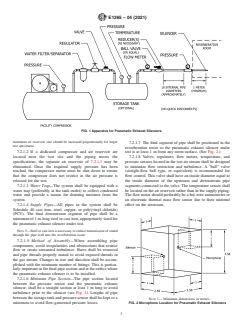
7.2.1 The test apparatus shall consist of a system similar to
compressed air or other gases to be exhausted rapidly. For
that shown in Fig. 1. The critical elements are the compressor-
example, in an automatic pneumatic press, compressed air
tank capacity, size of supply pipes and method of assembly,
must be exhausted rapidly to avoid a premature second cycle.
lengths of certain pipe sections, and design of devices in the air
For this reason, flow ratio is reported in addition to acoustical
stream (that is, valves, regulators, flow meters, temperature,
performance.
and pressure sensors).
7.2.1.1 Reservoir Capacity—The minimum air reservoir
6. Assumptions
size is determined by the maximum unrestricted pipe diameter
6.1 Studies have shown that the sound level (in decibels)
planned for the test. Use a reservoir whose size is adequate to
produced by quieted pneumatic exhausts generally is linear
permit obtaining three contiguous 1 s average sound levels
with supply pressure for the range of pressures covered in this
within 2 dB of each other (see 9.3.3.2).
test method. It is assumed that the air supply pressures called
NOTE 2—Based on experience, the minimum storage tank capacity for
for in this test method include those typical of most applica-
3 3
testing ⁄8 in. NPT devices is approximately 2.8 ft (0.08 m ). The
tions. Sound levels may be extrapolated for silencers operating
atpressuresslightlybeyondthetestrange.Alinearrelationship
can be assumed between discrete test supply pressures.
The Magnehelic gage, available from F.W. Dwyer Co., P. O. Box 3029, 1123
6.2 Generally, the sound power produced by pneumatic
Mearns Rd., Ivyland, PA 18974, or equivalent, has been found satisfactory for this
exhausts is dominant in the frequency range from 500 to measurement.
E1265 − 04 (2021)
FIG. 1 Apparatus for Pneumatic Exhaust Silencers
minimum air reservoir size should be increased proportionally for larger
7.2.1.7 The final segment of pipe shall be positioned in the
test specimens.
reverberation room so the pneumatic exhaust silencer under
7.2.1.2 If a dedicated compressor and air reservoir are test is at least 1 m from any room surface. (See Fig. 2.)
located near the test site and the piping meets the 7.2.1.8 Valves, regulators, flow meters, temperature, and
specifications, the separate air reservoir of 7.2.1.1 may be pressure sensors located in the test air stream shall be designed
eliminated. Once the required supply pressure has been to minimize flow restriction and turbulence. A “ball” valve
reached, the compressor motor must be shut down to ensure (straight-flow ball type, or equivalent) is recommended for
that the compressor does not restrict as the air pressure is flow control. This valve shall have an inside diameter equal to
released for the test. the inside diameter of the upstream and downstream pipe
...