

ASTM C1157/C1157M-23
(Specification)Standard Performance Specification for Hydraulic Cement
General Information
- Abstract
SCOPE
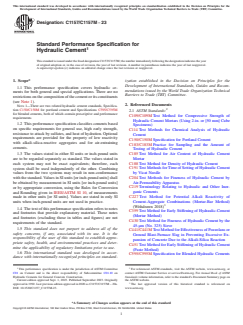
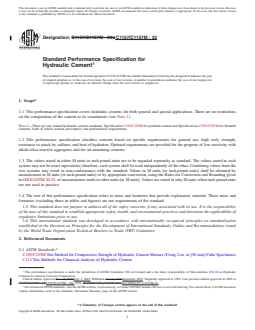
1.1 This performance specification covers hydraulic cements for both general and special applications. There are no restrictions on the composition of the cement or its constituents (see Note 1).
Note 1: There are two related hydraulic cement standards, Specification C150/C150M for portland cement and Specifications C595/C595M for blended cements, both of which contain prescriptive and performance requirements
1.2 This performance specification classifies cements based on specific requirements for general use, high early strength, resistance to attack by sulfates, and heat of hydration. Optional requirements are provided for the property of low reactivity with alkali-silica-reactive aggregates and for air-entraining cements.
1.3 The values stated in either SI units or inch-pound units are to be regarded separately as standard. The values stated in each system may not be exact equivalents; therefore, each system shall be used independently of the other. Combining values from the two systems may result in non-conformance with the standard. Values in SI units [or inch-pound units] shall be obtained by measurement in SI units [or inch-pound units] or by appropriate conversion, using the Rules for Conversion and Rounding given in IEEE/ASTM SI 10, of measurements made in other units [or SI units]. Values are stated in only SI units when inch-pound units are not used in practice.
1.4 The text of this performance specification refers to notes and footnotes that provide explanatory material. These notes and footnotes (excluding those in tables and figures) are not requirements of the standard.
1.5 This standard does not purport to address all of the safety concerns, if any, associated with its use. It is the responsibility of the user of this standard to establish appropriate safety, health, and environmental practices and determine the applicability of regulatory limitations prior to use.
1.6 This international standard was developed in accordance with internationally recognized principles on standardization established in the Decision on Principles for the Development of International Standards, Guides and Recommendations issued by the World Trade Organization Technical Barriers to Trade (TBT) Committee.
- Status
- Published
- Publication Date
- 31-Aug-2023
- Technical Committee
- C01 - Cement
- Drafting Committee
- C01.10 - Hydraulic Cements for General Concrete Construction
Overview
ASTM C1157/C1157M-23, the Standard Performance Specification for Hydraulic Cement, is an internationally recognized standard developed by ASTM International. This performance-based specification applies to hydraulic cements intended for both general and specialized concrete applications. Unlike standards with prescriptive composition requirements, ASTM C1157/C1157M-23 sets out performance criteria and classifies cements by properties such as strength development, sulfate resistance, and heat of hydration. The standard promotes flexibility in cement manufacturing while ensuring uniform quality, reliability, and safety for end use in varied construction environments.
Key Topics
- Performance-Based Classification: Cements are classified by desired outcomes-such as general use, high early strength, moderate or high sulfate resistance, and heat of hydration-rather than by specific compositional formulas.
- Optional Performance Features: The standard includes additional optional requirements:
- Air-entraining properties for freeze-thaw durability
- Low reactivity with alkali-silica-reactive aggregates for enhanced durability in certain environments
- Global Applicability: Values are provided in both SI and inch-pound units, though conversions must be handled carefully to ensure compliance.
- Reference to Related Standards: ASTM C1157/C1157M-23 operates alongside other recognized standards, such as ASTM C150/C150M for portland cement and ASTM C595/C595M for blended cements.
- Testing and Inspection: References to specific ASTM test methods for key properties-e.g., compressive strength, air content, setting time, and expansion-ensure reliable cement evaluation.
Applications
ASTM C1157/C1157M-23 is valuable for a wide range of stakeholders in the cement and construction industries:
- Cement Manufacturers: Provides broad flexibility in sourcing and formulating cements to meet diverse market demands while ensuring performance and uniformity.
- Specifiers and Engineers: Enables selection of cement types with tailored properties for:
- General construction (Type GU)
- High early strength for fast-track projects (Type HE)
- Sulfate resistance (Types MS and HS) for use in soils or waters with elevated sulfate content
- Control of heat of hydration (Types MH and LH) for mass concrete or hot weather applications
- Durability solutions requiring air-entraining or alkali-silica reactivity resistance
- Quality Control Laboratories: Relies on widely accepted ASTM test methods for validation, supporting consistency in manufacturing and supply.
- Construction Project Owners and Contractors: Ensures materials will deliver reliable strength, durability, and safety across a spectrum of construction scenarios, from infrastructure to hydraulic works.
Related Standards
ASTM C1157/C1157M-23 references and aligns with several other important standards within the cement and concrete industry:
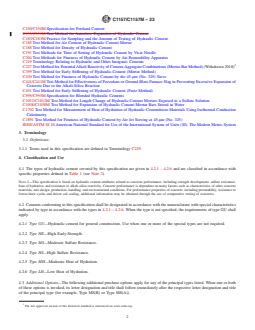
- ASTM C150/C150M - Specification for Portland Cement
- ASTM C595/C595M - Specification for Blended Hydraulic Cements
- ASTM C109/C109M - Compressive Strength of Hydraulic Cement Mortars
- ASTM C185 - Test Method for Air Content of Hydraulic Cement Mortar
- ASTM C191 - Test Methods for Time of Setting of Hydraulic Cement by Vicat Needle
- IEEE/ASTM SI 10 - Use of the International System of Units (SI)
Practical Value
ASTM C1157/C1157M-23 offers a robust, flexible approach to hydraulic cement performance, supporting innovative formulation while maintaining essential quality benchmarks. By focusing on performance outcomes-such as compressive strength, durability, and resistance to environmental factors-this standard helps ensure reliable concrete performance in a variety of construction projects, promoting both safety and cost-efficiency in the built environment.
Relations
- Effective Date
- 01-Apr-2024
- Effective Date
- 01-Apr-2024
- Effective Date
- 01-Apr-2024
- Refers
ASTM C204-24 - Standard Test Methods for Fineness of Hydraulic Cement by Air-Permeability Apparatus - Effective Date
- 01-Jan-2024
- Effective Date
- 15-Dec-2023
- Effective Date
- 01-Oct-2023
- Effective Date
- 01-Aug-2020
- Effective Date
- 01-Apr-2020
- Effective Date
- 01-Apr-2020
- Effective Date
- 15-Jan-2020
- Effective Date
- 15-Dec-2019
- Effective Date
- 01-Dec-2019
- Effective Date
- 15-Nov-2019
- Effective Date
- 15-Jun-2019
- Effective Date
- 15-Jun-2019
Get Certified
Connect with accredited certification bodies for this standard

DIBt (Deutsches Institut für Bautechnik)
German Institute for Building Technology.
DIN CERTCO
DIN Group product certification.

Aboma Certification B.V.
Specialized in construction, metal, and transport sectors.
Sponsored listings
Frequently Asked Questions
ASTM C1157/C1157M-23 is a technical specification published by ASTM International. Its full title is "Standard Performance Specification for Hydraulic Cement". This standard covers: SCOPE 1.1 This performance specification covers hydraulic cements for both general and special applications. There are no restrictions on the composition of the cement or its constituents (see Note 1). Note 1: There are two related hydraulic cement standards, Specification C150/C150M for portland cement and Specifications C595/C595M for blended cements, both of which contain prescriptive and performance requirements 1.2 This performance specification classifies cements based on specific requirements for general use, high early strength, resistance to attack by sulfates, and heat of hydration. Optional requirements are provided for the property of low reactivity with alkali-silica-reactive aggregates and for air-entraining cements. 1.3 The values stated in either SI units or inch-pound units are to be regarded separately as standard. The values stated in each system may not be exact equivalents; therefore, each system shall be used independently of the other. Combining values from the two systems may result in non-conformance with the standard. Values in SI units [or inch-pound units] shall be obtained by measurement in SI units [or inch-pound units] or by appropriate conversion, using the Rules for Conversion and Rounding given in IEEE/ASTM SI 10, of measurements made in other units [or SI units]. Values are stated in only SI units when inch-pound units are not used in practice. 1.4 The text of this performance specification refers to notes and footnotes that provide explanatory material. These notes and footnotes (excluding those in tables and figures) are not requirements of the standard. 1.5 This standard does not purport to address all of the safety concerns, if any, associated with its use. It is the responsibility of the user of this standard to establish appropriate safety, health, and environmental practices and determine the applicability of regulatory limitations prior to use. 1.6 This international standard was developed in accordance with internationally recognized principles on standardization established in the Decision on Principles for the Development of International Standards, Guides and Recommendations issued by the World Trade Organization Technical Barriers to Trade (TBT) Committee.
SCOPE 1.1 This performance specification covers hydraulic cements for both general and special applications. There are no restrictions on the composition of the cement or its constituents (see Note 1). Note 1: There are two related hydraulic cement standards, Specification C150/C150M for portland cement and Specifications C595/C595M for blended cements, both of which contain prescriptive and performance requirements 1.2 This performance specification classifies cements based on specific requirements for general use, high early strength, resistance to attack by sulfates, and heat of hydration. Optional requirements are provided for the property of low reactivity with alkali-silica-reactive aggregates and for air-entraining cements. 1.3 The values stated in either SI units or inch-pound units are to be regarded separately as standard. The values stated in each system may not be exact equivalents; therefore, each system shall be used independently of the other. Combining values from the two systems may result in non-conformance with the standard. Values in SI units [or inch-pound units] shall be obtained by measurement in SI units [or inch-pound units] or by appropriate conversion, using the Rules for Conversion and Rounding given in IEEE/ASTM SI 10, of measurements made in other units [or SI units]. Values are stated in only SI units when inch-pound units are not used in practice. 1.4 The text of this performance specification refers to notes and footnotes that provide explanatory material. These notes and footnotes (excluding those in tables and figures) are not requirements of the standard. 1.5 This standard does not purport to address all of the safety concerns, if any, associated with its use. It is the responsibility of the user of this standard to establish appropriate safety, health, and environmental practices and determine the applicability of regulatory limitations prior to use. 1.6 This international standard was developed in accordance with internationally recognized principles on standardization established in the Decision on Principles for the Development of International Standards, Guides and Recommendations issued by the World Trade Organization Technical Barriers to Trade (TBT) Committee.
ASTM C1157/C1157M-23 is classified under the following ICS (International Classification for Standards) categories: 91.100.10 - Cement. Gypsum. Lime. Mortar. The ICS classification helps identify the subject area and facilitates finding related standards.
ASTM C1157/C1157M-23 has the following relationships with other standards: It is inter standard links to ASTM C1038/C1038M-24, ASTM C219-24, ASTM C1012/C1012M-24, ASTM C204-24, ASTM C109/C109M-23, ASTM C114-23, ASTM C219-20a, ASTM C219-20, ASTM C185-20, ASTM C1891-20, ASTM C1038/C1038M-19, ASTM C185-19, ASTM C219-19a, ASTM C1891-19e1, ASTM C1891-19. Understanding these relationships helps ensure you are using the most current and applicable version of the standard.
ASTM C1157/C1157M-23 is available in PDF format for immediate download after purchase. The document can be added to your cart and obtained through the secure checkout process. Digital delivery ensures instant access to the complete standard document.
Standards Content (Sample)
This international standard was developed in accordance with internationally recognized principles on standardization established in the Decision on Principles for the
Development of International Standards, Guides and Recommendations issued by the World Trade Organization Technical Barriers to Trade (TBT) Committee.
Designation: C1157/C1157M − 23
Standard Performance Specification for
Hydraulic Cement
This standard is issued under the fixed designation C1157/C1157M; the number immediately following the designation indicates the year
of original adoption or, in the case of revision, the year of last revision. A number in parentheses indicates the year of last reapproval.
A superscript epsilon (´) indicates an editorial change since the last revision or reapproval.
1. Scope* ization established in the Decision on Principles for the
Development of International Standards, Guides and Recom-
1.1 This performance specification covers hydraulic ce-
mendations issued by the World Trade Organization Technical
ments for both general and special applications. There are no
Barriers to Trade (TBT) Committee.
restrictions on the composition of the cement or its constituents
(see Note 1).
2. Referenced Documents
NOTE 1—There are two related hydraulic cement standards, Specifica-
tion C150/C150M for portland cement and Specifications C595/C595M
2.1 ASTM Standards:
for blended cements, both of which contain prescriptive and performance
C109/C109M Test Method for Compressive Strength of
requirements
Hydraulic Cement Mortars (Using 2-in. or [50 mm] Cube
1.2 This performance specification classifies cements based
Specimens)
on specific requirements for general use, high early strength,
C114 Test Methods for Chemical Analysis of Hydraulic
resistance to attack by sulfates, and heat of hydration. Optional
Cement
requirements are provided for the property of low reactivity
C150/C150M Specification for Portland Cement
with alkali-silica-reactive aggregates and for air-entraining
C183/C183M Practice for Sampling and the Amount of
cements.
Testing of Hydraulic Cement
1.3 The values stated in either SI units or inch-pound units C185 Test Method for Air Content of Hydraulic Cement
Mortar
are to be regarded separately as standard. The values stated in
C188 Test Method for Density of Hydraulic Cement
each system may not be exact equivalents; therefore, each
C191 Test Methods for Time of Setting of Hydraulic Cement
system shall be used independently of the other. Combining
by Vicat Needle
values from the two systems may result in non-conformance
C204 Test Methods for Fineness of Hydraulic Cement by
with the standard. Values in SI units [or inch-pound units] shall
Air-Permeability Apparatus
be obtained by measurement in SI units [or inch-pound units]
or by appropriate conversion, using the Rules for Conversion C219 Terminology Relating to Hydraulic and Other Inor-
ganic Cements
and Rounding given in IEEE/ASTM SI 10, of measurements
made in other units [or SI units]. Values are stated in only SI C227 Test Method for Potential Alkali Reactivity of
Cement-Aggregate Combinations (Mortar-Bar Method)
units when inch-pound units are not used in practice.
(Withdrawn 2018)
1.4 The text of this performance specification refers to notes
C359 Test Method for Early Stiffening of Hydraulic-Cement
and footnotes that provide explanatory material. These notes
(Mortar Method)
and footnotes (excluding those in tables and figures) are not
C430 Test Method for Fineness of Hydraulic Cement by the
requirements of the standard.
45-μm (No. 325) Sieve
1.5 This standard does not purport to address all of the
C441/C441M Test Method for Effectiveness of Pozzolans or
safety concerns, if any, associated with its use. It is the
Ground Blast-Furnace Slag in Preventing Excessive Ex-
responsibility of the user of this standard to establish appro-
pansion of Concrete Due to the Alkali-Silica Reaction
priate safety, health, and environmental practices and deter-
C451 Test Method for Early Stiffening of Hydraulic Cement
mine the applicability of regulatory limitations prior to use.
(Paste Method)
1.6 This international standard was developed in accor-
C595/C595M Specification for Blended Hydraulic Cements
dance with internationally recognized principles on standard-
1 2
This performance specification is under the jurisdiction of ASTM Committee For referenced ASTM standards, visit the ASTM website, www.astm.org, or
C01 on Cement and is the direct responsibility of Subcommittee C01.10 on contact ASTM Customer Service at service@astm.org. For Annual Book of ASTM
Hydraulic Cements for General Concrete Construction. Standards volume information, refer to the standard’s Document Summary page on
Current edition approved Sept. 1, 2023. Published September 2023. Originally the ASTM website.
approved in 1992. Last previous edition approved in 2020 as C1157/C1157M – 20a. The last approved version of this historical standard is referenced on
DOI: 10.1520/C1157_C1157M-23. www.astm.org.
*A Summary of Changes section appears at the end of this standard
Copyright © ASTM International, 100 Barr Harbor Drive, PO Box C700, West Conshohocken, PA 19428-2959. United States
C1157/C1157M − 23
NOTE 2—This specification is based on hydraulic cement attributes
C1012/C1012M Test Method for Length Change of
related to concrete performance, including strength development, sulfate
Hydraulic-Cement Mortars Exposed to a Sulfate Solution
resistance, heat of hydration, and resistance to alkali-silica reactivity.
C1038/C1038M Test Method for Expansion of Hydraulic
Concrete performance is dependent on many factors such as characteris-
Cement Mortar Bars Stored in Water
tics of other concrete materials, mix design, production, handling, and
C1702 Test Method for Measurement of Heat of Hydration
environmental conditions. For performance properties of concrete, includ-
ing permeability, resistance to freeze-thaw cycles and deicer salt scaling,
of Hydraulic Cementitious Materials Using Isothermal
additional information may be obtained through the use of comparative
Conduction Calorimetry
testing of concretes.
C1891 Test Method for Fineness of Hydraulic Cement by
4.2 Cements conforming to this specification shall be des-
Air Jet Sieving at 45-μm (No. 325)
ignated in accordance with the nomenclature with special
IEEE/ASTM SI 10 American National Standard for Use of
characteristics indicated by type in accordance with the types
the International System of Units (SI): The Modern Metric
in 4.2.1 – 4.2.6. When the type is not specified, the require-
System
ments of type GU shall apply.
3. Terminology
4.2.1 Type GU—Hydraulic cement for general construction.
Use when one or more of the special types are not required.
3.1 Definitions:
4.2.2 Type HE—High Early-Strength.
3.1.1 Terms used in this specification are defined in Termi-
4.2.3 Type MS—Moderate Sulfate Resistance.
nology C219.
4.2.4 Type HS—High Sulfate Resistance.
4.2.5 Type MH—Moderate Heat of Hydration.
4. Classification and Use
4.2.6 Type LH—Low Heat of Hydration.
4.1 The types of hydraulic cement covered by this specifi-
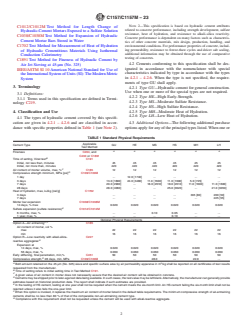
cation are given in 4.2.1 – 4.2.6 and are classified in accor- 4.3 Additional Options—The following additional purchase
dance with specific properties defined in Table 1 (see Note 2). options apply for any of the principal types listed. When one or
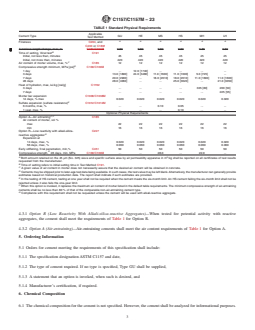
TABLE 1 Standard Physical Requirements
Applicable
Cement Type GU HE MS HS MH LH
Test Method
A A A A A A
Fineness C204, and
C430 or C1891
B
Time of setting, Vicat test C191
Initial, not less than, minutes 45 45 45 45 45 45
Initial, not more than, minutes 420 420 420 420 420 420
C
Air content of mortar volume, max, % C185 12 12 12 12 12 12
D
Compressive strength minimum, MPa [psi] C109/C109M
1 day . 12.0 [1740] . . . .
3 days 13.0 [1890] 24.0 [3480] 11.0 [1600] 11.0 [1600] 5.0 [725] .
7 days 20.0 [2900] . 18.0 [2610] 18.0 [2610] 11.0 [1600] 11.0 [1600]
28 days 28.0 [4060] . . 25.0 [3620] . 21.0 [3050]
Heat of hydration, max, kJ/kg [cal/g] C1702
3 days . . . . 335 [80] 200 [50]
7 days . . . . . 225 [55]
Mortar bar expansion C1038/C1038M
14 days, % max 0.020 0.020 0.020 0.020 0.020 0.020
E
Sulfate expansion (sulfate resistance) C1012/C1012M
6 months, max, % . . 0.10 0.05 . .
1 year, max, % . . . 0.10 . .
Optional Physical Requirements
C,F
Option A—Air entraining C185
Air content of mortar, vol %
max 22 22 22 22 22 22
min 16 16 16 16 16 16
Option R—Low reactivity with alkali-silica- C227
G
reactive aggregates
Expansion at
14 days, max, % 0.020 0.020 0.020 0.020 0.020 0.020
56 days, max, % 0.060 0.060 0.060 0.060 0.060 0.060
Early stiffening, final penetration, min,% C451 50 50 50 50 50 50
D
Compressive strength, 28 days, min, MPa C109/C109M . . 28.0 . 22.0 .
A 2
Both amount retained on the 45 μm (No. 325) sieve and specific surface area by air permeability apparatus in m /kg shall be reported on all certificates of test results
requested from the manufacturer.
B
Time of setting refers to initial setting time in Test Method C191.
C
A given value of air content in mortar does not necessarily assure that the desired air content will be obtained in concrete.
D
Cements may be shipped prior to later-age test data being available. In such cases, the test value may be left blank. Alternatively, the manufacturer can generally provide
estimates based on historical production data. The report shall indicate if such estimates are provided.
E
In the testing of HS cement, testing at one year shall not be required when the cement meets the six-month limit. An HS cement failing the six-month limit shall not be
rejected unless it also fails the one-year limit.
F
When this option is invoked, it replaces the maximum air content of mortar listed in the default table requirements. The minimum compressive strength of air-entraining
cements shall be no less than 80 % of that of the comparable non-air-entraining cement type.
G
Compliance with this requirement shall not be requested unless the cement will be used with alkali-reactive aggregate.
C1157/C1157M − 23
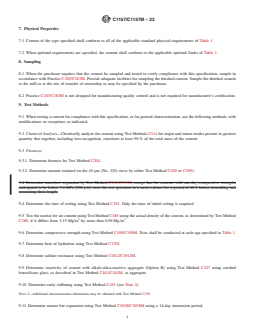
both of these options is invoked, its letter designation and title 9.5 Test the mortar for air content using Test Method C185
shall follow immediately after the respective letter designation using the actual density of the cement, as determined by Test
and title of the principal type (for example, Type MS(R) or Method C188, if it differs from 3.15 Mg/m by more than
Type MS(A)). 0.05 Mg ⁄m .
4.3.1 Option R (Low Reactivity With Alkali-silica-reactive
9.6 Determine compressive strength using Test Method
Aggregates)—When tested for potential activity with reactive
C109/C109M. Tests shall be conducted at each age specified in
aggregates, the cement shall meet the requirements of Table 1
Table 1.
for Option R.
9.7 Determine heat of hydration using Test Method C1702.
4.3.2 Option A (Air-entraining)—Air-entraining cements
shall meet t
...
This document is not an ASTM standard and is intended only to provide the user of an ASTM standard an indication of what changes have been made to the previous version. Because
it may not be technically possible to adequately depict all changes accurately, ASTM recommends that users consult prior editions as appropriate. In all cases only the current version
of the standard as published by ASTM is to be considered the official document.
Designation: C1157/C1157M − 20a C1157/C1157M − 23
Standard Performance Specification for
Hydraulic Cement
This standard is issued under the fixed designation C1157/C1157M; the number immediately following the designation indicates the year
of original adoption or, in the case of revision, the year of last revision. A number in parentheses indicates the year of last reapproval.
A superscript epsilon (´) indicates an editorial change since the last revision or reapproval.
1. Scope*
1.1 This performance specification covers hydraulic cements for both general and special applications. There are no restrictions
on the composition of the cement or its constituents (see Note 1).
NOTE 1—There are two related hydraulic cement standards, Specification C150/C150M for portland cement and Specifications C595/C595M for blended
cements, both of which contain prescriptive and performance requirements
1.2 This performance specification classifies cements based on specific requirements for general use, high early strength,
resistance to attack by sulfates, and heat of hydration. Optional requirements are provided for the property of low reactivity with
alkali-silica-reactive aggregates and for air-entraining cements.
1.3 The values stated in either SI units or inch-pound units are to be regarded separately as standard. The values stated in each
system may not be exact equivalents; therefore, each system shall be used independently of the other. Combining values from the
two systems may result in non-conformance with the standard. Values in SI units [or inch-pound units] shall be obtained by
measurement in SI units [or inch-pound units] or by appropriate conversion, using the Rules for Conversion and Rounding given
in IEEE/ASTM SI 10, of measurements made in other units [or SI units]. Values are stated in only SI units when inch-pound units
are not used in practice.
1.4 The text of this performance specification refers to notes and footnotes that provide explanatory material. These notes and
footnotes (excluding those in tables and figures) are not requirements of the standard.
1.5 This standard does not purport to address all of the safety concerns, if any, associated with its use. It is the responsibility
of the user of this standard to establish appropriate safety, health, and environmental practices and determine the applicability of
regulatory limitations prior to use.
1.6 This international standard was developed in accordance with internationally recognized principles on standardization
established in the Decision on Principles for the Development of International Standards, Guides and Recommendations issued
by the World Trade Organization Technical Barriers to Trade (TBT) Committee.
2. Referenced Documents
2.1 ASTM Standards:
C109/C109M Test Method for Compressive Strength of Hydraulic Cement Mortars (Using 2-in. or [50 mm] Cube Specimens)
C114 Test Methods for Chemical Analysis of Hydraulic Cement
This performance specification is under the jurisdiction of ASTM Committee C01 on Cement and is the direct responsibility of Subcommittee C01.10 on Hydraulic
Cements for General Concrete Construction.
Current edition approved Dec. 15, 2020Sept. 1, 2023. Published January 2021September 2023. Originally approved in 1992. Last previous edition approved in 2020 as
C1157/C1157M – 20.C1157/C1157M – 20a. DOI: 10.1520/C1157_C1157M-20A.10.1520/C1157_C1157M-23.
For referenced ASTM standards, visit the ASTM website, www.astm.org, or contact ASTM Customer Service at service@astm.org. For Annual Book of ASTM Standards
volume information, refer to the standard’s Document Summary page on the ASTM website.
*A Summary of Changes section appears at the end of this standard
Copyright © ASTM International, 100 Barr Harbor Drive, PO Box C700, West Conshohocken, PA 19428-2959. United States
C1157/C1157M − 23
C150/C150M Specification for Portland Cement
C151/C151M Test Method for Autoclave Expansion of Hydraulic Cement
C183/C183M Practice for Sampling and the Amount of Testing of Hydraulic Cement
C185 Test Method for Air Content of Hydraulic Cement Mortar
C188 Test Method for Density of Hydraulic Cement
C191 Test Methods for Time of Setting of Hydraulic Cement by Vicat Needle
C204 Test Methods for Fineness of Hydraulic Cement by Air-Permeability Apparatus
C219 Terminology Relating to Hydraulic and Other Inorganic Cements
C227 Test Method for Potential Alkali Reactivity of Cement-Aggregate Combinations (Mortar-Bar Method) (Withdrawn 2018)
C359 Test Method for Early Stiffening of Hydraulic-Cement (Mortar Method)
C430 Test Method for Fineness of Hydraulic Cement by the 45-μm (No. 325) Sieve
C441/C441M Test Method for Effectiveness of Pozzolans or Ground Blast-Furnace Slag in Preventing Excessive Expansion of
Concrete Due to the Alkali-Silica Reaction
C451 Test Method for Early Stiffening of Hydraulic Cement (Paste Method)
C595/C595M Specification for Blended Hydraulic Cements
C1012/C1012M Test Method for Length Change of Hydraulic-Cement Mortars Exposed to a Sulfate Solution
C1038/C1038M Test Method for Expansion of Hydraulic Cement Mortar Bars Stored in Water
C1702 Test Method for Measurement of Heat of Hydration of Hydraulic Cementitious Materials Using Isothermal Conduction
Calorimetry
C1891 Test Method for Fineness of Hydraulic Cement by Air Jet Sieving at 45-μm (No. 325)
IEEE/ASTM SI 10 American National Standard for Use of the International System of Units (SI): The Modern Metric System
3. Terminology
3.1 Definitions:
3.1.1 Terms used in this specification are defined in Terminology C219.
4. Classification and Use
4.1 The types of hydraulic cement covered by this specification are given in 4.2.1 – 4.2.6 and are classified in accordance with
specific properties defined in Table 1 (see Note 2).
NOTE 2—This specification is based on hydraulic cement attributes related to concrete performance, including strength development, sulfate resistance,
heat of hydration, and resistance to alkali-silica reactivity. Concrete performance is dependent on many factors such as characteristics of other concrete
materials, mix design, production, handling, and environmental conditions. For performance properties of concrete, including permeability, resistance to
freeze-thaw cycles and deicer salt scaling, additional information may be obtained through the use of comparative testing of concretes.
4.2 Cements conforming to this specification shall be designated in accordance with the nomenclature with special characteristics
indicated by type in accordance with the types in 4.2.1 – 4.2.6. When the type is not specified, the requirements of type GU shall
apply.
4.2.1 Type GU—Hydraulic cement for general construction. Use when one or more of the special types are not required.
4.2.2 Type HE—High Early-Strength.
4.2.3 Type MS—Moderate Sulfate Resistance.
4.2.4 Type HS—High Sulfate Resistance.
4.2.5 Type MH—Moderate Heat of Hydration.
4.2.6 Type LH—Low Heat of Hydration.
4.3 Additional Options—The following additional purchase options apply for any of the principal types listed. When one or both
of these options is invoked, its letter designation and title shall follow immediately after the respective letter designation and title
of the principal type (for example, Type MS(R) or Type MS(A)).
The last approved version of this historical standard is referenced on www.astm.org.
C1157/C1157M − 23
TABLE 1 Standard Physical Requirements
Applicable
Cement Type GU HE MS HS MH LH
Test Method
A A A A A A
Fineness C204, and
C430 or C1891
Autoclave length change, max, % C151/C151M 0.80 0.80 0.80 0.80 0.80 0.80
B
Time of setting, Vicat test C191
Initial, not less than, minutes 45 45 45 45 45 45
Initial, not more than, minutes 420 420 420 420 420 420
C
Air content of mortar volume, max, % C185 12 12 12 12 12 12
D
Compressive strength minimum, MPa [psi] C109/C109M
1 day . 12.0 [1740] . . . .
3 days 13.0 [1890] 24.0 [3480] 11.0 [1600] 11.0 [1600] 5.0 [725] .
7 days 20.0 [2900] . 18.0 [2610] 18.0 [2610] 11.0 [1600] 11.0 [1600]
28 days 28.0 [4060] . . 25.0 [3620] . 21.0 [3050]
Heat of hydration, max, kJ/kg [cal/g] C1702
3 days . . . . 335 [80] 200 [50]
7 days . . . . . 225 [55]
Mortar bar expansion C1038/C1038M
14 days, % max 0.020 0.020 0.020 0.020 0.020 0.020
E
Sulfate expansion (sulfate resistance) C1012/C1012M
6 months, max, % . . 0.10 0.05 . .
1 year, max, % . . . 0.10 . .
Optional Physical Requirements
C,F
Option A—Air entraining C185
Air content of mortar, vol %
max 22 22 22 22 22 22
min 16 16 16 16 16 16
Option R—Low reactivity with alkali-silica- C227
G
reactive aggregates
Expansion at
14 days, max, % 0.020 0.020 0.020 0.020 0.020 0.020
56 days, max, % 0.060 0.060 0.060 0.060 0.060 0.060
Early stiffening, final penetration, min,% C451 50 50 50 50 50 50
D
Compressive strength, 28 days, min, MPa C109/C109M . . 28.0 . 22.0 .
A 2
Both amount retained on the 45 μm (No. 325) sieve and specific surface area by air permeability apparatus in m /kg shall be reported on all certificates of test results
requested from the manufacturer.
B
Time of setting refers to initial setting time in Test Method C191.
C
A given value of air content in mortar does not necessarily assure that the desired air content will be obtained in concrete.
D
Cements may be shipped prior to later-age test data being available. In such cases, the test value may be left blank. Alternatively, the manufacturer can generally provide
estimates based on historical production data. The report shall indicate if such estimates are provided.
E
In the testing of HS cement, testing at one year shall not be required when the cement meets the six-month limit. An HS cement failing the six-month limit shall not be
rejected unless it also fails the one-year limit.
F
When this option is invoked, it replaces the maximum air content of mortar listed in the default table requirements. The minimum compressive strength of air-entraining
cements shall be no less than 80 % of that of the comparable non-air-entraining cement type.
G
Compliance with this requirement shall not be requested unless the cement will be used with alkali-reactive aggregate.
4.3.1 Option R (Low Reactivity With Alkali-silica-reactive Aggregates)—When tested for potential activity with reactive
aggregates, the cement shall meet the requirements of Table 1 for Option R.
4.3.2 Option A (Air-entraining)—Air-entraining cements shall meet the air content requirements of Table 1 for Option A.
5. Ordering Information
5.1 Orders for cement meeting the requirements of this specification shall include:
5.1.1 The specification designation ASTM C1157 and date,
5.1.2 The type of cement required. If no type is specified, Type GU shall be supplied,
5.1.3 A statement that an option is invoked, when such is desired, and
5.1.4 Manufacturer’s certification, if required.
6. Chemical Composition
6.1 The chemical composition for the cement is not specified. However, the cement shall be analyzed for informational purposes.
C1157/C1157M − 2
...