

ASTM D6023-16
(Test Method)Standard Test Method for Density (Unit Weight), Yield, Cement Content, and Air Content (Gravimetric) of Controlled Low-Strength Material (CLSM)
General Information
- Abstract
SIGNIFICANCE AND USE
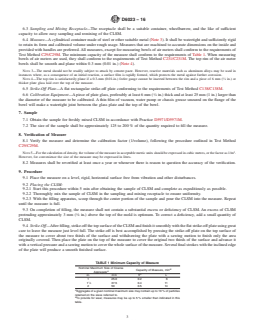
5.1 This test method provides the user with a procedure to calculate the density of freshly mixed CLSM for determination of compliance with specifications, for determining mass/volume relationships or conversions such as those found in purchase agreements, and also for quality control purposes.
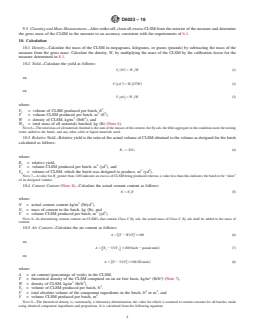
5.2 This test method is intended to assist the user for quality control purposes and when specified to determine compliance for air content, yield, and cement content of freshly mixed CLSM.
5.3 This test method is not meant to predict the air content of hardened CLSM, which may be either higher or lower than that determined by this test method.
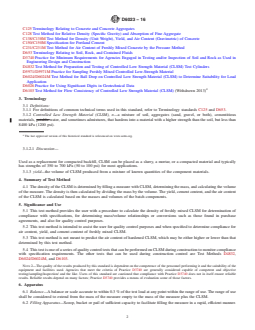
5.4 This test is one of a series of quality control tests that can be performed on CLSM during construction to monitor compliance with specification requirements. The other tests that can be used during construction control are Test Methods D4832, D6024/D6024M, and D6103.
Note 2: The quality of the results produced by this standard is dependent on the competence of the personnel performing it and the suitability of the equipment and facilities used. Agencies that meet the criteria of Practice D3740 are generally considered capable of competent and objective testing/sampling/inspection/ and the like. Users of this standard are cautioned that compliance with Practice D3740 does not in itself ensure reliable results. Reliable results depend on many factors; Practice D3740 provides a means of evaluation some of those factors.
SCOPE
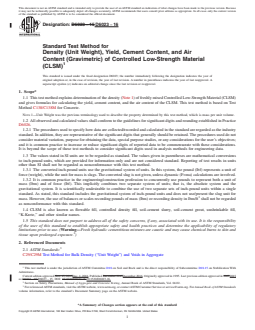
1.1 This test method explains determination of the density (Note 1) of freshly mixed Controlled Low-Strength Material (CLSM) and gives formulas for calculating the yield, cement content, and the air content of the CLSM. This test method is based on Test Method C138/C138M for Concrete.
Note 1: Unit Weight was the previous terminology used to describe the property determined by this test method, which is mass per unit volume.
1.2 All observed and calculated values shall conform to the guidelines for significant digits and rounding established in Practice D6026.
1.2.1 The procedures used to specify how data are collected/recorded and calculated in the standard are regarded as the industry standard. In addition, they are representative of the significant digits that generally should be retained. The procedures used do not consider material variation, purpose for obtaining the data, special purpose studies, or any considerations for the user’s objectives; and it is common practice to increase or reduce significant digits of reported data to be commensurate with these considerations. It is beyond the scope of these test methods to consider significant digits used in analysis methods for engineering data.
1.3 The values stated in SI units are to be regarded as standard. The values given in parentheses are mathematical conversions to inch-pound units, which are provided for information only and are not considered standard. Reporting of test results in units other than SI shall not be regarded as nonconformance with this test method.
1.3.1 The converted inch-pound units use the gravitational system of units. In this system, the pound (lbf) represents a unit of force (weight), while the unit for mass is slugs. The converted slug is not given, unless dynamic (F=ma) calculations are involved.
1.3.2 It is common practice in the engineering/construction profession to concurrently use pounds to represent both a unit of mass (lbm) and of force (lbf). This implicitly combines two separate system of units; that is, the absolute system and the gravitational system. It is scientifically undesirable to combine the use of two separate sets of inch-pound units within a single standard. As stated, this standard includes the gravitational system of inch-pound units and does not use/present the slug unit for mass. However, the use of balances or scales recording pounds of mass (lbm) or recording density in lbm/ft3 shall not be regarde...
- Status
- Published
- Publication Date
- 30-Nov-2016
- Technical Committee
- D18 - Soil and Rock
- Drafting Committee
- D18.15 - Stabilization With Admixtures
Buy Documents
ASTM D6023-16 - Standard Test Method for Density (Unit Weight), Yield, Cement Content, and Air Content (Gravimetric) of Controlled Low-Strength Material (CLSM)
REDLINE ASTM D6023-16 - Standard Test Method for Density (Unit Weight), Yield, Cement Content, and Air Content (Gravimetric) of Controlled Low-Strength Material (CLSM)
Overview
ASTM D6023-16, Standard Test Method for Density (Unit Weight), Yield, Cement Content, and Air Content (Gravimetric) of Controlled Low-Strength Material (CLSM), provides standardized procedures for evaluating the key physical properties of freshly mixed CLSM, also known as flowable fill or controlled density fill. This standard is essential for construction quality control, specification compliance, and material consistency, ensuring that controlled low-strength materials used in projects meet the desired performance requirements.
CLSM is widely used as a self-compacting, low-strength backfill material in infrastructure and utility construction due to its ease of placement and cost effectiveness. ASTM D6023-16 helps stakeholders-specifiers, contractors, suppliers, and quality assurance professionals-accurately determine the density, yield, cement content, and air content of CLSM mixtures.
Key Topics
- Density (Unit Weight): Determining the mass per unit volume of freshly mixed CLSM to ensure mixture consistency and compliance with project specifications.
- Yield: Calculating the actual volume of CLSM produced from known quantities of raw materials to confirm batch size and efficiency.
- Cement Content: Establishing the amount of cement in the mixture per unit volume, which is crucial for achieving the required strength profile.
- Air Content (Gravimetric): Measuring the proportion of air present in the fresh CLSM, providing a key indicator for potential settlement, permeability, and overall stability.
- Standardized Methodology: Emphasizing the use of accurate balances, properly calibrated measures, and established procedures for significant digits and data reporting per Practice D6026.
- Quality Control: Aiding in ongoing project quality assurance and specification adherence through reliable, repeatable measurements.
Applications
ASTM D6023-16 is designed for use during:
- Construction and Infrastructure Projects: Used to monitor the consistency of CLSM supplied for backfilling trenches, utility lines, and voids, ensuring that every batch meets the necessary density, yield, cement, and air content requirements.
- Specification Compliance: Assesses CLSM in accordance with purchase agreements, mix designs, and project specifications to verify that material properties align with contractual obligations.
- Material Optimization: Allows suppliers and specifiers to adjust mix designs or production processes based on test results, improving product performance and construction outcomes.
- Conversion and Calculation: Facilitates accurate conversions between mass and volume for batching and payment purposes.
- Quality Assurance Testing: Commonly implemented in series with other standards-such as ball drop, flow consistency, and cylinder strength tests-to provide comprehensive quality control.
It is important to note that the test method applies to freshly mixed CLSM and does not predict the properties of hardened material; further tests are required for in-place assessment.
Related Standards
ASTM D6023-16 references and supports integration with:
- ASTM C138/C138M: Density, yield, and air content of concrete
- ASTM D4832: Preparation and testing of CLSM cylinders for strength
- ASTM D6024/D6024M: Ball drop test for CLSM suitability for load application
- ASTM D6103: Flow consistency of CLSM (withdrawn, but historically referenced)
- ASTM D3740: Practice for agencies performing soil and rock testing
- ASTM D5971/D5971M: Sampling freshly mixed CLSM
- ASTM C29/C29M, C125, C128, C150/C150M, C231/C231M: Bulk density, terminology, material specifications, and air content determination related to cement, aggregate, and concrete materials
By following ASTM D6023-16, construction professionals, testing laboratories, and suppliers ensure that CLSM used in building and civil engineering projects consistently meets high-quality standards for density, yield, cement content, and air content-key factors in long-term performance and specification compliance.
Relations
- Effective Date
- 01-Dec-2016
- Effective Date
- 01-Jan-2024
- Effective Date
- 01-Nov-2023
- Refers
ASTM C29/C29M-23 - Standard Test Method for Bulk Density (“Unit Weight”) and Voids in Aggregate - Effective Date
- 01-Oct-2023
- Effective Date
- 15-Dec-2019
- Effective Date
- 01-Oct-2019
- Effective Date
- 01-Apr-2019
- Effective Date
- 01-Jan-2019
- Effective Date
- 01-Oct-2018
- Effective Date
- 01-Jul-2018
- Effective Date
- 01-Jan-2018
- Effective Date
- 01-Jan-2017
- Effective Date
- 15-Dec-2016
- Effective Date
- 15-Dec-2016
- Effective Date
- 15-Mar-2016
Buy Documents
ASTM D6023-16 - Standard Test Method for Density (Unit Weight), Yield, Cement Content, and Air Content (Gravimetric) of Controlled Low-Strength Material (CLSM)
REDLINE ASTM D6023-16 - Standard Test Method for Density (Unit Weight), Yield, Cement Content, and Air Content (Gravimetric) of Controlled Low-Strength Material (CLSM)
Get Certified
Connect with accredited certification bodies for this standard

DIBt (Deutsches Institut für Bautechnik)
German Institute for Building Technology.
DIN CERTCO
DIN Group product certification.

Aboma Certification B.V.
Specialized in construction, metal, and transport sectors.
Sponsored listings
Frequently Asked Questions
ASTM D6023-16 is a standard published by ASTM International. Its full title is "Standard Test Method for Density (Unit Weight), Yield, Cement Content, and Air Content (Gravimetric) of Controlled Low-Strength Material (CLSM)". This standard covers: SIGNIFICANCE AND USE 5.1 This test method provides the user with a procedure to calculate the density of freshly mixed CLSM for determination of compliance with specifications, for determining mass/volume relationships or conversions such as those found in purchase agreements, and also for quality control purposes. 5.2 This test method is intended to assist the user for quality control purposes and when specified to determine compliance for air content, yield, and cement content of freshly mixed CLSM. 5.3 This test method is not meant to predict the air content of hardened CLSM, which may be either higher or lower than that determined by this test method. 5.4 This test is one of a series of quality control tests that can be performed on CLSM during construction to monitor compliance with specification requirements. The other tests that can be used during construction control are Test Methods D4832, D6024/D6024M, and D6103. Note 2: The quality of the results produced by this standard is dependent on the competence of the personnel performing it and the suitability of the equipment and facilities used. Agencies that meet the criteria of Practice D3740 are generally considered capable of competent and objective testing/sampling/inspection/ and the like. Users of this standard are cautioned that compliance with Practice D3740 does not in itself ensure reliable results. Reliable results depend on many factors; Practice D3740 provides a means of evaluation some of those factors. SCOPE 1.1 This test method explains determination of the density (Note 1) of freshly mixed Controlled Low-Strength Material (CLSM) and gives formulas for calculating the yield, cement content, and the air content of the CLSM. This test method is based on Test Method C138/C138M for Concrete. Note 1: Unit Weight was the previous terminology used to describe the property determined by this test method, which is mass per unit volume. 1.2 All observed and calculated values shall conform to the guidelines for significant digits and rounding established in Practice D6026. 1.2.1 The procedures used to specify how data are collected/recorded and calculated in the standard are regarded as the industry standard. In addition, they are representative of the significant digits that generally should be retained. The procedures used do not consider material variation, purpose for obtaining the data, special purpose studies, or any considerations for the user’s objectives; and it is common practice to increase or reduce significant digits of reported data to be commensurate with these considerations. It is beyond the scope of these test methods to consider significant digits used in analysis methods for engineering data. 1.3 The values stated in SI units are to be regarded as standard. The values given in parentheses are mathematical conversions to inch-pound units, which are provided for information only and are not considered standard. Reporting of test results in units other than SI shall not be regarded as nonconformance with this test method. 1.3.1 The converted inch-pound units use the gravitational system of units. In this system, the pound (lbf) represents a unit of force (weight), while the unit for mass is slugs. The converted slug is not given, unless dynamic (F=ma) calculations are involved. 1.3.2 It is common practice in the engineering/construction profession to concurrently use pounds to represent both a unit of mass (lbm) and of force (lbf). This implicitly combines two separate system of units; that is, the absolute system and the gravitational system. It is scientifically undesirable to combine the use of two separate sets of inch-pound units within a single standard. As stated, this standard includes the gravitational system of inch-pound units and does not use/present the slug unit for mass. However, the use of balances or scales recording pounds of mass (lbm) or recording density in lbm/ft3 shall not be regarde...
SIGNIFICANCE AND USE 5.1 This test method provides the user with a procedure to calculate the density of freshly mixed CLSM for determination of compliance with specifications, for determining mass/volume relationships or conversions such as those found in purchase agreements, and also for quality control purposes. 5.2 This test method is intended to assist the user for quality control purposes and when specified to determine compliance for air content, yield, and cement content of freshly mixed CLSM. 5.3 This test method is not meant to predict the air content of hardened CLSM, which may be either higher or lower than that determined by this test method. 5.4 This test is one of a series of quality control tests that can be performed on CLSM during construction to monitor compliance with specification requirements. The other tests that can be used during construction control are Test Methods D4832, D6024/D6024M, and D6103. Note 2: The quality of the results produced by this standard is dependent on the competence of the personnel performing it and the suitability of the equipment and facilities used. Agencies that meet the criteria of Practice D3740 are generally considered capable of competent and objective testing/sampling/inspection/ and the like. Users of this standard are cautioned that compliance with Practice D3740 does not in itself ensure reliable results. Reliable results depend on many factors; Practice D3740 provides a means of evaluation some of those factors. SCOPE 1.1 This test method explains determination of the density (Note 1) of freshly mixed Controlled Low-Strength Material (CLSM) and gives formulas for calculating the yield, cement content, and the air content of the CLSM. This test method is based on Test Method C138/C138M for Concrete. Note 1: Unit Weight was the previous terminology used to describe the property determined by this test method, which is mass per unit volume. 1.2 All observed and calculated values shall conform to the guidelines for significant digits and rounding established in Practice D6026. 1.2.1 The procedures used to specify how data are collected/recorded and calculated in the standard are regarded as the industry standard. In addition, they are representative of the significant digits that generally should be retained. The procedures used do not consider material variation, purpose for obtaining the data, special purpose studies, or any considerations for the user’s objectives; and it is common practice to increase or reduce significant digits of reported data to be commensurate with these considerations. It is beyond the scope of these test methods to consider significant digits used in analysis methods for engineering data. 1.3 The values stated in SI units are to be regarded as standard. The values given in parentheses are mathematical conversions to inch-pound units, which are provided for information only and are not considered standard. Reporting of test results in units other than SI shall not be regarded as nonconformance with this test method. 1.3.1 The converted inch-pound units use the gravitational system of units. In this system, the pound (lbf) represents a unit of force (weight), while the unit for mass is slugs. The converted slug is not given, unless dynamic (F=ma) calculations are involved. 1.3.2 It is common practice in the engineering/construction profession to concurrently use pounds to represent both a unit of mass (lbm) and of force (lbf). This implicitly combines two separate system of units; that is, the absolute system and the gravitational system. It is scientifically undesirable to combine the use of two separate sets of inch-pound units within a single standard. As stated, this standard includes the gravitational system of inch-pound units and does not use/present the slug unit for mass. However, the use of balances or scales recording pounds of mass (lbm) or recording density in lbm/ft3 shall not be regarde...
ASTM D6023-16 is classified under the following ICS (International Classification for Standards) categories: 91.100.10 - Cement. Gypsum. Lime. Mortar. The ICS classification helps identify the subject area and facilitates finding related standards.
ASTM D6023-16 has the following relationships with other standards: It is inter standard links to ASTM D6023-15, ASTM C231/C231M-24, ASTM D3740-23, ASTM C29/C29M-23, ASTM C125-19a, ASTM D3740-19, ASTM C150/C150M-19, ASTM C125-19, ASTM C125-18b, ASTM C125-18a, ASTM C125-18, ASTM C29/C29M-17, ASTM C125-16, ASTM D4832-16, ASTM C150/C150M-16. Understanding these relationships helps ensure you are using the most current and applicable version of the standard.
ASTM D6023-16 is available in PDF format for immediate download after purchase. The document can be added to your cart and obtained through the secure checkout process. Digital delivery ensures instant access to the complete standard document.
Standards Content (Sample)
This international standard was developed in accordance with internationally recognized principles on standardization established in the Decision on Principles for the
Development of International Standards, Guides and Recommendations issued by the World Trade Organization Technical Barriers to Trade (TBT) Committee.
Designation: D6023 − 16
Standard Test Method for
Density (Unit Weight), Yield, Cement Content, and Air
Content (Gravimetric) of Controlled Low-Strength Material
(CLSM)
This standard is issued under the fixed designation D6023; the number immediately following the designation indicates the year of
original adoption or, in the case of revision, the year of last revision. A number in parentheses indicates the year of last reapproval. A
superscript epsilon (´) indicates an editorial change since the last revision or reapproval.
1. Scope* 1.3.2 It is common practice in the engineering/construction
profession to concurrently use pounds to represent both a unit
1.1 This test method explains determination of the density
of mass (lbm) and of force (lbf). This implicitly combines two
(Note 1) of freshly mixed Controlled Low-Strength Material
separate system of units; that is, the absolute system and the
(CLSM) and gives formulas for calculating the yield, cement
gravitational system. It is scientifically undesirable to combine
content, and the air content of the CLSM. This test method is
the use of two separate sets of inch-pound units within a single
based on Test Method C138/C138M for Concrete.
standard. As stated, this standard includes the gravitational
NOTE 1—Unit Weight was the previous terminology used to describe
system of inch-pound units and does not use/present the slug
the property determined by this test method, which is mass per unit
unit for mass. However, the use of balances or scales recording
volume.
pounds of mass (lbm) or recording density in lbm/ft shall not
1.2 All observed and calculated values shall conform to the
be regarded as nonconformance with this standard.
guidelines for significant digits and rounding established in
1.4 CLSM is also known as flowable fill, controlled density
Practice D6026.
fill, soil-cement slurry, soil-cement grout, unshrinkable fill,
1.2.1 Theproceduresusedtospecifyhowdataarecollected/
“K-Krete,” and other similar names.
recorded and calculated in the standard are regarded as the
1.5 This standard does not purport to address all of the
industry standard. In addition, they are representative of the
safety concerns, if any, associated with its use. It is the
significant digits that generally should be retained. The proce-
responsibility of the user of this standard to establish appro-
dures used do not consider material variation, purpose for
priate safety and health practices and determine the applica-
obtaining the data, special purpose studies, or any consider-
bility of regulatory limitations prior to use. (Warning—Fresh
ations for the user’s objectives; and it is common practice to
hydraulic cementitious mixtures are caustic and may cause
increase or reduce significant digits of reported data to be
chemical burns to skin and tissue upon prolonged exposure. )
commensuratewiththeseconsiderations.Itisbeyondthescope
of these test methods to consider significant digits used in
2. Referenced Documents
analysis methods for engineering data.
2.1 ASTM Standards:
1.3 The values stated in SI units are to be regarded as
C29/C29M Test Method for Bulk Density (“Unit Weight”)
standard. The values given in parentheses are mathematical
and Voids in Aggregate
conversions to inch-pound units, which are provided for
C125 Terminology Relating to Concrete and Concrete Ag-
information only and are not considered standard. Reporting of
gregates
test results in units other than SI shall not be regarded as
C128 Test Method for Relative Density (Specific Gravity)
nonconformance with this test method.
and Absorption of Fine Aggregate
1.3.1 The converted inch-pound units use the gravitational
C138/C138M Test Method for Density (UnitWeight),Yield,
systemofunits.Inthissystem,thepound(lbf)representsaunit
and Air Content (Gravimetric) of Concrete
of force (weight), while the unit for mass is slugs. The
C150/C150M Specification for Portland Cement
converted slug is not given, unless dynamic (F=ma) calcula-
C231/C231M Test Method forAir Content of Freshly Mixed
tions are involved.
1 2
ThistestmethodisunderthejurisdictionofASTMCommitteeD18onSoiland Section on Safety Precautions, Manual of Aggregate and Concrete Testing,
Rock and is the direct responsibility of Subcommittee D18.15 on Stabilization With Annual Book of ASTM Standards, Vol. 04.02.
Admixtures. For referenced ASTM standards, visit the ASTM website, www.astm.org, or
Current edition approved Dec. 1, 2016. Published December 2016. Originally contact ASTM Customer Service at service@astm.org. For Annual Book of ASTM
approved in 1995. Last previous edition approved in 2015 as D6023 – 15. DOI: Standards volume information, refer to the standard’s Document Summary page on
10.1520/D6023-16. the ASTM website.
*A Summary of Changes section appears at the end of this standard
Copyright © ASTM International, 100 Barr Harbor Drive, PO Box C700, West Conshohocken, PA 19428-2959. United States
D6023 − 16
Concrete by the Pressure Method 5.4 This test is one of a series of quality control tests that
D653 Terminology Relating to Soil, Rock, and Contained can be performed on CLSM during construction to monitor
Fluids compliance with specification requirements. The other tests
D3740 Practice for Minimum Requirements for Agencies that can be used during construction control are Test Methods
Engaged in Testing and/or Inspection of Soil and Rock as D4832, D6024/D6024M, and D6103.
Used in Engineering Design and Construction
NOTE 2—The quality of the results produced by this standard is
D4832 Test Method for Preparation and Testing of Con-
dependent on the competence of the personnel performing it and the
trolled Low Strength Material (CLSM) Test Cylinders
suitability of the equipment and facilities used. Agencies that meet the
criteria of Practice D3740 are generally considered capable of competent
D5971/D5971M Practice for Sampling Freshly Mixed Con-
and objective testing/sampling/inspection/ and the like. Users of this
trolled Low-Strength Material
standard are cautioned that compliance with Practice D3740 does not in
D6024/D6024M Test Method for Ball Drop on Controlled
itself ensure reliable results. Reliable results depend on many factors;
Low Strength Material (CLSM) to Determine Suitability
Practice D3740 provides a means of evaluation some of those factors.
for Load Application
D6026 Practice for Using Significant Digits in Geotechnical
6. Apparatus
Data
6.1 Balance—Abalance or scale accurate to within 0.3 % of
D6103 Test Method for Flow Consistency of Controlled
the test load at any point within the range of use. The range of
Low Strength Material (CLSM) (Withdrawn 2013)
use shall be considered to extend from the mass of the measure
empty to the mass of the measure plus the CLSM.
3. Terminology
6.2 Filling Apparatus—Scoop, bucket or pail of sufficient
3.1 Definitions:
capacity to facilitate filling the measure in a rapid, efficient
3.1.1 For definitions of common technical terms used in this
manner.
standard, refer to Terminology standards C125 and D653.
3.1.2 Controlled Low Strength Material (CLSM), n—a mix-
6.3 Sampling and Mixing Receptacle—The receptacle shall
ture of soil, aggregates (sand, gravel, or both), cementitious
be a suitable container, wheelbarrow, and the like of sufficient
materials, water, and sometimes admixtures, that hardens into
capacity to allow easy sampling and remixing of the CLSM.
a material with a higher strength than the soil, but less than
6.4 Measure—Acylindrical container made of steel or other
8400 kPa (1200 psi).
suitable metal (Note 3). It shall be watertight and sufficiently
3.1.2.1 Discussion—Used as a replacement for compacted
rigid to retain its form and calibrated volume under rough
backfill, CLSM can be placed as a slurry, a mortar, or a
usage. Measures that are machined to accurate dimensions on
compacted material and typically has strengths of 350 to 700
the inside and provided with handles are preferred. All
kPa (50 to 100 psi) for most applications.
measures, except for measuring bowls of air meters shall
3.1.3 yield—the volume of CLSM produced from a mixture
conform to the requirements of Test Method C29/C29M. The
of known quantities of the component materials.
minimum capacity of the measure shall conform to the
requirements of Table 1. When measuring bowls of air meters
4. Summary of Test Method
are used, they shall conform to the requirements of Test
4.1 The density of the CLSM is determined by filling a
Method C231/C231M.The top rim of the air meter bowls shall
measurewithCLSM,determiningthemass,andcalculatingthe
be smooth and plane within 0.3 mm (0.01 in.) (Note 4).
volume of the measure. The density is then calculated by
NOTE 3—The metal should not be readily subject to attack by cement
dividing the mass by the volume. The yield, cement content,
paste. However, reactive materials such as aluminum alloys may be used
and the air content of the CLSM is calculated based on the
in instances where, as a consequence of an initial reaction, a surface film
masses and volumes of the batch components.
is rapidly formed, which protects the metal against further corrosion.
NOTE4—Thetoprimissatisfactorilyplaneifa0.3-mm(0.01-in.)feeler
5. Significance and Use
gauge cannot be inserted between the rim and a piece of 6 mm ( ⁄4 in.) or
thicker plate glass laid over the top of the measure.
5.1 This test method provides the user with a procedure to
calculate the density of freshly mixed CLSM for determination 6.5 Strike-Off Plate—A flat rectangular strike-off plate con-
forming to the requirements of Test Method C138/C138M.
of compliance with specifications, for determining mass/
volume relationships or conversions such as those found in
purchase agreements, and also for quality control purposes.
5.2 This test method is intended to assist the user for quality
TABLE 1 Minimum Capacity of Measure
control purposes and when specified to determine compliance
Nominal Maximum Size of Coarse
B
Capacity of Measure, min
for air content, yield, and cement content
...
This document is not an ASTM standard and is intended only to provide the user of an ASTM standard an indication of what changes have been made to the previous version. Because
it may not be technically possible to adequately depict all changes accurately, ASTM recommends that users consult prior editions as appropriate. In all cases only the current version
of the standard as published by ASTM is to be considered the official document.
Designation: D6023 − 15 D6023 − 16
Standard Test Method for
Density (Unit Weight), Yield, Cement Content, and Air
Content (Gravimetric) of Controlled Low-Strength Material
(CLSM)
This standard is issued under the fixed designation D6023; the number immediately following the designation indicates the year of
original adoption or, in the case of revision, the year of last revision. A number in parentheses indicates the year of last reapproval. A
superscript epsilon (´) indicates an editorial change since the last revision or reapproval.
1. Scope*
1.1 This test method explains determination of the density (Note 1) of freshly mixed Controlled Low-Strength Material (CLSM)
and gives formulas for calculating the yield, cement content, and the air content of the CLSM. This test method is based on Test
Method C138/C138M for Concrete.
NOTE 1—Unit Weight was the previous terminology used to describe the property determined by this test method, which is mass per unit volume.
1.2 All observed and calculated values shall conform to the guidelines for significant digits and rounding established in Practice
D6026.
1.2.1 The procedures used to specify how data are collected/recorded and calculated in the standard are regarded as the industry
standard. In addition, they are representative of the significant digits that generally should be retained. The procedures used do not
consider material variation, purpose for obtaining the data, special purpose studies, or any considerations for the user’s objectives;
and it is common practice to increase or reduce significant digits of reported data to be commensurate with these considerations.
It is beyond the scope of these test methods to consider significant digits used in analysis methods for engineering data.
1.3 The values stated in SI units are to be regarded as standard. The values given in parentheses are mathematical conversions
to inch-pound units, which are provided for information only and are not considered standard. Reporting of test results in units
other than SI shall not be regarded as nonconformance with this test method.
1.3.1 The converted inch-pound units use the gravitational system of units. In this system, the pound (lbf) represents a unit of
force (weight), while the unit for mass is slugs. The converted slug is not given, unless dynamic (F=ma) calculations are involved.
1.3.2 It is common practice in the engineering/construction profession to concurrently use pounds to represent both a unit of
mass (lbm) and of force (lbf). This implicitly combines two separate system of units; that is, the absolute system and the
gravitational system. It is scientifically undesirable to combine the use of two separate sets of inch-pound units within a single
standard. As stated, this standard includes the gravitational system of inch-pound units and does not use/present the slug unit for
mass. However, the use of balances or scales recording pounds of mass (lbm) or recording density in lbm/ft shall not be regarded
as nonconformance with this standard.
1.4 CLSM is also known as flowable fill, controlled density fill, soil-cement slurry, soil-cement grout, unshrinkable fill,
“K-Krete,” and other similar names.
1.5 This standard does not purport to address all of the safety concerns, if any, associated with its use. It is the responsibility
of the user of this standard to establish appropriate safety and health practices and determine the applicability of regulatory
limitations prior to use. (Warning—Fresh hydraulic cementitious mixtures are caustic and may cause chemical burns to skin and
tissue upon prolonged exposure. )
2. Referenced Documents
2.1 ASTM Standards:
C29/C29M Test Method for Bulk Density (“Unit Weight”) and Voids in Aggregate
This test method is under the jurisdiction of ASTM Committee D18 on Soil and Rock and is the direct responsibility of Subcommittee D18.15 on Stabilization With
Admixtures.
Current edition approved Nov. 15, 2015Dec. 1, 2016. Published December 2015December 2016. Originally approved in 1995. Last previous edition approved in 20072015
as D6023 – 07.D6023 – 15. DOI: 10.1520/D6023-15.10.1520/D6023-16.
Section on Safety Precautions, Manual of Aggregate and Concrete Testing, Annual Book of ASTM Standards, Vol. 04.02.
For referenced ASTM standards, visit the ASTM website, www.astm.org, or contact ASTM Customer Service at service@astm.org. For Annual Book of ASTM Standards
volume information, refer to the standard’s Document Summary page on the ASTM website.
*A Summary of Changes section appears at the end of this standard
Copyright © ASTM International, 100 Barr Harbor Drive, PO Box C700, West Conshohocken, PA 19428-2959. United States
D6023 − 16
C125 Terminology Relating to Concrete and Concrete Aggregates
C128 Test Method for Relative Density (Specific Gravity) and Absorption of Fine Aggregate
C138/C138M Test Method for Density (Unit Weight), Yield, and Air Content (Gravimetric) of Concrete
C150/C150M Specification for Portland Cement
C231/C231M Test Method for Air Content of Freshly Mixed Concrete by the Pressure Method
D653 Terminology Relating to Soil, Rock, and Contained Fluids
D3740 Practice for Minimum Requirements for Agencies Engaged in Testing and/or Inspection of Soil and Rock as Used in
Engineering Design and Construction
D4832 Test Method for Preparation and Testing of Controlled Low Strength Material (CLSM) Test Cylinders
D5971/D5971M Practice for Sampling Freshly Mixed Controlled Low-Strength Material
D6024/D6024M Test Method for Ball Drop on Controlled Low Strength Material (CLSM) to Determine Suitability for Load
Application
D6026 Practice for Using Significant Digits in Geotechnical Data
D6103 Test Method for Flow Consistency of Controlled Low Strength Material (CLSM) (Withdrawn 2013)
3. Terminology
3.1 Definitions:
3.1.1 For definitions of common technical terms used in this standard, refer to Terminology standards C125 and D653.
3.1.2 Controlled Low Strength Material (CLSM), n—a mixture of soil, aggregates (sand, gravel, or both), cementitious
materials, potable water, and sometimes admixtures, that hardens into a material with a higher strength than the soil, but less than
8400 kPa (1200 psi).
The last approved version of this historical standard is referenced on www.astm.org.
3.1.2.1 Discussion—
Used as a replacement for compacted backfill, CLSM can be placed as a slurry, a mortar, or a compacted material and typically
has strengths of 350 to 700 kPa (50 to 100 psi) for most applications.
3.1.3 yield—the volume of CLSM produced from a mixture of known quantities of the component materials.
4. Summary of Test Method
4.1 The density of the CLSM is determined by filling a measure with CLSM, determining the mass, and calculating the volume
of the measure. The density is then calculated by dividing the mass by the volume. The yield, cement content, and the air content
of the CLSM is calculated based on the masses and volumes of the batch components.
5. Significance and Use
5.1 This test method provides the user with a procedure to calculate the density of freshly mixed CLSM for determination of
compliance with specifications, for determining mass/volume relationships or conversions such as those found in purchase
agreements, and also for quality control purposes.
5.2 This test method is intended to assist the user for quality control purposes and when specified to determine compliance for
air content, yield, and cement content of freshly mixed CLSM.
5.3 This test method is not meant to predict the air content of hardened CLSM, which may be either higher or lower than that
determined by this test method.
5.4 This test is one of a series of quality control tests that can be performed on CLSM during construction to monitor compliance
with specification requirements. The other tests that can be used during construction control are Test Methods D4832,
D6024/D6024M, and D6103.
NOTE 2—The quality of the results produced by this standard is dependent on the competence of the personnel performing it and the suitability of the
equipment and facilities used. Agencies that meet the criteria of Practice D3740 are generally considered capable of competent and objective
testing/sampling/inspection/ and the like. Users of this standard are cautioned that compliance with Practice D3740 does not in itself ensure reliable
results. Reliable results depend on many factors; Practice D3740 provides a means of evaluation some of those factors.
6. Apparatus
6.1 Balance—A balance or scale accurate to within 0.3 % of the test load at any point within the range of use. The range of use
shall be considered to extend from the mass of the measure empty to the mass of the measure plus the CLSM.
6.2 Filling Apparatus—Scoop, bucket or pail of sufficient capacity to facilitate filling the measure in a rapid, efficient manner.
D6023 − 16
6.3 Sampling and Mixing Receptacle—The receptacle shall be a suitable container, wheelbarrow, and the like of sufficient
capacity to allow easy sampling and remixing of the CLSM.
6.4 Measure—A cylindrical container made of steel or other suitable metal (Note 3). It shall be watertight and sufficiently rigid
to retain its form and calibrated volume under rough usage. Measures that are machined to accurate dimensions on the inside and
provided with handles are preferred. All measures, except for measuring bowls of air meters shall conform to the requirements of
Test Method C29/C29M. The minimum capacity of the measure shall conform to the requirements of Table 1. When measuring
bowls of air meters are used, they shall conform to the requirements of Test Method C231/C231M. The top rim of the air meter
bowls shall be smooth and plane within 0.3 mm (0.01 in.) (Note 4).
NOTE 3—The metal should not be readily subject to attack by cement paste. However, reactive materials such as aluminum alloys may be used in
instances where, as a consequence of an initial reaction, a surface film is rapidly formed, which protects the metal against further corrosion.
NOTE 4—The top
...