

ASTM D6886-18
(Test Method)Standard Test Method for Determination of the Weight Percent Individual Volatile Organic Compounds in Waterborne Air-Dry Coatings by Gas Chromatography
General Information
- Abstract
SIGNIFICANCE AND USE
5.1 In using Practice D3960 to measure the volatile organic compound content of waterborne coatings, precision can be poor for low volatile organic compound content air-dry coatings if the volatile organic weight percent is determined indirectly. The present method directly identifies and then quantifies the weight percent of individual volatile organic compounds in air-dry coatings (Note 6). The total volatile organic weight percent can be obtained by adding the individual weight percent values (Note 7).
Note 6: The present method may be used to speciate solvent-borne air-dry coatings. However, since these normally contain high, and often complex, quantities of solvent, precision tends to be better using other methods contained in Practice D3960, where the volatile fraction is determined by a direct weight loss determination.
Note 7: Detectable compounds may result from thermal decomposition in a hot injection port or from reaction with the extraction solvent. If it can be shown that a material is a decomposition product, or is the result of a reaction with the extraction solvent, then results for that compound should be discounted from the volatile measured by Test Method D6886.
SCOPE
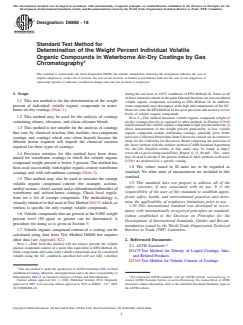
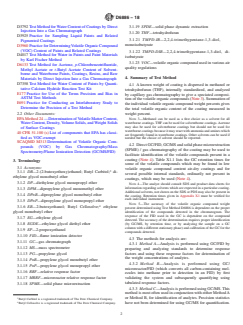
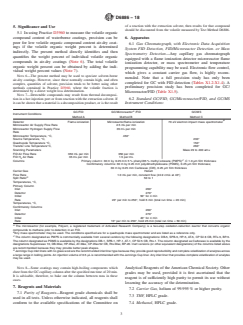
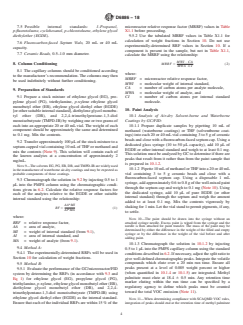
1.1 This test method is for the determination of the weight percent of individual volatile organic compounds in waterborne air-dry coatings (Note 1).
1.2 This method may be used for the analysis of coatings containing silanes, siloxanes, and silane-siloxane blends.
1.3 This method is not suitable for the analysis of coatings that cure by chemical reaction (this includes two-component coatings and coatings which cure when heated) because the dilution herein required will impede the chemical reaction required for these types of coatings.
1.4 Precision statistics for this method have been determined for waterborne coatings in which the volatile organic compound weight percent is below 5 percent. The method has been used successfully with higher organic content waterborne coatings and with solventborne coatings (Note 2).
1.5 This method may also be used to measure the exempt volatile organic compound content (for example, acetone, methyl acetate, t-butyl acetate and p-chlorobenzotrifluoride) of waterborne and solvent-borne coatings. Check local regulations for a list of exempt compounds. The methodology is virtually identical to that used in Test Method D6133 which, as written, is specific for only exempt volatile compounds.
1.6 Volatile compounds that are present at the 0.005 weight percent level (50 ppm) or greater can be determined. A procedure for doing so is given in Section 9.
1.7 Volatile organic compound content of a coating can be calculated using data from Test Method D6886 but requires other data (see Appendix X2.)
Note 1: Data from this method will not always provide the volatile organic compound content of a paint film equivalent to EPA Method 24. Some compounds and some semi-volatile compounds may be considered volatile using the GC conditions specified but will not fully volatilize during the one hour at 110°C conditions of EPA Method 24. Some or all of these materials remain in the paint film and therefore are not considered volatile organic compounds according to EPA Method 24. In addition, some compounds may decompose at the high inlet temperature of the GC. However, note the EPA Method 24 has poor precision and accuracy at low levels of volatile organic compounds.
Note 2: This method measures volatile organic compound weight of air-dry coatings directly as opposed to other methods in Practice D3960 which measure the volatile organic compound weight percent indirectly. A direct measurement of the weight percent particularly in low volatile organic compound content waterborne coatings, generally gives better precision. California Polytechnic State University carried out an extensive study for the California Air Resources Board comparing the precision of the direct method...
- Status
- Published
- Publication Date
- 30-Sep-2018
- Technical Committee
- D01 - Paint and Related Coatings, Materials, and Applications
- Drafting Committee
- D01.21 - Chemical Analysis of Paints and Paint Materials
Buy Documents
ASTM D6886-18 - Standard Test Method for Determination of the Weight Percent Individual Volatile Organic Compounds in Waterborne Air-Dry Coatings by Gas Chromatography
REDLINE ASTM D6886-18 - Standard Test Method for Determination of the Weight Percent Individual Volatile Organic Compounds in Waterborne Air-Dry Coatings by Gas Chromatography
Overview
ASTM D6886-18 is the standard test method developed by ASTM International for the direct determination of weight percent individual volatile organic compounds (VOCs) in waterborne air-dry coatings using gas chromatography. This method is widely referenced in the coatings industry to ensure compliance with strict air quality regulations and to provide accurate VOC profiling in paints and related materials. Accurate VOC determination is essential for regulatory reporting, labeling, and for minimizing environmental impact from coatings.
Key Topics
- Direct Determination of Individual VOCs: Unlike indirect mass loss methods, ASTM D6886-18 specifies procedures to identify and quantify each volatile organic compound in a waterborne air-dry coating by gas chromatography (GC).
- Applicability: The method is suitable for waterborne air-dry coatings and can be extended to silanes, siloxanes, and silane-siloxane blends. It is also applicable to solventborne coatings, but with some limitations regarding complexity and high VOC content.
- Analytical Methods: Utilizes capillary GC with flame ionization detection (FID), microreactor/FID, or mass spectrometry (MS) to separate, identify, and quantify VOCs.
- VOC Thresholds: Capable of quantifying compounds present at or above the 0.005 weight percent (50 ppm) level.
- Exempt VOC Measurement: Can be used to determine exempt VOCs (e.g., acetone, methyl acetate) in both waterborne and solventborne coatings.
Applications
ASTM D6886-18 plays a crucial role in:
- Regulatory Compliance: Many jurisdictions cap VOC content in architectural and industrial coatings to improve air quality. This standard provides the repeatable, detailed analysis needed to report or certify compliance.
- Product Development: Paint and coatings manufacturers use this method to optimize formulations for lower VOC emissions without compromising performance.
- Quality Control and Labeling: Accurate VOC content measurement allows manufacturers to confidently label products and maintain consistent quality across batches.
- Environmental Certifications: Essential for products seeking green building certifications or ecolabels that require precise documentation of VOC content.
- Research and Development: Enables more detailed studies of individual VOC emission profiles during development and formulation adjustments.
Practical Value
- Improved Precision: Direct analysis of individual VOCs typically offers better precision, especially for low-VOC and waterborne coatings, compared to indirect methods.
- Detailed Speciation: Identifies specific volatile compounds, aiding in troubleshooting, regulatory reporting, and environmental assessment.
- Flexibility: While optimized for waterborne, air-dry coatings, the standard can also be adapted to analyze certain solventborne coatings and diverse chemical systems, within specified limitations.
- Supporting Methods: Incorporates headspace, SPME, and alternative GC techniques for confirmation of compound identity and to avoid artefacts from decomposition or reactions with solvents.
Related Standards
- ASTM D3960 - VOC Content of Paints and Related Coatings (overall VOC measurement, indirect method)
- ASTM D2369 - Volatile Content of Coatings (general method)
- ASTM D6133 - Exempt VOCs in Paints and Coatings by GC
- ASTM D3925 - Sampling Liquid Paints and Related Pigment Coatings
- EPA Method 24 - Determination of Volatile Matter Content, Water Content, Density, Volume Solids, and Weight Solids of Surface Coatings
- SCAQMD Method 313 - VOC Determination by GC/MS/FID
- 40 CFR 51.100(s) - List of VOC-exempt compounds under US EPA regulations
Summary
ASTM D6886-18 helps paint, coatings, and chemical manufacturers precisely determine the specific volatile organic compound content in waterborne air-dry coatings, supporting accurate environmental compliance, industry certifications, and product quality. Its direct, detailed approach offers proven reliability for both regulatory and research applications, especially where low-level VOC quantification is critical.
Relations
- Effective Date
- 23-Dec-2019
- Effective Date
- 14-Jun-2019
- Effective Date
- 01-Oct-2018
- Effective Date
- 01-Feb-2024
- Effective Date
- 01-Jun-2018
- Effective Date
- 01-Jun-2018
- Effective Date
- 01-Jun-2015
- Effective Date
- 01-Jun-2015
- Effective Date
- 01-May-2014
- Effective Date
- 01-Nov-2013
- Effective Date
- 01-Jun-2013
- Effective Date
- 01-May-2013
- Effective Date
- 01-May-2013
- Effective Date
- 01-Nov-2012
- Effective Date
- 01-Nov-2011
Buy Documents
ASTM D6886-18 - Standard Test Method for Determination of the Weight Percent Individual Volatile Organic Compounds in Waterborne Air-Dry Coatings by Gas Chromatography
REDLINE ASTM D6886-18 - Standard Test Method for Determination of the Weight Percent Individual Volatile Organic Compounds in Waterborne Air-Dry Coatings by Gas Chromatography
Get Certified
Connect with accredited certification bodies for this standard

ECOCERT
Organic and sustainability certification.

Eurofins Food Testing Global
Global leader in food, environment, and pharmaceutical product testing.

Intertek Bangladesh
Intertek certification and testing services in Bangladesh.
Sponsored listings
Frequently Asked Questions
ASTM D6886-18 is a standard published by ASTM International. Its full title is "Standard Test Method for Determination of the Weight Percent Individual Volatile Organic Compounds in Waterborne Air-Dry Coatings by Gas Chromatography". This standard covers: SIGNIFICANCE AND USE 5.1 In using Practice D3960 to measure the volatile organic compound content of waterborne coatings, precision can be poor for low volatile organic compound content air-dry coatings if the volatile organic weight percent is determined indirectly. The present method directly identifies and then quantifies the weight percent of individual volatile organic compounds in air-dry coatings (Note 6). The total volatile organic weight percent can be obtained by adding the individual weight percent values (Note 7). Note 6: The present method may be used to speciate solvent-borne air-dry coatings. However, since these normally contain high, and often complex, quantities of solvent, precision tends to be better using other methods contained in Practice D3960, where the volatile fraction is determined by a direct weight loss determination. Note 7: Detectable compounds may result from thermal decomposition in a hot injection port or from reaction with the extraction solvent. If it can be shown that a material is a decomposition product, or is the result of a reaction with the extraction solvent, then results for that compound should be discounted from the volatile measured by Test Method D6886. SCOPE 1.1 This test method is for the determination of the weight percent of individual volatile organic compounds in waterborne air-dry coatings (Note 1). 1.2 This method may be used for the analysis of coatings containing silanes, siloxanes, and silane-siloxane blends. 1.3 This method is not suitable for the analysis of coatings that cure by chemical reaction (this includes two-component coatings and coatings which cure when heated) because the dilution herein required will impede the chemical reaction required for these types of coatings. 1.4 Precision statistics for this method have been determined for waterborne coatings in which the volatile organic compound weight percent is below 5 percent. The method has been used successfully with higher organic content waterborne coatings and with solventborne coatings (Note 2). 1.5 This method may also be used to measure the exempt volatile organic compound content (for example, acetone, methyl acetate, t-butyl acetate and p-chlorobenzotrifluoride) of waterborne and solvent-borne coatings. Check local regulations for a list of exempt compounds. The methodology is virtually identical to that used in Test Method D6133 which, as written, is specific for only exempt volatile compounds. 1.6 Volatile compounds that are present at the 0.005 weight percent level (50 ppm) or greater can be determined. A procedure for doing so is given in Section 9. 1.7 Volatile organic compound content of a coating can be calculated using data from Test Method D6886 but requires other data (see Appendix X2.) Note 1: Data from this method will not always provide the volatile organic compound content of a paint film equivalent to EPA Method 24. Some compounds and some semi-volatile compounds may be considered volatile using the GC conditions specified but will not fully volatilize during the one hour at 110°C conditions of EPA Method 24. Some or all of these materials remain in the paint film and therefore are not considered volatile organic compounds according to EPA Method 24. In addition, some compounds may decompose at the high inlet temperature of the GC. However, note the EPA Method 24 has poor precision and accuracy at low levels of volatile organic compounds. Note 2: This method measures volatile organic compound weight of air-dry coatings directly as opposed to other methods in Practice D3960 which measure the volatile organic compound weight percent indirectly. A direct measurement of the weight percent particularly in low volatile organic compound content waterborne coatings, generally gives better precision. California Polytechnic State University carried out an extensive study for the California Air Resources Board comparing the precision of the direct method...
SIGNIFICANCE AND USE 5.1 In using Practice D3960 to measure the volatile organic compound content of waterborne coatings, precision can be poor for low volatile organic compound content air-dry coatings if the volatile organic weight percent is determined indirectly. The present method directly identifies and then quantifies the weight percent of individual volatile organic compounds in air-dry coatings (Note 6). The total volatile organic weight percent can be obtained by adding the individual weight percent values (Note 7). Note 6: The present method may be used to speciate solvent-borne air-dry coatings. However, since these normally contain high, and often complex, quantities of solvent, precision tends to be better using other methods contained in Practice D3960, where the volatile fraction is determined by a direct weight loss determination. Note 7: Detectable compounds may result from thermal decomposition in a hot injection port or from reaction with the extraction solvent. If it can be shown that a material is a decomposition product, or is the result of a reaction with the extraction solvent, then results for that compound should be discounted from the volatile measured by Test Method D6886. SCOPE 1.1 This test method is for the determination of the weight percent of individual volatile organic compounds in waterborne air-dry coatings (Note 1). 1.2 This method may be used for the analysis of coatings containing silanes, siloxanes, and silane-siloxane blends. 1.3 This method is not suitable for the analysis of coatings that cure by chemical reaction (this includes two-component coatings and coatings which cure when heated) because the dilution herein required will impede the chemical reaction required for these types of coatings. 1.4 Precision statistics for this method have been determined for waterborne coatings in which the volatile organic compound weight percent is below 5 percent. The method has been used successfully with higher organic content waterborne coatings and with solventborne coatings (Note 2). 1.5 This method may also be used to measure the exempt volatile organic compound content (for example, acetone, methyl acetate, t-butyl acetate and p-chlorobenzotrifluoride) of waterborne and solvent-borne coatings. Check local regulations for a list of exempt compounds. The methodology is virtually identical to that used in Test Method D6133 which, as written, is specific for only exempt volatile compounds. 1.6 Volatile compounds that are present at the 0.005 weight percent level (50 ppm) or greater can be determined. A procedure for doing so is given in Section 9. 1.7 Volatile organic compound content of a coating can be calculated using data from Test Method D6886 but requires other data (see Appendix X2.) Note 1: Data from this method will not always provide the volatile organic compound content of a paint film equivalent to EPA Method 24. Some compounds and some semi-volatile compounds may be considered volatile using the GC conditions specified but will not fully volatilize during the one hour at 110°C conditions of EPA Method 24. Some or all of these materials remain in the paint film and therefore are not considered volatile organic compounds according to EPA Method 24. In addition, some compounds may decompose at the high inlet temperature of the GC. However, note the EPA Method 24 has poor precision and accuracy at low levels of volatile organic compounds. Note 2: This method measures volatile organic compound weight of air-dry coatings directly as opposed to other methods in Practice D3960 which measure the volatile organic compound weight percent indirectly. A direct measurement of the weight percent particularly in low volatile organic compound content waterborne coatings, generally gives better precision. California Polytechnic State University carried out an extensive study for the California Air Resources Board comparing the precision of the direct method...
ASTM D6886-18 is classified under the following ICS (International Classification for Standards) categories: 71.040.50 - Physicochemical methods of analysis. The ICS classification helps identify the subject area and facilitates finding related standards.
ASTM D6886-18 has the following relationships with other standards: It is inter standard links to ASTM D4457-02(2014), ASTM D3271-87(2012), ASTM D6886-14e1, ASTM D2369-24, ASTM D7358-07(2018), ASTM D3960-05(2018), ASTM D3792-05(2015), ASTM D2369-10(2015)e1, ASTM E177-14, ASTM D3960-05(2013), ASTM D7358-07(2013), ASTM E177-13, ASTM E691-13, ASTM D1475-98(2012), ASTM E691-11. Understanding these relationships helps ensure you are using the most current and applicable version of the standard.
ASTM D6886-18 is available in PDF format for immediate download after purchase. The document can be added to your cart and obtained through the secure checkout process. Digital delivery ensures instant access to the complete standard document.
Standards Content (Sample)
This international standard was developed in accordance with internationally recognized principles on standardization established in the Decision on Principles for the
Development of International Standards, Guides and Recommendations issued by the World Trade Organization Technical Barriers to Trade (TBT) Committee.
Designation: D6886 − 18
Standard Test Method for
Determination of the Weight Percent Individual Volatile
Organic Compounds in Waterborne Air-Dry Coatings by Gas
Chromatography
This standard is issued under the fixed designation D6886; the number immediately following the designation indicates the year of
original adoption or, in the case of revision, the year of last revision. A number in parentheses indicates the year of last reapproval. A
superscript epsilon (´) indicates an editorial change since the last revision or reapproval.
during the one hour at 110°C conditions of EPA Method 24. Some or all
1. Scope
ofthesematerialsremaininthepaintfilmandthereforearenotconsidered
1.1 This test method is for the determination of the weight
volatile organic compounds according to EPA Method 24. In addition,
percent of individual volatile organic compounds in water- some compounds may decompose at the high inlet temperature of the GC.
However, note the EPAMethod 24 has poor precision and accuracy at low
borne air-dry coatings (Note 1).
levels of volatile organic compounds.
1.2 This method may be used for the analysis of coatings
NOTE 2—This method measures volatile organic compound weight of
containing silanes, siloxanes, and silane-siloxane blends. air-dry coatings directly as opposed to other methods in Practice D3960
whichmeasurethevolatileorganiccompoundweightpercentindirectly.A
1.3 This method is not suitable for the analysis of coatings
direct measurement of the weight percent particularly in low volatile
that cure by chemical reaction (this includes two-component
organic compound content waterborne coatings, generally gives better
precision. California Polytechnic State University carried out an extensive
coatings and coatings which cure when heated) because the
study for the California Air Resources Board comparing the precision of
dilution herein required will impede the chemical reaction
the direct method with the indirect method (CARB Standard Agreement
required for these types of coatings.
No. 04.329) Detailed results of this study may be found at http://
www.arb.ca.gov/coatings/arch/Final_Report_6_11_09.pdf. This study
1.4 Precision statistics for this method have been deter-
may be used to decide if the present method or other methods in Practice
mined for waterborne coatings in which the volatile organic
D3960 are preferred for a specific coating.
compound weight percent is below 5 percent. The method has
1.8 The values stated in SI units are to be regarded as
been used successfully with higher organic content waterborne
standard. No other units of measurement are included in this
coatings and with solventborne coatings (Note 2).
standard.
1.5 This method may also be used to measure the exempt
1.9 This standard does not purport to address all of the
volatile organic compound content (for example, acetone,
safety concerns, if any, associated with its use. It is the
methyl acetate, t-butyl acetate and p-chlorobenzotrifluoride) of
responsibility of the user of this standard to establish appro-
waterborne and solvent-borne coatings. Check local regula-
priate safety, health, and environmental practices and deter-
tions for a list of exempt compounds. The methodology is
mine the applicability of regulatory limitations prior to use.
virtually identical to that used inTest Method D6133 which, as
1.10 This international standard was developed in accor-
written, is specific for only exempt volatile compounds.
dance with internationally recognized principles on standard-
1.6 Volatile compounds that are present at the 0.005 weight
ization established in the Decision on Principles for the
percent level (50 ppm) or greater can be determined. A
Development of International Standards, Guides and Recom-
procedure for doing so is given in Section 9.
mendations issued by the World Trade Organization Technical
1.7 Volatile organic compound content of a coating can be
Barriers to Trade (TBT) Committee.
calculated using data from Test Method D6886 but requires
other data (see Appendix X2.)
2. Referenced Documents
NOTE 1—Data from this method will not always provide the volatile
2.1 ASTM Standards:
organic compound content of a paint film equivalent to EPA Method 24.
D1475 Test Method for Density of Liquid Coatings, Inks,
Some compounds and some semi-volatile compounds may be considered
volatile using the GC conditions specified but will not fully volatilize and Related Products
D2369 Test Method for Volatile Content of Coatings
This test method is under the jurisdiction of ASTM Committee D01 on Paint
and Related Coatings, Materials, andApplications and is the direct responsibility of
Subcommittee D01.21 on Chemical Analysis of Paints and Paint Materials. For referenced ASTM standards, visit the ASTM website, www.astm.org, or
Current edition approved Oct. 1, 2018. Published October 2018. Originally contact ASTM Customer Service at service@astm.org. For Annual Book of ASTM
ɛ1
approved in 2003. Last previous edition approved in 2014 as D6886 – 14 . DOI: Standards volume information, refer to the standard’s Document Summary page on
10.1520/D6886-18. the ASTM website.
Copyright © ASTM International, 100 Barr Harbor Drive, PO Box C700, West Conshohocken, PA 19428-2959. United States
D6886 − 18
D3792 Test Method forWater Content of Coatings by Direct 3.1.19 SPDE—solid phase dynamic extraction
Injection Into a Gas Chromatograph
3.1.20 THF—tetrahydrofuran
D3925 Practice for Sampling Liquid Paints and Related
3.1.21 TMPD-IB—2,2,4-trimethypentane-1,3-diol,
Pigmented Coatings
monoisobutyrate
D3960 PracticeforDeterminingVolatileOrganicCompound
(VOC) Content of Paints and Related Coatings
3.1.22 TMPD-DIB—2,2,4-trimethypentane-1,3-diol, di-
D4017 Test Method for Water in Paints and Paint Materials
isobutyrate
by Karl Fischer Method
3.1.23 VOC—volatile organic compound used in various air
D6133 Test Method for Acetone, p-Chlorobenzotrifluoride,
quality regulations
Methyl Acetate or t-Butyl Acetate Content of Solvent-
borne and Waterborne Paints, Coatings, Resins, and Raw
4. Summary of Test Method
Materials by Direct Injection Into a Gas Chromatograph
D7358 Test Method for Water Content of Paints by Quanti-
4.1 A known weight of coating is dispersed in methanol or
tative Calcium Hydride Reaction Test Kit
tetrahydrofuran (THF), internally standardized, and analyzed
E177 Practice for Use of the Terms Precision and Bias in
by capillary gas chromatography to give a speciated composi-
ASTM Test Methods
tion of the volatile organic compounds (Note 3). Summation of
E691 Practice for Conducting an Interlaboratory Study to
theindividualvolatileorganiccompoundweightpercentsgives
Determine the Precision of a Test Method
the total volatile organic content of the coating measured in
weight percent.
2.2 Other Documents:
EPAMethod24 —DeterminationofVolatileMatterContent,
NOTE 3—Methanol can be used as a first choice as a solvent for all
waterborne coatings. THF can be used for solventborne coatings.Acetone
WaterContent,Density,VolumeSolids,andWeightSolids
may also be used for solventborne coatings but should not be used for
of Surface Coatings
waterbornecoatingsbecauseitmayreactwithammoniaandamineswhich
40 CFR 51.100 (s) List of components that EPA has classi-
are frequently found in waterborne coatings. Other solvents can be used if
fied as VOC-exempt
needed but the choice of solvent should be reported.
SCAQMD M313 Determination of Volatile Organic Com-
4.2 DirectGC/FID,GC/MSandsolidphasemicroextraction
pounds (VOC) by Gas Chromatography/Mass
(SPME) / gas chromatography of the coating may be used to
Spectrometry/Flame Ionization Detection (GC/MS/FID)
facilitate identification of the volatile compounds present in a
coating (Note 4). Table X1.1 lists the GC retention times for
3. Terminology
some of the volatile compounds which may be found in low
3.1 Acronyms:
volatile organic compound content air-dry coatings and for
3.1.1 DB—2-(2-butoxyethoxy)ethanol; Butyl Carbitol; di-
several possible internal standards, ordinarily not present in
ethylene glycol monobutyl ether
coatings, which may be used (Note 4).
3.1.2 DP—diethylene glycol monopropyl ether
NOTE 4—The analyst should consult SDS and product data sheets for
information regarding solvents which are expected in a particular coating.
3.1.3 DPM—dipropylene glycol monomethyl ether
Additional solvents, not shown on the SDS or PDS may also be present in
3.1.4 DPnB—dipropylene glycol monobutyl ether the coating. Retention times given in Appendix X1 must be verified for
each individual instrument.
3.1.5 DPnP—dipropylene glycol monopropyl ether
NOTE 5—The accuracy of the volatile organic compound weight
3.1.6 EB—2-butoxyethanol; Butyl Cellosolve; ethylene
percent determined using Test Method D6886 is dependent on the proper
glycol monobutyl ether identification of the compounds detected in the chromatogram. The
response of the FID used in the GC is dependent on the compound
3.1.7 EG—ethylene glycol
detected. The accuracy of the determination requires proper identification
(by GC/MS, by retention time, or by analyzing the sample on a GC
3.1.8 EGDE—ethylene glycol diethyl ether
column with a different stationary phase) and calibration of the GC for the
3.1.9 EP—2-propoxyethanol
compounds detected.
3.1.10 FID—flame ionization detector
4.3 The methods for analysis are:
3.1.11 GC—gas chromatograph
4.3.1 Method A—Analysis is performed using GC/FID by
3.1.12 MS—mass spectrometer
preparing and analyzing standards to determine response
factors and using these response factors for determination of
3.1.13 PG—propylene glycol
the weight concentrations of analytes.
3.1.14 PnB—propylene glycol monobutyl ether
4.3.2 Method B—Analysis is performed using GC/
3.1.15 PnP—propylene glycol monopropyl ether
microreactor/FID (which converts all carbon-containing mol-
3.1.16 RRF—relative response factor
ecules into methane prior to detection in an FID) by first
3.1.17 MRRF—microreactor relative response factor validating the system and subsequently quantifying using
tabulated response factors.
3.1.18 SPME—solid phase microextraction
4.3.3 Method C—Analysis is performed using GC/MS.This
methodismostoftenusedinconjunctionwitheitherMethodA
or Method B, for identification of analytes. Precision statistics
Butyl Carbitol is a registered trademark of The Dow Chemical Company.
Butyl Cellosolve is a registered trademark of The Dow Chemical Company. have not been determined for using GC/MS for quantification.
D6886 − 18
of a reaction with the extraction solvent, then results for that compound
5. Significance and Use
should be discounted from the volatile measured by Test Method D6886.
5.1 In using Practice D3960 to measure the volatile organic
compound content of waterborne coatings, precision can be 6. Apparatus
poor for low volatile organic compound content air-dry coat-
6.1 Gas Chromatograph, with Electronic Data Acquisition
ings if the volatile organic weight percent is determined
System FID Detection, FID/Microreactor Detection. or Mass
indirectly. The present method directly identifies and then
Spectrometry Detection—Any capillary gas chromatograph
quantifies the weight percent of individual volatile organic
equipped with a flame ionization detector microreactor flame
compounds in air-dry coatings (Note 6). The total volatile
ionization detector, or mass spectrometer and temperature
organic weight percent can be obtained by adding the indi-
programming capability may be used. Electronic flow control,
vidual weight percent values (Note 7).
which gives a constant carrier gas flow, is highly recom-
NOTE 6—The present method may be used to speciate solvent-borne
mended. Note that a full precision study has only been
air-dry coatings. However, since these normally contain high, and often
completed for GC with FID detection (Tables X1.2-X1.4). A
complex, quantities of solvent, precision tends to be better using other
preliminary precision study has been completed for GC/
methods contained in Practice D3960, where the volatile fraction is
determined by a direct weight loss determination.
Microreactor/FID (Table X1.5).
NOTE 7—Detectable compounds may result from thermal decomposi-
6.2 Standard GC/FID, GC/Microreactor/FID, and GC/MS
tion in a hot injection port or from reaction with the extraction solvent. If
it can be shown that a material is a decomposition product, or is the result Instrument Conditions:
A
GC/FID GC/Microreactor /FID GC/MS
Instrument Conditions
Method A Method B Method C
B
Detector Flame ionization Microreactor/flame ionization 70 eV electron impact mass spectrometer
Microreactor Air Supply Flow Rate 2.5 mL per min
Microreactor Hydrogen Supply Flow 35 mL per min
Rate
Microreactor Temperature, °C, 450°
Source Temperature, °C, 230°
Quadrupole Temperature °C, 150°
Transfer Line Temperature°C, 260°
Scanning Parameters Mass 29 to 400 amu
FID Air Flow Rate 350 mL per min 350 per min
FID H Air Rate 35 mL per min 1.5 per mL
C
Columns Primary column: 30 m by 0.25 mm 5 % phenyl/95 % methyl siloxane (PMPS) ,C 1.0 µm film thickness
Confirmatory columns: 30 m by 0.25 mm polydimethylsiloxane (PDMS), 0.25 µm film thickness;
30 m by 0.25 mm Carbowax (CW), 0.25 µm film thickness
Carrier Gas Helium
Flow Rate 1.0 mL per min, constant flow (24.9 cm/s at 40°)
D
Split Ratio 50 to 1
Temperatures, °C,
Primary Column
Inlet 260°
Detector 270°
Initial 50° for 4 min
Rate 20° per min to 250°, hold 6 min (total run time = 20 min)
Temperatures, °C,
Confirmatory Columns
Inlet 260°
Detector 270°
Initial 40° for 4 min
Rate 10° per min to 250°, hold 25 min (total run time = 50 min)
A
The microreactor (for example, Polyarc, a registered trademark of Activated Research Company) is a two-step oxidation-reduction reactor that converts organic
compounds to methane prior to detection in an FID.
B
Any mass spectrometer may be used. The conditions specified are for a quadrupole mass spectrometer and are listed as a reference only.
C
The column designated as PMPS is commercially available from several vendors by the following designations: DB-5, SPB-5, HP-5, AT-5, CP Sil 8 CB, RTx-5, BP-5.
The column designated as PDMS is available by the designations DB-1, SPB-1, HP-1,AT-1, CP Sil 5 CB, Rtx-1. The column designated as Carbowax is available by the
designations Supelcowax 10, DB-Wax, HP-Wax,AT-Wax, CP-Wax 52 CB, Rtx-Wax, BP-20. Inert versions (or other equivalent designations) of the columns listed above
are recommended because they may provide better peak shapes.
D
JenningsCupinletlinerswithnoglasswoolaretherecommendedinletlinertypebecausetheyprovidegoodreproducibilityandcompletevolatilizationofanalytesacross
a large range in boiling points.An injection volume of 0.5 µL is recommended with the Jennings Cup liner.Any inlet liner that provides complete volatilization of analytes
may be used.
NOTE 8—Some coatings may contain high-boiling components which
Analytical Reagents of the American Chemical Society. Other
elute from the GC capillary column after the specified run time of 20 min.
grades may be used, provided it is first ascertained that the
It is advisable, therefore, to bake out the column between runs in these
reagent is of sufficiently high purity to permit its use without
cases.
lessening the accuracy of the determination.
7. Reagents and Materials
7.2 Carrier Gas, helium of 99.995 % or higher purity.
7.1 Purity of Reagents—Reagent grade chemicals shall be
7.3 THF, HPLC grade.
used in all tests. Unless otherwise indicated, all reagents shall
conform to the available specifications of the Committee on 7.4 Methanol, HPLC grade.
D6886 − 18
7.5 Possible internal standards: 1-Propanol, microreactor relative response factor (MRRF) values in Table
p-fluorotoluene, cyclohexanol, p-chlorotoluene, ethylene glycol X1.1 before proceeding.
diethylether (EGDE). 9.5.2 Use the tabulated MRRF values in Table X1.1 for
calculation of weight fractions in Section 10. Do not use
7.6 Fluorocarbon-faced Septum Vials, 20 mL or 40 mL
experimentally-determined RRF values in Section 10.Ifa
capacity.
component is present in the sample, but not in Table X1.1,
7.7 Ceramic Beads, 0.5–1.0 mm diameter.
calculate the MRRF using the relationship:
MWI · CA
8. Column Conditioning MRRF 5 (2)
MWA ·CI
8.1 The capillary columns should be conditioned according
where:
to the manufacturer’s recommendation. The columns may then
MRRF = microreactor relative response factor,
be used indefinitely without further conditioning.
MWI = molecular weight of internal standard,
CA = number of carbon atoms per analyte molecule,
9. Preparation of Standards
MWA = molecular weight of analyte, and
9.1 Prepare a stock mixture of ethylene glycol (EG), pro- CI = number of carbon atoms per internal standard
pylene glycol (PG), triethylamine, p-xylene ethylene glycol molecule.
monobutyl ether (EB), ethylene glycol diethyl ether (EGDE)
10. Paint Analysis
[orothersuitableinternalstandard],diethyleneglycolmonobu-
tyl ether (DB), and 2,2,4-trimethylpentane-1,3-diol
10.1 Analysis of Air-dry Solvent-borne and Waterborne
monoisobutyrate (TMPD-IB) by weighing one or two grams of Coatings by GC/FID:
each into an appropriate 20 or 40 mL vial. The weight of each
10.1.1 Prepare duplicate samples by pipetting 10 mL of
component should be approximately the same and determined methanol (waterborne coatings) or THF (solventborne coat-
to 0.1 mg. Mix the contents.
ings) into each 20 or 40 mLvial containing 3 to5gof ceramic
beads and close with a fluorocarbon-faced septum cap. Using a
9.2 Transfer approximately 100 µLof the stock mixture to a
dedicated glass syringe (10 to 50 µL capacity), add 10 µL of
septum-capped vial containing 10 mLof THF or methanol and
EGDE or other internal standard and weigh to at least 0.1 mg.
mix the contents (Note 9). This solution will contain each of
This solution must be analyzed by GC to determine if there are
the known analytes at a concentration of approximately 2
peaks that result from it rather than from the paint sample that
mg/mL.
is prepared in 10.1.2.
NOTE9—ThesolventsEG,PG,EB,DB,andTMPD-IBarewidelyused
10.1.2 Pipette10mLofmethanolorTHFintoa20or40mL
in the manufacture of waterborne air-dry coatings and may be expected as
vial containing 3 to 5 g ceramic beads and close with a
probable components of these coatings.
fluorocarbon-faced septum cap. Using a disposable 1 mL
9.3 Chromatograph the solution in 9.2 by injecting 0.5 to 1
syringe, add approximately 0.6 to 0.8 g of the well-mixed paint
µL into the PMPS column using the chromatographic condi-
through the septum cap and weigh to 0.1 mg (Note 10). Using
tions given in 6.2. Calculate the relative response factors for
the dedicated syringe, add 10 µL of pure EGDE (or other
each of the analytes relative to the EGDE or other suitable
internal standard) through the septum and weigh the amount
internal standard using the relationship:
added to at least 0.1 mg. Mix the contents vigorously by
AA*MI
shaking for 1 min. Let the vial stand to permit pigments, if any,
RF 5 (1)
AI*MA
to settle.
where:
NOTE 10—The paint should be drawn into the syringe without an
attached syringe needle. Excess paint is wiped from the syringe and the
RRF = relative response factor,
needle is then attached for paint transfer. The mass of the paint may be
AA = area of analyte,
determined by either the difference in the weight of the filled and empty
MI = weight of internal standard (from 9.1),
syringe or by the difference in the weight of the vial before and after
AI = area of internal standard, and
adding paint.
MA = weight of analyte (from 9.1).
10.1.3 Chromatograph the solution in 10.1.2 by injecting
9.4 Method A:
0.5 to 1 µLinto the PMPS capillary column using the standard
9.4.1 The experimentally-determined RRFs will be used in
conditionsdescribedin6.2.Ifnecessary,adjustthesplitratioto
Section 10 for calculation of weight fractions.
givewell-definedchromatographicpeaks.Integratethevolatile
compounds which elute over a 20 min run time. Ensure all
9.5 Method B:
peaks present at a level of 0.005 weight percent or higher
9.5.1 Evaluate the performance of the GC/microreactor/FID
(when quantified in 10.1.4 or 10.1.5) are integrated. Methyl
system by determining the RRFs (in accordance with 9.3 and
palmitate must elute at 18.4 6 0.5 min. Any retention time
Eq 1) for ethylene glycol (EG), propylene glycol (PG),
marker eluting within the run time can be specified by a
triethylamine, p-xylene, ethylene glycol monobutyl ether (EB),
regulatory agency to define which peaks must be counted
diethylene glycol monobutyl ether (DB), and 2,2,4-
toward the total VOC emission (Note 11).
trimethylpentane-1,3-diol monoisobutyrate (TMPD-IB) using
ethylene glycol diethyl ether (EGDE) as the internal standard.
NOTE 11—When determining compliance with SCAQMD VOC rules,
Ensure that each of the individual RRFs are within 15 % of the integration of peaks should end at the retention time of methyl palmitate
D6886 − 18
as per SCAQMD Test Method 313. Any compound that elutes prior to a convenient procedure for determining this is to analyze the coating by
methyl palmitate should be counted as a VOC, unless otherwise excluded static headspace gas chromatograhpy. In using static headspace, a large
by SCAQMD. sample of the coating (15 to 20 g) is internally standardized with 10 mg/g
of EGDE, approximately 5 mLof ceramic beads are added, and manually
10.1.4 Method A:
mixed by shaking until the paint/internal standard mixture is homoge-
10.1.4.1 Calculatetheweightpercentofeachpeakusingthe
neous.The static headspace procedure is carried out on 40 to 60 mg of the
relationship: internally standardized coating using a 20 mL crimp-cap headspace vial.
Static headspace conditions are: Oven, 20 to 30 min at 130°C; Loop,
~AA!~MI!~100!
150°C; Transfer Line, 150°C. Chromatographic Conditions: as described
%X 5 (3)
~AI!~RRF!~MC!
in 6.2. Alternatively, if static headspace, SPME, or SPDE capability are
not available, the analysis can be done using a lower inlet temperature as
where:
long as the selected temperature is high enough to fully volatilize the
X = one of several possible volatile compounds in the suspect compounds. Cool on-column injection can also be used to
determineifacompoundisbeinggeneratedvialthermaldecompositionin
coating,
the hot GC inlet.
RRF = relative response factor of compound X,
AA = peak area of compound X,
10.2 Overlapping Chromatographic Peaks:
MI = weight
...
This document is not an ASTM standard and is intended only to provide the user of an ASTM standard an indication of what changes have been made to the previous version. Because
it may not be technically possible to adequately depict all changes accurately, ASTM recommends that users consult prior editions as appropriate. In all cases only the current version
of the standard as published by ASTM is to be considered the official document.
´1
Designation: D6886 − 14 D6886 − 18
Standard Test Method for
Determination of the Weight Percent Individual Volatile
Organic Compounds in Waterborne Air-Dry Coatings by Gas
Chromatography
This standard is issued under the fixed designation D6886; the number immediately following the designation indicates the year of
original adoption or, in the case of revision, the year of last revision. A number in parentheses indicates the year of last reapproval. A
superscript epsilon (´) indicates an editorial change since the last revision or reapproval.
ε NOTE—Research report was added editorially in August 2014.
1. Scope
1.1 This test method is for the determination of the weight percent of individual volatile organic compounds in waterborne
air-dry coatings (Note 1).
1.2 This method may be used for the analysis of coatings containing silanes, siloxanes, and silane-siloxane blends.
1.3 This method is not suitable for the analysis of coatings that cure by chemical reaction (this includes two-component coatings
and coatings which cure when heated) because the dilution herein required will impede the chemical reaction required for these
types of coatings.
1.4 This method can be used to determine the weight percent organic content of Precision statistics for this method have been
determined for waterborne coatings in which the volatile organic compound weight percent is below 5 percent. The method has
been used successfully with higher organic content waterborne coatings and with solventborne coatings (Note 2).
1.5 This method may also be used to measure the exempt volatile organic compound content (for example, acetone, methyl
acetate, t-butyl acetate and p-chlorobezotrifluoride)-chlorobenzotrifluoride) of waterborne and solvent-borne coatings. Check local
regulations for a list of exempt compounds. The methodology is virtually identical to that used in Test Method D6133 which, as
written, is specific for only exempt volatile compounds.
1.6 Volatile compounds that are present at the 0.005 weight percent level (50 ppm) or greater can be determined. A procedure
for doing so is given in Section 9.
1.7 Volatile organic compound content of a coating can be calculated using data from Test Method D6886 but requires other
data (see Appendix X2.)
NOTE 1—Data from this method will not always provide the volatile organic compound content of a paint film equivalent ofto EPA Method 24. Some
compounds and some semi-volatile compounds may be considered volatile using the GC conditions specified but will not fully volatilize during the one
hour at 110°C conditions of EPA Method 24. Some or all of these materials remain in the paint film and therefore are not considered volatile organic
compounds according to EPA Method 24. In addition, some compounds may decompose at the high inlet temperature of the GC. However, note the EPA
Method 24 has poor precision and accuracy at low levels of volatile organic compounds.
NOTE 2—This method measures volatile organic compound weight of air-dry coatings directly as opposed to other methods in Practice D3960 which
measure the volatile organic compound weight percent indirectly. A direct measurement of the weight percent particularly in low volatile organic
compound content waterborne coatings, generally gives better precision. California Polytechnic State University carried out an extensive study for the
California Air Resources Board comparing the precision of the direct method with the indirect method (CARB Standard Agreement No. 04.329) Detailed
results of this study may be found at http://www.arb.ca.gov/coatings/arch/Final_Report_6_11_09.pdf. This study may be used to decide if the present
method or other methods in Practice D3960 are preferred for a specific coating.
1.8 The values stated in SI units are to be regarded as standard. No other units of measurement are included in this standard.
1.9 This standard does not purport to address all of the safety concerns, if any, associated with its use. It is the responsibility
of the user of this standard to establish appropriate safety safety, health, and healthenvironmental practices and determine the
applicability of regulatory limitations prior to use.
1.10 This international standard was developed in accordance with internationally recognized principles on standardization
established in the Decision on Principles for the Development of International Standards, Guides and Recommendations issued
by the World Trade Organization Technical Barriers to Trade (TBT) Committee.
This test method is under the jurisdiction of ASTM Committee D01 on Paint and Related Coatings, Materials, and Applications and is the direct responsibility of
Subcommittee D01.21 on Chemical Analysis of Paints and Paint Materials.
Current edition approved June 15, 2014Oct. 1, 2018. Published July 2014October 2018. Originally approved in 2003. Last previous edition approved in 20122014 as D6886
ɛ1
– 12.14 . DOI: 10.1520/D6886-14E01.10.1520/D6886-18.
Copyright © ASTM International, 100 Barr Harbor Drive, PO Box C700, West Conshohocken, PA 19428-2959. United States
D6886 − 18
2. Referenced Documents
2.1 ASTM Standards:
D1475 Test Method for Density of Liquid Coatings, Inks, and Related Products
D2369 Test Method for Volatile Content of Coatings
D3792 Test Method for Water Content of Coatings by Direct Injection Into a Gas Chromatograph
D3925 Practice for Sampling Liquid Paints and Related Pigmented Coatings
D3960 Practice for Determining Volatile Organic Compound (VOC) Content of Paints and Related Coatings
D4017 Test Method for Water in Paints and Paint Materials by Karl Fischer Method
D6133 Test Method for Acetone, p-Chlorobenzotrifluoride, Methyl Acetate or t-Butyl Acetate Content of Solventborne and
Waterborne Paints, Coatings, Resins, and Raw Materials by Direct Injection Into a Gas Chromatograph
D7358 Test Method for Water Content of Paints by Quantitative Calcium Hydride Reaction Test Kit
E177 Practice for Use of the Terms Precision and Bias in ASTM Test Methods
E691 Practice for Conducting an Interlaboratory Study to Determine the Precision of a Test Method
2.2 Other Documents:
EPA Method 24 —Determination of Volatile Matter Content, Water Content, Density, Volume Solids, and Weight Solids of
Surface Coatings
40 CFR 51.100 (s) List of components that EPA has classified as VOC-exempt
SCAQMD M313 Determination of Volatile Organic Compounds (VOC) by Gas Chromatography/Mass Spectrometry/Flame
Ionization Detection (GC/MS/FID)
3. Terminology
3.1 Acronyms:
3.1.1 EGDE—ethylene glycol diethyl ether
3.1.1 DB—2-(2-butoxyethoxy)ethanol; Butyl Carbitol; diethylene glycol monobutyl ether
3.1.2 DP—diethylene glycol monopropyl ether
3.1.3 DPM—dipropylene glycol monomethyl ether
3.1.4 DPnB—dipropylene glycol monobutyl ether
3.1.5 DPnP—dipropylene glycol monopropyl ether
3.1.6 EB—2-butoxyethanol; Butyl Cellosolve; ethylene glycol monobutyl ether
3.1.7 EG—ethylene glycol
3.1.8 EGDE—ethylene glycol diethyl ether
3.1.9 EP—2-propoxyethanol
3.1.10 FID—flame ionization detector
3.1.11 GC—gas chromatograph
3.1.12 MS—mass spectrometer
3.1.13 PG—propylene glycol
3.1.14 PnB—propylene glycol monobutyl ether
3.1.15 PnP—propylene glycol monopropyl ether
3.1.16 RRF—relative response factor
3.1.17 MRRF—microreactor relative response factor
3.1.18 SPME—solid phase microextraction
3.1.19 SPDE—solid phase dynamic extraction
3.1.20 THF—tetrahydrofuran
3.1.21 TMPD-IB—2,2,4-trimethypentane-1,3-diol, monoisobutyrate
3.1.22 TMPD-DIB—2,2,4-trimethypentane-1,3-diol, diisobutyrate
3.1.23 VOC—volatile organic compound used in various air quality regulations
For referenced ASTM standards, visit the ASTM website, www.astm.org, or contact ASTM Customer Service at service@astm.org. For Annual Book of ASTM Standards
volume information, refer to the standard’s Document Summary page on the ASTM website.
Butyl Carbitol is a registered trademark of The Dow Chemical Company.
Butyl Cellosolve is a registered trademark of The Dow Chemical Company.
D6886 − 18
4. Summary of Test Method
4.1 A known weight of coating is dispersed in methanol or tetrahydrofuran (THF)(THF), internally standardized, and analyzed
by capillary gas chromatography to give a speciated composition of the volatile organic compounds (Note 3). Summation of the
individual volatile organic compound weight percents gives the total volatile organic content of the coating measured in weight
percent.
NOTE 3—Methanol can be used as a first choice as a solvent for all waterborne coatings. THF can be used for solventborne coatings. Acetone may
also be used for solventborne coatings but should not be used for waterborne coatings because it may react with ammonia and amines which are frequently
found in waterborne coatings. Other solvents can be used if needed but the choice of solvent should be reported.
4.2 Direct GC/FID, GC/MS and solid phase microextraction (SPME) / gas chromatography (SPME/GC) of the coating may be
used to facilitate identification of the volatile compounds present in a coating (Note 4). Table X1.1Table X1.1 lists the GC retention
times for some of the volatile compounds which may be found in low volatile organic compound content air-dry coatings and for
several possible internal standards, ordinarily not present in coatings, which may be used (Note 4).
NOTE 4—The analyst should consult MSDSSDS and product data sheets for information regarding solvents which are expected in a particular coating.
Additional solvents, not shown on the MSDSSDS or PDS may also be present in the coating. Retention times given in Appendix X1 must be verified
for each individual instrument.
NOTE 5—The accuracy of the volatile organic compound weight percent determined using Test Method D6886 is dependent on the proper identification
of the compounds detected in the chromatogram. The response of the flame ionization detector (FID) FID used in the GC is dependent on the compound
detected. The accuracy of the determination requires proper identification (by GC/MS, by retention time, or by analyzing the sample on a GC column
with a different stationary phase) and calibration of the GC for the compounds detected.
4.3 The methods for analysis are:
4.3.1 Method A—Analysis is performed using GC/FID by preparing and analyzing standards to determine response factors and
using these response factors for determination of the weight concentrations of analytes.
4.3.2 Method B—Analysis is performed using GC/microreactor/FID (which converts all carbon-containing molecules into
methane prior to detection in an FID) by first validating the system and subsequently quantifying using tabulated response factors.
4.3.3 Method C—Analysis is performed using GC/MS. This method is most often used in conjunction with either Method A or
Method B, for identification of analytes. Precision statistics have not been determined for using GC/MS for quantification.
5. Significance and Use
5.1 In using Practice D3960 to measure the volatile organic compound content of waterborne coatings, precision can be poor
for low volatile organic compound content air-dry coatings if the volatile organic weight percent is determined indirectly. The
present method directly identifies and then quantifies the weight percent of individual volatile organic compounds in air-dry
coatings (Note 6). The total volatile organic weight percent can be obtained by adding the individual weight percent values (Note
7).
NOTE 6—The present method may be used to speciate solvent-borne air-dry coatings. However, since these normally contain high, and often complex,
quantities of solvent, precision tends to be better using other methods contained in Practice D3960, where the volatile fraction is determined by a direct
weight loss determination.
NOTE 7—Detectable compounds may result from thermal decomposition in a hot injection port or from reaction with the extraction solvent. If it can
be shown that a material is a decomposition product, or is the result of a reaction with the extraction solvent, then results for that compound should be
discounted from the volatile measured by Test Method D6886.
6. Apparatus
6.1 Gas Chromatograph, FID Detection or Mass Spectrometry Detection with Electronic Data Acquisition System—with
Electronic Data Acquisition System FID Detection, FID/Microreactor Detection. or Mass Spectrometry Detection—Any capillary
gas chromatograph equipped with a flame ionization detector microreactor flame ionization detector, or mass spectrometer and
temperature programming capability may be used. Electronic flow control, which gives a constant carrier gas flow, is highly
recommended. Note that precision and accuracy have only been evaluated usinga full precision study has only been completed for
GC with FID detection.detection (Tables X1.2-X1.4). A preliminary precision study has been completed for GC/Microreactor/FID
(Table X1.5).
D6886 − 18
6.2 Standard GC/FID GC/FID, GC/Microreactor/FID, and GC/MS Instrument Conditions:
A
GC/FID GC/Microreactor /FID GC/MS
Instrument Conditions
Method A Method B Method C
Instrument Conditions FID GC/MS
Detector Flame ionization Microreactor/flame ionization 70 eV electron impact mass
B
spectrometer
Microreactor Air Supply Flow Rate 2.5 mL per min
Microreactor Hydrogen Supply Flow 35 mL per min
Rate
Microreactor Temperature, °C, 450°
Source Temperature, °C, 230°
Quadrupole Temperature °C, 150°
Transfer Line Temperature°C, 260°
Scanning Parameters Mass 29 to 400 amu
FID Air Flow Rate 350 mL per min 350 per min
FID H Air Rate 35 mL per min 1.5 per mL
Columns Primary column: Primary
30 by 0.25 mm 30 by
5 % phenyl/95 % methyl % phenyl/95
A
siloxane (PMPS), siloxane
1.0 μm film thickness 1.0 μm
Columns Primary column:
30 m by 0.25 mm
5 % phenyl/95 % methyl
C
siloxane (PMPS)
,C 1.0 μm film thickness
Confirmatory Columns: Confirmatory
30 by 0.25 mm 30 by
polydimethylsiloxane (PDMS), polydimethylsiloxane
0.25 μm film thickness; 0.25 μm
30 by 0.25 mm 30 by
Carbowax (CW), Carbowax
0.25 μm film thickness. 0.25 μm
Confirmatory columns:
30 m by 0.25 mm
polydimethylsiloxane (PDMS),
0.25 μm film thickness;
30 m by 0.25 mm Carbowax (CW), 0.25 μm film thickness
Carrier Gas Helium
Carrier Gas Helium
Flow Rate 1.0 mL per min, 1.0 mL
constant flow constant
(24.9 cm/s at 40°) (24.9
Flow Rate 1.0 mL per min,
constant flow
(24.9 cm/s at 40°)
Split Ratio 50 to 1
D
Split Ratio 50 to 1
Temperatures, °C,
Primary Column
Inlet 260°
Inlet 260°
Detector 270°
Detector 270°
Initial 50° for 4 min 50°
Initial 50° for 4 min
Rate 20° per min to 250°, 20° per
hold 6 min (total run time = 20 min) hold 6 min (total
Rate 20° per min to 250°,
hold 6 min (total run time = 20 min)
Temperatures, °C,
Confirmatory Columns
Inlet 260°
Inlet 260°
Detector 270°
Detector 270°
Initial 40° for 4 min 40°
Initial 40° for 4 min
Rate 10° per min to 250°, hold 25min 10° per min
Rate 10° per min to 250°, hold 25 min (total run time = 50 min)
Source 230°
Quadrupole 230°
Transfer Line 260°
Scanning Parameters Mass 29–400 amu
D6886 − 18
A
The microreactor (for example, Polyarc, a registered trademark of Activated Research Company) is a two-step oxidation-reduction reactor that converts organic
compounds to methane prior to detection in an FID.
B
Any mass spectrometer may be used. The conditions specified are for a quadrupole mass spectrometer and are listed as a reference only.
C
The column designated as PMPS is commercially available from several vendors by the following designations: DB-5, SPB-5, HP-5, AT-5, CP Sil 8 CB, RTx-5, BP-5.
The column designated as PDMS is available by the designations DB-1, SPB-1, HP-1, AT-1, CP Sil 5 CB, Rtx-1. The column designated as Carbowax is available by the
designations Supelcowax 10, DB-Wax, HP-Wax, AT-Wax, CP-Wax 52 CB, Rtx-Wax, BP-20. Inert versions (or other equivalent designations) of the columns listed above
are recommended because they may provide better peak shapes.
D
Jennings Cup inlet liners with no glass wool are the recommended inlet liner type because they provide good reproducibility and complete volatilization of analytes across
a large range in boiling points. An injection volume of 0.5 μL is recommended with the Jennings Cup liner. Any inlet liner that provides complete volatilization of analytes
may be used.
NOTE 8—Some coatings may contain high-boiling components which elute from the GC capillary column after the specified run time of 20 min. It
is advisable, therefore, to bake out the column between runs in these cases.
7. Reagents and Materials
7.1 Purity of Reagents—Reagent grade chemicals shall be used in all tests. Unless otherwise indicated, all reagents shall
conform to the available specifications of the Committee on Analytical Reagents of the American Chemical Society. Other grades
may be used, provided it is first ascertained that the reagent is of sufficiently high purity to permit its use without lessening the
accuracy of the determination.
7.2 Carrier Gas, helium of 99.995 % or higher purity.
7.3 Tetrahydrofuran (THF), THF, HPLC grade.
7.4 Methanol, HPLC grade.
7.5 Possible internal standards: 1-Propanol, p-fluorotoluene, cyclohexanol, p-chlorotoluene, ethylene glycol diethylether
(EGDE).
7.6 Fluorocarbon-faced Septum Vials, 20 mL andor 40 mL capacity.
7.7 Ceramic Beads, 0.5–1.0 mm diameter.
8. Column Conditioning
8.1 The capillary columns should be conditioned according to the manufacturer’s recommendation. The columns may then be
used indefinitely without further conditioning.
9. Preparation of Standards
9.1 Prepare a stock mixture of ethylene glycol (EG), propylene glycol (PG), triethylamine, p-xylene ethylene glycol monobutyl
ether (EB), ethylene glycol diethyl ether (EGDE) [or other suitable internal standard], diethylene glycol monobutyl ether (DB), and
2,2,4-trimethylpentane-1,3-diol monoisobutyrate (TMPD-IB) by weighing one or two grams of each into an appropriate 20 or 40
mL vial. The weight of each component should be approximately the same and determined to 0.1 mg. Mix the contents.
9.2 Transfer approximately 100 μL of the stock mixture to a septum-capped vial containing 10 mL of THF or methanol and mix
the contents (Note 9). This solution will contain each of the known analytes at a concentration of approximately 2 mg/mL.
NOTE 9—The solvents EG, PG, EB, DB DB, and TMPD-IB are widely used in the manufacture of waterborne air-dry coatings and may be expected
as probable components of these coatings.
9.3 Chromatograph the solution in 9.2 by injecting 0.5 to 1 μL into the PMPS column using the chromatographic conditions
given in 6.2. Calculate the relative response factors for each of the analytes relative to the EGDE or other suitable internal standard
using the relationship:
AA*MI
RF 5 (1)
AI*MA
where:
RF = relative response factor,
RRF = relative response factor,
AA = area of analyte,
MI = weight of internal standard (from 9.1),
AI = area of internal standard, and
MA = weight of analyte (from 9.1).
9.4 Method A:
9.4.1 The experimentally-determined RRFs will be used in Section 10 for calculation of weight fractions.
9.5 Method B:
9.5.1 Evaluate the performance of the GC/microreactor/FID system by determining the RRFs (in accordance with 9.3 and Eq
1) for ethylene glycol (EG), propylene glycol (PG), triethylamine, p-xylene, ethylene glycol monobutyl ether (EB), diethylene
glycol monobutyl ether (DB), and 2,2,4-trimethylpentane-1,3-diol monoisobutyrate (TMPD-IB) using ethylene glycol diethyl ether
D6886 − 18
(EGDE) as the internal standard. Ensure that each of the individual RRFs are within 15 % of the microreactor relative response
factor (MRRF) values in Table X1.1 before proceeding.
9.5.2 Use the tabulated MRRF values in Table X1.1 for calculation of weight fractions in Section 10. Do not use
experimentally-determined RRF values in Section 10. If a component is present in the sample, but not in Table X1.1, calculate the
MRRF using the relationship:
MWI · CA
MRRF 5 (2)
MWA ·CI
where:
MRRF = microreactor relative response factor,
MWI = molecular weight of internal standard,
CA = number of carbon atoms per analyte molecule,
MWA = molecular weight of analyte, and
CI = number of carbon atoms per internal standard molecule.
10. Paint Analysis
10.1 Analysis of Air-dry Solvent-borne and Waterborne Coatings by GC/FID:
10.1.1 Prepare duplicate samples by pipetting 10 mL of methanol (waterborne coatings) or THF (solventborne coatings) into
a each 20 or 40 mL vial containing 3 to 5 g of ceramic beads and close with a fluorcarbon-facedfluorocarbon-faced septum cap.
Using a dedicated glass syringe (25 or(10 to 50 microliterμL capacity), add 10 μL of EGDE or other internal standard and weigh
to at least 0.1 mg. This solution must be analyzed by GC to determine if there are peaks that result from it rather than from the
paint sample that is prepared in 10.1.2.
10.1.2 Pipette 10 mL of methanol or THF into a 20 or 40 mL vial containing 3 to 5 g ceramic beads and close with a
fluorocarbon-faced septum cap. Using a disposable 1 mL syringe, add approximately 0.6 to 0.8 g of the well-mixed paint through
the septum cap and weigh to 0.1 mg (Note 10). Using the dedicated syringe, add 10 microlitersμL of pure EGDE (or other internal
standard) through the septum and weigh the amount added to at least 0.1 mg. Mix the contents vigorously by shaking for 1 min.
Let the vial stand to permit pigments, if any, to settle.
NOTE 10—The paint should be drawn into the syringe without an attached syringe needle. Excess paint is wiped from the syringe and the needle is
then attached for paint transfer. The mass of the paint may be determined by either the difference in the weight of the filled and empty syringe or by the
difference in the weight of the vial before and after adding paint.
10.1.3 Chromatograph the solution in 10.1.2 by injecting 0.5 to 1 μL into the PMPS capillary column using the standard
conditions described in 6.2. If necessary, adjust the split ratio to give well-defined chromatographic peaks. Integrate the volatile
compounds which elute over a 20 min run time. Ensure all peaks present at a level of 0.005 weight percent or higher (when
quantified in 10.1.4 or 10.1.5) are integrated. Methyl palmitate must elute at 18.4 6 0.5 min. Any retention time marker eluting
within the run time can be specified by a regulatory agency to define which peaks must be counted toward the total VOC emission
(Note 11).
NOTE 11—When determining compliance with SCAQMD VOC rules, integration of peaks should end at the retention time of methyl palmitate as per
SCAQMD Test Method 313. Any compound that elutes prior to methyl palmitate should be counted as a VOC, unless otherwise excluded by SCAQMD.
10.1.4 Chromatograph the solution in 10.1.2 by injecting 1 μL into the PMPS capillary column using the standard conditions
described in 6.2. If necessary, adjust the split ratio to give well-defined chromatographic peaks. Identify the volatile compounds
which elute over a 20 minute run time. An optional, late-eluting compound, such as methyl palmitate (retention time of 18.4 min)
may be used to verify column performance and retention times. Note that methyl palmitate is not a marker to determine volatile
organic compound/non-volatile organic compound status of eluted compounds. Calculate the weight fraction of each peak using
the relationship:Method A:
~AA!~MI!~100!
%X 5 (2)
AI RF MC
~ !~ !~ !
10.1.4.1 Calculate the weight percent of each peak using the relationship:
AA MI 100
~ !~ !~ !
%X 5 (3)
AI RRF MC
~ !~ !~ !
where:
X = one of several possible volatile compounds in the coating,
RRF = relative response factor of compound X,
AA = peak area of compound X,
MI = weight of internal standard,
AI = peak area of internal standard, and
MC = weight of coating.
D6886 − 18
10.1.4.2 For molecules that have not been identified, use the RRF for 2,2,4-trimethylpentane-1,3-diol monoisobutyrate
(TMPD-IB) for calculation of weight percent in 10.1.4.1.
where:
X = one of several possible volatile compounds in the coating,
RF = relative response factor of compound X,
AA = peak area of compound X,
MI = weight of internal standard,
AI = peak area of internal standard, and
MC = weight of coating.
10.1.5 Method B:
10.1.5.1 Calculate the weight percent of each peak using the relationship:
A A M I 100
~ !~ !~ !
%X 5 (4)
A 1 M R R F M C
~ !~ !~ !
where:
X = one of several possible volatile compounds in the coating,
MRRF = microreactor relative response factor of compound X (Table X1.1 or Eq 2),
AA = peak area of compound X,
MI = weight of internal standard,
AI = peak area of internal standard, and
MC = = weight of coating.
10.1.5.2 For molecules that have not been identified, use the MRRF for 2,2,4-trimethylpentane-1,3-diol monoisobutyrate
(TMPD-IB) for calculation of weight percent in 10.1.5.1.
NOTE 12—If volatile compounds other than those in the standard (9.1) are present in the coating, the identity should be confirmed by FID retention
time comparison with standard material or by GC/MS and the relative response factor should be determined as outlined in 9.1 – 9.3. Commercial
2,2,4-trimethylpentane-1,3-diol monoisobutyrate (TMPD-IB) may contain small amounts of 2,2,4-trimethylpentane-1,3-diol which elutes approximately
0.5 minutesmin before butyl carbitol and 2,2,4-trimethylpentane-1,3-diol diisobutyrate (TMPD-IB) which elutes approximately 1.5 minutesmin after
2,2,4-trimethylpentane-1,3-diol monoisobutyrate (TMPD-IB). Acetone and isopropyl alcohol have nearly the same retention time on a PMPS column and
if either is found, their identities should be confirmed and quantitated on a Carbowax column or by using GC/MS. Isobutyl alcohol coelutes with the
solvent (THF) and must be determined on a different column (Carbowax) or using a different solvent (methanol). SPME, SPDE and static headspace
analysis are especially useful techniques for confirming that decomposition products are not being observed. Small quantities (up to 0.5 %) of acetic acid
are sometimes found in coatings containing vinyl acetate resins. The acetic acid is formed as a decomposition product in the GC inlet and should not
be counted as a volatile organic compound. Some coatings contain additives (for example, carbamate ester biocides) that may give decomposition
products in the hot inlet of the gas chromatograph. If decomposition products are suspected, a convenient procedure for determining this is to analyze
the coating by static headspace gas chromatograhpy. In using static headspace, a large sample of the coating (15 to 20 g) is internally standardized with
10 mg/g of EGDE, approximately 5 mL of ceramic beads are added, and manually mixed by shaking until the paint/internal standard mixture is
homogeneous. The static headspace procedure is carried out on 40 to 60 mg of the internally standardized coating using a 20 mL crimp-cap headspace
vial. Static headspace conditions are: Oven, 20 to 30 minutesmin at 130°C; Loop, 150°C; Transfer Line, 150°C. Chromatographic Conditions: as
described in 6.2. Alternatively, i
...