

ASTM E1756-08(2020)
(Test Method)Standard Test Method for Determination of Total Solids in Biomass
General Information
- Abstract
SIGNIFICANCE AND USE
4.1 Moisture is a ubiquitous and variable component of any biomass sample. Moisture is not considered a structural component of biomass and can change with storage and handling of biomass samples. The determination of the total solids content allows for the correction of biomass samples to an oven-dried solids mass that is constant for a particular sample.
4.2 This procedure is not suitable for biomass samples that visibly change on heating to 105 °C, for example, unwashed acid-pretreated biomass still containing free acid.
4.3 Some materials that contain large amount of free sugars or proteins will caramelize or brown under direct infrared heating elements used in Test Method B. Total solids in these materials should be done by Test Method A.
SCOPE
1.1 This test method covers the determination of the amount of total solids remaining after drying a sample. Materials suitable for this procedure include samples prepared in accordance with Practice E1757 and extractive-free material prepared in accordance with Test Method E1690. For particulate wood fuels, Test Method E871 should be used.
1.2 The values stated in SI units are to be regarded as standard. No other units of measurement are included in this standard.
1.3 This standard does not purport to address all of the safety concerns, if any, associated with its use. It is the responsibility of the user of this standard to establish appropriate safety, health, and environmental practices and determine the applicability of regulatory limitations prior to use.
1.4 This international standard was developed in accordance with internationally recognized principles on standardization established in the Decision on Principles for the Development of International Standards, Guides and Recommendations issued by the World Trade Organization Technical Barriers to Trade (TBT) Committee.
- Status
- Published
- Publication Date
- 30-Jun-2020
- Technical Committee
- E48 - Bioenergy and Industrial Chemicals from Biomass
- Drafting Committee
- E48.05 - Biomass Conversion


Overview
ASTM E1756-08(2020), Standard Test Method for Determination of Total Solids in Biomass, outlines a widely recognized procedure for accurately measuring the total solids content in various types of biomass. Administered by ASTM International and developed in accordance with international standardization principles, this method ensures consistent reporting by adjusting biomass mass to a moisture-free (oven-dried) basis. Moisture in biomass is highly variable, influenced by storage and handling, and is not considered a structural component. The determination of total solids is therefore essential for reliable, reproducible analysis in bioenergy, bioproducts, and related research or industry applications.
Key Topics
- Purpose: The primary objective is to quantify the total solids remaining after drying a biomass sample at 105 °C, essential for standardizing analytical results across different laboratories and contexts.
- Sample Suitability: The method applies to samples prepared by ASTM E1757 or extractive-free materials per ASTM E1690. For particulate wood fuels, ASTM E871 should be followed.
- Limitations:
- Not suitable for samples that physically change when heated to 105 °C (e.g., unwashed acid-pretreated biomass).
- For materials rich in free sugars or proteins that caramelize under infrared, only Test Method A is recommended.
- Test Methods:
- Method A: Oven-drying at 105 ± 3 °C to a constant mass, suitable for general biomass and extractive-free materials.
- Method B: Use of an infrared-heated moisture analyzer for rapid automated determination, best for compatible biomass types.
- Measurement Units: Only SI units are used for reporting and calculations.
- Safety: Users must establish suitable safety, health, and environmental practices based on the nature of the sample and applicable regulations.
Applications
The ASTM E1756 test method is critical in several fields where understanding biomass composition is necessary:
- Bioenergy Production: Accurate determination of moisture and solids content in raw materials such as agricultural residues, wood, and herbaceous biomass directly affects conversion efficiency and yield in biofuels and bioproducts manufacturing.
- Material Characterization: Supports research into new biomass sources by providing standardized moisture correction, allowing meaningful comparison of analytical results.
- Waste Management and Pulp & Paper: Useful for analyzing wastepaper and other cellulose-based materials in recycling and material recovery processes.
- Quality Control: Ensures consistency in commercial biomass supply chains where the mass of oven-dried solids is a key quality parameter.
Related Standards
Several ASTM standards are referenced or related to E1756 for broader application and consistent analytical practices:
- ASTM E1757: Practice for Preparation of Biomass for Compositional Analysis
- ASTM E1690: Test Method for Determination of Ethanol Extractives in Biomass
- ASTM E871: Test Method for Moisture Analysis of Particulate Wood Fuels
Adopting ASTM E1756-08(2020) ensures reliable, internationally recognized measurement of total solids in biomass, facilitating process optimization, research comparability, and quality assurance throughout the bioenergy and bioproducts industries.
Relations
- Effective Date
- 01-Jul-2020
- Effective Date
- 01-Apr-2019
- Effective Date
- 01-Apr-2019
- Effective Date
- 01-Jun-2015
- Effective Date
- 15-Aug-2013
- Effective Date
- 01-May-2008
- Effective Date
- 15-Nov-2007
- Effective Date
- 01-Nov-2006
- Effective Date
- 10-Nov-2001
- Effective Date
- 10-Nov-2001
- Effective Date
- 10-Nov-2001
- Effective Date
- 10-Nov-2001
- Effective Date
- 01-Jan-1987
- Effective Date
- 01-Jul-2020
- Effective Date
- 01-Jul-2020
Get Certified
Connect with accredited certification bodies for this standard

Control Union Certifications
Global certification for agriculture and sustainability.

ECOCERT
Organic and sustainability certification.

FSC International
Forest Stewardship Council certification.
Sponsored listings
Frequently Asked Questions
ASTM E1756-08(2020) is a standard published by ASTM International. Its full title is "Standard Test Method for Determination of Total Solids in Biomass". This standard covers: SIGNIFICANCE AND USE 4.1 Moisture is a ubiquitous and variable component of any biomass sample. Moisture is not considered a structural component of biomass and can change with storage and handling of biomass samples. The determination of the total solids content allows for the correction of biomass samples to an oven-dried solids mass that is constant for a particular sample. 4.2 This procedure is not suitable for biomass samples that visibly change on heating to 105 °C, for example, unwashed acid-pretreated biomass still containing free acid. 4.3 Some materials that contain large amount of free sugars or proteins will caramelize or brown under direct infrared heating elements used in Test Method B. Total solids in these materials should be done by Test Method A. SCOPE 1.1 This test method covers the determination of the amount of total solids remaining after drying a sample. Materials suitable for this procedure include samples prepared in accordance with Practice E1757 and extractive-free material prepared in accordance with Test Method E1690. For particulate wood fuels, Test Method E871 should be used. 1.2 The values stated in SI units are to be regarded as standard. No other units of measurement are included in this standard. 1.3 This standard does not purport to address all of the safety concerns, if any, associated with its use. It is the responsibility of the user of this standard to establish appropriate safety, health, and environmental practices and determine the applicability of regulatory limitations prior to use. 1.4 This international standard was developed in accordance with internationally recognized principles on standardization established in the Decision on Principles for the Development of International Standards, Guides and Recommendations issued by the World Trade Organization Technical Barriers to Trade (TBT) Committee.
SIGNIFICANCE AND USE 4.1 Moisture is a ubiquitous and variable component of any biomass sample. Moisture is not considered a structural component of biomass and can change with storage and handling of biomass samples. The determination of the total solids content allows for the correction of biomass samples to an oven-dried solids mass that is constant for a particular sample. 4.2 This procedure is not suitable for biomass samples that visibly change on heating to 105 °C, for example, unwashed acid-pretreated biomass still containing free acid. 4.3 Some materials that contain large amount of free sugars or proteins will caramelize or brown under direct infrared heating elements used in Test Method B. Total solids in these materials should be done by Test Method A. SCOPE 1.1 This test method covers the determination of the amount of total solids remaining after drying a sample. Materials suitable for this procedure include samples prepared in accordance with Practice E1757 and extractive-free material prepared in accordance with Test Method E1690. For particulate wood fuels, Test Method E871 should be used. 1.2 The values stated in SI units are to be regarded as standard. No other units of measurement are included in this standard. 1.3 This standard does not purport to address all of the safety concerns, if any, associated with its use. It is the responsibility of the user of this standard to establish appropriate safety, health, and environmental practices and determine the applicability of regulatory limitations prior to use. 1.4 This international standard was developed in accordance with internationally recognized principles on standardization established in the Decision on Principles for the Development of International Standards, Guides and Recommendations issued by the World Trade Organization Technical Barriers to Trade (TBT) Committee.
ASTM E1756-08(2020) is classified under the following ICS (International Classification for Standards) categories: 65.040.20 - Buildings and installations for processing and storage of agricultural produce. The ICS classification helps identify the subject area and facilitates finding related standards.
ASTM E1756-08(2020) has the following relationships with other standards: It is inter standard links to ASTM E1756-08(2015), ASTM E1757-19, ASTM E871-82(2019), ASTM E1757-01(2015), ASTM E871-82(2013), ASTM E1690-08, ASTM E1757-01(2007), ASTM E871-82(2006), ASTM E1690-01, ASTM E1690-95, ASTM E1757-01, ASTM E1757-95, ASTM E871-82(1998), ASTM E1758-01(2020), ASTM E1821-08(2020). Understanding these relationships helps ensure you are using the most current and applicable version of the standard.
ASTM E1756-08(2020) is available in PDF format for immediate download after purchase. The document can be added to your cart and obtained through the secure checkout process. Digital delivery ensures instant access to the complete standard document.
Standards Content (Sample)
This international standard was developed in accordance with internationally recognized principles on standardization established in the Decision on Principles for the
Development of International Standards, Guides and Recommendations issued by the World Trade Organization Technical Barriers to Trade (TBT) Committee.
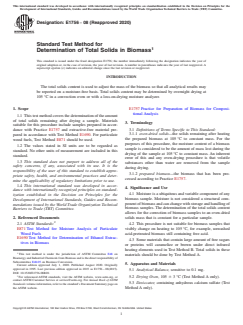
Designation:E1756 −08 (Reapproved 2020)
Standard Test Method for
Determination of Total Solids in Biomass
This standard is issued under the fixed designation E1756; the number immediately following the designation indicates the year of
original adoption or, in the case of revision, the year of last revision. A number in parentheses indicates the year of last reapproval. A
superscript epsilon (´) indicates an editorial change since the last revision or reapproval.
INTRODUCTION
The total solids content is used to adjust the mass of the biomass so that all analytical results may
be reported on a moisture-free basis. Total solids content may be determined by overnight drying at
105 °C in a convection oven or with a loss-on-drying moisture analyzer.
1. Scope E1757 Practice for Preparation of Biomass for Composi-
tional Analysis
1.1 This test method covers the determination of the amount
of total solids remaining after drying a sample. Materials
3. Terminology
suitable for this procedure include samples prepared in accor-
3.1 Definitions of Terms Specific to This Standard:
dance with Practice E1757 and extractive-free material pre-
3.1.1 oven-dried solids—the solids remaining after heating
pared in accordance with Test Method E1690. For particulate
the prepared biomass at 105 °C to constant mass. For the
wood fuels, Test Method E871 should be used.
purposes of this procedure, the moisture content of a biomass
1.2 The values stated in SI units are to be regarded as
sample is considered to be the amount of mass lost during the
standard. No other units of measurement are included in this
drying of the sample at 105 °C to constant mass. An inherent
standard.
error of this and any oven-drying procedure is that volatile
1.3 This standard does not purport to address all of the
substances other than water are removed from the sample
safety concerns, if any, associated with its use. It is the
during drying.
responsibility of the user of this standard to establish appro-
3.1.2 prepared biomass—the biomass that has been pro-
priate safety, health, and environmental practices and deter-
cessed according to Practice E1757.
mine the applicability of regulatory limitations prior to use.
1.4 This international standard was developed in accor-
4. Significance and Use
dance with internationally recognized principles on standard-
4.1 Moisture is a ubiquitous and variable component of any
ization established in the Decision on Principles for the
biomass sample. Moisture is not considered a structural com-
Development of International Standards, Guides and Recom-
ponentofbiomassandcanchangewithstorageandhandlingof
mendations issued by the World Trade Organization Technical
biomass samples. The determination of the total solids content
Barriers to Trade (TBT) Committee.
allows for the correction of biomass samples to an oven-dried
2. Referenced Documents
solids mass that is constant for a particular sample.
2.1 ASTM Standards:
4.2 This procedure is not suitable for biomass samples that
E871 Test Method for Moisture Analysis of Particulate
visibly change on heating to 105 °C, for example, unwashed
Wood Fuels
acid-pretreated biomass still containing free acid.
E1690 Test Method for Determination of Ethanol Extrac-
4.3 Some materials that contain large amount of free sugars
tives in Biomass
or proteins will caramelize or brown under direct infrared
heating elements used in Test Method B. Total solids in these
This test method is under the jurisdiction of ASTM Committee E48 on
materials should be done by Test Method A.
Bioenergy and Industrial Chemicals from Biomass and is the direct responsibility of
Subcommittee E48.05 on Biomass Conversion.
5. Apparatus and Materials
Current edition approved July 1, 2020. Published August 2020. Originally
approved in 1995. Last previous edition approved in 2015 as E1756 – 08(2015).
5.1 Analytical Balance, sensitive to 0.1 mg.
DOI: 10.1520/E1756-08R20.
For referenced ASTM standards, visit the ASTM website, www.astm.org, or 5.2 Drying Oven, 105 6 3 °C (Test Method A only).
contact ASTM Customer Service at service@astm.org. For Annual Book of ASTM
5.3 Desiccator, containing anhydrous calcium sulfate (Test
Standards volume information, refer to the standard’s Document Summary page on
the ASTM website. Method A only).
Copyright © ASTM International, 100 Barr Harbor Drive, PO Box C700, West Conshohocken, PA 19428-2959. United States
E1756−08 (2020)
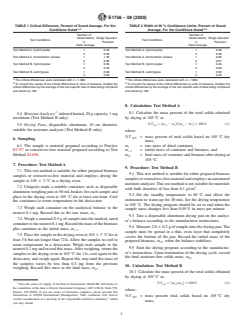
TABLE 1 Critical Difference, Percent of Grand Average, For the TABLE 2 Width of 95% Confidence Limits, Percent of Grand
A,B A,B
Conditions Noted Average, For the Conditions Noted
Number of Number of
Observations Single Operator Observations Single Operator
Test Conditions Test Conditions
in Precision in Precision
Each Average Each Average
Test Method A, hybrid poplar 1 0.55 Test Method A, hybrid poplar 1 0.39
2 0.39 2 0.28
Test Method A, fermentation residue 1 1.35 Test Method A, fermentation residue 1 0.95
2 0.95 2 0.67
Test Method B, hybrid poplar 1 0.56 Test Method B, hybrid poplar 1 0.40
2 0.40 2 0.28
Test Method B, switchgrass 1 0.89 Test Method B, switchgrass 1 0.63
2 0.63 2 0.45
A A
The critical differences were calculated with z = 1.960. The critical differences were calculated with z = 1.960.
B B
To convert the values of the critical differences to units of measure, multiply the To convert the values of the critical differences to units of measure, multiply the
critical differences by the average of the two specific sets of data being compared critical differences by the average of the two specific sets of data being compared
and divide by 100. and divide by 100.
8. Calculation: Test Method A
8.1 Calculate the mass percent of the total solids obtained
5.4 MoistureAnalyzer, infraredheated,20gcapacity,1mg
by drying at 105 °C as
resolution (Test Method B only).
%T 5 m 2 m / m 2 m 3100% (1)
~ ! ~ !
5.5 Drying Pans, disposable, aluminum, 10 cm diameter, 105 f1 t i1 t
suitable for moisture analyzer (Test Method B only).
where:
%T = mass percent of total solids based on 105 °C dry
6. Sampling
mass,
6.1 The sample is material prepared according to Practice
m = tare m
...