

ASTM F2440-24
(Specification)Standard Specification for Impact Attenuation of Wall Padding Used in Indoor Competitive and Recreational Sports Venues
General Information
- Abstract
ABSTRACT
This specification covers wall padding and padding for other indoor structures. All padding constructions are included. Qualification of construction designs and comparison of products shall be discussed. The padding can be classified into two types: Type 1 for permanently attached paddings and Type 2 for removable paddings. The paddings can also be classified into grades: Grade A for coated paddings and Grade B for covered or encased paddings. Physical properties such as shock absorption, gmax, HIC, and thickness shall be determined.
SIGNIFICANCE AND USE
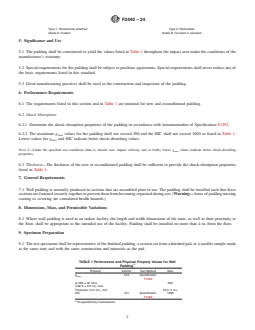
5.1 The padding shall be constructed to yield the values listed in Table 1 throughout the impact area under the conditions of the manufacturer's warranty. (A) As specified by manufacturer
5.2 Special requirements for the padding shall be subject to purchase agreements. Special requirements shall never reduce any of the basic requirements listed in this standard.
5.3 Good manufacturing practices shall be used in the construction and inspection of the padding.
SCOPE
1.1 This specification covers wall padding and padding for other indoor structures. All padding constructions are included. The intended use of this specification is for the qualification of construction designs and comparison of products.
Note 1: This specification was developed due to the numerous designs in existence and the need to provide a method to determine if a wall pad meets a minimum level of protection.
Note 2: There is no equivalent ISO standard.
1.2 The values as stated in SI units are to be regarded as the standard. The values in parentheses are given for information only.
1.3 This standard does not purport to address all of the safety concerns, if any, associated with its use. It is the responsibility of the user of this standard to establish appropriate safety, health, and environmental practices and determine the applicability of regulatory limitations prior to use. See 7.1 for specific hazards statement.
1.4 This international standard was developed in accordance with internationally recognized principles on standardization established in the Decision on Principles for the Development of International Standards, Guides and Recommendations issued by the World Trade Organization Technical Barriers to Trade (TBT) Committee.
- Status
- Published
- Publication Date
- 31-Jan-2024
- Technical Committee
- F08 - Sports Equipment, Playing Surfaces, and Facilities
- Drafting Committee
- F08.12 - Gymnastics and Wrestling Equipment
Buy Documents


ASTM F2440-24 - Standard Specification for Impact Attenuation of Wall Padding Used in Indoor Competitive and Recreational Sports Venues


REDLINE ASTM F2440-24 - Standard Specification for Impact Attenuation of Wall Padding Used in Indoor Competitive and Recreational Sports Venues
Overview
ASTM F2440-24: Standard Specification for Impact Attenuation of Wall Padding Used in Indoor Competitive and Recreational Sports Venues establishes clear criteria for the safety, performance, and classification of wall padding in indoor sports environments. The standard covers all types of padding constructions used to protect participants in competitive and recreational settings, such as gymnasiums, arenas, and other indoor sports venues. This specification is vital for facility managers, architects, manufacturers, and safety officers seeking to ensure wall padding meets essential impact attenuation requirements to help prevent injuries.
Key Topics
Scope and Purpose
- Applies to all wall padding and padding for other indoor structures regardless of construction design.
- Provides a unified method to evaluate and compare the protective effectiveness of different products.
- Addresses minimum protection levels given the variety of available designs.
Types and Grades
- Type 1: Permanently attached padding
- Type 2: Removable padding
- Grade A: Coated padding (e.g., PVC or similar polymeric coatings)
- Grade B: Covered or encased padding
Performance Indicators
- Shock absorption: Measured using standardized methods to ensure user protection.
- gmax and HIC (Head Injury Criterion): Limiting maximum g-force and HIC values to protect against injury.
- Minimum Thickness: Ensures baseline physical protection.
- Requirements for both new and reconditioned padding.
Manufacturing and Installation
- Good manufacturing practices are required throughout production and inspection.
- Padding sections must be securely fastened to prevent dislocation during use.
- Dimensions and proximity to the floor must align with facility requirements.
Applications
ASTM F2440-24 is directly applicable to:
- Indoor Sports Facilities: Gymnasiums, multi-purpose arenas, school gymnasiums, community recreation centers, and professional training facilities.
- Design and Construction: Assists architects, engineers, and contractors in specifying compliant wall protection systems during new construction or facility renovation.
- Product Comparison and Procurement: Provides buyers, facility managers, and operators with standardized measures to qualify, compare, and select wall padding products based on safety and performance.
- Maintenance and Facility Upgrades: Supports ongoing testing and replacement of padding to meet the minimum impact attenuation requirements, ensuring continued athlete and participant safety.
- Inspection and Compliance: Used by inspectors and safety officers to verify conformity with established safety standards in sports venues.
Related Standards
- ASTM F1292: Specification for Impact Attenuation of Surfacing Materials Within the Use Zone of Playground Equipment. This referenced standard provides test methods and performance criteria for shock attenuation, relevant for wall padding in sports applications.
- There is no equivalent ISO standard for indoor wall padding impact attenuation as of the publication date of ASTM F2440-24.
Practical Value
Specifying and using wall padding in accordance with ASTM F2440-24 ensures a standardized level of impact protection in indoor athletic venues, minimizing the risk of serious injury. The standard offers clarity in product classification, performance criteria, and testing methods, assisting stakeholders in achieving and verifying optimal safety. Whether applied in new facility design, product selection, or ongoing safety verification, ASTM F2440-24 is essential for anyone involved in the construction, outfitting, or management of indoor sports spaces.
Keywords: ASTM F2440-24, wall padding, impact attenuation, indoor sports safety, shock absorption, gmax, HIC, gymnasium wall protection, facility safety standards.
Relations
- Effective Date
- 01-Feb-2024
Buy Documents
ASTM F2440-24 - Standard Specification for Impact Attenuation of Wall Padding Used in Indoor Competitive and Recreational Sports Venues
REDLINE ASTM F2440-24 - Standard Specification for Impact Attenuation of Wall Padding Used in Indoor Competitive and Recreational Sports Venues
Get Certified
Connect with accredited certification bodies for this standard

DIBt (Deutsches Institut für Bautechnik)
German Institute for Building Technology.
DIN CERTCO
DIN Group product certification.

Aboma Certification B.V.
Specialized in construction, metal, and transport sectors.
Sponsored listings
Frequently Asked Questions
ASTM F2440-24 is a technical specification published by ASTM International. Its full title is "Standard Specification for Impact Attenuation of Wall Padding Used in Indoor Competitive and Recreational Sports Venues". This standard covers: ABSTRACT This specification covers wall padding and padding for other indoor structures. All padding constructions are included. Qualification of construction designs and comparison of products shall be discussed. The padding can be classified into two types: Type 1 for permanently attached paddings and Type 2 for removable paddings. The paddings can also be classified into grades: Grade A for coated paddings and Grade B for covered or encased paddings. Physical properties such as shock absorption, gmax, HIC, and thickness shall be determined. SIGNIFICANCE AND USE 5.1 The padding shall be constructed to yield the values listed in Table 1 throughout the impact area under the conditions of the manufacturer's warranty. (A) As specified by manufacturer 5.2 Special requirements for the padding shall be subject to purchase agreements. Special requirements shall never reduce any of the basic requirements listed in this standard. 5.3 Good manufacturing practices shall be used in the construction and inspection of the padding. SCOPE 1.1 This specification covers wall padding and padding for other indoor structures. All padding constructions are included. The intended use of this specification is for the qualification of construction designs and comparison of products. Note 1: This specification was developed due to the numerous designs in existence and the need to provide a method to determine if a wall pad meets a minimum level of protection. Note 2: There is no equivalent ISO standard. 1.2 The values as stated in SI units are to be regarded as the standard. The values in parentheses are given for information only. 1.3 This standard does not purport to address all of the safety concerns, if any, associated with its use. It is the responsibility of the user of this standard to establish appropriate safety, health, and environmental practices and determine the applicability of regulatory limitations prior to use. See 7.1 for specific hazards statement. 1.4 This international standard was developed in accordance with internationally recognized principles on standardization established in the Decision on Principles for the Development of International Standards, Guides and Recommendations issued by the World Trade Organization Technical Barriers to Trade (TBT) Committee.
ABSTRACT This specification covers wall padding and padding for other indoor structures. All padding constructions are included. Qualification of construction designs and comparison of products shall be discussed. The padding can be classified into two types: Type 1 for permanently attached paddings and Type 2 for removable paddings. The paddings can also be classified into grades: Grade A for coated paddings and Grade B for covered or encased paddings. Physical properties such as shock absorption, gmax, HIC, and thickness shall be determined. SIGNIFICANCE AND USE 5.1 The padding shall be constructed to yield the values listed in Table 1 throughout the impact area under the conditions of the manufacturer's warranty. (A) As specified by manufacturer 5.2 Special requirements for the padding shall be subject to purchase agreements. Special requirements shall never reduce any of the basic requirements listed in this standard. 5.3 Good manufacturing practices shall be used in the construction and inspection of the padding. SCOPE 1.1 This specification covers wall padding and padding for other indoor structures. All padding constructions are included. The intended use of this specification is for the qualification of construction designs and comparison of products. Note 1: This specification was developed due to the numerous designs in existence and the need to provide a method to determine if a wall pad meets a minimum level of protection. Note 2: There is no equivalent ISO standard. 1.2 The values as stated in SI units are to be regarded as the standard. The values in parentheses are given for information only. 1.3 This standard does not purport to address all of the safety concerns, if any, associated with its use. It is the responsibility of the user of this standard to establish appropriate safety, health, and environmental practices and determine the applicability of regulatory limitations prior to use. See 7.1 for specific hazards statement. 1.4 This international standard was developed in accordance with internationally recognized principles on standardization established in the Decision on Principles for the Development of International Standards, Guides and Recommendations issued by the World Trade Organization Technical Barriers to Trade (TBT) Committee.
ASTM F2440-24 is classified under the following ICS (International Classification for Standards) categories: 91.180 - Interior finishing. The ICS classification helps identify the subject area and facilitates finding related standards.
ASTM F2440-24 has the following relationships with other standards: It is inter standard links to ASTM F2440-18. Understanding these relationships helps ensure you are using the most current and applicable version of the standard.
ASTM F2440-24 is available in PDF format for immediate download after purchase. The document can be added to your cart and obtained through the secure checkout process. Digital delivery ensures instant access to the complete standard document.
Standards Content (Sample)
This international standard was developed in accordance with internationally recognized principles on standardization established in the Decision on Principles for the
Development of International Standards, Guides and Recommendations issued by the World Trade Organization Technical Barriers to Trade (TBT) Committee.
Designation: F2440 − 24 An American National Standard
Standard Specification for
Impact Attenuation of Wall Padding Used in Indoor
Competitive and Recreational Sports Venues
This standard is issued under the fixed designation F2440; the number immediately following the designation indicates the year of
original adoption or, in the case of revision, the year of last revision. A number in parentheses indicates the year of last reapproval. A
superscript epsilon (´) indicates an editorial change since the last revision or reapproval.
1. Scope 3.1.1 coating—polyvinyl chloride (PVC) or PVC
copolymer, or both, or other suitable polymeric materials.
1.1 This specification covers wall padding and padding for
other indoor structures. All padding constructions are included.
4. Classification
The intended use of this specification is for the qualification of
4.1 Classify padding in accordance with the specific appli-
construction designs and comparison of products.
cation.
NOTE 1—This specification was developed due to the numerous designs
Type 1: Permanently attached Type 2: Removable
in existence and the need to provide a method to determine if a wall pad
Grade A: Coated Grade B: Covered or encased
meets a minimum level of protection.
NOTE 2—There is no equivalent ISO standard.
5. Significance and Use
1.2 The values as stated in SI units are to be regarded as the
5.1 The padding shall be constructed to yield the values
standard. The values in parentheses are given for information
listed in Table 1 throughout the impact area under the condi-
only.
tions of the manufacturer’s warranty.
1.3 This standard does not purport to address all of the
5.2 Special requirements for the padding shall be subject to
safety concerns, if any, associated with its use. It is the
purchase agreements. Special requirements shall never reduce
responsibility of the user of this standard to establish appro-
any of the basic requirements listed in this standard.
priate safety, health, and environmental practices and deter-
mine the applicability of regulatory limitations prior to use.
5.3 Good manufacturing practices shall be used in the
See 7.1 for specific hazards statement.
construction and inspection of the padding.
1.4 This international standard was developed in accor-
dance with internationally recognized principles on standard- 6. Performance Requirements
ization established in the Decision on Principles for the
6.1 The requirements listed in this section and in Table 1 are
Development of International Standards, Guides and Recom-
minimal for new and reconditioned padding.
mendations issued by the World Trade Organization Technical
6.2 Shock Absorption:
Barriers to Trade (TBT) Committee.
6.2.1 Determine the shock absorption properties of the
padding in accordance with instrumentation of Specification
2. Referenced Documents
F1292.
2.1 ASTM Standards:
6.2.2 The maximum g values for the padding shall not
max
F1292 Specification for Impact Attenuation of Surfacing
exceed 200 and the HIC shall not exceed 1000 as listed in
Materials Within the Use Zone of Playground Equipment
Table 1. Lower values for g and HIC indicate better
max
shock-absorbing values.
3. Terminology
NOTE 3—Under the specified test conditions (that is, missile size,
3.1 Definitions of Terms Specific to This Standard:
impact velocity, and so forth), lower g values indicate better shock-
max
absorbing properties.
1 6.3 Thickness—The thickness of the new or reconditioned
This specification is under the jurisdiction of ASTM Committee F08 on Sports
Equipment, Playing Surfaces, and Facilitiesand is the direct responsibility of
padding shall be sufficient to provide the shock-absorption
Subcommittee F08.12 on Gymnastics and Wrestling Equipment.
properties listed in Table 1.
Current e
...
This document is not an ASTM standard and is intended only to provide the user of an ASTM standard an indication of what changes have been made to the previous version. Because
it may not be technically possible to adequately depict all changes accurately, ASTM recommends that users consult prior editions as appropriate. In all cases only the current version
of the standard as published by ASTM is to be considered the official document.
Designation: F2440 − 18 F2440 − 24 An American National Standard
Standard Specification for
Indoor Wall/Feature PaddingImpact Attenuation of Wall
Padding Used in Indoor Competitive and Recreational
Sports Venues
This standard is issued under the fixed designation F2440; the number immediately following the designation indicates the year of
original adoption or, in the case of revision, the year of last revision. A number in parentheses indicates the year of last reapproval. A
superscript epsilon (´) indicates an editorial change since the last revision or reapproval.
1. Scope
1.1 This specification covers wall padding and padding for other indoor structures. All padding constructions are included. The
intended use of this specification is for the qualification of construction designs and comparison of products.
NOTE 1—This specification was developed due to the numerous designs in existence and the need to provide a method to determine if a wall pad meets
a minimum level of protection.
NOTE 2—There is no equivalent ISO standard.
1.2 The values as stated in SI units are to be regarded as the standard. The values in parentheses are given for information only.
1.3 This standard does not purport to address all of the safety concerns, if any, associated with its use. It is the responsibility
of the user of this standard to establish appropriate safety, health, and environmental practices and determine the applicability of
regulatory limitations prior to use. See 7.1 for specific hazards statement.
1.4 This international standard was developed in accordance with internationally recognized principles on standardization
established in the Decision on Principles for the Development of International Standards, Guides and Recommendations issued
by the World Trade Organization Technical Barriers to Trade (TBT) Committee.
2. Referenced Documents
2.1 ASTM Standards:
F1292 Specification for Impact Attenuation of Surfacing Materials Within the Use Zone of Playground Equipment
3. Terminology
3.1 Definitions of Terms Specific to This Standard:
3.1.1 coating—polyvinyl chloride (PVC) or PVC copolymer, or both, or other suitable polymeric materials.
4. Classification
4.1 Classify padding in accordance with the specific application.
This specification is under the jurisdiction of ASTM Committee F08 on Sports Equipment, Playing Surfaces, and Facilitiesand is the direct responsibility of Subcommittee
F08.12 on Gymnastics and Wrestling Equipment.
Current edition approved Nov. 1, 2018Feb. 1, 2024. Published December 2018February 2024. Originally approved in 2004. Last previous edition approved in 20112018
as F2440 – 11.F2440 – 18. DOI: 10.1520/F2440-18.10.1520/F2440-24.
For referenced ASTM standards, visit the ASTM website, www.astm.org, or contact ASTM Customer Service at service@astm.org. For Annual Book of ASTM Standards
volume information, refer to the standard’s Document Summary page on the ASTM website.
Copyright © ASTM International, 100 Barr Harbor Drive, PO Box C700, West Conshohocken, PA 19428-2959. United States
F2440 − 24
Type 1: Permanently attached Type 2: Removable
Grade A: Coated Grade B: Covered or encased
5. Significance and Use
5.1 The padding shall be constructed to yield the values listed in Table 1 throughout the impact area under the conditions of the
manufacturer’s warranty.
5.2 Special requirements for the padding shall be subject to purchase agreements. Special requirements shall never reduce any of
the basic requirements listed in this standard.
5.3 Good manufacturing practices shall be used in the construction and inspection of the padding.
6. Performance Requirements
6.1 The requirements listed in this section and in Table 1 are minimal for new and recondi
...