

ASTM F3518-21
(Guide)Standard Guide for Quantitative Measures for Establishing Exoskeleton Functional Ergonomic Parameters and Test Metrics
General Information
- Abstract
SIGNIFICANCE AND USE
4.1 This guide provides a set of recommended quantitative measures which can be used to assess the task or human readiness, or both, of exoskeletons. All of the quantitative measures are used in ergonomic research to assist in objectively concluding the efficacy of an assessed metric.
4.2 Not every element of this guide may be applicable to all exoskeleton components or configurations. Nor are all the quantitative measures herein exhaustive. Selection of quantitative measures should be done based on the uncertainties surrounding the end use application of the exoskeleton. It is the manufacturer’s responsibility to determine which portions of this guide, and the corresponding measures, are applicable to their exoskeletons.
4.3 The ability to reproduce analysis between exoskeleton usage vs. non-exoskeleton usage is critical criteria in using a quantitative measures approach. A control method for reproducibility in a quantitative measures approach is a repeated measures design. A repeated measures design involves multiple measures of the same variable taken on the same end user, either under different conditions or over two or more time periods. The salient aspect of a repeated measures design is using the end user as the control.
SCOPE
1.1 This guide provides quantitative measures for assessing one or more specific ergonomic parameters with respect to exoskeletons. Furthermore, this guide should be used in conjunction with Practice F3474, Guide F3519, and Standard Guide for The Application of Ergonomics to Prevent Injury During Exoskeleton Use2.
1.2 This guide provides quantitative measures for the design, use, and construction of exoskeletons within the domains of industry, military, medical, first responders, and recreational.
1.2.1 Quantitative measures are a type of data that can be put into a numerical value. This type of measure allows statistical analysis to be performed on the data to yield an objective result.
1.3 Units—The values stated in SI units are to be regarded as the standard. No other units of measurement are included in this standard.
1.4 This standard does not purport to address all of the safety concerns, if any, associated with its use. It is the responsibility of the user of this standard to establish appropriate safety, health, and environmental practices and determine the applicability of regulatory limitations prior to use.
1.5 This international standard was developed in accordance with internationally recognized principles on standardization established in the Decision on Principles for the Development of International Standards, Guides and Recommendations issued by the World Trade Organization Technical Barriers to Trade (TBT) Committee.
- Status
- Published
- Publication Date
- 14-Jun-2021
- Technical Committee
- F48 - Exoskeletons and Exosuits
- Drafting Committee
- F48.02 - Human Factors and Ergonomics
Overview
ASTM F3518-21: Standard Guide for Quantitative Measures for Establishing Exoskeleton Functional Ergonomic Parameters and Test Metrics provides a comprehensive framework for assessing ergonomic performance and usability of exoskeletons. Developed by ASTM International, this guide outlines tangible, repeatable quantitative methods for evaluating exoskeleton function within domains such as industrial, military, medical, first responder, and recreational applications. The standard is aligned with internationally recognized principles and supports harmonization in testing, ensuring objective assessment and comparability of results.
Key Topics
Quantitative Measures Selection
- Recommends a range of quantitative approaches to assess exoskeleton impact, addressing both human readiness and task performance.
- Emphasizes flexibility: guidance must be tailored to specific exoskeleton types, use cases, and uncertainties in application.
- Manufacturers have responsibility for selecting applicable measures.
Core Test Metrics
- Electromyography (EMG): Measures muscle activity and fatigue for targeted muscles, offering insight into exertion levels with and without exoskeleton assistance.
- Motion Capture (MoCap): Quantifies range of motion and joint angles during tasks, highlighting potential restrictions or benefits from exoskeleton use.
- Completion Time: Compares task duration as a metric of efficiency or potential hindrance.
- Pressure Mapping: Evaluates contact pressure between user and device to prevent discomfort, tissue damage, or blood flow restriction.
- 3D Volumetric Changes: Assesses body dimension changes with exoskeleton to support fit and mobility analysis.
- Near-Infrared Spectroscopy (NIRS): Monitors muscle oxygenation and fatigue during activity.
- Energy Consumption & Metabolic Rate: Analyzes physiological effort using heart rate, oxygen, and carbon dioxide monitoring.
- Strength Assessment: Utilizes dynamometers and force plates to objectively measure user strength in relevant tasks.
- Heart Rate Variability (HRV): Monitors physiological stress and adaptation during exoskeleton operation.
Test Design and Reproducibility
- Advocates for repeated measures designs to ensure reliability by comparing individual users’ performance with and without exoskeletons.
Applications
Research and Development
- Supports exoskeleton manufacturers and designers in assessing functional performance, ensuring ergonomic suitability, and improving user safety and comfort.
- Provides scientists and engineers with standardized methods for objective data collection, comparison, and statistical analysis.
Product Certification and Quality Assurance
- Facilitates third-party testing and regulatory approval by establishing clearly defined, quantitative test metrics.
- Enhances reproducibility and comparability of results across products and studies.
End-User Validation
- Enables industrial, healthcare, military, and emergency response organizations to validate exoskeleton effectiveness for task-specific applications.
- Informs decisions on adoption, customization, and worker training based on objective ergonomic performance data.
Occupational Health and Safety
- Assists ergonomists and safety professionals in identifying risks and optimizing intervention strategies to reduce musculoskeletal injury and fatigue.
Related Standards
ASTM F3518-21 refers to and should be used in conjunction with several other key ASTM standards for exoskeletons and ergonomics, including:
- ASTM F3474: Practice for Establishing Exoskeleton Functional Ergonomic Parameters and Test Metrics
- ASTM F3519: Guide for Establishing a Reporting Structure for Exoskeleton Analysis
- Guide for The Application of Ergonomics to Prevent Injury During Exoskeleton Use
- Relevant Ergonomics and Population Accommodation Guidelines
Summary of Value
By offering a robust, objective system of ergonomic performance assessment, ASTM F3518-21 enables manufacturers, researchers, and end-users to systematically evaluate and compare exoskeleton solutions, optimize design and usage, and enhance health and safety outcomes. This standard is a critical resource for anyone involved in exoskeleton development, testing, procurement, or ergonomic research, ensuring that innovations in wearable robotics are both effective and user-centered.
Get Certified
Connect with accredited certification bodies for this standard

BSI Group
BSI (British Standards Institution) is the business standards company that helps organizations make excellence a habit.

TÜV Rheinland
TÜV Rheinland is a leading international provider of technical services.

TÜV SÜD
TÜV SÜD is a trusted partner of choice for safety, security and sustainability solutions.
Sponsored listings
Frequently Asked Questions
ASTM F3518-21 is a guide published by ASTM International. Its full title is "Standard Guide for Quantitative Measures for Establishing Exoskeleton Functional Ergonomic Parameters and Test Metrics". This standard covers: SIGNIFICANCE AND USE 4.1 This guide provides a set of recommended quantitative measures which can be used to assess the task or human readiness, or both, of exoskeletons. All of the quantitative measures are used in ergonomic research to assist in objectively concluding the efficacy of an assessed metric. 4.2 Not every element of this guide may be applicable to all exoskeleton components or configurations. Nor are all the quantitative measures herein exhaustive. Selection of quantitative measures should be done based on the uncertainties surrounding the end use application of the exoskeleton. It is the manufacturer’s responsibility to determine which portions of this guide, and the corresponding measures, are applicable to their exoskeletons. 4.3 The ability to reproduce analysis between exoskeleton usage vs. non-exoskeleton usage is critical criteria in using a quantitative measures approach. A control method for reproducibility in a quantitative measures approach is a repeated measures design. A repeated measures design involves multiple measures of the same variable taken on the same end user, either under different conditions or over two or more time periods. The salient aspect of a repeated measures design is using the end user as the control. SCOPE 1.1 This guide provides quantitative measures for assessing one or more specific ergonomic parameters with respect to exoskeletons. Furthermore, this guide should be used in conjunction with Practice F3474, Guide F3519, and Standard Guide for The Application of Ergonomics to Prevent Injury During Exoskeleton Use2. 1.2 This guide provides quantitative measures for the design, use, and construction of exoskeletons within the domains of industry, military, medical, first responders, and recreational. 1.2.1 Quantitative measures are a type of data that can be put into a numerical value. This type of measure allows statistical analysis to be performed on the data to yield an objective result. 1.3 Units—The values stated in SI units are to be regarded as the standard. No other units of measurement are included in this standard. 1.4 This standard does not purport to address all of the safety concerns, if any, associated with its use. It is the responsibility of the user of this standard to establish appropriate safety, health, and environmental practices and determine the applicability of regulatory limitations prior to use. 1.5 This international standard was developed in accordance with internationally recognized principles on standardization established in the Decision on Principles for the Development of International Standards, Guides and Recommendations issued by the World Trade Organization Technical Barriers to Trade (TBT) Committee.
SIGNIFICANCE AND USE 4.1 This guide provides a set of recommended quantitative measures which can be used to assess the task or human readiness, or both, of exoskeletons. All of the quantitative measures are used in ergonomic research to assist in objectively concluding the efficacy of an assessed metric. 4.2 Not every element of this guide may be applicable to all exoskeleton components or configurations. Nor are all the quantitative measures herein exhaustive. Selection of quantitative measures should be done based on the uncertainties surrounding the end use application of the exoskeleton. It is the manufacturer’s responsibility to determine which portions of this guide, and the corresponding measures, are applicable to their exoskeletons. 4.3 The ability to reproduce analysis between exoskeleton usage vs. non-exoskeleton usage is critical criteria in using a quantitative measures approach. A control method for reproducibility in a quantitative measures approach is a repeated measures design. A repeated measures design involves multiple measures of the same variable taken on the same end user, either under different conditions or over two or more time periods. The salient aspect of a repeated measures design is using the end user as the control. SCOPE 1.1 This guide provides quantitative measures for assessing one or more specific ergonomic parameters with respect to exoskeletons. Furthermore, this guide should be used in conjunction with Practice F3474, Guide F3519, and Standard Guide for The Application of Ergonomics to Prevent Injury During Exoskeleton Use2. 1.2 This guide provides quantitative measures for the design, use, and construction of exoskeletons within the domains of industry, military, medical, first responders, and recreational. 1.2.1 Quantitative measures are a type of data that can be put into a numerical value. This type of measure allows statistical analysis to be performed on the data to yield an objective result. 1.3 Units—The values stated in SI units are to be regarded as the standard. No other units of measurement are included in this standard. 1.4 This standard does not purport to address all of the safety concerns, if any, associated with its use. It is the responsibility of the user of this standard to establish appropriate safety, health, and environmental practices and determine the applicability of regulatory limitations prior to use. 1.5 This international standard was developed in accordance with internationally recognized principles on standardization established in the Decision on Principles for the Development of International Standards, Guides and Recommendations issued by the World Trade Organization Technical Barriers to Trade (TBT) Committee.
ASTM F3518-21 is classified under the following ICS (International Classification for Standards) categories: 11.180.10 - Aids and adaptation for moving. The ICS classification helps identify the subject area and facilitates finding related standards.
ASTM F3518-21 is available in PDF format for immediate download after purchase. The document can be added to your cart and obtained through the secure checkout process. Digital delivery ensures instant access to the complete standard document.
Standards Content (Sample)
This international standard was developed in accordance with internationally recognized principles on standardization established in the Decision on Principles for the
Development of International Standards, Guides and Recommendations issued by the World Trade Organization Technical Barriers to Trade (TBT) Committee.
Designation: F3518 − 21
Standard Guide for
Quantitative Measures for Establishing Exoskeleton
Functional Ergonomic Parameters and Test Metrics
This standard is issued under the fixed designation F3518; the number immediately following the designation indicates the year of
original adoption or, in the case of revision, the year of last revision. A number in parentheses indicates the year of last reapproval. A
superscript epsilon (´) indicates an editorial change since the last revision or reapproval.
1. Scope F3474 Practice for Establishing Exoskeleton Functional Er-
gonomic Parameters and Test Metrics
1.1 This guide provides quantitative measures for assessing
F3519 Guide for Establishing a Reporting Structure for
one or more specific ergonomic parameters with respect to
Exoskeleton Analysis
exoskeletons. Furthermore, this guide should be used in
conjunction with Practice F3474, Guide F3519, and Standard
3. Terminology
Guide for The Application of Ergonomics to Prevent Injury
During Exoskeleton Use . 3.1 Definitions:
3.1.1 dynamometer, n—instrument that measures the force
1.2 This guide provides quantitative measures for the
output of grip strength.
design, use, and construction of exoskeletons within the
domains of industry, military, medical, first responders, and 3.1.2 electromyography, n—recording of the electrical ac-
tivity of muscle tissue using electrodes to the skin or inserted
recreational.
into the muscle belly.
1.2.1 Quantitative measures are a type of data that can be
put into a numerical value. This type of measure allows
3.1.3 heart rate, n—speed with which the heart beats,
statistical analysis to be performed on the data to yield an
measured in the number of contractions of the heart over the
objective result.
course of a minute.
1.3 Units—The values stated in SI units are to be regarded
3.1.4 heart rate variability, n—variationofthetimebetween
as the standard. No other units of measurement are included in
each heartbeat, specifically, the variation of the “R” to “R”
this standard.
intervals of the heartbeat QRS component.
1.4 This standard does not purport to address all of the
3.1.5 kinematics, n—branch of mechanics concerned with
safety concerns, if any, associated with its use. It is the
the motion of objects without reference to the forces that cause
responsibility of the user of this standard to establish appro-
the motion.
priate safety, health, and environmental practices and deter-
3.1.6 motion capture, n—process or technique of recording
mine the applicability of regulatory limitations prior to use.
patterns of movement digitally.
1.5 This international standard was developed in accor-
3.1.7 non-invasive, adj—not requiring the introduction of
dance with internationally recognized principles on standard-
instruments into the body.
ization established in the Decision on Principles for the
3.1.8 oscilloscope, n—device for viewing oscillations, as of
Development of International Standards, Guides and Recom-
electrical voltage or current, by a display on the screen of a
mendations issued by the World Trade Organization Technical
cathode ray tube.
Barriers to Trade (TBT) Committee.
2. Referenced Documents
4. Significance and Use
2.1 ASTM Standards:
4.1 This guide provides a set of recommended quantitative
measures which can be used to assess the task or human
readiness, or both, of exoskeletons. All of the quantitative
This guide is under the jurisdiction ofASTM Committee F48 on Exoskeletons
measures are used in ergonomic research to assist in objec-
and Exosuits and is the direct responsibility of Subcommittee F48.02 on Human
Factors and Ergonomics.
tively concluding the efficacy of an assessed metric.
Current edition approved June 15, 2021. Published July 2021. DOI: 10.1520/
4.2 Not every element of this guide may be applicable to all
F3518-21.
Unpublished ASTM standard under development.
exoskeleton components or configurations. Nor are all the
For referenced ASTM standards, visit the ASTM website, www.astm.org, or
quantitative measures herein exhaustive. Selection of quanti-
contact ASTM Customer Service at service@astm.org. For Annual Book of ASTM
tative measures should be done based on the uncertainties
Standards volume information, refer to the standard’s Document Summary page on
the ASTM website. surroundingtheenduseapplicationoftheexoskeleton.Itisthe
Copyright © ASTM International, 100 Barr Harbor Drive, PO Box C700, West Conshohocken, PA 19428-2959. United States
F3518 − 21
manufacturer’s responsibility to determine which portions of specific task based on the required evaluation. The MVICs are
this guide, and the corresponding measures, are applicable to then averaged, bandpass filtered, and a root mean square
their exoskeletons. (RMS) is calculated to result in a single number for each
assessed muscle. This number is applied to the bandpass-
4.3 The ability to reproduce analysis between exoskeleton
filtered RMS value of the task evaluation results to conclude a
usage vs. non-exoskeleton usage is critical criteria in using a
percent MVIC of the user’s muscle exertion.
quantitative measures approach. A control method for repro-
5.1.2.1 Percent MVIC Reference Posture—The postures,
ducibility in a quantitative measures approach is a repeated
positions, or movement patterns, or combinations thereof,
measuresdesign.Arepeatedmeasuresdesigninvolvesmultiple
adopted to perform percent MVIC should correlate to the task
measures of the same variable taken on the same end user,
thattheuserwillperform.Forexample,ifataskrequiresauser
either under different conditions or over two or more time
to perform a pointing task and the muscle of interest is the
periods. The salient aspect of a repeated measures design is
anterior deltoid, then the percent MVIC should not use any
using the end user as the control.
resistance for the isometric contraction. Rather, the task should
5. Quantitative Measures
be performed by the user flexing their arm anteriorly without
bending their elbow. For example, if the task requires lifting
5.1 Electromyography (EMG)—EMG uses electrodes to
cans of paint from one table to another, and the muscle of
measure the electrical activity of contracting skeletal muscles.
interestisstilltheanteriordeltoid,thentheusershouldperform
There are several types of EMG depending on the type of
a resisted isometric contraction against an immovable object
electrodes used. Surface EMG (SEMG) traditionally uses
(such as a wall).
surface electrodes for a non-invasive analysis of a muscle of
interest. The muscle(s) of interest are those whose activations 5.1.3 Muscle Fatigue—Muscle fatigue is assessed by trans-
are anticipated to change due to use of the exoskeleton in
formingtheEMGsignalfromthetimedomaintothefrequency
comparison to the no-exoskeleton condition. (Activation of domain. This is commonly done using fast Fourier transform
these muscles may be increased or decreased by the exoskel-
(FFT) of the bandpass-filtered RMS EMG measured during the
eton.) For example, the muscles of interest for an upper task. Moving from the time to frequency domain allows the
extremity exoskeleton include those involved in shoulder and assessment of the onset of muscle fatigue based on changes in
upper arm movement. This assumes normally functioning firing rates of different muscle fibers. The two predominant
muscles and does not account for neuromuscular degenerative skeletal muscle fibers are Type I fibers, which are fatigue
pathologies (please seek a medical professional for appropriate resistant, while Type II fibers are fast fatiguing. Frequency
implementation). Another type of electromyography is known ranges from Type I and II fibers are 10 to 250 Hz. As a
as intramuscular electromyography. This is an invasive type of
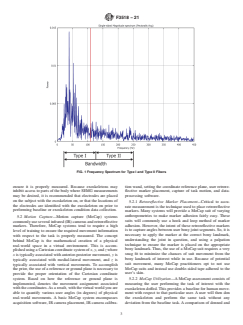
conceptual example, a frequency plot is a graph of frequency
measurementbecauseitusesfine-wireorneedleelectrodesthat on the x-axis against power (or muscle activity) on the y-axis.
areinserteddirectlyintothemuscle.Becauseofitstinysurface
Muscle fatigue occurs when the median value of the frequency
area for recording electrical activity, intramuscular EMG plot shifts from a higher value to a lower value (Fig. 1). This
allows for the assessment of individual motor units in the
shift is caused by an increase in the firing rate of Type I fibers
muscle of interest. Furthermore, fine-wire electrodes have a with a simultaneous decrease in firing ofType II fibers. Muscle
better signal-to-noise ratio than surface electrodes. However,
fatigue assessments should evaluate frequency change over
fine-wire electrodes require special training and medical super- time rather than an average frequency per job task.
vision to place the wires accurately and not damage the
5.1.4 SEMG Utilization—A SEMG user baseline task is
muscles during insertion and removal. For this reason, surface
measured with the exoskeleton doffed. Next, the task is
electrodes are recommended because of their non-invasive
repeated with the exoskeleton donned. MVIC and fatigue are
application.
subsequently analyzed and compared between the baseline and
5.1.1 SEMG Analysis—The SEMG percentage of maximum
exoskeleton task executions. The effect of the exoskeleton
voluntary isometric contraction (MVIC) analysis is evaluated
should be assessed by comparative analysis between these
using a peak amplitude analysis.The reason SEMG is assessed
conditions, and the results should show that the exoskeleton
through a percentage of MVIC is because SEMG is purely a
changes the level of muscle exertion in the desired direction
measure of muscle activity (measured in microvolts) without
from the baseline measurement. Appropriate sampling and
correlation to a force metric (1) . Once data are acquired,
statistical method should be considered. For example, an
descriptive statistics may be used to summarize the results.
exoskeletondesignedforindustrialusetosupporttheshoulders
5.1.2 Percent MVIC—Percent MVIC is conducted by cap-
should reduce the level of muscle exertion. Alternatively, an
turing three to five maximum voluntary contractions trials for
exoskeleton designed for medical use to improve a patient’s
6 s periods of a specific muscle of interest with external
strength may increase the level of muscle exertion. Generally,
resistance applied (1).Averaging of the middle2sof each trial
this is to ensure that the patient can use the medical product
is performed against the total number of trials. Thus, fora6s
safely and effectively for the intended use and use environ-
period, seconds 1 and 2 and 5 and 6 are dropped (1). Seconds
ment.
3 and 4 would be averaged. The user will then perform the
For further detail on SEMG, please review the Surface
Electromyography for the Non-Invasive Assessment of
Muscles (SENIAM) project (2) and Cram and Criswell (1).
The boldface numbers in parentheses refer to a list of references at the end of
this standard. SEMG research requires a high level of training and control to
F3518 − 21
FIG. 1 Frequency Spectrum for Type I and Type II Fibers
ensure it is properly measured. Because exoskeletons may tion wand, setting the coordinate reference plane, user retrore-
inhibit access to parts of the body where SEMG measurements flective marker placement, capture of task motion, and data-
may be desired, it is recommended that electrodes are placed processing software.
on the subject with the exoskeleton on, or that the locations of
5.2.1 Retroreflective Marker Placement—Critical to accu-
the electrodes are identified with the exoskeleton on prior to
rate measurement is the technique used to place retroreflective
performing baseline or exoskeleton condition data collection.
markers. Many systems will provide a MoCap suit of varying
anthropometries to make marker adhesion fairly easy. These
5.2 Motion Capture—Motion capture (MoCap) systems
suits will commonly use a hook and loop method of marker
commonlyuseseveralinfrared(IR)camerasandretroreflective
adhesion. However, the intent of these retroreflective markers
markers. Therefore, MoCap systems tend to require a high
is to capture angles between user bony joint segments. So, it is
level of training to ensure the required movement information
necessary to apply the marker at the correct bony landmark,
with respect to the task is properly measured. The concept
understanding the joint in question, and using a palpation
behind MoCap is the mathematical creation of a physical
technique to ensure the marker is placed on the appropriate
real-world space in a virtual environment. This is accom-
bony landmark. Thus, the use of a MoCap suit requires a very
plishedusingaCartesiancoordinatesystemof x, y,and zwhere
snug fit to minimize the chances of suit movement from the
x is typically associated with anterior-posterior movement, y is
bony landmark of interest while in use. Because of potential
typically associated with medial-lateral movement, and z is
suit movement, many MoCap practitioners opt to not use
typically associated with vertical movements. To accomplish
MoCap suits and instead use double-sided tape adhered to the
the prior, the use of a reference or ground plane is necessary to
user’s skin.
provide the proper orientation of the Cartesian coordinate
system. Based on how the reference or ground plane is 5.2.2 MoCap Utilization—A MoCap assessment consists of
implemented, denotes the movement assignment associated measuring the user performing the task of interest with the
with the coordinates.As a result, with the virtual world you are exoskeleton doffed. This provides a baseline for human move-
able to quantify various user angles (in degrees) of physical ment with respect to that particular user. A user will then don
real-world movements. A basic MoCap system encompasses the exoskeleton and perform the same task without any
acquisition software, IR camera placement, IR camera calibra- deviation from the baseline task. A comparison of donned and
F3518 − 21
doffed exoskeleton metrics can be analyzed to assess if the should be instrumented and fitted with an exoskeleton.
exoskeleton restricts the user’s range of motion or kinematics. Thereafter, the exoskeleton should be donned and the task
Results should show that the exoskeleton maintains the user’s performed. In addition to the objective pressure sensor
range of motion. Exoskeletons may obstruct the cameras’view measurements, a user survey should be administered to capture
of the reflective markers, it is recommended that reflective nuancedinformation.PleaseseetheStandardGuideandModel
markers are placed on the subject with the exoskeleton on, or forAssessing Exoskeleton Use Intent for further details. After
that the locations of the reflective markers are identified with data analysis, any deleterious pressure to the user should be
the exoskeleton on prior to performing baseline or exoskeleton mitigated.
condition data collection.
5.5 3D Volumetric Changes—Assessments of 3D volume
5.3 Completion Time—Completion time is a comparative
areaccomplishedthroughtheuseofa3Dscannerandsoftware
measurement in the temporal domain to ascertain the duration
application designed to extract such measurements. Relevant
oftimerequiredforausertoperformaspecifictask.Abaseline
volume changes include those of specific body parts as a
measurement of a specific task is assessed without the exoskel-
subject moves and bends, which may need to be accommo-
eton.The same task is repeated, this time with the exoskeleton.
dated within soft or rigid aspects of an exoskeleton. Failure to
Use of a time-measuring device is necessary with a resolution
account for the full volumetric change of a body within an
down to the second hash mark.Acomparison of the execution
exoskeleton with rigid parts may result in reduced mobility,
times with and without the exoskeleton are analyzed to
discomfort,pain,orinjuryasdiscussedin5.4.Additionally,the
understand which method took longer.The results should show
total volume occupied by a subject with and without an
thattheexoskeletonchangesthecompletiontimeinthedesired
exoskeleton may be calculated in order to account for any
direction from the baseline measurement. For example, an
additional space needed in the work environment where the
exoskeletondesignedforindustrialusetosupporttheshoulders
exoskeleton will be used, or any area a subject wearing the
should reduce or maintain completion time. Alternatively, an
exoskeleton may be expected to move through.
exoskeleton designed for medical use to improve a patient’s
5.5.1 3D Volumetric Changes Measurements—Any of sev-
strength or accuracy may increase the completion time.
eral high accuracy whole body 3D scanners with short imaging
time(<20s)maybeusedtocollect3Dscanimagesofsubjects.
5.4 Pressure Mapping—Pressure mapping is performed by
Likewise, there are multiple software applications which ex-
instrumenting the exoskeleton user-interface areas or joint
tract measurements from 3D scans (linear, circumferential,
locations of an exoskeleton with thin film pressure sensors.
surface area, and volumetric) though they often return dispa-
Exoskeleton may place increased pressure on the user’s soft
rate results and so some care should be taken in selecting the
and hard tissue, such as pinching or chafing. These pressure
appropriate scanner and software for each application. When
increases may occlude blood flow, reduce range of motion, and
collecting a 3D scan, the subject should be scanned outside of
cause pain or discomfort, or both. Exoskeleton design should
the exoskeleton, holding a neutral position and then scanned
meet the intended anthropomet
...