

ASTM D8071-21
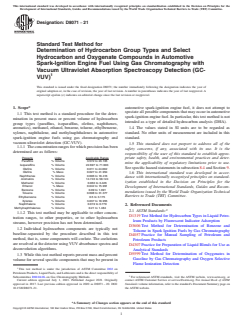
(Test Method)Standard Test Method for Determination of Hydrocarbon Group Types and Select Hydrocarbon and Oxygenate Compounds in Automotive Spark-Ignition Engine Fuel Using Gas Chromatography with Vacuum Ultraviolet Absorption Spectroscopy Detection (GC-VUV)
General Information
- Abstract
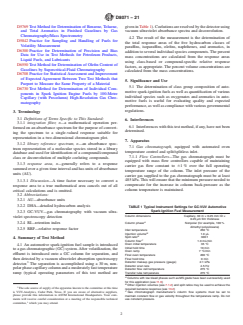
SIGNIFICANCE AND USE
5.1 The determination of class group composition of automotive spark-ignition fuels as well as quantification of various individual species such as oxygenates and aromatics in automotive fuels is useful for evaluating quality and expected performance, as well as compliance with various governmental regulations.
SCOPE
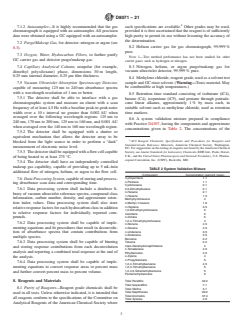
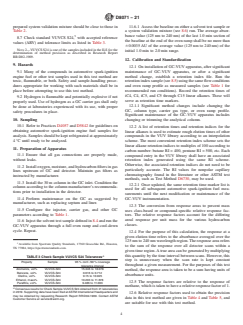
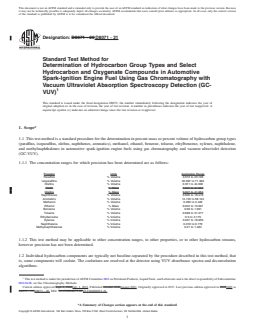
1.1 This test method is a standard procedure for the determination in percent mass or percent volume of hydrocarbon group types (paraffins, isoparaffins, olefins, naphthenes, aromatics), methanol, ethanol, benzene, toluene, ethylbenzene, xylenes, naphthalene, and methylnaphthalenes in automotive spark-ignition engine fuels using gas chromatography and vacuum ultraviolet detection (GC-VUV).
1.1.1 The concentration ranges for which precision has been determined are as follows:
Property
Units
Applicable Range
Paraffins
% Volume
3.572 to 23.105
Isoparaffins
% Volume
22.697 to 71.993
Olefins
% Volume
0.011 to 44.002
Olefins
% Mass
0.027 to 41.954
Naphthenes
% Volume
0.606 to 18.416
Aromatics
% Volume
14.743 to 58.124
Methanol
% Volume
0.063 to 3.426
Ethanol
% Mass
0.042 to 15.991
Benzene
% Volume
0.09 to 1.091
Toluene
% Volume
0.698 to 31.377
Ethylbenzene
% Volume
0.5 to 3.175
Xylenes
% Volume
3.037 to 18.955
Naphthalene
% Volume
0.019 to 0.779
Methylnaphthalenes
% Volume
0.21 to 1.484
1.1.2 This test method may be applicable to other concentration ranges, to other properties, or to other hydrocarbon streams, however precision has not been determined.
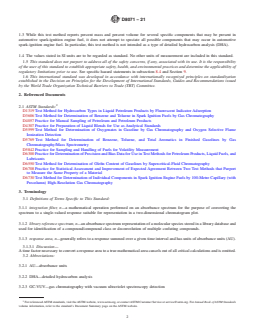
1.2 Individual hydrocarbon components are typically not baseline-separated by the procedure described in this test method, that is, some components will coelute. The coelutions are resolved at the detector using VUV absorbance spectra and deconvolution algorithms.
1.3 While this test method reports percent mass and percent volume for several specific components that may be present in automotive spark-ignition engine fuel, it does not attempt to speciate all possible components that may occur in automotive spark-ignition engine fuel. In particular, this test method is not intended as a type of detailed hydrocarbon analysis (DHA).
1.4 The values stated in SI units are to be regarded as standard. No other units of measurement are included in this standard.
1.5 This standard does not purport to address all of the safety concerns, if any, associated with its use. It is the responsibility of the user of this standard to establish appropriate safety, health, and environmental practices and determine the applicability of regulatory limitations prior to use. See specific hazard statements in subsection 8.4 and Section 9.
1.6 This international standard was developed in accordance with internationally recognized principles on standardization established in the Decision on Principles for the Development of International Standards, Guides and Recommendations issued by the World Trade Organization Technical Barriers to Trade (TBT) Committee.
- Status
- Published
- Publication Date
- 30-Jun-2021
- Technical Committee
- D02 - Petroleum Products, Liquid Fuels, and Lubricants
- Drafting Committee
- D02.04.0L - Gas Chromatography Methods
Buy Documents
ASTM D8071-21 - Standard Test Method for Determination of Hydrocarbon Group Types and Select Hydrocarbon and Oxygenate Compounds in Automotive Spark-Ignition Engine Fuel Using Gas Chromatography with Vacuum Ultraviolet Absorption Spectroscopy Detection (GC-VUV)
REDLINE ASTM D8071-21 - Standard Test Method for Determination of Hydrocarbon Group Types and Select Hydrocarbon and Oxygenate Compounds in Automotive Spark-Ignition Engine Fuel Using Gas Chromatography with Vacuum Ultraviolet Absorption Spectroscopy Detection (GC-VUV)
Overview
ASTM D8071-21: Standard Test Method for Determination of Hydrocarbon Group Types and Select Hydrocarbon and Oxygenate Compounds in Automotive Spark-Ignition Engine Fuel Using Gas Chromatography with Vacuum Ultraviolet Absorption Spectroscopy Detection (GC-VUV) is an internationally recognized analytical procedure developed by ASTM International. This standard outlines a reliable method for quantifying hydrocarbon group types and select oxygenate compounds-including paraffins, isoparaffins, olefins, naphthenes, aromatics, methanol, ethanol, benzene, toluene, ethylbenzene, and xylenes-in spark-ignition engine fuels. By leveraging gas chromatography with vacuum ultraviolet (VUV) spectroscopy detection, laboratories can accurately assess fuel composition, supporting quality control, performance prediction, and regulatory compliance in automotive fuel markets.
Key Topics
- Hydrocarbon Group Analysis: Identifies and quantifies major hydrocarbon classes (paraffins, isoparaffins, olefins, naphthenes, aromatics) and important individual compounds in automotive spark-ignition fuels.
- Oxygenate Measurement: Determines the content of oxygenate species such as methanol and ethanol, which are relevant for environmental and fuel quality standards.
- GC-VUV Technology: Utilizes gas chromatography (GC) for separation and vacuum ultraviolet absorption spectroscopy (VUV) for detection, enabling compound identification even when components are not baseline-separated.
- Precision and Applicability: Provides specified precision ranges for concentrations of key fuel constituents, making results dependable for both process optimization and regulatory reporting.
- Compliance Support: Results are suitable for evaluating fuel quality, predicting engine performance, and demonstrating adherence to environmental and governmental regulations.
Applications
Fuel Quality Assurance
- Assess bulk and individual hydrocarbon group composition in gasoline samples to monitor consistency and quality across production batches.
- Evaluate the concentration of regulated components such as benzene and aromatics critical to fuel emission standards.
Regulatory Compliance
- Generate accurate, reproducible test data required for meeting environmental regulations, product certification, and industry benchmarks.
- Support transparent reporting of oxygenate additives (e.g., ethanol, methanol) content, which is essential for compliance with regional fuel blending mandates.
Research and Development
- Analyze the impact of hydrocarbon profile variations on engine performance and emissions, enabling ongoing development of cleaner and more efficient fuels.
- Utilize the method for comparative testing of new fuel formulations or alternative hydrocarbon streams.
Process Control
- Employ precise hydrocarbon group quantification for real-time process monitoring and optimization in petroleum refineries and blending facilities.
Related Standards
For enhanced testing strategies and comprehensive analysis in the petroleum and fuels industry, consider these related ASTM standards:
- ASTM D1319: Test Method for Hydrocarbon Types in Liquid Petroleum Products by Fluorescent Indicator Adsorption
- ASTM D3606: Test Method for Determination of Benzene and Toluene in Spark Ignition Fuels by Gas Chromatography
- ASTM D5599: Test Method for Determination of Oxygenates in Gasoline by Gas Chromatography and Oxygen Selective Flame Ionization Detection
- ASTM D5769: Test Method for Determination of Benzene, Toluene, and Total Aromatics in Gasolines by GC/MS
- ASTM D6550: Test Method for Determination of Olefin Content of Gasolines by Supercritical-Fluid Chromatography
- ASTM D6730: Test Method for Determination of Individual Components in Spark-Ignition Engine Fuels by 100-Metre Capillary High-Resolution GC
Practical Value
ASTM D8071-21 offers a modern, robust approach to evaluating automotive spark-ignition engine fuels for both bulk hydrocarbon classes and key individual compounds. Its application ensures:
- Improved quality control and fuel consistency
- Confidence in meeting regulatory requirements
- Enhanced support for R&D and process optimization in the petroleum industry
By using gas chromatography with vacuum ultraviolet absorption spectroscopy, users benefit from superior analytical capabilities, especially for complex, coeluting fuel mixtures, making ASTM D8071-21 an essential standard for automotive fuel analysis.
Relations
- Effective Date
- 01-Mar-2024
- Effective Date
- 01-Mar-2024
- Effective Date
- 01-Mar-2024
- Effective Date
- 01-Dec-2023
- Refers
ASTM D5842-23 - Standard Practice for Sampling and Handling of Fuels for Volatility Measurement - Effective Date
- 01-Oct-2023
- Effective Date
- 01-Dec-2019
- Refers
ASTM D5842-19 - Standard Practice for Sampling and Handling of Fuels for Volatility Measurement - Effective Date
- 01-Nov-2019
- Effective Date
- 01-May-2019
- Effective Date
- 01-Apr-2018
- Effective Date
- 01-May-2017
- Effective Date
- 01-Apr-2016
- Effective Date
- 01-Apr-2016
- Effective Date
- 01-Jan-2016
- Effective Date
- 01-Dec-2015
- Effective Date
- 01-Oct-2015
Buy Documents
ASTM D8071-21 - Standard Test Method for Determination of Hydrocarbon Group Types and Select Hydrocarbon and Oxygenate Compounds in Automotive Spark-Ignition Engine Fuel Using Gas Chromatography with Vacuum Ultraviolet Absorption Spectroscopy Detection (GC-VUV)
REDLINE ASTM D8071-21 - Standard Test Method for Determination of Hydrocarbon Group Types and Select Hydrocarbon and Oxygenate Compounds in Automotive Spark-Ignition Engine Fuel Using Gas Chromatography with Vacuum Ultraviolet Absorption Spectroscopy Detection (GC-VUV)
Get Certified
Connect with accredited certification bodies for this standard

Element Materials Technology
Materials testing and product certification.

ABS Group Brazil
ABS Group certification services in Brazil.

ABS Quality Evaluations Inc.
American Bureau of Shipping quality certification.
Sponsored listings
Frequently Asked Questions
ASTM D8071-21 is a standard published by ASTM International. Its full title is "Standard Test Method for Determination of Hydrocarbon Group Types and Select Hydrocarbon and Oxygenate Compounds in Automotive Spark-Ignition Engine Fuel Using Gas Chromatography with Vacuum Ultraviolet Absorption Spectroscopy Detection (GC-VUV)". This standard covers: SIGNIFICANCE AND USE 5.1 The determination of class group composition of automotive spark-ignition fuels as well as quantification of various individual species such as oxygenates and aromatics in automotive fuels is useful for evaluating quality and expected performance, as well as compliance with various governmental regulations. SCOPE 1.1 This test method is a standard procedure for the determination in percent mass or percent volume of hydrocarbon group types (paraffins, isoparaffins, olefins, naphthenes, aromatics), methanol, ethanol, benzene, toluene, ethylbenzene, xylenes, naphthalene, and methylnaphthalenes in automotive spark-ignition engine fuels using gas chromatography and vacuum ultraviolet detection (GC-VUV). 1.1.1 The concentration ranges for which precision has been determined are as follows: Property Units Applicable Range Paraffins % Volume 3.572 to 23.105 Isoparaffins % Volume 22.697 to 71.993 Olefins % Volume 0.011 to 44.002 Olefins % Mass 0.027 to 41.954 Naphthenes % Volume 0.606 to 18.416 Aromatics % Volume 14.743 to 58.124 Methanol % Volume 0.063 to 3.426 Ethanol % Mass 0.042 to 15.991 Benzene % Volume 0.09 to 1.091 Toluene % Volume 0.698 to 31.377 Ethylbenzene % Volume 0.5 to 3.175 Xylenes % Volume 3.037 to 18.955 Naphthalene % Volume 0.019 to 0.779 Methylnaphthalenes % Volume 0.21 to 1.484 1.1.2 This test method may be applicable to other concentration ranges, to other properties, or to other hydrocarbon streams, however precision has not been determined. 1.2 Individual hydrocarbon components are typically not baseline-separated by the procedure described in this test method, that is, some components will coelute. The coelutions are resolved at the detector using VUV absorbance spectra and deconvolution algorithms. 1.3 While this test method reports percent mass and percent volume for several specific components that may be present in automotive spark-ignition engine fuel, it does not attempt to speciate all possible components that may occur in automotive spark-ignition engine fuel. In particular, this test method is not intended as a type of detailed hydrocarbon analysis (DHA). 1.4 The values stated in SI units are to be regarded as standard. No other units of measurement are included in this standard. 1.5 This standard does not purport to address all of the safety concerns, if any, associated with its use. It is the responsibility of the user of this standard to establish appropriate safety, health, and environmental practices and determine the applicability of regulatory limitations prior to use. See specific hazard statements in subsection 8.4 and Section 9. 1.6 This international standard was developed in accordance with internationally recognized principles on standardization established in the Decision on Principles for the Development of International Standards, Guides and Recommendations issued by the World Trade Organization Technical Barriers to Trade (TBT) Committee.
SIGNIFICANCE AND USE 5.1 The determination of class group composition of automotive spark-ignition fuels as well as quantification of various individual species such as oxygenates and aromatics in automotive fuels is useful for evaluating quality and expected performance, as well as compliance with various governmental regulations. SCOPE 1.1 This test method is a standard procedure for the determination in percent mass or percent volume of hydrocarbon group types (paraffins, isoparaffins, olefins, naphthenes, aromatics), methanol, ethanol, benzene, toluene, ethylbenzene, xylenes, naphthalene, and methylnaphthalenes in automotive spark-ignition engine fuels using gas chromatography and vacuum ultraviolet detection (GC-VUV). 1.1.1 The concentration ranges for which precision has been determined are as follows: Property Units Applicable Range Paraffins % Volume 3.572 to 23.105 Isoparaffins % Volume 22.697 to 71.993 Olefins % Volume 0.011 to 44.002 Olefins % Mass 0.027 to 41.954 Naphthenes % Volume 0.606 to 18.416 Aromatics % Volume 14.743 to 58.124 Methanol % Volume 0.063 to 3.426 Ethanol % Mass 0.042 to 15.991 Benzene % Volume 0.09 to 1.091 Toluene % Volume 0.698 to 31.377 Ethylbenzene % Volume 0.5 to 3.175 Xylenes % Volume 3.037 to 18.955 Naphthalene % Volume 0.019 to 0.779 Methylnaphthalenes % Volume 0.21 to 1.484 1.1.2 This test method may be applicable to other concentration ranges, to other properties, or to other hydrocarbon streams, however precision has not been determined. 1.2 Individual hydrocarbon components are typically not baseline-separated by the procedure described in this test method, that is, some components will coelute. The coelutions are resolved at the detector using VUV absorbance spectra and deconvolution algorithms. 1.3 While this test method reports percent mass and percent volume for several specific components that may be present in automotive spark-ignition engine fuel, it does not attempt to speciate all possible components that may occur in automotive spark-ignition engine fuel. In particular, this test method is not intended as a type of detailed hydrocarbon analysis (DHA). 1.4 The values stated in SI units are to be regarded as standard. No other units of measurement are included in this standard. 1.5 This standard does not purport to address all of the safety concerns, if any, associated with its use. It is the responsibility of the user of this standard to establish appropriate safety, health, and environmental practices and determine the applicability of regulatory limitations prior to use. See specific hazard statements in subsection 8.4 and Section 9. 1.6 This international standard was developed in accordance with internationally recognized principles on standardization established in the Decision on Principles for the Development of International Standards, Guides and Recommendations issued by the World Trade Organization Technical Barriers to Trade (TBT) Committee.
ASTM D8071-21 is classified under the following ICS (International Classification for Standards) categories: 75.160.20 - Liquid fuels. The ICS classification helps identify the subject area and facilitates finding related standards.
ASTM D8071-21 has the following relationships with other standards: It is inter standard links to ASTM D3606-24, ASTM D6300-24, ASTM D6708-24, ASTM D6300-23a, ASTM D5842-23, ASTM D6300-19a, ASTM D5842-19, ASTM D6708-19, ASTM D6708-18, ASTM D5599-17, ASTM D6300-16, ASTM D6708-16a, ASTM D6708-16, ASTM D6550-15, ASTM D4307-99(2015). Understanding these relationships helps ensure you are using the most current and applicable version of the standard.
ASTM D8071-21 is available in PDF format for immediate download after purchase. The document can be added to your cart and obtained through the secure checkout process. Digital delivery ensures instant access to the complete standard document.
Standards Content (Sample)
This international standard was developed in accordance with internationally recognized principles on standardization established in the Decision on Principles for the
Development of International Standards, Guides and Recommendations issued by the World Trade Organization Technical Barriers to Trade (TBT) Committee.
Designation: D8071 − 21
Standard Test Method for
Determination of Hydrocarbon Group Types and Select
Hydrocarbon and Oxygenate Compounds in Automotive
Spark-Ignition Engine Fuel Using Gas Chromatography with
Vacuum Ultraviolet Absorption Spectroscopy Detection (GC-
VUV)
This standard is issued under the fixed designation D8071; the number immediately following the designation indicates the year of
original adoption or, in the case of revision, the year of last revision. A number in parentheses indicates the year of last reapproval. A
superscript epsilon (´) indicates an editorial change since the last revision or reapproval.
1. Scope* automotive spark-ignition engine fuel, it does not attempt to
speciate all possible components that may occur in automotive
1.1 This test method is a standard procedure for the deter-
spark-ignition engine fuel. In particular, this test method is not
mination in percent mass or percent volume of hydrocarbon
intended as a type of detailed hydrocarbon analysis (DHA).
group types (paraffins, isoparaffins, olefins, naphthenes,
aromatics), methanol, ethanol, benzene, toluene, ethylbenzene, 1.4 The values stated in SI units are to be regarded as
xylenes, naphthalene, and methylnaphthalenes in automotive standard. No other units of measurement are included in this
spark-ignition engine fuels using gas chromatography and standard.
vacuum ultraviolet detection (GC-VUV).
1.5 This standard does not purport to address all of the
1.1.1 Theconcentrationrangesforwhichprecisionhasbeen
safety concerns, if any, associated with its use. It is the
determined are as follows:
responsibility of the user of this standard to establish appro-
Property Units Applicable Range
priate safety, health, and environmental practices and deter-
Paraffins % Volume 3.572 to 23.105
mine the applicability of regulatory limitations prior to use.
Isoparaffins % Volume 22.697 to 71.993
See specific hazard statements in subsection 8.4 and Section 9.
Olefins % Volume 0.011 to 44.002
Olefins % Mass 0.027 to 41.954
1.6 This international standard was developed in accor-
Naphthenes % Volume 0.606 to 18.416
dance with internationally recognized principles on standard-
Aromatics % Volume 14.743 to 58.124
ization established in the Decision on Principles for the
Methanol % Volume 0.063 to 3.426
Ethanol % Mass 0.042 to 15.991
Development of International Standards, Guides and Recom-
Benzene % Volume 0.09 to 1.091
mendations issued by the World Trade Organization Technical
Toluene % Volume 0.698 to 31.377
Barriers to Trade (TBT) Committee.
Ethylbenzene % Volume 0.5 to 3.175
Xylenes % Volume 3.037 to 18.955
Naphthalene % Volume 0.019 to 0.779
2. Referenced Documents
Methylnaphthalenes % Volume 0.21 to 1.484
2.1 ASTM Standards:
1.1.2 This test method may be applicable to other concen-
D1319 Test Method for Hydrocarbon Types in Liquid Petro-
tration ranges, to other properties, or to other hydrocarbon
leum Products by Fluorescent Indicator Adsorption
streams, however precision has not been determined.
D3606 Test Method for Determination of Benzene and
1.2 Individual hydrocarbon components are typically not
Toluene in Spark Ignition Fuels by Gas Chromatography
baseline-separated by the procedure described in this test
D4057 Practice for Manual Sampling of Petroleum and
method, that is, some components will coelute. The coelutions
Petroleum Products
are resolved at the detector using VUV absorbance spectra and
D4307 Practice for Preparation of Liquid Blends for Use as
deconvolution algorithms.
Analytical Standards
D5599 Test Method for Determination of Oxygenates in
1.3 While this test method reports percent mass and percent
Gasoline by Gas Chromatography and Oxygen Selective
volume for several specific components that may be present in
Flame Ionization Detection
This test method is under the jurisdiction of ASTM Committee D02 on
Petroleum Products, Liquid Fuels, and Lubricants and is the direct responsibility of
Subcommittee D02.04.0L on Gas Chromatography Methods. For referenced ASTM standards, visit the ASTM website, www.astm.org, or
Current edition approved July 1, 2021. Published August 2021. Originally contact ASTM Customer Service at service@astm.org. For Annual Book of ASTM
approved in 2017. Last previous edition approved in 2020 as D8071 – 20. DOI: Standards volume information, refer to the standard’s Document Summary page on
10.1520/D8071-21. the ASTM website.
*A Summary of Changes section appears at the end of this standard
Copyright © ASTM International, 100 Barr Harbor Drive, PO Box C700, West Conshohocken, PA 19428-2959. United States
D8071 − 21
D5769 Test Method for Determination of Benzene, Toluene, giveninTable1).Coelutionsareresolvedbythedetectorusing
and Total Aromatics in Finished Gasolines by Gas vacuum ultraviolet absorbance spectra and deconvolution.
Chromatography/Mass Spectrometry
4.2 The result of the measurement is the determination of
D5842 Practice for Sampling and Handling of Fuels for
the total response areas of the five hydrocarbon classes of
Volatility Measurement
paraffins, isoparaffins, olefins, naphthenes, and aromatics, in
D6300 Practice for Determination of Precision and Bias
addition to several individual species components. The percent
Data for Use in Test Methods for Petroleum Products,
mass concentrations are calculated from the response areas
Liquid Fuels, and Lubricants
using class-based or compound-specific relative response
D6550 Test Method for Determination of Olefin Content of
factors, as appropriate. The percent volume concentrations are
Gasolines by Supercritical-Fluid Chromatography
calculated from the mass concentrations.
D6708 Practice for StatisticalAssessment and Improvement
of Expected Agreement Between Two Test Methods that
5. Significance and Use
Purport to Measure the Same Property of a Material
5.1 The determination of class group composition of auto-
D6730 Test Method for Determination of Individual Com-
motive spark-ignition fuels as well as quantification of various
ponents in Spark Ignition Engine Fuels by 100-Metre
individual species such as oxygenates and aromatics in auto-
Capillary (with Precolumn) High-Resolution Gas Chro-
motive fuels is useful for evaluating quality and expected
matography
performance,aswellascompliancewithvariousgovernmental
regulations.
3. Terminology
3.1 Definitions of Terms Specific to This Standard:
6. Interferences
3.1.1 integration filter, n—a mathematical operation per-
6.1 Interferenceswiththistestmethod,ifany,havenotbeen
formed on an absorbance spectrum for the purpose of convert-
determined.
ing the spectrum to a single-valued response suitable for
representation in a two-dimensional chromatogram plot.
7. Apparatus
3.1.2 library reference spectrum, n—an absorbance spec-
7.1 Gas chromatograph, equipped with automated oven
trum representation of a molecular species stored in a library
temperature control and split/splitless inlet.
database and used for identification of a compound/compound
7.1.1 Flow Controllers—The gas chromatograph must be
class or deconvolution of multiple coeluting compounds.
equipped with mass flow controllers capable of maintaining
3.1.3 response area, n—generally refers to a response
carrier gas flow constant to 61 % over the full operating
summed over a given time interval and has units of absorbance
temperature range of the column. The inlet pressure of the
units (AU).
carrier gas supplied to the gas chromatograph must be at least
485 kPa.This will ensure that the minimum pressure needed to
3.1.3.1 Discussion—A time factor necessary to convert a
compensate for the increase in column back-pressure as the
response area to a true mathematical area cancels out of all
column temperature is maintained.
critical calculations and is omitted.
3.2 Abbreviations:
3.2.1 AU—absorbance units
3.2.2 DHA—detailed hydrocarbon analysis
TABLE 1 Typical Instrument Settings for GC-VUV Automotive
Spark-Ignition Fuel Measurement
3.2.3 GC-VUV—gas chromatography with vacuum ultra-
Column dimensions Capillary, 30m×0.25mmID×
violet spectroscopy detection
0.25 µm film thickness
A
3.2.4 RI—retention index Column phase Nonpolar (for example, 100 %
dimethyl polysiloxane)
3.2.5 RRF—relative response factor
Inlet temperature 250 °C
B
Injection volume 1.0 µL
B
Split ratio 300:1
4. Summary of Test Method
C
Column flow 1.0 mL/min
4.1 An automotive spark-ignition fuel sample is introduced Oven initial temperature 35 °C
Initial hold time 10 min
to a gas chromatographic (GC) system.After volatilization, the
Oven ramp 7 °C/min
effluent is introduced onto a GC column for separation, and
Final oven temperature 200 °C
then detected by a vacuum ultraviolet absorption spectroscopy Final hold time 0 min
3 Detector makeup gas pressure (gauge) 2.1 kPa
detector. The separation is accomplished using a 30 m, non-
Detector scan rate 4.5 Hz
polarphasecapillarycolumnandamoderatelyfasttemperature
Detector flow cell temperature 275 °C
Transfer tube temperature 275 °C
ramp (typical operating parameters of this test method are
A
ColumnswithlowbleedphasessuchasMSgradehavebeensuccessfullyused
for this application (see 11.6)
B
Other injection volumes (see 7.1.2) and split ratios may be used to achieve the
The sole source of supply of the apparatus known to the committee at this time
required benzene response (see 13.2)
C
is VUV-Analytics, Cedar Park, Texas. If you are aware of alternative suppliers,
Gas chromatograph manufacturer’s column flow systems must be set to
please provide this information to ASTM International Headquarters. Your com-
maintain constant flow or gas velocity throughout the temperature ramp. Do not
ments will receive careful consideration at a meeting of the responsible technical
use constant pressure.
committee, which you may attend.
D8071 − 21
7.1.2 Autosampler—It is highly recommended that the gas such specifications are available. Other grades may be used,
chromatograph is equipped with an autosampler. All precision provided it is first ascertained that the reagent is of sufficiently
data were obtained using a GC equipped with an autosampler. high purity to permit its use without lessening the accuracy of
the determination.
7.2 Purge/Makeup Gas, for detector: nitrogen or argon (see
8.2 Helium carrier gas for gas chromatograph, 99.999 %
8.3).
pure.
7.3 Oxygen, Water, Hydrocarbon Filters, to further purify
NOTE 1—Test method performance has not been studied for other
GC carrier gas and detector purge/makeup gas.
carrier gases such as hydrogen or nitrogen.
8.3 Nitrogen, helium, or argon purge/makeup gas for
7.4 Capillary Analytical Column, nonpolar (for example,
dimethyl polysiloxane) phase, dimensions 30 m length, vacuum ultraviolet detector, 99.999 % pure.
0.25 mm internal diameter, 0.25 µm film thickness.
8.4 Methylenechloride,reagentgrade,usedasasolventtest
sample and GC rinse solvent. (Warning—Toxic material. May
7.5 Vacuum Ultraviolet Absorption Spectroscopy Detector,
be combustible at high temperatures.)
capable of measuring 125 nm to 240 nm absorbance spectra
with a wavelength resolution of 1 nm or better.
8.5 Retention time standard consisting of isobutane (iC4),
7.5.1 The detector shall be able to interface with a gas
butane (C4), isopentane (iC5), and pentane through pentade-
chromatographic system and measure an eluent with a scan cane linear alkanes, approximately 1 % by mass each, in
frequency of at least 4.5 Hz with a baseline peak-to-peak noise
suitable solvent such as methylene chloride, used as retention
width over a 10 s interval no greater than 0.002 AU when time markers.
averaged over the following wavelength regions: 125 nm to
8.6 A system validation mixture prepared in compliance
240 nm, 170 nm to 200 nm, 125 nm to 160 nm, and 0.001 AU
with Practice D4307, having the components and approximate
when averaged over the 140 nm to 160 nm wavelength region.
concentrations given in Table 2. The concentrations of the
7.5.2 The detector shall be equipped with a shutter or
equivalent mechanism that allows the detector array to be
ACS Reagent Chemicals, Specifications and Procedures for Reagents and
blocked from the light source in order to perform a “dark”
Standard-Grade Reference Materials, American Chemical Society, Washington,
measurement of electronic noise level.
DC. For suggestions on the testing of reagents not listed by theAmerican Chemical
7.5.3 Thedetectorshallbeequippedwithaflowcellcapable
Society, see Analar Standards for Laboratory Chemicals, BDH Ltd., Poole, Dorset,
U.K., and the United States Pharmacopeia and National Formulary, U.S. Pharma-
of being heated to at least 275 °C.
copeial Convention, Inc. (USPC), Rockville, MD.
7.5.4 The detector shall have an independently controlled
makeup gas capability, capable of providing up to 5 mL⁄min
TABLE 2 System Validation Mixture
additional flow of nitrogen, helium, or argon to the flow cell.
Component Concentration (percent mass)
Cyclopentane 1.1
7.6 Data Processing System,capableofstoringandprocess-
n-Pentane 1.1
ing absorbance scan data and corresponding time.
Cyclohexane 2.1
7.6.1 Data processing system shall include a database li- 2,3-Dimethylbutane 2.1
n-Hexane 2.1
brary of vacuum ultraviolet reference spectra, compound class
1-Hexene 1.5
information, carbon number, density, and approximate reten-
Methylcyclohexane 4
tion index values. Data processing system shall also store 4-Methyl-1-hexene 1.6
n-Heptane 3.5
relative response factors for each hydrocarbon class in addition
1,2-Dimethylcyclohexane 5
to relative response factors for individually reported com-
Isooctane 5
pounds. n-Octane 5
1,2,4-Trimethylcyclohexane 4
7.6.2 Data processing system shall be capable of imple-
n-Nonane 4.5
menting equations and fit procedures that result in deconvolu-
n-Decane 4.5
n-Undecane 3.5
tion of absorbance spectra that contain contributions from
n-Dodecane 3.5
multiple species.
Benzene 2.2
Toluene 2.2
7.6.3 Data processing system shall be capable of binning
trans-Decahydronaphthalene 4
and storing response contributions from each deconvolution
n-Tetradecane 4.5
analysis and reporting a combined total response at the end of
Ethylbenzene 4.5
the analysis. o-Xylene 4
n-Propylbenzene 5
7.6.4 Data processing system shall be capable of imple-
1,2,4-Trimethylbenzene 4.5
menting equations to convert response areas to percent mass 1,2,3-Trimethylbenzene 5
1,2,4,5-Tetramethylbenzene 5
and further convert percent mass to percent volume.
Pentamethylbenzene 5
8. Reagents and Materials Total Paraffins 32.2
Total Isoparaffins 7.1
8.1 Purity of Reagents—Reagent grade chemicals shall be Total Olefins 3.1
Total Naphthenes 20.2
used in all tests. Unless otherwise indicated, it is intended that
Total Aromatics 37.4
all reagents conform to the specifications of the Committee on
Total Xylenes 4.0
Analytical Reagents of the American Chemical Society where
D8071 − 21
prepared system validation mixture should be close to those in 11.6.1 Assess the baseline on either a solvent test sample or
Table 2. a system validation mixture (see 8.6) run. The average absor-
5 bance value (125 nm to 240 nm) of the last 1.0 min section of
8.7 Check standard VUVCS S24, with accepted reference
the baseline at the end of the oven ramp shall be no more than
values (ARV) and tolerance limits as listed in Table 3.
60.0035 AU of the average value (125 nm to 240 nm) of the
NOTE 2—VUVCS S24 is one of the samples included in the ILS for the
initial 1.0 min to 2.0 min range.
determination of method precision as described in Research Report
RR:D02-1909.
12. Calibration and Standardization
9. Hazards
12.1 On installation of GC-VUV apparatus, after significant
9.1 Many of the compounds in automotive spark-ignition maintenance of GC-VUV apparatus, or after a significant
engine fuel or other test samples used in this test method are
method change, establish a retention index file. Run the
toxic, flammable, or both. Safety and sample-handling proce- retentionindexsample(see8.5)usingthesameflowconditions
dures appropriate for working with such materials shall be in and oven ramp profile as measured samples (see Table 1 for
place before attempting to use this test method.
recommended run conditions). Record the retention times of
iC4, C4, iC5, and C5 through C15 linear alkanes. These will
9.2 Hydrogen is flammable and potentially explosive if not
serve as retention time markers.
properly used. Use of hydrogen as a GC carrier gas shall only
12.1.1 Significant method changes include changing the
be done at laboratories experienced with its use, with proper
GC, column type, carrier gas type, or oven ramp profile.
safety procedures in place.
Significant maintenance of the GC-VUV apparatus includes
10. Sampling
changing or trimming the analytical column.
10.1 Refer to Practices D4057 and D5842 for guidelines on
12.2 A list of retention times and retention indices for the
obtaining automotive spark-ignition engine fuel samples for
linear alkanes is used to estimate rough elution times of other
analysis. Samples should be kept refrigerated at approximately
compounds in the VUV library according to an interpolation
4 °C until ready to be analyzed.
scheme. The most convenient retention index scheme sets the
linear alkane retention indices to multiples of 100 according to
11. Preparation of Apparatus
carbon number: butane RI = 400, pentane RI = 500, etc. Each
11.1 Ensure that all gas connections are properly made, compound entry in the VUV library shall have an associated
without leaks.
retention index generated using the same RI scheme.
Otherwise, the associated retention indices do not need to be
11.2 Install oxygen, moisture, and hydrocarbon filters in gas
particularly accurate. The RI values for nonpolar capillary
lines upstream of GC and detector. Maintain gas filters as
chromatography found in the literature or other ASTM test
instructed by manufacturer.
methods, such as Test Method D6730, may be used.
11.3 Install the 30 m column in the GC inlet. Condition the
12.2.1 Once updated, the same retention time marker list is
column according to the column manufacturer’s recommenda-
used for all subsequent automotive spark-ignition fuel mea-
tions prior to installation in the detector.
surements until the next modification or maintenance of the
11.4 Perform maintenance on the GC as suggested by
GC-VUV instrumentation.
manufacturer, such as replacing septum and liner.
12.3 The conversion from response areas to percent mass
11.5 Configure the injector, carrier gas, and other GC
uses class-based or compound-specific relative response fac-
parameters according to Table 1.
tors. The relative response factors account for the differing
areal response per unit mass for the various hydrocarbon
11.6 Inject the solvent test sample defined in 8.4 and run the
classes.
GC-VUV apparatus through a full oven ramp and cool-down
cycle. Repeat.
12.4 For the purpose of this calculation, the response at a
given elution time refers to the absorbance averaged over the
125 nm to 240 nm wavelength region.The response area refers
Available from Spectrum Quality Standards, 17360 Groeschke Rd., Houston,
to the sum of the response over all detector scans within a
TX 77084, https://spectrumstandards.com.
given time region.Atrue area can be generated by multiplying
A this quantity by the time interval between scans. However, this
TABLE 3 Check Sample VUVCS S24 Tolerances
step is unnecessary when the scan rate is kept constant
Property Sample 95 % conf. ⁄99 % coverage
throughout a given measurement. For the purposes of this test
tolerance interval
Aromatics, vol% VUVCS-S24 15.346 to 18.078
method, the response area is taken to be a sum having units of
Benzene, vol% VUVCS-S24 0.616 to 0.712
absorbance units.
Olefins, vol% VUVCS-S24 9.15 to 10.925
Ethanol, mass% VUVCS-S24 10.203 to 11.678
12.5 The response factors are relative to the response of
Paraffins, vol% VUVCS-S24 9.486 to 11.003
methane, which is taken to have a relative response factor of 1.
A
ConsensusresultsforCheckSampleVUVCSS24obtainedfrom21laboratories
in2019.SupportingdatahavebeenfiledatASTMInternationalHeadquartersand
12.6 Relative response factors used to obtain the precision
may be obtained by requesting Research Report RR:D02-1909. Contact ASTM
data in this test method are given in Table 4 and Table 5, and
Customer Service at service@astm.org.
are suitable for use with this test method.
D8071 − 21
TABLE 4 Relative Response Factors for Bulk Hydrocarbon
in Sections 11, 12, and 13 as necessary to ensure tolerances in
Classes
13.3 or 13.4 are met before proceeding.
Hydrocarbon Class Relative Response Factor
Paraffin 0.769
14. Procedure
Isoparaffin 0.781
Olefin 0.465
14.1 Inject the sample into the GC inlet port. Typical GC
Naphthene 0.786
method and detector conditions are given in Table 1.
C + Aromatics 0.296
14.2 The system shall record a dark scan immediately after
start.
TABLE 5 Relative Response Factors for Specific Individual
14.3 The system shall record a reference scan immediately
Compounds and Compound Groups
after the dark scan.
Compound Relative Response Factor
Ethanol 1.029 14.3.1 The reference scan refers to an initial detector scan
Methanol 1.211
used as a reference to convert subsequent detector scans to
Isooctane 0.674
absorbancescans,andisdefinedinAnnexA1.Itisnotalibrary
Benzene 0.258
Toluene 0.267
reference spectrum.
Ethylbenzene 0.284
14.4 The system shall record 125 nm to 240 nm absorbance
Xylenes 0.284
Naphthalene 0.207
spectra and time of scan for each detector scan. Conversion of
1-Methylnaphthalene, 2-Methylnaphthalene 0.250
recorded intensity data to absorbance is given in Annex A1.
14.5 At the end of the GC run, the data collection shall
automatically stop, and the recorded absorbance spectra pro-
13. Pre-Measurement Validation
cessed in order to obtain response areas for each of the
13.1 Before proceeding with measurements after a signifi-
hydrocarbon classes and individual compounds being moni-
cant change or maintenance of the GC-VUV system, the
tored.
procedures in Section 11 shall have been completed, and a
14.5.1 Calculate percent mass for each hydrocarbon group
retention index file generated or verified following the proce-
and each of the individual compounds/compound groups
dure in 12.1 and 12.2.
ethanol, methanol, isooctane, benzene, toluene, ethylbenzene,
and total xylenes.
13.2 Analyzethesystemvalidationmixture(8.6)andverify
that the total response for benzene is 3.5 6 0.25. 14.5.2 Calculate percent volume results from the percent
mass results and class/compound densities.
13.2.1 If the total response is outside the required range,
adjust the detector make-up gas pressure and reanalyze the
14.6 Generateareportdisplayingtheinformationcalculated
systemvalidationmixture,checkingthebenzeneresponseuntil
in 14.5.
itiswithinthespecifiedrange.Increasingthedetectormake-up
gas pressure will decrease the benzene response. Do not adjust
15. Calculation
the make up gas pressure to less than 1.0 kPa or to more than
NOTE 3—See pertinent information on modeling absorbance data in
4.1 kPa.
Annex A2.
13.2.2 If the detector make-up gas pressure has been
15.1 Divide the measured chromatogram into time slices of
changed, reanalyze the retention index sample (12.1 and 12.2)
a given width, ∆t. Define the following parameters:
and establish a new retention index file.Adjusting the detector
15.1.1 A retention index (RI) window,
make-up gas pressure will change retention times. Reanalyze
15.1.2 A chi-squared iteration threshold, expressed as a
the system validation mixture (8.6) and verify the total re-
percentage,
sponse for benzene (13.2).
15.1.3 An R threshold,
13.3 Verify that the system validation mixture results are 15.1.4 A saturation threshold, and
within tolerance limits. 15.1.5 An initial background time region (optional).
13.3.1 The group totals for paraffins, isoparaffins, olefins,
15.2 If an initial background time region is defined, calcu-
naphthenes, and aromatics shall be within 61.0 % by mass of
lateabackgroundspectrumfromtheaverageoftheabsorbance
the known totals.
scans over the background time region.
13.3.2 The benzene, toluene, ethylbenzene, total xylenes,
15.3 Analyze each time slice using the following algorithm:
and isooctane shall be within 60.5 % by mass of their known
15.3.1 Calculate the total absorbance from the sum of the
values.
absorbance scans within the time slice.
13.3.3 The ratio of tetradecane to pentane shall be between
15.3.1.1 If a background spectrum is defined, subtract the
3.8 and 4.5.
background spectrum from each of the individual absorbance
13.4 Analyze the check sample VUVCS S24 as defined in
spectra within the time slice. Sum the resulting background-
8.7. Results shall be within the tolerances stated in Table 3.
subtracted spectra to obtain the total absorbance spectrum for
13.5 If the tolerances in 13.3 or 13.4 are not met, verify the time slice.
functionality of all GC-VUV components, validity of retention 15.3.1.2 If the absorbance value at a given wavelength
time marker list, and validity/quality of the check sample or exceeds the saturation threshold for any of the absorbance
system validation mixture, or both. Repeat setup methodology scans within the time slice, remove the data at that wavelength
D8071 − 21
value from the total absorbance and library reference spectra reject the three-component result and retain the best two-
used in subsequent fits for that time slice. component result, unless the best two-component result was
also rejected, in which case retain the best one-component
15.3.2 Calculate the average retention index of the time
result.
sliceusingtheaverageelutiontimeofthetimesliceandthelist
of retention time markers. A linear interpolation scheme is
15.3.5 The result of the tiered search procedure is a predic-
sufficient.
tion of the number of compounds that contribute to the total
15.3.3 Construct a list consisting of all compounds in the absorbance spectrum, their likely identities, as well as the
VUV reference library within 6RI window of the average best-fit values. “Integrate” the library reference spectra of the
retention index of the time slice. best-fit compounds by averaging them over the 125 nm to
240 nm region, generating an integration factor for each
15.3.4 Perform a tiered search on the total absorbance
compound. Multiply the best-fit values, f, by the correspond-
spectrum, drawing from the constructed list of compounds:
i
ingintegrationfactors.Thesearethecompounds’contributions
15.3.4.1 Construct Eq A2.1 (see Annex A2) assuming a
to the response area of the time slice.
single component contributes to the total absorbance. Select a
compound from the list and assign its library reference 15.3.6 If the R value, determined from
spectrum to A in Eq A2.1. Fit the total absorbance to Eq N
1,ref
A2.1 using general linear least squares. Calculate a metric, ~A 2 A !
( i,meas i,calc
i51
such as the chi-squared statistic: R 5 1 2 (2)
N
¯
N ~A 2 A!
( i,meas
1 1
i51
2 2
x 5 A 2 A (1)
~ !
( i,meas i,calc
N σ
i51 i
is less than the R threshold value, reject the analysis results
where:
for the time slice (optional). Otherwise, add the compound
N = the number of data points in an absorbance spec-
contributionstothetotalclassresponseareasaccordingtotheir
trum fit, class, or to an individual compound’s response area if a
A = the measured total absorbance at data point i,
i,meas compound is one of the speciated compounds given in Table 5.
A = the calculated total absorbance at data point i, and
i,calc If an individual compound in Table 5 also belongs to a
σ = the uncertainty of measured data point i, expressed
i
compound class in Table 4 (for example, isooctane), add its
as a standard deviation
response to the individual compound response area and not to
¯
theclassresponsearea.InEq2, Aisthewavelengthaverageof
If the uncertainty in the measured data have not been
the measured total absorbance spectrum.
estimated, theσ may be set to 1. Normalization by the number
i
of data points, N, is also optional.
15.3.7 Iterate the algorithm until all of the time slices have
15.3.4.2 Repeat the fit for each compound in the list and been analyzed.
retain the fit yielding the best chi-square value, along with the
15.4 Implementation of an analysis criterion for determin-
best-fit compound’s fit value f .
ing whether to analyze a time slice and a background subtrac-
15.3.4.3 Construct Eq A2.1 assuming two compounds con-
tion is permissible. If a background subtraction is used, a
tribute to the total absorbance spectrum. Populate A and
1,ref
criterion for automatically determining that a time region
A in Eq A2.1 with library reference spectra for each
2,ref
should be used as a background spectrum may be defined.
possible pair of compounds from the compound list. Fit the
15.4.1 Absorbance Check 1—Compare the change of a
total absorbance to Eq A2.1 for each pair. Retain the pair
response filter over a time slice. If the response filter changes
resulting in the best chi-squared value along with their fit
by more than the absorbance threshold, then analyze the time
values, f and f . Compare the chi-squared value from the best
1 2
slice. Otherwise, skip the time slice.
two-component fit to the chi-squared value from the best
15.4.1.1 If a time slice is skipped, the background threshold
one-component fit. If the percent improvement of the chi-
may be checked and if the response change over the time slice
squared value for the best two-component fit over the best
is less than the background threshold, update the background
one-component fit is greater than the chi-squared iteration
spectrum using the average absorbance spectrum over the time
threshold, retain the two-component result. Otherwise, reject
slice.
the two-component result and retain the one-component result.
15.4.2 Absorbance Check 2—If the maximum response of
15.3.4.4 Construct Eq A2.1 assuming three compounds
the four filters consisting of average 125 nm to 240 nm
contribute to the total absorbance spectrum. Populate A ,
1,ref
absorbance, average 170 nm to 200 nm absorbance, average
A , and A with library reference spectra for each possible
2,ref 3,ref
125 nm to 160 nm absorbance, and average 140 nm to 160 nm
triplet of compounds from the compound list. Fit the total
absorbance exceeds the maximum response of the same four
absorbance to Eq A2.1 for each triplet. Retain the triplet
filtersappliedtothecurrentbackgroundspectrumbymorethan
resulting in the best chi-squaredvaluealongwiththefitvalues,
three times the absorbance threshold, then analyze the time
f , f , and f . Compare the chi-squared value from the best
1 2 3
slice (and do not update the background spectrum) regardless
three-component fit to the chi-squared value from the best
of the outcome of Absorbance Check 1.
two-component fit. If the percentage improvement of the
chi-squaredvalueforthebestthree-componentfitoverthebest 15.4.3 Other threshold criteria may be used, provided it is
two-component fit is greater than the chi-squared iteration first determined that use of alternative threshold criteria does
threshold, retain the best three-component result. Otherwise, not lessen the accuracy or precision of the test method.
D8071 − 21
15.5 Due to the similarities of absorbance spectra of com- 15.8.1 Calculate the total aromatics percent mass by adding
pounds belonging to the same class, as well as the similarities the percent mass for the individual mono-aromatics in Table 5
ofrelativeresponsefactorsamongcompoundsbelongingtothe to the C + aromatics class percent mass.
sameclass,itisnotnecessarytohaveanexplicitrepresentation
15.8.2 Calculate total isoparaffins percent mass by adding
of all compounds in the VUV reference library. The following
the percent mass for isooctane to the percent mass for the
substitutions for an uncharacterized compound are permissible
isoparaffins class.
and will generally automatically be made by the algorithm:
15.9 Calculate total saturate content by summing the per-
15.5.1 Library reference spectra of similar compound class
cent mass values of the hydrocarbon classes of paraffins,
and similar carbon number.
isoparaffins, and naphthenes.
15.5.2 Linear combinations of spectra of similar compound
class and similar carbon number. 15.10 Convert the percent mass result for analyte or analyte
class, a, to percent volume using:
15.6 If an R threshold is applied, record the amount of
response area rejected by implementation of the R threshold. M
a
ρ
Compare the rejected amount to the total response area at the
a
V 5 100 3 (4)
a N
end of the analysis. If more than 3 % of the response area was
M
i
S D
(
rejected, the analysis should be flagged, and the measurement ρ
i51
i
data and GC-VUV instrumentation should be inspected.
where:
15.7 Table 6 lists values for analysis parameters used in the
M = percent mass for analyte or analyte class a,
a
statistical study given in Section 17, and are suitable for use
M = percent mass for analyte or analyte class i,
i
with this test method.
V = percent volume for analyte or analyte class a,
a
ρ = liquid density for analyte or average relative density
i
15.8 The result of the measurement and analysis procedure
for analyte class i, and
aretotalresponseareasforeachofthehydrocarbonclassesand
ρ = liquid density for analyte or average relative density
a
each individually speciated compound. For a given class or
for analyte class a.
specific compound, a, calculate the percent mass from
The liquid density values may be obtained from various
A 3RRF
a a
M 5 100 3 (3)
a n
literature or ASTM publications. For example, densities for
A 3RRF
i i manyrelevantcompoundsaregiveninTestMethodD6730and
(
i51
in ASTM publication DS4A, Physical Constants of Hydrocar-
1 10
where:
bons C to C . Average density values may be used for
M = percent mass for analyte or analyte class a, densities of bulk PIONA classes or for PIONA classes at
a
A = totalresponseareaforanalyteoranalyteclass a,and
various carbon numbers. Recommended densities for use with
a
RRF = relative response factor for analyte or analyte
this test method are given in Table 7.
a
class a.
15.10.1 Eq 4 shall be applied to percent mass values before
The sum runs over all hydrocarbon classes and speciated the individually speciated aromatics percent mass values are
compounds. added to the C + aromatics percent mass, and before the
TABLE 6 Parameters Used in Analysis of GC-VUV Scan Data
Parameter Value
Time slice width 0.02 min
RI window ±25
Initial background region 1.6 min to 1.8 min
Saturation threshold 0.8 AU
R Threshold 0.4
Background scalar 1.5
Absorbance threshold 0.0005 AU
Background threshold 0.00025 AU
Response filter to apply Average 140 nm to 160 nm absorbance
Absorbance Check 1
Response filter to apply Average 140 nm to 160 nm absorbance
background check
Response filter(s) to apply Average 125 nm to 240 nm absorbance
Absorbance Check 2 Average 170 nm to 200 nm absorbance
Average 125 nm to 160 nm absorbance
Average 140 nm to 160 nm absorbance
Chi-square iteration threshold 60 %
Area reject (15.6) Max3%
D8071 − 21
TABLE 7 Densities for Various Hydrocarbon Classes and
17. Precision and Bias
Individual Compounds
17.1 Precision—The precision of this test method, which
Hydrocarbon Class/Compound Density
was determined by statistical examination of interlaboratory
Paraffin 0.660
Isoparaffin 0.660 results using Practice D6300, is as follows.
Olefin 0.657
17.1.1 Repeatability—The difference between two indepen-
Naphthene 0.774
dentresultsobtainedbythesameoperatorinagivenlaboratory
C + Aromatics 0.872
Ethanol 0.789 applying the same test method with the same apparatus under
Methanol 0.792
constant operating conditions on identical test material within
Isooctane 0.660
short intervals of time would exceed the values computed from
Benzene 0.879
Toluene 0.867 Table 8, where X is the average of the two results, with an
Ethylbenzene 0.867
approximate probability of 5 % (one case in 20 in the long run)
Xylenes 0.870
in the normal and correct operation of the test method.
Naphthalene 1.025
Methylnaphthalenes 1.020 17.1.2 Test Method D8071 reproducibility and repeatability
at selected levels:
Total Aromatics, vol%
Level Rr
isooctane percent mass value is added to the isoparaffins
20 1.415 0.488
percent mass. After the percent volume values are calculated,
28 1.746 0.602
the percent volume values of the mono-aromatics from Table 5 36 2.044 0.705
44 2.318 0.799
shall be added to the percent volume result for the C +
51 2.574 0.887
aromatics class in order to report total aromatics content.
Benzene, vol%
Similarly for isooctane and the isoparaffins class.
Level Rr
0.2 0.012 0.005
15.11 Calculate total saturate percent volume by summing
0.4 0.024 0.008
the percent volume values of the hydrocarbon classes of
0.6 0.037 0.011
0.7 0.050 0.014
paraffins, isoparaffins, and naphthenes.
0.9 0.063 0.017
Olefin, vol%
16. Report
Level Rr
16.1 Report percent mass and percent volume for each of 4 0.629 0.340
13 1.056 0.570
the compound classes (paraffins, isoparaffins, olefins,
21 1.347 0.727
naphthenes, and aromatics), methanol, ethanol, benzene,
30 1.582 0.854
toluene, ethylbenzene, xylenes, naphthalene, and methylnaph- 38 1.784 0.963
thalenes to the nearest 0.01 %. Olefin, mass%
Level Rr
16.1.1 (Optional): Calculate and report oxygen content to
1.0 0.264 0.128
the nearest 0.01 % by mass using Eq 5.
4.1 0.566 0.273
12.1 1.016 0.490
x ·16.0·A
i i
20.1 1.336 0.644
X 5Σ (5)
total
MW
28.0 1.600 0.772
i
36.0 1.832 0.884
where:
X = total % by mass oxygen in the fuel,
total
Supporting data have been filed at ASTM International Headquarters and may
x = % by mass of each oxygenate,
i
beobtainedbyrequestingResearchReportRR:D02-1909.ContactASTMCustomer
16.0 = atomic mass of oxygen,
Service at service@astm.org.
A = numberofoxygenatomsinoxygenatemolecule,and Supporting data for precision of the olefin % by mass data and D6708
i
correlation to ASTM D6550 have been filed at ASTM International Headquarters
and may be obtained by requesting Research Report RR:D02-2009. ContactASTM
MW = molecular mass of the oxygenate.
i
Customer Service at service@astm.org.
TABLE 8 Practice D6300 Precision Analysis (Reproducibility and Repeatability) Outcome
Property Reproducibility Repeatability Applicable Test Result Range
0.63 0.63
Aromatics, vol% 0.2149(X) 0.0741(X) 14.743 to 58.124
1.05 0.75
Benzene, vol% 0.0676(X) 0.0176(X) 0.09 to 1.091
0.48 0.48
Olefins, vol% 0.3115(X) 0.1681(X) 0.011 to 44.002
0.54 0.54
Olefins, mass% 0.2645(X) 0.1276(X) 0.027 to 41.954
0.67 0.67
Ethanol, mass% 0.1424(X+0.002) 0.0497(X+0.002) 0.042 to 15.991
1.06 1.06
Ethylbenzene, vol% 0.0735(X) 0.0237(X) 0.5 to 3.175
Isoparaffins, vol% 1.2933 0.7644 22.697 to 71.993
0.5 0.5
Methanol, vol% 0.2111(X) 0.0348(X) 0.063 to 3.426
0.8 0.8
Methylnaphthalenes, vol% 0.0884(X) 0.0395(X) 0.021 to 1.484
0.88 0.7
Naphthalene, vol% 0.0775(X) 0.0202(X) 0.019 to 0.779
0.38 0.38
Naphthene, vol% 0.4994(X) 0.3301(X) 0.606 to 18.416
0.77 0.77
Paraffins, vol% 0.1257(X) 0.0538(X) 3.572 to 23.105
0.75 0.75
Toluene, vol% 0.0878(X) 0.026(X) 0.698 to 31.377
0.91 0.91
Xylenes, vol% 0.079(X) 0.029(X) 3.037 to 18.955
D8071 − 21
results, with an approximate probability of 5 % (one case in 20
Ethanol, mass%
Level Rr
in the long run) in the normal and correct operation of the test
2 0.193 0.067
method.
5 0.395 0.138
17.1.4 Bias—Since there is no accepted reference material
8 0.554 0.193
11 0.693 0.242
suitable for determining bias for the procedure in this test
14 0.819 0.286
method, no statement of bias is being made.
Ethyl Benzene, vol%
Level Rr 17.2 Relative Bias—A relative bias assessment of Test
0.8 0.056 0.018
Method D8071 versus Test Method D1319 for the determina-
1.3 0.094 0.030
tion of total aromatics in spark ignition fuel was conducted in
1.7 0.132 0.043
2.2 0.171 0.055
accordance with the requirements of Practice D6708 with a
2.7 0.211 0.068
successful outcome. It was based on measurements of total
Isoparaffins, vol%
aromaticsinsparkignitionfuelsbyparticipatinglaboratoriesin
Level Rr
an interlaboratory study and is documented in Research Report
29 1.293 0.764
38 1.293 0.764
RR:D02-1909.
47 1.293 0.764
17.2.1 The degree of agreement between results from Test
57 1.293 0.764
Method D8071 and Test Method D1319 can be further im-
66 1.293 0.764
proved by applying a correlation equation (Eq 6) (Research
Methanol, vol%
Level Rr Report RR:D02-1909). Sample-specific bias, as defined in
0.4 0.139 0.023
Practice D6708, was observed for some samples after applying
1.0 0.213 0.035
the bias-correction for the material types and property range
1.6 0.267 0.044
2.2 0.312 0.051
listed below.
2.8 0.351 0.058
17.2.2 Correlation Equation:
Methyl Naphthalenes, vol%
Predicted Test Method D13195 (6)
Level Rr
0.2 0.020 0.009
0.4 0.045 0.020
Bias-corrected Test Method D8071=
0.7 0.066 0.030
1.0 0.086 0.038
C 2 0.8313
D8071
1.2 0.105 0.047
Naphthalene, vol% where:
Level Rr
C = unrounded volume percent
D8071
0.1 0.009 0.004
0.2 0.021 0.007 total aromatics as reported
0.4 0.032 0.010
by Test Method D8071,
0.5 0.043 0.013
and
0.7 0.053 0.015
Predicted Test Method D1319 = the outcome from Eq 6
Naphthenes, vol%
rounded to the reported
Level Rr
3 0.729 0.482
resolution of Test Method
6 0.979 0.647
D1319.
9 1.153 0.762
12 1.292 0.854
17.2.2.1 Use of this correlation equation to predict Test
15 1.411 0.932
Method D1319 result is only applicable for fuels in the
Paraffins, vol%
concentration range from 14.743 % to 58.124 % by volume as
Level Rr
6 0.481 0.206 reported by Test Method D8071.
9 0.699 0.299
13 0.898 0.384 NOTE 4—The Test Method D1319 concentration range used to develop
16 1.084 0.464 thePracticeD6708assessmentmaynotcovertheentirescopeindicatedin
20 1.261 0.540
the scope of Test Method D1319 for total aromatics.
NOTE 5—The correlation equation was developed from a variety of fuel
Toluene, vol%
Level Rr samples from interlaboratory proficiency test programs; however, it is
4 0.235 0.071
recommended that the correlation equation be verified for samples of
10 0.480 0.145
interest to ensure applicability.
16 0.686 0.207
17.2.2.2 Between-Method Reproducibility (R )—
21 0.874 0.264
xy
27 1.049 0.316
Differences between bias-corrected results from Test Method
D8071 and Test Method D1319, for the sample types and
17.1.3 Reproducibility—The difference between two single
property ranges studied, are expected to exceed the following
and independent results obtained by different operators apply-
between-methods reproducibility (R ), as defined in Practice
xy
ing the same test method in different laboratories using
D6708, about 5 % of the time.
different apparatus on identical test material would exceed the
2 2 0.5
following values in Table 8, where X is the average of the two
R 5 @0.72 ~R ! 1 0.72~R ! # (7)
xy x y
D8071 − 21
recommended that the correlation equation be verified for samples of
where:
interest to ensure applicability.
R = reproducibility of Test Method D8071,
x
17.3.2.2 Between-Method Reproducibility (R )—
R = reproducibility of Test Method D1319 for total
xy
y
Differences between bias-corrected results from Test Method
aromatics, and
D8071 and Test Method D1319, for the sample types and
R = between-method reproducibility as defined in Practice
xy
D6708. property ranges studied, are expected to exceed the following
between-methods reproducibility (R ), as defined in Practice
xy
R comparison at selected X levels (with ethanol):
D6708, about 5 % of the time.
XR R R
x y xy
2 2 0.5
15.0 1.18 3.70 3.30
R 5 @0.41 R 1 0.6 R # (9)
~ ! ~ !
xy x y
25.0 1.63 3.70 3.43
35.0 2.02 3.70 3.58
where:
50.0 2.53 3.70 3.80
R = reproducibility of Test Method D8071,
x
17.3 Relative Bias—A relative bias assessment of Test
R = reproducibility of Test Method D1319 for olefins, and
y
Method D8071 versus Test Method D1319 for the determina-
tion of total olefins in spark ignition fuel was conducted in
R = between-method reproducibility as defined in Practice
xy
accordance with the requirements of Practice D6708 with a
D6708.
successful outcome. It was based on measurements of total
R comparison at selected X levels (with ethanol):
olefinsinsparkignitionfuelsbyparticipatinglaboratoriesinan
XR R R
x y xy
interlaboratory study and is documented in
...
This document is not an ASTM standard and is intended only to provide the user of an ASTM standard an indication of what changes have been made to the previous version. Because
it may not be technically possible to adequately depict all changes accurately, ASTM recommends that users consult prior editions as appropriate. In all cases only the current version
of the standard as published by ASTM is to be considered the official document.
Designation: D8071 − 20 D8071 − 21
Standard Test Method for
Determination of Hydrocarbon Group Types and Select
Hydrocarbon and Oxygenate Compounds in Automotive
Spark-Ignition Engine Fuel Using Gas Chromatography with
Vacuum Ultraviolet Absorption Spectroscopy Detection (GC-
VUV)
This standard is issued under the fixed designation D8071; the number immediately following the designation indicates the year of
original adoption or, in the case of revision, the year of last revision. A number in parentheses indicates the year of last reapproval. A
superscript epsilon (´) indicates an editorial change since the last revision or reapproval.
1. Scope*
1.1 This test method is a standard procedure for the determination in percent mass or percent volume of hydrocarbon group types
(paraffins, isoparaffins, olefins, naphthenes, aromatics), methanol, ethanol, benzene, toluene, ethylbenzene, xylenes, naphthalene,
and methylnaphthalenes in automotive spark-ignition engine fuels using gas chromatography and vacuum ultraviolet detection
(GC-VUV).
1.1.1 The concentration ranges for which precision has been determined are as follows:
Property Units Applicable Range
Paraffins % Volume 3.572 to 23.105
Isoparaffins % Volume 22.697 to 71.993
Olefins % Volume 0.011 to 44.002
Olefin % Mass 0.027 to 41.954
Olefins % Mass 0.027 to 41.954
Naphthenes % Volume 0.606 to 18.416
Aromatics % Volume 14.743 to 58.124
Methanol % Volume 0.063 to 3.426
Ethanol % Mass 0.042 to 15.991
Benzene % Volume 0.09 to 1.091
Toluene % Volume 0.698 to 31.377
Ethylbenzene % Volume 0.5 to 3.175
Xylenes % Volume 3.037 to 18.955
Naphthalene % Volume 0.019 to 0.779
Methylnaphthalenes % Volume 0.21 to 1.484
1.1.2 This test method may be applicable to other concentration ranges, to other properties, or to other hydrocarbon streams,
however precision has not been determined.
1.2 Individual hydrocarbon components are typically not baseline-separated by the procedure described in this test method, that
is, some components will coelute. The coelutions are resolved at the detector using VUV absorbance spectra and deconvolution
algorithms.
This test method is under the jurisdiction of ASTM Committee D02 on Petroleum Products, Liquid Fuels, and Lubricants and is the direct responsibility of Subcommittee
D02.04.0L on Gas Chromatography Methods.
Current edition approved Sept. 1, 2020July 1, 2021. Published October 2020August 2021. Originally approved in 2017. Last previous edition approved in 20192020 as
D8071 – 19.D8071 – 20. DOI: 10.1520/D8071-20.10.1520/D8071-21.
*A Summary of Changes section appears at the end of this standard
Copyright © ASTM International, 100 Barr Harbor Drive, PO Box C700, West Conshohocken, PA 19428-2959. United States
D8071 − 21
1.3 While this test method reports percent mass and percent volume for several specific components that may be present in
automotive spark-ignition engine fuel, it does not attempt to speciate all possible components that may occur in automotive
spark-ignition engine fuel. In particular, this test method is not intended as a type of detailed hydrocarbon analysis (DHA).
1.4 The values stated in SI units are to be regarded as standard. No other units of measurement are included in this standard.
1.5 This standard does not purport to address all of the safety concerns, if any, associated with its use. It is the responsibility
of the user of this standard to establish appropriate safety, health, and environmental practices and determine the applicability of
regulatory limitations prior to use. See specific hazard statements in subsection 8.4 and Section 9.
1.6 This international standard was developed in accordance with internationally recognized principles on standardization
established in the Decision on Principles for the Development of International Standards, Guides and Recommendations issued
by the World Trade Organization Technical Barriers to Trade (TBT) Committee.
2. Referenced Documents
2.1 ASTM Standards:
D1319 Test Method for Hydrocarbon Types in Liquid Petroleum Products by Fluorescent Indicator Adsorption
D3606 Test Method for Determination of Benzene and Toluene in Spark Ignition Fuels by Gas Chromatography
D4057 Practice for Manual Sampling of Petroleum and Petroleum Products
D4307 Practice for Preparation of Liquid Blends for Use as Analytical Standards
D5599 Test Method for Determination of Oxygenates in Gasoline by Gas Chromatography and Oxygen Selective Flame
Ionization Detection
D5769 Test Method for Determination of Benzene, Toluene, and Total Aromatics in Finished Gasolines by Gas
Chromatography/Mass Spectrometry
D5842 Practice for Sampling and Handling of Fuels for Volatility Measurement
D6300 Practice for Determination of Precision and Bias Data for Use in Test Methods for Petroleum Products, Liquid Fuels, and
Lubricants
D6550 Test Method for Determination of Olefin Content of Gasolines by Supercritical-Fluid Chromatography
D6708 Practice for Statistical Assessment and Improvement of Expected Agreement Between Two Test Methods that Purport
to Measure the Same Property of a Material
D6730 Test Method for Determination of Individual Components in Spark Ignition Engine Fuels by 100-Metre Capillary (with
Precolumn) High-Resolution Gas Chromatography
3. Terminology
3.1 Definitions of Terms Specific to This Standard:
3.1.1 integration filter, n—a mathematical operation performed on an absorbance spectrum for the purpose of converting the
spectrum to a single-valued response suitable for representation in a two-dimensional chromatogram plot.
3.1.2 library reference spectrum, n—an absorbance spectrum representation of a molecular species stored in a library database and
used for identification of a compound/compound class or deconvolution of multiple coeluting compounds.
3.1.3 response area, n—generally refers to a response summed over a given time interval and has units of absorbance units (AU).
3.1.3.1 Discussion—
A time factor necessary to convert a response area to a true mathematical area cancels out of all critical calculations and is omitted.
3.2 Abbreviations:
3.2.1 AU—absorbance units
3.2.2 DHA—detailed hydrocarbon analysis
3.2.3 GC-VUV—gas chromatography with vacuum ultraviolet spectroscopy detection
For referenced ASTM standards, visit the ASTM website, www.astm.org, or contact ASTM Customer Service at service@astm.org. For Annual Book of ASTM Standards
volume information, refer to the standard’s Document Summary page on the ASTM website.
D8071 − 21
3.2.4 RI—retention index
3.2.5 RRF—relative response factor
4. Summary of Test Method
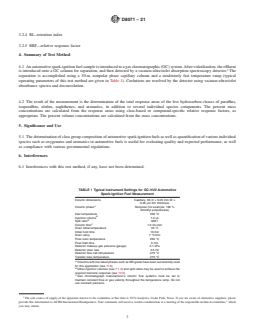
4.1 An automotive spark-ignition fuel sample is introduced to a gas chromatographic (GC) system. After volatilization, the effluent
is introduced onto a GC column for separation, and then detected by a vacuum ultraviolet absorption spectroscopy detector. The
separation is accomplished using a 30 m, nonpolar phase capillary column and a moderately fast temperature ramp (typical
operating parameters of this test method are given in Table 1). Coelutions are resolved by the detector using vacuum ultraviolet
absorbance spectra and deconvolution.
4.2 The result of the measurement is the determination of the total response areas of the five hydrocarbon classes of paraffins,
isoparaffins, olefins, naphthenes, and aromatics, in addition to several individual species components. The percent mass
concentrations are calculated from the response areas using class-based or compound-specific relative response factors, as
appropriate. The percent volume concentrations are calculated from the mass concentrations.
5. Significance and Use
5.1 The determination of class group composition of automotive spark-ignition fuels as well as quantification of various individual
species such as oxygenates and aromatics in automotive fuels is useful for evaluating quality and expected performance, as well
as compliance with various governmental regulations.
6. Interferences
6.1 Interferences with this test method, if any, have not been determined.
TABLE 1 Typical Instrument Settings for GC-VUV Automotive
Spark-Ignition Fuel Measurement
Column dimensions Capillary, 30 m × 0.25 mm ID ×
0.25 μm film thickness
A
Column phase Nonpolar (for example, 100 %
dimethyl polysiloxane)
Inlet temperature 250 °C
B
Injection volume 1.0 μL
B
Split ratio 300:1
C
Column flow 1.0 mL/min
Oven initial temperature 35 °C
Initial hold time 10 min
Oven ramp 7 °C/min
Final oven temperature 200 °C
Final hold time 0 min
Detector makeup gas pressure (gauge) 2.1 kPa
Detector scan rate 4.5 Hz
Detector flow cell temperature 275 °C
Transfer tube temperature 275 °C
A
Columns with low bleed phases such as MS grade have been successfully used
for this application (see 11.6)
B
Other injection volumes (see 7.1.2) and split ratios may be used to achieve the
required benzene response (see 13.2)
C
Gas chromatograph manufacturer’s column flow systems must be set to
maintain constant flow or gas velocity throughout the temperature ramp. Do not
use constant pressure.
The sole source of supply of the apparatus known to the committee at this time is VUV-Analytics, Cedar Park, Texas. If you are aware of alternative suppliers, please
provide this information to ASTM International Headquarters. Your comments will receive careful consideration at a meeting of the responsible technical committee, which
you may attend.
D8071 − 21
7. Apparatus
7.1 Gas chromatograph, equipped with automated oven temperature control and split/splitless inlet.
7.1.1 Flow Controllers—The gas chromatograph must be equipped with mass flow controllers capable of maintaining carrier gas
flow constant to 61 % over the full operating temperature range of the column. The inlet pressure of the carrier gas supplied to
the gas chromatograph must be at least 485 kPa. This will ensure that the minimum pressure needed to compensate for the increase
in column back-pressure as the column temperature is maintained.
7.1.2 Autosampler—It is highly recommended that the gas chromatograph is equipped with an autosampler. All precision data
were obtained using a GC equipped with an autosampler.
7.2 Purge/Makeup Gas, for detector: nitrogen or argon (see 8.3).
7.3 Oxygen, Water, Hydrocarbon Filters, to further purify GC carrier gas and detector purge/makeup gas.
7.4 Capillary Analytical Column, nonpolar (for example, dimethyl polysiloxane) phase, dimensions 30 m length, 0.25 mm internal
diameter, 0.25 μm film thickness.
7.5 Vacuum Ultraviolet Absorption Spectroscopy Detector, capable of measuring 125 nm to 240 nm absorbance spectra with a
wavelength resolution of 1 nm or better.
7.5.1 The detector shall be able to interface with a gas chromatographic system and measure an eluent with a scan frequency of
at least 4.5 Hz with a baseline peak-to-peak noise width over a 10 s interval no greater than 0.002 AU when averaged over the
following wavelength regions: 125 nm to 240 nm, 170 nm to 200 nm, 125 nm to 160 nm, and 0.001 AU when averaged over the
140 nm to 160 nm wavelength region.
7.5.2 The detector shall be equipped with a shutter or equivalent mechanism that allows the detector array to be blocked from the
light source in order to perform a “dark” measurement of electronic noise level.
7.5.3 The detector shall be equipped with a flow cell capable of being heated to at least 275 °C.
7.5.4 The detector shall have an independently controlled makeup gas capability, capable of providing up to 5 mL ⁄min additional
flow of nitrogen, helium, or argon to the flow cell.
7.6 Data Processing System, capable of storing and processing absorbance scan data and corresponding time.
7.6.1 Data processing system shall include a database library of vacuum ultraviolet reference spectra, compound class information,
carbon number, density, and approximate retention index values. Data processing system shall also store relative response factors
for each hydrocarbon class in addition to relative response factors for individually reported compounds.
7.6.2 Data processing system shall be capable of implementing equations and fit procedures that result in deconvolution of
absorbance spectra that contain contributions from multiple species.
7.6.3 Data processing system shall be capable of binning and storing response contributions from each deconvolution analysis and
reporting a combined total response at the end of the analysis.
7.6.4 Data processing system shall be capable of implementing equations to convert response areas to percent mass and further
convert percent mass to percent volume.
8. Reagents and Materials
8.1 Purity of Reagents—Reagent grade chemicals shall be used in all tests. Unless otherwise indicated, it is intended that all
reagents conform to the specifications of the Committee on Analytical Reagents of the American Chemical Society where such
D8071 − 21
specifications are available. Other grades may be used, provided it is first ascertained that the reagent is of sufficiently high purity
to permit its use without lessening the accuracy of the determination.
8.2 Helium carrier gas for gas chromatograph, 99.999 % pure.
NOTE 1—Test method performance has not been studied for other carrier gases such as hydrogen or nitrogen.
8.3 Nitrogen, helium, or argon purge/makeup gas for vacuum ultraviolet detector, 99.999 % pure.
8.4 Methylene chloride, reagent grade, used as a solvent test sample and GC rinse solvent. (Warning—Toxic material. May be
combustible at high temperatures.)
8.5 Retention time standard consisting of isobutane (iC4), butane (C4), isopentane (iC5), and pentane through pentadecane linear
alkanes, approximately 1 % by mass each, in suitable solvent such as methylene chloride, used as retention time markers.
8.6 A system validation mixture prepared in compliance with Practice D4307, having the components and approximate
concentrations given in Table 2. The concentrations of the prepared system validation mixture should be close to those in Table
2.
8.7 Check standard VUVCS S24, with accepted reference values (ARV) and tolerance limits as listed in Table 3.
NOTE 2—VUVCS S24 is one of the samples included in the ILS for the determination of method precision as described in Research Report RR:D02-1909.
TABLE 2 System Validation Mixture
Component Concentration (percent mass)
Cyclopentane 1.1
n-Pentane 1.1
Cyclohexane 2.1
2,3-Dimethylbutane 2.1
n-Hexane 2.1
1-Hexene 1.5
Methylcyclohexane 4
4-Methyl-1-hexene 1.6
n-Heptane 3.5
1,2-Dimethylcyclohexane 5
Isooctane 5
n-Octane 5
1,2,4-Trimethylcyclohexane 4
n-Nonane 4.5
n-Decane 4.5
n-Undecane 3.5
n-Dodecane 3.5
Benzene 2.2
Toluene 2.2
trans-Decahydronaphthalene 4
n-Tetradecane 4.5
Ethylbenzene 4.5
o-Xylene 4
n-Propylbenzene 5
1,2,4-Trimethylbenzene 4.5
1,2,3-Trimethylbenzene 5
1,2,4,5-Tetramethylbenzene 5
Pentamethylbenzene 5
Total Paraffins 32.2
Total Isoparaffins 7.1
Total Olefins 3.1
Total Naphthenes 20.2
Total Aromatics 37.4
Total Xylenes 4.0
ACS Reagent Chemicals, Specifications and Procedures for Reagents and Standard-Grade Reference Materials, American Chemical Society, Washington, DC. For
suggestions on the testing of reagents not listed by the American Chemical Society, see Analar Standards for Laboratory Chemicals, BDH Ltd., Poole, Dorset, U.K., and
the United States Pharmacopeia and National Formulary, U.S. Pharmacopeial Convention, Inc. (USPC), Rockville, MD.
Available from Spectrum Quality Standards, 17360 Groeschke Rd., Houston, TX 77084, https://spectrumstandards.com.
D8071 − 21
A
TABLE 3 Check Sample VUVCS S24 Tolerances
Property Sample 95 % conf. ⁄99 % coverage
tolerance interval
Aromatics, vol% VUVCS-S24 15.346 to 18.078
Benzene, vol% VUVCS-S24 0.616 to 0.712
Olefins, vol% VUVCS-S24 9.15 to 10.925
Ethanol, mass% VUVCS-S24 10.203 to 11.678
Paraffins, vol% VUVCS-S24 9.486 to 11.003
A
Consensus results for Check Sample VUVCS S24 obtained from 21 laboratories
in 2019. Supporting data have been filed at ASTM International Headquarters and
may be obtained by requesting Research Report RR:D02-1909. Contact ASTM
Customer Service at service@astm.org.
9. Hazards
9.1 Many of the compounds in automotive spark-ignition engine fuel or other test samples used in this test method are toxic,
flammable, or both. Safety and sample-handling procedures appropriate for working with such materials shall be in place before
attempting to use this test method.
9.2 Hydrogen is flammable and potentially explosive if not properly used. Use of hydrogen as a GC carrier gas shall only be done
at laboratories experienced with its use, with proper safety procedures in place.
10. Sampling
10.1 Refer to Practices D4057 and D5842 for guidelines on obtaining automotive spark-ignition engine fuel samples for analysis.
Samples should be kept refrigerated at approximately 4 °C until ready to be analyzed.
11. Preparation of Apparatus
11.1 Ensure that all gas connections are properly made, without leaks.
11.2 Install oxygen, moisture, and hydrocarbon filters in gas lines upstream of GC and detector. Maintain gas filters as instructed
by manufacturer.
11.3 Install the 30 m column in the GC inlet. Condition the column according to the column manufacturer’s recommendations
prior to installation in the detector.
11.4 Perform maintenance on the GC as suggested by manufacturer, such as replacing septum and liner.
11.5 Configure the injector, carrier gas, and other GC parameters according to Table 1.
11.6 Inject the solvent test sample defined in 8.4 and run the GC-VUV apparatus through a full oven ramp and cool-down cycle.
Repeat.
11.6.1 Assess the baseline on either a solvent test sample or a system validation mixture (see 8.6) run. The average absorbance
value (125 nm to 240 nm) of the last 1.0 min section of the baseline at the end of the oven ramp shall be no more than 60.0035 AU
of the average value (125 nm to 240 nm) of the initial 1.0 min to 2.0 min range.
12. Calibration and Standardization
12.1 On installation of GC-VUV apparatus, after significant maintenance of GC-VUV apparatus, or after a significant method
change, establish a retention index file. Run the retention index sample (see 8.5) using the same flow conditions and oven ramp
profile as measured samples (see Table 1 for recommended run conditions). Record the retention times of iC4, C4, iC5, and C5
through C15 linear alkanes. These will serve as retention time markers.
12.1.1 Significant method changes include changing the GC, column type, carrier gas type, or oven ramp profile. Significant
maintenance of the GC-VUV apparatus includes changing or trimming the analytical column.
D8071 − 21
12.2 A list of retention times and retention indices for the linear alkanes is used to estimate rough elution times of other compounds
in the VUV library according to an interpolation scheme. The most convenient retention index scheme sets the linear alkane
retention indices to multiples of 100 according to carbon number: butane RI = 400, pentane RI = 500, etc. Each compound entry
in the VUV library shall have an associated retention index generated using the same RI scheme. Otherwise, the associated
retention indices do not need to be particularly accurate. The RI values for nonpolar capillary chromatography found in the
literature or other ASTM test methods, such as Test Method D6730, may be used.
12.2.1 Once updated, the same retention time marker list is used for all subsequent automotive spark-ignition fuel measurements
until the next modification or maintenance of the GC-VUV instrumentation.
12.3 The conversion from response areas to percent mass uses class-based or compound-specific relative response factors. The
relative response factors account for the differing areal response per unit mass for the various hydrocarbon classes.
12.4 For the purpose of this calculation, the response at a given elution time refers to the absorbance averaged over the 125 nm
to 240 nm wavelength region. The response area refers to the sum of the response over all detector scans within a given time
region. A true area can be generated by multiplying this quantity by the time interval between scans. However, this step is
unnecessary when the scan rate is kept constant throughout a given measurement. For the purposes of this test method, the response
area is taken to be a sum having units of absorbance units.
12.5 The response factors are relative to the response of methane, which is taken to have a relative response factor of 1.
12.6 Relative response factors used to obtain the precision data in this test method are given in Table 4 and Table 5, and are
suitable for use with this test method.
13. Pre-Measurement Validation
13.1 Before proceeding with measurements after a significant change or maintenance of the GC-VUV system, the procedures in
Section 11 shall have been completed, and a retention index file generated or verified following the procedure in 12.1 and 12.2.
13.2 Analyze the system validation mixture (8.6) and verify that the total response for benzene is 3.5 6 0.25.
13.2.1 If the total response is outside the required range, adjust the detector make-up gas pressure and reanalyze the system
validation mixture, checking the benzene response until it is within the specified range. Increasing the detector make-up gas
pressure will decrease the benzene response. Do not adjust the make up gas pressure to less than 1.0 kPa or to more than 4.1 kPa.
13.2.2 If the detector make-up gas pressure has been changed, reanalyze the retention index sample (12.1 and 12.2) and establish
a new retention index file. Adjusting the detector make-up gas pressure will change retention times. Reanalyze the system
validation mixture (8.6) and verify the total response for benzene (13.2).
13.3 Verify that the system validation mixture results are within tolerance limits.
13.3.1 The group totals for paraffins, isoparaffins, olefins, naphthenes, and aromatics shall be within 61.0 % by mass of the known
totals.
13.3.2 The benzene, toluene, ethylbenzene, total xylenes, and isooctane shall be within 60.5 % by mass of their known values.
TABLE 4 Relative Response Factors for Bulk Hydrocarbon
Classes
Hydrocarbon Class Relative Response Factor
Paraffin 0.769
Isoparaffin 0.781
Olefin 0.465
Naphthene 0.786
C + Aromatics 0.296
D8071 − 21
TABLE 5 Relative Response Factors for Specific Individual
Compounds and Compound Groups
Compound Relative Response Factor
Ethanol 1.029
Methanol 1.211
Isooctane 0.674
Benzene 0.258
Toluene 0.267
Ethylbenzene 0.284
Xylenes 0.284
Naphthalene 0.207
1-Methylnaphthalene, 2-Methylnaphthalene 0.250
13.3.3 The ratio of tetradecane to pentane shall be between 3.8 and 4.5.
13.4 Analyze the check sample VUVCS S24 as defined in 8.7. Results shall be within the tolerances stated in Table 3.
13.5 If the tolerances in 13.3 or 13.4 are not met, verify functionality of all GC-VUV components, validity of retention time
marker list, and validity/quality of the check sample or system validation mixture, or both. Repeat setup methodology in Sections
11, 12, and 13 as necessary to ensure tolerances in 13.3 or 13.4 are met before proceeding.
14. Procedure
14.1 Inject the sample into the GC inlet port. Typical GC method and detector conditions are given in Table 1.
14.2 The system shall record a dark scan immediately after start.
14.3 The system shall record a reference scan immediately after the dark scan.
14.3.1 The reference scan refers to an initial detector scan used as a reference to convert subsequent detector scans to absorbance
scans, and is defined in Annex A1. It is not a library reference spectrum.
14.4 The system shall record 125 nm to 240 nm absorbance spectra and time of scan for each detector scan. Conversion of
recorded intensity data to absorbance is given in Annex A1.
14.5 At the end of the GC run, the data collection shall automatically stop, and the recorded absorbance spectra processed in order
to obtain response areas for each of the hydrocarbon classes and individual compounds being monitored.
14.5.1 Calculate percent mass for each hydrocarbon group and each of the individual compounds/compound groups ethanol,
methanol, isooctane, benzene, toluene, ethylbenzene, and total xylenes.
14.5.2 Calculate percent volume results from the percent mass results and class/compound densities.
14.6 Generate a report displaying the information calculated in 14.5.
15. Calculation
NOTE 3—See pertinent information on modeling absorbance data in Annex A2.
15.1 Divide the measured chromatogram into time slices of a given width, Δt. Define the following parameters:
15.1.1 A retention index (RI) window,
15.1.2 A chi-squared iteration threshold, expressed as a percentage,
15.1.3 An R threshold,
D8071 − 21
15.1.4 A saturation threshold, and
15.1.5 An initial background time region (optional).
15.2 If an initial background time region is defined, calculate a background spectrum from the average of the absorbance scans
over the background time region.
15.3 Analyze each time slice using the following algorithm:
15.3.1 Calculate the total absorbance from the sum of the absorbance scans within the time slice.
15.3.1.1 If a background spectrum is defined, subtract the background spectrum from each of the individual absorbance spectra
within the time slice. Sum the resulting background-subtracted spectra to obtain the total absorbance spectrum for the time slice.
15.3.1.2 If the absorbance value at a given wavelength exceeds the saturation threshold for any of the absorbance scans within
the time slice, remove the data at that wavelength value from the total absorbance and library reference spectra used in subsequent
fits for that time slice.
15.3.2 Calculate the average retention index of the time slice using the average elution time of the time slice and the list of
retention time markers. A linear interpolation scheme is sufficient.
15.3.3 Construct a list consisting of all compounds in the VUV reference library within 6RI window of the average retention
index of the time slice.
15.3.4 Perform a tiered search on the total absorbance spectrum, drawing from the constructed list of compounds:
15.3.4.1 Construct Eq A2.1 (see Annex A2) assuming a single component contributes to the total absorbance. Select a compound
from the list and assign its library reference spectrum to A in Eq A2.1. Fit the total absorbance to Eq A2.1 using general linear
1,ref
least squares. Calculate a metric, such as the chi-squared statistic:
N
1 1
2 2
x 5 ~A 2 A ! (1)
( 2 i,meas i,calc
N σ
i51
i
where:
N = the number of data points in an absorbance spectrum fit,
A = the measured total absorbance at data point i,
i,meas
A = the calculated total absorbance at data point i, and
i,calc
σ = the uncertainty of measured data point i, expressed as a standard deviation
i
If the uncertainty in the measured data have not been estimated, the σ may be set to 1. Normalization by the number of data
i
points, N, is also optional.
15.3.4.2 Repeat the fit for each compound in the list and retain the fit yielding the best chi-square value, along with the best-fit
compound’s fit value f .
15.3.4.3 Construct Eq A2.1 assuming two compounds contribute to the total absorbance spectrum. Populate A and A in Eq
1,ref 2,ref
A2.1 with library reference spectra for each possible pair of compounds from the compound list. Fit the total absorbance to Eq
A2.1 for each pair. Retain the pair resulting in the best chi-squared value along with their fit values, f and f . Compare the
1 2
chi-squared value from the best two-component fit to the chi-squared value from the best one-component fit. If the percent
improvement of the chi-squared value for the best two-component fit over the best one-component fit is greater than the
chi-squared iteration threshold, retain the two-component result. Otherwise, reject the two-component result and retain the
one-component result.
15.3.4.4 Construct Eq A2.1 assuming three compounds contribute to the total absorbance spectrum. Populate A ,A , and A
1,ref 2,ref 3,ref
with library reference spectra for each possible triplet of compounds from the compound list. Fit the total absorbance to Eq A2.1
for each triplet. Retain the triplet resulting in the best chi-squared value along with the fit values, f ,f , and f . Compare the
1 2 3
chi-squared value from the best three-component fit to the chi-squared value from the best two-component fit. If the percentage
improvement of the chi-squared value for the best three-component fit over the best two-component fit is greater than the
D8071 − 21
chi-squared iteration threshold, retain the best three-component result. Otherwise, reject the three-component result and retain the
best two-component result, unless the best two-component result was also rejected, in which case retain the best one-component
result.
15.3.5 The result of the tiered search procedure is a prediction of the number of compounds that contribute to the total absorbance
spectrum, their likely identities, as well as the best-fit values. “Integrate” the library reference spectra of the best-fit compounds
by averaging them over the 125 nm to 240 nm region, generating an integration factor for each compound. Multiply the best-fit
values, f , by the corresponding integration factors. These are the compounds’ contributions to the response area of the time slice.
i
15.3.6 If the R value, determined from
N
~A 2 A !
( i,meas i,calc
i51
R 5 12 (2)
N
¯
~A 2 A!
( i,meas
i51
is less than the R threshold value, reject the analysis results for the time slice (optional). Otherwise, add the compound
contributions to the total class response areas according to their class, or to an individual compound’s response area if a compound
is one of the speciated compounds given in Table 5. If an individual compound in Table 5 also belongs to a compound class in
Table 4 (for example, isooctane), add its response to the individual compound response area and not to the class response area.
In Eq 2, A¯ is the wavelength average of the measured total absorbance spectrum.
15.3.7 Iterate the algorithm until all of the time slices have been analyzed.
15.4 Implementation of an analysis criterion for determining whether to analyze a time slice and a background subtraction is
permissible. If a background subtraction is used, a criterion for automatically determining that a time region should be used as a
background spectrum may be defined.
15.4.1 Absorbance Check 1—Compare the change of a response filter over a time slice. If the response filter changes by more than
the absorbance threshold, then analyze the time slice. Otherwise, skip the time slice.
15.4.1.1 If a time slice is skipped, the background threshold may be checked and if the response change over the time slice is less
than the background threshold, update the background spectrum using the average absorbance spectrum over the time slice.
15.4.2 Absorbance Check 2—If the maximum response of the four filters consisting of average 125 nm to 240 nm absorbance,
average 170 nm to 200 nm absorbance, average 125 nm to 160 nm absorbance, and average 140 nm to 160 nm absorbance exceeds
the maximum response of the same four filters applied to the current background spectrum by more than three times the absorbance
threshold, then analyze the time slice (and do not update the background spectrum) regardless of the outcome of Absorbance Check
1.
15.4.3 Other threshold criteria may be used, provided it is first determined that use of alternative threshold criteria does not lessen
the accuracy or precision of the test method.
15.5 Due to the similarities of absorbance spectra of compounds belonging to the same class, as well as the similarities of relative
response factors among compounds belonging to the same class, it is not necessary to have an explicit representation of all
compounds in the VUV reference library. The following substitutions for an uncharacterized compound are permissible and will
generally automatically be made by the algorithm:
15.5.1 Library reference spectra of similar compound class and similar carbon number.
15.5.2 Linear combinations of spectra of similar compound class and similar carbon number.
2 2
15.6 If an R threshold is applied, record the amount of response area rejected by implementation of the R threshold. Compare
the rejected amount to the total response area at the end of the analysis. If more than 3 % of the response area was rejected, the
analysis should be flagged, and the measurement data and GC-VUV instrumentation should be inspected.
15.7 Table 6 lists values for analysis parameters used in the statistical study given in Section 17, and are suitable for use with this
test method.
D8071 − 21
TABLE 6 Parameters Used in Analysis of GC-VUV Scan Data
Parameter Value
Time slice width 0.02 min
RI window ±25
Initial background region 1.6 min to 1.8 min
Saturation threshold 0.8 AU
R Threshold 0.4
Background scalar 1.5
Absorbance threshold 0.0005 AU
Background threshold 0.00025 AU
Response filter to apply Average 140 nm to 160 nm absorbance
Absorbance Check 1
Response filter to apply Average 140 nm to 160 nm absorbance
background check
Response filter(s) to apply Average 125 nm to 240 nm absorbance
Absorbance Check 2 Average 170 nm to 200 nm absorbance
Average 125 nm to 160 nm absorbance
Average 140 nm to 160 nm absorbance
Chi-square iteration threshold 60 %
Area reject (15.6) Max 3 %
15.8 The result of the measurement and analysis procedure are total response areas for each of the hydrocarbon classes and each
individually speciated compound. For a given class or specific compound, a, calculate the percent mass from
A 3RRF
a a
M 5 100 3 (3)
a n
A 3RRF
( i i
i51
where:
M = percent mass for analyte or analyte class a,
a
A = total response area for analyte or analyte class a, and
a
RRF = relative response factor for analyte or analyte class a.
a
The sum runs over all hydrocarbon classes and speciated compounds.
15.8.1 Calculate the total aromatics percent mass by adding the percent mass for the individual mono-aromatics in Table 5 to the
C + aromatics class percent mass.
15.8.2 Calculate total isoparaffins percent mass by adding the percent mass for isooctane to the percent mass for the isoparaffins
class.
15.9 Calculate total saturate content by summing the percent mass values of the hydrocarbon classes of paraffins, isoparaffins, and
naphthenes.
15.10 Convert the percent mass result for analyte or analyte class, a, to percent volume using:
M
a
ρ
a
V 5 100 3 (4)
a N
M
i
S D
(
ρ
i51 i
where:
M = percent mass for analyte or analyte class a,
a
M = percent mass for analyte or analyte class i,
i
V = percent volume for analyte or analyte class a,
a
ρ = liquid density for analyte or average relative density for analyte class i, and
i
ρ = liquid density for analyte or average relative density for analyte class a.
a
D8071 − 21
The liquid density values may be obtained from various literature or ASTM publications. For example, densities for many
relevant compounds are given in Test Method D6730 and in ASTM publication DS4A, Physical Constants of Hydrocarbons C
to C . Average density values may be used for densities of bulk PIONA classes or for PIONA classes at various carbon numbers.
Recommended densities for use with this test method are given in Table 7.
15.10.1 Eq 4 shall be applied to percent mass values before the individually speciated aromatics percent mass values are added
to the C + aromatics percent mass, and before the isooctane percent mass value is added to the isoparaffins percent mass. After
the percent volume values are calculated, the percent volume values of the mono-aromatics from Table 5 shall be added to the
percent volume result for the C + aromatics class in order to report total aromatics content. Similarly for isooctane and the
isoparaffins class.
15.11 Calculate total saturate percent volume by summing the percent volume values of the hydrocarbon classes of paraffins,
isoparaffins, and naphthenes.
16. Report
16.1 Report percent mass and percent volume for each of the compound classes (paraffins, isoparaffins, olefins, naphthenes, and
aromatics), methanol, ethanol, benzene, toluene, ethylbenzene, xylenes, naphthalene, and methylnaphthalenes to the nearest
0.01 %.
16.1.1 (Optional): Calculate and report oxygen content to the nearest 0.01 % by mass using Eq 5.
x ·16.0·A
i i
X 5 Σ (5)
total
MW
i
where:
X = total % by mass oxygen in the fuel,
total
x = % by mass of each oxygenate,
i
16.0 = atomic mass of oxygen,
A = number of oxygen atoms in oxygenate molecule, and
i
MW = molecular mass of the oxygenate.
i
17. Precision and Bias
17.1 Precision—The precision of this test method, which was determined by statistical examination of interlaboratory results using
Practice D6300, is as follows.
17.1.1 Repeatability—The difference between two independent results obtained by the same operator in a given laboratory
applying the same test method with the same apparatus under constant operating conditions on identical test material within short
TABLE 7 Densities for Various Hydrocarbon Classes and
Individual Compounds
Hydrocarbon Class/Compound Density
Paraffin 0.660
Isoparaffin 0.660
Olefin 0.657
Naphthene 0.774
C + Aromatics 0.872
Ethanol 0.789
Methanol 0.792
Isooctane 0.660
Benzene 0.879
Toluene 0.867
Ethylbenzene 0.867
Xylenes 0.870
Naphthalene 1.025
Methylnaphthalenes 1.020
Supporting data have been filed at ASTM International Headquarters and may be obtained by requesting Research Report RR:D02-1909. Contact ASTM Customer
Service at service@astm.org.
D8071 − 21
intervals of time would exceed the values computed from Table 8, where X is the average of the two results, with an approximate
probability of 5 % (one case in 20 in the long run) in the normal and correct operation of the test method.
17.1.2 Test Method D8071 reproducibility and repeatability at selected levels:
Total Aromatics, vol%
Level R r
20 1.415 0.488
28 1.746 0.602
36 2.044 0.705
44 2.318 0.799
51 2.574 0.887
Benzene, vol%
Level R r
0.2 0.012 0.005
0.4 0.024 0.008
0.6 0.037 0.011
0.7 0.050 0.014
0.9 0.063 0.017
Olefin, vol%
Level R r
4 0.629 0.340
13 1.056 0.570
21 1.347 0.727
30 1.582 0.854
38 1.784 0.963
Olefin, mass%
Level R r
1.0 0.264 0.128
4.1 0.566 0.273
12.1 1.016 0.490
20.1 1.336 0.644
28.0 1.600 0.772
36.0 1.832 0.884
Ethanol, mass%
Level R r
2 0.193 0.067
5 0.395 0.138
8 0.554 0.193
11 0.693 0.242
14 0.819 0.286
TABLE 8 Practice D6300 Precision Analysis (Reproducibility and Repeatability) Outcome
Property Reproducibility Repeatability Applicable Test Result Range
0.63 0.63
Aromatics, vol% 0.2149(X) 0.0741(X) 14.743 to 58.124
1.05 0.75
Benzene, vol% 0.0676(X) 0.0176(X) 0.09 to 1.091
0.48 0.48
Olefins, vol% 0.3115(X) 0.1681(X) 0.011 to 44.002
0.54 0.54
Olefins, mass% 0.2645(X) 0.1276(X) 0.027 to 41.954
0.67 0.67
Ethanol, mass% 0.1424(X+0.002) 0.0497(X+0.002) 0.042 to 15.991
1.06 1.06
Ethylbenzene, vol% 0.0735(X) 0.0237(X) 0.5 to 3.175
Isoparaffins, vol% 1.2933 0.7644 22.697 to 71.993
0.5 0.5
Methanol, vol% 0.2111(X) 0.0348(X) 0.063 to 3.426
0.8 0.8
Methylnaphthalenes, vol% 0.0884(X) 0.0395(X) 0.021 to 1.484
0.88 0.7
Naphthalene, vol% 0.0775(X) 0.0202(X) 0.019 to 0.779
0.38 0.38
Naphthene, vol% 0.4994(X) 0.3301(X) 0.606 to 18.416
0.77 0.77
Paraffins, vol% 0.1257(X) 0.0538(X) 3.572 to 23.105
0.75 0.75
Toluene, vol% 0.0878(X) 0.026(X) 0.698 to 31.377
0.91 0.91
Xylenes, vol% 0.079(X) 0.029(X) 3.037 to 18.955
Supporting data for precision of the olefin % by mass data and D6708 correlation to ASTM D6550 have been filed at ASTM International Headquarters and may be
obtained by requesting Research Report RR:D02-2009. Contact ASTM Customer Service at service@astm.org.
D8071 − 21
Ethyl Benzene, vol%
Level R r
0.8 0.056 0.018
1.3 0.094 0.030
1.7 0.132 0.043
2.2 0.171 0.055
2.7 0.211 0.068
Isoparaffins, vol%
Level R r
29 1.293 0.764
38 1.293 0.764
47 1.293 0.764
57 1.293 0.764
66 1.293 0.764
Methanol, vol%
Level R r
0.4 0.139 0.023
1.0 0.213 0.035
1.6 0.267 0.044
2.2 0.312 0.051
2.8 0.351 0.058
Methyl Naphthalenes, vol%
Level R r
0.2 0.020 0.009
0.4 0.045 0.020
0.7 0.066 0.030
1.0 0.086 0.038
1.2 0.105 0.047
Naphthalene, vol%
Level R r
0.1 0.009 0.004
0.2 0.021 0.007
0.4 0.032 0.010
0.5 0.043 0.013
0.7 0.053 0.015
Naphthenes, vol%
Level R r
3 0.729 0.482
6 0.979 0.647
9 1.153 0.762
12 1.292 0.854
15 1.411 0.932
Paraffins, vol%
Level R r
6 0.481 0.206
9 0.699 0.299
13 0.898 0.384
16 1.084 0.464
20 1.261 0.540
Toluene, vol%
Level R r
4 0.235 0.071
10 0.480 0.145
16 0.686 0.207
21 0.874 0.264
27 1.049 0.316
17.1.3 Reproducibility—The difference between two single and independent results obtained by different operators applying the
same test method in different laboratories using different apparatus on identical test material would exceed the following values
D8071 − 21
in Table 8, where X is the average of the two results, with an approximate probability of 5 % (one case in 20 in the long run) in
the normal and correct operation of the test method.
17.1.4 Bias—Since there is no accepted reference material suitable for determining bias for the procedure in this test method, no
statement of bias is being made.
17.2 Relative Bias—A relative bias assessment of Test Method D8071 versus Test Method D1319 for the determination of total
aromatics in spark ignition fuel was conducted in accordance with the requirements of Practice D6708 with a successful outcome.
It was based on measurements of total aromatics in spark ignition fuels by participating laboratories in an interlaboratory study
and is documented in Research Report RR:D02-1909.
17.2.1 The degree of agreement between results from Test Method D8071 and Test Method D1319 can be further improved by
applying a correlation equation (Eq 6) (Research Report RR:D02-1909). Sample-specific bias, as defined in Practice D6708, was
observed for some samples after applying the bias-correction for the material types and property range listed below.
17.2.2 Correlation Equation:
Predicted Test Method D13195 (6)
Bias-corrected Test Method D8071=
C 2 0.8313
D8071
where:
C = unrounded volume percent total aromatics as reported by Test Method D8071, and
D8071
Predicted Test Method D1319 = the outcome from Eq 6 rounded to the reported resolution of Test Method D1319.
17.2.2.1 Use of this correlation equation to predict Test Method D1319 result is only applicable for fuels in the concentration range
from 14.743 % to 58.124 % by volume as reported by Test Method D8071.
NOTE 4—The Test Method D1319 concentration range used to develop the Practice D6708 assessment may not cover the entire scope indicated in the
scope of Test Method D1319 for total aromatics.
NOTE 5—The correlation equation was developed from a variety of fuel samples from interlaboratory proficiency test programs; however, it is
recommended that the correlation equation be verified for samples of interest to ensure applicability.
17.2.2.2 Between-Method Reproducibility (R )—Differences between bias-corrected results from Test Method D8071 and Test
xy
Method D1319, for the sample types and property ranges studied, are expected to exceed the following between-methods
reproducibility (R ), as defined in Practice D6708, about 5 % of the time.
xy
2 2 0.5
R 5 0.72 R 1 0.72 R (7)
@ ~ ! ~ ! #
xy x y
where:
R = reproducibility of Test Method D8071,
x
R = reproducibility of Test Method D1319 for total aromatics, and
y
R = between-method reproducibility as defined in Practice D6708.
xy
R comparison at selected X levels (with ethanol):
X R R R
x y xy
15.0 1.18 3.70 3.30
25.0 1.63 3.70 3.43
35.0 2.02 3.70 3.58
50.0 2.53 3.70 3.80
17.3 Relative Bias—A relative bias assessment of Test Method D8071 versus Test Method D1319 for the determination of total
olefins in spark ignition fuel was conducted in accordance with the requirements of Practice D6708 with a successful outcome.
It was based on measurements of
...