

ASTM D6393/D6393M-21
(Test Method)Standard Test Method for Bulk Solids Characterization by Carr Indices
General Information
- Abstract
SIGNIFICANCE AND USE
5.1 This test method provides measurements that can be used to describe the bulk properties of a powder or granular material.
5.2 The measurements can be combined with practical experience to provide relative rankings of various forms of bulk handling behavior of powders and granular materials for a specific application.
Note 1: The quality of the result produced by this standard is dependent on the competence of the personnel performing it, and the suitability of the equipment and facilities used. Agencies that meet the criteria of Practice D3740 are generally considered capable of competent and objective testing/sampling/inspection/etc. Users of this standard are cautioned that compliance with Practice D3740 does not in itself assure reliable results. Reliable results depend on many factors; Practice D3740 provides a means of evaluating some of those factors. Practice D3740 was developed for agencies engaged in the testing or inspection (or both) of soil and rock. As such it is not totally applicable to agencies performing this standard. However, users of this standard should recognize that the framework of Practice D3740 is appropriate for evaluating the quality of an agency performing this standard. Currently there is no known qualifying national authority that inspects agencies that perform this standard.
SCOPE
1.1 This test method covers an apparatus and procedures for measuring properties of bulk solids, henceforth referred to as Carr Indices.2
1.2 This test method is suitable for free flowing and moderately cohesive powders and granular materials up to 2.0 mm [1/16 in.] in size. Materials must be able to pour through a 6.0 to 8.0-mm [1/4 to 5/16 in.] diameter funnel outlet when in an aerated state.
1.3 This method consists of eight measurements and two calculations for Carr Indices as follows. Each measurement, or calculation, or combination of them, can be used to characterize the properties of bulk solids.
1.3.1 Measurement of Carr Angle of Repose
1.3.2 Measurement of Carr Angle of Fall
1.3.3 Calculation of Carr Angle of Difference
1.3.4 Measurement of Carr Loose Bulk Density
1.3.5 Measurement of Carr Packed Bulk Density
1.3.6 Calculation of Carr Compressibility
1.3.7 Measurement of Carr Cohesion
1.3.8 Measurement of Carr Uniformity
1.3.9 Measurement of Carr Angle of Spatula
1.3.10 Measurement of Carr Dispersibility
1.4 All observed and calculated values shall conform to the guidelines for significant digits and rounding established in Practice D6026.
1.4.1 The procedures used to specify how data are collected/recorded or calculated in this standard are regarded as the industry standard. In addition, they are representative of the significant digits that generally should be retained. The procedures used do not consider material variation, purpose for obtaining the data, special purpose studies, or any considerations for the user’s objectives: and it is common practice to increase or reduce significant digits of reported data to be commensurate with these considerations. It is beyond the scope of this standard to consider significant digits used in analysis methods for engineering design.
1.5 Units—The values stated in either SI units or inch-pound units are to be regarded separately as standard. The values stated in each system are not necessarily exact equivalents; therefore, to ensure conformance with the standard, each system shall be used independently of the other, and values from the two systems shall not be combined.
1.6 This standard does not purport to address all of the safety concerns, if any, associated with its use. It is the responsibility of the user of this standard to establish appropriate safety, health, and environmental practices and determine the applicability of regulatory limitations prior to use.
1.7 This international standard was developed in accordance with internationally recognized principles on st...
- Status
- Published
- Publication Date
- 30-Apr-2021
- Technical Committee
- D18 - Soil and Rock
- Drafting Committee
- D18.24 - Characterization and Handling of Powders and Bulk Solids
Overview
ASTM D6393/D6393M-21, titled Standard Test Method for Bulk Solids Characterization by Carr Indices, is a critical international standard developed by ASTM for the laboratory evaluation of bulk flow properties of powders and granular materials. This test method is widely used to characterize materials up to 2.0 mm (1/16 in.) in size, particularly those that are free-flowing or moderately cohesive. It provides a set of measured values, known as Carr Indices, which help determine the handling and flow behavior of bulk solids during storage, transport, and processing.
Key Topics
- Purpose: The standard outlines procedures to measure and calculate key properties of powders and granular materials, supporting the selection and management of bulk solids in various industrial processes.
- Carr Indices: Ten distinct indices are determined through a combination of eight measurements and two calculations:
- Carr Angle of Repose
- Carr Angle of Fall
- Carr Angle of Difference
- Carr Loose Bulk Density
- Carr Packed Bulk Density
- Carr Compressibility
- Carr Cohesion
- Carr Uniformity
- Carr Angle of Spatula
- Carr Dispersibility
- Applicability: The method is suitable for materials that can pass through a 6.0 to 8.0-mm diameter funnel outlet in an aerated state, ensuring broad usability in quality control and material selection.
- Precision and Data Reporting: The method establishes reporting protocols for significant digits and rounding, referencing ASTM Practice D6026, to maintain consistency across laboratories.
Applications
The standardized measurement of powder flow properties is essential in several industries:
- Pharmaceuticals: Ensures reliable powder flow during tablet manufacturing and capsule filling, reducing process variability.
- Food Processing: Supports consistent material handling for ingredients such as flour, sugar, and powdered additives.
- Chemical Manufacturing: Facilitates the safe transport, blending, and storage of chemicals in powdered or granular form.
- Materials Science and Engineering: Aids in research and development of new powders and granular materials, optimizing for flow and bulk behavior.
- Quality Control: Provides objective data for material acceptance, supplier qualification, and troubleshooting of flow-related issues in production lines.
The results from Carr Indices tests assist users in ranking powders for specific handling applications and anticipating potential problems with flowability, caking, or dusting.
Related Standards
ASTM D6393/D6393M-21 references and aligns with several related ASTM standards to ensure completeness and integration with broader material testing practices:
- ASTM D653: Terminology Relating to Soil, Rock, and Contained Fluids
- ASTM D2216: Test Methods for Laboratory Determination of Water (Moisture) Content of Soil and Rock
- ASTM D3740: Practice for Minimum Requirements for Agencies Engaged in Testing and/or Inspection of Soil and Rock
- ASTM D6026: Practice for Using Significant Digits in Geotechnical Data
- ASTM E11: Specification for Woven Wire Test Sieve Cloth and Test Sieves
These standards collectively support rigorous, repeatable, and industry-accepted approaches to bulk solids characterization and flow property assessment.
Keywords: Carr Indices, bulk solids characterization, powder flow properties, ASTM D6393, bulk handling, compressibility, cohesion, loose bulk density, packed bulk density, angle of repose, granular material testing, flowability, powder testing standard, tapped bulk density.
Relations
- Effective Date
- 01-Nov-2023
- Effective Date
- 01-Oct-2019
- Effective Date
- 01-Mar-2019
- Effective Date
- 01-Aug-2014
- Effective Date
- 01-Oct-2013
- Effective Date
- 01-May-2012
- Effective Date
- 01-Mar-2012
- Effective Date
- 01-Sep-2011
- Effective Date
- 01-Sep-2011
- Effective Date
- 01-Jul-2010
- Effective Date
- 01-Mar-2010
- Effective Date
- 01-May-2009
- Effective Date
- 01-Jan-2009
- Effective Date
- 01-Dec-2008
- Effective Date
- 01-Nov-2008
Get Certified
Connect with accredited certification bodies for this standard

IMP NDT d.o.o.
Non-destructive testing services. Radiography, ultrasonic, magnetic particle, penetrant, visual inspection.
Inštitut za kovinske materiale in tehnologije
Institute of Metals and Technology. Materials testing, metallurgical analysis, NDT.
Q Techna d.o.o.
NDT and quality assurance specialist. 30+ years experience. NDT personnel certification per ISO 9712, nuclear and thermal power plant inspections, QA/
Sponsored listings
Frequently Asked Questions
ASTM D6393/D6393M-21 is a standard published by ASTM International. Its full title is "Standard Test Method for Bulk Solids Characterization by Carr Indices". This standard covers: SIGNIFICANCE AND USE 5.1 This test method provides measurements that can be used to describe the bulk properties of a powder or granular material. 5.2 The measurements can be combined with practical experience to provide relative rankings of various forms of bulk handling behavior of powders and granular materials for a specific application. Note 1: The quality of the result produced by this standard is dependent on the competence of the personnel performing it, and the suitability of the equipment and facilities used. Agencies that meet the criteria of Practice D3740 are generally considered capable of competent and objective testing/sampling/inspection/etc. Users of this standard are cautioned that compliance with Practice D3740 does not in itself assure reliable results. Reliable results depend on many factors; Practice D3740 provides a means of evaluating some of those factors. Practice D3740 was developed for agencies engaged in the testing or inspection (or both) of soil and rock. As such it is not totally applicable to agencies performing this standard. However, users of this standard should recognize that the framework of Practice D3740 is appropriate for evaluating the quality of an agency performing this standard. Currently there is no known qualifying national authority that inspects agencies that perform this standard. SCOPE 1.1 This test method covers an apparatus and procedures for measuring properties of bulk solids, henceforth referred to as Carr Indices.2 1.2 This test method is suitable for free flowing and moderately cohesive powders and granular materials up to 2.0 mm [1/16 in.] in size. Materials must be able to pour through a 6.0 to 8.0-mm [1/4 to 5/16 in.] diameter funnel outlet when in an aerated state. 1.3 This method consists of eight measurements and two calculations for Carr Indices as follows. Each measurement, or calculation, or combination of them, can be used to characterize the properties of bulk solids. 1.3.1 Measurement of Carr Angle of Repose 1.3.2 Measurement of Carr Angle of Fall 1.3.3 Calculation of Carr Angle of Difference 1.3.4 Measurement of Carr Loose Bulk Density 1.3.5 Measurement of Carr Packed Bulk Density 1.3.6 Calculation of Carr Compressibility 1.3.7 Measurement of Carr Cohesion 1.3.8 Measurement of Carr Uniformity 1.3.9 Measurement of Carr Angle of Spatula 1.3.10 Measurement of Carr Dispersibility 1.4 All observed and calculated values shall conform to the guidelines for significant digits and rounding established in Practice D6026. 1.4.1 The procedures used to specify how data are collected/recorded or calculated in this standard are regarded as the industry standard. In addition, they are representative of the significant digits that generally should be retained. The procedures used do not consider material variation, purpose for obtaining the data, special purpose studies, or any considerations for the user’s objectives: and it is common practice to increase or reduce significant digits of reported data to be commensurate with these considerations. It is beyond the scope of this standard to consider significant digits used in analysis methods for engineering design. 1.5 Units—The values stated in either SI units or inch-pound units are to be regarded separately as standard. The values stated in each system are not necessarily exact equivalents; therefore, to ensure conformance with the standard, each system shall be used independently of the other, and values from the two systems shall not be combined. 1.6 This standard does not purport to address all of the safety concerns, if any, associated with its use. It is the responsibility of the user of this standard to establish appropriate safety, health, and environmental practices and determine the applicability of regulatory limitations prior to use. 1.7 This international standard was developed in accordance with internationally recognized principles on st...
SIGNIFICANCE AND USE 5.1 This test method provides measurements that can be used to describe the bulk properties of a powder or granular material. 5.2 The measurements can be combined with practical experience to provide relative rankings of various forms of bulk handling behavior of powders and granular materials for a specific application. Note 1: The quality of the result produced by this standard is dependent on the competence of the personnel performing it, and the suitability of the equipment and facilities used. Agencies that meet the criteria of Practice D3740 are generally considered capable of competent and objective testing/sampling/inspection/etc. Users of this standard are cautioned that compliance with Practice D3740 does not in itself assure reliable results. Reliable results depend on many factors; Practice D3740 provides a means of evaluating some of those factors. Practice D3740 was developed for agencies engaged in the testing or inspection (or both) of soil and rock. As such it is not totally applicable to agencies performing this standard. However, users of this standard should recognize that the framework of Practice D3740 is appropriate for evaluating the quality of an agency performing this standard. Currently there is no known qualifying national authority that inspects agencies that perform this standard. SCOPE 1.1 This test method covers an apparatus and procedures for measuring properties of bulk solids, henceforth referred to as Carr Indices.2 1.2 This test method is suitable for free flowing and moderately cohesive powders and granular materials up to 2.0 mm [1/16 in.] in size. Materials must be able to pour through a 6.0 to 8.0-mm [1/4 to 5/16 in.] diameter funnel outlet when in an aerated state. 1.3 This method consists of eight measurements and two calculations for Carr Indices as follows. Each measurement, or calculation, or combination of them, can be used to characterize the properties of bulk solids. 1.3.1 Measurement of Carr Angle of Repose 1.3.2 Measurement of Carr Angle of Fall 1.3.3 Calculation of Carr Angle of Difference 1.3.4 Measurement of Carr Loose Bulk Density 1.3.5 Measurement of Carr Packed Bulk Density 1.3.6 Calculation of Carr Compressibility 1.3.7 Measurement of Carr Cohesion 1.3.8 Measurement of Carr Uniformity 1.3.9 Measurement of Carr Angle of Spatula 1.3.10 Measurement of Carr Dispersibility 1.4 All observed and calculated values shall conform to the guidelines for significant digits and rounding established in Practice D6026. 1.4.1 The procedures used to specify how data are collected/recorded or calculated in this standard are regarded as the industry standard. In addition, they are representative of the significant digits that generally should be retained. The procedures used do not consider material variation, purpose for obtaining the data, special purpose studies, or any considerations for the user’s objectives: and it is common practice to increase or reduce significant digits of reported data to be commensurate with these considerations. It is beyond the scope of this standard to consider significant digits used in analysis methods for engineering design. 1.5 Units—The values stated in either SI units or inch-pound units are to be regarded separately as standard. The values stated in each system are not necessarily exact equivalents; therefore, to ensure conformance with the standard, each system shall be used independently of the other, and values from the two systems shall not be combined. 1.6 This standard does not purport to address all of the safety concerns, if any, associated with its use. It is the responsibility of the user of this standard to establish appropriate safety, health, and environmental practices and determine the applicability of regulatory limitations prior to use. 1.7 This international standard was developed in accordance with internationally recognized principles on st...
ASTM D6393/D6393M-21 is classified under the following ICS (International Classification for Standards) categories: 19.120 - Particle size analysis. Sieving. The ICS classification helps identify the subject area and facilitates finding related standards.
ASTM D6393/D6393M-21 has the following relationships with other standards: It is inter standard links to ASTM D3740-23, ASTM D3740-19, ASTM D2216-19, ASTM D653-14, ASTM E11-13, ASTM D3740-12a, ASTM D3740-12, ASTM D3740-11, ASTM D653-11, ASTM D2216-10, ASTM D3740-10, ASTM E11-09e1, ASTM D653-09, ASTM D653-08a, ASTM D653-08. Understanding these relationships helps ensure you are using the most current and applicable version of the standard.
ASTM D6393/D6393M-21 is available in PDF format for immediate download after purchase. The document can be added to your cart and obtained through the secure checkout process. Digital delivery ensures instant access to the complete standard document.
Standards Content (Sample)
This international standard was developed in accordance with internationally recognized principles on standardization established in the Decision on Principles for the
Development of International Standards, Guides and Recommendations issued by the World Trade Organization Technical Barriers to Trade (TBT) Committee.
Designation: D6393/D6393M − 21
Standard Test Method for
Bulk Solids Characterization by Carr Indices
This standard is issued under the fixed designation D6393/D6393M; the number immediately following the designation indicates the
year of original adoption or, in the case of revision, the year of last revision. A number in parentheses indicates the year of last
reapproval. A superscript epsilon (´) indicates an editorial change since the last revision or reapproval.
1. Scope* of this standard to consider significant digits used in analysis
methods for engineering design.
1.1 This test method covers an apparatus and procedures for
measuring properties of bulk solids, henceforth referred to as 1.5 Units—The values stated in either SI units or inch-
Carr Indices. pound units are to be regarded separately as standard. The
values stated in each system are not necessarily exact equiva-
1.2 This test method is suitable for free flowing and mod-
lents; therefore, to ensure conformance with the standard, each
erately cohesive powders and granular materials up to 2.0 mm
system shall be used independently of the other, and values
[ ⁄16 in.] in size. Materials must be able to pour through a 6.0
from the two systems shall not be combined.
1 5
to 8.0-mm [ ⁄4 to ⁄16 in.] diameter funnel outlet when in an
1.6 This standard does not purport to address all of the
aerated state.
safety concerns, if any, associated with its use. It is the
1.3 This method consists of eight measurements and two
responsibility of the user of this standard to establish appro-
calculations for Carr Indices as follows. Each measurement, or
priate safety, health, and environmental practices and deter-
calculation, or combination of them, can be used to character-
mine the applicability of regulatory limitations prior to use.
ize the properties of bulk solids.
1.7 This international standard was developed in accor-
1.3.1 Measurement of Carr Angle of Repose
dance with internationally recognized principles on standard-
1.3.2 Measurement of Carr Angle of Fall
ization established in the Decision on Principles for the
1.3.3 Calculation of Carr Angle of Difference
Development of International Standards, Guides and Recom-
1.3.4 Measurement of Carr Loose Bulk Density
mendations issued by the World Trade Organization Technical
1.3.5 Measurement of Carr Packed Bulk Density
Barriers to Trade (TBT) Committee.
1.3.6 Calculation of Carr Compressibility
1.3.7 Measurement of Carr Cohesion
2. Referenced Documents
1.3.8 Measurement of Carr Uniformity
2.1 ASTM Standards:
1.3.9 Measurement of Carr Angle of Spatula
D653 Terminology Relating to Soil, Rock, and Contained
1.3.10 Measurement of Carr Dispersibility
Fluids
1.4 All observed and calculated values shall conform to the
D2216 Test Methods for Laboratory Determination of Water
guidelines for significant digits and rounding established in
(Moisture) Content of Soil and Rock by Mass
Practice D6026.
D3740 Practice for Minimum Requirements for Agencies
1.4.1 Theproceduresusedtospecifyhowdataarecollected/
Engaged in Testing and/or Inspection of Soil and Rock as
recorded or calculated in this standard are regarded as the
Used in Engineering Design and Construction
industry standard. In addition, they are representative of the
D6026 Practice for Using Significant Digits in Geotechnical
significant digits that generally should be retained. The proce-
Data
dures used do not consider material variation, purpose for
E11 Specification for Woven Wire Test Sieve Cloth and Test
obtaining the data, special purpose studies, or any consider-
Sieves
ations for the user’s objectives: and it is common practice to
increase or reduce significant digits of reported data to be
3. Terminology
commensuratewiththeseconsiderations.Itisbeyondthescope
3.1 Definitions of Terms:
3.1.1 For definitions of common technical terms in this
This test method is under the jurisdiction ofASTM Committee D18 on Soil and
standard, refer to Terminology D653.
Rock and is the direct responsibility of Subcommittee D18.24 on Characterization
and Handling of Powders and Bulk Solids.
Current edition approved May 1, 2021. Published May 2021. Originally
approved in 1999. Last previous edition approved in 2014 as D6393 – 14. DOI: For referenced ASTM standards, visit the ASTM website, www.astm.org, or
10.1520/D6393_D6393M-21. contact ASTM Customer Service at service@astm.org. For Annual Book of ASTM
Carr, R.L., “Evaluating Flow Properties of Solids,” Chemical Engineering, Standards volume information, refer to the standard’s Document Summary page on
January 18, 1965, pp. 163–168. the ASTM website.
*A Summary of Changes section appears at the end of this standard
Copyright © ASTM International, 100 Barr Harbor Drive, PO Box C700, West Conshohocken, PA 19428-2959. United States
D6393/D6393M − 21
3.2 Definitions of Terms Specific to This Standard: horizontalcircularplatformandmeasuringtheangleofpowder
3.2.1 Carr Indices, n—in storing, handling and processing cone in relation to the edge of the circular platform.
bulk solids using industrial equipment, a series of ten values
4.2 CarrAngle of Fall is determined by measuring the angle
obtained using the Hosokawa Micron Powder Characteristics
of powder cone in relation to the edge of a circular platform
Tester.
after applying shock impacts to the powder cone. The mea-
3.2.2 Carr Angle of Repose, n—in storing, handling and
surement is performed after completing the measurement of
processing bulk solids using industrial equipment,aCarrIndex
Carr Angle of Repose.
that denotes the slope of a pile formed using the Hosokawa
4.3 Carr Angle of Difference is calculated by subtracting
Micron Powder Characteristics Tester
Carr Angle of Fall from Carr Angle of Repose.
3.2.3 Carr Angle of Fall, n—in storing, handling and
4.4 Carr Loose Bulk Density is determined by sieving
processing bulk solids using industrial equipment,aCarrIndex
powder specimen through a vibrating chute to fill a measuring
that denotes the slope of a pile after applying shock impacts
cup and calculating the mass of loose powder in a given
using the Hosokawa Micron Powder Characteristics Tester
volume.
3.2.4 Carr Angle of Difference, n—in storing, handling and
4.5 Carr Packed Bulk Density is determined by dropping a
processing bulk solids using industrial equipment,aCarrIndex
measuring cup filled with powder specimen for a specific
calculatedbysubtractingCarrAngleofFallfromCarrAngleof
number of times from the same height and calculating the mass
Repose
of packed powder in a given volume.
3.2.5 Carr Loose Bulk Density, n—in storing, handling and
4.6 Carr Compressibility is a calculation based on the Carr
processing bulk solids using industrial equipment,aCarrIndex
Loose Bulk Density and Carr Packed Bulk Density.
that denotes the mass of loose powder in a given volume using
the Hosokawa Micron Powder Characteristics Tester 4.7 Carr Cohesion is a descriptive measure of inter-particle
forces based on the rate at which particles pass through sieves.
3.2.6 Carr Packed Bulk Density, n—in storing, handling
It is determined by measuring the mass of powder on each
and processing bulk solids using industrial equipment, a Carr
sieve after vibrating it with powder specimen for a specific
Index that denotes the mass of packed powder in a given
period of time. Sieve selection and its vibration time are
volume using the Hosokawa Micron Powder Characteristics
determined based on the Carr Loose Bulk Density and Carr
Tester
Packed Bulk Density.
3.2.7 Carr Compressibility, n—in storing, handling and
4.8 Carr Uniformity is chosen when Carr Cohesion mea-
processing bulk solids using industrial equipment,aCarrIndex
surement is not recommended. It is determined by measuring
calculated based on the Carr Loose Bulk Density and Carr
the particle size distribution of the powder specimen using
Packed Bulk Density.
sieveanalysiswithsuitablesievescreensthatcovertheparticle
3.2.8 Carr Cohesion, n—in storing, handling and process-
sizerangeofthepowderspecimen,thencalculatingtheratioof
ing bulk solids using industrial equipment, a Carr Index that is
particle sizes which corresponding to 60% of powder by
a descriptive measure of inter-particle forces based on the rate
volume passing to that of 10 % of powder by volume passing.
at which particles pass through sieves using the Hosokawa
Micron Powder Characteristics Tester. 4.9 CarrAngleofSpatulaisanaverageangleofpowderpile
in relation to the edge of a spatula before and after applying
3.2.9 Carr Uniformity, n—in storing, handling and process-
shock impacts. The powder pile on the spatula is formed by
ing bulk solids using industrial equipment, a Carr Index that is
covering the spatula with a specific volume of powder speci-
chosen when Carr Cohesion measurement is not recom-
men on a pan, then lowering the pan to expose the spatula with
mended. It is determined by measuring the particle size
a considerable amount of powder on it.
distribution of the powder specimen using sieve analysis with
suitable sieve screens using the Hosokawa Micron Powder
4.10 CarrDispersibilityisdeterminedbydroppingapowder
Characteristics Tester.
specimen through a hollow cylinder above a watch glass, then
measuring the mass of powder collected by the watch glass.
3.2.10 Carr Angle of Spatula, n—in storing, handling and
processing bulk solids using industrial equipment,aCarrIndex
5. Significance and Use
that is an average angle of powder pile in relation to the edge
of a spatula before and after applying shock impacts using the
5.1 This test method provides measurements that can be
Hosokawa Micron Powder Characteristics Tester.
used to describe the bulk properties of a powder or granular
material.
3.2.11 Carr Dispersibility, n—in storing, handling and pro-
cessing bulk solids using industrial equipment, a Carr Index is
5.2 The measurements can be combined with practical
determined by dropping a powder specimen through a hollow
experience to provide relative rankings of various forms of
cylinder above a watch glass using the Hosokawa Micron
bulk handling behavior of powders and granular materials for
Powder Characteristics Tester.
a specific application.
NOTE 1—The quality of the result produced by this standard is
4. Summary of Test Method
dependent on the competence of the personnel performing it, and the
4.1 Carr Angle of Repose is determined by dropping the
suitability of the equipment and facilities used. Agencies that meet the
powder specimen through a vibrating sieve and funnel above a criteria of Practice D3740 are generally considered capable of competent
D6393/D6393M − 21
and objective testing/sampling/inspection/etc. Users of this standard are
6.2 Carr Spatula Assembly—The spatula assembly consists
cautioned that compliance with Practice D3740 does not in itself assure
of a spatula blade (A), a pan base/elevator stand (B), and a
reliable results. Reliable results depend on many factors; Practice D3740
spatula shocker (C) (see Fig. 2).
provides a means of evaluating some of those factors. Practice D3740 was
6.2.1 Spatula Blade—A chrome-plated brass plate mounted
developed for agencies engaged in the testing or inspection (or both) of
on the blade receiver to retain powder while the elevator stand
soil and rock. As such it is not totally applicable to agencies performing
this standard. However, users of this standard should recognize that the
lowers the powder-filled pan. The dimensions of the spatula
framework of Practice D3740 is appropriate for evaluating the quality of
blade are 80 to 130 mm [3 to 5 in.] length, 21.0 to 23.0 mm
an agency performing this standard. Currently there is no known quali-
1 1
[0.83 to 0.91 in.] width and 3.0 to 6.0 mm [ ⁄8 to ⁄4 in.] thick.
fying national authority that inspects agencies that perform this standard.
6.2.2 Spatula Shocker—A sliding bushing with a mass of
6. Apparatus 109.0 to 111.0 g [0.240 to 0.245 lbm] and a drop height of
1 1
140.0 to 160.0 mm [5 ⁄2 to 6 ⁄4 in.], measured from the lower
6.1 Powder Characteristics Tester—The main instrument
edge of the bushing to the shocker base for the measurement of
includes a timer/counter (A), a vibrating mechanism (B), an
CarrAngle of Spatula. The total mass of the shocker assembly
amplitude gauge (C), a rheostat (D), and a tapping device (E)
4 including the sliding bushing, pole, spatula blade, and blade
(see Fig. 1).
receiver is 0.3 to 1.0 kg [0.66 to 2.20 lbm] depending on the
6.1.1 Timer/Counter—The timer is used to control the
material of construction.
durationofvibrationandthenumberoftaps.Aminimum180-s
timer for 60 Hz power supply or a counter is necessary. 6.3 A dispersibility measuring unit consists of a container
(A) with shutter cover (B), a cylindrical glass tube (C), and a
6.1.2 Vibrating Mechanism, to deliver vibration at 50 to 60
Hz to the vibration plate at an amplitude of 0.0 to 3.0 mm [0 watch glass (D), (see Fig. 3).
6.3.1 Container—A hopper unit with a shutter cover at the
to ⁄8 in.].
6.1.3 Amplitude Gauge, mounted on the vibration plate to bottom to support a powder specimen. The shutter cover opens
horizontally to release the powder specimen, which then falls
measure the amplitude of the vibration from 0.0 to 4.0 mm [0
to 0.16 in.]. through the glass tube onto the watch glass.
6.3.2 Cylindrical Glass Tube, located vertically 160 to 180
6.1.4 Rheostat—A dial used to adjust the vibration ampli-
1 1
tude of vibration plate from 0.0 to 3.0 mm [0 to ⁄8 in.]. mm [6 ⁄4 to 7 in.] under the shutter cover to confine the
6.1.5 Tapping Device, consists of tap holder and tapping lift scattering/dispersed powder.The dimension of the tube is 90 to
1 1 1
bar (tapping pin), which lifts and free-fall drops a measuring 110 mm [3 ⁄2 to 4 ⁄4 in.] diameter and 320 to 360 mm [12 ⁄2 to
cup a stroke of 18.0 6 0.1 mm [0.71 6 0.004 in.] at a rate of 14 in.] length.
7 1
1.0 6 0.2 taps/s. 6.3.3 Watch Glass, centered 100 to 105 mm [3 ⁄8 to 4 ⁄8 in.]
under the cylindrical glass tube to collect undispersed powder.
1 1
The dimension of watch glass is 90 to 110 mm [3 ⁄2 to 4 ⁄4 in.]
4 1
The sole source of supply of the apparatus known to the committee at this time diameter and about 2.0 mm [ ⁄16 in.] thickness with the radius
is Hosokawa Micron International Inc., 10 Chatham Road, Summit, NJ. If you are
of curvature of about 96.3 mm [3.79 in.], concave upwards.
aware of alternative suppliers, please provide this information to ASTM Interna-
tional Headquarters.Your comments will receive careful consideration at a meeting 6.4 Accessories:
of the responsible technical committee, which you may attend.
6.4.1 Spatula Pan—A stainless steel pan with at least a
100.0mm[3 ⁄8in.]width,a125.0mm[5in.]length,a25.0mm
[1 in.] height, and a 1.0 mm [ ⁄32 in.] thickness, used to retain
powder for the preparation of the measurement of Carr Angle
of Spatula.
6.4.2 Scoop—A stainless steel container used to transport
powder.
FIG. 1 Powder Characteristics Tester for Carr Indices FIG. 2 Carr Spatula Assembly
D6393/D6393M − 21
6.4.12 Sieve Holding Bar—A chrome-plated brass holding
bar used to hold sieve assembly on the vibration plate.
6.4.13 Pan, with base for tapping device, measuring cup,
and shocker. A stainless steel pan, at least 200 mm [8 in.]
1 1
length,140mm[5 ⁄2in.]width,30mm[1 ⁄4in.]height,and1.0
mm [ ⁄32 in.] thickness, designed to accept tapping device,
measuringcupandplatform,aswellasprovideastandbasefor
shocker.
NOTE 2—The pan has molded-in feet so it is slightly raised from the
table top. This helps make vibration more consistent.
6.4.14 Platform—A chrome-plated brass circular platform
with a diameter of 79.0 to 81.0 mm [3.11 to 3.19 in.] and a
1 1
height of 58.0 to 62.0 mm [2 ⁄4 to 2 ⁄2 in.] to be used for the
measurement of Carr Angle of Repose.
6.4.15 Shocker—A sliding bushing with a mass of 109.0 to
111.0 g [0.240 to 0.245 lbm] at a drop height of 140.0 to 160.0
FIG. 3 Carr Dispersibility Measuring Unit
1 1
mm [5 ⁄2 to 6 ⁄4 in.], measured from the lower edge of the
bushing to the shocker base for the measurement of CarrAngle
of Fall.The total mass of the shocker, platform, and pan for the
6.4.3 Scraper—A chrome plated brass or stainless steel
measurement of angle of fall is 1.1 to 1.6 kg [2.4 to 3.5 lbm].
plate used to scrape off excess powder in the cup.
3 3
6.4.16 Brush, a laboratory brush for dust removal.
6.4.4 Cup—A 100 cm [6 in. ] stainless steel cylindrical
6.4.17 Cover, for measuring Carr Dispersibility. A remov-
container with the inside dimensions of 49.9 to 50.1 mm [1.96
able enclosure to confine the dust of specimen powder when it
to 1.97 in.] diameter and 49.9 to 50.1 mm [1.96 to 1.97 in.]
falls onto the watch glass for the measurement of Carr
height used for Carr Bulk Density measurement. The wall
Dispersibility.
thickness of the cup is 1.3 to 2.3 mm [0.05 to 0.09 in.]. The
interior walls of the cup shall be sufficiently smooth that 6.5 Balance, capable of measuring specimen mass to an
machining marks are not evident.
accuracy of 60.01 g [0.00002 lbm] with a max of 2.0 kg [4.4
6.4.5 Cup Extension—Awhite polyoxymethylene extension lbm].
3 3
sleeve for the 100 cm [6 in. ] measuring cup, 53.0 to 55.0 mm
6.6 Scale (ruler), with mm [in.] increments, at least 150 mm
[2.09 to 2.17 in.] in diameter by 47.0 to 49.0 mm [1.85 to 1.93
[6 in.] long.
in.] in height.
6.7 Data Acquisition Equipment—A microprocessor or
6.4.6 Funnel for Carr Angle of Repose—Aglass funnel with
computer may be used to guide the measuring operation,
a 65° 6 5° angle bowl as measured from the horizontal, 6.0 to
collect data, calculate data, and print test results.
1 5
8.0 mm [ ⁄4 to ⁄16 in.] bottom outlet diameter and outlet stem
length 32.0 to 36.0 mm [1.26 to 1.42 in.] for the measurement
6.8 A properly calibrated photo image of the powder cone
of Carr Angle of Repose. can be used for relevant measurement.
6.4.7 Stationary Chute—Astainless steel conical chute with
7. Procedure
the dimensions of 73.0 to 77.0 mm [2.87 to 3.03 in.] top
diameter, 53.0 to 57.0 mm [2.09 to 2.24 in.] height, and 48.0 to
7.1 Carefully riffle a representative powder sample from
52.0 mm [1.89 to 2.05 in.] bottom diameter to guide the
process stream into enough specimens, one for each individual
powder flow into the measuring cup (see 6.4.4).
measurement.
6.4.8 Vibration Chute—A stainless steel conical chute with
7.2 Perform all the measurements on a strong, horizontally-
the dimensions of 73.0 to 77.0 mm [2.87 to 3.03 in.] top
leveled bench or work table. If practicable, use a concrete or
diame
...
This document is not an ASTM standard and is intended only to provide the user of an ASTM standard an indication of what changes have been made to the previous version. Because
it may not be technically possible to adequately depict all changes accurately, ASTM recommends that users consult prior editions as appropriate. In all cases only the current version
of the standard as published by ASTM is to be considered the official document.
Designation: D6393 − 14 D6393/D6393M − 21
Standard Test Method for
Bulk Solids Characterization by Carr Indices
This standard is issued under the fixed designation D6393;D6393/D6393M; the number immediately following the designation indicates
the year of original adoption or, in the case of revision, the year of last revision. A number in parentheses indicates the year of last
reapproval. A superscript epsilon (´) indicates an editorial change since the last revision or reapproval.
1. Scope*
1.1 This test method covers an apparatus and procedures for measuring properties of bulk solids, henceforth referred to as Carr
Indices.
1.2 This test method is suitable for free flowing and moderately cohesive powders and granular materials up to 2.0 mm [ ⁄16 in.]
1 5
in size. Materials must be able to pour through a 6.0 to 8.0-mm [ ⁄4 to ⁄16 in.] diameter funnel outlet when in an aerated state.
1.3 This method consists of eight measurements and two calculations for Carr Indices as follows. Each measurement, or
calculation, or combination of them, can be used to characterize the properties of bulk solids.
1.3.1 Measurement of Carr Angle of Repose
1.3.2 Measurement of Carr Angle of Fall
1.3.3 Calculation of Carr Angle of Difference
1.3.4 Measurement of Carr Loose Bulk Density
1.3.5 Measurement of Carr Packed Bulk Density
1.3.6 Calculation of Carr Compressibility
1.3.7 Measurement of Carr Cohesion
1.3.8 Measurement of Carr Uniformity
1.3.9 Measurement of Carr Angle of Spatula
1.3.10 Measurement of Carr Dispersibility
1.4 All observed and calculated values shall conform to the guidelines for significant digits and rounding established in Practice
D6026.
This test method is under the jurisdiction of ASTM Committee D18 on Soil and Rock and is the direct responsibility of Subcommittee D18.24 on Characterization and
Handling of Powders and Bulk Solids.
Current edition approved Nov. 1, 2014May 1, 2021. Published November 2014May 2021. Originally approved in 1999. Last previous edition approved in 20082014 as
D6393 – 08.D6393 – 14. DOI: 10.1520/D6393-14.10.1520/D6393_D6393M-21.
Carr, R.L., “Evaluating Flow Properties of Solids,” Chemical Engineering, January 18, 1965, pp. 163–168.
*A Summary of Changes section appears at the end of this standard
Copyright © ASTM International, 100 Barr Harbor Drive, PO Box C700, West Conshohocken, PA 19428-2959. United States
D6393/D6393M − 21
1.4.1 The procedures used to specify how data are collected/recorded or calculated in this standard are regarded as the industry
standard. In addition, they are representative of the significant digits that generally should be retained. The procedures used do not
consider material variation, purpose for obtaining the data, special purpose studies, or any considerations for the user’s objectives:
and it is common practice to increase or reduce significant digits of reported data to be commensurate with these considerations.
It is beyond the scope of this standard to consider significant digits used in analysis methods for engineering design.
1.5 Units—The values stated in either SI units or inch-pound units are to be regarded as standard. No other units of measurement
are included in this standard.separately as standard. The values stated in each system are not necessarily exact equivalents;
therefore, to ensure conformance with the standard, each system shall be used independently of the other, and values from the two
systems shall not be combined.
1.6 This standard does not purport to address all of the safety concerns, if any, associated with its use. It is the responsibility
of the user of this standard to establish appropriate safety safety, health, and healthenvironmental practices and determine the
applicability of regulatory limitations prior to use.
1.7 This international standard was developed in accordance with internationally recognized principles on standardization
established in the Decision on Principles for the Development of International Standards, Guides and Recommendations issued
by the World Trade Organization Technical Barriers to Trade (TBT) Committee.
2. Referenced Documents
2.1 ASTM Standards:
D653 Terminology Relating to Soil, Rock, and Contained Fluids
D2216 Test Methods for Laboratory Determination of Water (Moisture) Content of Soil and Rock by Mass
D3740 Practice for Minimum Requirements for Agencies Engaged in Testing and/or Inspection of Soil and Rock as Used in
Engineering Design and Construction
D6026 Practice for Using Significant Digits in Geotechnical Data
E11 Specification for Woven Wire Test Sieve Cloth and Test Sieves
3. Terminology
3.1 Definitions of Terms:
3.1.1 For common definitions of common technical terms in this test method, standard, refer to Terminology D653.
3.2 Definitions of Terms Specific to This Standard:
3.2.1 Carr Indices, n—in storing, handling and processing bulk solids using industrial equipment, a series of ten values obtained
using the Hosokawa Micron Powder Characteristics Tester.
3.2.2 Carr Angle of Repose, n—in storing, handling and processing bulk solids using industrial equipment, a Carr Index that
denotes the slope of a pile formed using the Hosokawa Micron Powder Characteristics Tester
3.2.3 Carr Angle of Fall, n—in storing, handling and processing bulk solids using industrial equipment, a Carr Index that denotes
the slope of a pile after applying shock impacts using the Hosokawa Micron Powder Characteristics Tester
3.2.4 Carr Angle of Difference, n—in storing, handling and processing bulk solids using industrial equipment, a Carr Index
calculated by subtracting Carr Angle of Fall from Carr Angle of Repose
3.2.5 Carr Loose Bulk Density, n—in storing, handling and processing bulk solids using industrial equipment, a Carr Index that
denotes the mass of loose powder in a given volume using the Hosokawa Micron Powder Characteristics Tester
3.2.6 Carr Packed Bulk Density, n—in storing, handling and processing bulk solids using industrial equipment, a Carr Index that
denotes the mass of packed powder in a given volume using the Hosokawa Micron Powder Characteristics Tester
For referenced ASTM standards, visit the ASTM website, www.astm.org, or contact ASTM Customer Service at service@astm.org. For Annual Book of ASTM Standards
volume information, refer to the standard’s Document Summary page on the ASTM website.
D6393/D6393M − 21
3.2.7 Carr Compressibility, n—in storing, handling and processing bulk solids using industrial equipment, a Carr Index calculated
based on the Carr Loose Bulk Density and Carr Packed Bulk Density.
3.2.8 Carr Cohesion, n—in storing, handling and processing bulk solids using industrial equipment, a Carr Index that is a
descriptive measure of inter-particle forces based on the rate at which particles pass through sieves using the Hosokawa Micron
Powder Characteristics Tester.
3.2.9 Carr Uniformity, n—in storing, handling and processing bulk solids using industrial equipment, a Carr Index that is chosen
when Carr Cohesion measurement is not recommended. It is determined by measuring the particle size distribution of the powder
specimen using sieve analysis with suitable sieve screens using the Hosokawa Micron Powder Characteristics Tester.
3.2.10 Carr Angle of Spatula, n—in storing, handling and processing bulk solids using industrial equipment, a Carr Index that is
an average angle of powder pile in relation to the edge of a spatula before and after applying shock impacts using the Hosokawa
Micron Powder Characteristics Tester.
3.2.11 Carr Dispersibility, n—in storing, handling and processing bulk solids using industrial equipment, a Carr Index is
determined by dropping a powder specimen through a hollow cylinder above a watch glass using the Hosokawa Micron Powder
Characteristics Tester.
4. Summary of Test Method
4.1 Carr Angle of Repose is determined by dropping the powder specimen through a vibrating sieve and funnel above a horizontal
circular platform and measuring the angle of powder cone in relation to the edge of the circular platform.
4.2 Carr Angle of Fall is determined by measuring the angle of powder cone in relation to the edge of a circular platform after
applying shock impacts to the powder cone. The measurement is performed after completing the measurement of Carr Angle of
Repose.
4.3 Carr Angle of Difference is calculated by subtracting Carr Angle of Fall from Carr Angle of Repose.
4.4 Carr Loose Bulk Density is determined by sieving powder specimen through a vibrating chute to fill a measuring cup and
calculating the mass of loose powder in a given volume.
4.5 Carr Packed Bulk Density is determined by dropping a measuring cup filled with powder specimen for a specific number of
times from the same height and calculating the mass of packed powder in a given volume.
4.6 Carr Compressibility is a calculation based on the Carr Loose Bulk Density and Carr Packed Bulk Density.
4.7 Carr Cohesion is a descriptive measure of inter-particle forces based on the rate at which particles pass through sieves. It is
determined by measuring the mass of powder on each sieve after vibrating it with powder specimen for a specific period of time.
Sieve selection and its vibration time are determined based on the Carr Loose Bulk Density and Carr Packed Bulk Density.
4.8 Carr Uniformity is chosen when Carr Cohesion measurement is not recommended. It is determined by measuring the particle
size distribution of the powder specimen using sieve analysis with suitable sieve screens that cover the particle size range of the
powder specimen, then calculating the ratio of particle sizes which corresponding to 60% of powder by volume passing to that of
10 % of powder by volume passing.
4.9 Carr Angle of Spatula is an average angle of powder pile in relation to the edge of a spatula before and after applying shock
impacts. The powder pile on the spatula is formed by covering the spatula with a specific volume of powder specimen on a pan,
then lowering the pan to expose the spatula with a considerable amount of powder on it.
4.10 Carr Dispersibility is determined by dropping a powder specimen through a hollow cylinder above a watch glass, then
measuring the mass of powder collected by the watch glass.
D6393/D6393M − 21
5. Significance and Use
5.1 This test method provides measurements that can be used to describe the bulk properties of a powder or granular material.
5.2 The measurements can be combined with practical experience to provide relative rankings of various forms of bulk handling
behavior of powders and granular materials for a specific application.
NOTE 1—The quality of the result produced by this standard is dependent on the competence of the personnel performing it, and the suitability of the
equipment and facilities used. Agencies that meet the criteria of Practice D3740 are generally considered capable of competent and objective
testing/sampling/inspection/etc. Users of this standard are cautioned that compliance with Practice D3740 does not in itself assure reliable results. Reliable
results depend on many factors; Practice D3740 provides a means of evaluating some of those factors. Practice D3740 was developed for agencies
engaged in the testing or inspection (or both) of soil and rock. As such it is not totally applicable to agencies performing this standard. However, users
of this standard should recognize that the framework of Practice D3740 is appropriate for evaluating the quality of an agency performing this standard.
Currently there is no known qualifying national authority that inspects agencies that perform this standard.
6. Apparatus
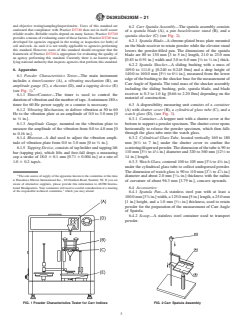
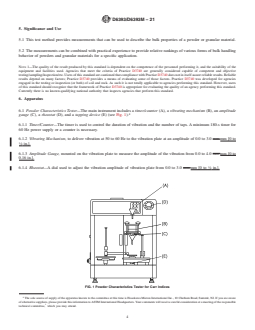
6.1 Powder Characteristics Tester—The main instrument includes a timer/counter (A), a vibrating mechanism (B), an amplitude
gauge (C), a rheostat (D), and a tapping device (E) (see Fig. 1).
6.1.1 Timer/Counter—The timer is used to control the duration of vibration and the number of taps. A minimum 180-s timer for
60 Hz power supply or a counter is necessary.
6.1.2 Vibrating Mechanism, to deliver vibration at 50 to 60 Hz to the vibration plate at an amplitude of 0.0 to 3.0 mm.mm [0 to
⁄8 in.].
6.1.3 Amplitude Gauge, mounted on the vibration plate to measure the amplitude of the vibration from 0.0 to 4.0 mm.mm [0 to
0.16 in.].
6.1.4 Rheostat—A dial used to adjust the vibration amplitude of vibration plate from 0.0 to 3.0 mm.mm [0 to ⁄8 in.].
FIG. 1 Powder Characteristics Tester for Carr Indices
The sole source of supply of the apparatus known to the committee at this time is Hosokawa Micron International Inc., 10 Chatham Road, Summit, NJ. If you are aware
of alternative suppliers, please provide this information to ASTM International Headquarters. Your comments will receive careful consideration at a meeting of the responsible
technical committee, which you may attend.
D6393/D6393M − 21
6.1.5 Tapping Device, consists of tap holder and tapping lift bar (tapping pin), which lifts and free-fall drops a measuring cup a
stroke of 18.0 6 0.1 mm [0.71 6 0.004 in.] at a rate of 1.0 6 0.2 taps/s.
6.2 Carr Spatula Assembly—The spatula assembly consists of a spatula blade (A), a pan base/elevator stand (B), and a spatula
shocker (C) (see Fig. 2).
6.2.1 Spatula Blade—A chrome-plated brass plate mounted on the blade receiver to retain powder while the elevator stand lowers
the powder-filled pan. The dimensions of the spatula blade are 80 to 130 mm [3 to 5 in.] length, 21.0 to 23.0-mm 23.0 mm [0.83
1 1
to 0.91 in.] width and 3.0 to 6.0-mm 6.0 mm [ ⁄8 to ⁄4 in.] thick.
6.2.2 Spatula Shocker—A sliding bushing with a mass of 109.0 to 111.0 g [0.240 to 0.245 lbm] and a drop height of 140.0 to 160.0
1 1
mm, mm [5 ⁄2 to 6 ⁄4 in.], measured from the lower edge of the bushing to the shocker base for the measurement of Carr Angle
of Spatula. The total mass of the shocker assembly including the sliding bushing, pole, spatula blade, and blade receiver is 0.3 to
1.0 kg [0.66 to 2.20 lbm] depending on the material of construction.
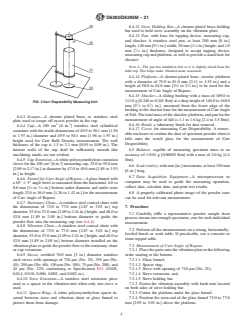
6.3 A dispersibility measuring unit consists of a container (A) with shutter cover (B), a cylindrical glass tube (C), and a watch
glass (D), (see Fig. 3).
6.3.1 Container—A hopper unit with a shutter cover at the bottom to support a powder specimen. The shutter cover opens
horizontally to release the powder specimen, which then falls through the glass tube onto the watch glass.
6.3.2 Cylindrical Glass Tube, located vertically 160 to 180 mm [6 ⁄4 to 7 in.] under the shutter cover to confine the
1 1
scattering/dispersed powder. The dimension of the tube is 90 to 110-mm 110 mm [3 ⁄2 to 4 ⁄4 in.] diameter and 320 to 360-mm
360 mm [12 ⁄2 to 14 in.] length.
7 1
6.3.3 Watch Glass, centered 100 to 105 mm [3 ⁄8 to 4 ⁄8 in.] under the cylindrical glass tube to collect undispersed powder. The
1 1 1
dimension of watch glass is 90 to 110-mm 110 mm [3 ⁄2 to 4 ⁄4 in.] diameter and about 2.0-mm 2.0 mm [ ⁄16 in.] thickness with
the radius of curvature of about 96.3 mm, mm [3.79 in.], concave upwards.
6.4 Accessories:
6.4.1 Spatula Pan—A stainless steel pan with at least a 100.0-mm 100.0 mm [3 ⁄8 in.] width, a 125.0-mm 125.0 mm [5 in.] length,
a 25.0 mm [1 in.] height, and a 1.0-mm 1.0 mm [ ⁄32 in.] thickness, used to retain powder for the preparation of the measurement
of Carr Angle of Spatula.
6.4.2 Scoop—A stainless steel container used to transport powder.
6.4.3 Scraper—A chrome plated brass or stainless steel plate used to scrape off excess powder in the cup.
3 3
6.4.4 Cup—A 100-cm100 cm [6 in. ] stainless steel cylindrical container with the inside dimensions of 49.9 to 50.1-mm 50.1 mm
FIG. 2 Carr Spatula Assembly
D6393/D6393M − 21
FIG. 3 Carr Dispersibility Measuring Unit
[1.96 to 1.97 in.] diameter and 49.9 to 50.1 mm [1.96 to 1.97 in.] height used for Carr Bulk Density measurement. The wall
thickness of the cup is 1.3 to 2.3 mm. mm [0.05 to 0.09 in.]. The interior walls of the cup shall be sufficiently smooth that
machining marks are not evident.
3 3
6.4.5 Cup Extension—A white Delrin (trademarked) polyoxymethylene extension sleeve for the 100 cm [6 in. ] measuring cup,
53.0 to 55.0 mm [2.09 to 2.17 in.] in diameter by 47.0 to 49.0 mm [1.85 to 1.93 in.] in height.
6.4.6 Funnel for Carr Angle of Repose—A glass funnel with a 65° 6 5° angle bowl as measured from the horizontal, 6.0 to 8.0
1 5
mm [ ⁄4 to ⁄16 in.] bottom outlet diameter and outlet stem length 32.0 to 36.0 mm [1.26 to 1.42 in.] for the measurement of Carr
Angle of Repose.
6.4.7 Stationary Chute—A stainless steel conical chute with the dimensions of 73.0 to 77.0 mm [2.87 to 3.03 in.] top diameter,
53.0 to 57.0 mm [2.09 to 2.24 in.] height, and 48.0 to 52.0 mm [1.89 to 2.05 in.] bottom diameter to guide the powder flow into
the measuring cup (see 6.4.4).
6.4.8 Vibration Chute—A stainless steel conical chute with the dimensions of 73.0 to 77.0 mm [2.87 to 3.03 in.] top diameter, 53.0
to 57.0 mm [2.09 to 2.24 in.] height, and 48.0 to 52.0 mm [1.89 to 2.05 in.] bottom diameter installed on the vibration plate to
guide the powder flow to the stationary chute or cup extension.
6.4.9 Sieves, certified 76.0-mm 76.0 mm [3 in.] diameter stainless steel sieves with openings of 710 μm, 355 μm, 250 μm, 150
μm, 75 μm, and 45 μm.μm (No. 25), 355 μm (No. 45), 250 μm (No. 60), 150 μm (No. 100), 75 μm (No. 200), and 45 μm (No.
325) conforming to Specification E11 (0.028, 0.014, 0.010, 0.006, 0.003, and 0.002 in.).
6.4.10 Sieve Extension—A stainless steel extension piece used as a spacer in the vibration unit when only one sieve is used.
6.4.11 Spacer Ring—A white Delrin (trademarked) polyoxymethylene spacer inserted between sieve and vibration chute or glass
funnel to protect them from damage.
6.4.12 Sieve Holding Bar—A chrome-plated brass holding bar used to hold sieve assembly on the vibration plate.
6.4.13 Pan, with base for tapping device, measuring cup, and shocker. A stainless steel pan, at least 200-mm length, 140-mm 200
1 1 1
mm [8 in.] length, 140 mm [5 ⁄2width, 30-mm in.] width, 30 mm [1 ⁄4 in.] height, and 1.0-mm 1.0 mm [ ⁄32 in.] thickness, designed
to accept tapping device, measuring cup and platform, as well as provide a stand base for shocker.
NOTE 2—The pan has molded-in feet so it is slightly raised from the table top. This helps make vibration more consistent.
6.4.14 Platform—A chrome-plated brass circular platform with a diameter of 79.0 to 81.0 mm [3.11 to 3.19 in.] and a height of
1 1
58.0 to 62.0 mm [2 ⁄4 to 2 ⁄2 in.] to be used for the measurement of Carr Angle of Repose.
6.4.15 Shocker—A sliding bushing with a mass of 109.0 to 111.0 g [0.240 to 0.245 lbm] at a drop height of 140.0 to 160.0 mm,
D6393/D6393M − 21
1 1
mm [5 ⁄2 to 6 ⁄4 in.], measured from the lower edge of the bushing to the shocker base for the measurement of Carr Angle of Fall.
The total mass of the shocker, platform, and pan for the measurement of angle of fall is 1.1 to 1.6 kg.kg [2.4 to 3.5 lbm].
6.4.16 Brush, a laboratory brush for dust removal.
6.4.17 Cover, for measuring Carr Dispersibility. A removable enclosure to confine the dust of specimen powder when it falls onto
the watch glass for the measurement of Carr Dispersibility.
6.5 Balance, capable of measuring specimen mass to an accuracy of 6 0.01 g 60.01 g [0.00002 lbm] with a max of 2.0 kg.kg
[4.4 lbm].
6.6 Scale (ruler), with mm [in.] increments, at least 150 mm [6 in.] long.
6.7 Data Acquisition Equipment—A microprocessor or computer may be used to guide the measuring operation, collect data,
calculate data, and print test results.
6.8 A properly calibrated photo image of the powder cone can be used for relevant measurement.
7. Procedure
7.1 A Carefully riffle a representative powder sample from process stream should be riffled carefully into enough specimens, one
for each individual measurement.
7.2 All Perform all the measurements should be performed on a strong, horizontally-l
...