

ASTM D7673/D7673M-21
(Specification)Standard Specification for Halon 1211, Bromochlorodifluoromethane (CF2BrCl)
General Information
- Abstract
ABSTRACT
This specification covers the requirements for Halon 1211 as a fire-fighting medium. There are a number of limitations to this specification, such as the fire-fighting equipment or hardware that require the use of Halon 1211 and the storage or transportation of Halon 1211. Due to these limitations in this specification, storage, handling, and transportation issues may be addressed in future ASTM standards.
SCOPE
1.1 This specification covers the requirements for Halon 1211 as a fire-fighting medium.
1.2 This specification does not address the fire-fighting equipment or hardware that employs Halon 1211 or the conditions of employing such equipment (for example, handhelds, fixed installations, etc.).
1.3 This specification does not address the storage or transportation of Halon 1211. Storage, handling, and transportation issues are addressed in Practice D7815.
1.4 The values stated in either SI units or inch-pound units are to be regarded separately as standard. The values stated in each system are not necessarily exact equivalents; therefore, to ensure conformance with the standard, each system shall be used independently of the other, and values from the two systems shall not be combined.
1.5 The following safety hazards caveat pertains only to the test methods portion, Section 6, of this specification: This standard does not purport to address all of the safety concerns, if any, associated with its use. It is the responsibility of the user of this standard to establish appropriate safety, health, and environmental practices and determine the applicability of regulatory limitations prior to use. Specific hazards statements are given in Section 4.
1.6 This international standard was developed in accordance with internationally recognized principles on standardization established in the Decision on Principles for the Development of International Standards, Guides and Recommendations issued by the World Trade Organization Technical Barriers to Trade (TBT) Committee.
- Status
- Published
- Publication Date
- 31-May-2021
- Technical Committee
- D26 - Halogenated Organic Solvents and Fire Extinguishing Agents
- Drafting Committee
- D26.09 - Fire Extinguishing Agents
Buy Documents

ASTM D7673/D7673M-21 - Standard Specification for Halon 1211, Bromochlorodifluoromethane (CF<inf>2</inf>BrCl)
REDLINE ASTM D7673/D7673M-21 - Standard Specification for Halon 1211, Bromochlorodifluoromethane (CF<inf>2</inf>BrCl)
Overview
ASTM D7673/D7673M-21 sets forth the standard specification for Halon 1211, bromochlorodifluoromethane (CF₂BrCl), which is widely used as a fire-fighting medium. This specification provides the essential purity and quality requirements for Halon 1211, including properties such as purity, acidity, moisture content, nonvolatile residue, and the allowed level of non-condensable gases. While the standard specifically addresses Halon 1211 as a substance, it does not cover the hardware or equipment that deploys Halon 1211, nor does it give requirements for storage and transportation-which are detailed in other standards.
ASTM D7673/D7673M-21 was developed in accordance with globally recognized principles on standardization, ensuring international applicability in the fire protection and fire suppression industry.
Key Topics
- Purity and Quality Requirements: Halon 1211 must meet strict minimum purity standards, and limits are set for byproducts such as acidity (as HBr) and water content to ensure effective and safe performance.
- Types:
- Type I covers Halon 1211 mixed with nitrogen, detailing the maximum acceptable nitrogen partial pressure to prevent exceeding safe vessel limits.
- Type II includes additional limits on non-condensable gases in the vapor phase.
- Testing and Analysis: The standard outlines accepted methods for verifying properties, including gas chromatography and color analysis, referencing established procedures for accurate and reproducible results.
- Sampling and Inspection: Guidance is provided on proper techniques for taking samples from liquid or vapor phases in accordance with referenced ISO and AHRI methods.
- Marking and Labeling: Requirements are given for container marking under US DOT regulations and EPA guidelines to ensure safety and regulatory compliance during transport.
- Measurement Units: Specifies that SI and inch-pound unit systems must be used independently and not combined.
Applications
ASTM D7673/D7673M-21 is relevant for industries and professionals involved in the formulation, procurement, distribution, and certification of Halon 1211 as a fire suppressant:
- Fire Protection: Specifiers and contractors rely on this standard to ensure the Halon 1211 used in extinguishers or fixed suppression systems meets consistent efficacy and safety criteria.
- Manufacturing and Refilling: Producers and refillers use the quality benchmarks and testing protocols to certify their Halon 1211 aligns with international safety expectations.
- Compliance Assessments: Regulatory authorities and inspectors use the standard to validate that Halon 1211 in the supply chain complies with required documentation, labeling, and purity metrics.
- Transportation and Storage: Although not directly covered by this document, the marking, identification, and container requirements remain essential for organizations involved in the logistics of Halon 1211.
Related Standards
- ASTM D7815: Practice for Handling, Transportation, and Storage of Halon 1211, covering topics not detailed in D7673/D7673M-21.
- ASTM D2108: Test Method for Color of Halogenated Organic Solvents.
- ASTM D6806: Practice for Analysis of Halogenated Organic Solvents and Their Admixtures by Gas Chromatography.
- AHRI Standard 700-2014 Appendix C: Analytical procedures for refrigerants including Halon 1211.
- ISO 3427: Method for sampling gaseous halogenated hydrocarbons (liquefied gases).
- 49 CFR Part 172 (US DOT): Addresses hazardous materials communication and packaging marking.
- Section 611, Clean Air Act (US EPA): Labeling requirements for Halon containers in the United States.
Conclusion
The ASTM D7673/D7673M-21 standard is an essential reference for ensuring the quality, safety, and regulatory compliance of Halon 1211 as a fire-fighting agent. Adherence to this specification helps safeguard the effectiveness of fire suppression systems and supports international trade and usage of Halon 1211 in fire protection applications. For issues related to handling and logistics, consult ASTM D7815 and relevant transport regulations.
Relations
- Effective Date
- 01-Jan-2020
- Effective Date
- 01-Jun-2015
- Effective Date
- 01-Sep-2012
- Effective Date
- 01-Mar-2012
- Effective Date
- 01-Feb-2010
- Effective Date
- 01-Feb-2007
- Effective Date
- 01-Jun-2005
- Effective Date
- 10-Jun-2002
- Effective Date
- 01-Jan-2001
- Effective Date
- 01-Jan-2001
Buy Documents
ASTM D7673/D7673M-21 - Standard Specification for Halon 1211, Bromochlorodifluoromethane (CF<inf>2</inf>BrCl)
REDLINE ASTM D7673/D7673M-21 - Standard Specification for Halon 1211, Bromochlorodifluoromethane (CF<inf>2</inf>BrCl)
Get Certified
Connect with accredited certification bodies for this standard

CIS Institut d.o.o.
Personal Protective Equipment (PPE) certification body. Notified Body NB-2890 for EU Regulation 2016/425 PPE.

Kiwa BDA Testing
Building and construction product certification.
Kmetijski inštitut Slovenije
Agricultural Institute of Slovenia. Soil testing, plant health, agricultural product analysis.
Sponsored listings
Frequently Asked Questions
ASTM D7673/D7673M-21 is a technical specification published by ASTM International. Its full title is "Standard Specification for Halon 1211, Bromochlorodifluoromethane (CF<inf>2</inf>BrCl)". This standard covers: ABSTRACT This specification covers the requirements for Halon 1211 as a fire-fighting medium. There are a number of limitations to this specification, such as the fire-fighting equipment or hardware that require the use of Halon 1211 and the storage or transportation of Halon 1211. Due to these limitations in this specification, storage, handling, and transportation issues may be addressed in future ASTM standards. SCOPE 1.1 This specification covers the requirements for Halon 1211 as a fire-fighting medium. 1.2 This specification does not address the fire-fighting equipment or hardware that employs Halon 1211 or the conditions of employing such equipment (for example, handhelds, fixed installations, etc.). 1.3 This specification does not address the storage or transportation of Halon 1211. Storage, handling, and transportation issues are addressed in Practice D7815. 1.4 The values stated in either SI units or inch-pound units are to be regarded separately as standard. The values stated in each system are not necessarily exact equivalents; therefore, to ensure conformance with the standard, each system shall be used independently of the other, and values from the two systems shall not be combined. 1.5 The following safety hazards caveat pertains only to the test methods portion, Section 6, of this specification: This standard does not purport to address all of the safety concerns, if any, associated with its use. It is the responsibility of the user of this standard to establish appropriate safety, health, and environmental practices and determine the applicability of regulatory limitations prior to use. Specific hazards statements are given in Section 4. 1.6 This international standard was developed in accordance with internationally recognized principles on standardization established in the Decision on Principles for the Development of International Standards, Guides and Recommendations issued by the World Trade Organization Technical Barriers to Trade (TBT) Committee.
ABSTRACT This specification covers the requirements for Halon 1211 as a fire-fighting medium. There are a number of limitations to this specification, such as the fire-fighting equipment or hardware that require the use of Halon 1211 and the storage or transportation of Halon 1211. Due to these limitations in this specification, storage, handling, and transportation issues may be addressed in future ASTM standards. SCOPE 1.1 This specification covers the requirements for Halon 1211 as a fire-fighting medium. 1.2 This specification does not address the fire-fighting equipment or hardware that employs Halon 1211 or the conditions of employing such equipment (for example, handhelds, fixed installations, etc.). 1.3 This specification does not address the storage or transportation of Halon 1211. Storage, handling, and transportation issues are addressed in Practice D7815. 1.4 The values stated in either SI units or inch-pound units are to be regarded separately as standard. The values stated in each system are not necessarily exact equivalents; therefore, to ensure conformance with the standard, each system shall be used independently of the other, and values from the two systems shall not be combined. 1.5 The following safety hazards caveat pertains only to the test methods portion, Section 6, of this specification: This standard does not purport to address all of the safety concerns, if any, associated with its use. It is the responsibility of the user of this standard to establish appropriate safety, health, and environmental practices and determine the applicability of regulatory limitations prior to use. Specific hazards statements are given in Section 4. 1.6 This international standard was developed in accordance with internationally recognized principles on standardization established in the Decision on Principles for the Development of International Standards, Guides and Recommendations issued by the World Trade Organization Technical Barriers to Trade (TBT) Committee.
ASTM D7673/D7673M-21 is classified under the following ICS (International Classification for Standards) categories: 13.220.10 - Fire-fighting. The ICS classification helps identify the subject area and facilitates finding related standards.
ASTM D7673/D7673M-21 has the following relationships with other standards: It is inter standard links to ASTM D2108-10(2020), ASTM D2108-10(2015), ASTM D7815-12, ASTM D6806-02(2012), ASTM D2108-10, ASTM D6806-02(2007)e1, ASTM D2108-05, ASTM D6806-02, ASTM D2108-97(2001), ASTM D2108-97. Understanding these relationships helps ensure you are using the most current and applicable version of the standard.
ASTM D7673/D7673M-21 is available in PDF format for immediate download after purchase. The document can be added to your cart and obtained through the secure checkout process. Digital delivery ensures instant access to the complete standard document.
Standards Content (Sample)
This international standard was developed in accordance with internationally recognized principles on standardization established in the Decision on Principles for the
Development of International Standards, Guides and Recommendations issued by the World Trade Organization Technical Barriers to Trade (TBT) Committee.
Designation: D7673/D7673M −21
Standard Specification for
Halon 1211, Bromochlorodifluoromethane (CF BrCl)
This standard is issued under the fixed designation D7673/D7673M; the number immediately following the designation indicates the
year of original adoption or, in the case of revision, the year of last revision. A number in parentheses indicates the year of last
reapproval. A superscript epsilon (´) indicates an editorial change since the last revision or reapproval.
1. Scope D2108 Test Method for Color of Halogenated Organic
Solvents and Their Admixtures (Platinum-Cobalt Scale)
1.1 This specification covers the requirements for Halon
D7815 Practice for Handling, Transportation, and Storage of
1211 as a fire-fighting medium.
Halon 1211, Bromochlorodifluoromethane (CF BrCl)
1.2 This specification does not address the fire-fighting
D6806 Practice for Analysis of Halogenated Organic Sol-
equipment or hardware that employs Halon 1211 or the
vents and Their Admixtures by Gas Chromatography
conditions of employing such equipment (for example,
2.2 U.S. Government Standard:
handhelds, fixed installations, etc.).
49 CFR Part 172 Hazardous Materials Table, Special
1.3 This specification does not address the storage or
Provisions, Hazardous Materials Communications, Emer-
transportation of Halon 1211. Storage, handling, and transpor-
gency Response Information, Training Requirements, and
tation issues are addressed in Practice D7815.
Security Plans
1.4 The values stated in either SI units or inch-pound units
2.3 AHRI Standard:
are to be regarded separately as standard. The values stated in
2008 Appendix C for Analytical Procedures for AHRI Stan-
each system are not necessarily exact equivalents; therefore, to
dard 700-2014
ensure conformance with the standard, each system shall be
used independently of the other, and values from the two
3. Terminology
systems shall not be combined.
3.1 Definitions of Terms Specific to This Standard:
1.5 The following safety hazards caveat pertains only to the
3.1.1 Halon 1211, n—the halogenated hydrocarbon com-
test methods portion, Section 6, of this specification: This
pound Bromochlorodifluoromethane used as a fire extinguish-
standard does not purport to address all of the safety concerns,
ing medium.
if any, associated with its use. It is the responsibility of the user
3.1.1.1 Discussion—The halon terminology system pro-
of this standard to establish appropriate safety, health, and
vides a convenient means to reference halogenated hydrocar-
environmental practices and determine the applicability of
bon fire extinguishants. Halogenated hydrocarbons are acyclic
regulatory limitations prior to use. Specific hazards statements
saturated hydrocarbons in which one or more of the hydrogen
are given in Section 4.
atoms have been replaced by atoms from the halogen series
1.6 This international standard was developed in accor-
(that is, fluorine, chlorine, bromine, and iodine). By definition,
dance with internationally recognized principles on standard-
the first digit of the halon numbering system represents the
ization established in the Decision on Principles for the
numberofcarbonatomsinthecompoundmolecule;thesecond
Development of International Standards, Guides and Recom-
digit, the number of fluorine atoms; the third digit, the number
mendations issued by the World Trade Organization Technical
of chlorine atoms; the fourth digit, the number of bromine
Barriers to Trade (TBT) Committee.
atoms; and the fifth digit, the number of iodine atoms. Trailing
zeros are not expressed. Unaccounted for valence requirements
2. Referenced Documents
are assumed to be hydrogen atoms.
2.1 ASTM Standards:
number of hydrogen atoms5 (1)
This specification is under the jurisdiction of ASTM Committee D26 on
number of carbon atoms 32 12 2 sum of halogen atoms
Halogenated Organic Solvents and Fire Extinguishing Agents, and is the direct @~~ ! ! ~ !#
responsibility of Subcommittee D26.09 on Fire Extinguishing Agents.
Current edition approved June 1, 2021. Published June 2021. Originally
approved in 2010. Last previous edition approved in 2015 as D7673/D7673M–15.
DOI: 10.1520/D7673_D7673M-21. Code of Federal Regulations (CFR) documents are available from U.S.
For referenced ASTM standards, visit the ASTM website, www.astm.org, or Government Publishing Office (GPO), 732 N. Capitol St., NW, Washington, DC
contact ASTM Customer Service at service@astm.org. For Annual Book of ASTM 20401, http://www.gpo.gov.
Standards volume information, refer to the standard’s Document Summary page on Available from Air-Conditioning, Heating, and Refrigeration Institute (AHRI),
the ASTM website. 2311 Wilson Blvd., Suite 400, Arlington, VA 22201, http://www.ahrinet.org.
Copyright © ASTM International, 100 Barr Harbor Drive, PO Box C700, West Conshohocken, PA 19428-2959. United States
D7673/D7673M − 21
For example, (2) temperature of the Halon 1211 container shall be reported in
degrees Fahrenheit (preferred) or in degrees Celsius and shall
bromochlorodifluoromethane 2 CF BrCl 2 Halon 1211
conform to applicable regulations for the Halon 1211 container
3.1.2 non-condensable gases, n—non-condensable gases
design and use.
consist primarily of air (nitrogen, oxygen) accumulated in the
4.2 Type II—Halon 1211 shall conform to the requirements
vapor phase of a liquefied compressed gas where the solubility
ofType I, as listed in 4.1, and shall contain no more than 1.5 %
of air in the liquid phase is extremely low and air is not
by volume non-condensable gases in the vapor phase, ex-
significant as a liquid phase contaminant. Non-condensable
pressed as air when tested by the appropriate test method(s)
gases are in some instances termed non-absorbable gases.
listed in Section 6.
4. Material Requirements 4.3 By agreement between the purchaser and the supplier,
analysis may be required and limits established for elements or
4.1 Type I—Mixtures of Halon 1211 and Nitrogen:
compounds not specified in Table 1.
4.1.1 The nitrogen (N ) partial pressure shall be such that
4.4 Unless otherwise specified, Type I is assumed.
the safe working pressure of the receiving vessel is not
exceeded. To prevent excessive pressure, the fill density of
4.5 Warning—ExposuretoconcentrationsofHalon1211in
Halon1211withinacontainershouldnotexceedthatneededto
excess of 1.0 % by volume in air during periods of elevated
achieve complete filling of the container at the maximum
adrenaline could produce cardiac arrhythm
...
This document is not an ASTM standard and is intended only to provide the user of an ASTM standard an indication of what changes have been made to the previous version. Because
it may not be technically possible to adequately depict all changes accurately, ASTM recommends that users consult prior editions as appropriate. In all cases only the current version
of the standard as published by ASTM is to be considered the official document.
Designation: D7673/D7673M − 15 D7673/D7673M − 21
Standard Specification for
Halon 1211, Bromochlorodifluoromethane (CF BrCl)
This standard is issued under the fixed designation D7673/D7673M; the number immediately following the designation indicates the
year of original adoption or, in the case of revision, the year of last revision. A number in parentheses indicates the year of last
reapproval. A superscript epsilon (´) indicates an editorial change since the last revision or reapproval.
1. Scope
1.1 This specification covers the requirements for Halon 1211 as a fire-fighting medium.
1.2 This specification does not address the fire-fighting equipment or hardware that employs Halon 1211 or the conditions of
employing such equipment (for example, handhelds, fixed installations, etc.).
1.3 This specification does not address the storage or transportation of Halon 1211. Storage, handling, and transportation issues
may be are addressed in futurePractice D7815ASTM standards.
1.4 The values stated in either SI units or inch-pound units are to be regarded separately as standard. The values stated in each
system are not necessarily exact equivalents; therefore, to ensure conformance with the standard, each system shall be used
independently of the other, and values from the two systems shall not be combined.
1.5 The following safety hazards caveat pertains only to the test methods portion, Section 6, of this specification: This standard
does not purport to address all of the safety concerns, if any, associated with its use. It is the responsibility of the user of this
standard to establish appropriate safety safety, health, and healthenvironmental practices and determine the applicability of
regulatory limitations prior to use. Specific hazards statements are given in Section 4.
1.6 This international standard was developed in accordance with internationally recognized principles on standardization
established in the Decision on Principles for the Development of International Standards, Guides and Recommendations issued
by the World Trade Organization Technical Barriers to Trade (TBT) Committee.
2. Referenced Documents
2.1 ASTM Standards:
D2108 Test Method for Color of Halogenated Organic Solvents and Their Admixtures (Platinum-Cobalt Scale)
D7815 Practice for Handling, Transportation, and Storage of Halon 1211, Bromochlorodifluoromethane (CF BrCl)
D6806 Practice for Analysis of Halogenated Organic Solvents and Their Admixtures by Gas Chromatography
2.2 U.S. Government Standard:
49 CFR Part 172 Hazardous Materials Table, Special Provisions, Hazardous Materials Communications, Emergency Response
Information, Training Requirements, and Security Plans
This specification is under the jurisdiction of ASTM Committee D26 on Halogenated Organic Solvents and Fire Extinguishing Agents, and is the direct responsibility
of Subcommittee D26.09 on Fire Extinguishing Agents.
Current edition approved Jan. 1, 2015June 1, 2021. Published February 2015June 2021. Originally approved in 2010. Last previous edition approved in 20102015 as
ε2
D7673/D7673M– 10–15. . DOI: 10.1520/D7673_D7673M-15.10.1520/D7673_D7673M-21.
For referenced ASTM standards, visit the ASTM website, www.astm.org, or contact ASTM Customer Service at service@astm.org. For Annual Book of ASTM Standards
volume information, refer to the standard’sstandard’s Document Summary page on the ASTM website.
Copyright © ASTM International, 100 Barr Harbor Drive, PO Box C700, West Conshohocken, PA 19428-2959. United States
D7673/D7673M − 21
2.3 AHRI Standards:Standard:
2008 Appendix C for Analytical Procedures for AHRI Standard 700-2012700-2014
2.3 ISO Standards:
ISO 3427 Gaseous Halogenated Hydrocarbons (Liquefied Gases) – Taking of a Sample
2.4 U.S. Governmental Standards:
CFR Title 49, Part 172.101 Tables of Hazardous Materials and Special Provisions
CFR Title 49, Part 172 Subpart D Marking Requirements of Packaging for Transportation
3. Terminology
3.1 Definitions of Terms Specific to This Standard:
3.1.1 Halon 1211—1211, n—the halogenated hydrocarbon compound Bromochlorodifluoromethane used as a fire extinguishing
medium.
3.1.1.1 Discussion—
The halon terminology system provides a convenient means to reference halogenated hydrocarbon fire extinguishants. Halogenated
hydrocarbons are acyclic saturated hydrocarbons in which one or more of the hydrogen atoms have been replaced by atoms from
the halogen series (that is, fluorine, chlorine, bromine, and iodine). By definition, the first digit of the halon numbering system
represents the number of carbon atoms in the compound molecule; the second digit, the number of fluorine atoms; the third digit,
the number of chlorine atoms; the fourth digit, the number of bromine atoms; and the fifth digit, the number of iodine atoms.
Trailing zeros are not expressed. Unaccounted for valence requirements are assumed to be hydrogen atoms.
number of hydrogen atoms5 (1)
@ number of carbon atoms 32 12 2 sum of halogen atoms #
~~ ! ! ~ !
For example, (2)
bromochlorodifluoromethane 2CF BrCl 2 Halon 1211
3.1.2 non-condensable gases—gases, n—non-condensable gases consist primarily of air (nitrogen, oxygen) accumulated in the
vapor phase of a liquefied compressed gas where the solubility of air in the liquid phase is extremely low and air is not significant
as a liquid phase contaminant. Non-condensable gases are in some instances termed non-absorbable gases.
4. Material Requirements
4.1 Type I—Mixtures of Halon 1211 and Nitrogen:
4.1.1 The nitrogen (N ) partial pressure shall be such that the safe working pressure of the receiving vessel is not exceeded. To
prevent excessive pressure, the fill density of Halon 1211 within a container should not exceed that needed to achieve complete
filling of the container at the maximum envisaged storage temperature. For example, for a U.S. DOT Department of Transportation
(DOT) 4W260 cylinder, the nitrogen partial pressure shall not exceed 129 psig at 70°F70 °F [9.9 bar at 21°C]21 °C] for a 100 lb/ft
[1602 kg/m ] fill density, which yields a total pressure of 150 psig at 70°F70 °F [11.4 bar at 21°C].21 °C]. For this example, the
safe working pressure of the 4BW260 cylinder is not exceeded for temperatures below 131°F [55°C].131 °F [55 °C]. (See Practice
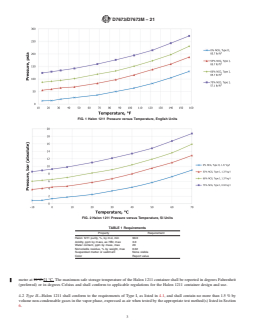
D7815.) (See Figs. 1 and 2.)
4.1.2 Halon 1211 shall conform to the requirements prescribed in Table 1 when tested by the appropriate test method(s) listed in
Section 6.
4.1.3 When a material analysis is required, by agreement between the purchaser and the supplier, the total pressure in the Halon
1211 container, partial pressure of the N , the fill density of the Halon 1211 within the container, and the maximum safe storage
temperature shall be part of the material analysis (certification). The pressure shall be reported in pound-force per square inch
gauge (preferred) or bar. The fill density shall be reported in pounds per cubic foot at 70°F70 °F (preferred) or kilograms per cubic
Available from Air-Conditioning, Heating, and Refrigeration Institute (AHRI), 21112311 Wilson Blvd., Suite 500,400, Arlington, VA 22201, http://www.ari.org.http://
www.ahrinet.org.
Code of Federal Regulations (CFR) documents are available from U.S. Government Publishing Office (GPO), 732 N. Capitol St., NW, Washington, DC 20401,
http://www.gpo.gov.
D7673/D7673M − 21
FIG. 1 Halon 1211 Pressure versus Temperature, English Units
FIG. 2 Halon 1211 Pressure versus Temperature, SI Units
TABLE 1 Requirements
Property Requirement
Halon 1211 purity, %, by mol, min 99.0
Acidity, ppm by mass, as HBr, max 3.0
Water content, ppm by mass, max 20
Nonvolatile residue, % by weight, max 0.02
Suspended matter or sediment None visible
Color Report value
metre at 21°C.21 °C. The maximum safe storage temperature of the Halon 1211 container shall be reported in degrees Fahrenheit
(preferred) or in degrees Celsius and shall conform to applicable regulations for the Halon 1211 container design and use.
4.2 Type II—Halon 1211 shall conform to the requirements of Type I, as listed in 4.1, and shall contain no more than 1.5 % by
volume non-condensable gases in the vapor phase, expressed as air when tested by the appropriate test method(s) listed in Section
6.
D7673/D7673M − 21
4.3 By agreement between the purchaser and the supplier, analysis may be required and limits established for elements or
compounds not specified in Table 1.
4.4 Unless otherwise specified, Type I is assumed.
4.5 (Warning—Exposure to concentrations of Halon 1211 in excess of 1.0 % by volume in air during periods of elevated
adrenaline could produce cardiac arrhythmia in some personnel.)
5. Sampling
5.1 Samples of Halon 1211 shall be taken from the liquid or vapor phase as appropriate. Samples of Halon 1211, taken from the
liquid phase, shall be taken from filled containers in accordance with the method specified in ISO 3427 or the method specified
in phase in a closed system as described in 2008 Appendix C for Analytical Procedures for to AHRI Standard 700-2012,700-2014,
Part 7.
5.1.1 The sampling vessel shall be capable of safely resisting the vapor pressure of the sample at the highest temperature that could
be encountered during handling, storage, or transport. (See Practice D7815.)
5.2 The Halon 1211 selected in accordance with 5.1 shall be tested for quality conformance in accordance with Section 6. The
presence of one or more defects shall be cause for rejection.
6. Test Methods
6.1 Purity: Purity—
6.1.1 Determine the purity by gas chromatography in accordance with the technique described in 6.1.2 – 6.1.5 or by gas
chromatography/mass spectrometry (GC/MS) in accordance with 6.2.2 – 6.2.5.
6.1.1.1 Prior to sample introducti
...